
Bhagavad Gita — Sankhya Yoga, Shloka 15
Sankhya Yoga
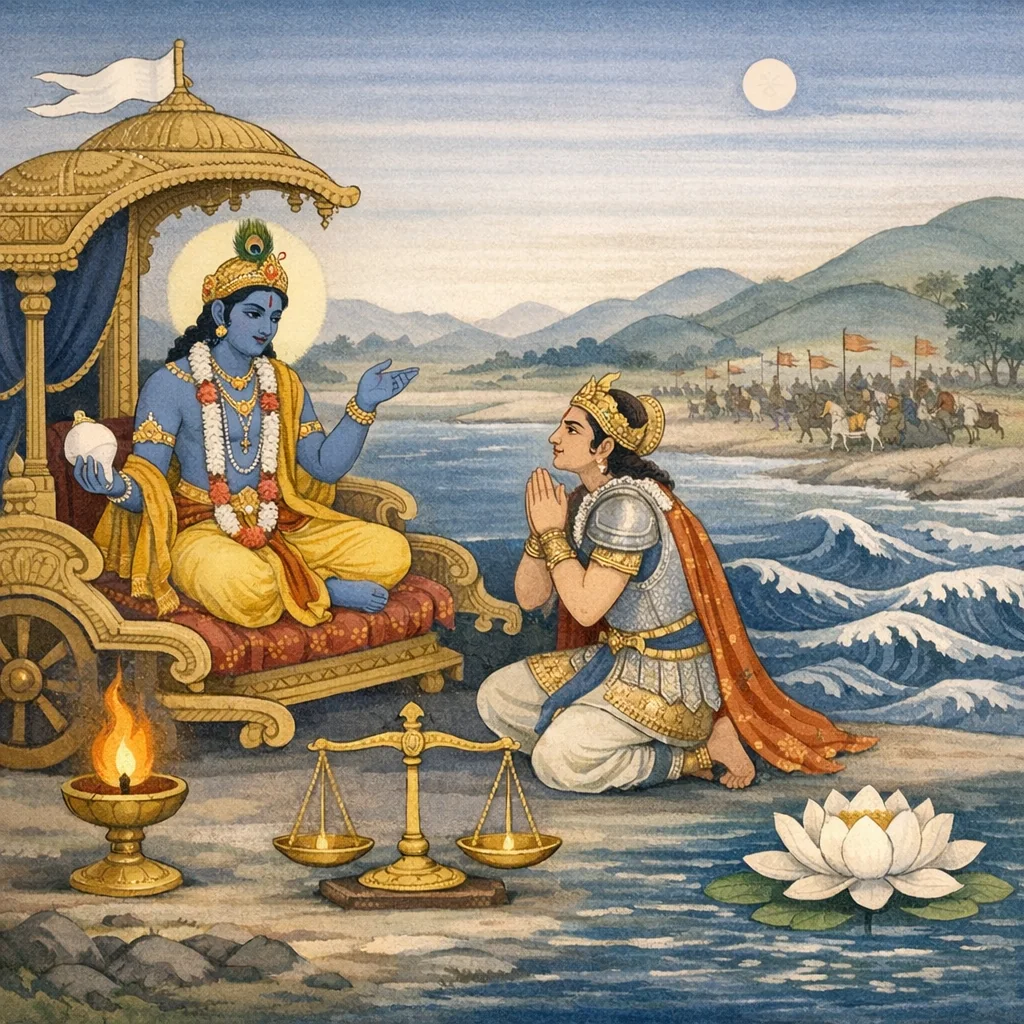
यं हि न व्यथयन्त्येते पुरुषं पुरुषर्षभ । समदुःखसुखं धीरं सोऽमृतत्वाय कल्पते ॥ २.१५ ॥
yaṃ hi na vyathayanty ete puruṣaṃ puruṣarṣabha | sama-duḥkha-sukhaṃ dhīraṃ so 'mṛtatvāya kalpate || 2.15 ||

O best among men, that steadfast one whom these (sense-contacts) do not agitate, who remains equal in sorrow and joy—he becomes fit for immortality (liberation).
O best of men, that steadfast person whom these (sense-contacts) do not disturb, who is the same in sorrow and joy, becomes fit for immortality (liberation).
O bull among men, the person whom these do not afflict—steady, with equal sorrow and pleasure—becomes suited for deathlessness.
Most traditional readings gloss “these” as sense-contacts (mātrā-sparśāḥ from 2.14). ‘Amṛtatva’ is commonly interpreted as mokṣa; academically it can be rendered more literally as ‘deathlessness’ without committing to a specific soteriology.
FAQs
The verse highlights emotional regulation: a stable mind is not easily shaken by changing sensations and circumstances, supporting resilience and clarity.
It implies that steadiness amid opposites aligns one with the imperishable principle (often identified with ātman), making liberation conceivable.
Krishna continues advising Arjuna that fluctuating experiences are transient; composure is presented as a prerequisite for insight and right action.
Cultivating balanced response to success and setback can improve decision-making and reduce reactivity in stressful environments.