
Bhagavad Gita — Sankhya Yoga, Shloka 11
Sankhya Yoga
श्रीभगवानुवाच । अशोच्यानन्वशोचस्त्वं प्रज्ञावादांश्च भाषसे । गतासूनगतासूंश्च नानुशोचन्ति पण्डिताः ॥ २.११ ॥
śrī-bhagavān uvāca | aśocyān anvaśocas tvaṃ prajñā-vādāṃś ca bhāṣase | gatāsūn agatāsūṃś ca nānuśocanti paṇḍitāḥ || 2.11 ||

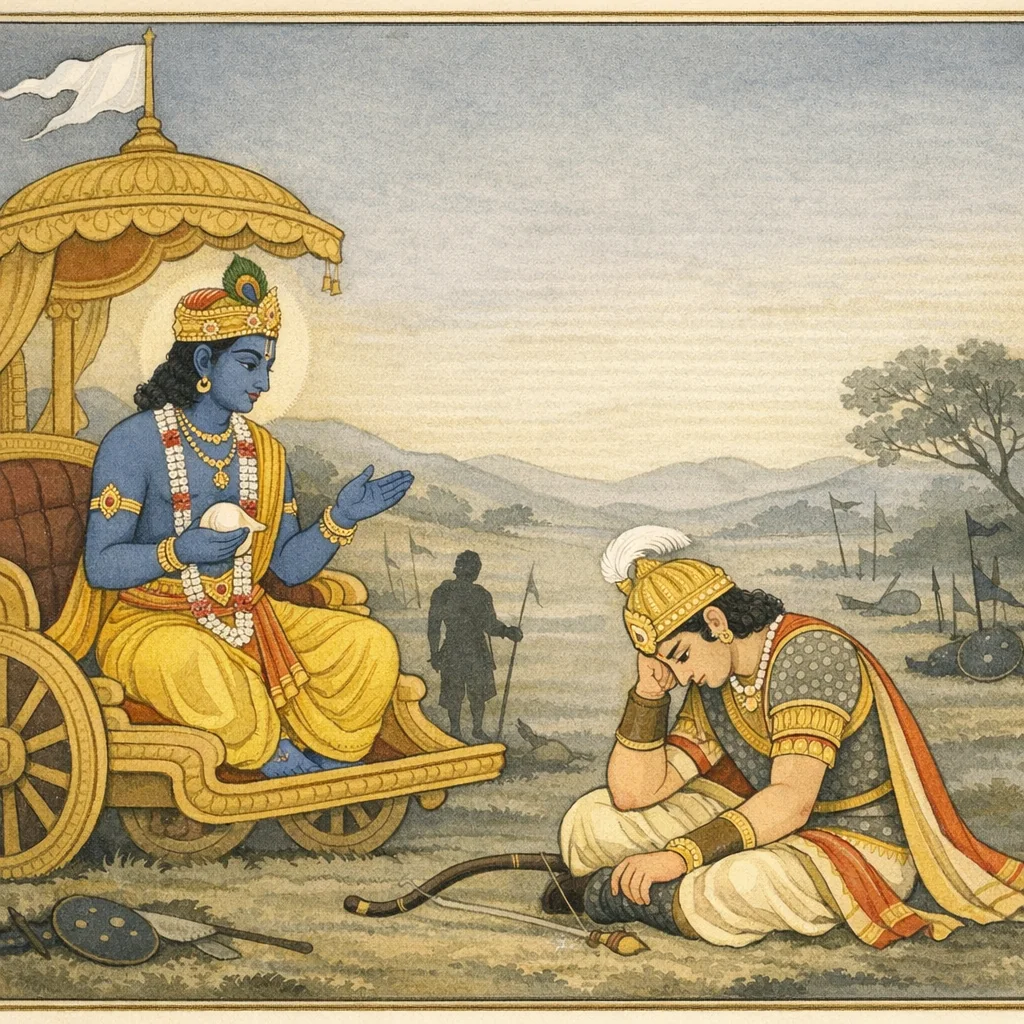
The Blessed Lord said: You grieve for those who are not to be grieved for, yet you speak words of wisdom; the wise grieve neither for the departed nor for those who yet live.
The Lord says: You grieve for those who should not be grieved for, yet you speak words of wisdom; the wise do not grieve for the dead or the living.
Bhagavān says: ‘You have mourned for what is not to be mourned, and you speak in the manner of the wise; the learned do not mourn for those whose life has departed nor for those still living.’
The verse juxtaposes rhetoric and insight: Arjuna’s arguments resemble ‘wise speech’ but are grounded in misplaced sorrow. ‘Gatāsūn/agatāsūn’ is often treated as a formal pair (‘dead/living’), introducing the coming discussion on the self’s continuity.
FAQs
Krishna distinguishes between articulate reasoning and genuine clarity, pointing to how grief can masquerade as principled argument while still distorting perception.
It introduces the premise that the deepest self is not reducible to the body’s life-status, setting up the doctrine of the enduring self and the limits of mourning.
This is Krishna’s opening corrective statement, initiating the shift from Arjuna’s ethical lament to a broader philosophical account of self and duty.
The verse can be used to discuss emotional reasoning: one may sound ‘wise’ while still being driven by unexamined sorrow; reflective practices aim to align insight with emotion.