
Bhagavad Gita — Sankhya Yoga, Shloka 31
Sankhya Yoga
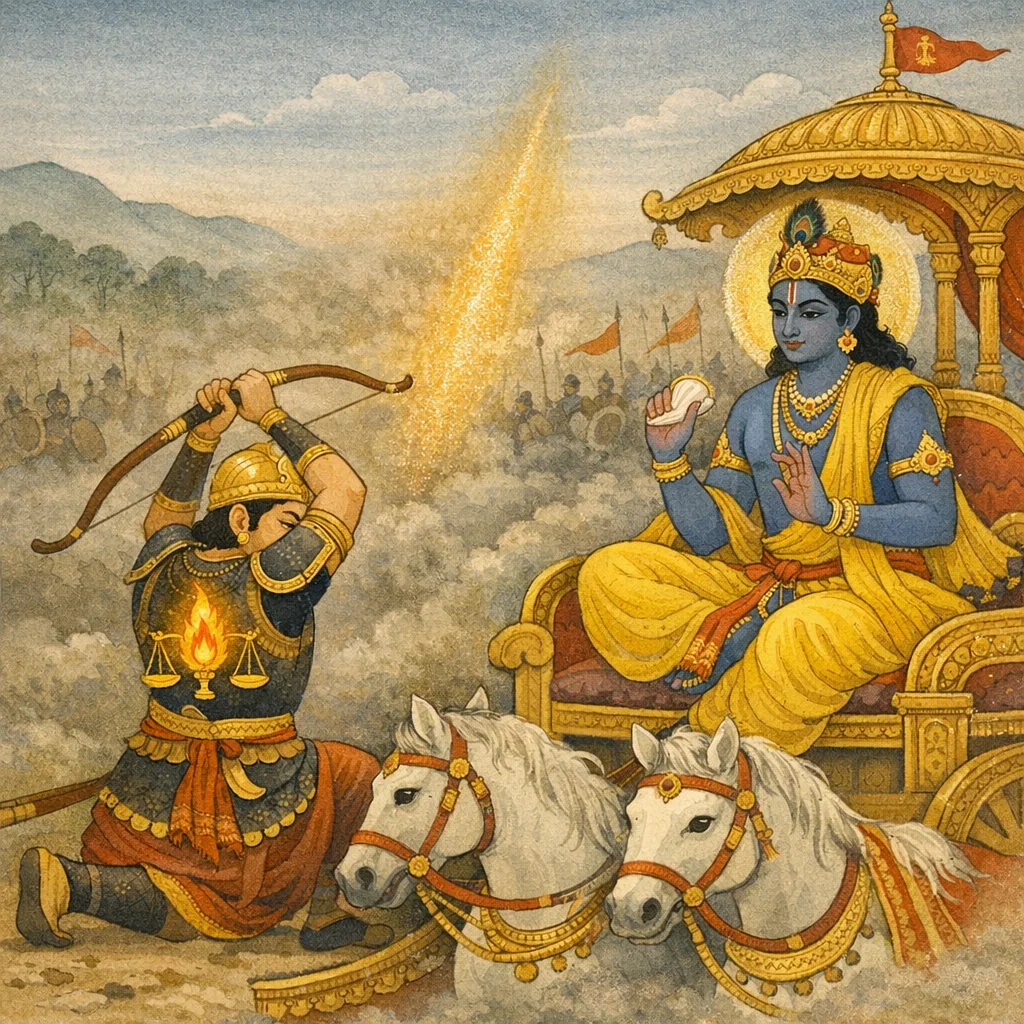
स्वधर्ममपि चावेक्ष्य न विकम्पितुमर्हसि । धर्म्याद्धि युद्धाच्छ्रेयोऽन्यत्क्षत्रियस्य न विद्यते ॥ २.३१ ॥
svadharmam api cāvekṣya na vikampitum arhasi | dharmyād dhi yuddhāc chreyo ’nyat kṣatriyasya na vidyate || 2.31 ||

Moreover, considering your own svadharma, you should not waver; for a kṣatriya there is nothing higher than a righteous battle.
Considering your own duty, you should not waver; for a warrior, there is nothing better than a righteous struggle.
Even looking to your own duty, you should not tremble; for a kṣatriya there is no higher good than a duty-aligned conflict (i.e., a just contest).
Translations differ in rendering yuddha: some retain “battle,” while others emphasize “duty-aligned struggle.” In academic framing, the verse is read within the epic’s social-ethical context (varṇa-dharma) and can also be interpreted as an inner moral struggle.
FAQs
It addresses indecision and anxiety by recommending alignment with a clear value-framework (one’s duty), which can reduce inner conflict.
Metaphysics is not primary here; the focus shifts from ontology of the self to ethical action consistent with dharma.
In the narrative setting of a civil conflict, Krishna reframes Arjuna’s crisis as a test of vocational and moral responsibility rather than personal aversion.
It can be applied as guidance to act according to principled responsibility (professional ethics, civic duty) especially when emotionally difficult.