
Bhagavad Gita — Sankhya Yoga, Shloka 8
Sankhya Yoga
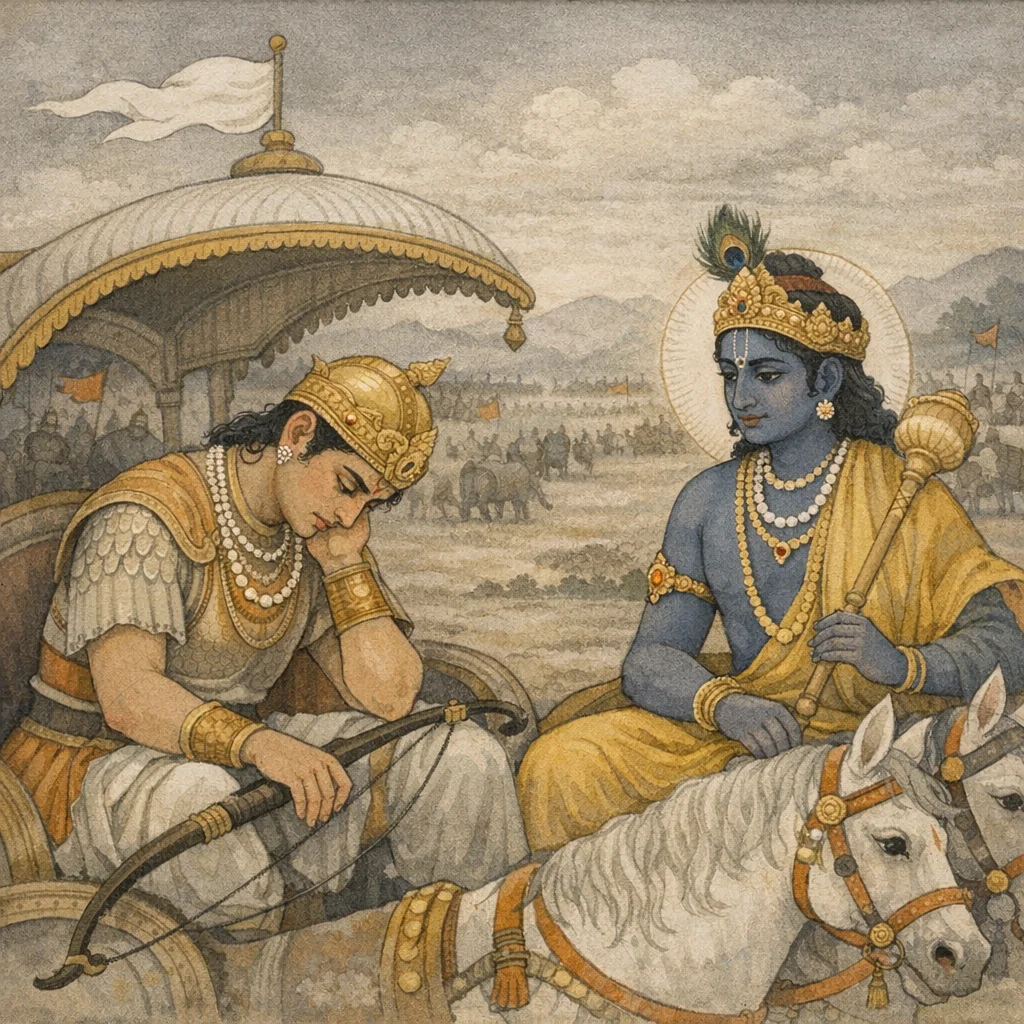
न हि प्रपश्यामि ममापनुद्याद्यच्छोकमुच्छोषणमिन्द्रियाणाम् । अवाप्य भूमावसपत्नमृद्धं राज्यं सुराणामपि चाधिपत्यम् ॥ २.८ ॥
na hi prapaśyāmi mamāpanudyād yac chokam ucchoṣaṇam indriyāṇām | avāpya bhūmāv asapatnam ṛddhaṃ rājyaṃ surāṇām api cādhipatyam || 2.8 ||

For I do not see what could dispel this sorrow of mine that withers the senses—even if I were to obtain on earth a prosperous, unrivaled kingdom, or even lordship over the gods.
Arjuna says he does not see what could remove his sorrow that dries up his senses, even if he were to obtain an unrivaled and prosperous kingdom on earth or even sovereignty among the gods.
Arjuna says: ‘I do not foresee anything that would dispel my grief that withers the faculties—even if I were to gain an unmatched, flourishing kingship on earth, or even lordship among the celestial beings.’
The verse is often read psychologically: grief is described as somatically affecting the senses (‘indriyāṇām ucchoṣaṇam’). Translations vary between ‘dries up’ (literal) and ‘paralyzes/exhausts’ (interpretive), but the point is that external success cannot resolve inner distress.
FAQs
Arjuna articulates anhedonia-like despair: even maximal external rewards would not alleviate his internal suffering, highlighting the autonomy of mental affliction from status or success.
It anticipates the teaching that lasting resolution requires insight into self and duty rather than reliance on contingent objects of desire.
This strengthens the rationale for philosophical instruction: the problem is not tactical but existential, requiring a deeper framework than material incentives.
It can inform discussions about well-being: achievement and authority may not address grief or moral distress; reflective practice and ethical clarity may be needed.