
Bhagavad Gita — Sankhya Yoga, Shloka 27
Sankhya Yoga
जातस्य हि ध्रुवो मृत्युर्ध्रुवं जन्म मृतस्य च । तस्मादपरिहार्येऽर्थे न त्वं शोचितुमर्हसि ॥ २.२७ ॥
jātasya hi dhruvo mṛtyur dhruvaṁ janma mṛtasya ca | tasmād aparihārye ’rthe na tvaṁ śocitum arhasi || 2.27 ||

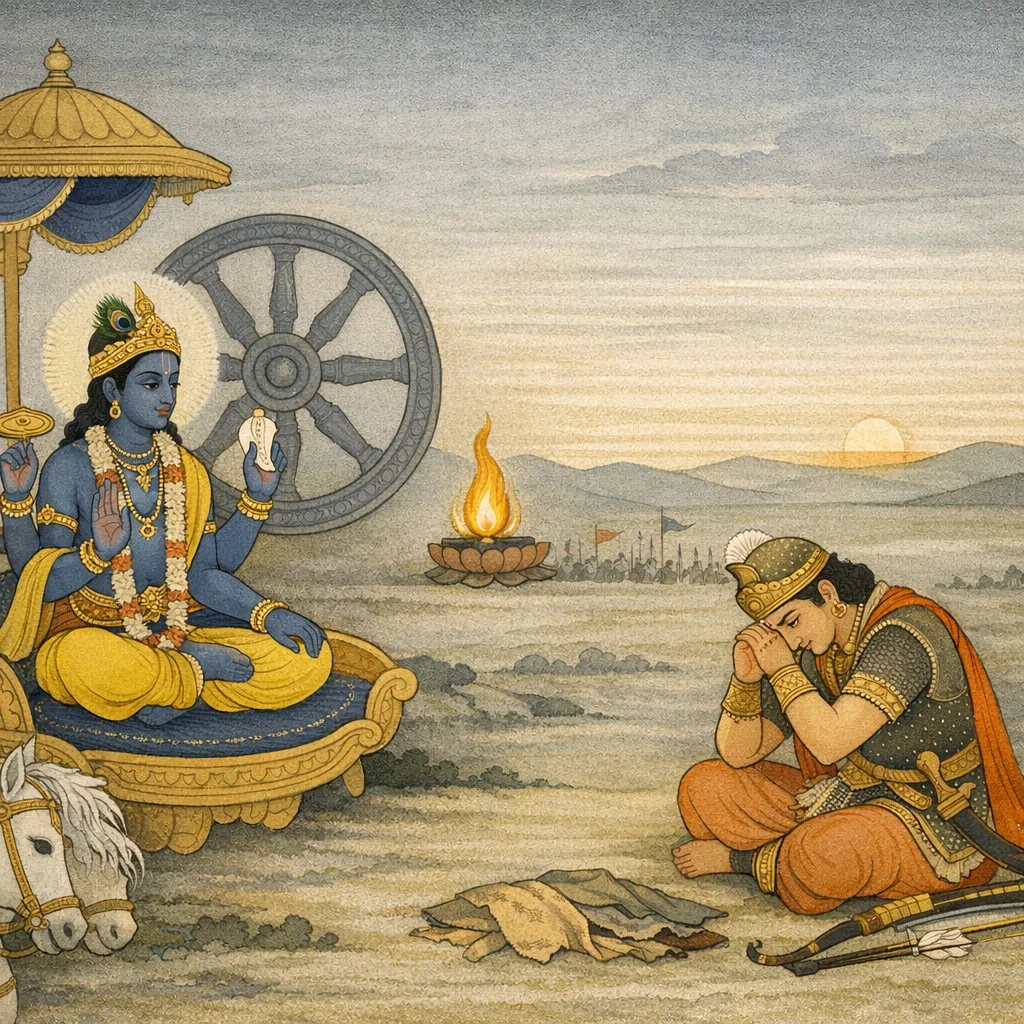
For one who is born, death is certain; and for one who has died, birth is certain. Therefore, in an unavoidable matter, you should not grieve.
For one who is born, death is certain, and for one who is dead, birth is certain; therefore, regarding an unavoidable matter, you should not grieve.
Indeed, for what has come to be, death is certain; and for what has died, birth is certain. Therefore, concerning what cannot be avoided, you are not fit to mourn.
Interpretations vary on whether “birth after death” is literal (rebirth doctrine) or a generalized claim about cyclical coming-to-be; the ethical thrust (non-grief about inevitabilities) remains consistent.
FAQs
The verse encourages acceptance-based coping: distress decreases when one stops treating inevitabilities as personal failures or solvable problems.
Within an Indian cyclic worldview, it frames embodied existence as governed by recurring emergence and dissolution, while implying that lamentation does not alter that structure.
Krishna targets Arjuna’s grief by classifying the feared outcome as unavoidable in the ordinary course of embodied life.
It can support equanimity in situations where outcomes are fixed (e.g., natural life cycles), shifting focus toward ethical action in the present.