
Bhagavad Gita — Sankhya Yoga, Shloka 52
Sankhya Yoga
यदा ते मोहकलिलं बुद्धिर्व्यतितरिष्यति । तदा गन्तासि निर्वेदं श्रोतव्यस्य श्रुतस्य च ॥ २.५२ ॥
yadā te moha-kalilaṃ buddhir vyatitariṣyati | tadā gantāsi nirvedaṃ śrotavyasya śrutasya ca || 2.52 ||

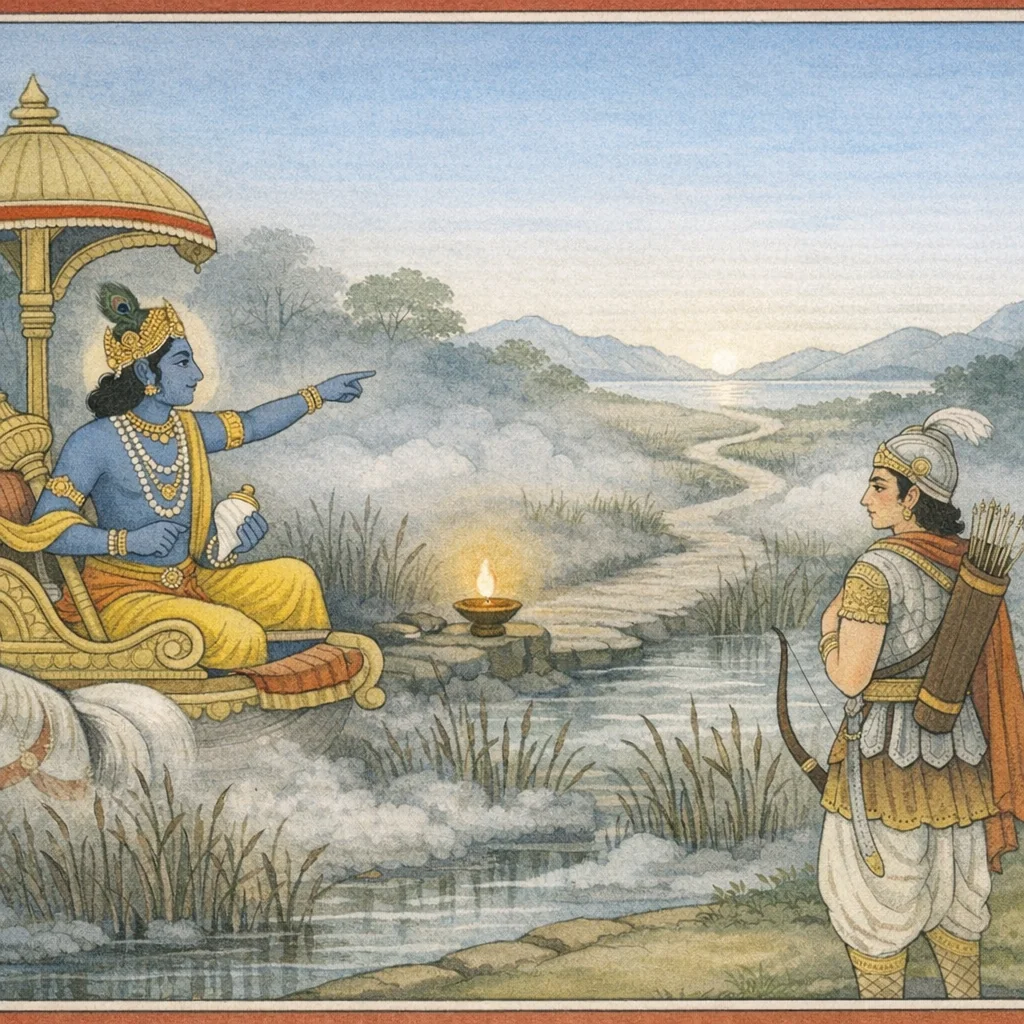
When your buddhi crosses beyond the mire of delusion, then you will attain dispassion toward what is yet to be heard and what has been heard.
When your intellect crosses beyond the mire of delusion, then you will attain dispassion toward what is yet to be heard and what has been heard.
When your understanding passes beyond the thicket/mire of confusion, then you will arrive at indifference (disenchantment) regarding what is to be heard and what has been heard.
“Śrotavya” and “śruta” refer to prospective and already-received teachings (including scriptural learning). The point is not anti-intellectualism but a shift from accumulating information to stabilized insight, where further instruction no longer functions as a compensatory substitute for realization.
FAQs
It describes a cognitive-emotional transition: when confusion clears, compulsive seeking of new inputs (or fixation on past teachings) relaxes, making room for stable judgment.
In many Indian soteriologies, liberating knowledge culminates in a non-dependent certainty; the verse signals that stage where the mind no longer needs constant external confirmation.
After defining yoga as equanimity and buddhi-guided action, Krishna indicates a future maturation: Arjuna’s intellect will move beyond perplexity and second-hand authority.
Avoid endless self-help consumption: prioritize practice and integration so learning becomes lived competence rather than perpetual searching.