
Bhagavad Gita — Sankhya Yoga, Shloka 6
Sankhya Yoga
न चैतद्विद्मः कतरन्नो गरीयो यद्वा जयेम यदि वा नो जयेयुः । यानेव हत्वा न जिजीविषामस् तेऽवस्थिताः प्रमुखे धार्तराष्ट्राः ॥ २.६ ॥
na caitad vidmaḥ kataran no garīyo yadvā jayema yadi vā no jayeyuḥ | yān eva hatvā na jijīviṣāmas te 'vasthitāḥ pramukhe dhārtarāṣṭrāḥ || 2.6 ||

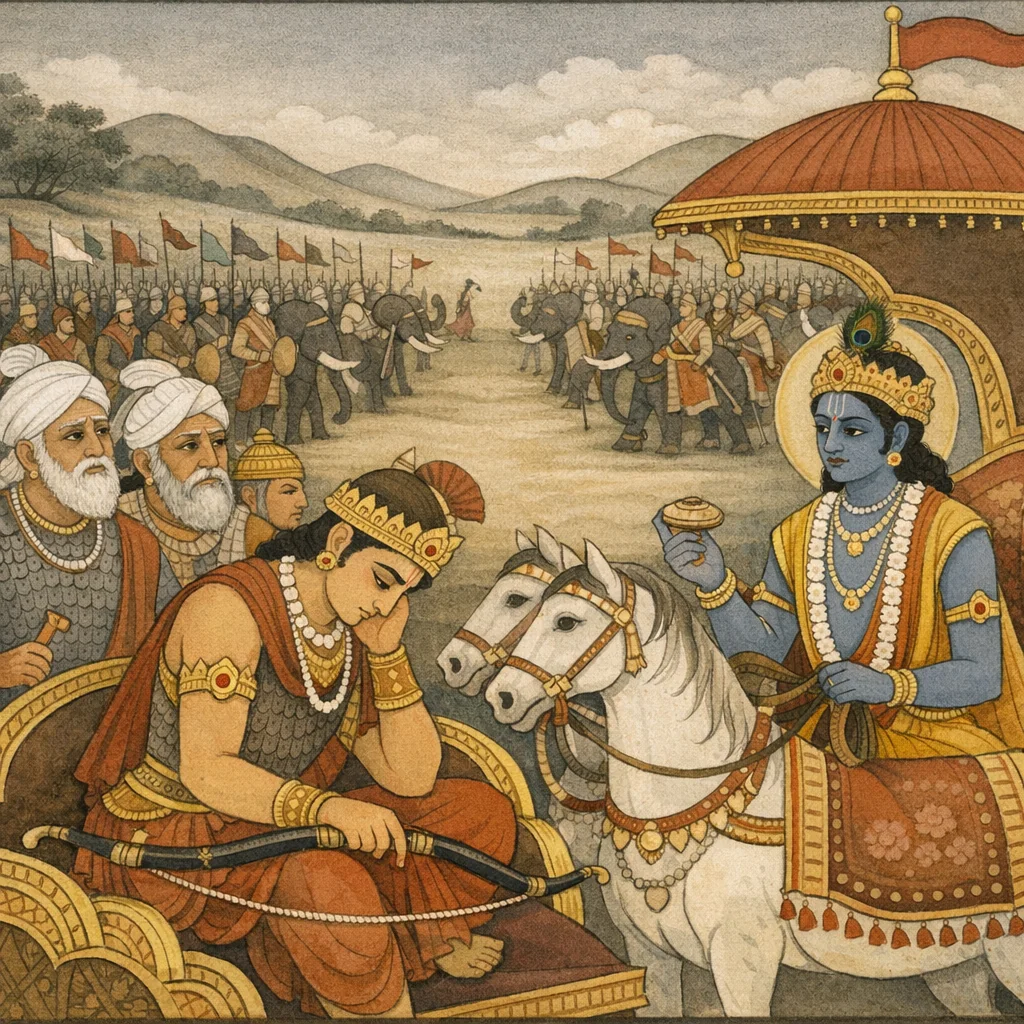
Nor do we know which is better for us—whether we should conquer, or whether they should conquer us. Those very sons of Dhritarashtra stand before us in battle; having slain them, we would not wish to live.
Arjuna says they do not know which is better—whether they should prevail or their opponents should prevail; those very people, after whose loss they would not wish to live, stand before them.
Arjuna admits uncertainty: ‘We do not know which is weightier for us—whether we should succeed or whether they should succeed; those Dhrtarāṣṭras stand facing us, and having overcome them we would not want to continue living.’
The verse emphasizes epistemic and ethical uncertainty (‘kataran no garīyaḥ’). Some translations keep the literal ‘having killed’ idiom; neutral academic paraphrase often renders it as ‘overcome/defeat’ to foreground the moral dilemma rather than physical imagery.
FAQs
It captures decision paralysis: Arjuna cannot rank competing goods (duty, loyalty, compassion), a hallmark of crisis cognition under stress.
The verse indirectly points to the need for a standpoint beyond fluctuating outcomes; later teaching will argue that clarity arises from understanding the self and action without attachment to results.
This deepens the narrative: Arjuna’s hesitation is not mere fear but a principled uncertainty about what constitutes the ‘greater good’ in a tragic situation.
Useful for ethics education: it models how people may be unable to choose when every option seems to violate a core commitment, motivating structured reflection and guidance.