
Bhagavad Gita — Sankhya Yoga, Shloka 25
Sankhya Yoga
अव्यक्तोऽयमचिन्त्योऽयमविकार्योऽयमुच्यते । तस्मादेवं विदित्वैनं नानुशोचितुमर्हसि ॥ २.२५ ॥
avyakto ’yam acintyo ’yam avikāryo ’yam ucyate | tasmād evaṁ viditvainaṁ nānuśocitum arhasi || 2.25 ||

This Self is said to be unmanifest, inconceivable, and unchangeable. Therefore, knowing It thus, you ought not to grieve.
This Self is said to be unmanifest, inconceivable, and unchangeable; therefore, knowing It thus, you ought not to grieve.
This (Self) is called unmanifest, unthinkable, and not subject to modification; therefore, having understood it in this way, you are not fit to mourn for it.
Most recensions read closely as here; interpretive differences typically concern whether “unmanifest” (avyakta) is taken epistemically (not an object of perception) or metaphysically (beyond empirical manifestation).
FAQs
The verse reframes grief as arising from misidentifying the enduring self with changing conditions; it offers a cognitive reappraisal strategy grounded in a stable identity beyond fluctuation.
It asserts that the self is not an object among objects: it is not directly manifest to the senses, not fully capturable by discursive thought, and not subject to transformation.
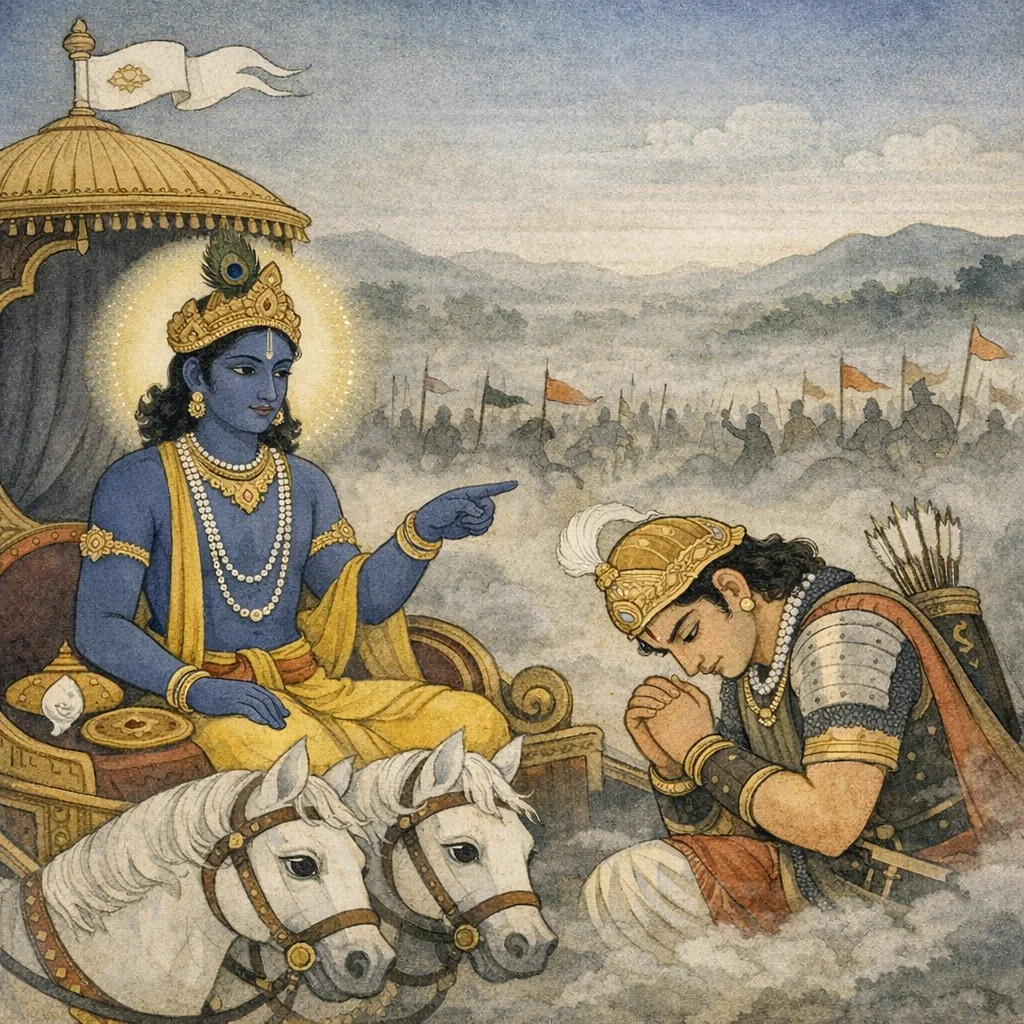
Krishna continues a teaching sequence aimed at reducing Arjuna’s despair by presenting a view of the person that is not exhausted by bodily change.
In stressful transitions, one may distinguish between changing roles and a deeper continuity of awareness, supporting steadiness and reduced rumination.