
Bhagavad Gita — Sankhya Yoga, Shloka 22
Sankhya Yoga
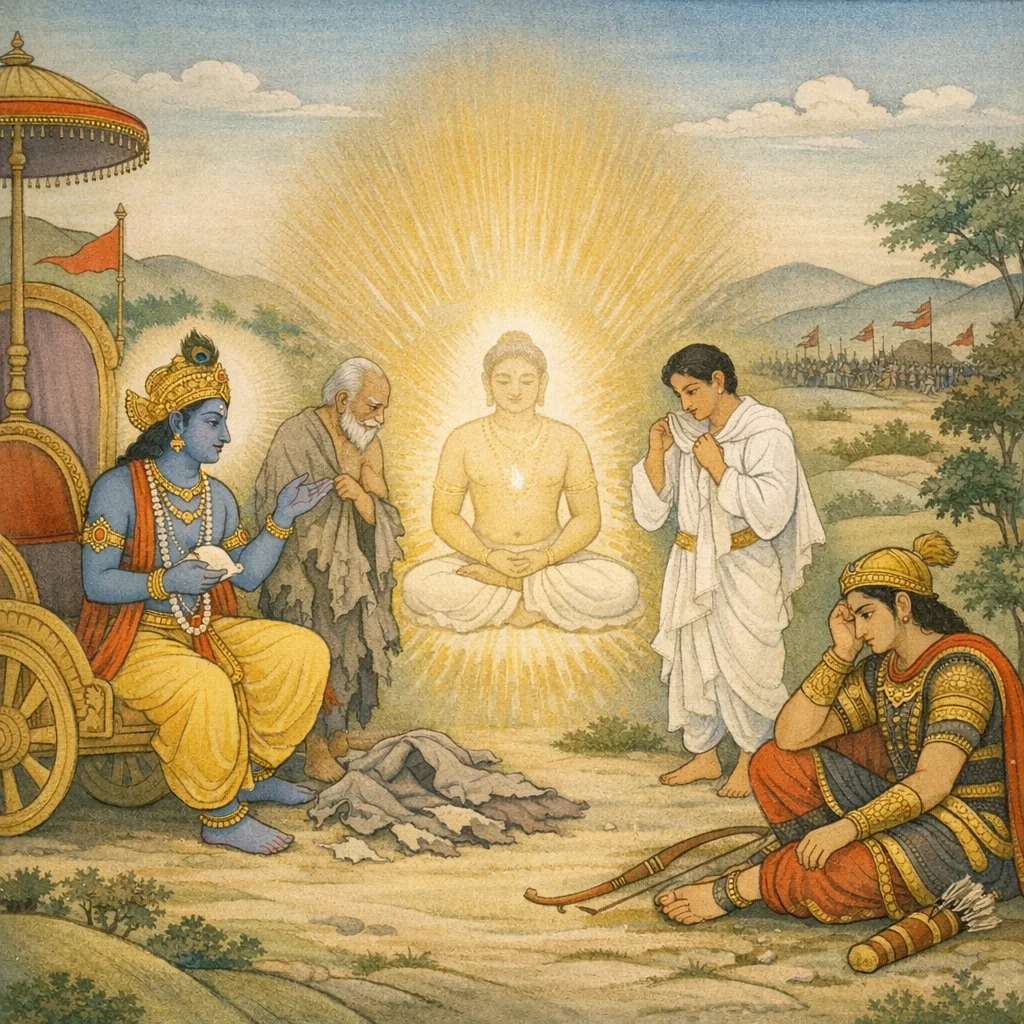
वासांसि जीर्णानि यथा विहाय नवानि गृह्णाति नरोऽपराणि । तथा शरीराणि विहाय जीर्णा- न्यन्यानि संयाति नवानि देही ॥ २.२२ ॥
vāsāṃsi jīrṇāni yathā vihāya navāni gṛhṇāti naro 'parāṇi | tathā śarīrāṇi vihāya jīrṇāny anyāni saṃyāti navāni dehī || 2.22 ||

As a person casts off worn-out garments and takes up others that are new, so the embodied Self casts off worn-out bodies and enters into others that are new.
As a person casts off worn-out garments and takes others that are new, so the embodied (self) casts off worn-out bodies and enters others that are new.
Just as a person, abandoning old clothes, takes up other new ones, so the embodied one, abandoning worn-out bodies, comes to other new ones.
The garment metaphor is widely cited to support rebirth (saṃsāra). Some modern interpreters read it as a broader image of changing identities, but the plain sense in context favors continuity of an embodied self across bodies.
FAQs
The metaphor can reduce clinging by normalizing transition—inviting a less fear-driven stance toward change.
It presents a model where the self persists while bodies change, supporting a rebirth framework common in Indian traditions.
Krishna offers an accessible analogy to make the self/body distinction vivid for Arjuna.
Even outside literal rebirth beliefs, it can be used to reflect on letting go of outdated roles and adopting healthier patterns.