
Bhagavad Gita — Sankhya Yoga, Shloka 2
Sankhya Yoga
श्रीभगवानुवाच । कुतस्त्वा कश्मलमिदं विषमे समुपस्थितम् अनार्यजुष्टमस्वर्ग्यमकीर्तिकरमर्जुन ॥ २.२ ॥
śrībhagavān uvāca | kutas tvā kaśmalam idaṃ viṣame samupasthitam | anāryajuṣṭam asvargyam akīrtikaram arjuna || 2.2 ||

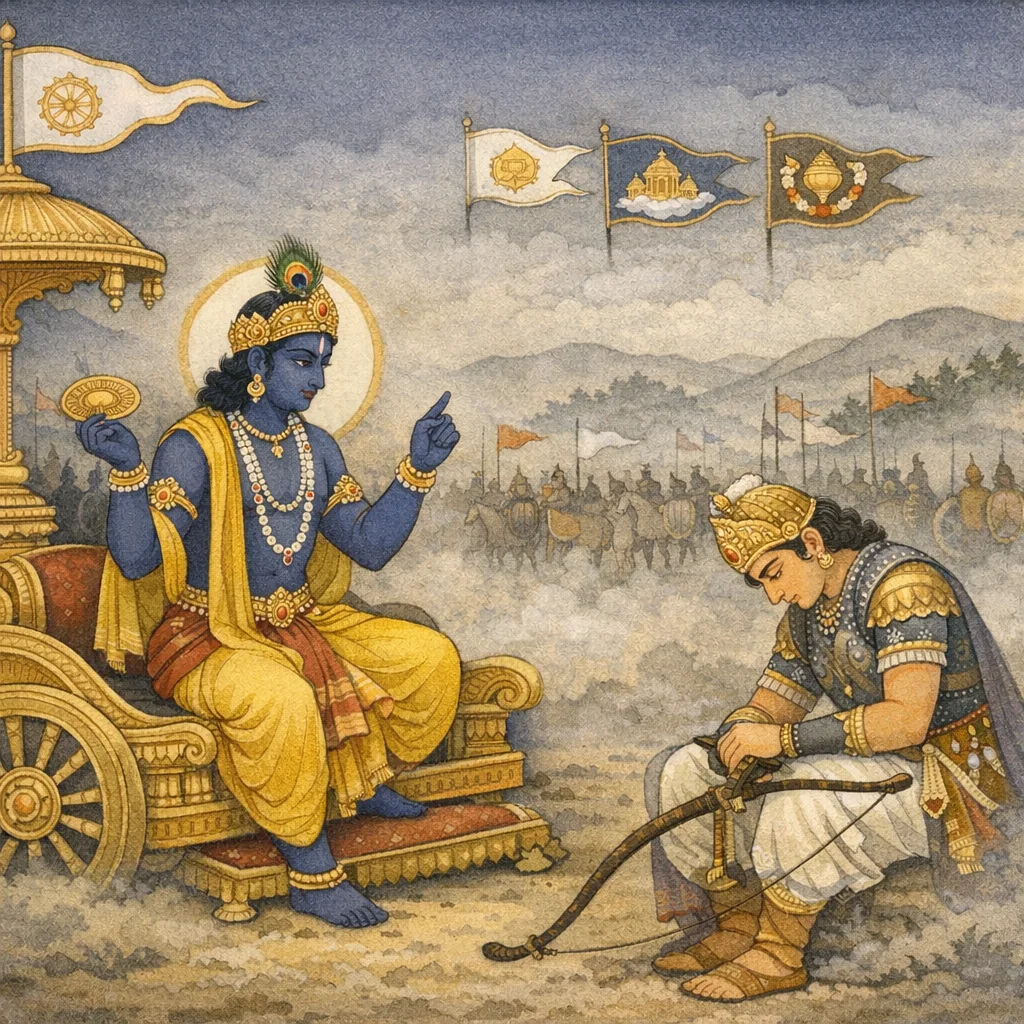
The Blessed Lord said: Whence has this dejection come upon you at this critical hour, O Arjuna? It is not befitting of the noble; it leads neither to heaven nor to honor, but to disgrace.
श्रीभगवान बोले—हे अर्जुन! इस विषम समय में तुझे यह मोह/कश्मल कहाँ से आ गया? यह न तो आर्य-आचरण है, न स्वर्ग देने वाला है और न यश देने वाला।
The Blessed Lord said: From where has this dejection/confusion (kaśmala) come upon you at this critical juncture? It is not practiced by the noble (anārya-juṣṭa), it does not lead to heaven (asvargya), and it brings disgrace (akīrti-kara).
‘anārya’ is better read as ‘not befitting the noble/ideal person’ rather than an ethnic label. ‘svarga’ can be interpreted as ritual-moral reward in the epic worldview; some modern readings treat it as ‘well-being’ or ‘uplift’ more generally.
FAQs
Krishna identifies Arjuna’s state as ‘kaśmala’—a confusion that masquerades as virtue—challenging him to distinguish compassion from disabling indecision.
The verse sets the stage for metaphysical teaching by first diagnosing the problem as misapprehension, not merely emotion.
It is Krishna’s opening response, reframing Arjuna’s hesitation as inconsistent with the role-ethics and ideals assumed in the narrative.
It can be read as a call to examine whether one’s reluctance is principled restraint or avoidant confusion, especially in high-stakes decisions.