
Bhagavad Gita — Sankhya Yoga, Shloka 1
Sankhya Yoga
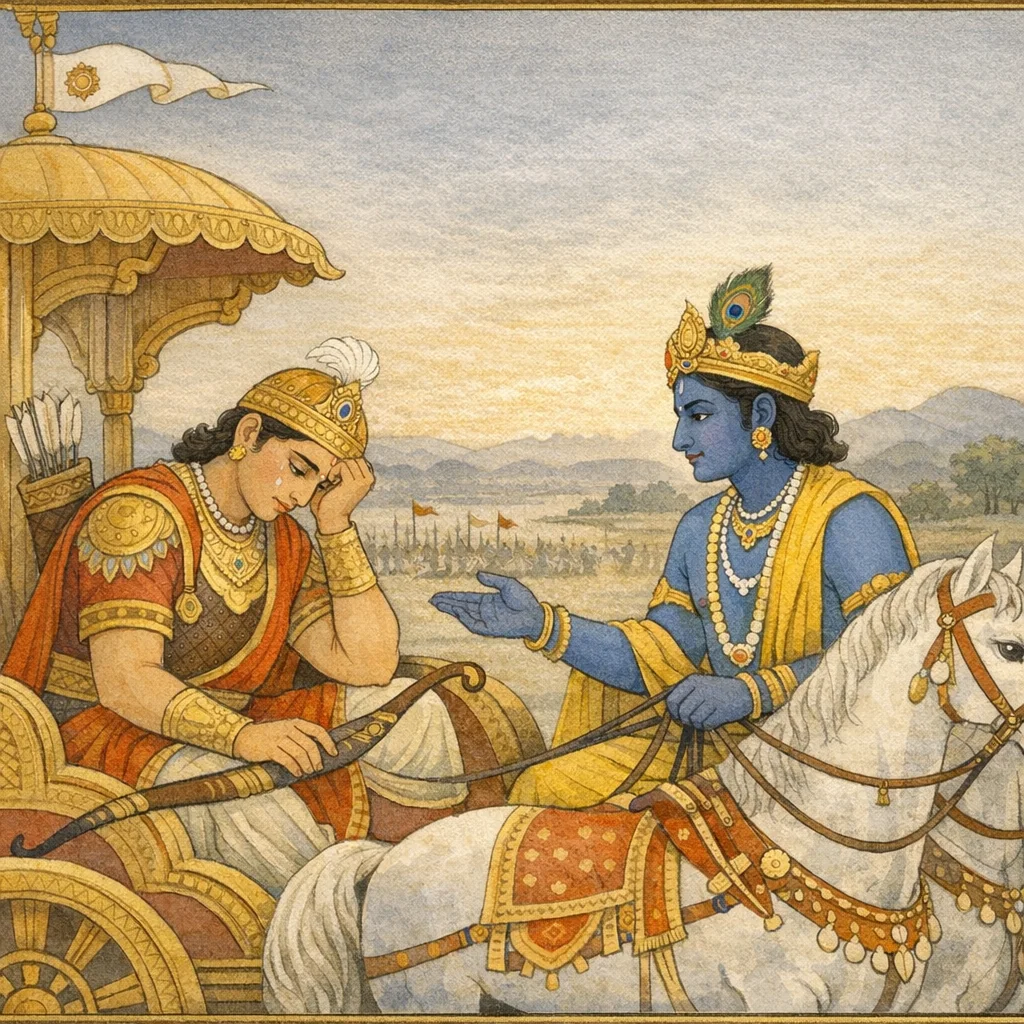
संजय उवाच । तं तथा कृपयाविष्टमश्रुपूर्णाकुलेक्षणम् विषीदन्तमिदं वाक्यमुवाच मधुसूदनः ॥ २.१ ॥
sañjaya uvāca | taṃ tathā kṛpayāviṣṭam aśrupūrṇākulekṣaṇam | viṣīdantam idaṃ vākyam uvāca madhusūdanaḥ || 2.1 ||

Sanjaya said: To him who was thus seized by compassion, with eyes troubled and filled with tears, and who was sinking into despondency, Madhusudana spoke these words.
संजय बोले—इस प्रकार करुणा से व्याप्त, आँसुओं से भरी व्याकुल आँखों वाले और विषाद करते हुए अर्जुन से मधुसूदन ने ये वचन कहे।
Sañjaya said: To him—thus overwhelmed by compassion, with eyes troubled and filled with tears, sinking into despondency—Madhusūdana spoke these words.
‘kṛpā’ here is often translated ‘compassion,’ but commentators debate whether it is commendable empathy or a debilitating pity that clouds discernment; Krishna’s next verse suggests the latter in this context.
FAQs
The verse describes acute affect: compassion mixed with overwhelm, signaling that Arjuna’s empathy has become incapacitating rather than clarifying.
It is a narrative bridge: the metaphysical teaching that follows is motivated by a human breakdown that requires a deeper framework for action.
It transitions from Arjuna’s speech to Krishna’s response, marking the start of doctrinal instruction in the dialogue.
It highlights a common experience: strong empathy can coexist with impaired judgment, and timely guidance can help reorient decision-making.