
Bhagavad Gita — Sankhya Yoga, Shloka 30
Sankhya Yoga
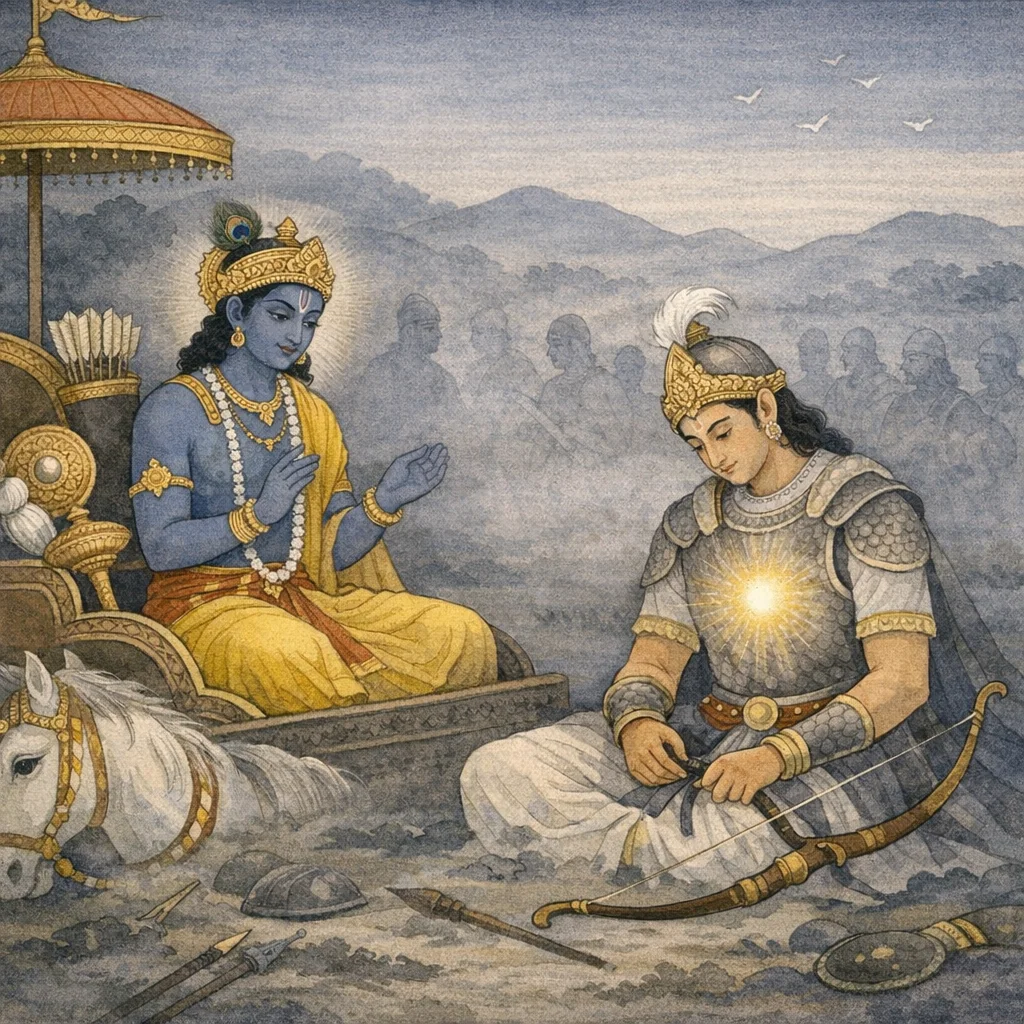
देही नित्यमवध्योऽयं देहे सर्वस्य भारत । तस्मात्सर्वाणि भूतानि न त्वं शोचितुमर्हसि ॥ २.३० ॥
dehī nityam avadhyo ’yaṁ dehe sarvasya bhārata | tasmāt sarvāṇi bhūtāni na tvaṁ śocitum arhasi || 2.30 ||

O Bhārata, the embodied Self within the bodies of all beings is ever indestructible; therefore you ought not to grieve for any being.
The embodied self is eternally not to be destroyed in the body of all beings; therefore, you should not grieve for any beings.
This embodied one is always not to be slain within the body of everyone, O Bhārata; therefore you are not fit to mourn for any beings.
Modern academic translations often avoid martial idiom by rendering avadhya as “invulnerable” or “not destructible,” emphasizing metaphysical indestructibility rather than literal harm.
FAQs
By locating identity in what is not vulnerable to change, the verse offers a framework for reducing fear-based grief and fostering steadiness.
It asserts an indestructible principle (dehī/ātman) present across embodied beings, distinguishing it from the perishable body.
This concludes a cluster of arguments intended to stabilize Arjuna’s mind before turning to duty-based reasoning.
It can be read as an invitation to see a shared inner continuity in others, supporting compassion and reduced reactivity.