
Bhagavad Gita — Sankhya Yoga, Shloka 72
Sankhya Yoga
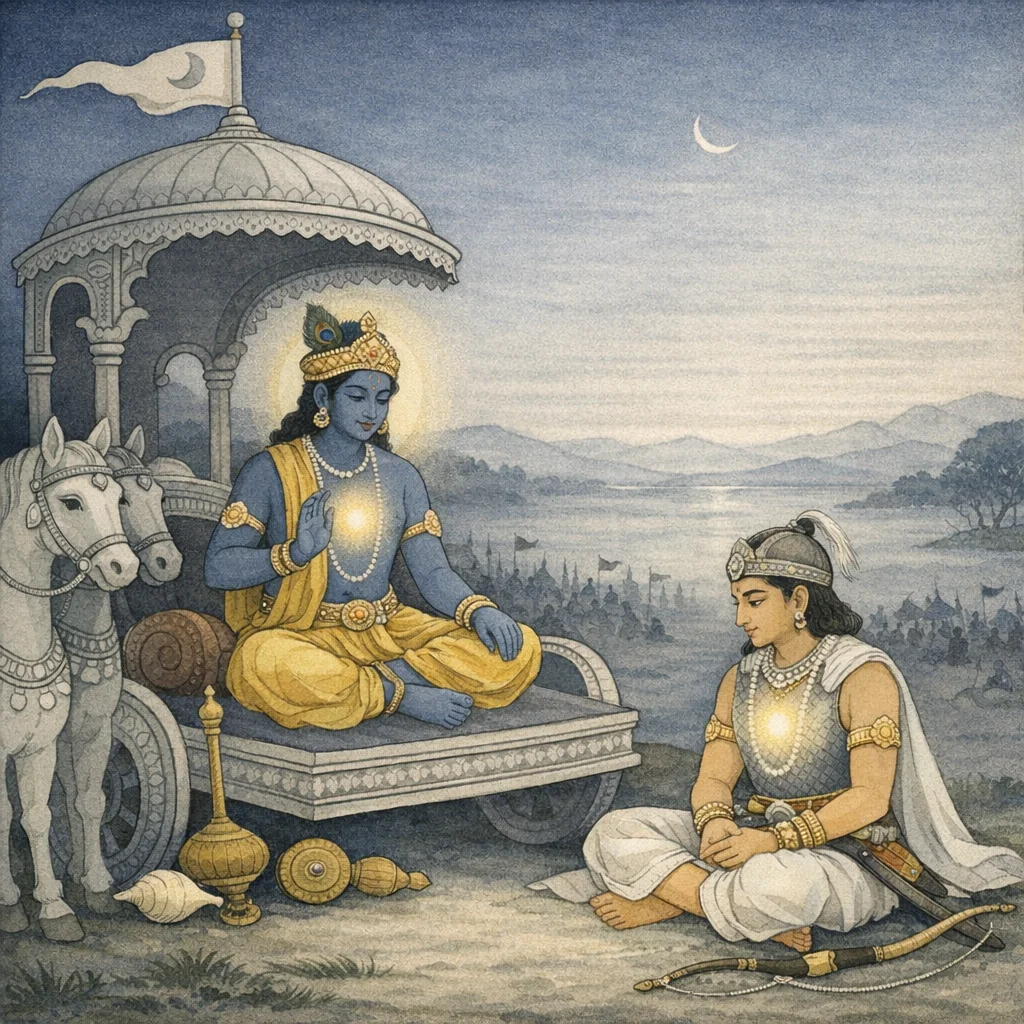
एषा ब्राह्मी स्थितिः पार्थ नैनां प्राप्य विमुह्यति । स्थित्वास्यामन्तकालेऽपि ब्रह्मनिर्वाणमृच्छति ॥ २.७२ ॥
eṣā brāhmī sthitiḥ pārtha naināṁ prāpya vimuhyati | sthitvāsyām anta-kāle 'pi brahma-nirvāṇam ṛcchati || 2.72 ||

This is the Brahmic state, O Pārtha; having attained it, one is not deluded. Established in it even at the time of death, one reaches Brahman-nirvāṇa.
This is the Brahmic state, O Pārtha; attaining it, one is not deluded. Established in it even at the time of death, one reaches Brahman-nirvāṇa.
This is the ‘brahmic’ abiding, O Pārtha; having attained it, one is not confused. Abiding in it even at life’s end, one reaches extinction-in-Brahman (brahma-nirvāṇa).
Brāhmī sthiti may be read as ‘state pertaining to Brahman’ or ‘spiritual abiding.’ Brahma-nirvāṇa is interpreted across traditions as liberation in/through Brahman; the verse is a doctrinal culmination of the sthitaprajña teaching.
FAQs
It presents a stable, non-confused mode of being as an attainable culmination of disciplined life, suggesting enduring clarity even under major life transitions.
It explicitly connects the steady state to brahma-nirvāṇa, a liberation concept that later Vedāntic and other traditions interpret as final release grounded in ultimate reality (Brahman).
This verse closes Chapter 2’s portrait of the sthitaprajña and transitions toward Arjuna’s next question about the relation between insight and action.
As a non-sectarian takeaway, it can be read as valuing deep stability and reduced delusion as life goals, cultivated over time rather than sought through external change.