Adhyaya 98
Droṇa–Arjuna Yuddha; Trigarta-Āvaraṇa; Bhīmasena Gajānīka-bheda (Droṇa and Arjuna Engage; Trigarta Containment; Bhīma Breaks the Elephant Corps)
Upa-parva: Droṇa–Arjuna Saṃmukha (Strategic Encounter Episode)
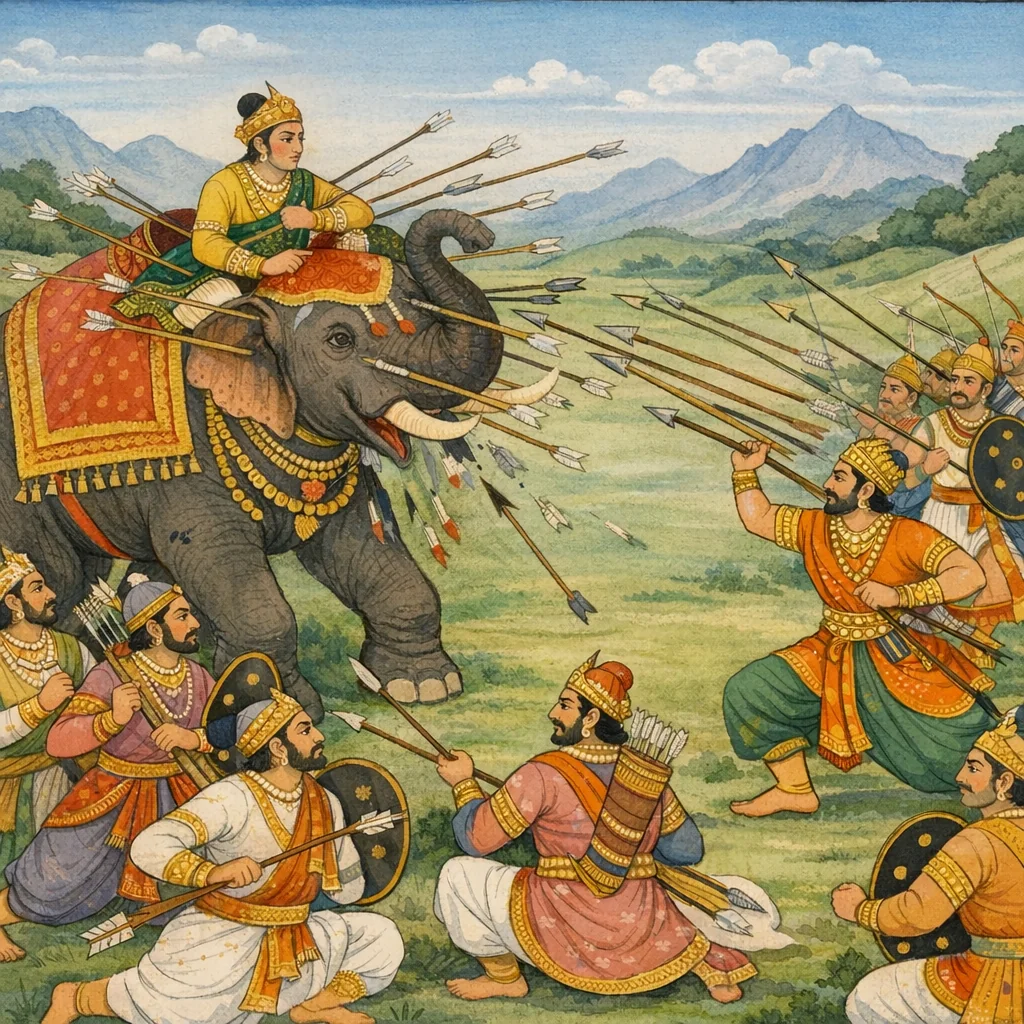
Dhṛtarāṣṭra questions Sanjaya on how Droṇa and Arjuna—mutually dear as teacher and student—can meet in battle. Sanjaya frames the encounter through kṣatra-dharma: in war, combatants do not abstain even against fathers, brothers, or revered persons, and personal affection does not override role-duty. Arjuna strikes Droṇa with arrows and follows with a dense missile-rain; Droṇa checks Arjuna with well-jointed shafts. Duryodhana, seeking to restrain Arjuna (pārṣṇi-grahaṇa, a containment measure), urges Suśarmā and the Trigartas to engage; they shower Arjuna with iron-pointed arrows, which Arjuna answers by piercing their leader and sustaining a counter-volley. Observers note Arjuna’s technical dexterity in parrying massed weapon-rain, likened to wind dispersing cloud-banks, earning approval from celestial and demonic beings as narrative witnesses. Arjuna releases Vāyavyāstra, producing turbulent winds that disrupt the field; Droṇa responds with a formidable counter-weapon (described as ‘Śaila’), pacifying the disturbance. Arjuna then demoralizes the Trigarta chariot-units. Concurrently, Kaurava leaders distribute to contain Pandava divisions: Bhīṣma encloses Yudhiṣṭhira; other chiefs check the twins; Bhagadatta and Śrutāyu press Bhīma with an elephant corps. Bhīma, armed with a mace, leaps into the elephant formation, shatters it, and drives the surviving elephants into flight, causing broader disarray in Duryodhana’s line.
Chapter Arc: संजय धृतराष्ट्र को आठवें दिन के युद्ध का वृत्तांत सुनाते हैं—दुर्योधन हाँफता-सा, बार-बार दीर्घ निःश्वास लेकर, घटोत्कच की विजय और अपनी सेना की दुर्दशा का वर्णन करता है। → दुर्योधन भीष्म-पितामह के पास जाकर पाण्डवों के साथ छिड़े घोर संग्राम की बात रखता है और घटोत्कच के प्रचण्ड पराक्रम से उत्पन्न भय को उभारता है। रणभूमि में पाण्डव-पक्ष के अनेक महारथी (अभिमन्यु, धृष्टकेतु, द्रौपदी-पुत्र, केकयकुमार आदि) एक क्रुद्ध गजराज को चारों ओर से घेरते हैं; कवच, शस्त्र और तोमरों की वर्षा से दृश्य और भी उग्र होता जाता है। → प्राग्ज्योतिष-नरेश (भगदत्त) क्रोध में दशार्ण-नरेश के हाथी के अग्रभाग पर लगातार तोमर प्रहार करता है; तोमर कवच को चीरते हुए ऐसे धँसते हैं जैसे सर्प वल्मीक में घुसते हों, और हाथी-युद्ध की भीषणता चरम पर पहुँचती है। → हाथी के उन्मत्त आघातों और भगदत्त की मारक शक्ति से पाण्डवों की विशाल सेना दबकर सिमट जाती है—आग पर रखे चमड़े की तरह संकुचित होकर मोर्चा बदलने को विवश होती है; दुर्योधन का भय और भीष्म के समक्ष उसकी शिकायत/प्रार्थना इस दबाव को स्थिर रूप देती है। → दुर्योधन की व्याकुल वाणी और पाण्डव-सेना के संकुचन के बाद प्रश्न लटकता है—क्या भीष्म कोई निर्णायक प्रतिकार रचेंगे, या घटोत्कच/पाण्डव-पक्ष अगले प्रहार से युद्ध की धारा पलट देंगे?
Shlokas
Verse 1
इस प्रकार श्रीमह् भारत भीष्मपर्वके अन्तर्गत भीष्मवधपर्वरमें आठवें दिनके युद्धमें घटोत्कचका युद्धविषयक चौरानबेवाँ अध्याय पूरा हुआ ॥/ ९४ ॥। #+>.ोी >> | न हि कक पञ्चनवतितमो< ध्याय: दुर्योधनके अनुरोध और भीष्मजीकी आज्ञासे भगदत्तका घटोत्कच, भीमसेन और पाण्डव-सेनाके साथ घोर युद्ध संजय उवाच तस्मिन् महति संक्रन्दे राजा दुर्योधनस्तदा । (पराजयं राक्षसेन नामृष्यत परंतप: ।) गाड़ेयमुपसंगम्य विनयेनाभिवाद्य च,कथयामास दुर्धर्षो विनि:श्वस्य पुनः पुनः । संजय कहते हैं--महाराज! शत्रुओंको संताप देनेवाला राजा दुर्योधन उस महान् युद्धमें एक राक्षसके द्वारा प्राप्त हुई अपनी पराजयको नहीं सह सका। उसने गंगानन्दन भीष्मजीके पास जाकर उन्हें विनीतभावसे प्रणाम करनेके पश्चात् सारा वृत्तान्त यथावत् रूपसे कह सुनाया। उस दुर्धर्ष वीरने बारंबार लम्बी साँस खींचकर घटोत्कचकी विजय और अपनी पराजयकी कथा कही इस प्रकार श्रीमह्या भारत भीष्मपर्वके अन्तर्गत भीष्यवधपर्वमें भगदत्तका युद्धाविषयक पंचानबेवाँ अध्याय प्रा हुआ ॥/ ९५ ॥। [दाक्षिणात्य अधिक पाठका १ श्लोक मिलाकर कुल ८७ श्लोक हैं।] जीन जन लि ंडहडइड: - प्रलयकालकी अग्निका नाम संवर्तक है। षण्णवतितमोब< ध्याय: इरावानके वधसे का का दुःखपूर्ण उद्गार, भीमसेनके द्वारा धृतराष्ट्रके नौ पुत्रोंका वध, अभिमन्यु और अम्बष्ठका युद्ध, युद्धकी भयानक स्थितिका वर्णन तथा आठवें दिनके युद्धका उपसंहार संजय उवाच पुत्रं विनिहतं श्रुत्वा इरावन्तं धनंजय: । दुःखेन महता<<विष्टो निःश्वसन् पन्नगो यथा
Sañjaya said: In that great tumult of battle, King Duryodhana—scorcher of foes—could not endure the defeat inflicted upon him by a rākṣasa. Approaching Bhīṣma, the son of the Gaṅgā, he bowed with humility and then reported the entire matter as it had occurred. The hard-to-subdue warrior, again and again drawing long breaths, recounted how Ghaṭotkaca had prevailed and how he himself had been brought low—revealing the strain that pride and desperation place upon a leader amid the moral chaos of war.
Verse 2
तस्य सर्व यथावृत्तमाख्यातुमुपचक्रमे । घटोत्कचस्य विजयमात्मनश्ल पराजयम्,कथयामास दुर्धर्षो विनि:श्वस्य पुनः पुनः । संजय कहते हैं--महाराज! शत्रुओंको संताप देनेवाला राजा दुर्योधन उस महान् युद्धमें एक राक्षसके द्वारा प्राप्त हुई अपनी पराजयको नहीं सह सका। उसने गंगानन्दन भीष्मजीके पास जाकर उन्हें विनीतभावसे प्रणाम करनेके पश्चात् सारा वृत्तान्त यथावत् रूपसे कह सुनाया। उस दुर्धर्ष वीरने बारंबार लम्बी साँस खींचकर घटोत्कचकी विजय और अपनी पराजयकी कथा कही
Sañjaya said: He then began to relate everything exactly as it had occurred. The hard-to-subdue Duryodhana, repeatedly heaving deep sighs, recounted Ghaṭotkaca’s victory and his own defeat—unable to endure the humiliation of being overcome in that great battle by a rākṣasa. Having approached Bhīṣma, the son of the Gaṅgā, and bowed to him with humility, he narrated the entire account in full.
Verse 3
अब्रवीच्च तदा राजन् भीष्म कुरुपितामहम्,कथयामास दुर्धर्षो विनि:श्वस्य पुनः पुनः । संजय कहते हैं--महाराज! शत्रुओंको संताप देनेवाला राजा दुर्योधन उस महान् युद्धमें एक राक्षसके द्वारा प्राप्त हुई अपनी पराजयको नहीं सह सका। उसने गंगानन्दन भीष्मजीके पास जाकर उन्हें विनीतभावसे प्रणाम करनेके पश्चात् सारा वृत्तान्त यथावत् रूपसे कह सुनाया। उस दुर्धर्ष वीरने बारंबार लम्बी साँस खींचकर घटोत्कचकी विजय और अपनी पराजयकी कथा कही राजन्! फिर उसने कुरुकुलके वृद्ध पितामह भीष्मसे कहा--'प्रभो! जैसे मेरे शत्रु वसुदेवनन्दन श्रीकृष्णका आश्रय लेकर युद्ध करते हैं, उसी प्रकार मैंने केवल आपका सहारा लेकर पाण्डवोंके साथ भयंकर युद्ध छेड़ा है
Sañjaya said: “O King, at that time Duryodhana spoke to Bhīṣma, the grandsire of the Kurus. The hard-to-subdue prince, heaving deep sighs again and again, recounted everything as it had happened—how he could not bear the humiliation of his defeat at the hands of a fearsome foe in that great battle. Having approached Bhīṣma with deference and bowed, he narrated the full account, and then addressed the aged patriarch: ‘Lord, just as my enemies fight relying on Vāsudeva’s son, Śrī Kṛṣṇa, so too have I undertaken this dreadful war against the Pāṇḍavas relying only on you.’”
Verse 4
भवन्तं समुपश्रित्य वासुदेवं यथा परै: । पाण्डवैर्विग्रहो घोर: समारब्धो मया प्रभो,कथयामास दुर्धर्षो विनि:श्वस्य पुनः पुनः । संजय कहते हैं--महाराज! शत्रुओंको संताप देनेवाला राजा दुर्योधन उस महान् युद्धमें एक राक्षसके द्वारा प्राप्त हुई अपनी पराजयको नहीं सह सका। उसने गंगानन्दन भीष्मजीके पास जाकर उन्हें विनीतभावसे प्रणाम करनेके पश्चात् सारा वृत्तान्त यथावत् रूपसे कह सुनाया। उस दुर्धर्ष वीरने बारंबार लम्बी साँस खींचकर घटोत्कचकी विजय और अपनी पराजयकी कथा कही राजन्! फिर उसने कुरुकुलके वृद्ध पितामह भीष्मसे कहा--'प्रभो! जैसे मेरे शत्रु वसुदेवनन्दन श्रीकृष्णका आश्रय लेकर युद्ध करते हैं, उसी प्रकार मैंने केवल आपका सहारा लेकर पाण्डवोंके साथ भयंकर युद्ध छेड़ा है
Sañjaya said: “O Lord, just as my enemies, taking refuge in Vāsudeva, wage war, so have I, relying upon you, begun a dreadful conflict with the Pāṇḍavas.” Having spoken thus, the hard-to-subdue (Duryodhana) repeatedly heaved deep sighs, laying bare the strain of pride, dependence, and the moral weight of a war undertaken through the shelter of a revered elder.
Verse 5
एकादश समाख्याता अक्षौहिण्यश्न या मम । निदेशे तव तिष्ठन्ति मया सार्थ परंतप,कथयामास दुर्धर्षो विनि:श्वस्य पुनः पुनः । संजय कहते हैं--महाराज! शत्रुओंको संताप देनेवाला राजा दुर्योधन उस महान् युद्धमें एक राक्षसके द्वारा प्राप्त हुई अपनी पराजयको नहीं सह सका। उसने गंगानन्दन भीष्मजीके पास जाकर उन्हें विनीतभावसे प्रणाम करनेके पश्चात् सारा वृत्तान्त यथावत् रूपसे कह सुनाया। उस दुर्धर्ष वीरने बारंबार लम्बी साँस खींचकर घटोत्कचकी विजय और अपनी पराजयकी कथा कही 'परंतप! मेरे साथ ही मेरी ये प्रसिद्ध ग्यारह अक्षौहिणी सेनाएँ आपकी आज्ञाके अधीन हैं
Sañjaya said: “O scorcher of foes, the eleven famed akṣauhiṇīs that are mine stand together with me under your command.” Having said this, the hard-to-subdue (Duryodhana) repeatedly heaved deep sighs as he related the matter—his humiliation and the enemy’s success—seeking to place the burden of leadership and the moral responsibility of the coming slaughter upon Bhīṣma’s authority.
Verse 6
सो*<हं भरतशार्दूल भीमसेनपुरोगमै: । घटोत्कचं समाश्रित्य पाण्डवैर्युधि निर्जित:,कथयामास दुर्धर्षो विनि:श्वस्य पुनः पुनः । संजय कहते हैं--महाराज! शत्रुओंको संताप देनेवाला राजा दुर्योधन उस महान् युद्धमें एक राक्षसके द्वारा प्राप्त हुई अपनी पराजयको नहीं सह सका। उसने गंगानन्दन भीष्मजीके पास जाकर उन्हें विनीतभावसे प्रणाम करनेके पश्चात् सारा वृत्तान्त यथावत् रूपसे कह सुनाया। उस दुर्धर्ष वीरने बारंबार लम्बी साँस खींचकर घटोत्कचकी विजय और अपनी पराजयकी कथा कही “भरतश्रेष्ठ! ऐसा शक्तिशाली होनेपर भी मुझे भीमसेन आदि पाण्डवोंने घटोत्कचका सहारा लेकर युद्धमें परास्त कर दिया है
Sañjaya said: “O tiger among the Bharatas, I—Duryodhana—have been defeated in battle by the Pāṇḍavas, led by Bhīmasena, who took refuge in (and relied upon) Ghaṭotkaca. That hard-to-overcome warrior then recounted the matter again and again, repeatedly heaving deep sighs.”
Verse 7
तन्मे दहति गात्राणि शुष्कवृक्षमिवानल: । यदिच्छामि महाभाग त्वत्प्रसादात् परंतप,कथयामास दुर्धर्षो विनि:श्वस्य पुनः पुनः । संजय कहते हैं--महाराज! शत्रुओंको संताप देनेवाला राजा दुर्योधन उस महान् युद्धमें एक राक्षसके द्वारा प्राप्त हुई अपनी पराजयको नहीं सह सका। उसने गंगानन्दन भीष्मजीके पास जाकर उन्हें विनीतभावसे प्रणाम करनेके पश्चात् सारा वृत्तान्त यथावत् रूपसे कह सुनाया। उस दुर्धर्ष वीरने बारंबार लम्बी साँस खींचकर घटोत्कचकी विजय और अपनी पराजयकी कथा कही “महाभाग! जैसे आग सूखे पेड़को जलाकर भस्म कर देती है, उसी प्रकार यह अपमान मेरे अंग-अंगको दग्ध कर रहा है। शत्रुओंको संताप देनेवाले पितामह! मैं आपकी कृपासे स्वयं ही उस नीच एवं दुर्धर्ष राक्षणको मारना चाहता हूँ। आपका सहारा लेकर उसपर विजयी होना चाहता हूँ। अत: आप मेरे इस मनोरथको पूर्ण करें”
Sañjaya said: “This disgrace burns my limbs like fire consuming a dry tree. O noble one, O scorcher of foes, by your favor I wish to accomplish it.” Thus the hard-to-subdue (Duryodhana), heaving deep sighs again and again, related his tale—seeking Bhīṣma’s support to overcome the humiliation of defeat and to regain honor within the harsh moral economy of war, where wounded pride can drive further violence.
Verse 8
राक्षसापसदं हन्तुं स्वयमेव पितामह । त्वां समाश्रित्य दुर्धर्ष तन्मे कर्तु त्वमहसि,कथयामास दुर्धर्षो विनि:श्वस्य पुनः पुनः । संजय कहते हैं--महाराज! शत्रुओंको संताप देनेवाला राजा दुर्योधन उस महान् युद्धमें एक राक्षसके द्वारा प्राप्त हुई अपनी पराजयको नहीं सह सका। उसने गंगानन्दन भीष्मजीके पास जाकर उन्हें विनीतभावसे प्रणाम करनेके पश्चात् सारा वृत्तान्त यथावत् रूपसे कह सुनाया। उस दुर्धर्ष वीरने बारंबार लम्बी साँस खींचकर घटोत्कचकी विजय और अपनी पराजयकी कथा कही “महाभाग! जैसे आग सूखे पेड़को जलाकर भस्म कर देती है, उसी प्रकार यह अपमान मेरे अंग-अंगको दग्ध कर रहा है। शत्रुओंको संताप देनेवाले पितामह! मैं आपकी कृपासे स्वयं ही उस नीच एवं दुर्धर्ष राक्षणको मारना चाहता हूँ। आपका सहारा लेकर उसपर विजयी होना चाहता हूँ। अत: आप मेरे इस मनोरथको पूर्ण करें”
Sanjaya said: “O Grandfather, I myself wish to slay that vile outcast among the rākṣasas. Relying upon you, O unconquerable one, you ought to help me accomplish this.” Thus spoke the hard-to-subdue Duryodhana, again and again heaving deep sighs—his words driven by the sting of humiliation and the desire to restore his standing in the war through Bhīṣma’s support.
Verse 9
एतच्छुत्वा तु वचन राज्ञो भरतसत्तम | दुर्योधनमिदं वाक्य भीष्म: शान्तनवोडब्रवीत्,कथयामास दुर्धर्षो विनि:श्वस्य पुनः पुनः । संजय कहते हैं--महाराज! शत्रुओंको संताप देनेवाला राजा दुर्योधन उस महान् युद्धमें एक राक्षसके द्वारा प्राप्त हुई अपनी पराजयको नहीं सह सका। उसने गंगानन्दन भीष्मजीके पास जाकर उन्हें विनीतभावसे प्रणाम करनेके पश्चात् सारा वृत्तान्त यथावत् रूपसे कह सुनाया। उस दुर्धर्ष वीरने बारंबार लम्बी साँस खींचकर घटोत्कचकी विजय और अपनी पराजयकी कथा कही भरतश्रेष्ठ! राजा दुर्योधनका यह वचन सुनकर शान्तनुनन्दन भीष्मने उससे इस प्रकार कहा--
Sañjaya said: “O best of the Bharatas, having heard these words of the king, Śāntanu’s son Bhīṣma addressed Duryodhana in reply. Duryodhana, hard to assail, repeatedly heaved deep sighs as he recounted the matter again and again—unable to endure the humiliation of his setback in that great battle. Then Bhīṣma spoke to him in this manner.”
Verse 10
शृणु राजन् मम वचो यत् त्वां वक्ष्यामि कौरव । यथा त्वया महाराज वर्तितव्यं परंतप,कथयामास दुर्धर्षो विनि:श्वस्य पुनः पुनः । संजय कहते हैं--महाराज! शत्रुओंको संताप देनेवाला राजा दुर्योधन उस महान् युद्धमें एक राक्षसके द्वारा प्राप्त हुई अपनी पराजयको नहीं सह सका। उसने गंगानन्दन भीष्मजीके पास जाकर उन्हें विनीतभावसे प्रणाम करनेके पश्चात् सारा वृत्तान्त यथावत् रूपसे कह सुनाया। उस दुर्धर्ष वीरने बारंबार लम्बी साँस खींचकर घटोत्कचकी विजय और अपनी पराजयकी कथा कही “राजन! कुरुनन्दन! मैं तुमसे जो कहता हूँ, उसे ध्यान देकर सुनो। शत्रुओंको संताप देनेवाले महाराज! तुम्हें जिस प्रकार बर्ताव करना चाहिये, वह सुनो
Sañjaya said: “Listen, O King, to my words—what I am about to tell you, O Kaurava. O great king, scorcher of foes, hear how you ought to conduct yourself.” Having spoken thus, the hard-to-overcome warrior, again and again heaving deep sighs, proceeded to relate the matter—his distress and counsel arising from defeat amid the pressures of war, where a ruler’s composure and right course of action are repeatedly tested.
Verse 11
' आत्मा रक्ष्यो रणे तात सर्वावस्थास्वरिंदम । धर्मराजेन संग्रामस्त्वया कार्य: सदानघ,कथयामास दुर्धर्षो विनि:श्वस्य पुनः पुनः । संजय कहते हैं--महाराज! शत्रुओंको संताप देनेवाला राजा दुर्योधन उस महान् युद्धमें एक राक्षसके द्वारा प्राप्त हुई अपनी पराजयको नहीं सह सका। उसने गंगानन्दन भीष्मजीके पास जाकर उन्हें विनीतभावसे प्रणाम करनेके पश्चात् सारा वृत्तान्त यथावत् रूपसे कह सुनाया। उस दुर्धर्ष वीरने बारंबार लम्बी साँस खींचकर घटोत्कचकी विजय और अपनी पराजयकी कथा कही “तात! शत्रुदमन! तुम युद्धमें सदा अपनी रक्षा करो। अनघ! तुम्हें सदा धर्मराज युधिष्ठिरसे ही संग्राम करना चाहिये
Sanjaya said: “O King, O subduer of foes—guard yourself in battle in every condition. O blameless one, you must always direct your fighting against Dharmaraja (Yudhisthira).” Having said this, the hard-to-overcome (Duryodhana) repeatedly heaved deep sighs, recounting again and again the tale of his defeat and the enemy’s victory—unable to bear the humiliation he had suffered in that great conflict.
Verse 12
अर्जुनेन यमाभ्यां वा भीमसेनेन वा पुन: । राजधर्म पुरस्कृत्य राजा राजानमारछति,कथयामास दुर्धर्षो विनि:श्वस्य पुनः पुनः । संजय कहते हैं--महाराज! शत्रुओंको संताप देनेवाला राजा दुर्योधन उस महान् युद्धमें एक राक्षसके द्वारा प्राप्त हुई अपनी पराजयको नहीं सह सका। उसने गंगानन्दन भीष्मजीके पास जाकर उन्हें विनीतभावसे प्रणाम करनेके पश्चात् सारा वृत्तान्त यथावत् रूपसे कह सुनाया। उस दुर्धर्ष वीरने बारंबार लम्बी साँस खींचकर घटोत्कचकी विजय और अपनी पराजयकी कथा कही “अर्जुन, नकुल, सहदेव अथवा भीमसेनके साथ भी तुम युद्ध कर सकते हो। राजधर्मको सामने रखकर यह बात कही गयी है। राजा राजासे ही युद्ध करता है
Sañjaya said: “Whether with Arjuna, or with the twin sons of Yama (Nakula and Sahadeva), or again with Bhīmasena—keeping the king’s duty foremost, a king should engage only a king in battle.” Having approached Bhīṣma, the formidable Duryodhana repeatedly heaved deep sighs and related the matter, speaking of his humiliation and the enemy’s success in the great war.
Verse 13
(न तु कार्यस्त्वया राजन् हैडिम्बेन दुरात्मना ।।) अहं द्रोण: कृपो द्रौणि: कृतवर्मा च सात्वत: । शल्यश्ष सौमदत्तिक्ष विकर्णश्र महारथ:,कथयामास दुर्धर्षो विनि:श्वस्य पुनः पुनः । संजय कहते हैं--महाराज! शत्रुओंको संताप देनेवाला राजा दुर्योधन उस महान् युद्धमें एक राक्षसके द्वारा प्राप्त हुई अपनी पराजयको नहीं सह सका। उसने गंगानन्दन भीष्मजीके पास जाकर उन्हें विनीतभावसे प्रणाम करनेके पश्चात् सारा वृत्तान्त यथावत् रूपसे कह सुनाया। उस दुर्धर्ष वीरने बारंबार लम्बी साँस खींचकर घटोत्कचकी विजय और अपनी पराजयकी कथा कही “राजन! तुम्हें दुरात्मा घटोत्कचके साथ कदापि युद्ध नहीं करना चाहिये। मैं, द्रोणाचार्य, कृपाचार्य, अश्वत्थामा, सात्वतवंशी कृतवर्मा, शल्य, भूरिश्रवा, महारथी विकर्ण तथा दुःशासन आदि तुम्हारे अच्छे भ्राता--ये सब लोग तुम्हारे लिये उस महाबली राक्षससे युद्ध करेंगे
Sanjaya said: “O King, you should not engage in combat with the wicked son of Hidimbā (Ghaṭotkaca). I—Droṇa, Kṛpa, Droṇa’s son Aśvatthāmā, Kṛtavarmā of the Sātvatas, Śalya, Saumadatti (Bhūriśravas), the great chariot-warrior Vikarṇa, and your other brothers—will fight that mighty rākṣasa on your behalf.” Having been unable to bear his defeat at the hands of the rākṣasa in that great battle, the hard-to-overcome Duryodhana went to Bhīṣma, bowed with humility, and, sighing again and again, reported in full the account of Ghaṭotkaca’s victory and his own reverse—seeking protection through counsel and delegation rather than reckless pride.
Verse 14
तव च भ्रातर श्रेष्ठा दःशासनपुरोगमा: । त्वदर्थे प्रतियोत्स्यामो राक्षसं तं महाबलम्,कथयामास दुर्धर्षो विनि:श्वस्य पुनः पुनः । संजय कहते हैं--महाराज! शत्रुओंको संताप देनेवाला राजा दुर्योधन उस महान् युद्धमें एक राक्षसके द्वारा प्राप्त हुई अपनी पराजयको नहीं सह सका। उसने गंगानन्दन भीष्मजीके पास जाकर उन्हें विनीतभावसे प्रणाम करनेके पश्चात् सारा वृत्तान्त यथावत् रूपसे कह सुनाया। उस दुर्धर्ष वीरने बारंबार लम्बी साँस खींचकर घटोत्कचकी विजय और अपनी पराजयकी कथा कही “राजन! तुम्हें दुरात्मा घटोत्कचके साथ कदापि युद्ध नहीं करना चाहिये। मैं, द्रोणाचार्य, कृपाचार्य, अश्वत्थामा, सात्वतवंशी कृतवर्मा, शल्य, भूरिश्रवा, महारथी विकर्ण तथा दुःशासन आदि तुम्हारे अच्छे भ्राता--ये सब लोग तुम्हारे लिये उस महाबली राक्षससे युद्ध करेंगे
Sañjaya said: “And your foremost brothers, led by Duḥśāsana, will fight for your sake against that mighty Rākṣasa.” Having spoken thus, the hard-to-face warrior, again and again drawing deep breaths, related the account—how Ghaṭotkaca had prevailed and how he himself had been brought low—urging the king not to engage that fierce being directly, but to let the great champions bear the burden of the combat. The passage underscores a war-ethic of prudence and delegation: personal pride must yield to strategic restraint when the opponent’s power threatens the larger cause.
Verse 15
रौद्रे तस्मिन् राक्षसेन्द्रे यदि तेडनुशयो महान् । अयं वा गच्छतु रणे तस्य युद्धाय दुर्मते:,कथयामास दुर्धर्षो विनि:श्वस्य पुनः पुनः । संजय कहते हैं--महाराज! शत्रुओंको संताप देनेवाला राजा दुर्योधन उस महान् युद्धमें एक राक्षसके द्वारा प्राप्त हुई अपनी पराजयको नहीं सह सका। उसने गंगानन्दन भीष्मजीके पास जाकर उन्हें विनीतभावसे प्रणाम करनेके पश्चात् सारा वृत्तान्त यथावत् रूपसे कह सुनाया। उस दुर्धर्ष वीरने बारंबार लम्बी साँस खींचकर घटोत्कचकी विजय और अपनी पराजयकी कथा कही
Sanjaya said: “If, in that dreadful encounter with the lord of the rākṣasas, you still feel deep regret, then let this man go into battle to fight that evil-minded foe.” Having spoken thus, the hard-to-assail warrior repeatedly heaved long sighs, recounting again and again the tale of Ghaṭotkaca’s victory and his own humiliation—revealing how wounded pride and resentment can cloud judgment amid the demands of dharma in war.
Verse 16
भगदत्तो महीपाल: पुरन्दरसमो युधि । “यदि उस भयंकर राक्षसराज घटोत्कचपर तुम्हारा अधिक रोष है तो उस दुष्टके साथ युद्ध करनेके लिये राजा भगदत्त जायँ; क्योंकि युद्धमें ये इन्द्रके समान पराक्रमी हैं! || १५६ || एतावदुक्त्वा राजानं भगदत्तमथाब्रवीत्,कथयामास दुर्धर्षो विनि:श्वस्य पुनः पुनः । संजय कहते हैं--महाराज! शत्रुओंको संताप देनेवाला राजा दुर्योधन उस महान् युद्धमें एक राक्षसके द्वारा प्राप्त हुई अपनी पराजयको नहीं सह सका। उसने गंगानन्दन भीष्मजीके पास जाकर उन्हें विनीतभावसे प्रणाम करनेके पश्चात् सारा वृत्तान्त यथावत् रूपसे कह सुनाया। उस दुर्धर्ष वीरने बारंबार लम्बी साँस खींचकर घटोत्कचकी विजय और अपनी पराजयकी कथा कही
Sanjaya said: “Bhagadatta, the king, is in battle like Purandara (Indra). If your anger against the dreadful rākṣasa-king Ghaṭotkaca is especially great, then let King Bhagadatta go to fight that wicked one; for in war he is as valiant as Indra.” Having said this much, Duryodhana then addressed King Bhagadatta and, hard to withstand though he was, repeatedly heaved deep sighs as he recounted again and again how Ghaṭotkaca had prevailed and how he himself had been brought to humiliation. The episode underscores how wounded pride and rage can drive counsel in war, turning strategy into a quest for retribution.
Verse 17
समक्ष पार्थिवेन्द्रस्य वाक्यं वाक्यविशारद: । इतना कहकर बोलनेमें कुशल भीष्मने राजाधिराज दुर्योधनके सामने ही राजा भगदत्तसे यह बात कही-- ।। १६६ गच्छ शीघ्रं महाराज हैडिगम्बं युद्धदुर्मदम्,कथयामास दुर्धर्षो विनि:श्वस्य पुनः पुनः । संजय कहते हैं--महाराज! शत्रुओंको संताप देनेवाला राजा दुर्योधन उस महान् युद्धमें एक राक्षसके द्वारा प्राप्त हुई अपनी पराजयको नहीं सह सका। उसने गंगानन्दन भीष्मजीके पास जाकर उन्हें विनीतभावसे प्रणाम करनेके पश्चात् सारा वृत्तान्त यथावत् रूपसे कह सुनाया। उस दुर्धर्ष वीरने बारंबार लम्बी साँस खींचकर घटोत्कचकी विजय और अपनी पराजयकी कथा कही
Sañjaya said: In the very presence of the lord of kings, the eloquent Bhīṣma—skilled in measured speech—having thus spoken, addressed King Bhagadatta before the emperor Duryodhana. The scene underscores how counsel in war is delivered openly in the royal court, where words are weighed for their strategic and moral consequences.
Verse 18
वारयस्व रणे यत्तो मिषतां सर्वधन्विनाम् | “महाराज! तुम रणदुर्मद घटोत्कचका सामना करनेके लिये शीघ्र जाओ और समस्त धनुर्धरोंके देखते-देखते प्रयत्नपूर्वक उसे रणक्षेत्रमें आगे बढ़नेसे रोको || १७ है ।। राक्षसं क्रूरकर्माणं यथेन्द्रस्तारकं पुरा,कथयामास दुर्धर्षो विनि:श्वस्य पुनः पुनः । संजय कहते हैं--महाराज! शत्रुओंको संताप देनेवाला राजा दुर्योधन उस महान् युद्धमें एक राक्षसके द्वारा प्राप्त हुई अपनी पराजयको नहीं सह सका। उसने गंगानन्दन भीष्मजीके पास जाकर उन्हें विनीतभावसे प्रणाम करनेके पश्चात् सारा वृत्तान्त यथावत् रूपसे कह सुनाया। उस दुर्धर्ष वीरने बारंबार लम्बी साँस खींचकर घटोत्कचकी विजय और अपनी पराजयकी कथा कही 'पूर्वकालमें इन्द्रने जैसे तारकासुरकी प्रगति रोक दी थी, उसी प्रकार तुम भी उस क्रूरकर्मा राक्षसको रोक दो। परंतप! तुम्हारे पास दिव्य अस्त्र हैं। तुममें पराक्रम भी महान् है और पूर्वकालमें बहुत-से देवताओंके साथ तुम्हारा युद्ध भी हो चुका है
Sañjaya said: “Go forth at once in the battle and, before the eyes of all the bowmen, strive to check him. Restrain that rākṣasa of cruel deeds—just as Indra in former times stopped Tāraka’s advance.” Having spoken thus, the hard-to-overcome (king) repeatedly heaved deep sighs, recounting again and again the rākṣasa’s victory and his own humiliation—unable to bear the setback amid the great war. The appeal frames the crisis as a test of martial duty: to protect the army’s morale and order by halting a destructive force through rightful prowess and superior weapons.
Verse 19
तव दिव्यानि चास्त्राणि विक्रमश्न॒ परंतप । समागमश्च बहुभि: पुराभूदमरै: सह,कथयामास दुर्धर्षो विनि:श्वस्य पुनः पुनः । संजय कहते हैं--महाराज! शत्रुओंको संताप देनेवाला राजा दुर्योधन उस महान् युद्धमें एक राक्षसके द्वारा प्राप्त हुई अपनी पराजयको नहीं सह सका। उसने गंगानन्दन भीष्मजीके पास जाकर उन्हें विनीतभावसे प्रणाम करनेके पश्चात् सारा वृत्तान्त यथावत् रूपसे कह सुनाया। उस दुर्धर्ष वीरने बारंबार लम्बी साँस खींचकर घटोत्कचकी विजय और अपनी पराजयकी कथा कही 'पूर्वकालमें इन्द्रने जैसे तारकासुरकी प्रगति रोक दी थी, उसी प्रकार तुम भी उस क्रूरकर्मा राक्षसको रोक दो। परंतप! तुम्हारे पास दिव्य अस्त्र हैं। तुममें पराक्रम भी महान् है और पूर्वकालमें बहुत-से देवताओंके साथ तुम्हारा युद्ध भी हो चुका है
Sanjaya said: “O scorcher of foes, you possess divine weapons and mighty prowess; and in former times you have even met in battle with many of the immortals. Thus the unassailable Duryodhana, heaving repeated sighs, recounted again and again the tale of his defeat and of Ghaṭotkaca’s victory, and urged Bhīṣma to check that cruel, destructive rākṣasa—just as Indra once checked the advance of Tārakāsura.”
Verse 20
त्वं तस्य नृपशार्दूल प्रतियोद्धा महाहवे । स्वबलेनोच्छितो राजज्जहि राक्षसपुज्रवम्,कथयामास दुर्धर्षो विनि:श्वस्य पुनः पुनः । संजय कहते हैं--महाराज! शत्रुओंको संताप देनेवाला राजा दुर्योधन उस महान् युद्धमें एक राक्षसके द्वारा प्राप्त हुई अपनी पराजयको नहीं सह सका। उसने गंगानन्दन भीष्मजीके पास जाकर उन्हें विनीतभावसे प्रणाम करनेके पश्चात् सारा वृत्तान्त यथावत् रूपसे कह सुनाया। उस दुर्धर्ष वीरने बारंबार लम्बी साँस खींचकर घटोत्कचकी विजय और अपनी पराजयकी कथा कही “नृपश्रेष्ठट इस महायुद्धमें घटोत्कवका सामना करनेवाले योद्धा केवल तुम्हीं हो। राजन! तुम अपने ही बलसे उत्कर्षको प्राप्त होकर राक्षस-शिरोमणि घटोत्कचको मार डालो”
Sañjaya said: “O tiger among kings, in this great battle you alone are the warrior fit to meet him. O King, rising to eminence by your own strength, slay that foremost of Rākṣasas.” Thus spoke the hard-to-overcome (Duryodhana), again and again heaving deep sighs, recounting the Rākṣasa’s victory and his own humiliation—urging Bhīṣma to restore the Kaurava cause by confronting and killing Ghaṭotkaca.
Verse 21
एतच्छुत्वा तु वचन भीष्मस्य पृतनापते: । प्रययौँ सिंहनादेन परानभिमुखो द्रुतम्,कथयामास दुर्धर्षो विनि:श्वस्य पुनः पुनः । संजय कहते हैं--महाराज! शत्रुओंको संताप देनेवाला राजा दुर्योधन उस महान् युद्धमें एक राक्षसके द्वारा प्राप्त हुई अपनी पराजयको नहीं सह सका। उसने गंगानन्दन भीष्मजीके पास जाकर उन्हें विनीतभावसे प्रणाम करनेके पश्चात् सारा वृत्तान्त यथावत् रूपसे कह सुनाया। उस दुर्धर्ष वीरने बारंबार लम्बी साँस खींचकर घटोत्कचकी विजय और अपनी पराजयकी कथा कही सेनापति भीष्मका यह वचन सुनकर राजा भगदत्त सिंहनाद करते हुए तुरंत ही शत्रुओंका सामना करनेके लिये चल दिये
Sañjaya said: Hearing these words of Bhīṣma, the lord of the host, the king set out at once—facing the enemy and roaring like a lion. The hard-to-subdue warrior, again and again drawing long breaths, recounted the matter in full: the victory of Ghaṭotkaca and his own humiliation, unable to endure the sting of defeat amid the great war. The passage underscores how pride and the inability to bear reversal drive men back into the furnace of battle, even when counsel has been given.
Verse 22
तमाद्रवन्तं सम्प्रेक्ष्य गर्जन्तमिव तोयदम् । अभ्यवर्तन्त संक्रुद्धा: पाण्डवानां महारथा:,कथयामास दुर्धर्षो विनि:श्वस्य पुनः पुनः । संजय कहते हैं--महाराज! शत्रुओंको संताप देनेवाला राजा दुर्योधन उस महान् युद्धमें एक राक्षसके द्वारा प्राप्त हुई अपनी पराजयको नहीं सह सका। उसने गंगानन्दन भीष्मजीके पास जाकर उन्हें विनीतभावसे प्रणाम करनेके पश्चात् सारा वृत्तान्त यथावत् रूपसे कह सुनाया। उस दुर्धर्ष वीरने बारंबार लम्बी साँस खींचकर घटोत्कचकी विजय और अपनी पराजयकी कथा कही
Sañjaya said: Seeing him rushing forward, roaring like a rain-cloud, the great chariot-warriors of the Pāṇḍavas, enraged, advanced to meet him. The hard-to-overcome warrior then recounted the matter again and again, heaving deep sighs—his words carrying the sting of humiliation and the moral pressure of war, where pride, anger, and the duty to report truthfully to one’s commander collide.
Verse 23
भीमसेनो5भिमन्युश्न राक्षसश्न॒ घटोत्कच: । द्रौपदेया: सत्यधृति: क्षत्रदेवश्ष भारत,कथयामास दुर्धर्षो विनि:श्वस्य पुनः पुनः । संजय कहते हैं--महाराज! शत्रुओंको संताप देनेवाला राजा दुर्योधन उस महान् युद्धमें एक राक्षसके द्वारा प्राप्त हुई अपनी पराजयको नहीं सह सका। उसने गंगानन्दन भीष्मजीके पास जाकर उन्हें विनीतभावसे प्रणाम करनेके पश्चात् सारा वृत्तान्त यथावत् रूपसे कह सुनाया। उस दुर्धर्ष वीरने बारंबार लम्बी साँस खींचकर घटोत्कचकी विजय और अपनी पराजयकी कथा कही
Sañjaya said: O Bhārata, Bhīmasena and Abhimanyu, and the rākṣasa Ghaṭotkaca, and the sons of Draupadī—Satyadhṛti and Kṣatradeva—(were there). The hard-to-overcome (Duryodhana), repeatedly heaving deep sighs, related the whole account: how Ghaṭotkaca had prevailed and how he himself had been brought to defeat—an outcome he could not bear in that great war. In this telling lies a moral tension: pride and refusal to accept reversals drive a leader to seek support, while the narrative underscores how unchecked anger and ego intensify the cycle of violence.
Verse 24
चेदिपो वसुदानश्न दशार्णाधिपतिस्तथा । भारत! गर्जते हुए मेघके समान राजा भगदत्तको धावा करते देख भीमसेन, अभिमन्यु, राक्षस घटोत्कच, द्रौपदीके पाँचों पुत्र, सत्यधृति, क्षत्रदेव, चेदिराज धृष्टकेतु, वसुदान और दशार्णराज--ये सभी पाण्डवपक्षीय महारथी क्रोधमें भरकर उनका सामना करनेके लिये आये |। सुप्रतीकेन तांश्वापि भगदत्तोडप्युपाद्रवत्,कथयामास दुर्धर्षो विनि:श्वस्य पुनः पुनः । संजय कहते हैं--महाराज! शत्रुओंको संताप देनेवाला राजा दुर्योधन उस महान् युद्धमें एक राक्षसके द्वारा प्राप्त हुई अपनी पराजयको नहीं सह सका। उसने गंगानन्दन भीष्मजीके पास जाकर उन्हें विनीतभावसे प्रणाम करनेके पश्चात् सारा वृत्तान्त यथावत् रूपसे कह सुनाया। उस दुर्धर्ष वीरने बारंबार लम्बी साँस खींचकर घटोत्कचकी विजय और अपनी पराजयकी कथा कही भगदत्तने भी सुप्रतीक नामक हाथीपर आरूढ़ होकर उनपर धावा किया। फिर तो पाण्डवोंका भगदत्तके साथ घोर एवं भयानक युद्ध होने लगा, जो यमराजके राष्ट्रकी वृद्धि करनेवाला था
Sañjaya said: O Bhārata, seeing King Bhagadatta—like a thunderous, roaring cloud—charging forward, Bhīmasena, Abhimanyu, the rākṣasa Ghaṭotkaca, the five sons of Draupadī, Satyadhṛti, Kṣatradeva, the Cedi king Dhṛṣṭaketu, Vasudāna, and the ruler of Daśārṇa—all these great chariot-warriors of the Pāṇḍava side, inflamed with wrath, advanced to meet him. Then Bhagadatta too, mounted on the elephant Supratīka, rushed at them. The hard-to-subdue warrior, heaving deep breaths again and again, continued to recount the events—his agitation revealing how fiercely the struggle was pressing upon the leaders in that dreadful war.
Verse 25
ततः: समभवद् युद्ध घोररूपं भयानकम् | पाण्डूनां भगदत्तेन यमराष्ट्रविवर्धनम्,कथयामास दुर्धर्षो विनि:श्वस्य पुनः पुनः । संजय कहते हैं--महाराज! शत्रुओंको संताप देनेवाला राजा दुर्योधन उस महान् युद्धमें एक राक्षसके द्वारा प्राप्त हुई अपनी पराजयको नहीं सह सका। उसने गंगानन्दन भीष्मजीके पास जाकर उन्हें विनीतभावसे प्रणाम करनेके पश्चात् सारा वृत्तान्त यथावत् रूपसे कह सुनाया। उस दुर्धर्ष वीरने बारंबार लम्बी साँस खींचकर घटोत्कचकी विजय और अपनी पराजयकी कथा कही भगदत्तने भी सुप्रतीक नामक हाथीपर आरूढ़ होकर उनपर धावा किया। फिर तो पाण्डवोंका भगदत्तके साथ घोर एवं भयानक युद्ध होने लगा, जो यमराजके राष्ट्रकी वृद्धि करनेवाला था
Sañjaya said: “Then there arose a battle—terrible in form and fearsome to behold—between the Pāṇḍavas and Bhagadatta, a conflict that swelled the realm of Yama, for it sent many to death. Thus the war’s violence, driven by pride and rivalry, became an engine of destruction rather than a protector of righteousness.”
Verse 26
प्रयुक्ता रथिभिर्बाणा भीमवेगा: सुतेजना: । ते निपेतुर्महाराज नागेषु च रथेषु च,कथयामास दुर्धर्षो विनि:श्वस्य पुनः पुनः । संजय कहते हैं--महाराज! शत्रुओंको संताप देनेवाला राजा दुर्योधन उस महान् युद्धमें एक राक्षसके द्वारा प्राप्त हुई अपनी पराजयको नहीं सह सका। उसने गंगानन्दन भीष्मजीके पास जाकर उन्हें विनीतभावसे प्रणाम करनेके पश्चात् सारा वृत्तान्त यथावत् रूपसे कह सुनाया। उस दुर्धर्ष वीरने बारंबार लम्बी साँस खींचकर घटोत्कचकी विजय और अपनी पराजयकी कथा कही महाराज! रथियोंद्वारा प्रयुक्त हुए भयंकर वेगशाली तेज बाण हाथियों और रथोंपर गिरने लगे
Sañjaya said: O King, arrows shot by the chariot-warriors—terrible in speed and blazing with power—fell in showers upon the elephants and the chariots. The scene underscores how, in the frenzy of battle, martial skill and wrath turn into indiscriminate destruction of men and war-beasts alike, intensifying the moral weight of the conflict.
Verse 27
प्रभिन्नाश्न महानागा विनीता हस्तिसादिभि: । परस्परं समासाद्य संनिपेतुरभीतवत्,जिनके मस्तकसे मदकी धारा बहती थी, ऐसे बड़े-बड़े गजराज गजारोहियोंद्वारा प्रेरित हो एक-दूसरेके पास पहुँचकर निर्भीक हो परस्पर भिड़ जाते थे
Sanjaya said: Great lordly elephants, their temples streaming with the rut-fluid of excitement, urged on by their riders and drivers, closed in upon one another and, fearless, crashed together in mutual combat. The scene underscores how, in the fury of war, even mighty creatures are driven by human command into violent collision, amplifying the battlefield’s relentless momentum.
Verse 28
मदान्धा रोषसंरब्धा विषाणाग्रैर्महाहवे । बिभिदुर्दन्तमुसलै: समासाद्य परस्परम्,उस महायुद्धमें रोषपूर्ण मदान्ध हाथी अपने दाँतोंके अग्रभागसे अथवा दाँतरूपी मूसलोंसे परस्पर भिड़कर एक-दूसरेको विदीर्ण करने लगे
Sañjaya said: In that great battle, elephants—blinded by rut and driven on by wrath—closed upon one another and, meeting head-on, tore each other apart with the tips of their tusks, like clubs. The scene underscores how unchecked rage and intoxication in war turn living strength into mutual destruction.
Verse 29
हयाक्ष चामरापीडा: प्रासपाणिभिरास्थिता: । चोदिता: सादिद्ि: क्षिप्रं निपेतुरितरेतरम्,चामरभूषित अश्व प्रासधारी सवारोंसे संचालित हो तुरंत ही एक-दूसरेपर टूट पड़ते थे
Sañjaya said: The horses, adorned with yak-tail fans, and the spear-bearers mounted upon them—urged on swiftly by their charioteers—rushed at once and fell upon one another. Thus the battle’s momentum, driven by command and skill, turned living beings into instruments of violent collision, revealing the grim ethical cost of war even amid martial splendor.
Verse 30
पादाताशक्ष पदात्योघैस्ताडिता: शक्तितोमरै: । न्यपतन्त तदा भूमौ शतशो5थ सहस्रश:,उस समय पैदल सिपाही पैदलोंद्वारा ही शक्ति और तोमरोंसे घायल हो सैकड़ों और हजारोंकी संख्यामें धराशायी हो रहे थे
Sañjaya said: Then the foot-soldiers, struck down amid the surging masses of infantry and wounded by spears and javelins, fell to the earth in hundreds and in thousands. The scene underscores the grim impartiality of battle, where common warriors bear the heaviest cost and violence multiplies beyond individual intent.
Verse 31
रथिनश्न रथै राजन् कर्णिनालीकसायकै: । निहत्य समरे वीरान् सिंहनादान् विनेदिरे,राजन! रथी लोग रथोंपर आरूढ़ हो कर्णी, नालीक और सायकोंद्वारा समरमें वीरोंका वध करके सिंहनाद कर रहे थे
Sañjaya said: “O King, the chariot-warriors, mounted upon their chariots, slew heroes in the press of battle with karṇī, nālīka, and other arrows; and having struck them down, they roared lion-like cries of triumph.”
Verse 32
तस्मिंस्तथा वर्तमाने संग्रामे लोमहर्षणे । भगदत्तो महेष्वासो भीमसेनमथाद्रवत्,जब इस प्रकार रोंगटे खड़े कर देनेवाला भयंकर संग्राम चल रहा था, उसी समय महाधनुर्धर भगदत्तने भीमसेनपर धावा किया
Sañjaya said: While that hair-raising battle was raging in such a dreadful manner, the great archer Bhagadatta then charged straight at Bhīmasena. The verse underscores the relentless momentum of war—where personal valor and martial duty drive sudden, decisive confrontations amid a terrifying collective conflict.
Verse 33
कुण्जरेण प्रभिन्नेन सप्तधा स्रवता मदम् | पर्वतेन यथा तोयं स्रवमाणेन सर्वश:,वे जिस हाथीपर आरूढ़ थे, उसके कुम्भस्थलसे मदकी सात धाराएँ गिर रही थीं। वह सब ओरसे जलके झरने बहानेवाले पर्वतके समान जान पड़ता था
Sanjaya said: The elephant on which he was mounted, its temples split and streaming must in seven rivulets, looked like a mountain from which water pours down in cascades on every side—an image of overwhelming force and unstoppable momentum amid the press of war.
Verse 34
किरज्छरसहस्राणि सुप्रतीकशिरोगत: । ऐरावतस्थो मघवान् वारिधारा इवानघ,निष्पाप नरेश! भगदत्त सुप्रतीककी पीठपर बैठकर सहस्रों बाणोंकी वर्षा करने लगे, मानो देवराज इन्द्र ऐगावतपर आरूढ़ हो झलकी धारा गिरा रहे हों
Sañjaya said: Seated upon Supratīka and positioned above its head, Bhagadatta poured forth thousands of arrows—like Maghavan (Indra) mounted on Airāvata, sending down streams of rain. Thus, O sinless king, he rained weapons upon the battlefield, intensifying the fury of war.
Verse 35
स भीम॑ शरधाराभिस्ताडयामास पार्थिव: | पर्वतं वारिधाराभिस्तपान्ते जलदो यथा,जैसे वर्षा-ऋतुमें बादल पर्वतके शिखरपर जलकी धारा गिराता है, उसी प्रकार राजा भगदत्त भीमसेनपर बाणोंकी वर्षा करते हुए उन्हें पीड़ित करने लगे
Sañjaya said: The king (Bhagadatta) struck Bhīma with continuous streams of arrows, tormenting him—just as, at the end of summer, a rain-cloud pours down torrents of water upon a mountain peak. The simile underscores the overwhelming force of martial prowess in battle, where endurance and steadfastness are tested amid relentless assault.
Verse 36
भीमसेनस्तु संक़्रुद्ध: पादरक्षान् पर:शतान् | निजघान महेष्वास: संरब्ध: शरवृष्टिभि:,तब महाधनुर्धर भीमसेनने अत्यन्त कुपित हो अपने बाणोंकी बौछारसे हाथीके पैरोंकी रक्षा करनेवाले सैकड़ों योद्धाओंको मार गिराया
Sañjaya said: Bhīmasena, inflamed with anger, the mighty archer, in a fierce surge of battle, struck down hundreds of enemy foot-guards—those assigned to protect the elephant’s feet—by pouring forth a rain of arrows. The verse underscores how wrath in war drives overwhelming force against even protective attendants, revealing the brutal logic of battlefield necessity and the moral tension between duty in combat and the devastation it unleashes.
Verse 37
तान् दृष्टवा निहतान् क्रुद्धो भगदत्त: प्रतापवान् | चोदयामास नागेन््द्रं भीमसेनरथं प्रति,उन सबको मारा गया देख प्रतापी भगदत्तने कुपित हो उस गजराजको भीमसेनके रथकी ओर बढ़ाया
Sañjaya said: Seeing them slain, the mighty and valorous Bhagadatta, inflamed with anger, urged his lordly elephant forward toward Bhīmasena’s chariot—his wrath turning grief and shock into a renewed, targeted assault amid the moral chaos of war.
Verse 38
स नाग: प्रेषितस्तेन बाणो ज्याचोदितो यथा । अभ्यधावत वेगेन भीमसेनमरिंदमम्,उनके द्वारा प्रेरित होकर वह गजराज धनुषकी प्रत्यंचासे छोड़े हुए बाणकी भाँति शत्रुदमन भीमसेनकी ओर बड़े वेगसे दौड़ा
Sañjaya said: Urged on by him, that lordly elephant charged at Bhīmasena—the tamer of foes—with tremendous speed, like an arrow released from a bowstring. The image underscores how, in war, power becomes morally charged by the intention of the one who directs it: a mighty creature is turned into a weapon through command and momentum.
Verse 39
तमापततन्तं सम्प्रेक्ष्य पाण्डवानां महारथा: । अभ्यवर्तन्त वेगेन भीमसेनपुरोगमा:,उस हाथीको आते देख भीमसेन आदि पाण्डव महारथी शीघ्रतापूर्वक उसके चारों ओर खड़े हो गये
Sañjaya said: Seeing that elephant charging toward them, the great chariot-warriors of the Pāṇḍavas—led by Bhīmasena—swiftly moved forward and took their positions around it, meeting the onrush with disciplined courage and protective resolve amid the chaos of war.
Verse 40
केकयाश्चाभिमन्युश्न द्रौपदेयाश्व सर्वश: । दशार्णाधिपति: शूर: क्षत्रदेवश्ष मारिष
Sañjaya said: “The Kekayas too, and Abhimanyu, and all the sons of Draupadī; and the valiant lord of Daśārṇa, Kṣatradeva as well—O revered one.”
Verse 41
चेदिपश्षित्रकेतुश्च संरब्धा: सर्व एव ते । उत्तमास्त्राणि दिव्यानि दर्शयन्तो महाबला:
Sañjaya said: The king of Cedi and Citraketu—indeed all of them—were inflamed with fury. Those mighty warriors began displaying their finest, divine weapons, as if to proclaim their resolve and intimidate the foe in the righteous yet terrible work of war.
Verse 42
तमेक॑ कुण्जरं क्रुद्धा: समन्तात् पर्यवारयन् | आर्य! केकयराजकुमार, अभिमन्यु, द्रौपदीके पाँचों पुत्र, शूरवीर दशार्णराज, क्षत्रदेव, चेदिराज धृष्टकेतु तथा चित्रकेतु--ये सभी महाबली वीर रोषावेषमें भरकर अपने उत्तम दिव्यास्त्रोंका प्रदर्शन करते हुए उस एकमात्र हाथीको क्रोधपूर्वक चारों ओरसे घेरकर खड़े हो गये || ४०-४१ ह || स विद्धो बहुभिर्बाणव्यरोचत महाद्विप:
Sañjaya said: Enraged, they surrounded that single elephant from every side. The noble prince of Kekaya, Abhimanyu, the five sons of Draupadī, the heroic king of Daśārṇa, Kṣatradeva, the Cedi king Dhṛṣṭaketu, and Citraketu—all these mighty warriors, filled with wrath and displaying their finest divine weapons, stood encircling that lone elephant on all quarters in anger. Pierced by many arrows, the great elephant still shone forth—its formidable presence undiminished even amid wounds.
Verse 43
संजातरुधिरोत्पीडो धातुचित्र इवाद्रिराट् । अनेक बाणोंसे घायल हुआ वह महान् गज रक्तरंजित होकर गेरु आदि धातुओंसे विचित्र दिखायी देनेवाले गिरिराजके समान सुशोभित हुआ ।। ४२ है ।। दशार्णाधिपतिश्वापि गजं भूमिधरोपमम्
Sañjaya said: Struck by many arrows, the great elephant began to gush with blood. Stained crimson, it appeared splendid—like a king of mountains variegated with red ochre and other mineral hues. And the lord of Daśārṇa too (advanced), with an elephant comparable to a mountain-bearing peak.
Verse 44
समास्थितो$भिदुद्राव भगदत्तस्यथ वारणम् । तदनन्तर दशार्णदेशके राजा भी एक पर्वताकार हाथीपर आरूढ़ हो भगदत्तके हाथीकी ओर बढ़े || ४३ ह || तमापतन्तं समरे गजं गजपति: स च
Sañjaya said: Then, having taken his position, the king of Daśārṇa charged straight toward Bhagadatta’s elephant. Mounted upon a mountain-like elephant, he advanced in battle against Bhagadatta’s great mount. As that elephant came rushing in the fight, its lord and driver also pressed forward—an encounter of power with power, where pride and prowess are tested amid the moral weight of war.
Verse 45
दधार सुप्रतीको5पि वेलेव मकरालयम् । समरभूमिमें अपनी ओर आते हुए उस हाथीको गजराज सुप्रतीकने उसी प्रकार रोक दिया, जैसे तटकी भूमि समुद्रको आगे बढ़नेसे रोके रहती है || ४४ हू ।। वारितं प्रेक्ष्य नागेन्द्रं दशार्णस्य महात्मन:
Sañjaya said: Even Supratīka held him back—just as the shoreline holds back the ocean, the abode of sea-creatures. Seeing the lordly elephant thus checked by the great-souled warrior of Daśārṇa, the battle’s momentum was arrested, as if nature itself had set a limit to unchecked force.
Verse 46
ततः प्राग्ज्योतिष: क्रुद्धस्तोमरान् वै चतुर्दश
Sañjaya said: Then the lord of Prāgjyotiṣa, enraged, hurled fourteen spears—an escalation of force that signals how wrath on the battlefield drives warriors toward ever more lethal acts, tightening the cycle of violence.
Verse 47
वर्म मुख्यं तनुत्राणं शातकुम्भपरिष्कृतम्
Sanjaya said: “(He wore) a foremost coat of mail—a protective cuirass—adorned and refined with śātakumbha-gold.” The line underscores the deliberate preparation for battle: protection of the body and the display of royal splendor, reflecting how warfare in the Mahābhārata joins practical defense with the ethics of kṣatriya readiness and public honor.
Verse 48
स गाढविद्धो व्यथितो नागो भरतसत्तम
Sañjaya said: Deeply pierced and writhing in pain, the mighty elephant—O best of the Bharatas—was thrown into distress, a vivid sign of how relentless and morally weighty the violence of battle had become.
Verse 49
उपावृत्तमद: क्षिप्रमभ्यवर्तत वेगित: । भरतश्रेष्ठ! उन तोमरोंसे अत्यन्त घायल हो वह हाथी व्यथित हो उठा। उसका सारा मद उतर गया और वह बड़े वेगसे पीछेकी ओर लौट पड़ा || ४८ ई || स प्रदुद्राव वेगेन प्रणदन् भैरवं रवम्
Sanjaya said: “O best of the Bharatas, the elephant—its rut suddenly spent—quickly turned back in haste. Struck and grievously wounded by the tomara-spears, it was shaken with pain; all its intoxicated fury drained away, and it wheeled around and retreated at great speed. Then it fled swiftly, trumpeting a dreadful cry.”
Verse 50
सम्मर्दयान: स्वबल वायुर्वृक्षानिवौजसा । जैसे वायु अपनी शक्तिसे वृक्षोंको उखाड़ फेंकती है, उसी प्रकार वह हाथी भयानक स्वरमें चिग्धाड़ता और अपनी ही सेनाको रौंदता हुआ बड़े वेगसे भाग चला ।। तस्मिन् पराजिते नागे पाण्डवानां महारथा:
Sañjaya said: Trampling down his own troops, that elephant—like a mighty wind uprooting trees by sheer force—rushed away at great speed, bellowing in a dreadful roar. When that elephant had been routed, the great chariot-warriors of the Pāṇḍavas (pressed the advantage in the battle).
Verse 51
सिंहनादं विनद्योच्चैर्युद्धायैवावतस्थिरे । उस हाथीके पराजित हो जानेपर भी पाण्डव महारथी उच्च स्वरसे सिंहनाद करके युद्धके लिये ही खड़े रहे || ५० है ।। ततो भीम॑ पुरस्कृत्य भगदत्तमुपाद्रवन्
Sañjaya said: Even after that elephant had been overcome, the Pāṇḍava great chariot-warriors stood their ground for battle, roaring aloud like lions. Then, placing Bhīma at the fore, they surged forward to assail Bhagadatta—signaling steadfast resolve and coordinated leadership amid the moral strain of war.
Verse 52
किरन्तो विविधान् बाणान् शस्त्राणि विविधानि च । तत्पश्चात् पाण्डव-सैनिक भीमसेनको आगे करके नाना प्रकारके बाणों तथा अस्त्र- शस्त्रोंकी वर्षा करते हुए भगदत्तपर टूट पड़े ।। ५१ ह || तेषामापततां राजन् संक्रुद्धानाममर्षिणाम्,राजन! क्रोधमें भरकर आक्रमण करनेवाले, अमर्षशील उन पाण्डवोंका वह घोर सिंहनाद सुनकर महाधनुर्धर भगदत्तने अमर्षवश बिना किसी भयके अपने हाथीको उनकी ओर बढ़ाया
Sanjaya said: O King, as those Pandava warriors—enraged and intolerant of affront—came rushing on, the mighty archer Bhagadatta, hearing their dreadful lion-roar, driven by wounded pride and without fear, urged his elephant forward against them. The scene underscores how wrath and injured honor can harden resolve in battle, pushing leaders to meet aggression head-on despite peril.
Verse 53
श्रुत्वा स निनदं घोरममर्षादू गतसाध्वस: । भगदत्तो महेष्वास: स्वनागं प्रत्यचोदयत्,राजन! क्रोधमें भरकर आक्रमण करनेवाले, अमर्षशील उन पाण्डवोंका वह घोर सिंहनाद सुनकर महाधनुर्धर भगदत्तने अमर्षवश बिना किसी भयके अपने हाथीको उनकी ओर बढ़ाया
Sañjaya said: Hearing that dreadful roar, Bhagadatta—the great archer—driven by fierce indignation and free from fear, urged his own war-elephant forward toward the Pāṇḍavas, O King. The verse highlights how wrath and wounded pride can harden a warrior’s resolve, intensifying the violence of battle.
Verse 54
अड्कुशाड्गुछनुदित: स गजप्रवरो युधि । तस्मिन् क्षणे समभवत् सांवर्तक इवानल:,उस समय उनके अंकुशों और पैरके अँगूठोंसे प्रेरित हो वह गजराज युद्धस्थलमें संवर्तक- अग्निकी भाँति भयंकर हो उठा
Sañjaya said: Urged on by the goad and by the pressure of the rider’s toes, that foremost of elephants in the midst of battle became, in that very instant, terrifying—like the all-consuming Saṁvartaka fire. The image underscores how disciplined control and martial stimulus can turn immense power into sudden, destructive force on the battlefield.
Verse 55
रथसंघांस्तथा नागान् हयांश्न हयसादिभि: । पादातांश्व सुसंक़ुद्ध/ शशशो5थ सहस्रश:
Sañjaya said: “There were also masses of chariots, elephants, and horses—along with horsemen and the like—and countless foot-soldiers, all fiercely enraged, surging forward in their thousands.”
Verse 56
अमृदनात् समरे नाग: सम्प्रधावंस्ततस्तत: । उस हाथीने अत्यन्त कुपित होकर रथके समूहों, हाथियों, घुड़सवारोंसहित घोड़ों तथा सैकड़ों-हजारों पैदल सिपाहियोंको भी समरांगणमें इधर-उधर दौड़ते हुए रौंद डाला || ५५ - तेन संलोड्यमानं तु पाण्डवानां बल॑ महत्
Sañjaya said: In the midst of battle, the great war-elephant trampled and crushed as it charged about here and there. By its onrush, the mighty army of the Pāṇḍavas was being violently churned and thrown into disorder—an image of how uncontrolled fury in war can overwhelm even disciplined forces.
Verse 57
भग्नं तु स्वबलं दृष्टवा भगदत्तेन धीमता
Sañjaya said: Seeing his own forces shattered by the wise Bhagadatta, he recognized the grave turn of the battle—how a single capable leader can break an army’s confidence and compel urgent resolve amid the demands of war.
Verse 58
घटोत्कचो<थ संक्रुद्धों भगदत्तमुपाद्रवत् | बुद्धिमान् भगदत्तके द्वारा अपनी सेनामें भगदड़ पड़ी हुई देख घटोत्कचने अत्यन्त कुपित होकर भगदत्तपर धावा किया ।। ५७ ह || विकट: परुषो राजन् दीप्तास्यथो दीप्तलोचन:
Sañjaya said: Then Ghaṭotkaca, inflamed with anger, charged at Bhagadatta. Terrible and fierce, O king, with a blazing face and fiery eyes, he rushed forward—his wrath reflecting the ruthless momentum of war, where the collapse of an army’s order provokes retaliatory violence and escalates the cycle of destruction.
Verse 59
रूपं विभीषणं कृत्वा रोषेण प्रज्वलन्निव | राजन्! उस समय वह अत्यन्त भयानक रूप बनाकर रोषसे प्रज्वलित-सा हो उठा। उसकी आकृति विकट एवं निष्ठर दिखायी देती थी तथा मुख और नेत्र उज्ज्वल एवं प्रकाशित हो रहे थे || ५८ है ।। जग्राह विमलं शूलं गिरीणामपि दारणम्
Sanjaya said: “O King, at that time he assumed a terrifying form, as though blazing with wrath. His figure appeared grotesque and hard; his face and eyes shone with a fierce brilliance. Then he seized a spotless spear, capable of rending even mountains.”
Verse 60
नागं जिघांसु: सहसा चिक्षेप च महाबल: । उस महाबली निशाचरने हाथीको मार डालनेकी इच्छासे एक निर्मल त्रिशूल हाथमें लिया, जो पर्वतोंको भी विदीर्ण करनेवाला था। फिर सहसा उसे चला दिया ।। ५९ ह ।। स विस्फुलिड्रमालाभि: समन्तात् परिवेष्टित:,वह त्रिशूल चारों ओरसे आगकी चिनगारियोंके समूहसे घिरा हुआ था। उसे सहसा अपने ऊपर आते देख प्राग्ज्योतिषपुरके नरेश भगदत्तने अत्यन्त भयंकर तीक्ष्ण और सुन्दर एक अर्धचन्द्राकार बाण चलाया
Sanjaya said: The mighty night-ranger, intent on killing the elephant, suddenly hurled a spotless trident—one capable of rending even mountains. Encircled on all sides by garlands of fiery sparks, that trident rushed forward. Seeing it coming straight upon him, Bhagadatta, king of Pragjyotisha, shot a very dreadful, razor-sharp, beautiful arrow shaped like a half-moon. Ethically, the scene underscores the battlefield’s harsh reciprocity: lethal intent is met by swift, skillful counteraction, where protection of one’s force (and one’s duty as a warrior-king) demands immediate response.
Verse 61
तमापतन्तं सहसा दृष्ट्वा प्राग्ज्योतिषो नृपः । चिक्षेप रुचिरं तीक्ष्णमर्धचन्द्रं सुदारुणम्,वह त्रिशूल चारों ओरसे आगकी चिनगारियोंके समूहसे घिरा हुआ था। उसे सहसा अपने ऊपर आते देख प्राग्ज्योतिषपुरके नरेश भगदत्तने अत्यन्त भयंकर तीक्ष्ण और सुन्दर एक अर्धचन्द्राकार बाण चलाया
Sañjaya said: Seeing that weapon rushing upon him all at once, the king of Prāgjyotiṣa hurled a beautiful, razor-sharp, exceedingly dreadful crescent-headed arrow. In the moral atmosphere of the war, the verse highlights alertness and swift counteraction as a kṣatriya’s battlefield duty—responding decisively to imminent danger without hesitation.
Verse 62
चिच्छेद तन्महच्छूलं तेन बाणेन वेगवान् । उत्पपात द्विधा च्छिन्नं शूलं हेमपरिष्कृतम्
Sañjaya said: With that swift arrow, the valiant warrior cut down that great spear. Split into two, the gold-adorned weapon sprang upward, severed in mid-flight—an image of skill and resolve prevailing over brute force amid the moral strain of war.
Verse 63
महाशनिर्यथा भ्रष्टा शक्रमुक्ता नभोगता । उन वेगवान् नरेशने उक्त बाणके द्वारा उस महान् त्रिशूलको काट डाला। वह सुवर्णभूषित त्रिशूल दो टुकड़ोंमें कटकर ऊपरकी ओर उछला। उस समय वह इन्द्रके हाथसे छूटकर आकाशशसे गिरते हुए महान् वज़्के समान सुशोभित हुआ || ६२ ह ।। शूलं निपतितं दृष्ट्वा द्विधा कृत्तं च पार्थिव:,त्रिशूलको दो टुकड़ोंमें कटकर गिरा हुआ देख राजा भगदत्तने आगकी लपटोंसे वेष्टित तथा सुवर्णमय दण्डसे विभूषित एक महाशक्ति हाथमें ली और उसे राक्षसपर चला दिया। फिर वे बोले--खड़ा रह, खड़ा रह
Sañjaya said: As a mighty thunderbolt, released by Indra, falls from the sky, so did that trident—severed in two—drop down and gleam. Seeing the trident cut in half and fallen, the king (Bhagadatta) seized a great śakti-weapon, wreathed in flames and adorned with a golden shaft, and hurled it at his foe, crying, “Stand! Stand!”
Verse 64
रुक्मदण्डां महाशक्ति जग्राहाग्निशिखोपमाम् । चिक्षेप तां राक्षसस्य तिष्ठ तिछेति चाब्रवीत्,त्रिशूलको दो टुकड़ोंमें कटकर गिरा हुआ देख राजा भगदत्तने आगकी लपटोंसे वेष्टित तथा सुवर्णमय दण्डसे विभूषित एक महाशक्ति हाथमें ली और उसे राक्षसपर चला दिया। फिर वे बोले--खड़ा रह, खड़ा रह
Sañjaya said: When he saw the trident-bearer cut and fallen in two, King Bhagadatta seized a great spear, its shaft adorned with gold and its blaze like a tongue of fire. He hurled it at the rākṣasa, crying, “Stand! Stand!” The scene underscores the relentless momentum of battle—where pride, wrath, and the urge to dominate drive warriors to ever more fearsome weapons, even as the moral weight of violence continues to accumulate.
Verse 65
तामापतन्तीं सम्प्रेक्ष्य वियत्स्थामशनीमिव । उत्पत्य राक्षसस्तूर्ण जग्राह च ननाद च,आकाशमें प्रकाशित होनेवाली अशनि (वज्र)-के समान उस महाशक्तिको गिरती हुई देख राक्षस घटोत्कचने उछलकर तुरंत ही उसे पकड़ लिया और सिंहके समान गर्जना की
Sañjaya said: Seeing that mighty missile hurtling down through the sky like a thunderbolt, the rākṣasa Ghaṭotkaca sprang up at once, seized it, and roared aloud like a lion—an act of fearless intervention amid the chaos of war.
Verse 66
बभज्च चैनां त्वरितो जानुन्यारोप्य भारत । पश्यत: पार्थिवेन्द्रस्य तदद्भुतमिवाभवत्,भारत! फिर उसने तुरंत ही राजा भगदत्तके देखते-देखते उस शक्तिको घुटनेपर रखकर तोड़ डाला। वह एक अद्भुत-सी बात हुई
Sañjaya said: Then, with swift resolve, he set that śakti upon his knee and snapped it in two, even as the king of rulers looked on. To all who witnessed it, O Bhārata, it seemed like something wondrous—an astonishing reversal amid the brutal logic of war.
Verse 67
तददवेक्ष्य कृतं कर्म राक्षसेन बलीयसा । दिवि देवा: सगन्धर्वा मुनयश्लापि विस्मिता:,महाबली राक्षसके द्वारा किये गये इस महान् कर्मको देखकर आकाशमें खड़े हुए देवता, गन्धर्व और मुनि बड़े विस्मित हुए
Sañjaya said: Seeing that deed accomplished by the mighty Rākṣasa, the gods in the sky—together with the Gandharvas and the sages—were struck with astonishment. The moment underscores how extraordinary power, even when arising from a fearsome being, can compel recognition from the highest witnesses, while leaving open the ethical question of how such power is to be used.
Verse 68
पाण्डवाश्न महाराज भीमसेनपुरोगमा: । साधु साध्विति नादेन पृथिवीमन्वनादयन्,महाराज! उस समय भीमसेन आदि पाण्डवोंने वाह-वाह कहते हुए अपने सिंहनादसे पृथ्वीको गुँजा दिया
Sañjaya said: O King, the Pāṇḍavas, led by Bhīmasena, cried out “Well done! Well done!” and with their lion-like roar made the earth resound—an exultation that signals approval of righteous resolve amid the moral gravity of war.
Verse 69
तंतु श्रुत्वा महानादं प्रह्ष्टानां महात्मनाम् । नामृष्यत महेष्वासो भगदत्त: प्रतापवान्,हर्षमें भरे हुए उन महामना वीरोंका महान् सिंहनाद सुनकर महाधनुर्धर एवं प्रतापी राजा भगदत्त न सह सके
Sañjaya said: Hearing that mighty lion-roar raised by the high-souled warriors in their exhilaration, the great archer, the valiant King Bhagadatta, could not endure it—his pride and wrath flared amid the clash of arms.
Verse 70
स विस्फार्य महच्चापमिन्द्राशनिसमप्रभम् । तर्जयामास वेगेन पाण्डवानां महारथान्,उन्होंने इन्द्रके वज़की भाँति प्रकाशित होनेवाले अपने विशाल धनुषको खींचकर पाण्डव महारथियोंको वेगपूर्वक डाँट बतायी
Sañjaya said: Drawing back his great bow, radiant like Indra’s thunderbolt, he fiercely challenged the Pandava great chariot-warriors with impetuous speed—an act that heightens the battle’s moral tension, where prowess and intimidation are wielded as instruments of war rather than of restraint.
Verse 71
विसृजन् विमलांस्ती क्ष्णान् नाराचाठ्ज्वलनप्रभान् । भीममेकेन विव्याध राक्षसं नवभि: शरै:,तत्पश्चात् अग्निके समान प्रकाशित होनेवाले निर्मल और तीखे नाराचोंका प्रहार करते हुए एकके द्वारा भीमसेनको घायल किया और नौ बाणोंसे राक्षस घटोत्कचको बींध डाला
Verse 72
अभिमन्यु त्रिभिश्वैव केकयान् पञ्चभिस्तथा । पूर्णायतविसृष्टेन शरेणानतपर्वणा,फिर तीन बाणोंसे अभिमन्युको और पाँचसे केकयराजकुमारोंको घायल किया। तत्पश्चात् धनुषको अच्छी तरह खींचकर छोड़े हुए झुकी हुई गाँठवाले बाणके द्वारा उन्होंने युद्धमें क्षत्रदेवकी दाहिनी बाँह काट डाली। उसके कटनेके साथ ही सहसा उनका बाणसहित उत्तम धनुष पृथ्वीपर गिर पड़ा
Sañjaya said: With three arrows he struck Abhimanyu, and with five he struck the Kekaya princes as well. Then, drawing his bow to the full and releasing a shaft with bent joints, he cut off Kṣatradeva’s right arm in the fight; as it fell, his excellent bow—still with an arrow—dropped at once to the ground. The scene underscores the ruthless efficiency of battlefield skill, where prowess can instantly disable a warrior, raising the ethical tension between martial duty and the grim cost of war.
Verse 73
बिभेद दक्षिण बाहूं क्षत्रदेवस्य चाहवे । पपात सहसा तस्य सशरं धनुरुत्तमम्,फिर तीन बाणोंसे अभिमन्युको और पाँचसे केकयराजकुमारोंको घायल किया। तत्पश्चात् धनुषको अच्छी तरह खींचकर छोड़े हुए झुकी हुई गाँठवाले बाणके द्वारा उन्होंने युद्धमें क्षत्रदेवकी दाहिनी बाँह काट डाली। उसके कटनेके साथ ही सहसा उनका बाणसहित उत्तम धनुष पृथ्वीपर गिर पड़ा
Sanjaya said: In the thick of battle, he shattered Kṣatradeva’s right arm. At once Kṣatradeva’s excellent bow, still with an arrow upon it, slipped and fell to the ground—an image of how martial power, when severed from self-mastery and protection, collapses in an instant amid the ruthless momentum of war.
Verse 74
द्रौपदेयांस्ततः पठडच पठचभि: समताडयत् | भीमसेनस्य च क्रोधान्निजघान तुरड्गमान्,इसके बाद भगदलत्तने द्रौपदीके पाँच पुत्रोंको पाँच बाणोंसे घायल कर दिया और क्रोधपूर्वक भीमसेनके घोड़ोंको मार डाला
Sañjaya said: Then he struck the sons of Draupadī with five arrows. And, in anger directed at Bhīmasena, he slew Bhīma’s horses. The episode underscores how wrath in battle quickly shifts from measured combat to destructive excess, widening suffering beyond the immediate opponent.
Verse 75
ध्वजं केसरिणं चास्य चिच्छेद विशिखैस्त्रिभि: । निर्बिभेद त्रिभिश्षान्यै: सारथिं चास्य पत्रिभि:,फिर तीन बाणोंसे उनके सिंहचिह्वलित ध्वजको काट दिया और अन्य तीन पंखयुक्त बाण मारकर उनके सारथिको भी विदीर्ण कर डाला
Sañjaya said: With three sharp arrows he cut down his lion-emblazoned banner; and with three other feathered shafts he pierced his charioteer as well. The episode underscores the ruthless precision of battlefield skill, where symbols of honor (the standard) and the very means of mobility (the driver) are targeted to break an opponent’s strength and resolve.
Verse 76
स गाढविद्धो व्यथितो रथोपस्थ उपाविशत् | विशोको भरतश्रेष्ठ भगदत्तेन संयुगे,भरतश्रेष्ठ! भगदत्तके द्वारा युद्धमें अधिक घायल होकर भीमसेनका सारथि विशोक व्यथित हो उठा और रथके पिछले भागमें चुपचाप बैठ गया
Sañjaya said: Deeply pierced and shaken with pain, Viśoka sat down upon the rear part of the chariot. O best of the Bharatas, in the thick of battle he had been grievously wounded by Bhagadatta—yet, enduring his hurt in silence, he withdrew to the chariot’s back, marking the harsh cost borne even by those who serve in war.
Verse 77
ततो भीमो महाबाहुर्विरथो रथिनां वर: । गदां प्रगृह वेगेन प्रचस्कन्द रथोत्तमात्,इस प्रकार रथहीन होनेपर रथियोंमें श्रेष्ठ महाबाहु भीमसेन हाथमें गदा लेकर उस उत्तम रथसे वेगपूर्वक कूद पड़े
Sañjaya said: Then Bhīma, the mighty-armed—though now without a chariot, yet foremost among chariot-warriors—grasped his mace and, with swift force, leapt down from that excellent chariot. The moment underscores a warrior’s resolve: even when deprived of customary advantage, he does not abandon his duty in battle, but adapts and presses on with courage and discipline.
Verse 78
तमुद्यतगदं दृष्टवा सशृज्भमिव पर्वतम् । तावकानां भयं घोरं समपद्यत भारत,भारत! शुंगयुक्त पर्वतके समान उन्हें गदा उठाये आते देख आपके सैनिकोंके मनमें घोर भय समा गया
Sañjaya said: Seeing him advancing with his mace raised—like a mountain with its peaks—your warriors, O Bhārata, were seized by dreadful fear. The verse underscores how the visible resolve and weapon-readiness of a formidable fighter can morally and psychologically unnerve an opposing host, shaping the course of battle even before blows are struck.
Verse 79
एतस्मिन्नेव काले तु पाण्डव: कृष्णसारथि: । आजगाम महाराज निष्नन् शत्रून् समनन््ततः,महाराज! इसी समय श्रीकृष्ण जिनके सारथि हैं, वे पाण्डुनन्दन अर्जुन सब ओरसे शत्रुओंका संहार करते हुए वहाँ आ पहुँचे, जहाँ वे दोनों पुरुषसिंह महाबली पिता-पुत्र भीमसेन और घटोत्कच भगदत्तके साथ युद्ध कर रहे थे
Sañjaya said: “Just at that very time, O King, the Pāṇḍava warrior Arjuna—whose charioteer was Kṛṣṇa—arrived there, cutting down enemies on every side, to the place where the two mighty lion-like heroes, the father and son Bhīmasena and Ghaṭotkaca, were engaged in battle with Bhagādattā.”
Verse 80
यत्र तौ पुरुषव्याप्रौ पितापुत्रो महाबलौ | प्राग्ज्योतिषेण संयुक्ती भीमसेनघटोत्कचौ,महाराज! इसी समय श्रीकृष्ण जिनके सारथि हैं, वे पाण्डुनन्दन अर्जुन सब ओरसे शत्रुओंका संहार करते हुए वहाँ आ पहुँचे, जहाँ वे दोनों पुरुषसिंह महाबली पिता-पुत्र भीमसेन और घटोत्कच भगदत्तके साथ युद्ध कर रहे थे
Sañjaya said: At that very time, Arjuna—the son of Pāṇḍu, with Śrī Kṛṣṇa as his charioteer—arrived there, cutting down enemies on every side, to the spot where the two mighty lion-like warriors, the father and son Bhīmasena and Ghaṭotkaca, were locked in combat with Bhagadatta of Prāgjyotiṣa. The verse highlights the swift convergence of allies in battle and the protective duty of a warrior to support comrades under pressure.
Verse 81
दृष्टवा च पाण्डवो भ्रातृन् युध्यमानान् महारथान् | त्वरितो भरतश्रेष्ठ तत्रायुध्यत् किरञ्छरान्,भरतश्रेष्ठ! पाण्डुनन्दन अर्जुन अपने महारथी भाइयोंको युद्ध करते देख स्वयं भी बाणोंकी वर्षा करते हुए तुरंत ही युद्धमें प्रवृत्त हो गये
Sañjaya said: Seeing his brothers—those great chariot-warriors—already engaged in battle, Arjuna, the son of Pāṇḍu, hastened forward, O best of the Bharatas, and there fought at once, showering arrows. The moment underscores a warrior’s duty to stand with one’s kin in a righteous struggle, meeting violence with disciplined resolve rather than hesitation.
Verse 82
ततो दुर्योधनो राजा त्वरमाणो महारथ: । सेनामचोदयत् क्षिप्रं रथनागाश्व॒संकुलाम्,तब महारथी राजा दुर्योधनने बड़ी उतावलीके साथ रथ, हाथी और घोड़ोंसे भरी हुई अपनी सेनाको शीतघ्र ही युद्धके लिये प्रेरित किया
Then King Duryodhana, the great chariot-warrior, in urgent haste, swiftly urged his army—crowded with chariots, elephants, and horses—forward for battle. The verse highlights the momentum of war driven by human impatience and ambition, where a ruler’s agitation becomes the army’s immediate command, tightening the moral pressure upon all who follow.
Verse 83
तामापतन्ती सहसा कौरवाणां महाचमूम् । अभिदुद्राव वेगेन पाण्डव: श्वेतवाहन:,कौरवोंकी उस विशाल वाहिनीको आती देख श्वेत घोड़ोंवाले पाण्डुपुत्र अर्जुन सहसा बड़े वेगसे उसकी ओर दौड़े
Sañjaya said: Seeing the vast Kaurava host rushing on all at once, Arjuna—the Pāṇḍava warrior whose chariot was drawn by white horses—charged straight toward it with swift force, meeting the oncoming army without hesitation in the face of imminent battle.
Verse 84
भगदत्तश्ष समरे तेन नागेन भारत । विमृद्नन् पाण्डवबलं युधिष्ठिरमुपाद्रवत्,भारत! भगदत्तने भी समरभूमिमें उस हाथीके द्वारा पाण्डवसेनाको कुचलते हुए युधिष्ठिरपर धावा किया
Sañjaya said: O Bhārata, in the midst of battle Bhagadatta, using that elephant, crushed the Pāṇḍava forces and then charged straight at Yudhiṣṭhira. The scene underscores how, in war, power and momentum are turned into direct threats against the righteous leader, testing steadiness and dharma under violent pressure.
Verse 85
तदा5<5सीत् सुमहद् युद्धे भगदत्तस्य मारिष । पज्चालै: पाण्डवेयैश्न केकयैश्लोद्यतायुथै:,आर्य! उस समय हथियार उठाये हुए पांचालों, पाण्डवों तथा केकयोंके साथ भगदत्तका बड़ा भारी युद्ध हुआ
Sañjaya said: Then, O venerable one, there arose a very great battle involving Bhagadatta, as he engaged the weapon-raised Pāñcālas, the sons of the Pāṇḍus, and the Kekayas. The scene underscores the relentless momentum of war, where many allied hosts converge and duty is pursued through combat despite its grave cost.
Verse 86
भीमसेनो5पि समरे तावुभौ केशवार्जुनौ । अश्रावयद् यथावृत्तमिरावद्ध धमुत्तमम्,भीमसेनने भी समरभूमिमें श्रीकृष्ण और अर्जुन दोनोंको इरावान्के वधका यथावत् वृत्तान्त अच्छी तरह सुना दिया
Sanjaya said: Bhimasena too, on the battlefield, clearly recounted to both Keshava (Krishna) and Arjuna the exact course of events—how Iravan was slain—so that the leaders might grasp what had occurred and respond in accordance with duty amid the moral weight of war.
Verse 95
इति श्रीमहाभारते भीष्मपर्वणि भीष्मवधपर्वणि भगदत्तयुद्धे पज्चनवतितमो< ध्याय:
Thus, in the Śrī Mahābhārata, within the Bhīṣma Parva—specifically in the section concerning the slaying of Bhīṣma—during the battle with Bhagadatta, ends the ninety-fifth chapter. This closing colophon frames the narrative as part of the larger ethical and martial arc of the war, marking the chapter’s place within the unfolding struggle where duty, loyalty, and the costs of violence converge.
Verse 456
साधु साध्विति सैन्यानि पाण्डवेयान्यपूजयन् । महामना दशार्णनरेशके गजराजको रोका गया देख समस्त पाण्डव सैनिक भी साधु- साधु कहकर सुप्रतीककी प्रशंसा करने लगे
Sanjaya said: The Pandava troops applauded, crying “Well done! Well done!” On seeing the great-hearted king of Dasharna’s lordly elephant brought to a halt, all the Pandava soldiers began praising Supratika. The scene underscores how, even amid war, valor and mastery are publicly acknowledged, and excellence—whether of warrior or war-elephant—is met with open commendation.
Verse 463
प्राहिणोत् तस्य नागस्य प्रमुखे नृपसत्तम । नृपश्रेष्ठी तदनन्तर प्राग्ज्योतिषनरेशने कुपित होकर दशार्णनरेशके हाथीको सामनेसे चौदह तोमर मारे
Sañjaya said: O best of kings, he hurled (weapons) at the forefront of that elephant. Then, the foremost of rulers—the king of Prāgjyotiṣa—angered, struck the Daśārṇa king’s elephant from the front with fourteen javelins. The scene underscores the escalating fury of battle, where wrath drives warriors to intensify violence, testing restraint and righteous conduct amid war.
Verse 476
विदार्य प्राविशन् क्षिप्रं वल्मीकमिव पन्नगा: । जैसे सर्प बाँबीमें प्रवेश करते हैं, उसी प्रकार वे तोमर हाथीपर पड़े हुए सुवर्णभूषित श्रेष्ठ कवचको छिलन्न-भिन्न करके शीघ्र ही उसके शरीरमें घुस गये
Sañjaya said: Having torn it open, they swiftly entered—like serpents slipping into an anthill. In the same way, the tomara-spears, after rending the elephant’s splendid, gold-adorned armor, quickly pierced into its very body, portraying the ruthless momentum of battle where even noble protection is shattered by force.
Verse 566
संचुकोच महाराज चर्मेवाग्नौ समाहितम् । महाराज! उस हाथीके द्वारा आलोडित होकर पाण्डवोंकी वह विशाल सेना आगपर रखे हुए चमड़ेकी भाँति संकुचित हो गयी
Sañjaya said: O King, the vast army of the Pāṇḍavas, churned and thrown into confusion by that elephant’s onslaught, contracted and drew inward—like leather shriveling when held to the fire. The image underscores how, in war, even a great host can be morally and materially tested by sudden terror and disorder, and how fear compresses collective resolve unless steadied by discipline and dharma.
Frequently Asked Questions
The tension is how a revered teacher (Droṇa) and a devoted student (Arjuna), mutually affectionate, can still fight; the chapter answers that in the war context, kṣatra-dharma and role-obligation supersede private attachment.
The chapter presents a clinical ethic of role-consistency: combat is pursued without exemption for kinship, while skill, restraint through countermeasures, and coordinated strategy are treated as the proper means of fulfilling duty.
No explicit phalaśruti appears in the provided passage; the meta-level function is carried instead by Sanjaya’s framing, which interprets events through kṣatra-dharma and strategic causality within the war narrative.