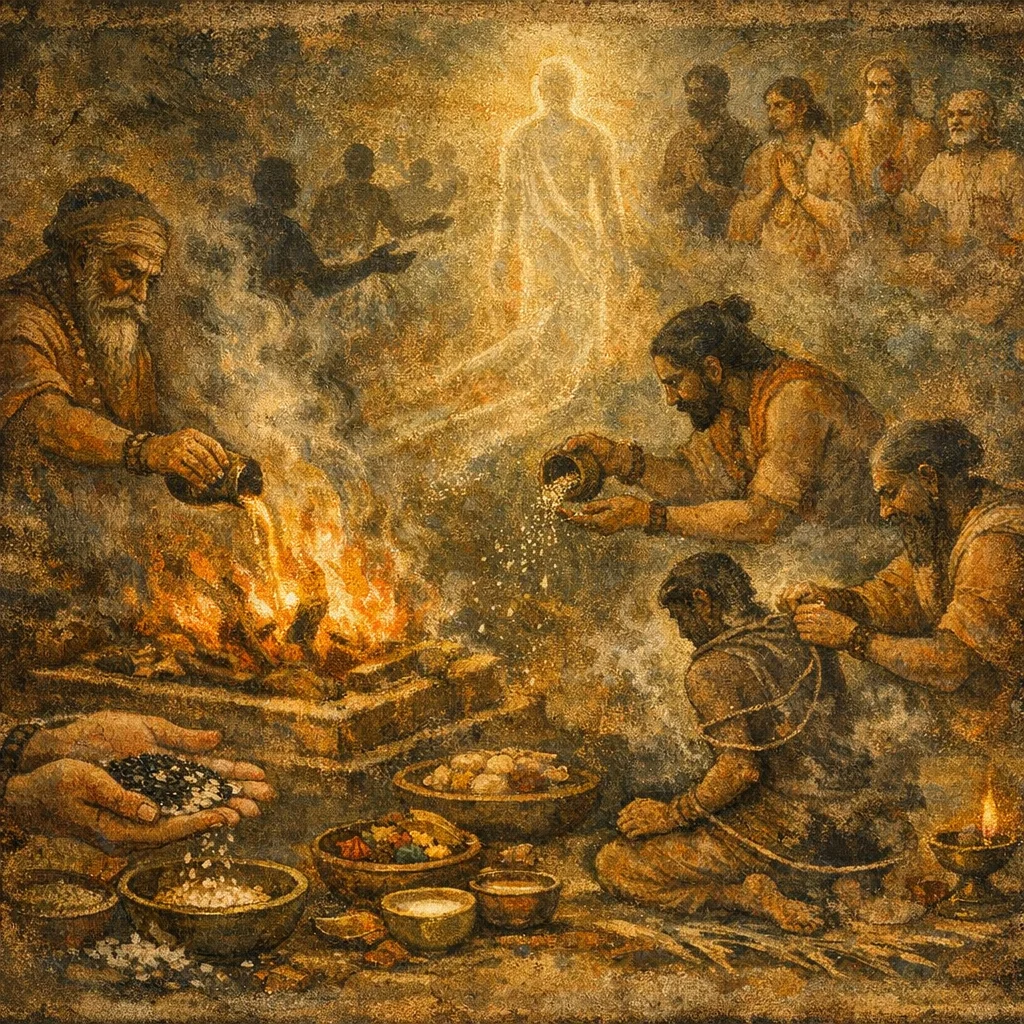
Sukta 4
Rishi: Atharvanic tradition (funerary book; r̥ṣi attribution varies by anukramaṇī traditions)
Devata: Lokakṛt/Pathikṛt powers (a class of invoked recipients; often treated as divine/ancestral order-establishers)
Chandas: Anuṣṭubh (predominant cadence; with Atharvanic stylistic variation)
Mantras
Mantra 1
पितृमेधः। (८६ ककुम्मती, ८७ शंकुमती), ८८ त्र्यवसाना पथ्यापङ्क्तिः, ८९ पञ्चपदा पथ्यापङ्क्तिः। आ रोहत जनित्रीं जातवेदसः पितृयाणैः सं व आ रोहयामि । अवाड्ढव्येषितो हव्यवाह ईजानं युक्ताः सुकृतां धत्त लोके
Ascend ye by the Fathers’ pathways unto the Generatrix: with Jātavedas I cause you to mount together. The Oblation-bearer, urged by the offering, hath come from below; harnessed, bestow the well-wrought merit on the sacrificer in his world.
Mantra 2
देवा यज्ञमृतवः कल्पयन्ति हविः पुरोडाशं स्रुचो यज्ञायुधानि । तेभिर्याहि पथिभिर्देवयानैर्यैरीजानाः स्वर्गं यन्ति लोकम्
The Gods, the Seasons, marshal the Sacrifice—oblation and cake, the ladles, the sacrificial instruments. By these go forth upon the godward paths, whereby the sacrificing attain the heavenly world.
Mantra 3
ऋतस्य पन्थामनु पश्य साध्वङ्गिरसः सुकृतो येन यन्ति । तेभिर्याहि पथिभिः स्वर्गं यत्रादित्या मधु भक्षयन्ति तृतीये नाके अधि वि श्रयस्व
Look well, in order of Ṛta, upon the pathway whereby the well-doers go, O Angiras. By those paths go thou to heaven, where the Ādityas feed on honey; in the third firmament, thereon take thou thy settled seat.
Mantra 4
त्रयः सुपर्णा उपरस्य मायू नाकस्य पृष्ठे अधि विष्टपि श्रिताः । स्वर्गा लोका अमृतेन विष्ठा इषमूर्जं यजमानाय दुह्राम्
Three fair-winged ones, the upper region’s supports, are stayed upon the back of heaven, in the wide firm seat. The heavenly worlds are made fast with immortality: let them milk forth refreshment and strength unto the sacrificer.
Mantra 5
जुहूर्दाधार द्यामुपभृदन्तरिक्षं ध्रुवा दाधार पृथिवीं प्रतिष्ठाम्। प्रतीमां लोका घृतपृष्ठाः स्वर्गाः कामंकामं यजमानाय दुह्राम्
The Juhū hath upheld the Sky; the Upabhṛt the Mid-air; the Dhruvā hath upheld the Earth as firm foundation. In answer, let these heavenly worlds, ghee-backed, milk forth each wish—wish upon wish—unto the sacrificer.
Mantra 6
ध्रुव आ रोह पृथिवीं विश्वभोजसमन्तरिक्षमुपभृदा क्रमस्व । जुहु द्यां गच्छ यजमानेन साकं स्रुवेण वत्सेन दिशः प्रपीनाः सर्वा धुक्ष्वाहृण्यमानः
Steadfast, ascend the Earth; stride with the upabhṛt-ladle through the all-nourishing Mid-air. Offer: go unto Heaven together with the Sacrificer; with the sruva, with the calf, do thou milk—all the Directions, made full—being drawn hither.
Mantra 7
तीर्थैस्तरन्ति प्रवतो महीरिति यज्ञकृतः सुकृतो येन यन्ति । अत्रादधुर्यजमानाय लोकं दिशो भूतानि यदकल्पयन्त
‘By the fords they cross the mighty slopes’: thus go the sacrifice-makers, the well-deserving, by that same way. Here have they established for the Sacrificer a world, when the Directions and the Beings set all in order.
Mantra 8
अङ्गिरसामयनं पूर्वो अग्निरादित्यानामयनं गार्हपत्यो दक्षिणानामयनं दक्षिणाग्निः । महिमानमग्नेर्विहितस्य ब्रह्मणा समङ्गः सर्व उप याहि शग्मः
The eastern Agni is the pathway of the Aṅgirases; the Gārhapatya is the pathway of the Ādityas; the Dakṣiṇāgni is the pathway of the southern powers. Come hither, O helpful one—complete in every member—by the brahman, to the majesty of Agni duly established.
Mantra 9
पूर्वो अग्निष्ट्वा तपतु शं पुरस्ताच्छं पश्चात् तपतु गार्हपत्यः । दक्षिणाग्निष्टे तपतु शर्म वर्मोत्तरतो मध्यतो अन्तरिक्षाद् दिशोदिशो अग्ने परि पाहि घोरात्
Let the eastern Agni warm thee for welfare from the front; for welfare from behind let the Gārhapatya warm thee. Let the southern fire warm thee—shelter, armor—from the north, from the midst, from the mid-air; from every quarter, O Agni, guard thou round about from the terrible.
Mantra 10
यूयमग्ने शंतमाभिस्तनूभिरीजानमभि लोकं स्वर्गम्। अश्वा भूत्वा पृष्टिवाहो वहाथ यत्र देवैः सधमादं मदन्ति
Ye, O Agni, with forms most full of welfare, convey the worshipper unto the heavenly world. Becoming horses, back-bearing, bear him thither—where with the Gods they rejoice in the common festal gladness.
Mantra 11
शमग्ने पश्चात् तप शं पुरस्ताच्छमुत्तराच्छमधरात् तपैनम्। एकस्त्रेधा विहितो जातवेदः सम्यगेनं धेहि सुकृतामु लोके
O Agni, with welfare from behind do thou heat him; with welfare from before; with welfare from the north; with welfare from beneath do thou heat him. Thou, one, yet threefold-disposed, O Jātavedas, do thou duly set him in the world of the well-deserving.
Mantra 12
शमग्नयः समिद्धा आ रभन्तां प्राजापत्यं मेध्यं जातवेदसः । शृतं कृण्वन्त इह माव चिक्षिपन्
With welfare, let the kindled Fires lay hold—O Jātavedases—of what is Prajāpatian, sacrificially pure; making it here well-supported, let them not cast it down.
Mantra 13
यज्ञ एति विततः कल्पमान ईजानमभि लोकं स्वर्गम्। तमग्नयः सर्वहुतं जुषन्तां प्राजापत्यं मेध्यं जातवेदसः
The sacrifice goes forth, stretched out and being duly ordered, unto the sacrificer, toward the heavenly world. Him—an all-offered one—let the Fires, O Jātavedases, graciously accept: Prajāpatian, sacrificially pure.
Mantra 14
ईजानश्चितमारुक्षदग्निं नाकस्य पृष्ठाद् दिवमुत् पतिष्यन्। तस्मै प्र भाति नभसो ज्योतिषीमान्त्स्वर्गः पन्थाः सुकृते देवयानः
The sacrificer, indeed, hath mounted Agni, about to soar upward to heaven from the ridge of the firmament. For him there shines forth, luminous in the sky-space, the heavenly path—the god-going way—for the well-deserving.
Mantra 15
अग्निर्होताध्वर्युष्टे बहस्पतिरिन्द्रो ब्रह्मा दक्षिणतस्ते अस्तु । हुतोऽयं संस्थितो यज्ञ एति यत्र पूर्वमयनं हुतानाम्
Agni is thy Hotṛ, thy Adhvaryu; Bṛhaspati, Indra, and the Brahman be on thy right. Offered, this sacrifice—well-established—goes on, where of old is the course of the offered.
Mantra 16
अपूपवान् क्षीरवांश्चरुरेह सीदतु । लोककृतः पथिकृतो यजामहे ये देवानां हुतभागा इह स्थ
Let the cooked oblation, furnished with cake and rich in milk, sit down here. We sacrifice unto the World-makers, the Path-makers—those who, of the Gods, possess a share in the offered gift—be ye here present.
Mantra 17
अपूपवान् दधिवांश्चरुरेह सीदतु । लोककृतः पथिकृतो यजामहे ये देवानां हुतभागा इह स्थ
Let the cooked oblation, furnished with cake and rich in curds, sit down here. We sacrifice unto the World-makers, the Path-makers—those who, of the Gods, possess a share in the offered gift—be ye here present.
Mantra 18
अपूपवान् द्रप्सवांश्चरुरेह सीदतु । लोककृतः पथिकृतो यजामहे ये देवानां हुतभागा इह स्थ
Let the cooked oblation, furnished with cake and rich in drops of essence, sit down here. We sacrifice unto the World-makers, the Path-makers—those who, of the Gods, possess a share in the offered gift—be ye here present.
Mantra 19
अपूपवान् घृतवांश्चरुरेह सीदतु । लोककृतः पथिकृतो यजामहे ये देवानां हुतभागा इह स्थ
Let the cooked oblation, furnished with cake and rich in ghee, sit down here. We sacrifice unto the World-makers, the Path-makers—those who, of the Gods, possess a share in the offered gift—be ye here present.
Mantra 20
अपूपवान् मांसवांश्चरुरेह सीदतु । लोककृतः पथिकृतो यजामहे ये देवानां हुतभागा इह स्थ
Let the cooked oblation, furnished with cake and bearing meat, sit down here. We sacrifice unto the World-makers, the Path-makers—those who, of the Gods, possess a share in the offered gift—be ye here present.
Mantra 21
अपूपवानन्नवांश्चरुरेह सीदतु । लोककृतः पथिकृतो यजामहे ये देवानां हुतभागा इह स्थ
Let the cooked oblation, rich in cake and rich in food, be set down here. We do sacrifice unto the World-builders, the Path-makers, who have their portion in the gods’ oblation: be ye here present.
Mantra 22
अपूपवान् मधुमांश्चरुरेह सीदतु । लोककृतः पथिकृतो यजामहे ये देवानां हुतभागा इह स्थ
Let the cooked offering, rich in cake and honey-sweet, be set down here. We do sacrifice unto the World-builders, the Path-makers, who have their portion in the gods’ oblation: be ye here present.
Mantra 23
अपूपवान् रसवांश्चरुरेह सीदतु । लोककृतः पथिकृतो यजामहे ये देवानां हुतभागा इह स्थ
Let the cooked offering, rich in cake and full of sap and savour, be set down here. We do sacrifice unto the World-builders, the Path-makers, who have their portion in the gods’ oblation: be ye here present.
Mantra 24
अपूपवानपवांश्चरुरेह सीदतु । लोककृतः पथिकृतो यजामहे ये देवानां हुतभागा इह स्थ
Let the cooked offering, rich in cake and rich in waters, be set down here. We do sacrifice unto the World-builders, the Path-makers, who have their portion in the gods’ oblation: be ye here present.
Mantra 25
अपूपापिहितान् कुम्भान् यांस्ते देवा अधारयन्। ते ते सन्तु स्वधावन्तो मधुमन्तो घृतश्चुतः
The jars which the Gods set in place for thee, covered over with sacrificial cakes—may those be thine, endowed with svadhā, honey-sweet, and dripping with ghee.
Mantra 26
यास्ते धाना अनुकिरामि तिलमिश्राः स्वधावतीः । तास्ते सन्तूद्भ्वीः प्रभ्वीस्तास्ते यमो राजानु मन्यताम्
What grains I strew for thee in order, mingled with sesame, rich in Svadhā—let these be thine, upbearing, puissant; let these for thee King Yama, in due course, acknowledge and approve.
Mantra 27
अक्षितिं भूयसीम्
Imperishability—more abundant still.
Mantra 28
द्रप्सश्चस्कन्द पृथिवीमनु द्यामिमं च योनिमनु यश्च पूर्वः । समानं योनिमनु संचरन्तं द्रप्सं जुहोम्यनु सप्त होत्राः
The Drop hath streamed—along the Earth, along Heaven, along this womb, and that which is the former. The Drop that moves along the self-same womb, in ordered course—this Drop I offer, following the Seven Hotṛ-calls.
Mantra 29
शतधारं वायुमर्कं स्वर्विदं नृचक्षसस्ते अभि चक्षते रयिम्। ये पृणन्ति प्र च यच्छन्ति सर्वदा ते दुह्रते दक्षिणां सप्तमातरम्
The hundred-streaming Wind, the Sun, heaven-winning, man-beholding—these look with favor upon wealth. They who fill and who bestow, evermore—these milk forth the priestly meed, the seven-mothered.
Mantra 30
कोशं दुहन्ति कलशं चतुर्बिलमिडां धेनुं मधुमतीं स्वस्तये । ऊर्जं मदन्तीमदितिं जनेष्वग्ने मा हिंसीः परमे व्योऽमन्
They milk the pail, the jar, the four-holed vessel—Nourishment, the honeyed Cow—for welfare; the strength that gladdens, Aditi among the peoples. O Agni, harm thou not in the highest heaven.
Mantra 31
एतत् ते देवः सविता वासो ददाति भर्तवे । तत् त्वं यमस्य राज्ये वसानस्तार्प्यंऽ चर
This vesture Savitar, the God, bestoweth unto thee for wearing. Wearing it, do thou in Yama’s kingdom move at ease, in due refreshment.
Mantra 32
धाना धेनुरभवद् वत्सो अस्यास्तिलोऽभवत्। तां वै यमस्य राज्ये अक्षितामुप जीवति
Parched grain became a Cow, and sesame of her became the Calf. By her, in Yama’s kingdom, verily he liveth on—on her that wasteth not.
Mantra 33
एतास्ते असौ धेनवः कामदुघा भवन्तु । एनीः श्येनीः सरूपा विरूपास्तिलवत्सा उप तिष्ठन्तु त्वात्र
These, for thee, yonder, let the cows be wish-milking. Eni-cows, Śyenī-cows, like-formed and unlike-formed, with sesame for calves—let them stand nigh unto thee here.
Mantra 34
एनीर्धाना हरिणीः श्येनीरस्य कृष्णा धाना रोहिणीर्धेनवस्ते । तिलवत्सा ऊर्जमस्मै दुहाना विश्वाहा सन्त्वनपस्फुरन्तीः
Eni-cows of grain, tawny; Śyenī-cows of grain—black, and ruddy—these be thy cows. With sesame for calves, yielding him nourishment, let them be for all days, unfaltering.
Mantra 35
वैश्वानरे हविरिदं जुहोमि साहस्रं शतधारमुत्सम्। स बिभर्ति पितरं पितामहान् प्रपितामहान् बिभर्ति पिन्वमानः
To Vaiśvānara I offer here this oblation, a fountain thousandfold, with hundred streams. He beareth the father, he beareth the grandsires; the great-grandsires he beareth, waxing full.
Mantra 36
सहस्रधारं शतधारमुत्समक्षितं व्यच्यमानं सलिलस्य पृष्ठे। ऊर्जं दुहानमनपस्फुरन्तमुपासते पितरः स्वधाभिः
The spring with thousand currents, with hundred currents, unwasting, spreading abroad upon the surface of the waters—milking forth nourishment, never failing—this do the Fathers attend with their svadhā-offerings.
Mantra 37
इदं कसाम्बु चयनेन चितं तत् सजाता अव पश्यतेत । मर्त्योऽयममृतत्वमेति तस्मै गृहान् कृणुत यावत्सबन्धु
This kasa-water, built up by the piling—behold it well, ye kinsmen. This mortal attains deathlessness: for him make ye dwellings, so far as kinship reaches.
Mantra 38
इहैवैधि धनसनिरिहचित्त इहक्रतुः । इहैधि वीर्यऽवत्तरो वयोधा अपराहतः
Here verily thrive—winning wealth; here be thy thought, here thy resolve. Here thrive thou, more richly endowed with manly might, bestower of vitality, unconquered.
Mantra 39
पुत्रं पौत्रमभितर्पयन्तीरापो मधुमतीरिमाः । स्वधां पितृभ्यो अमृतं दुहाना आपो देवीरुभयांस्तर्पयन्तु
These honeyed Waters, refreshing son and grandson, milking forth for the Fathers svadhā—an immortal essence—let the divine Waters satisfy them both.
Mantra 40
आपो अग्निं प्र हिणुत पितॄंरुपेमं यज्ञं पितरो मे जुषन्ताम्। आसीनामूर्जमुप ये सचन्ते ते नो रयिं सर्ववीरं नि यच्छान्
O Waters, set Agni forth; bring near the Fathers: let the Fathers of me take pleasure in this sacrifice. They who, seated, attach themselves unto nourishment—let them bestow upon us wealth, rich in all brave sons, and fix it firmly.
Mantra 41
समिन्धते अमर्त्यं हव्यवाहं घृतप्रियम्। स वेद निहितान्निधीन् पितॄन् परावतो गतान्
They kindle the Immortal, the Oblation-bearer, the lover of clarified butter. He knoweth the treasures laid away—the Fathers who have gone to the far-off realm.
Mantra 42
यं ते मन्थं यमोदनं यन्मांसं निपृणामि ते । ते ते सन्तु स्वधावन्तो मधुमन्तो घृतश्चुतः
What stirred draught I give thee, what Yama’s rice-porridge, what flesh I furnish thee—let these be thine, endowed with Svadhā, honeyed, and dripping with ghee.
Mantra 43
यास्ते धाना अनुकिरामि तिलमिश्राः स्वधावतीः । तास्ते सन्तूद्भ्वीः प्रभ्वीस्तास्ते यमो राजानु मन्यताम्
The grains that I strew for thee, mingled with sesame, endowed with Svadhā—let these be thine, abundant and prevailing; these for thee may King Yama approve.
Mantra 44
इदं पूर्वमपरं नियानं येना ते पूर्वे पितरः परेताः । पुरोगवा ये अभिशाचो अस्य ते त्वा वहन्ति सुकृतामु लोकम्
This is the former and the later leading—by which thy earlier Fathers have departed. The forerunners, going before with cattle, who repel the hostile spell, they bear thee onward, verily, to the world of the well-deserving.
Mantra 45
सरस्वतीं देवयन्तो हवन्ते सरस्वतीमध्वरे तायमाने । सरस्वतीं सुकृतो हवन्ते सरस्वती दाशुषे वार्यं दात्
Sarasvatī the god-seeking call upon—Sarasvatī in the sacrifice as it is drawn out. Sarasvatī the well-doers call upon: Sarasvatī may give the offerer a choice boon.
Mantra 46
सरस्वतीं पितरो हवन्ते दक्षिणा यज्ञमभिनक्षमाणाः । आसद्यास्मिन् बर्हिषि मादयध्वमनमीवा इष आ धेह्यस्मे
Sarasvatī the Fathers call, while the Dakṣiṇā-gifts speed on the Sacrifice to its goal. Having sat you down upon this Barhis, rejoice ye: being free from hurt, set hither for us the powers of nourishment.
Mantra 47
सरस्वति या सरथं ययाथोक्थैः स्वधाभिर्देवि पितृभिर्मदन्ती । सहस्रार्घमिडो अत्र भागं रायस्पोषं यजमानाय धेहि
O Sarasvatī, who, sharing one car, hast gone—rejoicing with the Fathers—by hymns and by svadhā-offerings: here set thou for the sacrificer a portion of Iḍā, of thousandfold price, even increase of wealth and thriving store.
Mantra 48
पृथिवीं त्वा पृथिव्यामा वेशयामि देवो नो धाता प्र तिरात्यायुः । परापरैता वसुविद् वो अस्त्वधा मृताः पितृषु सं भवन्तु
Into Earth, within the Earth, I lay thee down. May Dhātṛ, the God, for us prolong the life. Let this thy passing hence and thither be wealth-finding for you; and then let the dead be gathered wholly among the Fathers.
Mantra 49
आ प्र च्यवेथामप तन्मृजेथां यद् वामभिभा अत्रोचुः । अस्मादेतमघ्न्यौ तद् वशीयो दातुः पितृष्विहभोजनौ मम
Move ye forth, and wipe away that stain—what hostile speech men here have uttered against you twain. From this man drive ye it away, O Aghnyā pair; make that more subject to control—ye two, my partakers here, and with the Fathers, of the giver.
Mantra 50
एयमगन् दक्षिणा भद्रतो नो अनेन दत्ता सुदुघा वयोधाः । यौवने जीवानुपपृञ्चती जरा पितृभ्य उपसंपराणयादिमान्
Hither hath Dakṣiṇā come, auspicious unto us—by this, when duly given, well-milking, setting vigor. Sprinkling the living with youth, may she, when age draws on, convey these unto the Fathers, leading them safely over.
Mantra 51
इदं पितृभ्यः प्र भरामि बर्हिर्जीवं देवेभ्य उत्तरं स्तृणामि । तदा रोह पुरुष मेध्यो भवन् प्रति त्वा जानन्तु पितरः परेतम्
This sacred strewing I bring forth for the Fathers; for the Gods I spread the living, higher Barhis. Then do thou ascend, O man, becoming meet for sacrifice: may the Fathers, the Departed, acknowledge thee.
Mantra 52
एदं बर्हिरसदो मेध्योऽभूः प्रति त्वा जानन्तु पितरः परेतम्। यथापरु तन्वं१ सं भरस्व गात्राणि ते ब्रह्मणा कल्पयामि
On this Barhis thou hast sat; thou hast become meet for sacrifice: may the Fathers acknowledge thee, the Departed. As joint by joint, so do thou gather thy body together; thy limbs I duly fashion by the power of sacred speech.
Mantra 53
पर्णो राजापिधानं चरूणामूर्जो बलं सह ओजो न आगन्। आयुर्जीवेभ्यो विदधद् दीर्घायुत्वाय शतशारदाय
The Leaf, a kingly covering of the cooked oblations, hath come to us with sap, with strength, with might, with vital power—bestowing life upon the living, for length of days, for a hundred autumns.
Mantra 54
ऊर्जो भागो य इमं जजानाश्मान्नानामाधिपत्यं जगाम । तमर्चत विश्वमित्रा हविर्भिः स नो यमः प्रतरं जीवसे धात्
The share of nourishment—he who begat this, who hath attained lordship over the stones—him honor ye, O all-friends, with oblations: may that Yama establish us the more securely for living on.
Mantra 55
यथा यमाय हर्म्यमवपन् पञ्च मानवाः । एवा वपामि हर्म्यं यथा मे भूरयोऽसत
As for Yama a mansion the five sons of Manu built down, even so build I a mansion—so that for me there may be abundance.
Mantra 56
इदं हिरण्यं बिभृहि यत् ते पिताबिभः पुरा। स्वर्गं यतः पितुर्हस्तं निर्मृड्ढि दक्षिणम्
Bear thou this gold, which erst thy father wore of old. From the Father’s hand, whence heaven is won, cleanse thou the right (hand/side) from harm.
Mantra 57
ये च जीवा ये च मृता ये जाता ये च यज्ञियाः । तेभ्यो घृतस्य कुल्यैऽतु मधुधारा व्युन्दती
Whether living, whether dead, whether born, or worthy of the sacrifice,—to them let the channel of ghee go forth, a honey-stream, welling and outpoured.
Mantra 58
वृषा मतीनां पवते विचक्षणः सूरो अह्नां प्रतरीतोषसां दिवः । प्राणः सिन्धूनां कलशाँ अचिक्रददिन्द्रस्य हार्दिमाविशन् मनीषया
The Bull of thoughts is purified, the clear-sighted; a Sun of days, prevailing through the dawns of heaven. The Breath of rivers hath cried aloud into the jars, entering with wise intent into Indra’s heart.
Mantra 59
त्वेषस्ते धूम ऊर्णोतु दिवि षंच्छुक्र आततः । सूरो न हि द्युता त्वं कृपा पावक रोचसे
Let thy fierce smoke enwrap (us) in the sky, all-bright, outstretched abroad. For like the Sun in radiance thou, O Purifier, shinest in thine own proper form.
Mantra 60
प्र वा एतीन्दुरिन्द्रस्य निष्कृतिं सखा सख्युर्न प्र मिनाति संगिरः । मर्य इव योषाः समर्षसे सोमः कलशे शतयामना पथा
Forth verily goes Indu to Indra’s outlet and release: a friend, he mars not the friend’s bond, the singer. Like a young man unto maidens thou rushest together; Soma, into the jar, by a path of hundred courses.
Mantra 61
अक्षन्नमीमदन्त ह्यव प्रियां अधूषत । अस्तोषत स्वभानवो विप्रा यविष्ठा ईमहे
They have eaten; they have been made glad indeed; they have, in aid, accepted the dear (portion). They have uttered praise: the self-radiant, inspired, most youthful (Fathers)—these we implore.
Mantra 62
आ यात पितरः सोम्यासो गम्भीरैः पथिभिः पितृयाणैः । आयुरस्मभ्यं दधतः प्रजां च रायश्च पोषैरभि नः सचध्वम्
Come hither, O Fathers, soma-loving, by the deep paths, the Fathers’ ways. Bestowing upon us life and progeny, with wealth and with prosperings—cleave ye unto us.
Mantra 63
परा यात पितरः सोम्यासो गम्भीरैः पथिभिः पूर्याणैः । अधा मासि पुनरा यात नो गृहान् हविरत्तुं सुप्रजसः सुवीराः
Depart, O Fathers, soma-loving, by the deep paths, the ancient ways. Then, in the month, come ye again unto our homes to eat the oblation—ye of good progeny, ye of good heroes.
Mantra 64
यद् वो अग्निरजहादेकमङ्गं पितृलोकं गमयं जातवेदाः । तद् व एतत् पुनरा प्याययामि साङ्गाः स्वर्गे पितरो मादयध्वम्
What limb of you Agni, Jātavedas, conveying (you) to the Fathers’ world, left behind—this very thing I now again restore unto you. Whole-limbed in heaven, O Fathers, rejoice ye.
Mantra 65
अभूद् दूतः प्रहितो जातवेदाः सायं न्यह्न उपवन्द्यो नृभिः । प्रादाः पितृभ्यः स्वधया ते अक्षन्नद्धि त्वं देव प्रयता हवींषि
Jātavedas became the messenger, dispatched—at evening, at the day’s decline, to be reverenced by men. Thou hast delivered unto the Fathers with svadhā; they have eaten. Do thou, O god, eat the duly presented oblations.
Mantra 66
असौ हा इह ते मनः ककुत्सलमिव जामयः । अभ्येऽनं भूम ऊर्णुहि
Yonder, verily, here is thy mind, as though a jutting crest among thy kindred: do thou, O Earth, wrap this man about and cover him over.
Mantra 67
शुम्भन्तां लोकाः पितृषदनाः पितृषदने त्वा लोक आ सादयामि
Let the worlds, the Fathers’ seats, be made fair: in the Fathers’ seat, in that world, I set thee down and establish thee.
Mantra 68
ये३स्माकं पितरस्तेषां बर्हिरसि
Thou art the sacred grass-seat for those Fathers of ours who are our own.
Mantra 69
उदुत्तमं वरुण पाशमस्मदवाधमं वि मध्यमं श्रथाय । अधा वयमादित्य व्रते तवानागसो अदितये स्याम
Loose from us, O Varuṇa, the uppermost noose; take off the nether one; rend apart the middle: then may we, O Āditya, in thine ordinance, be guiltless, and belong to Freedom (Aditi).
Mantra 70
प्रास्मत् पाशान् वरुण मुञ्च सर्वान् यैः समामे बध्यते यैर्व्यामे। अधा जीवेम शरदं शतानि त्वया राजन् गुपिता रक्षमाणाः
Release from us, O Varuṇa, all nooses wherewith one is bound, whether in half-measure or in full stretch: then may we live a hundred autumns, by thee, O King, guarded and kept in ward.
Mantra 71
अग्नये कव्यवाहनाय स्वधा नमः
To Agni, the Bearer of the Fathers’ oblation—svadhā! reverence.
Mantra 72
सोमाय पितृमते स्वधा नमः
To Soma, attended by the Fathers—svadhā! reverence.
Mantra 73
पितृभ्यः सोमवद्भ्यः स्वधा नमः
To the Fathers, Soma-possessing—svadhā! reverence.
Mantra 74
यमाय पितृमते स्वधा नमः
To Yama, attended by the Fathers—svadhā! reverence.
Mantra 75
एतत् ते प्रततामह स्वधा ये च त्वामनु
This for thee, O great-great-grandfather—svadhā! and for those who follow after thee.
Mantra 76
एत् ते ततामह स्वधा ये च त्वामनु
This, O Great-grandsire, is for thee—Svadhā!—and for those also who attend upon thee.
Mantra 77
एतत् ते तत स्वधा
This is for thee, O Grandsire—Svadhā!
Mantra 78
स्वधा पितृभ्यः पृथिविषद्भ्यः
Svadhā to the Fathers, to the earth-abiding Fathers.
Mantra 79
स्वधा पितृभ्यो अन्तरिक्षसद्भ्यः
Svadhā to the Fathers, to the mid-air-abiding Fathers.
Mantra 80
स्वधा पितृभ्यो दिविषद्भ्यः
Svadhā to the Fathers, to the heaven-abiding Fathers.
Mantra 81
नमो वः पितर ऊर्जे नमो वः पितरो रसाय
Homage to you, O Fathers, for strength; homage to you, O Fathers, for vital sap.
Mantra 82
नमो वः पितरो भामाय नमो वः पितरो मन्यवे
Homage to you, O Fathers, for your dread glare; homage to you, O Fathers, for your wrath.
Mantra 83
नमो वः पितरो यद् घोरं तस्मै नमो वः पितरो यत् क्रूरं तस्मै
Homage to you, O Fathers—whatsoever in you is terrible, to that be homage; homage to you, O Fathers—whatsoever in you is cruel, to that be homage.
Mantra 84
नमो वः पितरो यच्छिवं तस्मै नमो वः पितरो यत् स्योनं तस्मै
Homage to you, O Fathers—whatsoever in you is auspicious, to that be homage; homage to you, O Fathers—whatsoever in you is gracious and soothing, to that be homage.
Mantra 85
नमो वः पितरः स्वधा वः पितरः
Homage to you, O Fathers; svadhā be yours, O Fathers.
Mantra 86
येऽत्र पितरः पितरो येऽत्र यूयं स्थ युष्मांस्तेऽनु यूयं तेषां श्रेष्ठा भूयास्थ
Ye Fathers who are here—ye Fathers who are here and stand present—after you, in your track, may those (of ours) become pre-eminent among them.
Mantra 87
य इह पितरो जीवा इह वयं स्मः । अस्मांस्तेऽनु वयं तेषां श्रेष्ठा भूयास्म
Those Fathers who are living here, and we who are here—following after them, may we become the foremost of them.
Mantra 88
आ त्वाग्न इधीमहि द्युमन्तं देवाजरम्। यद् घ सा ते पनीयसी समिद् दीदयति द्यवि । इषं स्तोतृभ्य आ भर
Hither we kindle thee, O Agni, radiant, the god that waxeth not old. For when, indeed, that thy most gracious kindling-stick blazeth in the sky, then bring thou nourishment unto the praisers.
Mantra 89
चन्द्रमा अप्स्व१न्तरा सुपर्णो धावते दिवि। न वो हिरण्यनेमयः पदं विन्दन्ति विद्युतो वित्तं मे अस्य रोदसी
The Moon, within the waters, the fair-winged, speedeth in the heaven. Your golden-rimmed lightnings find not the track: for me, of this, the two Worlds are the possession (and witness).
Frequently Asked Questions
They are invoked as ‘world-establishers’ and ‘path-establishers’—powers that uphold order, recognize rightful shares of offerings, and open the correct route for the rite and the departed to proceed without obstruction.
In Atharvanic funerary liturgy, ‘seating’ formalizes the offering’s presence and readiness, then invites the entitled recipients to take their share—so the sacrifice is valid, accepted, and effective for safe transition.
Such verses are often reused for their core function: guaranteeing unhindered flow to the proper destination and ‘release’ (niṣkṛti). In funerary application, that imagery supports successful delivery of offerings and smooth passage along the ancestral path.