Adhyaya 12
सदाचार-नियमाः: शील, संयम, संग-निषेध, शुचिता, वाणी-नीति, परोपकारः
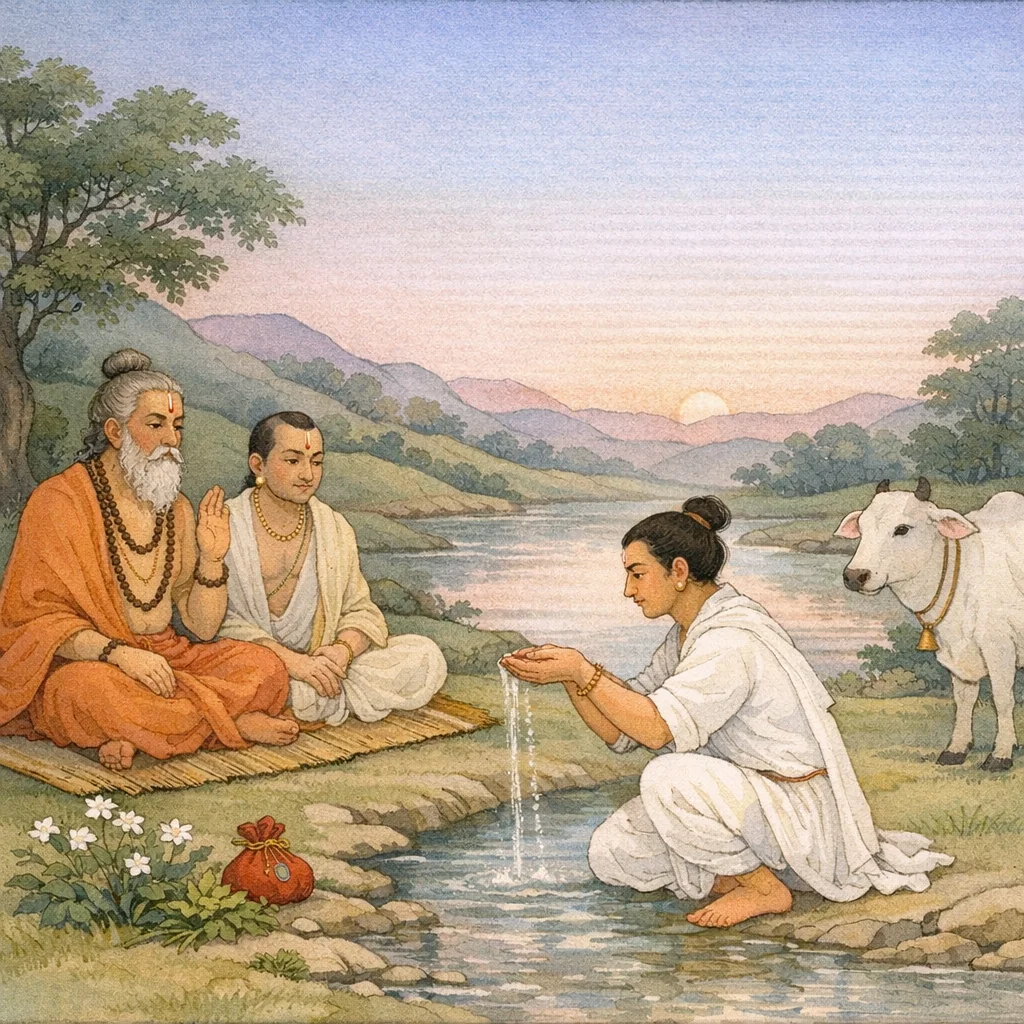
Parāśara continues teaching Maitreya, gathering sadācāra into a practical code of self-restraint, right association, and ethics of speech. He commands reverence for devas, cows, brāhmaṇas, siddhas, elders, and teachers; the keeping of sandhyā rites and household fires; and an auspicious personal order through clean garments, herbs, protective signs, and flowers. He then sets out small but guarding prohibitions: steal not even trifles, speak neither harshly nor falsely, do not broadcast others’ faults, avoid another’s wife and needless enmity, refuse corrupt company, and shun dangerous or impure places and habits. Bodily decorum—yawning, spitting, nail-biting, unclothed rites—is treated as an outward support for inner steadiness. Social prudence is urged: avoid quarrel, choose comparable alliances, and seek the proximity of the well-conducted even briefly. Speech is exalted: speak truth that benefits; if truth only harms, keep silence; and prefer beneficial words even when unpleasant. The chapter ends with dharma’s aim—paropakāra by deed, mind, and speech—presenting sadācāra as the lived path that protects beings and stabilizes the world-order upheld by Viṣṇu.
Shlokas
Verse 1
देवगोब्राह्मणान् सिद्धवृद्धाचार्यांस् तथार्चयेत् द्विकालं च नमेत् संध्याम् अग्नीन् उपचरेत् तथा
Let a person duly honor the gods, the cows, and the brāhmaṇas, and likewise the accomplished, the elders, and one’s teachers. At both twilights, let him bow in reverence in the Sandhyā rites, and properly attend the sacred fires as well.
Verse 2
सदानुपहते वस्त्रे प्रशस्ताश् च तथौषधीः गारुडानि च रत्नानि बिभृयात् प्रयतो नरः
A disciplined person should always wear unblemished garments, and with reverent care keep auspicious herbs, Garuḍa-protected charms, and sacred jewels.
Verse 3
प्रस्निग्धामलकेशश् च सुगन्धश् चारुवेषधृक् सिताः सुमनसो हृद्या बिभृयाच् च नरः सदा
A man should always keep his hair smooth and clean, remain pleasantly fragrant, and wear comely attire; and he should continually bear white, fair, heart-delighting flowers upon himself.
Verse 4
किंचित् परस्वं न हरेन् नाल्पम् अप्य् अप्रियं वदेत् प्रियं च नानृतं ब्रूयान् नान्यदोषान् उदीरयेत्
One should not take what belongs to another—not even the slightest thing. One should not utter displeasing words, even in small measure. Yet one should not speak falsehood merely because it sounds pleasant, nor go about proclaiming the faults of others.
Verse 5
नान्यस्त्रियं तथा वैरं रोचयेत् पुरुषेश्वर न दुष्टयानम् आरोहेत् कूलच्छायां न संश्रयेत्
O lord among men, one should not seek the company of another’s wife, nor cultivate enmity. One should not mount a wicked conveyance, nor take shelter even in the shade of a treacherous bank.
Verse 6
विद्विष्टपतितोन्मत्तबहुवैरादिकीटकैः बन्धकीबन्धकीभर्तृक्षुद्रानृतकथैः सह
Along with the vermin of the age—men hateful, fallen, and deranged, nursing many enmities and base impulses—there will also be those who live by bondage and disgrace: keepers and husbands of courtesans, petty-minded persons, and speakers of false tales.
Verse 7
तथातिव्ययशीलैश् च परिवादरतैः शठैः बुधो मैत्रीं न कुर्वीत नैकः पन्थानम् आश्रयेत्
Likewise, the wise should not grow intimate with those addicted to wasteful excess, delighting in slander, and given to deceit. Nor should one take up many ways at once; let one hold to a single, steady path.
Verse 8
नावगाहेज् जलौघस्य वेगम् अग्रे नरेश्वर प्रदीप्तं वेश्म न विशेन् नारोहेच् छिखरं तरोः
O lord of men, do not plunge into the rushing current of a flood; do not enter a house that is ablaze; and do not climb to the top of a tree. Thus the wise avoid needless peril, preserving life for dharma and the higher good upheld under the sovereignty of the Supreme, Viṣṇu.
Verse 9
न कुर्याद् दन्तसंघर्षं न कुष्णीयाच् च नासिकाम् नासंवृतमुखो जृम्भेच् श्वासकासौ च वर्जयेत्
One should not grind the teeth together, nor pick at the nose; one should not yawn with the mouth uncovered, and one should avoid noisy breathing and coughing—thus maintaining bodily restraint and refined conduct in accordance with dharma.
Verse 10
नोच्चैर् हसेत् सशब्दं च न मुञ्चेत् पवनं बुधः नखान् न खादयेच् छिन्द्यान् न तृणं न महीं लिखेत्
A wise person should not laugh loudly or noisily; nor should he release wind. He should not bite his nails—rather, he should trim them; and he should not idly scratch at grass or score lines upon the earth. Such small restraints preserve dignity and steadiness, aligning outward conduct with inner discipline under dharma.
Verse 11
न श्मश्रु भक्षयेल् लोष्टं न मृद् नीयाद् विचक्षणः ज्योतींष्य् अमेध्यः शस्तानि नाभिवीक्षेत च प्रभो
O Lord, a discerning man should not bite his own moustache or beard, nor carry about lumps of clay or earth; and, mindful of purity, he should not stare at impure things, at sacred fires or lights, or at weapons.
Verse 12
नग्नां परस्त्रियं चैव सूर्यं चास्तमनोदये न हुंकुर्याच् छवं चैव शवगन्धो हि सोमजः
One should not utter a harsh snort or contemptuous sound in the presence of a naked person, another man’s wife, or the Sun at its rising and setting; nor should one do so near a corpse, for the Soma-born (the Moon) is said to bear the taint of the smell of the dead.
Verse 13
चतुष्पथं चैत्यतरुं श्मशानोपवनानि च दुष्टस्त्रीसंनिकर्षं च वर्जयेन् निशि सर्वदा
At night one should always avoid the crossroads, sacred trees at shrines, groves adjoining cremation-grounds, and the close company of women of corrupt conduct.
Verse 14
पूज्यदेवद्विजज्योतिश्छायां नातिक्रमेद् बुधः नैकः शून्याटवीं गच्छेन् न च शून्यगृहे वसेत्
A wise person should not step across the shadow of those worthy of reverence—of the gods, the twice-born, and sacred lights. Nor should one travel alone into a desolate forest, and one should not dwell in an empty, uninhabited house.
Verse 15
केशास्थिकण्टकामेध्यबलिभस्मतुषांस् तथा स्नानार्द्रधरणीं चैव दूरतः परिवर्जयेत्
One should keep well away from fallen hair, bones, thorns, impure substances, offerings left for spirits, ashes, and husks; and likewise avoid ground made wet by bathing, maintaining purity in accordance with dharma.
Verse 16
नानार्यान् आश्रयेत् कांश्चिन् न जिह्मं रोचयेद् बुधः उपसर्पेत न व्यालांश् चिरं तिष्ठेन् न चोत्थितः
A wise person should not seek shelter with the ignoble, nor take delight in crookedness. He should not go near those who are like serpents, and he should not linger long—nor rise up in haste; for steadiness, discernment, and clean conduct are the marks of one who walks the path of dharma.
Verse 17
अतीव जागरस्वप्ने तद्वत् स्थानासने बुधः न सेवेत तथा शय्यां व्यायामं च नरेश्वर
O lord of men, the wise should not indulge in excess—whether in wakefulness or in sleep; likewise, he should not become habituated to idleness in standing or sitting, nor to overfondness for the bed, nor even to exertion carried to extremes.
Verse 18
दंष्ट्रिणः शृङ्गिणश् चैव प्राज्ञो दूरेण वर्जयेत् अवश्यायं च राजेन्द्र पुरो वातातपौ तथा
A wise man should keep well away from creatures that bite with fangs and those that strike with horns. And you too, O best of kings, should avoid the chilling dew, and likewise the direct onrush of wind and the harshness of the sun—guarding the body as an instrument of dharma, under the sovereign order upheld by the Supreme Vishnu.
Verse 19
न स्नायान् न स्वपेन् नग्नो न चैवोपस्पृशेद् बुधः मुक्तकच्छश् च नाचामेद् देवाद्यर्चां च वर्जयेत्
A discerning person should not bathe, sleep, or even perform purificatory sipping (ācāmana) while unclothed; nor should he touch sacred things in such a state. Likewise, with the lower garment loosened and decorum undone, he should refrain from ācāmana—and he should also avoid worship of the gods and similar rites. Through such restraint, outer order is made fit to mirror inner purity, by which devotion to the Supreme Lord, Viṣṇu, becomes steady and undistracted.
Verse 20
होमदेवार्चनाद्यासु क्रियास्व् आचमने तथा नैकवस्त्रः प्रवर्तेत द्विजवाचनके जपे
During rites such as fire-offerings and the worship of the gods—and also while performing ācamana (ritual sipping for purification)—one should not proceed wearing only a single garment, especially when engaged in Vedic recitation or in mantra-japa prescribed for the twice-born. Such disciplines preserve outward purity as a support for inward steadiness in dharma.
Verse 21
नासमञ्जसशीलैस् तु सहासीत कदाचन सद्वृत्तसंनिकर्षो हि क्षणार्धम् अपि शस्यते
Never keep company with those of perverse and unbalanced conduct; even half a moment’s closeness to the truly well‑behaved is praised as a blessing.
Verse 22
विरोधं नोत्तमैर् गच्छेन् नाधमैश् च सदा बुधः विवाहश् च विवादश् च तुल्यशीलैर् नृपेष्यते
A wise person should not enter into hostility with those who are superior, nor with those who are base; marriage alliances and disputes are rightly pursued only among those of comparable character, especially in matters of kingship and governance.
Verse 23
नारभेत कलिं प्राज्ञः शुष्कवैरं च वर्जयेत् अप्य् अल्पहानिः सोढव्या वैरेणार्थागमं त्यजेत्
A wise person should not provoke quarrel and should avoid barren enmity; even a small loss is to be endured, and gains that come by hostility should be renounced.
Verse 24
स्नातो नाङ्गानि निर्मार्जेत् स्नानशाट्या न पाणिना न च निर्धूनयेत् केशान् नाचामेच् चैव चोत्थितः
After bathing, one should not rub the limbs—neither with the bathing cloth nor with the hands; one should not shake the hair dry; and one should not perform ācamana while standing.
Verse 25
पादेन नाक्रमेत् पादं न पूज्याभिमुखं नयेत् वीरासनं गुरोर् अग्रे भजेत विनयान्वितः
With one’s foot one should never tread upon another’s foot; nor should one move about facing a venerable person as if confronting them. In the presence of the guru, one should sit in vīrāsana, endowed with humility and disciplined courtesy.
Verse 26
अपसव्यं न गच्छेच् च देवागारचतुष्पथान् माङ्गल्यपूज्यांश् च ततो विपरीतान् न दक्षिणम्
One should not go around temples and crossroads in the inauspicious apasavya (counter‑clockwise) manner; nor should one so circle persons or things worthy of auspicious reverence; likewise, one should not proceed in the contrary way, keeping them to one’s right against the prescribed course of respect.
Verse 27
सोमाग्न्यर्काम्बुवायूनां पूज्यानां च न संमुखम् कुर्यात् ष्ठीवनविण्मूत्रसमुत्सर्गं च पण्डितः
A wise person should never discharge spittle, feces, or urine while facing the Moon, Fire, the Sun, Water, the Wind, or any being worthy of reverence.
Verse 28
तिष्ठन् न मूत्रयेत् तद्वत् पन्थानं नावमूत्रयेत् श्लेष्मविण्मूत्ररक्तानि सर्वदैव न लङ्घयेत्
One should not urinate while standing; nor should one ever urinate upon a roadway. And one should never step over mucus, feces, urine, or blood.
Verse 29
श्लेष्मसिंहानकोत्सर्गो नान्नकाले प्रशस्यते बलिमङ्गलजप्यादौ न होमे न महाजने
The expulsion of phlegm and the act of spitting are not proper at the time of eating; nor are they approved during bali offerings, auspicious rites, japa recitation, a homa, or in the midst of a large assembly.
Verse 30
योषितो नावमन्येत न चासां विश्वसेद् बुधः न चैवेर्ष्युर् भवेत् तासु नाधिकुर्यात् कदाचन
A wise man should never despise women; yet he should not place blind trust in them. Nor should he become jealous toward them, and he should never behave with overbearing authority.
Verse 31
मङ्गल्यपुष्परत्नाज्यपूज्यान् अनभिवाद्य च न निष्क्रमेद् गृहात् प्राज्ञः सदाचारपरो नृप
O King, the wise who are devoted to righteous conduct should not leave the house without first offering due salutations—having honored the auspicious, such as flowers, gems, and clarified butter, and also those who are worthy of worship.
Verse 32
चतुष्पथान् नमस् कुर्यात् काले होमपरो भवेत् दीनान् अभ्युद्धरेत् साधून् उपासीत बहुश्रुतान्
At the crossroads he should offer reverent salutations; at the proper times he should be devoted to the homa, the fire-offering. He should uplift the destitute, attend upon the virtuous, and seek the company of the deeply learned.
Verse 33
देवर्षिपूजकः सम्यक् पितृपिण्डोदकप्रदः सत्कर्ता चातिथीनां यः स लोकान् उत्तमान् व्रजेत्
One who duly worships the gods and the divine seers, who properly offers the ancestral rites—piṇḍa and libations of water—and who honors guests with sincere hospitality: such a person attains the highest worlds.
Verse 34
हितं मितं प्रियं काले वश्यात्मा यो ऽभिभाषते स याति लोकान् आह्लादहेतुभूतान् नृपाक्षयान्
He whose self is mastered—who speaks what is beneficial, measured, and pleasing, and who speaks it at the proper time—attains enduring royal worlds, realms that become the very cause of delight.
Verse 35
धीमान् ह्रीमान् क्षमायुक्त आस्तिको विनयान्वितः विद्याभिजनवृद्धानां याति लोकान् अनुत्तमान्
One who is wise, modest, endowed with forgiveness, faithful in sacred truth, and adorned with humility—such a person attains the unsurpassed worlds reserved for those enriched by learning, noble lineage, and venerable elders.
Verse 36
अकालगर्जितादौ तु पर्वस्व् आशौचकादिषु अनध्यायं बुधः कुर्याद् उपरागादिके तथा
At untimely thunder and the like, on sacred festival days, in states of impurity such as mourning, and likewise during eclipses and similar portents—the wise should observe anadhyāya, suspending Vedic study and recitation.
Verse 37
शमं नयति यः क्रुद्धान् सर्वबन्धुर् अमत्सरी भीताश्वासनकृत् साधुः स्वर्गस् तस्याल्पकं फलम्
He who pacifies the wrathful, who is a friend to all and free from envy, and who reassures the fearful—such a noble person attains heaven; yet for him, heaven is only a small reward.
Verse 38
वर्षातपादिके छत्री दण्डी रात्र्यटवीषु च शरीरत्राणकामो वै सोपानत्कः सदा व्रजेत्
In rain and blazing sun, and also when moving through forests at night, one who seeks the body’s protection should always go equipped—with umbrella, staff, and footwear.
Verse 39
नोर्ध्वं न तिर्यग् दूरं वा निरीक्षन् पर्यटेद् बुधः युगमात्रं महीपृष्ठं नरो गच्छेद् विलोकयन्
Let the wise wander without looking upward, sideways, or far away; for a man who walks while constantly looking about advances on earth only a yuga’s measure.
Verse 40
दोषहेतून् अशेषांश् च वश्यात्मा यो निरस्यति तस्य धर्मार्थकामानां हानिर् नाल्पापि जायते
He whose self is under control and who casts away, without remainder, all causes of fault and downfall—for him there arises not even the slightest loss of dharma, artha, and kāma.
Verse 41
पापे ऽप्य् अपापः पुरुषे ऽप्य् अभिधत्ते प्रियाणि यः मैत्रीद्रवान्तःकरणस् तस्य मुक्तिः करे स्थिता
Even among the sinful he remains unstained; even among the harsh he offers what is dear. For one whose heart melts with friendliness and compassion, liberation rests already in the palm of his hand.
Verse 42
ये कामक्रोधलोभानां वीतरागा न गोचरे सदाचारस्थितास् तेषाम् अनुभावैर् धृता मही
Those beyond the reach of desire, anger, and greed—free from attachment and established in right conduct—by the power of their spiritual presence, the Earth itself is upheld.
Verse 43
तस्मात् सत्यं वदेत् प्राज्ञो यत् परप्रीतिकारणम् सत्यं यत् परदुःखाय तत्र मौनपरो भवेत्
Therefore the wise should speak that truth which brings another’s welfare and gladness. But if a ‘truth’ would only cause sorrow to others, then in that matter one should be devoted to silence.
Verse 44
प्रियम् उक्तं हितं नैतद् इति मत्वा न तद् वदेत् श्रेयस् तत्र हितं वाक्यं यद्य् अप्य् अत्यन्तम् अप्रियम्
Thinking, “Though it sounds pleasing, it is not truly beneficial,” one should not speak such words. There, what is best is to speak what is beneficial—even if it is exceedingly unpleasant to hear.
Verse 45
प्राणिनाम् उपकाराय यद् एवेह परत्र च कर्मणा मनसा वाचा तद् एव मतिमान् भजेत्
Whatever truly serves the welfare of living beings—both here in this world and hereafter—let the wise devote himself to that alone, through deed, through mind, and through speech.
Frequently Asked Questions
Speak truth that benefits and pleases in a dharmic sense (parapṛīti/upa-kāra); if a ‘truth’ would only cause another’s suffering, silence is recommended—while beneficial speech may be spoken even if unpleasant.
Anadhyāya is the suspension of Vedic study/recitation; it is prescribed during portents like untimely thunder, on parva days, during impurity periods (āśauca), and during eclipses (uparāga) and similar events.
By treating outer cleanliness, restraint, and right association as supports for inner steadiness; these disciplines protect dharma, which in the Purāṇic frame is the world-order ultimately upheld by Viṣṇu’s all-pervading sovereignty.