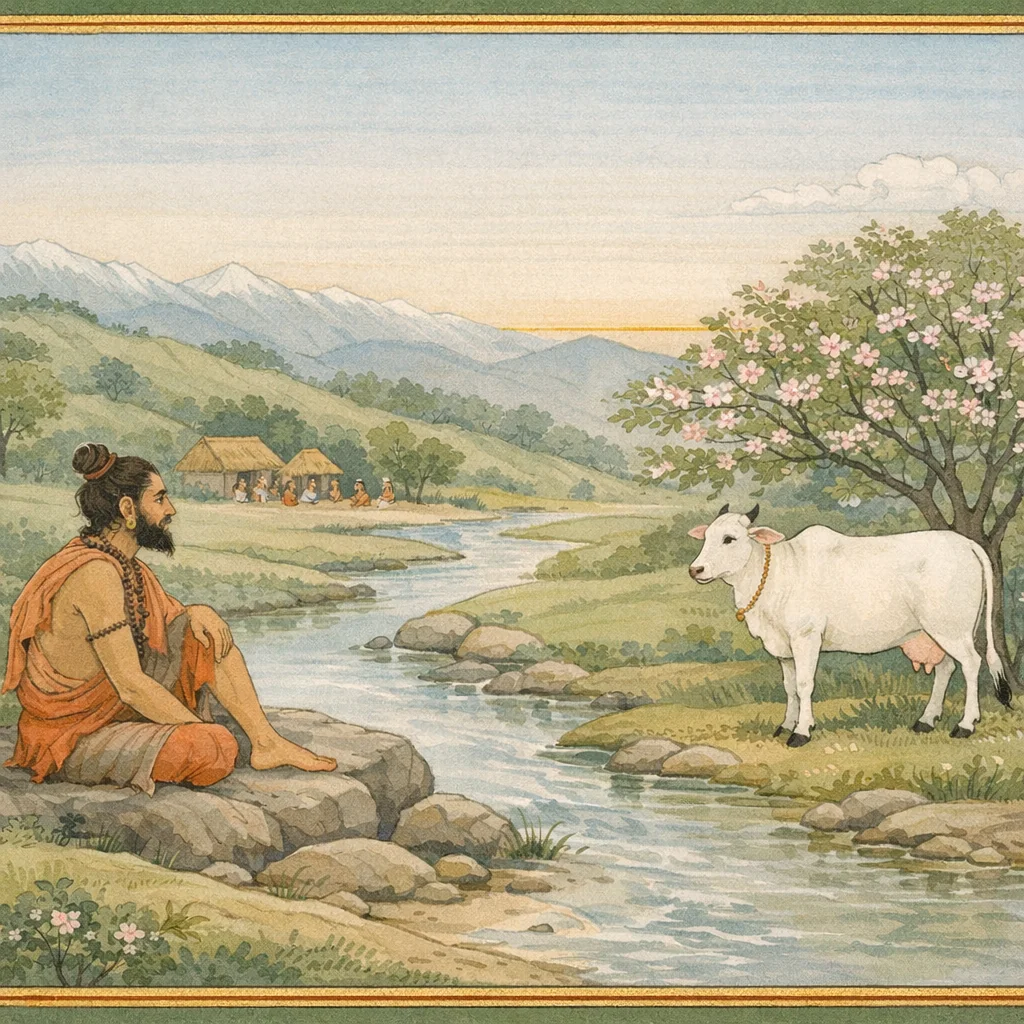
Satyavrata, Vasiṣṭha, and the Crisis of Dharma: Protection, Anger, and Vow-Discipline
This adhyāya continues Sūta’s narration of Satyavrata and the sage Vasiṣṭha, using a morally charged sequence to probe how bhakti, compassion, and vow-bound action meet social approval and censure. Satyavrata sustains Viśvāmitra’s household by hunting and providing food near the āśrama, while Vasiṣṭha’s stance is shaped by priestly authority (yājya–upādhyāya ties), paternal abandonment, and mounting anger. A technical ritual note marks the completion point of the pāṇigrahaṇa mantras at the “seventh step,” showing concern for procedural validity alongside ethical judgment. A prolonged dīkṣā is mentioned, and the tension rises when the hungry, exhausted Satyavrata encounters a wish-fulfilling cow, foreshadowing a transgressive act and debate over necessity, dharma, and the limits of compassion. The chapter thus serves as a Purāṇic case-study in moral jurisprudence, where intention, circumstance, and ritual status complicate judgment within Śaiva didactic storytelling.
Shlokas
Verse 1
सूत उवाच । सत्यव्रतस्तु तद्भक्त्या कृपया च प्रतिज्ञया । विश्वामित्रकलत्रं च पोषयामास वै तदा
Sūta said: Then Satyavrata, moved by devotion, compassion, and his pledged word, indeed maintained and supported Viśvāmitra’s wife as well.
Verse 2
हत्वा मृगान्वराहांश्च महिषांश्च वनेचरान् । विश्वामित्राश्रमाभ्याशे तन्मांसं चाक्षिपन्मुने
Having killed deer, boars, and forest-dwelling buffaloes, he then threw that meat near the hermitage of the sage Viśvāmitra.
Verse 3
तीर्थं गां चैव रात्रं च तथैवांतःपुरं मुनिः । याज्योपाध्यायसंयोगाद्वसिष्ठः पर्य्यरक्षत
Through the combined sacred authority of the officiating priest and the preceptorial teacher, the sage Vasiṣṭha duly safeguarded the holy place, the cows, the night-watch, and the inner apartments of the palace.
Verse 4
सत्यव्रतस्य वाक्याद्वा भाविनोर्थस्य वै बलात् । वसिष्ठोऽभ्यधिकं मन्युं धारयामास नित्यशः
Either because of Satyavrata’s words, or by the compelling force of what was destined to happen, Vasiṣṭha continually bore an even greater anger within himself.
Verse 5
पित्रा तु तं तदा राष्ट्रात्परित्यक्तं स्वमात्मजम् । न वारयामास मुनिर्वसिष्ठः कारणेन च
But when the father, at that time, cast out his own son from the kingdom, the sage Vasiṣṭha did not restrain him either—because there was a reason behind it.
Verse 6
पाणिग्रहणमंत्राणां निष्ठा स्यात्सप्तमे पदे । न च सत्यव्रतस्थस्य तमुपांशुमबुद्ध्यत
The hand-taking (marriage) mantras reach their firm completion at the seventh step. But one established in the vow of truth should not utter that (mantra) in a whisper, nor repeat it without clear awareness.
Verse 7
तस्मिन्स परितोषाय पितुरासीन्महात्मनः । कुलस्य निष्कृतिं विप्र कृतवान्वै भवेदिति
In that act, O brāhmaṇa, the noble one found satisfaction for his revered father, thinking, “Indeed, I have accomplished the due expiation and redemption of my lineage.”
Verse 8
न तं वसिष्ठो भगवान्पित्रा त्यक्तं न्यवारयत् । अभिषेक्ष्याम्यहं पुत्रमस्यां नैवाब्रवीन्मुनिः
The venerable Vasiṣṭha did not restrain him, though he had been cast off by his father; nor did the sage say, “I shall consecrate (anoint) this son in her stead.”
Verse 9
स तु द्वादश वर्षाणि दीक्षां तामुद्वहद्बली । अविद्यामाने मांसे तु वसिष्ठस्य महात्मनः
That mighty one sustained that consecrated discipline (dīkṣā) for twelve years; but when the flesh of the great-souled Vasiṣṭha could not be found for the rite, the matter fell into a grave impasse.
Verse 10
सर्वकामदुहां दोग्ध्रीं ददर्श स नृपात्मजः । तां वै क्रोधाच्च लोभाच्च श्रमाद्वै च क्षुधान्वितः
The king’s son beheld the wish-fulfilling cow, the milch-giver who grants all desired enjoyments. Overcome by anger and greed, and worn with fatigue and hunger, he fixed his mind upon her.
Verse 11
दाशधर्मगतो राजा तां जघान स वै मुने । स तं मांसं स्वयं चैव विश्वामित्रस्य चात्मजम्
O sage, the king—having taken refuge in the dharma of a fisherman—killed her. Then he himself ate that flesh, and also gave it to Viśvāmitra’s son.
Verse 12
भोजयामास तच्छ्रुत्वा वसिष्ठो ह्यस्य चुक्रुधे । उवाच च मुनिश्रेष्ठस्तं तदा क्रोधसंयुतः
Hearing that he had arranged the feast, Vasiṣṭha became enraged. Then that foremost of sages, filled with wrath, spoke to him.
Verse 13
वसिष्ठ उवाच । पातयेयमहं क्रूरं तव शंकुमयोमयम् । यदि ते द्वाविमौ शंकू नश्येतां वै कृतौ पुरा
Vasiṣṭha said: “O cruel one, I would strike down your body that is made of pegs. If these two pegs of yours had indeed been destroyed earlier, then this harm would already have been done.”
Verse 14
पितुश्चापरितोषेण गुरोर्दोग्ध्रीवधेन च । अप्रोक्षितोपयोगाच्च त्रिविधस्ते व्यतिक्रमः
By displeasing your father, by killing the guru’s milk-cow, and by using what was not ritually purified (sprinkled/cleansed), your transgression is threefold.
Verse 15
त्रिशंकुरिति होवाच त्रिशंकुरिति स स्मृतः । विश्वामित्रस्तु दाराणामागतो भरणे कृते
He said, “(He is) Triśaṅku,” and thus he came to be remembered as Triśaṅku. Then Viśvāmitra arrived for the purpose of supporting and maintaining his wife.
Verse 16
तेन तस्मै वरं प्रादान्मुनिः प्रीतस्त्रिशंकवे । छन्द्यमानो वरेणाथ वरं वव्रे नृपात्मजः
Pleased with him, the sage granted a boon to Triśaṅku. Then, when invited to choose a boon, the king’s son asked for the boon he desired.
Verse 17
अनावृष्टिभये चास्मिञ्जाते द्वादशवार्षिके । अभिषिच्य पितृ राज्ये याजयामास तं मुनिः
And when a fearsome drought arose—lasting for twelve years—the sage consecrated him to his father’s kingdom and had him perform the prescribed royal sacrifices.
Verse 18
मिषतां देवतानां च वसिष्ठस्य च कौशिकः । सशरीरं तदा तं तु दिवमारोह यत्प्रभुः
While the gods looked on—along with Vasiṣṭha—Kauśika (Viśvāmitra), by the Lord’s command, then ascended to heaven in that very body.
Verse 19
तस्य सत्यरथा नाम भार्या केकयवंशजा । कुमारं जनयामास हरिश्चन्द्रमकल्मषम्
His wife, named Satyarathā, born in the Kekaya lineage, gave birth to a son—Hariścandra—spotless and free from sin.
Verse 20
स वै राजा हरिश्चन्द्रो त्रैशंकव इति स्मृतः । आहर्ता राजसूयस्य सम्राडिति ह विश्रुतः
That king was Hariścandra, remembered as a descendant of Triśaṅku. He performed the Rājasūya sacrifice and was truly renowned as a samrāṭ, a universal sovereign.
Verse 21
हरिश्चन्द्रस्य हि सुतो रोहितो नाम विश्रुतः । रोहितस्य वृकः पुत्रो वृकाद्बाहुस्तु जज्ञिवान्
Hariścandra had a son renowned as Rohita. Rohita’s son was Vṛka, and from Vṛka was born Bāhu.
Verse 22
हैहयास्तालजंघाश्च निरस्यंति स्म तं नृपम् । नात्मार्थे धार्मिको विप्रः स हि धर्मपरोऽभवत
The Haihayas and the Tālajaṅghas drove that king away. Yet the righteous brāhmaṇa did not act for his own gain, for he was wholly devoted to Dharma.
Verse 23
सगरं ससुतं बाहुर्जज्ञे सह गरेण वै । और्वस्याश्रममासाद्य भार्गवेणाभिरक्षितः
Indeed, Bāhu was born through Gāra, together with Sagara and his son. Reaching the hermitage of the sage Aurva, he was protected and safeguarded by the Bhārgava (Aurva).
Verse 24
आग्नेयमस्त्रं लब्ध्वा च भार्गवात्सगरो नृपः । जिगाय पृथिवीं हत्वा तालजंघान्सहैहयान
Having obtained the fiery missile, the Āgneya-astra, from the Bhārgava (Paraśurāma), King Sagara slew Tāla-jaṅgha and the Haihayas, and thus brought the earth under his conquest.
Verse 25
शकान्बहूदकांश्चैव पारदांतगणान्खशान् । सुधर्मं स्थापयामास शशास वृषतः क्षितिम्
He brought the Śakas, the Bahūdakas, the Pāradāntagaṇas, and the Khaśas under discipline. Establishing Sudharma, the righteous law, he ruled the earth steadfast in dharma—like the very Bull of Dharma.
Verse 26
शौनक उवाच । स वै गरेण सहितः कथं जातस्तु क्षत्रियात् । जितवानेतदाचक्ष्व विस्तरेण हि सूतज
Śaunaka said: “How was he born from a Kṣatriya, and how did he come to be accompanied by that ‘Gara’? O son of Sūta, explain in detail how he became victorious.”
Verse 27
सूत उवाच । पारीक्षितेन संपृष्टो वैशंपायन एव च । यदाचष्ट स्म तद्वक्ष्ये शृणुष्वैकमना मुने
Sūta said: When King Parīkṣit questioned him, the sage Vaiśaṃpāyana spoke. I shall now relate exactly what he then declared—listen, O sage, with a one-pointed mind.
Verse 28
पारीक्षितो उवाच । कथं स सगरो राजा गरेण सहितो मुने । जातस्स जघ्निवान्भूयानेतदाख्यातुमर्हसि
Pārīkṣit said: “O sage, how was King Sagara born together with Gara, and how did he later slay him? Pray explain this to me in full.”
Verse 29
वैशम्पायन उवाच । बाहोर्व्यसनिनस्तात हृतं राज्यमभूत्किल । हैहयैस्तालजंघैश्च शकैस्सार्द्धं विशांपते
Vaiśampāyana said: “O dear one, it is indeed told that the kingdom of Bāhu—fallen into misfortune and weakness—was seized by the Haihayas and the Tālajaṅghas, together with the Śakas, O lord of men.”
Verse 30
यवनाः पारदाश्चैव काम्बोजाः पाह्नवास्तथा । बहूदकाश्च पंचैव गणाः प्रोक्ताश्च रक्षसाम्
“The Yavanas, the Pāradās, the Kāmbojas, the Pāhnavas, and the Bahūdakas—these five groups are declared to be among the hosts of the Rākṣasas.”
Verse 31
एते पंच गणा राजन्हैहयार्थेषु रक्षसाम् । कृत्वा पराक्रमान् बाहो राज्यं तेभ्यो ददुर्बलात्
O King, these five—gaṇas, attendants of Lord Śiva—displayed their valor on behalf of the Haihayas against the Rākṣasas; and the Rākṣasas, overpowered, were compelled to hand over their kingdom to them.
Verse 32
हृतराज्यस्ततो विप्राः स वै बाहुर्वनं ययौ । पत्न्या चानुगतो दुःखी स वै प्राणानवासृजत्
O brāhmaṇas, then Bāhu, deprived of his kingdom, went to the forest. Followed by his wife and overwhelmed with sorrow, he finally gave up his life-breath.
Verse 33
पत्नी या यादवी तस्य सगर्भा पृष्ठतो गता । सपत्न्या च गरस्तस्यै दत्तः पूर्वं सुतेर्ष्यया
His Yādavī wife, being pregnant, walked behind him. Out of jealousy toward her co-wife’s son, that co-wife had earlier given her a dose of poison.
Verse 34
सा तु भर्तुश्चितां कृत्वा ज्वलनं चावरोहत । और्वस्तां भार्गवो राजन्कारुण्यात्समवारयत्
After preparing her husband’s funeral pyre, she herself stepped down into the blazing fire. But Aurva, the Bhārgava sage, O King, restrained her out of compassion.
Verse 35
तस्याश्रमे स्थिता राज्ञी गर्भरक्षणहेतवे । सिषेवे मुनिवर्यं तं स्मरन्ती शंकरं हृदा
Dwelling in that sage’s hermitage to safeguard her pregnancy, the queen attended upon that foremost of seers, while within her heart she ever remembered Śaṅkara.
Verse 36
एकदा खलु तद्गर्भो गरेणैव सह च्युतः । सुमुहूर्त्ते सुलग्ने च पंचोच्चग्रहसंयुते
Once indeed, her pregnancy slipped and was cast out together with the poison garā; it happened at an auspicious muhūrta and favorable ascendant, when five planets stood in exaltation.
Verse 37
तस्मिंल्लग्ने च बलिनि सर्वथा मुनिसत्तम । व्यजायत महाबाहुस्सगरो नाम पार्थिवः
O best of sages, at that very auspicious and potent ascendant, there was born a mighty-armed king named Sagara.
Verse 38
इति श्रीशिवमहापुराणे पञ्चम्यामुमासंहितायां सत्यव्रतादिसगरपर्यंत वंशवर्णनं नामाष्टत्रिंशोऽध्यायः
Thus, in the Śrī Śiva Mahāpurāṇa, in the Fifth Book—the Umāsaṃhitā—ends the thirty-eighth chapter entitled “The Description of the Dynasty from Satyavrata up to Sagara.”
Verse 39
आग्नेयं तं महाभागो ह्यमरैरपि दुस्सहम् । जग्राह विधिना प्रीत्या सगरोसौ नृपोत्तमः
That illustrious King Sagara—foremost among rulers—joyfully received, according to proper rite, that fiery Agneya weapon, difficult to endure even for the gods.
Verse 40
स तेनास्त्रबलेनैव बलेन च समन्वितः । हैहयान्विजघानाशु संकुद्धोऽस्त्रबलेन च
Endowed with that very might of divine weapons, and with bodily strength as well, he—enraged—swiftly struck down the Haihayas by the power of his missiles.
Verse 41
आजहार च लोकेषु कीर्तिं कीर्तिमतां वरः । धर्मं संस्थापयामास सगरोऽसौ महीतले
That Sagara—foremost among the renowned—won fame throughout the worlds, and on the face of the earth he established dharma, the righteous order.
Verse 42
ततश्शकास्सयवनाः काम्बोजाः पाह्नवास्तथा । हन्यमानास्तदा ते तु वसिष्ठं शरणं ययुः
Then the Śakas, together with the Yavanas, the Kāmbojas, and the Pāhnavas—being struck down in that conflict—went to the sage Vasiṣṭha for refuge.
Verse 43
वसिष्ठो वंचनां कृत्वा समयेन महाद्युतिः । सगरं वारयामास तेषां दत्त्वाभयं नृपम्
At the appointed time, the greatly radiant sage Vasiṣṭha, having employed a strategic ruse, restrained King Sagara—first granting those people safety and assurance (abhaya).
Verse 44
सगरस्स्वां प्रतिज्ञां तु गुरोर्वाक्यं निशम्य च । धर्मं जघान तेषां वै केशान्यत्वं चकार ह
Hearing the words of his preceptor, Sagara upheld his own vow and, in accord with dharma, caused their hair to be altered.
Verse 45
अर्द्धं शकानां शिरसो मुंडं कृत्वा व्यसर्जयत् । यवनानां शिरस्सर्वं कांबोजानां तथैव च
Having shaved half of the Śakas’ heads, he dismissed them; and likewise he shaved completely the heads of the Yavanas, and also of the Kāmbojas.
Verse 46
पारदा मुंडकेशाश्च पाह्नवाश्श्मश्रुधारिणः । निस्स्वाध्यायवषट्काराः कृतास्तेन महात्मना
That great-souled one made them live as ascetics—some bearing the sacred mark (tilaka/bhasma), some with shaven heads, some with unkempt hair and beards—deprived of Vedic study and of the ritual cry “vaṣaṭ,” thus cut off from formal Vedic sacrificial acts.
Verse 47
जिता च सकला पृथ्वी धर्मतस्तेन भूभुजा । सर्वे ते क्षत्रियास्तात धर्महीनाः कृताः पुराः
By that king, the entire earth was conquered through righteousness (dharma). And, dear one, all those kṣatriyas were formerly made bereft of dharma.
Verse 48
स धर्मविजयी राजा विजित्वेमां वसुंधराम् । अश्वं संस्कारयामास वाजिमेधाय पार्थिवः
That earthly king, victorious through dharma, having conquered this whole earth, duly prepared a horse for the Vājimedha (Aśvamedha) sacrifice.
Verse 49
तस्य चास्यतेस्सोऽश्वस्समुद्रे पूर्वदक्षिणे । गतः षष्टिसहस्रैस्तु तत्पुत्रैरन्वितो मुने
O sage, when he released it, that sacrificial horse went toward the ocean in the south‑eastern direction, accompanied by his sixty thousand sons.
Verse 50
देवराजेन शक्रेण सोऽश्वो हि स्वार्थसाधिना । वेलासमीपेऽपहृतो भूमिं चैव प्रवेशितः
That horse was indeed carried off by Śakra, the king of the gods, acting for his own advantage; near the seashore he stole it away and then caused it to be hidden within the earth.
Verse 51
महाराजोऽथ सगरस्तद्धयान्वेषणाय च । स तं देशं तदा पुत्रैः खानयामास सर्वतः
Then King Sagara, in order to search for that horse, had that region dug up on all sides by his sons.
Verse 52
आसेदुस्ते ततस्तत्र खन्यमाने महार्णवे । तमादिपुरुषं देवं कपिलं विश्वरूपिणम्
Then, at that very place, as the great ocean was being dug, they approached that primordial Person—God Kapila—who bears the form of the entire universe.
Verse 53
तस्य चक्षुस्समुत्थेन वह्निना प्रतिबुध्यतः । दग्धाः षष्टिसहस्राणि चत्वारस्त्ववशेषिताः
When he was roused, the fire that sprang forth from his eyes blazed out; sixty thousand were burned to ashes, and only four remained.
Verse 54
हर्षकेतुस्सुकेतुश्च तथा धर्मरथोपरः । शूरः पंचजनश्चैव तस्य वंशकरा नृपाः
Harṣaketu, Suketu, and also Dharmaratha; Śūra and Pañcajana as well—these kings became the continuers of his royal lineage.
Verse 55
प्रादाच्च तस्मै भगवान् हरिः पंचवरान्स्वयम् । वंशं मेधां च कीर्तिञ्च समुद्रं तनयं धनम्
Then Lord Hari (Viṣṇu) personally granted him five boons: a noble lineage, keen intelligence, enduring fame, lordship over the ocean, a son, and wealth.
Verse 56
सागरत्वं च लेभे स कर्मणा तस्य तेन वै । तं चाश्वमेधिकं सोऽश्वं समुद्रादुपलब्धवान्
By that very deed, he indeed attained the state of being a sea. And from the ocean he recovered that horse meant for the Aśvamedha sacrifice.
Verse 57
आजहाराश्वमेधानां शतं स तु महायशाः । ईजे शंभुविभूतीश्च देवतास्तत्र सुव्रताः
That greatly renowned king performed a hundred Aśvamedha sacrifices; and there, with disciplined vows, he duly worshipped the divine manifestations and powers of Śambhu (Lord Śiva) as deities.
Frequently Asked Questions
It narrates a dharma-crisis episode: Satyavrata sustains Viśvāmitra’s family through hunting and provisioning near the āśrama while Vasiṣṭha’s responses—shaped by priestly authority and paternal abandonment—build toward conflict, culminating in the appearance of a wish-fulfilling cow under conditions of hunger and strain.
The mention that pāṇigrahaṇa mantras reach completion at the seventh step signals the Purāṇic insistence that moral narratives are inseparable from ritual grammar: social legitimacy, vow-status, and karmic evaluation hinge on procedural completion (krama/niṣṭhā), not merely intention.
No distinct Śiva or Umā manifestation is foregrounded in the sampled portion; the chapter’s emphasis is didactic-ethical, using a rishi–royal narrative to articulate how dharma, initiation discipline, and authority operate within a Śaiva Purāṇic framework.