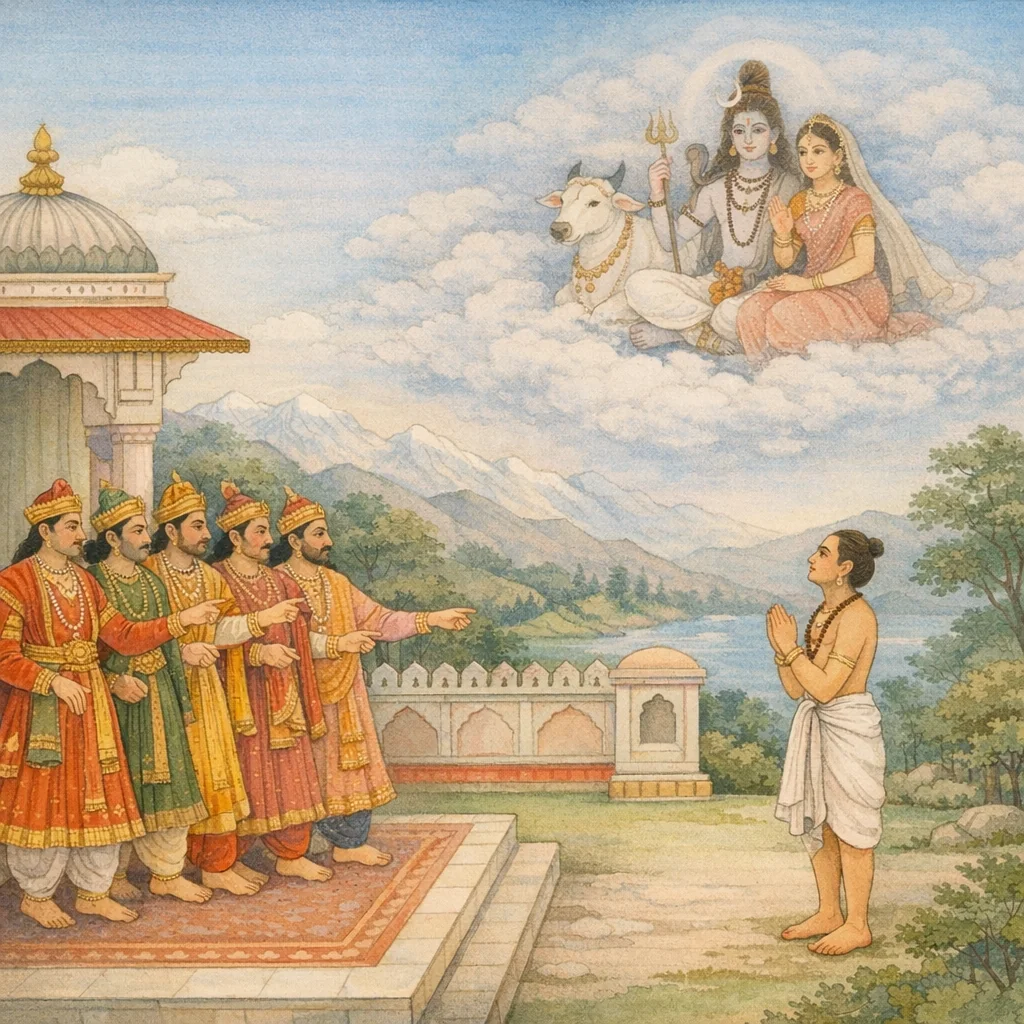
नभगोपाख्यानम् (Nabhaga-Upākhyāna: The Account of Nabhaga and Shiva-Jñāna)
This chapter is cast as Nandīśvara’s instruction to Sanatkumāra, recounting a “supreme avatāra” episode connected with Nabhaga and the liberating knowledge (jñāna) bestowed by Śiva. It first places Nabhaga in the Ikṣvāku lineage, with passing mention of Ambarīṣa and the sage Durvāsā. A moral, legal, and spiritual dilemma then arises: after long disciplined study in his guru’s household, Nabhaga returns to find his brothers have divided the inheritance without granting him a share. Claiming his rightful portion (dāya), Nabhaga’s dispute moves toward a resolution that is not merely juridical but theological—the chapter’s true end is Śiva’s grace in granting Nabhaga saving knowledge. Thus, dharmaic concerns of inheritance and family division are woven together with Śaiva soteriology, presenting a worldly conflict as the occasion for spiritual transmission and revelation of Śiva-jñāna as the ultimate “portion.”
Shlokas
Verse 1
नन्दीश्वर उवाच । सनत्कुमार शम्भोस्त्ववतारं परमं शृणु । नभगज्ञानदं कृष्णदर्शनाह्वयमुत्तमम्
Nandīśvara said: “O Sanatkumāra, listen to the supreme descent (avatāra) of Śambhu. It is the most excellent—bestowing spiritual knowledge upon Nabhāga—and is renowned as ‘Kṛṣṇa-darśana’, the vision of the Dark-Hued Lord.”
Verse 2
इक्ष्वाकुप्रमुखा आसन्श्राद्धदेवसुताश्च ये । नभगस्तत्र नवमो नाभगस्तत्सुतः स्मृतः
Among the sons of Śrāddhadeva (Vaivasvata Manu), Ikṣvāku and the others were born. There, Nabhāga was the ninth; and Nābhāga is remembered as his son.
Verse 3
अम्बरीषस्सुतस्तस्य विष्णुभक्तो बभूव सः । यस्योपरि प्रसन्नोभूद्दुर्वासा ब्रह्मभक्तितः
His son was Ambarīṣa, who became a devoted worshipper of Lord Viṣṇu. Because of his reverence for Brahman and the Vedic way, the sage Durvāsā became pleased with him.
Verse 4
पितामहोऽम्बरीषस्य नभगो यः प्रकीर्तितः । तच्चरितं शृणु मुने यस्मै ज्ञानमदाच्छिवः
Nabhaga, famed as the grandsire of Ambarīṣa—listen, O sage, to his sacred account, to whom Lord Śiva bestowed spiritual knowledge.
Verse 5
नभगो मनुपुत्रस्तु पठनार्थं सुबुद्धि मान् । चक्रे गुरुकुले वासं बहुकालं जितेन्द्रियः
Nabhaga, the son of Manu—highly intelligent and intent on study—lived for a long time in the teacher’s household, dwelling there with disciplined senses.
Verse 6
एतस्मिन्समये ते वा इक्ष्वाकुप्रमुखास्सुताः । तस्मै भागमकल्प्यैव भेजुर्भागान्निजान्क्रमात्
At that time, those sons—led by Ikṣvāku—without first allotting a proper share to him, proceeded in due order to take their own respective portions.
Verse 7
स्वंस्वं भागं गृहीत्वा ते बुभुजू राज्यमुत्तमम् । अविषादं महाभागा पित्रादेशात्सुबुद्धयः
Receiving each his own rightful share, those noble and wise ones enjoyed the excellent kingdom—free from sorrow—because they faithfully followed their father’s command.
Verse 8
स पश्चादागतस्तत्र ब्रह्मचारी गुरुस्थलात् । नभगोऽधीत्य सर्वाश्च सांगोपांगाः श्रुतीः क्रमात्
Afterwards, that brahmacārin returned there from the dwelling of his preceptor. Nabhāga, having duly studied in proper sequence all the Vedic revelations together with their ancillary and subsidiary disciplines, came back fully trained.
Verse 9
भ्रातृन्विलोक्य नभगो विभक्तान्सकलान्निजान् । दायार्थी प्राह तान्स्नेहादिक्ष्वाकुप्रमुखान्मुने
Seeing all his own brothers already apportioned with their shares, Nabhāga—desiring his rightful inheritance—affectionately addressed them, beginning with Ikṣvāku, O sage.
Verse 10
नभग उवाच । भ्रातरोभक्तकं मह्यं दायं कृत्वा यथातथम् । सर्वे विभक्तास्सुप्रीत्या स्वदायार्थागताय च
Nabhāga said: “O brothers, having apportioned a share for me as you see fit, may you all be happily divided, with mutual goodwill—having come here for the sake of your own allotted portions as well.”
Verse 11
तदा विस्मृतमस्माभिरिदानीं पितरं तव । विभजामो वयं भागं तं गृहाण न संशयः
Then we realized that we had forgotten your father. Now we are allotting you your rightful share—accept it, without any doubt.
Verse 12
तच्छुत्वा भ्रातृवचनं नभगः परविस्मृतः । तदोपकण्ठमागत्य पितरं समभाषत
Hearing those words spoken by his brothers, Nabhāga was utterly astonished. Then, approaching his father at once, he addressed him directly.
Verse 13
नभग उवाच । हे तात भ्रातरः सर्वे त्यक्त्वा मां न्यभजंश्च ते । पठनार्थं गतश्चाहं ब्रह्मचारी गुरोः कुले
Nabhaga said: “O dear father, all my brothers abandoned me and divided the inheritance among themselves. I, living as a brahmacārin, a celibate student, went to my teacher’s household for the sake of study.”
Verse 14
तत आगत्य मे पृष्टा दायदानार्थमादरात् । ते त्वामूचुर्विभागं मे तदर्थमहमागतः
Then, coming to me earnestly, they questioned me about granting their rightful share. They said to you, “Give us our portion”; therefore I have come here for that very purpose.
Verse 15
नन्दीश्वर उवाच । तदाकर्ण्य वचस्तस्य पिता तं प्राह विस्मितः । आश्वास्य श्राद्धदेवस्स सत्यधर्मरतं मुने
Nandīśvara said: Hearing his words, his father—Śrāddhadeva—astonished, spoke to that sage devoted to truth and righteousness, first consoling and reassuring him.
Verse 16
मनुरुवाच । तदुक्तं मादृथास्तात प्रतारणकरं हि तत् । न ह्यहं परमं दायं सर्वथा भोगसाधनम्
Manu said: “As has been said—do not grieve, dear son. Indeed, that would only lead to deception and delusion. For I do not at all regard the supreme inheritance as a mere instrument for enjoyment; the highest bequest is not worldly pleasure, but the right path that leads the soul toward Śiva.”
Verse 17
तथापि दायभावेन दत्तोऽहं तैः प्रतारिभिः । तव वै जीवनोपाय वदामि शृणु तत्त्वतः
Yet, those deceivers handed me over under the pretext of a rightful share. Now I shall tell you, in truth, the means for your very survival—listen carefully to the reality of it.
Verse 18
सत्रमांगिरसा विप्राः कुर्वंत्यद्य सुमेधसः । तत्र कर्मणि मुह्यन्ति षष्ठं षष्ठमहः प्रति
Today the wise Brāhmaṇa sages are performing the Āṅgirasa sacrificial session. Yet, in that very rite, they become perplexed again and again, each time the sixth day returns in its cycle.
Verse 19
तत्र त्वं गच्छ नभग तान् सुशंस महाकवे । सूक्ते द्वे वैश्वदेवे हि सत्रं शुद्धं हि तद्भवेत्
Therefore, O Nabhāga, go there and instruct them well, O great sage-poet. For by two Vaiśvadeva hymns, that sacrificial session (satra) is indeed purified.
Verse 20
तत्कर्मणि समाप्ते हि स्वयान्तो ब्राह्मणाश्च ते । धनं दास्यन्ति ते तुष्टास्स्वसत्रपरिशेषितम्
When that sacred rite is duly completed, those brāhmaṇas—having themselves reached its proper conclusion—will be pleased and will bestow wealth: whatever remains over from their own sacrificial provisions.
Verse 21
नन्दीश्वर उवाच । तदाकर्ण्य पितुर्वाक्यं नभगः सत्यसारवान् । जगाम तत्र सुप्रीत्या यत्र तत्सत्रमुत्तमम्
Nandīśvara said: Hearing his father’s words, Nabhāga—whose very essence was truth—went there with heartfelt joy, to where that excellent sacrificial session (satra) was being conducted.
Verse 22
तदाहः कर्मणि मुने सत्रे तस्मिन्स मानवः । सूक्ते द्वे वैश्वदेवे हि प्रोवाच स्पष्टतस्सुधीः
Then, O sage, on that day—during that sacred rite of the satra—an enlightened man clearly recited two hymns addressed to the Viśvadevas.
Verse 23
समाप्ते कर्मणि ततो विप्रा आंगिरसाश्च ते । तस्मै दत्त्वा ययुः स्वर्गं स्वंस्वं सत्रावशेषितम्
When the rite was completed, those brāhmaṇa sages of the Āṅgirasa lineage, having presented to him the remaining portions of their sacrificial session (satra), departed to heaven—each to his own attained realm. From a Śaiva standpoint, the verse teaches that karma, duly concluded and offered in proper order with reverence, yields higher worlds; yet final liberation is secured by devotion to Pati (Śiva) beyond ritual reward.
Verse 24
तत्तदा स्वीकरिष्यंतं सुसत्रपरिशेषितम् । विज्ञाय गिरिशः सद्य आविर्भूत सदूतिकृत्
Knowing that the devotee was then about to accept what remained after the sacrifice had been duly performed, Girīśa (Lord Śiva) at once manifested, taking upon Himself the role of a messenger.
Verse 25
सर्वांगसुन्दरः श्रीमान्पुरुषः कृष्णदर्शनः । भावं समीक्षितुं भागं दातुं ज्ञानं परं च तत्
He was a splendid and auspicious person, beautiful in every limb, dark-hued in appearance—one who could discern the inner bhāva, bestow the fitting share, and impart that highest knowledge.
Verse 26
अथो स शंकरः शम्भुः परीक्षाकर ईश्वरः । उवाचोत्तरतोऽभ्येत्य नभगं तं हि मानवम्
Then that Lord—Śaṅkara, Śambhu, the Supreme Īśvara who tests beings—approached Nabha ga from the north and spoke to that man.
Verse 27
ईश्वर उवाच । कस्त्वं गृह्णासि पुरुष ममेदं वास्तुकं वसु । प्रेषितः केन तत्सर्वं सत्यं वद ममाग्रतः
Īśvara said: “Who are you, O man, that you seize this wealth belonging to my dwelling? By whom were you sent? Speak all of that truthfully before me.”
Verse 28
नन्दीश्वर उवाच । तच्छुत्वा तद्वचस्तात मानवो नभगः कवि । प्रत्युवाच विनीतात्मा पुरुषं कृष्णदर्शनम्
Nandīśvara said: “Beloved one, having heard those words, the human Nabhaga—wise and inspired, a kavi—humbly replied to that Person whose appearance was dark-hued.”
Verse 29
इति श्रीशिवमहापुराणे तृतीयायां शतरुद्रसंहितायां नन्दीश्वरसनत्कुमारसंवादे कृष्णदर्शनशिवावतारवर्णनंनामैकोनत्रिंशोऽध्यायः
Thus ends the twenty-ninth chapter, entitled “The Vision of Kṛṣṇa and the Description of Śiva’s Incarnation,” in the third book of the Śrī Śiva Mahāpurāṇa—within the Śatarudra Saṃhitā, in the dialogue between Nandīśvara and Sanatkumāra.
Verse 30
नन्दीश्वर उवाच । आकर्ण्य नाभगं वाक्यमिदं सत्यमुदीरितम् । प्रत्युवाच प्रसन्नात्मा पुरुषः कृष्णदर्शनः
Nandīśvara said: Having heard this truthful statement spoken by Nābhāga, that Person of dark radiance—serene in heart—replied.
Verse 31
कृष्णदर्शन उवाच । विवादेऽस्मिन्हि नौ तात प्रमाणं जनकस्तव । याहि तम्पृच्छ स ब्रूयात्तत्प्रमाणन्तु सत्यतः
Kṛṣṇadarśana said: “Dear one, in this dispute between us, your father is the true authority and proof. Go and ask him; whatever he declares in truth—only that should be accepted as valid testimony.”
Verse 32
नन्दीश्वर उवाच । तदाकर्ण्य वचस्तस्य नभगो मानवः कविः । आगच्छत्पितरं प्रीत्या तदुक्तं पृष्टवान्मुने
Nandīśvara said: Hearing his words, Nabhaga—descendant of Manu and a poet-sage—approached his father with affection and then asked the muni about what had been spoken.
Verse 33
पुत्रोदितं समाकर्ण्य श्राद्धदेवस्स वै मनुः । स्मृत्वा शिवपदाम्भोजं प्राप्तस्मृतिरुवाच तम्
Hearing what his son had said, Manu—known as Śrāddhadeva—remembered the lotus-feet of Lord Śiva; and through that remembrance his true awareness returned, whereupon he spoke to him.
Verse 34
मनुरुवाच । हे तात शृणु मद्वाक्यं स देवः पुरुषः शिवः । तस्यैव सकलं वस्तु यज्ञप्राप्तं विशेषतः
Manu said: “O dear one, listen to my words. That God—indeed the supreme Person—is Śiva. Everything belongs to Him alone; and especially whatever is obtained through sacrifice is truly meant for Him.”
Verse 35
अध्वरोर्वरितं वस्तु रुद्रभागः प्रकीर्तितः । इत्यपि प्राज्ञवादो हि क्वचिज्जातस्तदिच्छया
That consecrated substance belonging to the sacrifice (adhvara) is proclaimed to be Rudra’s rightful share. Indeed, this statement of the wise arose at times by His own will.
Verse 36
स देव ईश्वरः सर्वं वस्त्वर्हति न संशयः । यज्ञावशिष्टं किमुत परे तस्येच्छया विभोः
That God—Śiva, the Supreme Lord—truly deserves every offering; of this there is no doubt. If so, what need be said of the remnants of a sacrifice? Everything, in every way, is sanctified and made worthy solely by the will of that all-pervading Lord.
Verse 37
अनुग्रहार्थमायातस्तव तद्रूपतः प्रभुः । तत्र त्वं गच्छ नभग प्रसन्नं कुरु सत्यतः
For your grace, the Lord has come there in that very form. Therefore, O Nabhaga, go to that place and, in all truth, make Him graciously pleased.
Verse 38
क्षमापय स्वापराधं सुप्रणम्य स्तुतिं कुरु । सर्वप्रभुस्स एवेशो यज्ञाधीशोऽखिलेश्वरः
Beg forgiveness for your own offense; bow down properly and offer praise. He alone is the Lord of all masters—the Supreme Ruler, the presiding Lord of sacrifice (yajña), and the Sovereign of the entire universe.
Verse 39
विष्णुब्रह्मादयो देवाः सिद्धास्सर्वर्षयोऽपि हि । तदनुग्रहतस्तात समर्थः सर्वकर्मणि
Even the gods such as Viṣṇu and Brahmā, the Siddhas, and indeed all the Ṛṣis, dear one, become capable in every undertaking only through His grace.
Verse 40
किम्बहूक्त्यात्मजश्रेष्ठ गच्छ तत्राशु माचिरम् । प्रसादय महादेवं सर्वथा सकलेश्वरम्
“O best of sons—why speak at length? Go there quickly, without delay. In every way, seek to propitiate Mahādeva, the Lord of all lords, the sovereign of the entire universe.”
Verse 41
नन्दीश्वर उवाच । इत्युक्त्वा स मनुः श्राद्धदेवश्च तनयं द्रुतम् । प्रेषयामास निकटं शम्भोस्सोऽपि समेत्य तम्
Nandīśvara said: Having spoken thus, Manu—Śrāddhadeva—swiftly dispatched his son to go near Śambhu (Lord Śiva). And that son, too, approached Him and met Him.
Verse 42
नभगश्च प्रणम्याशु साञ्जलिर्नतमस्तकः । प्रोवाच सुप्रसन्नात्मा विनयेन महामतिः
Then Nabhaga quickly bowed down; with folded hands and head lowered, that great-souled and highly intelligent one—his mind serene—spoke with humility.
Verse 43
नभग उवाच । इदं तवेश सर्वं हि वस्तु त्रिभुवने हि यत् । इत्याह मे पिता नूनं किमुताध्वरशेषितम्
Nabhāga said: “O Lord, indeed all that exists in the three worlds is Yours. This is what my father has surely told me—so what need is there to speak of what remains after a sacrifice?”
Verse 44
अजानता मया नाथ यदुक्तन्तद्वचो भ्रमात् । अपराधन्त्वं क्षमस्व शिरसा त्वां प्रसादये
O Lord, in ignorance I spoke those words in delusion. Please forgive this offense; bowing my head, I seek to propitiate You and obtain Your grace.
Verse 45
इत्युक्त्वा नभगस्सोतिदीनधीस्तु कृताञ्जलिः । तुष्टाव तं महेशानं कृष्णदर्शनमानतः
Having spoken thus, Nabhaga—his mind uplifted by that vision—joined his palms in reverence and, with head bowed, praised Mahēśāna, the Great Lord, after beholding His dark-hued form.
Verse 46
श्राद्धदेवोऽपि शुद्धात्मा नतकस्साञ्जलिस्सुधीः । तुष्टाव तं प्रभुं नत्वा स्वापराधं क्षमापयत्
Then Śrāddhadeva too—pure in heart and wise—bowed with joined palms. After prostrating to that Lord, he praised Him and sought forgiveness for his own offence.
Verse 47
एतस्मिन्नन्तरे तत्र विष्णुर्ब्रह्माखिलः सुधीः । वासवाद्याः समाजग्मुः सिद्धाश्च मुनयोऽपि हि
Meanwhile, at that very moment, Viṣṇu and the all-knowing, wise Brahmā arrived there; Indra and the other gods also assembled, along with the Siddhas and the sages as well.
Verse 48
महोत्सवं प्रकुर्वन्तः सुकृतालयोऽखिलाः । तुष्टुवुर्नतका भक्त्या सुप्रणम्य पृथक्पृथक्
All those righteous devotees—abodes of meritorious deeds—celebrated a great festival; and, having bowed down with devotion, each in his own way, they offered hymns of praise.
Verse 49
अथ रुद्रः प्रसन्नात्मा कृपादृष्ट्या विलोक्य तान् । उवाच नभगं प्रीत्या सस्मितं कृष्णदर्शनः
Then Rudra—his heart appeased—looked upon them with a compassionate gaze. With affection he spoke to Nabhaga, smiling gently, the dark-hued Lord whose very sight grants grace.
Verse 50
कृष्णदर्शन उवाच । यत्ते पितावदद्धर्म्यं वाक्यन्तत्तु तथैव हि । त्वयापि सत्यमुक्तं तत्साधुस्त्वन्नात्र संशयः
Kṛṣṇadarśana said: “Truly, the unrighteous words spoken by your father are exactly as you have declared. What you have spoken is true and fitting—of this there is no doubt.”
Verse 51
अतोऽहं सुप्रसन्नोऽस्मि सर्वथा सुव्रतेन ते । ददामि कृपया ते हि ज्ञानम्ब्रह्म सनातनम्
Therefore I am wholly pleased with you because of your excellent vow. Out of compassion, I grant you the eternal Brahma-knowledge—true liberating wisdom.
Verse 52
महाज्ञानी भव त्वं हि सविप्रो नभगं द्रुतम् । गृहाण वस्त्विदं सर्वं मद्दत्तं कृपयाधुना
Truly, become a great knower of the highest truth and a genuine brāhmaṇa, O Nabhaga—without delay. Now, out of compassion, accept all this wealth and property, bestowed by me.
Verse 53
इह सर्वसुखं भुङ्क्ष्व निर्विकारं महामते । सुगतिं प्राप्स्यसि त्वं हि सविप्रः कृपया मम
O great-souled one, enjoy here all happiness, free from inner disturbance. By my compassion, you—together with the brāhmaṇas—will indeed attain the auspicious highest state, the good passage to liberation.
Verse 54
नन्दीश्वर उवाच । इत्युक्त्वा तात भगवान्स रुद्रः सत्यवत्सलः । सर्वेषाम्पश्यतान्तेषान्तत्रैवान्तर्दधे हरः
Nandīśvara said: “Having spoken thus, O dear one, the Blessed Lord Rudra—ever tender toward truth—vanished then and there from sight, even as all of them looked on.”
Verse 55
विष्णुर्ब्रह्मापि देवाद्यास्सर्वे ते मुनिसत्तम । स्वंस्वं धाम ययुः प्रीत्या तस्यै नत्वा दिशे मुदा
O best of sages, Viṣṇu, Brahmā, and all the other gods, having joyfully bowed in reverence to that Divine Direction where Śiva’s presence was revealed, departed with glad hearts to their respective abodes.
Verse 56
सपुत्रः श्राद्धदेवोऽपि स्वस्थानमगमन्मुदा । भुक्त्वा भोगान्सुविपुलान्सोऽन्ते शिवपुर ययौ
Śrāddhadeva too, along with his son, joyfully returned to his own abode. After experiencing abundant enjoyments, in the end he went to Śivapura—the supreme realm of Lord Śiva.
Verse 57
इत्थन्ते कीर्तितो ब्रह्मन्नवतारः शिवस्य हि । कृष्णदर्शननामा वै नभगानन्ददायकः
Thus, O Brahman, the incarnation of Lord Śiva has been described to you—indeed, the one named “Kṛṣṇadarśana,” who bestows joy upon Nabhaga.
Verse 58
इदमाख्यानमनघं भुक्तिमुक्तिप्रदं सताम् । पठतां शृण्वतां वापि सर्व कामफलप्रदम्
This spotless sacred narrative grants the virtuous both worldly enjoyment and liberation (moksha). Whether one reads it or even merely listens, it bestows the fruits of all rightful desires.
Verse 59
य एतच्चरितम्प्रातस्सायं च स्मरते सुधीः । कविर्भवति मन्त्रज्ञो गतिमन्ते लभेत्पराम्
The wise who remember this sacred account in the morning and again in the evening become true poets and knowers of mantras; and in the end, by Śiva’s grace, they attain the supreme state—the highest liberation.
Frequently Asked Questions
The chapter presents the Nabhaga narrative: after extended gurukula study and self-restraint, Nabhaga returns to a family estate already divided by his brothers, asserts his rightful share (dāya), and the account culminates in the higher theological resolution—Śiva grants Nabhaga liberating knowledge, reframing “portion” from property to jñāna.
The ‘share’ (bhāga/dāya) functions as a layered symbol: on the surface, an inheritance claim; at depth, the teaching that the supreme allotment is Śiva-jñāna. Gurukula residence and ‘jitendriya’ discipline symbolize the purification required to receive transcendent instruction, turning social dharma into a vehicle for soteriology.
Rather than emphasizing a distinct iconographic form of Śiva or Gaurī in the sampled portion, the Adhyāya highlights Śiva as the giver of jñāna (knowledge-bestowing Lord) whose grace resolves human limitation by granting the highest ‘portion’—liberation-oriented insight.