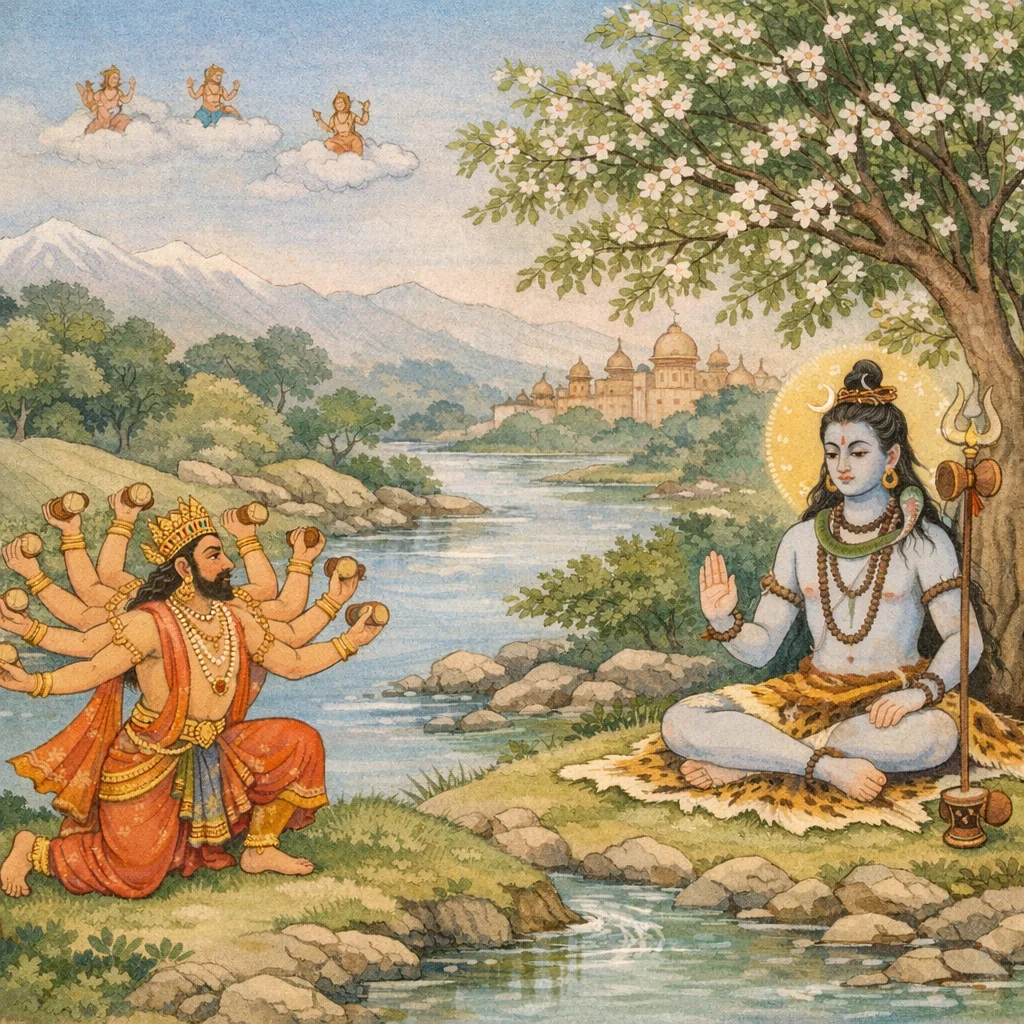
बाणासुरस्य शङ्करस्तुतिः तथा युद्धयाचनम् | Bāṇāsura’s Praise of Śiva and Petition for Battle
Sanatkumāra introduces an additional episode meant to reveal Śiva’s supreme nature and his bhakta-vātsalya, his protective affection for devotees. The asura Bāṇa pleases Śaṅkara (Śiva, beloved of Pārvatī) by performing the tāṇḍava. Seeing the Lord satisfied, Bāṇa approaches with bowed shoulders and joined palms, praising him as Devadeva, Mahādeva, and the “crest-jewel of all gods.” He then voices a paradox of boons: though granted a thousand arms, the gift feels burdensome without a worthy opponent. Boasting that he has subdued Yama, Agni, Varuṇa, Kubera, and Indra and struck fear into the mighty, he nevertheless asks chiefly for the “coming of war”—a battlefield where enemy weapons will break and batter his arms. The chapter thus sets an ethical tension: devotion and divine favor coexist with asuric pride and a craving for violence, preparing for Śiva’s corrective ordering of conflict.
Shlokas
Verse 1
सनत्कुमार उवाच । शृणुष्वान्यच्चरित्रं च शिवस्य परमात्मनः । भक्तवात्सल्यसंगर्भि परमानन्ददायकम्
Sanatkumāra said: “Listen also to another sacred account of Shiva, the Supreme Self—an episode filled with His tender compassion for devotees and capable of bestowing the highest bliss.”
Verse 2
पुरा बाणासुरो नाम दैवदोषाच्च गर्वितः । कृत्वा तांडवनृत्यं च तोषयामास शंकरम्
In former times there was an Asura named Bāṇāsura; through a fault of destiny he became arrogant. Yet, performing the Tāṇḍava dance, he pleased Śaṅkara (Lord Śiva).
Verse 3
ज्ञात्वा संतुष्टमनसं पार्वतीवल्लभं शिवम् । उवाच चासुरो बाणो नतस्कन्धः कृतांजलिः
Knowing that Lord Śiva—the beloved of Pārvatī—was pleased in His heart, the asura Bāṇa spoke, bowing his shoulders in humility and joining his palms in reverence.
Verse 4
बाण उवाच । देवदेव महादेव सर्वदेवशिरोमणे । त्वत्प्रसादाद्बली चाहं शृणु मे परमं वचः
Bāṇa said: “O God of gods, O Mahādeva, crest-jewel of all the deities! By Your grace I too am mighty. Please hear my supreme word.”
Verse 5
दोस्सहस्रं त्वया दत्तं परं भाराय मेऽभवेत् । त्रिलोक्यां प्रतियोद्धारं न लभे त्वदृते समम्
“The gift of a thousand arms that you have bestowed would become a heavy burden to me. In the three worlds I find no opponent equal to you—apart from you, there is none comparable.”
Verse 6
हे देव किमनेनापि सहस्रेण करोम्यहम् । बाहूनां गिरितुल्यानां विना युद्धं वृषध्वज
O Lord, what need have I of even a thousand (supports or helpers)? Without a battle, I shall accomplish it by means of my arms that are like mountains—O Bull-bannered One (Śiva).
Verse 7
कडूंत्या निभृतैदोंर्भिर्युयुत्सुर्दिग्गजानहम् । पुराण्याचूर्णयन्नद्रीन्भीतास्तेपि प्रदुद्रुवुः
Eager for battle, he seized the mighty guardian elephants of the quarters with arms restrained yet powerful; and, grinding even ancient mountains into dust, he pressed forward—so that the foes, terrified, fled away as well.
Verse 8
मया यमः कृतो योद्धा वह्निश्च कृतको महान् । वरुणश्चापि गोपालो गवां पालयिता तथा
“By me, Yama was made a warrior; and Agni too was made great, as a mighty appointed power. Varuṇa also became a cowherd—indeed, the protector and keeper of the cows.”
Verse 9
गजाध्यक्षः कुबेरस्तु सैरन्ध्री चापि निरृतिः । जितश्चाखंडलो लोके करदायी सदा कृतः
Kubera, the lord of the Guhyakas, was subdued; Nirṛti too—together with Sairandhrī—was conquered. Even Akhaṇḍala (Indra) was defeated in the world and was made to pay tribute continually.
Verse 10
युद्धस्यागमनं ब्रूहि यत्रैते बाहवो मम । शत्रुहस्तप्रयुक्तश्च शस्त्रास्त्रैर्जर्जरीकृताः
Tell me how this battle came to be—how it happened that these my arms were shattered and mangled by weapons and missiles hurled from the hands of the enemy.
Verse 11
पतंतु शत्रुहस्ताद्वा पातयन्तु सहस्रधा । एतन्मनोरथं मे हि पूर्णं कुरु महेश्वर
Whether I fall into the enemy’s hands, or whether they strike me down into a thousand pieces—O Maheśvara, fulfill this very wish of mine completely.
Verse 12
सनत्कुमार उवाच । तच्छ्रुत्वा कुपितो रुद्रस्त्वट्टहासं महाद्भुतम् । कृत्वाऽब्रवीन्महामन्युर्भक्तबाधाऽपहारकः
Sanatkumāra said: Hearing that, Rudra became enraged. He then let out a most wondrous, thunderous laugh and spoke—He whose great wrath removes the afflictions inflicted upon His devotees.
Verse 13
रुद्र उवाच । धिग्धिक्त्वां सर्वतो गर्विन्सर्वदैत्यकुलाधम । बलिपुत्रस्य भक्तस्य नोचितं वच ईदृशम्
Rudra said: “Fie upon you—puffed up with pride on every side, the lowest of all the Daitya clans! Such words are not fitting for you, who are a devotee and the son of Bali.”
Verse 14
दर्पस्यास्य प्रशमनं लप्स्यसे चाशु दारुणम् । महायुद्धमकस्माद्वै बलिना मत्समेन हि
“You will soon meet a fierce and swift crushing of this arrogance. Indeed, all at once there will arise a great battle—against a mighty one equal to me in strength.”
Verse 15
तत्र ते गिरिसंकाशा बाहवोऽनलकाष्ठवत् । छिन्ना भूमौ पतिष्यंति शस्त्रास्त्रैः कदलीकृताः
There, his arms—vast as mountains and hard as firewood—were severed by weapons and missiles; felled like plantain-stems, they fell upon the earth.
Verse 16
यदेष मानुषशिरो मयूरसहितो ध्वजः । विद्यते तव दुष्टात्मंस्तस्य स्यात्पतनं यदा
So long as your banner—bearing a human head and adorned with peacock feathers—still stands, O wicked-souled one, your fall is held at bay; but when that standard collapses, your downfall will surely come.
Verse 17
स्थापितस्यायुधागारे विना वातकृतं भयम् । तदा युद्धं महाघोरं संप्राप्तमिति चेतसि
Though the weapons had been stored in the armory, an uncaused fear arose, as if stirred by the wind; and in the heart it was felt: “Now a most dreadful battle has arrived.”
Verse 18
निधाय घोरं संग्रामं गच्छेथाः सर्वसैन्यवान् । सांप्रतं गच्छ तद्वेश्म यतस्तद्विद्यते शिवः
“Having launched this dreadful battle with all your forces, now go at once to that dwelling—because it is there that Śiva is to be found.”
Verse 19
तथा तान्स्वमहोत्पातांस्तत्र द्रष्टासि दुर्मते । इत्युक्त्वा विररामाथ गर्वहृद्भक्तवत्सलः
“And there, O evil-minded one, you shall also behold those very great portents—calamities of your own making.” Having spoken thus, that devotee-loving one, who shatters pride in the heart, then fell silent.
Verse 20
सनत्कुमार उवाच । तच्छ्रुत्वा रुद्रमभ्यर्च्य दिव्यैरजंलिकुड्मलैः । प्रणम्य च महादेवं बाणश्च स्वगृहं गतः
Sanatkumāra said: Having heard that, Bāṇa worshipped Rudra with divine buds of the ajamli plant; and, bowing down to Mahādeva, Bāṇa then returned to his own home.
Verse 21
कुंभाण्डाय यथावृत्तं पृष्टः प्रोवाच हर्षितः । पर्यैक्षिष्टासुरो बाणस्तं योगं ह्युत्सुकस्सदा
Questioned by Kumbhāṇḍa, he joyfully recounted everything exactly as it had occurred. Meanwhile, the asura Bāṇa kept observing that very yogic discipline, ever eager to master it.
Verse 22
अथ दैवात्कदाचित्स स्वयं भग्नं ध्वजं च तम् । दृष्ट्वा तत्रासुरो बाणो हृष्टो युद्धाय निर्ययौ
Then, by the turn of fate, at one time that banner was seen broken of itself. Seeing it there, the asura Bāṇa became delighted and marched out for battle.
Verse 23
स स्वसैन्यं समाहूय संयुक्तः साष्टभिर्गणैः । इष्टिं सांग्रामिकां कृत्वा दृष्ट्वा सांग्रामिकं मधु
He summoned his own army and, accompanied by the eight gaṇas, performed a war-rite—a consecratory sacrifice for battle. Having done so, he beheld the battle-madhu, the rousing draught prepared for the campaign.
Verse 24
ककुभां मंगलं सर्वं संप्रेक्ष्य प्रस्थितोऽभवत् । महोत्साहो महावीरो बलिपुत्रो महारथः
Having looked all around in every direction for auspicious signs, Bali’s son—the great chariot-warrior, full of high resolve and heroic might—set forth.
Verse 25
इति हृत्कमले कृत्वा कः कस्मादागमिष्यति । योद्धा रणप्रियो यस्तु नानाशस्त्रास्त्रपारगः
Thus, having fixed it within the lotus of the heart, who—coming from where—could come against him? For the warrior who delights in battle and is skilled in many weapons and missiles is thereby rendered unassailable.
Verse 26
यस्तु बाहुसहस्रं मे छिनत्त्वनलकाष्ठवत् । तथा शस्त्रैर्महातीक्ष्णैश्च्छिनद्मि शतशस्त्विह
Whoever here cuts off my thousand arms as though they were mere dry sticks of the forest—him too, in the same manner, I shall cut down again and again with exceedingly sharp weapons.
Verse 27
एतस्मिन्नंतरे कालः संप्राप्तश्शंकरेण हि । यत्र सा बाणदुहिता सुजाता कृतमंगला
Meanwhile, the destined moment arrived by Śaṅkara’s ordinance. It was the time when Sujātā—the daughter of Bāṇa—stood there, made auspicious and fully prepared for the sacred rite.
Verse 28
माधवं माधवे मासि पूजयित्वा महानिशि । सुप्ता चांतः पुरे गुप्ते स्त्रीभावमुपलंभिता
Having worshipped Mādhava (Viṣṇu) in the month of Mādhava (Vaiśākha), on that great night she fell asleep within the inner, concealed quarters of the city; and upon waking/being noticed, she was found to have assumed a woman’s state (feminine form/condition).
Verse 29
गौर्या संप्रेषितेनापि व्याकृष्टा दिव्यमायया । कृष्णात्मजात्मजेनाथ रुदंती सा ह्यनाथवत्
Though sent forth by Gaurī, she was drawn away by divine māyā. Then, seized by the grandson of Kṛṣṇa, she wept like one without refuge.
Verse 30
स चापि तां बलाद्भुक्त्वा पार्वत्याः सखिभिः पुनः । नीतस्तु दिव्ययोगेन द्वारकां निमिषांतरात्
And he, having violated her by force, was again seized by Pārvatī’s companions and, by their divine yogic power, was borne to Dvārakā in the space of a single blink.
Verse 31
मृदिता सा तदोत्थाय रुदंती विविधा गिरः । सखीभ्यः कथयित्वा तु देहत्यागे कृतक्षणा
Overwhelmed and broken by grief, she rose then, weeping and uttering many lamenting words. After speaking to her friends, she resolved at once to abandon her body, fixing her mind upon the final act.
Verse 32
सख्या कृतात्मनो दोषं सा व्यास स्मारिता पुनः । सर्वं तत्पूर्ववृत्तांतं ततो दृष्ट्वा च सा भवत्
Then, O Vyāsa, her friend again reminded her of the fault she had committed through her own resolve; and thereafter, beholding the entire course of what had previously occurred, she became fully aware of it.
Verse 33
अब्रवीच्चित्रलेखां च ततो मधुरया गिरा । ऊषा बाणस्य तनया कुंभांडतनयां मुने
Then Uṣā—the daughter of Bāṇa—spoke to Citralekhā in a sweet voice, O sage; Citralekhā being the daughter of Kumbhāṇḍa.
Verse 34
ऊषोवाच । सखि यद्येष मे भर्ता पार्वत्या विहितः पुरा । केनोपायेन ते गुप्तः प्राप्यते विधिवन्मया
Ūṣā said: “O friend, if this one is indeed the husband appointed for me long ago by Pārvatī, then by what means can he—kept hidden by you—be obtained by me in the proper, lawful way?”
Verse 35
कस्मिन्कुले स वा जातो मम येन हृतं मनः । इत्युषावचनं श्रुत्वा सखी प्रोवाच तां तदा
Uṣā said, “In what lineage was he born—he who has stolen my heart?” Hearing her words, her companion then replied to her.
Verse 36
चित्रलेखोवाच । त्वया स्वप्ने च यो दृष्टः पुरुषो देवि तं कथम् । अहं संमानयिष्यामि न विज्ञातस्तु यो मम
Citralekhā said, “O Goddess, the man you saw in a dream—how am I to honour him, when he is not known to me?”
Verse 37
दैत्यकन्या तदुक्ते तु रागांधा मरणोत्सुका । रक्षिता च तया सख्या प्रथमे दिवसे ततः
When those words were spoken, the demon’s daughter—blinded by passion and eager even for death—was protected by her friend on that very first day thereafter.
Verse 38
पुनः प्रोवाच सोषा वै चित्रलेखा महामतिः । कुंभांडस्य सुता बाणतनयां मुनिसत्तम
O best of sages, that great-minded Citralekhā—Kumbhāṇḍa’s daughter—spoke again to Bāṇa’s daughter (Uṣā).
Verse 39
चित्रलेखोवाच । व्यसनं तेऽपकर्षामि त्रिलोक्यां यदि भाष्यते । समानेष्ये नरं यस्ते मनोहर्ता तमादिश
Citralekhā said: “I shall remove your distress, if it can be spoken of in the three worlds. I will bring that man who has stolen your heart—tell me who he is.”
Verse 40
सनत्कुमार उवाच । इत्युक्त्वा वस्त्रपुटके देवान्दैत्यांश्च दानवान् । गन्धर्वसिद्धनागांश्च यक्षादींश्च तथालिखत्
Sanatkumāra said: Having spoken thus, he then wrote down—upon a packet wrapped in cloth—the Devas, the Daityas and Dānavas, and likewise the Gandharvas, Siddhas, Nāgas, and the Yakṣas and other beings.
Verse 41
तथा नरांस्तेषु वृष्णीञ्शूरमानकदुंदुभिम् । व्यलिखद्रामकृष्णौ च प्रद्युम्नं नरसत्तमम्
Likewise, among those men he singled out the Vṛṣṇis—Śūra, Ānakadundubhi, and also Rāma and Kṛṣṇa—and he also wrote down Pradyumna, the best of men.
Verse 42
अनिरुद्धं विलिखितं प्राद्युम्निं वीक्ष्य लज्जिता । आसीदवाङ्मुखी चोषा हृदये हर्षपूरिता
Seeing the portrait of Aniruddha drawn by Pradyumna, Uṣā became bashful. With her face lowered and words failing her, she remained inwardly filled with joy in her heart.
Verse 43
ऊषा प्रोवाच चौरोऽसौ मया प्राप्तस्तु यो निशि । पुरुषः सखि येनाशु चेतोरत्नं हृतं मम
Uṣā said: “Friend, this man who came to me at night is a thief indeed—for he has swiftly stolen away my heart’s jewel.”
Verse 44
यस्य संस्पर्शनादेव मोहिताहं तथाभवम् । तमहं ज्ञातुमिच्छामि वद सर्वं च भामिनि
By whose mere touch I became so deluded—him I wish to know. O radiant lady, tell me everything.
Verse 45
कस्यायमन्वये जातो नाम किं चास्य विद्यते । इत्युक्ता साब्रवीन्नाम योगिनी तस्य चान्वयम्
When asked, “In whose lineage was he born, and what name does he bear?”, the Yoginī spoke forth his name and also proclaimed his family line.
Verse 46
सर्वमाकर्ण्य सा तस्य कुलादि मुनिसत्तम । उत्सुका बाणतनया बभाषे सा तु कामिनी
O best of sages, having heard everything about his lineage and origins, Bāṇa’s daughter—eager and love-struck—then spoke.
Verse 47
ऊषोवाच । उपायं रचय प्रीत्या तत्प्राप्त्यै सखि तत्क्षणात् । येनोपायेन तं कांतं लभेयं प्राणवल्लभम्
Uṣā said: “O friend, lovingly devise at once a means by which I may attain him—my beloved, dearer to me than life itself.”
Verse 48
यं विनाहं क्षणं नैकं सखि जीवितुमुत्सहे । तमानयेह सद्यत्नात्सुखिनीं कुरु मां सखि
“O friend, without him I do not have the strength to live even for a single moment. Bring him here at once with all your effort, O friend, and make me happy.”
Verse 49
सनत्कुमार उवाच । इत्युक्ता सा तथा बाणात्मजया मंत्रिकन्यका । विस्मिताभून्मुनिश्रेष्ठ सुविचारपराऽभवत्
Sanatkumāra said: Thus addressed by Bāṇa’s daughter, that minister’s maiden was struck with wonder, O best of sages, and she turned her mind toward careful reflection.
Verse 50
ततस्सखीं समाभाष्य चित्रलेखा मनोजवा । बुद्ध्वा तं कृष्णपौत्रं सा द्वारकां गंतुमुद्यता
Then, after speaking with her friend, swift-moving Citralekhā—having understood that he was a grandson of Kṛṣṇa—made ready to go to Dvārakā.
Verse 51
ज्येष्ठकृष्णचतुर्दश्यां तृतीये तु गतेऽहनि । आप्रभातान्मुहूर्ते तु संप्राप्ता द्वारकां पुरीम्
On the fourteenth lunar day (caturdaśī) of the dark fortnight in the month of Jyeṣṭha, when the third day had passed, she arrived at the city of Dvārakā at a muhurta just before dawn.
Verse 52
इति श्रीशिवमहापुराणे द्वितीयायां रुद्रसंहि तायां पंचमे युद्धखण्डे ऊषाचरित्रवर्णनं नाम द्विपञ्चाशत्तमोऽध्यायः
Thus ends the fifty-second chapter, called “The Description of the Episode of Ūṣā,” in the fifth section, the Yuddha-khaṇḍa, of the second division (Rudra-saṃhitā) of the holy Śiva Mahāpurāṇa.
Verse 53
क्रीडन्नारीजनैस्सार्द्धं प्रपिबन्माधवी मधु । सर्वांगसुन्दरः श्यामः सुस्मितो नवयौवनः
Sporting in the company of women, he drank the sweet Mādhavī liquor. Dark-hued, beautiful in every limb, gently smiling, he appeared in the freshness of new youth.
Verse 54
ततः खट्वां समारूढमंधकारपटेन सा । आच्छादयित्वा योगेन तामसेन च माधवम्
Then she mounted the bier and, by a tamasic yogic power, covered Mādhava (Viṣṇu) with a curtain of darkness, veiling his perception.
Verse 55
ततस्सा मूर्ध्नि तां खट्वां गृहीत्वा निमिषांतरात् । संप्राप्ता शोणितपुरं यत्र सा बाणनंदिनी
Then, placing that bier upon her head and taking it up, she reached Śoṇitapura in the space of a blink—there where Bāṇa’s beloved daughter dwelt.
Verse 56
कामार्ता विविधान्भावाञ्चकारोन्मत्तमानसा । आनीतमथ तं दृष्ट्वा तदा भीता च साभवत्
Tormented by desire, her mind became unsteady and she displayed many changing emotions. But when he was brought before her and she saw him, she then became afraid.
Verse 57
अंतःपुरे सुगुप्ते च नवे तस्मिन्समागमे । यावत्क्रीडितुमारब्धं तावज्ज्ञातं च तत्क्षणात्
In that new and well-guarded meeting within the inner palace, no sooner had they begun their playful dalliance than it was known at once, in that very moment.
Verse 58
अंतःपुरद्वारगतैर्वेत्रजर्जरपाणिभिः । इंगितैरनुमानैश्च कन्यादौःशील्यमाचरन्
Standing at the doorway of the inner apartments, the attendants—staffs and batons in hand—by signs and careful inferences conducted themselves so as to test and ascertain the maiden’s character and conduct.
Verse 59
स चापि दृष्टस्तैस्तत्र नरो दिव्यवपुर्धरः । तरुणो दर्शनीयस्तु साहसी समरप्रियः
There they also beheld a man endowed with a radiant, divine form—youthful and pleasing to behold, bold in spirit, and fond of the battlefield.
Verse 60
तं दृष्ट्वा सर्वमाचख्युर्बाणाय बलिसूनवे । पुरुषास्ते महावीराः कन्यान्तःपुररक्षकाः
Seeing him, those mighty heroes—men appointed as guards of the maidens’ inner palace—reported everything to Bāṇa, the son of Bali.
Verse 61
द्वारपाला ऊचुः । देव कश्चिन्न जानीते गुप्तश्चांतःपुरे बलात् । स कस्तु तव कन्यां वै स्वयंग्राहादधर्षयत्
The gatekeepers said: “O Lord, no one knows who it is—he has forced his way in and lies hidden within the inner palace by sheer might. Who, then, is that one who seized your daughter with his own hands and violated propriety?”
Verse 62
दानवेन्द्र महाबाहो पश्यपश्यैनमत्र च । यद्युक्तं स्यात्तत्कुरुष्व न दुष्टा वयमित्युत
“O lord of the Dānavas, mighty-armed one—look, look at him here! Do whatever is proper and fitting. Indeed, we are not wicked,” they said.
Verse 63
सनत्कुमार उवाच । तेषां तद्वचनं श्रुत्वा दानवेन्द्रो महाबलः । विस्मितोभून्मुनिश्रेष्ठ कन्यायाः श्रुतदूषणः
Sanatkumāra said: “Hearing their words, the mighty lord of the Dānavas was struck with astonishment, O best of sages, for he had heard disparaging talk concerning the maiden.”
Frequently Asked Questions
Bāṇāsura pleases Śiva through a tāṇḍava dance and, after offering reverential praise, petitions Śiva for the advent of a war with worthy opponents.
It exposes the ambiguity of empowered devotion: divine gifts (e.g., a thousand arms) can inflate ego and generate violent craving, prompting Śiva’s role as regulator of śakti and restorer of dharmic equilibrium.
Śiva is emphasized as paramātman, Devadeva/Mahādeva, Pārvatīvallabha (beloved of Pārvatī), and Vṛṣadhvaja—simultaneously accessible through bhakti and supreme over all cosmic authorities.