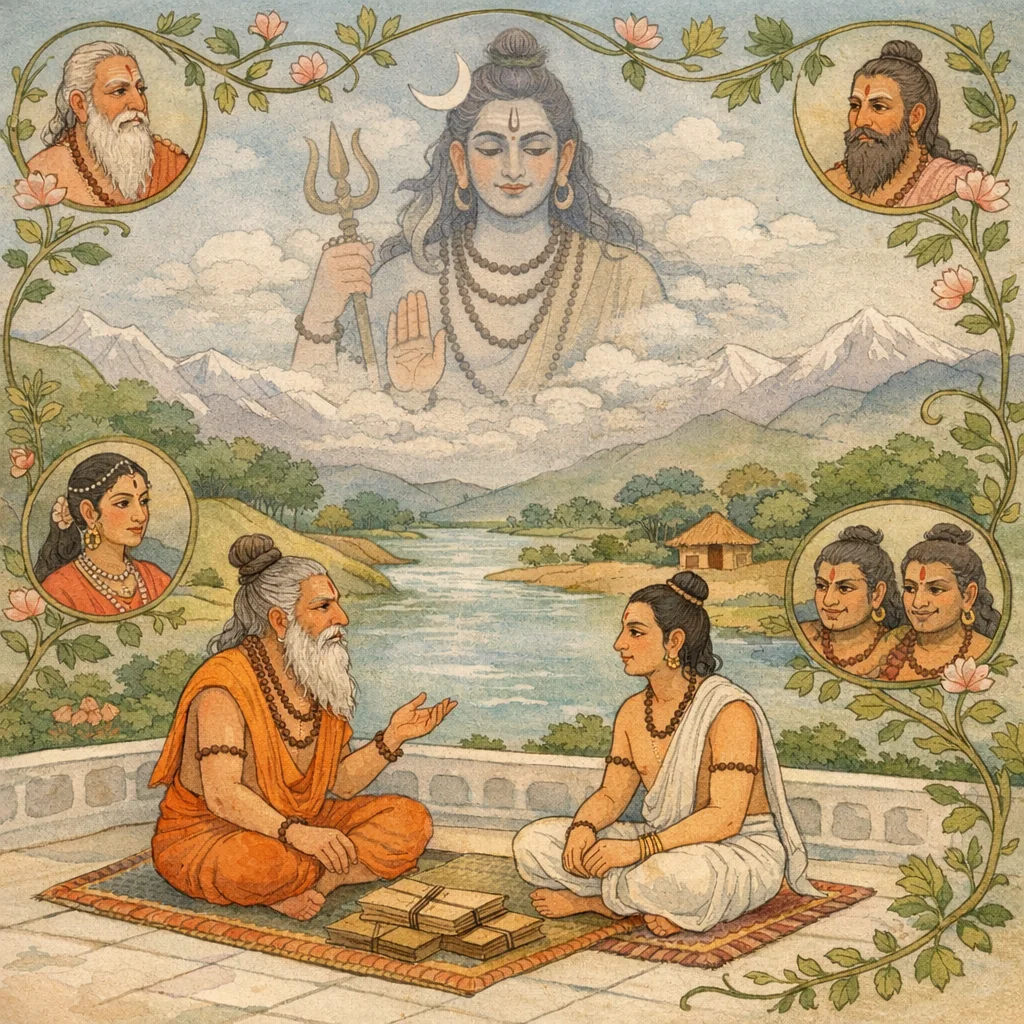
गाणपत्यदानकथा (Bāṇāsura Receives Gaṇapatya; Genealogical Prelude)
Adhyāya 51 begins with a dialogic handoff: Vyāsa asks Sanatkumāra to recount the carita of Śaśimauli Śiva, especially how Śiva, out of affection, granted Bāṇāsura “gāṇapatya” (affiliation and authority within Śiva’s gaṇa-sphere). Sanatkumāra agrees, presenting the tale as Śiva-līlā and a meritorious itihāsa, meant to delight and to instruct. The chapter then turns to a purāṇic genealogical prelude: Marīci, Brahmā’s mind-born son, is introduced, followed by his son Kaśyapa, a chief agent of cosmic proliferation. Kaśyapa’s marriages to Dakṣa’s daughters are noted, with Diti highlighted as the eldest and mother of the Daityas. From Diti are born two mighty sons—Hiraṇyakaśipu (elder) and Hiraṇyākṣa (younger). This genealogical framework serves as the causal setup for later asura lineages and for Bāṇa’s emergence, preparing the ethical-theological question of how an asura can nevertheless receive Śiva’s grace and gaṇa-status.
Shlokas
Verse 1
व्यास उवाच । सनत्कुमार सर्वज्ञ श्राविता सुकथाद्भुता । भवतानुग्रहात्प्रीत्या शभ्वनुग्रहनिर्भरा
Vyāsa said: “O Sanatkumāra, O all-knowing one—through your gracious favor, you have lovingly caused me to hear this wondrous and excellent sacred narrative, which is filled with the grace of Śambhu (Lord Śiva).”
Verse 2
इदानीं श्रोतुमिच्छामि चरितं शशिमौलिनः । गाणपत्यं ददौ प्रीत्या यथा बाणासुराय वै
Now I wish to hear the sacred account of the Moon-crested Lord (Śiva)—how, in gracious delight, He bestowed upon Bāṇāsura the status of Gaṇapatya, a place of belonging and lordship among His Gaṇas.
Verse 3
सनत्कुमार उवाच । शृणु व्यासादरात्तां वै कथां शंभोः परात्मनः । गाणपत्यं यथा प्रीत्या ददौ बाणा सुराय हि
Sanatkumāra said: Listen, indeed, to the sacred tale of Śambhu, the Supreme Self, received with reverence from Vyāsa—how, out of affection, He bestowed upon Bāṇa the status of Gaṇapatya.
Verse 4
अत्रैव सुचरित्रं च शंकरस्य महाप्रभोः । कृष्णेन समरोप्यत्र शंभोर्बाणानुगृह्णतः
Here itself is also the noble account of Śaṅkara, the great Lord—how, in this very battle brought about by Kṛṣṇa, Śambhu graciously bestowed His favor upon Bāṇa.
Verse 5
अत्रानुरूपं शृणु मे शिवलीलान्वितं परम् । इतिहासं महापुण्यं मनःश्रोत्रसुखावहम्
Now, listen to me as I relate what is fitting here—an exalted account imbued with Lord Śiva’s divine play. It is a supremely meritorious sacred history, bringing delight to both the mind and the ear.
Verse 6
ब्रह्मपुत्रो मरीचिर्यो मुनिरासीन्महामतिः । मानसस्सर्वपुत्रेषु ज्येष्ठः श्रेष्ठः प्रजापतिः
Marīci, the son of Brahmā, was a great-minded sage. Among all the mind-born sons, he was the eldest and the most excellent Prajāpati.
Verse 7
तस्य पुत्रो महात्मासीत्कश्यपो मुनिसत्तमः । सृष्टिप्रवृद्धकोऽत्यंतं पितुर्भक्तो विधेरपि
His son was the great-souled Kaśyapa, the finest among sages—one who greatly expanded creation, and who was supremely devoted both to his father and also to Vidhi (Brahmā, the Ordainer).
Verse 8
स्वस्य त्रयोदशमितादक्षकन्या स्सुशीलिकाः । कश्यपस्य मुनेर्व्यास पत्न्यश्चासन्पतिव्रताः
The thirteen daughters of Dakṣa—virtuous and of noble conduct—became the devoted, chaste (pativratā) wives of the sage Kaśyapa, O Vyāsa.
Verse 9
तत्र ज्येष्ठा दितिश्चासीद्दैत्यास्तत्तनयास्स्मृताः । अन्यासां च सुता जाता देवाद्यास्सचराचराः
There, Diti was the eldest, and her sons are remembered as the Daityas. From the other wives were born offspring beginning with the Devas—indeed, the whole creation, moving and unmoving.
Verse 10
ज्येष्ठायाः प्रथमौ पुत्रौ दितेश्चास्तां महाबलौ । हिरण्यकशिपुर्ज्येष्ठो हिरण्याक्षोऽनुजस्ततः
From Diti, the elder wife, were born the first two sons, both exceedingly mighty: the elder was Hiraṇyakaśipu, and thereafter the younger was Hiraṇyākṣa.
Verse 11
हिरण्यकशिपोः पुत्राश्चत्वारो दैत्यसत्तमाः । ह्रादानुह्रादसंह्रादा प्रह्रादश्चेत्यनुक्रमात्
Hiraṇyakaśipu had four sons—foremost among the Daityas—namely Hrāda, Anuhrāda, Saṃhrāda, and, in due order, Prahrāda.
Verse 12
प्रह्रादस्तत्र हि महान्विष्णुभक्तो जितेन्द्रियः । यं नाशितुं न शक्तास्तेऽभवन्दैत्याश्च केपि ह
There, Prahlāda was indeed a great soul—devoted to Viṣṇu and master of his senses. Those Daityas were not capable of destroying him at all, though they tried in various ways.
Verse 13
विरोचनः सुतस्तस्य महा दातृवरोऽभवत् । शक्राय स्वशिरो योऽदाद्याचमानाय विप्रतः
His son Virocana became famed as an excellent and mighty giver; for when Indra (Śakra) came to him disguised as a brahmin and begged, Virocana bestowed even his own head in charity.
Verse 14
तस्य पुत्रो बलिश्चासीन्महादानी शिवप्रियः । येन वामनरूपाय हरयेऽदायि मेदिनी
His son was Bali, a supremely generous king and a beloved devotee of Śiva; it was he who bestowed the earth upon Hari, who had assumed the form of Vāmana.
Verse 15
तस्यौरसः सुतो बाणश्शिवभक्तो बभूव ह । मान्यो वदान्यो धीमांश्च सत्यसंधस्स हस्रदः
From him was born his own son, Bāṇa, who indeed became a devoted worshipper of Lord Śiva. Honored by all, generous in giving, intelligent, steadfast in truth, he was famed as a bestower of thousands of gifts.
Verse 16
शोणिताख्ये पुरे स्थित्वा स राज्यमकरोत्पुरा । त्रैलोक्यं च बलाञ्ज्जित्वा तन्नाथानसुरेश्वरः
Dwelling in the city called Śoṇita, that lord of the Asuras established his sovereignty. By sheer force he conquered the three worlds and brought their rulers into subjection.
Verse 17
तस्य बाणासुरस्यैव शिवभक्तस्य चामराः । शंकरस्य प्रसादेन किंकरा इव तेऽभवन्
By Śaṅkara’s grace, the Cāmaras belonging to that Bāṇāsura—who was indeed a devotee of Śiva—became like attendants in service, as though they were Śiva’s own servants.
Verse 18
तस्य राज्येऽमरान्हित्वा नाभवन्दुःखिताः प्रजाः । सापत्न्यादुःखितास्ते हि परधर्मप्रवर्तिनः
In his reign, once the gods’ interference was set aside, the subjects did not fall into distress. Those tormented by rivalry and other afflictions were, in truth, people who had turned to alien duties, straying from their own path of dharma.
Verse 19
सहस्रबाहुवाद्येन स कदाचिन्महासुरः । तांडवेन हि नृत्येनातोषयत्तं महेश्वरम्
Once, that mighty Asura, with the resounding music of his thousand arms, performed the Tāṇḍava dance and thereby pleased Mahādeva, the Great Lord Mahēśvara.
Verse 20
तेन नृत्येन संतुष्टस्सुप्रसन्नो बभूव ह । ददर्श कृपया दृष्ट्या शंकरो भक्तवत्सलः
Pleased by that dance, Śaṅkara became wholly delighted and serene. The Lord—ever affectionate to His devotees—looked upon (him) with a compassionate gaze.
Verse 21
भगवान्सर्वलोकेश्शशरण्यो भक्तकामदः । वरेण च्छंदयामास बालेयं तं महासुरम्
Bhagavān Śiva, Lord of all worlds—refuge of those who seek shelter and fulfiller of devotees’ rightful desires—then gratified the great asura Bāleya by granting him a boon.
Verse 22
शंकर उवाच । बालेयः स महादैत्यो बाणो भक्तवरस्सुधीः । प्रणम्य शंकरं भक्त्या नुनाव परमेश्वरम्
Shankara said: That great asura Bāṇa, the son of Bali—noble in devotion and wise—bowed to Shankara with heartfelt bhakti and began to praise the Supreme Lord, Parameśvara.
Verse 23
बाणासुर उवाच । देवदेव महादेव शरणागतवत्सल । संतुष्टोऽसि महेशान ममोपरि विभो यदि
Bāṇāsura said: O God of gods, O Mahādeva, tender to those who seek refuge; O Maheśāna, all-pervading Lord—if you are pleased with me, then grant me your grace.
Verse 24
मद्रक्षको भव सदा मदुपस्थः पुराधिपः । सर्वथा प्रीतिकृन्मे हि ससुतस्सगणः प्रभो
O Lord, sovereign of the city, remain ever near me and be my constant protector. In every way grant me joy and favor—together with your sons and your attendant hosts (gaṇas), O Master.
Verse 25
सनत्कुमार उवाच । बलिपुत्रस्स वै बाणो मोहितश्शिवमायया । मुक्तिप्रदं महेशानं दुराराध्यमपि ध्रुवम्
Sanatkumāra said: “Truly, Bāṇa, the son of Bali, was deluded by Śiva’s māyā. Yet Maheśāna—bestower of liberation and indeed hard to propitiate—remains ever constant.”
Verse 26
स भक्तवत्सलः शंभुर्दत्त्वा तस्मै वरांश्च तान् । तत्रोवास तथा प्रीत्या सगणस्ससुतः प्रभुः
That Śambhu, ever tender toward His devotees, granted him those boons. Then, pleased at heart, the Lord remained there—together with His gaṇas and with His son.
Verse 27
स कदाचिद्बाणपुरे चक्रे देवासुरैस्सह । नदीतीरे हरः क्रीडां रम्ये शोणितकाह्वये
Once, in Bāṇa’s city, Hara (Lord Śiva), together with the devas and the asuras, sported in divine play on the lovely bank of the river called Śoṇita.
Verse 28
ननृतुर्जहसुश्चापि गंधर्वासरसस्तथा । जेयुः प्रणेमुर्मुनय आनर्चुस्तुष्टुवुश्च तम्
The Gandharvas and Apsarases danced and laughed in joy; the sages cried, “Victory!”, bowed down, offered worship, and praised Him—Lord Śiva—utterly delighted.
Verse 29
ववल्गुः प्रथमास्सर्वे ऋषयो जुहुवुस्तथा । आययुः सिद्धसंघाश्च दृदृशुश्शांकरी रतिम्
First, all the ṛṣis danced in joy and likewise poured oblations into the sacred fire. Then hosts of Siddhas arrived and beheld the divine love-play of Śaṅkara and His Śakti.
Verse 30
कुतर्किका विनेशुश्च म्लेच्छाश्च परिपंथिनः । मातरोभिमुखास्तस्थुर्विनेशुश्च विभीषिका
The sophists who lived by false reasoning, the mlecchas and hostile marauders of the road were destroyed. The Mothers (Mātṛkās), facing the foe, stood firm; and the forces of ruin and terror were likewise brought to destruction.
Verse 31
रुद्रसद्भावभक्तानां भवदोषाश्च विस्तृताः । तस्मिन्दृष्टे प्रजास्सर्वाः सुप्रीतिं परमां ययुः
The faults of saṃsāra that trouble even those devoted to Rudra with sincere feeling were set forth in detail. Yet, upon beholding Him, all the people attained the highest gladness and deep contentment.
Verse 32
ववल्गुर्मुनयस्सिद्धाः स्त्रीणां दृष्ट्वा विचेष्टितम् । पुपुषुश्चापि ऋतवस्स्वप्रभावं तु तत्र च
Seeing the strange, agitating behavior of the women, the perfected sages became inwardly disturbed; and there, even the seasons, too, began to manifest and intensify their own distinctive powers.
Verse 33
ववुर्वाताश्च मृदवः पुष्पकेसरधूसराः । चुकूजुः पक्षिसंघाश्च शाखिनां मधुलम्पटाः
Gentle breezes blew, greyed with the pollen of blossoms; and flocks of birds, greedy for the honey upon the trees, warbled sweetly.
Verse 34
पुष्पभारावनद्धानां रारट्येरंश्च कोकिलाः । मधुरं कामजननं वनेषूपवनेषु च
In the forests and groves, trees were laden with the burden of blossoms, and the cuckoos cried out delightfully. Everywhere there arose a sweetness that awakens desire—an enchanting springtime charm pervading the woods and gardens.
Verse 35
ततः क्रीडाविहारे तु मत्तो बालेन्दुशेखरः । अनिर्जितेन कामेन दृष्टाः प्रोवाच नन्दिनम्
Then, during their sportive revelry, Bālenduśekhara (Lord Śiva, the wearer of the crescent moon), stirred with divine play, beheld them—his desire not yet subdued—and spoke to Nandin.
Verse 36
चन्द्रशेखर उवाच । वामामानय गौरीं त्वं कैलासात्कृतमंडनाम् । शीघ्रमस्माद्वनाद्गत्वा ह्युक्त्वाऽकृष्णामिहानय
Chandrashekhara (Lord Śiva) said: “Bring my beloved Gaurī from Kailāsa, adorned with her ornaments. Go quickly from this forest; having informed Akṛṣṇā, bring her here.”
Verse 37
सनत्कुमार उवाच । स तथेति प्रतिज्ञाय गत्वा तत्राह पार्वतीम् । सुप्रणम्य रहो दूतश्शंकरस्य कृतांजलिः
Sanatkumāra said: “Agreeing, ‘So be it,’ he gave his pledge and went there. In private, Śaṅkara’s messenger addressed Pārvatī; bowing deeply and with hands joined in reverence.”
Verse 38
नन्दीश्वर उवाच । द्रष्टुमिच्छति देवि त्वां देवदेवो महेश्वरः । स्ववल्लभां रूपकृतां मयोक्तं तन्निदेशतः
Nandīśvara said: “O Goddess, Mahādeva, the God of gods, Mahēśvara, desires to behold you. By His command I have fashioned that form for you, befitting His beloved.”
Verse 39
सनत्कुमार उवाच । ततस्तद्वचनाद्गौरी मंडनं कर्तुमादरात् । उद्यताभून्मुनिश्रेष्ठ पतिव्रतपरायणा
Sanatkumāra said: Then, at those words, Gaurī—steadfast in the dharma of wifely fidelity to her Lord—rose eagerly to adorn herself, O best of sages.
Verse 40
आगच्छामि प्रभुं गच्छ वद तं त्वं ममाज्ञया । आजगाम ततो नंदी रुद्रासन्नं मनोगतिः
“I shall come. Go to the Lord and convey this by my command.” Thereupon Nandī, swift as thought, went and approached Rudra (Lord Śiva).
Verse 41
पुनराह ततो रुद्रो नन्दिनं परविभ्रमः । पुनर्गच्छ ततस्तात क्षिप्रमा नय पार्वतीम्
Then Rudra, the Supreme Lord—unshaken and sovereign—again addressed Nandin: “Dear one, go once more at once, and quickly bring Pārvatī.”
Verse 42
बाढमुक्त्वा स तां गत्वा गौरीमाह सुलोचनाम् । द्रष्टुमिच्छति ते भर्ता कृतवेषां मनोरमाम्
Having said, “So be it,” he went to fair-eyed Gaurī and told her: “Your husband desires to see you—adorned in a prepared and delightful attire.”
Verse 43
शंकरो बहुधा देवि विहर्तुं संप्रतीक्षते । एवं पतौ सुकामार्ते गम्यतां गिरिनंदिनि
O Goddess, Śaṅkara is waiting in many ways to sport in divine play. Since your Lord is yearning with loving desire, O daughter of the Mountain, go to him.
Verse 44
क्सरोभिस्समग्राभिरन्योन्यमभिमंत्रितम् । लब्धभावो यथा सद्यः पार्वत्या दर्शनोत्सुकः
Thus, with complete and mutually exchanged incantations and signals, he at once regained his composure and became eager to behold Pārvatī—his heart turning swiftly toward her presence.
Verse 45
अयं पिनाकी कामारिः वृणुयाद्यां नितंबिनीम् । सर्वासां दिव्यनारीणां राज्ञी भवति वै धुवम्
This Lord Pinākī, bearer of the Pināka and slayer of Kāma, will choose this maiden of fair hips; and she shall surely become the queen among all the divine women.
Verse 46
वीक्षणं गौरिरूपेण क्रीडयेन्मन्मथैर्गणैः । कामोऽयं हंति कामारिमूचुरन्योन्यमादताः
Assuming the form of Gaurī, he sportfully cast glances, accompanied by hosts of Kāma-like powers. Then they said to one another: “This desire indeed strikes even Kāma’s foe (Śiva).”
Verse 47
स्प्रष्टुं शक्नोति या काचिदृते दाक्षायणी स्त्रियम् । सा गच्छेत्तत्र निश्शंकं मोहयेत्पार्वतीपतिम्
Any woman who is able to approach and touch him—except Dākṣāyaṇī (Satī)—should go there without fear and attempt to bewilder the Lord of Pārvatī (Śiva).
Verse 48
कूष्मांडतनया तत्र शंकरं स्प्रष्टुमुत्सहे । अहं गौरीसुरूपेण चित्रलेखा वचोऽब्रवीत्
There, the daughter of Kūṣmāṇḍa said, “I am able to touch Śaṅkara.” Then Citralekhā, assuming the beautiful form of Gaurī, spoke these words.
Verse 49
चित्रलेखोवाच । यदधान्मोहिनीरूपं केशवो मोह नेच्छया । पुरा तद्वैष्णवं योगमाश्रित्य परमार्थतः
Citralekhā said: “Formerly, Keśava assumed the form of Mohinī—not from any wish to delude, but by taking refuge in that Vaiṣṇava yogic power, in accord with the highest truth.”
Verse 50
उर्वश्याश्च ततो दृष्ट्वा रूपस्य परिवर्तनम् । कालीरूपं घृताची तु विश्वाची चांडिकं वपुः
Then, seeing Urvaśī’s form transformed, Ghṛtācī assumed the form of Kālī, and Viśvācī took on the fierce body of Cāṇḍikā.
Verse 51
इति श्रीशिवमहापुराणे द्वितीयायां रुद्रसंहितायां पञ्चमे युद्धखंडे ऊषा चरित्रवर्णनं शिवशिवाविवाहवर्णनं नामैकपंचाशत्तमोऽध्यायः
Thus, in the Śrī Śiva Mahāpurāṇa—within the Second, the Rudra-saṃhitā, in the Fifth section called the Yuddha-khaṇḍa—ends the fifty-first chapter, entitled “The narration of Ūṣā’s story” and “The description of the marriage of Śiva and Śivā (Pārvatī).”
Verse 52
मातॄणामप्यनुक्तानामनुक्ताश्चाप्सरोवराः । रत्नाद्रूपाणि ताश्चक्रुस्स्वविद्यासंयुता अनु
Even the Mother-goddesses whose names were not spoken—and the excellent Apsarās likewise unmentioned—then, endowed with their own occult vidyās, assumed forms like jewels and precious substances.
Verse 53
ततस्तासां तु रूपाणि दृष्ट्वा कुंभां डनंदिनी । वैष्णवादात्मयोगाच्च विज्ञातार्था व्यडंबयत्
Then, seeing their forms, Kumbhāṇḍanandinī—through inward yogic insight and her knowledge of Vaiṣṇava stratagems—recognized their intent and skillfully countered their display.
Verse 54
ऊषा बाणासुरसुता दिव्ययोगविशारदा । चकार रूपं पार्वत्या दिव्यमत्यद्भुतं शुभम्
Uṣā, the daughter of Bāṇāsura, skilled in divine yoga, fashioned for Pārvatī a supremely wondrous, radiant, and auspicious form.
Verse 55
महारक्ताब्जसंकाशं चरणं चोक्तमप्रभम् । दिव्यलक्षणसंयुक्तं मनोऽभीष्टार्थदायकम्
His foot, described as resembling a great red lotus, is said to be free from worldly glare; adorned with divine marks, it grants the devotee the fulfilment of the heart’s cherished aims.
Verse 56
तस्या रमणसंकल्पं विज्ञाय गिरिजा ततः । उवाच सर्वविज्ञाना सर्वान्तर्यामिनी शिवा
Then Girijā, perceiving her intent concerning her beloved, spoke—She who knows all, the all-indwelling Śivā, the inner ruler present within every heart.
Verse 57
गिरिजोवाच । यतो मम स्वरूपं वै धृतभूषे सखि त्वया । सकामत्वेन समये संप्राप्ते सति मानिनि
Girijā said: “O friend, O fair-ornamented one, since you have assumed my very form—at a time when desire has arisen and the destined moment has arrived—O proud one, listen.”
Verse 58
अस्मिंस्तु कार्तिके मासि ऋतुधर्मास्तु माधवे । द्वादश्यां शुक्लपक्षे तु यस्तु घोरे निशागमे
In the month of Kārtika—and likewise in Mādhava (Vaiśākha), when seasonal observances are enjoined—on the twelfth lunar day of the bright fortnight, whoever performs (this rite) at the dreadful approach of night…
Verse 59
कृतोपवासां त्वां भोक्ता सुप्तामंतःपुरे नरः । स ते भर्त्ता कृतो देवैस्तेन सार्द्धं रमिष्यसि
“While you are observing a fast, a man will violate you as you sleep within the inner chambers. The gods have appointed him as your husband; with him you shall dwell in conjugal enjoyment.”
Verse 60
आबाल्याद्विष्णुभक्तासि यतोऽनिशमतंद्रिता । एवमस्त्विति सा प्राह मनसा लज्जितानना
“Since childhood you have been a devotee of Viṣṇu, ever constant and untiring.” Hearing this, she—her face lowered in inner modesty—replied in her heart, “So be it.”
Verse 61
अथ सा पार्वती देवी कृतकौतुकमण्डना । रुद्रसंनिधिमागत्य चिक्रीडे तेन शंभुना
Then Goddess Pārvatī, adorned with festive ornaments, came into Rudra’s presence and, rejoicing, sported with Śambhu—revealing the auspicious intimacy of the Divine Lord in His saguṇa (manifest) aspect with His Śakti.
Verse 62
ततो रतांते भगवान्रुद्रश्चादर्शनं ययौ । सदारः सगणश्चापि सहितो दैवतैर्मुने
Then, when their amorous union had concluded, Bhagavān Rudra vanished from sight—O sage—together with His consort, His gaṇas, and accompanied by the assembled gods.
Frequently Asked Questions
The chapter announces and begins the narrative of Śiva granting “gāṇapatya” (gaṇa-affiliation/authority) to Bāṇāsura, then supplies a genealogical preface (Marīci → Kaśyapa → Diti → Hiraṇyakaśipu/Hiraṇyākṣa) to situate the asura lineage.
It suggests that Śiva’s anugraha can confer spiritual-political legitimacy beyond conventional deva/asura binaries, while genealogy functions as karmic-historical context rather than final determinism.
Śiva is invoked through epithets emphasizing transcendence and lordship—Śaśimauli (moon-crested), Śambhu/Śaṅkara, Mahāprabhu, Parātman—foregrounding grace and sovereignty as the chapter’s theological lens.