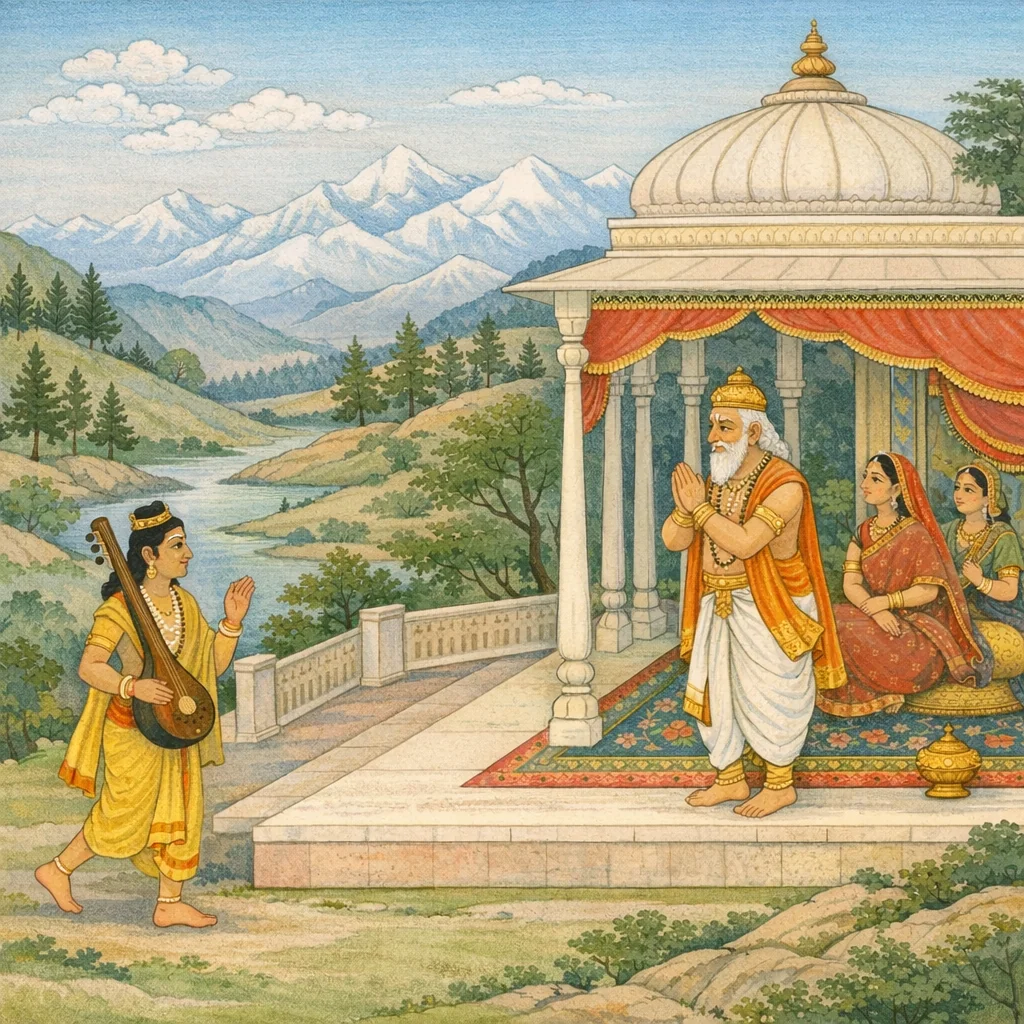
हिमालयगृहे नारदस्य आगमनम् तथा विश्वकर्मनिर्मितवैभववर्णनम् — Nārada’s Arrival at Himālaya’s Palace and the Description of Viśvakarman’s Marvels
In this chapter, Brahmā narrates a diplomatic messenger sequence connected with the forthcoming marriage of Śiva and Pārvatī. After consultation and with Śaṅkarī’s assent, Hari (Viṣṇu) sends the sage Nārada first to the mountain abode (Kudharālaya/Himālaya’s residence). Nārada bows to the Supreme Lord and reaches Himācala’s home, where he beholds a wondrous, deliberately fashioned setting attributed to Viśvakarman: a gem-inlaid pavilion on Himādri, crowned with golden finials and celestial ornaments, upheld by a thousand pillars and graced with a remarkable altar (vedikā). Astonished, Nārada asks Himavān, lord of mountains, whether the gods led by Viṣṇu, the sages, siddhas, and other divine beings have arrived, and whether Mahādeva—mounted on the bull and surrounded by gaṇas—has come for the marriage. Himavān replies with a factual explanation, and the narrative moves on to the preparations, arrivals, and protocol surrounding the sacred wedding.
Shlokas
Verse 1
ब्रह्मोवाच । ततस्सम्मन्त्र्य च मिथः प्राप्याज्ञां शांकरीं हरिः । मुने त्वाम्प्रेषयामास प्रथमं कुधरालयम्
Brahmā said: Then, after consulting together and obtaining Śāṅkarī’s permission, Hari (Viṣṇu) sent you first, O sage, to Kudharālaya.
Verse 2
अथ प्रणम्य सर्वेशं गतस्त्वं नारदाग्रतः । हरिणा नोदितः प्रीत्या हिमाचलगृहम्प्रति
Then, having bowed to the Lord of all, you set out ahead of Nārada; and, urged with affection by Hari (Viṣṇu), you proceeded toward the home of Himācala, the king of mountains (Himālaya).
Verse 3
त्वं मुनेऽपश्य आत्मानं गत्वा तद्व्रीडयान्वितम् । कृत्रिमं रचितं तत्र विस्मितो विश्वकर्मणा
O sage, go and behold yourself there—endowed with that very sense of modesty. There you will see an artificial form fashioned by Viśvakarman, and you will be astonished.
Verse 4
श्रान्तस्त्वमात्मना तेन कृत्रिमेण महामुने । अवलोकपरस्सोऽभूच्चरितं विश्वकर्मणः
O great sage, by that contrived, artificial undertaking you have wearied yourself; and you have become intent only on watching the deeds and craftsmanship of Viśvakarmā.
Verse 5
प्रविष्टो मण्डपस्तस्य हिमाद्रे रत्नचित्रितम् । सुवर्णकलशैर्जुष्टं रम्भादिबहुशोभितम्
He entered that pavilion upon Himālaya, richly inlaid with gems, adorned with golden pitchers, and splendidly beautified by Rambhā and other celestial maidens.
Verse 6
सहस्रस्तम्भसंयुक्तं विचित्रम्परमाद्भुतम् । वेदिकां च तथा दृष्ट्वा विस्मयं त्वं मुने ह्ययाः
Seeing that altar-platform—joined with a thousand pillars, ornate and supremely wondrous—you, O sage, were indeed overcome with astonishment.
Verse 7
तदावोचश्च स मुने नारद त्वं नगेश्वरम् । विस्मितोऽतीव मनसि नष्टज्ञानो विमूढधीः
Then, O sage, Nārada—his mind utterly astonished—spoke to the Lord of the Mountain; his understanding had slipped away, and his intellect was bewildered.
Verse 8
आगतास्ते किमधुना देवा विष्णुपुरोगमाः । तथा महर्षयस्सर्वे सिद्धा उपसुरास्तथा
“Why have those gods come here now—led by Viṣṇu? And likewise, why have all the great sages, the Siddhas, and the attendant divine beings also arrived?”
Verse 9
महादेवो वृषारूढो गणैश्च परिवारितः । आगतः किं विवाहार्थं वद तथ्यं नगेश्वर
Mahādeva—mounted upon the bull and surrounded by His gaṇas—has arrived. O Lord of the mountains, tell me truly: has He come here for the purpose of marriage?
Verse 10
ब्रह्मोवाच । इत्येवं वचनं श्रुत्वा तव विस्मित चेतसः । उवाच त्वां मुने तथ्यं वाक्यं स हिमवान् गिरिः
Brahmā said: Having thus heard your words, while your mind was filled with wonder, Himavān, the king of mountains, spoke to you, O sage, a truthful and fitting reply.
Verse 11
हिमवानुवाच । हे नारद महाप्राज्ञागतो नैवाधुना शिवः । विवाहार्थं च पार्वत्यास्सगणस्सवरातकः
Himavān said: “O Nārada, great wise one, Śiva has not yet arrived even now—He who is coming for Pārvatī’s marriage, accompanied by His gaṇas and with the bridal procession.”
Verse 12
विश्वकर्मकृतं चित्रं विद्धि नारद सद्धिया । विस्मयन्त्यज देवर्षे स्वस्थो भव शिवं स्मर
Know with right understanding, O Nārada, that this wondrous creation is fashioned by Viśvakarmā. Abandon astonishment, O divine seer; become composed and remember Śiva.
Verse 13
भुक्त्वा विश्रम्य सुप्रीतः कृपां कृत्वा ममोपरि । मैनाकादिधरैस्सार्द्धं गच्छ त्वं शंकरान्तिकम्
Having eaten and rested, and being well pleased, show compassion to me; then, together with Maināka and the other mountain-lords, go to Lord Śaṅkara’s presence.
Verse 14
एभिस्समेतो गिरिभिर्महामत संप्रार्थ्य शीघ्रं शिवमत्र चानय । देवैस्समेतं च महर्षिसंघैस्सुरासुरैरर्चितपादपल्लवम्
O great-minded one, accompanied by these mountains, earnestly beseech Śiva and quickly bring Him here—Him whose lotus-feet are worshipped by the gods together with the hosts of great sages, and revered by both the devas and the asuras.
Verse 15
ब्रह्मोवाच । तथेति चोक्त्वागम आशु हि त्वं सदैव तैश्शैलसुतादिभिश्च । तत्रत्यकृत्यं सुविधाय भुक्त्वा महामनास्त्वं शिवस न्निधानम्
Brahmā said: “So be it.” Having spoken thus, you should come quickly, ever accompanied by Śailasutā (Pārvatī) and the others. Having duly attended to the duties there and received hospitality with fitting ease, O great-souled one, you shall then proceed to the very presence (abode) of Śiva.
Verse 16
तत्र दृष्टो महादेवो देवादिपरिवारितः । नमस्कृतस्त्वया दीप्तश्शैलैस्तैर्भक्तितश्च वै
There you beheld Mahādeva, surrounded by the foremost of the gods. With devotion you bowed to Him; and those radiant mountains too, in reverence, offered their homage.
Verse 17
तदा मया विष्णुना च सर्वे देवास्सवासवाः । पप्रच्छुस्त्वां मुने सर्वे रुद्रस्यानुचरास्तथा
Then, along with me and Viṣṇu, all the gods—together with Indra—questioned you, O sage; and likewise all the attendants of Rudra also questioned you.
Verse 18
विस्मिताः पर्वतान्दृष्ट्वा सन्देहाकुलमानसाः । मैनाकसह्यमेर्वाद्यान्नानालंकारसंयुतान्
Beholding the mountains, they were struck with wonder, their minds agitated by doubt—seeing Maināka, Sahya, Meru and others, all adorned with many diverse ornaments.
Verse 19
देवा ऊचुः । हे नारद महाप्राज्ञ विस्मितस्त्वं हि दृश्यसे । सत्कृतोऽसि हिमागेन किं न वा वद विस्तरात्
The Devas said: “O Nārada, great sage of lofty wisdom, you indeed appear astonished. You have been honoured by Himavān, the lord of the Himalayas. What, then, has occurred? Tell us in full detail.”
Verse 20
एते कस्मात्समायाताः पर्वता इह सत्तमाः । मैनाकसह्यमेर्वाद्यास्सुप्रतापास्स्वलंकृताः
“For what reason have these excellent mountains come here—Maināka, Sahya, Meru and the rest—mighty in splendor and beautifully adorned?”
Verse 21
कन्यां दास्यति शैलोऽसौ स भवे वा न नारद । हिमालयगृहे तात किं भवत्यद्य तद्वद
O Nārada, whether that Mountain—Himālaya—will truly give his daughter in marriage or not, tell me, dear one: what is happening today in the house of Himālaya?
Verse 22
इति सन्दिग्धमनसामस्माकं च दिवौकसाम् । वद् त्वं पृच्छमानानां सन्देहं हर सुव्रत
Thus our minds—ours and those of the dwellers in heaven as well—are filled with doubt. O you of noble vows, speak to us who ask, and take away this uncertainty.
Verse 23
ब्रह्मोवाच । इत्याकर्ण्य वचस्तेषां विष्ण्वादीनान्दिवौकसाम् । अवोचस्तान्मुने त्वं हि विस्मितस्त्वाष्ट्रमायया
Brahmā said: “Having thus heard the words of those celestials—Viṣṇu and the others—you, O sage, spoke to them, for you had been astonished by the Tvaṣṭṛ-born power of illusion.”
Verse 24
एकान्तमाश्रित्य च मां हि विष्णुमभाषथा वाक्यमिदं मुने त्वम् । शचीपतिं सर्वसुरेश्वरं वै पक्षाच्छिदं पूर्वरिपुन्धराणाम्
O sage, taking me—Viṣṇu—aside in private, you spoke these words: “(Approach) Indra, Śacī’s lord, the sovereign of all the gods—he who once cut the wings of the primordial enemies, the great mountains that turned hostile.”
Verse 25
नारद उवाच । त्वष्ट्रा कृतन्तद्विकृतं विचित्रं विमोहनं सर्वदिवौकसां हि । येनैव सर्वान्स विमोहितुं सुरान्समिच्छति प्रेमत एव युक्त्या
Narada said: “Indeed, Tvaṣṭṛ has fashioned a wondrous, extraordinary enchantment meant to delude all the dwellers of heaven. By that very device he desires to bewilder all the gods—through a strategy born of attachment (premā).”
Verse 26
पुरा कृतन्तस्य विमोहनन्त्वया सुविस्मृतन्तत् सकलं शचीपते । तस्मादसौ त्वां विजिगीषुरेव गृहे धुवन्तस्य गिरेर्महात्मन
O Śacīpati (Indra), formerly you utterly forgot everything because you were deluded by Kṛtānta (Death). Therefore that very one, intent on conquering you, has now come to the house of the great-souled Himālaya, while he is engaged in his rites.
Verse 27
अहं विमोहितस्तेन प्रतिरूपेण भास्वता । तथा विष्णुः कृतस्तेन ब्रह्मा शक्रोऽपि तादृशः
I was deluded by that radiant manifested form; likewise, Viṣṇu was made so (bewildered) by him, and Brahmā and even Śakra (Indra) became the same.
Verse 28
किम्बहूक्तेन देवेश सर्वदेवगणाः कृताः । कृत्रिमाश्चित्ररूपेण न किंचिदवशेषितम्
O Lord of the gods, what is the use of speaking at length? All the hosts of deities have been fashioned—artificially, in wondrous forms—so that nothing whatsoever remains unmade.
Verse 29
विमोहनार्थं सर्वेषां देवानां च विशेषतः । कृता माया चित्रमयी परिहासविकारिणी
To bewilder all beings—and most especially the gods—she fashioned a wondrous, many-hued Māyā: a playful power that brings forth sportive transformations.
Verse 30
ब्रह्मोवाच । तच्छुत्वा वचनस्तस्य देवेन्द्रो वाक्यमब्रवीत् । विष्णुम्प्रति तदा शीघ्रं भयाकुलतनुर्हरिम्
Brahmā said: Having heard his words, Indra, lord of the gods, spoke in reply. Then, his body trembling with fear, he quickly addressed Hari—Viṣṇu.
Verse 31
देवेन्द्र उवाच । देवदेव रमानाथ त्वष्टा मां निहनिष्यति । पुत्रशोकेन तप्तोऽसौ व्याजेनानेन नान्यथा
Indra said: “O God of gods, O Lord of Ramā (Śrī), Tvaṣṭṛ will strike me down. Burned by grief for his son, he seeks my death under this pretext—surely for no other reason.”
Verse 32
ब्रह्मोवाच । तस्य तद्वचनं श्रुत्वा देवदेवो जनार्दनः । उवाच प्रहसन् वाक्यं शक्रमाश्वासयंस्तदा
Brahmā said: Hearing his words, Janārdana—the God of gods—spoke then with a gentle smile, reassuring Śakra (Indra).
Verse 33
विष्णुरुवाच । निवातकवचैः पूर्वं मोहितोऽसि शचीपते । महाविद्यावलेनैव दानवैः पूर्ववैरिभिः
Viṣṇu said: “O lord of Śacī (Indra), in former times you were deluded by the Nivātakavaca demons—ancient foes among the Dānavas—by the sheer power of their great occult knowledge (mahāvidyā).”
Verse 34
पर्वतो हिमवानेष तथान्यऽखिलपर्वताः । विपक्षा हि कृतास्सर्वे मम वाक्याच्च वासव
O Vāsava (Indra), this Himavān mountain—and indeed all other mountains as well—have been made your opponents, entirely by my command.
Verse 35
तेनुस्मृत्या तु वै दृष्ट्वा मायया गिरयो ह्यमी । जेतुमिच्छन्तु ये मूढा न भेतव्यमरावपि
But having perceived—through that recollection—the mountains fashioned by Māyā, those deluded ones may indeed wish to conquer them; yet even then, O foe-crusher, there is no need to fear at all.
Verse 36
ईश्वरो नो हि सर्वेषां शंकरो भक्तवत्सलः । सर्वथा कुशलं शक्र करिष्यति न संशयः
Śaṅkara is indeed the Lord of us all, ever affectionate to His devotees. O Śakra (Indra), He will surely bring about welfare and well-being in every way—of this there is no doubt.
Verse 37
ब्रह्मोवाच । एवं संवदमानन्तं शक्रं विकृतमानसम् । हरिणोक्तश्च गिरिशो लौकिकीं गतिमाश्रितः
Brahmā said: While Śakra (Indra), his mind disturbed, was speaking in this manner, Girīśa (Lord Śiva)—instructed by Hari (Viṣṇu)—assumed an outwardly worldly course of action (for the sake of the divine play and the order of the worlds).
Verse 38
ईश्वर उवाच । हे हरे हे सुरेशान किम्ब्रूथोऽद्य परस्परम् । इत्युक्त्वा तौ महेशानो मुने त्वाम्प्रत्युवाच सः
Īśvara said: “O Hari, O lord of the gods, what are you two saying to one another today?” Having thus addressed them, that Mahēśāna then spoke in reply to you, O sage.
Verse 39
किंनु वक्ति महाशैलो यथार्थं वद नारद । वृत्तान्तं सकलम्ब्रूहि न गोप्यं कर्तुमर्हसि
“What indeed did the great mountain say? Speak the truth, O Nārada. Tell me the entire account in full—you ought not to keep it concealed.”
Verse 40
ददाति वा नैव ददाति शैलस्सुतां स्वकीयां वद तच्च शीघ्रम् । किन्ते दृष्टं किं कृतन्तत्र गत्वा प्रीत्या सर्वं तद्वदाश्वद्य तात
Tell me quickly whether the Lord of the Mountain gives his own daughter or does not give her. And what did you see there? What did you do after going there? O dear son, tell me everything at once with affection.
Verse 41
इति श्रीशिवमहापुराणे द्वितीयायां रुद्रसंहितायां तृतीये पार्वतीखण्डे मण्डपरचनावर्णनं नामैकचत्वारिंशोऽध्यायः
Thus ends the forty-first chapter, called “The Description of the Arrangement and Construction of the Maṇḍapa (ritual pavilion),” in the Pārvatī-khaṇḍa—the third section of the Rudra-saṃhitā, within the second part of the Śrī Śiva Mahāpurāṇa.
Verse 42
नारद उवाच । देवदेव महादेव शृणु मद्वचनं शुभम् । नास्ति विघ्नभयं नाथ विवाहे किंचिदेव हि
Narada said: “O God of gods, O Mahadeva, hear my auspicious words. O Lord, in this marriage there is truly no fear of obstacles whatsoever.”
Verse 43
अवश्यमेव शैलेशस्तुभ्यं दास्यति कन्यकाम् । त्वामानयितुमायाता इमे शैला न संशयः
Surely the Lord of the Mountains will give you his maiden daughter. These mountain-lords have come to escort you back—of this there is no doubt.
Verse 44
किन्तु ह्यमरमोहार्थं माया विरचिताद्भुता । कुतूहलार्थं सर्वज्ञ न कश्चिद्विघ्नसम्भवः
Yet this wondrous Māyā has been fashioned only to bewilder the immortals; it is meant merely for divine sport and curiosity. O Omniscient One, in truth no obstacle whatsoever can arise for You.
Verse 45
विचित्रम्मण्डपं गेहेऽकार्षीत्तस्य तदाज्ञया । विश्वकर्मा महामायी नानाश्चर्यमयं विभो
O mighty one, by his command Viśvakarmā—endowed with great creative power and Māyā—constructed within the house a wondrous, elaborate pavilion, filled with many marvels.
Verse 46
सर्वदेवसमाजश्च कृतस्तत्र विमोहनः । तन्दृष्ट्वा विस्मयं प्राप्तोहं तन्मायाविमोहितः
There, a bewildering assembly of all the gods was conjured. Seeing it, I was seized with astonishment, for I had been deluded by that very Māyā.
Verse 47
ब्रह्मोवाच । तच्छ्रुत्वा तद्वचस्तात लोकाचारकरः प्रभुः । हर्षादीन्प्रहसञ्छम्भुरुवाच सकलान्सुरान्
Brahmā said: Hearing those words, O dear one, the Lord—who establishes the proper conduct of the worlds—Śambhu, smiling with joy and the like, spoke to all the gods.
Verse 48
ईश्वर उवाच । कन्यां दास्यति चेन्मह्यं पर्वतो हि हिमाचलः । मायया मम किं कार्यं वद विष्णो यथातथम्
Īśvara said: “If the mountain Himācala truly gives his daughter to Me, then what need have I of Māyā? Tell Me, O Viṣṇu, exactly as it is.”
Verse 49
हे ब्रह्मञ्छक्र मुनयस्तुरा ब्रूत यथार्थतः । मायया मम किं कार्यं कन्यां दास्यति चेद्गिरिः
O Brahmā, O Śakra (Indra), and you sages—quickly tell me the truth as it truly is. What need have I of any contrivance of māyā? If Girirāja (Himālaya) is willing, he will give his daughter (Pārvatī) in marriage.
Verse 50
केनाप्युपायेन फलं हि साध्यमित्युच्यते पण्डितैर्न्यायविद्भिः । तस्मात्सर्वैर्गम्यतां शीघ्रमेव कार्यार्थिभिर्विष्णुपुरोगमैश्च
The learned—those skilled in nyāya, right reasoning—declare that a desired result can indeed be accomplished by some suitable means. Therefore let everyone proceed at once, quickly—especially those intent on fulfilling the task—with Viṣṇu himself going in the lead.
Verse 51
ब्रह्मोवाच । एवं संवदमानोऽसौ देवैश्शम्भुरभूत्तदा । कृतः स्मरेणैव वशी वशं वा प्राकृतो नरः
Brahmā said: At that time, as Śambhu was conversing with the gods, he was, by Kāma—the god of desire—alone made as though brought under control, like an ordinary worldly man who falls under another’s power.
Verse 52
अथ शम्भ्वाज्ञया सर्वे विष्ण्वाद्या निर्जरास्तदा । ऋषयश्च महात्मानो ययुर्मोहभ्रमापहम्
Then, by Śambhu’s command, all the deathless gods—Viṣṇu and the rest—together with the great-souled sages, set forth to Him who dispels delusion and error.
Verse 53
पुरस्कृत्य मुने त्वां च पर्वतांस्तान्सविस्मयाः । हिमाद्रेश्च तदा जग्मुर्मन्दिरम्परमाद्भुतम्
Honouring you, O sage, by placing you in the forefront, and marvelling at those mountains, they then proceeded to the supremely wondrous abode of Himālaya.
Verse 54
अथ विष्ण्वादिसंयुक्तो मुदितैस्स्वबलैर्युतः । आजगामोपहैमागपुरं प्रमुदितो हरः
Then Hara (Lord Śiva), accompanied by Viṣṇu and the other gods, and attended by His own delighted retinue, joyfully arrived at the city called Upahaimāga.
Frequently Asked Questions
Nārada is sent as an initial envoy to Himālaya’s abode in the lead-up to the Śiva–Pārvatī marriage narrative, where he witnesses extraordinary preparations and seeks confirmation of the divine entourage’s arrival.
The ‘kṛtrima’ yet divinely crafted pavilion symbolizes the transformation of worldly space into ritual-cosmic space: architecture becomes theology, preparing a locus where Śiva–Śakti union can be ritually and cosmically enacted.
Śiva appears as Mahādeva vṛṣārūḍha (bull-mounted) with gaṇas, while Viśvakarman’s craftsmanship manifests divine order through form; the assembly of gods/sages indicates a pan-cosmic participation in the event.