अविमुक्तक्षेत्रमाहात्म्य (The Greatness of Avimukta–Vārāṇasī and Viśveśvara)
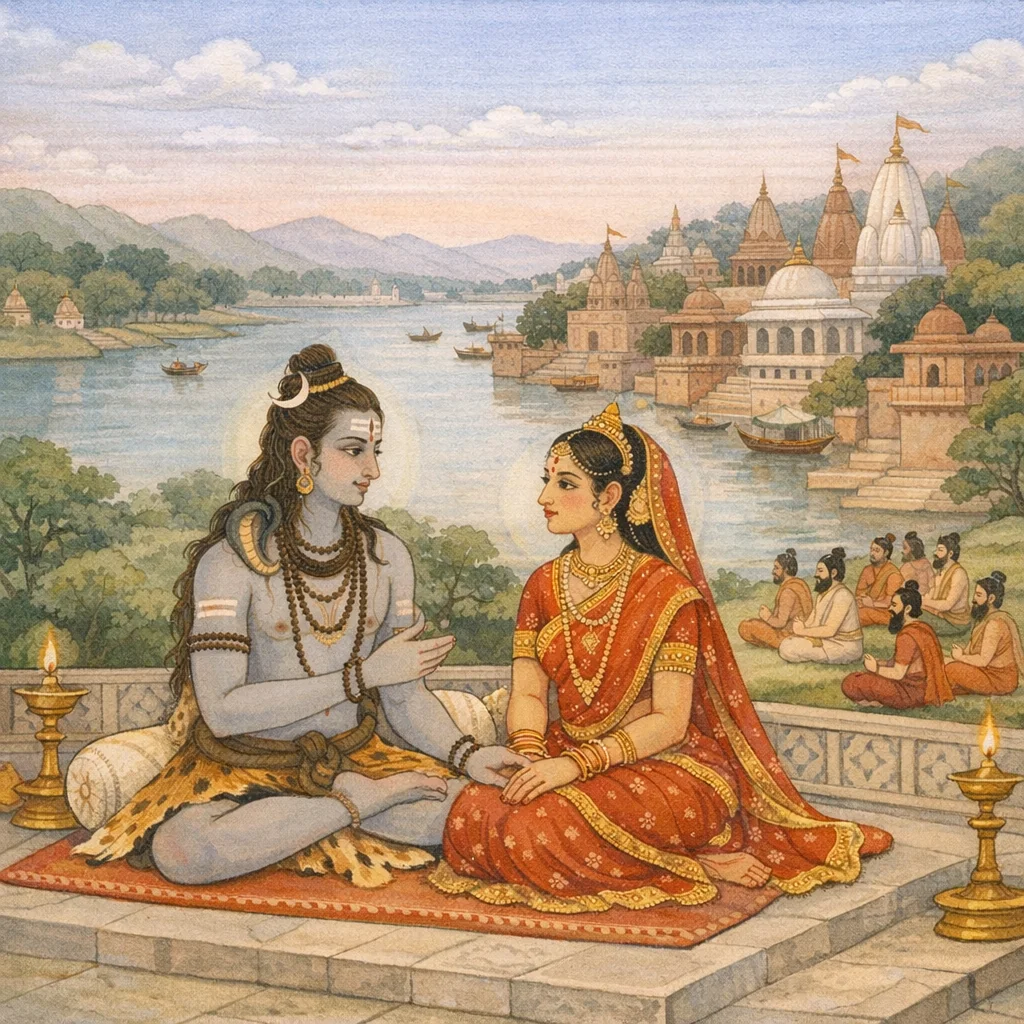
Adhyāya 23 begins with the ṛṣis asking Sūta why Vārāṇasī is uniquely meritorious and to describe the prabhāva (efficacy) of Avimukta. Sūta gives a concise yet authoritative account of Vārāṇasī’s splendor and the māhātmya of Viśveśvara. The chapter then turns to a paradigmatic divine dialogue: Pārvatī, out of compassion for the welfare of beings (lokānāṃ hitakāmyayā), asks Śaṅkara to explain fully the greatness of the sacred kṣetra. Śiva (Parameśvara) praises the question as auspicious and beneficial, declaring Avimukta/Vārāṇasī to be his most secret and constant abode, a universal cause of mokṣa. The kṣetra is portrayed as ever inhabited by siddhas and disciplined practitioners devoted to Śiva’s vow, practicing great yoga with conquered senses, oriented toward both bhukti and mukti. The theological emphasis is that sacred geography is soteriological, not merely commemorative: Vārāṇasī is an enduring locus of Śiva’s presence where yogic and ritual disciplines culminate in liberation under Viśveśvara’s guardianship.
Shlokas
Verse 1
ऋषय ऊचुः । एवं वाराणसी पुण्या यदि सूत महापुरी । तत्प्रभावं वदास्माकमविमुक्तस्य च प्रभो
The sages said: “If Vārāṇasī is truly a holy and great city, O Sūta, then tell us its greatness—and also the divine power of Avimukta, O revered one.”
Verse 2
सूत उवाच । वक्ष्ये संक्षेपतस्सम्यग्वाराणस्यास्सुशोभनम् । विश्वेश्वरस्य माहात्म्यं श्रूयतां च मुनीश्वराः
Sūta said: “I shall now rightly describe, in brief, the splendid glory of Vārāṇasī. O best of sages, listen also to the māhātmya—the sacred greatness—of Lord Viśveśvara.”
Verse 3
कदाचित्पार्वती देवी शङ्करं परया मुदा । लोककामनयापृच्छन्माहात्म्यमविमुक्तयोः
Once, the Goddess Pārvatī, filled with supreme joy, asked Śaṅkara—out of compassion for the welfare and aspirations of the world—about the greatness of Avimukta, the sacred place never abandoned by Śiva.
Verse 4
पार्वत्युवाच । अस्य क्षेत्रस्य माहात्म्यं वक्तुमर्हस्य शेषतः । ममोपरि कृपां कृत्वा लोकानां हितकाम्यया
Pārvatī said: “You should describe in full, leaving nothing out, the sacred greatness of this holy place. Showing compassion to me, speak it completely for the welfare of all worlds.”
Verse 5
सूत उवाच । देव्यास्तद्वचनं श्रुत्वा देवदेवो जगत्प्रभुः । प्रत्युवाच भवानीं तां जीवानां प्रियहेतवे
Sūta said: Having heard the Goddess’s words, the God of gods—the Lord of the universe—replied to Bhavānī, for the sake of what is dear and beneficial to living beings.
Verse 6
परमेश्वर उवाच । साधु पृष्टं त्वया भद्रे लोकानां सुखदं शुभम् । कथयामि यथार्थं वै महा त्म्यमविमुक्तयोः
The Supreme Lord said: “O noble lady, you have asked well—an auspicious question that brings welfare and happiness to the worlds. I shall now declare, in accordance with truth, the true glory of Avimukta.”
Verse 7
इदं गुह्यतमं क्षेत्रं सदा वाराणसी मम । सर्वेषामेव जंतूनां हेतुर्मोक्षस्य सर्वथा
“This is My most secret and supremely hidden sacred field—Varanasi, ever Mine. For all living beings, it is in every way a direct cause of liberation (moksha).”
Verse 8
अस्मिन्सिद्धास्सदा क्षेत्रे मदीयं व्रतमाश्रिताः । नानालिंगधरा नित्यं मम लोकाभिकांक्षिणः
In this sacred kṣetra, the siddhas always abide, taking refuge in My vow. Ever bearing various forms of the Liṅga, they constantly long to attain My divine world.
Verse 9
अभ्यस्यंति महायोगं जितात्मानो जितेन्द्रियाः । परं पाशुपतं श्रौतं भुक्तिमुक्तिफलप्रदम्
Those who have conquered the mind and mastered the senses diligently practice the Great Yoga—the supreme Pāśupata discipline taught in the Śruti—which bestows the fruits of both worldly enjoyment and final liberation.
Verse 10
रोचते मे सदा वासो वाराणस्यां महेश्वरि । हेतुना येन सर्वाणि विहाय शृणु तद्ध्रुवम्
O Maheshvarī, dwelling in Vārāṇasī ever delights Me. Hear with certainty the reason for which, setting aside all else, I choose that abode.
Verse 11
यो मे भक्तश्च विज्ञानी तावुभौ मुक्तिभागिनौ । तीर्थापेक्षा च न तयोर्विहिता विहिते समौ
Whoever is My devotee, and whoever is a knower endowed with true spiritual discernment—both are entitled to liberation. For these two, dependence upon pilgrimage to sacred tīrthas is not enjoined; in prescribed discipline and right conduct, they stand as equals.
Verse 12
जीवन्मुक्तौ तु तौ ज्ञेयौ यत्रकुत्रापि वै मृतौ । प्राप्नुतो मोक्षमाश्वेव मयोक्तं निश्चितं वचः
Know these two to be liberated even while living; and wherever they may die, they swiftly attain mokṣa. This is My certain and definitive declaration.
Verse 13
अत्र तीर्थे विशेषोस्त्यविमुक्ताख्ये परोत्तमे । श्रूयतां तत्त्वया देवि परशक्ते सुचित्तया
In this sacred tīrtha there is a special excellence—at the supremely exalted place called Avimukta. O Goddess, O Supreme Śakti, listen with a clear and attentive mind to its true principle.
Verse 14
सर्वे वर्णा आश्रमाश्च बालयौवनवार्द्धकाः । अस्यां पुर्यां मृताश्चेत्त्स्युर्मुक्ता एव न संशयः
All people—of every varṇa and every āśrama, whether in childhood, youth, or old age—if they die in this sacred city, are indeed liberated; of this there is no doubt.
Verse 15
अशुचिश्च शुचिर्वापि कन्या परिणता तथा । विधवा वाथ वा वंध्या रजोदोषयुतापि वा
Whether she is ritually impure or pure—whether a maiden or a married woman; whether a widow or even barren; even if she is affected by menstrual impurity—she is not to be excluded, for devotion (bhakti) to Śiva is not denied on these grounds.
Verse 16
प्रसूता संस्कृता कापि यादृशी तादृशी द्विजाः । अत्र क्षेत्रे मृता चेत्स्यान्मोक्षभाङ् नात्र संशयः
O twice-born ones, whatever her condition of birth and however refined (or unrefined) she may be, if she dies in this sacred kṣetra, she will indeed attain liberation (mokṣa). Of this there is no doubt.
Verse 17
स्वेदजश्चांडजो वापि द्युद्भिज्जोऽथ जरायुजः । मृतो मोक्षमवाप्नोति यथात्र न तथा क्वचित्
Whether born from sweat, from an egg, from sprouting through the earth, or from a womb—whoever dies here attains liberation. Such a bestowal of mokṣa is found here, and nowhere else.
Verse 18
ज्ञानापेक्षा न चात्रैव भत्तयपेक्षा न वै पुनः । कर्मापेक्षा न देव्यत्र दानापेक्षा न चैव हि
O Goddess, here there is no dependence at all on doctrinal knowledge, nor again on elaborate devotion. In this matter no ritual action is required, and indeed no gifts or charity are required either.
Verse 19
संस्कृत्यपेक्षा नैवात्र ध्यानापेक्षा न कर्हिचित् । नामापेक्षार्चनापेक्षा सुजातीनां तथात्र न
Here there is no dependence on refined learning or formal cultivation, nor is meditation ever a strict requirement. Likewise, for the well-born there is no compulsory dependence on merely uttering the Name or even on elaborate ritual worship.
Verse 20
मम क्षेत्रे मोक्षदे हि यो वा वसति मानवः । यथा तथा मृतः स्याच्चेन्मोक्षमाप्नोति निश्चितम्
“Any person who dwells in My kṣetra, which indeed bestows liberation—no matter in what manner he may die—certainly attains mokṣa.”
Verse 21
एतन्मम पुरं दिव्यं गुह्याद्गुह्यतरं प्रिये । ब्रह्मादयोऽपि जानंति माहात्म्यं नास्य पार्वति
Beloved, this is My divine city—more secret than the secret itself. Even Brahmā and the other gods do not know its true greatness, O Pārvatī.
Verse 22
महत्क्षेत्रमिदं तस्मादविमुक्तमिति स्मृतम् । सर्वेभ्यो नैमिषादिभ्यः परं मोक्षप्रदं मृते
Therefore this is a supremely great sacred field, remembered as Avimukta. Even beyond all holy places such as Naimiṣa and the rest, it is the highest bestower of liberation for one who dies here.
Verse 23
इति श्रीशिवमहापुराणे चतुर्थ्यां कोटिरुद्रसंहितायां काशीविश्वेश्वरज्योतिर्लिङ्गमाहात्म्यवर्णनंनामत्रयोविंशोध्याय
Thus, in the Śrī Śiva Mahāpurāṇa, in the Fourth section called the Koṭirudrasaṃhitā, ends the twenty-third chapter entitled “The Description of the Greatness of the Kāśī Viśveśvara Jyotirliṅga.”
Verse 24
कामं भुंजन्स्वपन्क्रीडन्कुर्वन्हि विविधाः क्रियाः । अविमुक्ते त्यजन्प्राणाञ्जंतुर्मोक्षाय कल्पते
Even while freely enjoying pleasures—eating, sleeping, playing, and performing various actions—any living being who gives up the vital breath in Avimukta becomes fit for liberation (moksha).
Verse 25
कृत्वा पापसहस्राणि पिशाचत्वं वरं नृणाम् । न च क्रतुसहस्रत्वं स्वर्गे काशीं पुरीं विना
Even after committing thousands of sins, for men it is preferable to become a piśāca; but even gaining in heaven the fruit of a thousand Vedic sacrifices is not to be desired if it is without the sacred city of Kāśī.
Verse 26
तस्मात्सर्वप्रयत्नेन सेव्यते काशिका पुरी । अव्यक्तलिंगं मुनिभिर्ध्यायते च सदाशिवः
Therefore, with every earnest effort, the sacred city of Kāśī should be revered and served; for there the sages meditate upon Sadāśiva as the unmanifest Liṅga, beyond form.
Verse 27
यद्यत्फलं समुद्दिश्य तपन्त्यत्र नरः प्रिये । तेभ्यश्चाहं प्रय च्छामि सम्यक्तत्तत्फलं धुवम्
Beloved, whatever fruit a person seeks and, with that aim, performs austerity here—unto them I grant, in full measure, that very fruit, assuredly and unfailingly.
Verse 28
सायुज्यमात्मनः पश्चादीप्सितं स्थानमेव च । न कुतश्चित्कर्मबंधस्त्यजतामत्र वै तनुम्
Thereafter, they attain sāyujya—union with the Lord—and indeed reach the desired supreme abode; for those who cast off the body here, no bondage of karma arises from any quarter.
Verse 29
ब्रह्मा देवर्षिभिस्सार्द्धं विष्णुर्वापि दिवाकरः । उपासते महात्मानस्सर्वे मामिह चापरे
Here, Brahmā along with the divine seers—and also Viṣṇu and the Sun—worship Me; indeed, all great-souled beings and many others as well adore Me in this very place.
Verse 30
विषयासक्तचित्तोऽपि त्यक्त धर्मरुचिर्नरः । इह क्षेत्रे मृतो यो वै संसारं न पुनर्विशेत्
“Even a man whose mind is attached to sense-objects, and who has abandoned all taste for dharma—if he truly dies here in this sacred field, he does not enter saṃsāra again.”
Verse 31
किं पुनर्निर्ममा धीरासत्त्वस्था दंभवर्जिताः । कृतिनश्च निरारंभास्सर्वे ते मयि भाविताः
“How much more so those steady souls who are free from possessiveness, established in purity (sattva), and devoid of hypocrisy—those accomplished ones who act without self-serving enterprise: all of them are inwardly absorbed in Me (Śiva).”
Verse 32
जन्मांतरसहस्रेषु जन्म योगी समाप्नुयात् । तदिहैव परं मोक्षं मरणादधिगच्छति
“After thousands of successive births, one may at last obtain a birth as a yogin; but the one who attains this Shiva-oriented realization here itself reaches the supreme liberation immediately upon death.”
Verse 33
अत्र लिंगान्यनेकानि भक्तैस्संस्थापितानि हि । सर्वकामप्रदानीह मोक्षदानि च पार्वति
Here, O Pārvatī, many Liṅgas have indeed been established and consecrated by devotees. In this very place they grant the fulfillment of all rightful desires, and they also bestow mokṣa (liberation).
Verse 34
पंचक्रोशं चतुर्दिक्षु क्षेत्रमेतत्प्रकीर्तितम् । समंताच्च तथा जंतोर्मृतिकालेऽमृतप्रदम्
This sacred region is declared to extend for five krośas in the four directions; and all around, for a living being, it bestows immortality—liberation—at the time of death.
Verse 35
अपापश्च मृतो यो वै सद्यो मोक्षं समश्नुते । सपापश्च मृतौ यस्स्यात्कायव्यूहान्समश्नुते
Indeed, one who dies free from sin attains liberation immediately. But one who dies burdened with sin undergoes further embodied formations, taking on successive bodily states according to the web of karma.
Verse 36
यातनां सोनुभूयैव पश्चान्मोक्षमवाप्नुयात् । पातकं योऽविमुक्ताख्ये क्षेत्रेऽस्मिन्कुरुते ध्रुवम्
Even if one commits sin in this sacred field called Avimukta, he surely first undergoes the torments that are due; thereafter, he attains liberation. Such is the unfailing power of this kṣetra under Lord Shiva’s grace.
Verse 37
भैरवीं यातनां प्राप्य वर्षाणामयुते पुनः । ततो मोक्षमवाप्नोति भुक्त्वा पापं च सुन्दरि
Having endured the “Bhairavī” torment for ten thousand years, and having thus exhausted the sin by tasting its fruit, O fair one, the soul thereafter attains mokṣa—liberation.
Verse 38
इति ते च समाख्याता पापाचारे च या गतिः । एवं ज्ञात्वा नरस्सम्यक्सेवयेदविमुक्तकम्
Thus have I explained to you the fate that befalls one who lives in sinful conduct. Knowing this, a person should rightly and wholeheartedly take refuge in the holy Avimukta (Kāśī), serving it with due reverence, and thus turn toward Śiva’s liberating grace.
Verse 39
कृतकर्मक्षयो नास्ति कल्पकोटिशतैरपि । अवश्यमेव भोक्तव्यं कृतं कर्म शुभाशुभम्
There is no destruction of karma once performed, even across hundreds of crores of kalpas. Whatever karma has been done—auspicious or inauspicious—must inevitably be experienced as its result.
Verse 40
केवलं चाशुभं कर्म नरकाय भवेदिह । शुभं स्वर्गाय जायेत द्वाभ्यां मानुष्यमीरितम्
Here, purely harmful action leads to hell, while wholesome action gives rise to heaven. From a mixture of both, human birth is said to arise.
Verse 41
जन्म सम्यगसम्यक् च न्यूनाधिक्ये भवेदिह । उभयोश्च क्षयो मुक्तिर्भवेत्सत्यं हि पार्वति
O Pārvatī, it is indeed true: in this world, birth may be proper or improper, and may occur with deficiency or with excess. When both these (defect and excess) are worn away, liberation (mokṣa) arises.
Verse 42
कर्म च त्रिविधं प्रोक्तं कर्मकाण्डे महेश्वरि । संचितं क्रियमाणं च प्रारब्धं चेति बंधकृत्
O Maheśvarī, in the sphere of ritual action (karmakāṇḍa), karma is declared to be threefold: the accumulated (saṃcita), the presently performed (kriyamāṇa), and that which has begun to bear fruit (prārabdha)—and this indeed becomes the maker of bondage.
Verse 43
पूर्वजन्मसमुद्भूतं संचितं समुदाहृतम् । भुज्यते च शरीरेण प्रारब्धं परिकीर्तितम्
Karma arising from former births is called “saṃcita,” the accumulated. That which is truly experienced and undergone through the body is proclaimed “prārabdha,” the karma already set in motion.
Verse 44
जन्मना यच्च क्रियते कर्म सांप्रतम् । शुभाशुभं च देवेशि क्रियमाणं विदुर्बुधाः
O Goddess, the wise know that whatever action is performed now, by the very fact of one’s birth, is karma in the making (kriyamāṇa), whether auspicious or inauspicious.
Verse 45
प्रारब्धकर्मणो भोगात्क्षयश्चैव चान्यथा । उपायेन द्वयोर्नाशः कर्मणोः पूजनादिना
Prārabdha karma is exhausted only by being experienced as its fruit (bhoga), and not otherwise. Yet, by a sacred means, both kinds of karma can be destroyed—through worship of Śiva and allied observances filled with devotion.
Verse 46
सर्वेषां कर्मणां नाशो नास्ति काशीं पुरीं विना । सर्वं च सुलभं तीर्थं दुर्ल्लभा काशिका पुरी
Without the sacred city of Kāśī, the destruction of all karmas is not attained. Other pilgrimage-places may be easy to reach, but the city of Kāśikā is rare to obtain as a true spiritual refuge.
Verse 47
पूर्वजन्मकृतं चेद्वै काशीदर्शनमादरात् । तदा काशीं च संप्राप्य लभेन्मृत्युं न चान्यथा
If indeed, in a former birth, one has earned the merit of reverently beholding Kāśī, then—having reached Kāśī in this life—one attains death there, and not otherwise. Such a death in Kāśī is upheld as a Śiva-granted passage toward liberation.
Verse 48
काशीं प्राप्य नरो यस्तु गंगायां स्नानमाचरेत् । तदा च क्रियमाणस्य संचितस्यापि संक्षयः
But the person who, having reached Kāśī, bathes in the Gaṅgā—then even the sins presently being accrued and those already accumulated are brought to destruction.
Verse 49
प्रारब्धं न विना भोगो नश्य तीति सुनिश्चितम् । मृतिश्च तस्य संजाता तदा तस्य क्षयो भवेत्
It is firmly ascertained that prārabdha karma is not destroyed without being experienced as its fruit (bhoga). When, through that very course, death comes to him, then his embodied existence comes to its end.
Verse 50
पूर्वं चैव कृता काशी पश्चात्पापं समाचरेत् । तद्बीजेन बलवता नीयते काशिका पुनः
If one has first attained the merit of Kāśī and later commits sin, then by the powerful seed of that prior merit and contact, one is led back to Kāśī again.
Verse 51
तदा सर्वाणि पापानि भस्मसाच्च भवंति हि । तस्मात्काशीं नरस्सेवेत्कर्मनिर्मूलनीं ध्रुवम्
Then indeed all sins are reduced to ashes. Therefore one should devotedly resort to Kāśī, for it surely uproots karma at its very root.
Verse 52
एकोऽपि ब्राह्मणो येन काश्यां संवासितः प्रिये । काशीवासमवाप्यैव ततो मुक्तिं स विंदति
Beloved, even if one causes just a single brāhmaṇa to dwell in Kāśī, by that very attainment of residence in Kāśī one thereafter obtains liberation.
Verse 53
काश्यां यो वै मृतश्चैव तस्य जन्म पुनर्नहि । समुद्दिश्य प्रयागे च मृतस्य कामनाफले
Whoever truly dies in Kāśī is not born again. And if, on behalf of the departed, one performs at Prayāga the rite of intention and offering, it becomes fruitful—fulfilling the desired spiritual aim for that deceased person.
Verse 54
संयोगश्च तयोश्चेत्स्यात्काशीजन्यफलं वृथा । यदि न स्यात्तयोर्योगस्तीर्थराजफलं वृथा
If there is only a mere conjunction of the two, then the fruit said to arise from Kāśī becomes futile. And if there is no true union of the two, then the fruit of the ‘King of Tīrthas’ also becomes futile.
Verse 55
तस्मान्मच्छासनाद्विष्णुस्सृष्टिं साक्षाद्धि नूतनाम् । विधाय मनसोद्दिष्टां तत्सिद्धिं यच्छति ध्रुवम्
Therefore, by My command, Viṣṇu indeed directly brings forth a fresh creation; and, having fashioned it according to what is conceived in the mind (of the ordained creator), he unfailingly grants its sure fulfilment.
Verse 56
सूत उवाच । इत्यादि बहुमाहात्म्यं काश्यां वै मुनिसत्तमाः । तथा विश्वेश्वरस्यापि भुक्तिमुक्तिप्रदं सताम्
Sūta said: “Thus, O best of sages, manifold is the greatness found in Kāśī; and likewise, Viśveśvara too bestows upon the virtuous both worldly enjoyment (bhukti) and final liberation (mukti).”
Verse 57
अतः परं प्रवक्ष्यामि माहात्म्यं त्र्यंबकस्य च । यच्छ्रुत्वा सर्वपापेभ्यो मुच्यते मानवः क्षणात्
Now, further, I shall proclaim the sacred glory of Tryambaka (Lord Śiva). Hearing it, a human being is instantly released from all sins.
Frequently Asked Questions
The chapter’s central theological argument is delivered via the Pārvatī–Śiva dialogue: Avimukta (Vārāṇasī) is declared Śiva’s perpetual, most secret abode and a universal instrument of mokṣa, validated through Sūta’s transmission to the sages.
Avimukta functions as a ‘guhyatama-kṣetra’ symbol: sacred space as an active soteriological medium. The presence of siddhas, vrata-observance, and Pāśupata-oriented yoga encode the idea that liberation is stabilized by disciplined embodiment within Śiva’s constant field of presence.
Śiva is foregrounded as Parameśvara/Śaṅkara speaking as the lord of the kṣetra, with Viśveśvara named as the focal form anchoring Vārāṇasī’s sanctity; Pārvatī appears as the compassionate interlocutor who elicits the teaching for the benefit of all beings.