Sarga 1
पम्पा-तीर-वर्णनम् / Rama’s Lament at Pampa and the Approach to Rishyamuka
किष्किन्धाकाण्ड
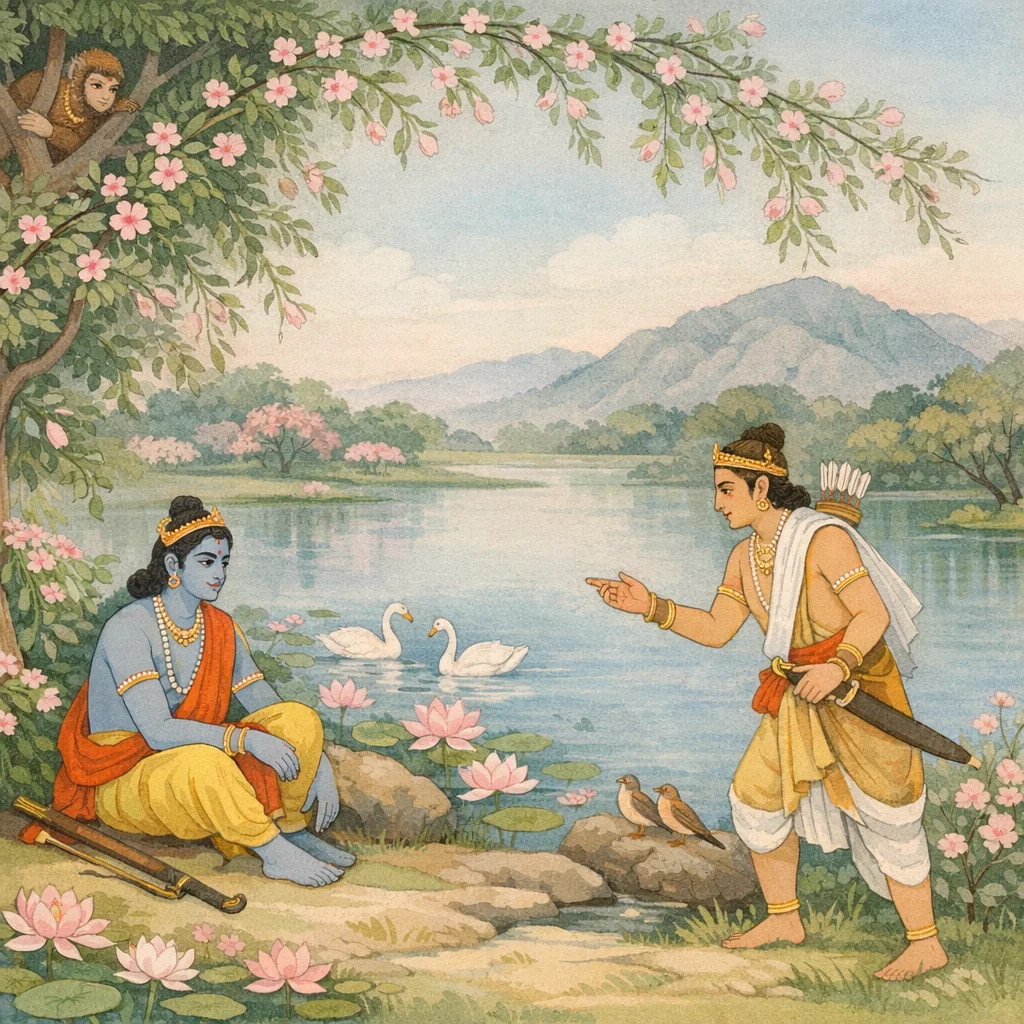
In this sarga, Rama, accompanied by Lakshmana, reaches the sacred lake Pampa and surveys the forest—filled with lotus and utpala, thronged with hamsa, karandava, and chakravaka birds, and adorned with rivers, cascades, and caves. The spring season (Madhava/Chaitra) is described in poetic detail: showers of blossoms, the hum of bees, the call of the kokila, the dance of peacocks, and luxuriant vines and vegetation. Yet this very beauty sharpens Rama’s sorrow: his separation from Vaidehi (Sita), his anxiety over dharma and social duty connected with Janaka, Kausalya, and Bharata, and a despair that questions the purpose of life itself. Lakshmana counsels him to be steadfast, abandon consuming grief, uphold courage and effort, and know that Ravana’s slaying is an unavoidable duty. Strengthened, Rama passes beyond Pampa and goes near Rishyamuka. There Sugriva, lord of the vanaras, seeing the two men of wondrous appearance, is seized by fear and suspicion, while the other vanaras, alarmed, seek refuge—thus setting the stage for Rama’s first contact with the vanaras.
Shlokas
Verse 1
स तां पुष्करिणीं गत्वा पद्मोत्पलझषाकुलाम्।रामस्सौमित्रि सहितो विललापाकुलेन्द्रियः।।।।
Reaching that lake teeming with lotuses, lilies, and fish, Rama—together with Saumitri—lamented, his senses thrown into turmoil.
Verse 2
तस्य दृष्ट्वैव तां हर्षादिन्द्रियाणि चकम्पिरे।स कामवशमापन्नस्सौमित्रिमिदमब्रवीत्।।।।
On seeing it, his senses trembled with joy; yet, overpowered by longing, he spoke these words to Saumitri (Lakshmana).
Verse 3
सौमित्रे शोभते पम्पा वैदूर्यविमलोदका।फुल्लपद्मोत्पलवती शोभिता विविधैर्द्रुमैः।।।।
O Saumitri, Lake Pampā shines—its waters clear like vaidūrya, filled with blooming lotuses and utpalas, and adorned with trees of many kinds.
Verse 4
सौमित्रे पश्य पम्पायाः काननं शुभदर्शनम्।यत्र राजन्ति शैला वा द्रुमास्सशिखरा इव।।।।
O Saumitri, look upon the lovely forest of Pampā, pleasing and auspicious to the eye—where the trees shine like mountains crowned with peaks.
Verse 5
मां तु शोकाभिसन्तप्तं माधवः पीडयन्ति वै।भरतस्य च दुःखेन वैदेह्या हरणेन च।।।।
But I, already scorched by sorrow, am truly tormented by spring—by Bharata’s grief as well, and by the abduction of Vaidehī.
Verse 6
शोकार्तस्यापि मे पम्पा शोभते चित्रकानना।व्यवकीर्णा बहुविधैः पुष्पैश्शीतोदका शिवा।।।।
Even though I am stricken with grief, Pampā still appears beautiful to me—adorned with wondrous woods, strewn with many kinds of flowers, cool-watered and auspicious.
Verse 7
नलिनैरपि सञ्छन्ना ह्यत्यर्थशुभदर्शना।सर्पव्यालानुचरिता मृगद्विजसमाकुला।।।।
Covered with lotuses and therefore exceedingly lovely to behold, it is also frequented by fierce serpents, and is filled with beasts and birds.
Verse 8
अधिकं प्रविभात्येतन्नीलपीतं तु शाद्वलम्।द्रुमाणां विविधैः पुष्पैः परिस्तोमैरिवार्पितम्।।।।
This bluish-yellow grassy ground shines all the more, as though a carpet were spread upon it with the many kinds of flowers fallen from the trees.
Verse 9
पुष्पभारसमृद्धानि शिखराणि समन्ततः।लताभिः पुष्पिताग्राभिरुपगूढानि सर्वशः।।।।
All around, the tree-tops are heavy with abundant blossoms, everywhere embraced and covered by creepers whose tips are in bloom.
Verse 10
सुखानिलोऽयं सौमित्रे कालः प्रचुरमन्मथः।गन्धवान्सुरभिर्मासो जातपुष्पफलद्रुमः।।।।
O Saumitri, this is the time when a gentle breeze blows and desire swells; the fragrant season has come, with trees bearing blossoms and fruits.
Verse 11
पश्य रूपाणि सौमित्रे वनानां पुष्पशालिनाम्।सृजतां पुष्पवर्षाणि तोयं तोयमुचामिव।।।।
Behold, O Saumitri, the lovely scenes of forests rich in blossoms—trees casting down showers of flowers like rainwater poured forth by the cloud-bearers.
Verse 12
प्रस्तरेषु च रम्येषु विविधाः काननद्रुमाः।वायुवेगप्रचलिताः पुष्पैरवकिरन्ति गाम्।।।।
On those lovely rocky stretches, many kinds of forest trees—shaken by the force of the wind—scatter flowers and carpet the ground.
Verse 13
पतितैः पतमानैश्च पादपस्थैश्च मारुतः।कुसुमैः पश्य सौमित्रे क्रीडन्निव समन्ततः।।।।
Behold, Saumitri: the wind seems to be playing everywhere with the flowers—some already fallen, some falling, and some still resting upon the trees.
Verse 14
विक्षिपन्विविधाश्शाखा नगानां कुसुमोत्कचाः।मारुतश्चलितस्थानैष्षट्पदैरनुगीयते।।।।
As the wind shakes the many flower-laden branches of the trees, it seems as though it is sung along by bees that flit from place to place.
Verse 15
मत्तकोकिलसन्नादैर्नर्तयन्निव पादपान्।शैलकन्दरनिष्क्रान्तः प्रगीत इव चानिलः।।।।
The wind, issuing from the mountain-caves, seems to sing sweetly; and with the rapturous calls of the cuckoos it is as though it makes the trees dance.
Verse 16
तेन विक्षिपताऽत्यर्थं पवनेन समन्ततः।अमी संसक्तशाखाग्रा ग्रथिता इव पादपाः।।।।
Shaken exceedingly by that wind on every side, these trees, their branch-tops interlaced, appear as though they have been knitted together.
Verse 17
स एष सुखसंस्पर्शो वाति चन्दनशीतलः।गन्धमभ्यवहन्पुण्यं श्रमापनयनोऽनिलः।।।।
This very wind blows with a pleasant touch, cool as sandalwood; bearing a pure fragrance, it seems to take away weariness.
Verse 18
अमी पवनविक्षिप्ता विनदन्तीव पादपाः।षट्पदैरनुकूजन्तो वनेषु मधुगन्धिषु।।।।
These trees, tossed by the wind, seem to resound as though singing; and in the honey-fragrant woods the bees hum together in chorus.
Verse 19
गिरिप्रस्थेषु रम्येषु पुष्पवद्भिर्मनोरमैः।संसक्तशिखराश्शैला विराजन्ते महाद्रुमैः।।।।
On these lovely mountain slopes, the mountains—whose peaks seem to meet—shine splendidly with great trees, delightful and laden with blossoms.
Verse 20
पुष्पसञ्छन्नशिखरा मारुतोत्क्षेपचञ्चलाः।अमी मधुकरोत्तंसाः प्रगीता इव पादपाः।।।।
These trees—with tops hidden by blossoms, trembling under gusty winds, and crowned by swarming bees—appear as though they are accomplished singers.
Verse 21
सुपुष्पितांस्तु पश्येमान्कर्णिकारांत्समन्ततः।हाटकप्रतिसञ्छन्नान्नरान्पीताम्बरानिव।।।।
Behold these karṇikāra trees, blooming everywhere—like people clad in yellow garments and adorned with golden ornaments.
Verse 22
अयं वसन्तस्सौमित्रे नानाविहगनादितः।सीतया विप्रहीनस्य शोकसन्दीपनो मम।।।।
O Saumitri, this spring—resounding with the calls of many kinds of birds—only kindles my sorrow, for I am separated from Sītā.
Verse 23
मां हि शोकसमाक्रान्तं सन्तापयति मन्मथः।हृष्टः प्रवदमानश्च ममाह्वयति कोकिलः।।।।
Even as I am overwhelmed by sorrow, Manmatha burns me; and the cuckoo—joyful and as though jeering—keeps calling out to me.
Verse 24
एष दात्यूहको हृष्टो रम्ये मां वननिर्झरे।प्रणदन्मन्मथाविष्टं शोचयिष्यति लक्ष्मण।।।।
Lakṣmaṇa, this joyful dātyūhaka, clucking by the lovely forest waterfall, torments me—already afflicted by love.
Verse 25
श्रुत्वैतस्य पुरा शब्दमाश्रमस्था मम प्रिया।मामाहूय प्रमुदिताः परमं प्रत्यनन्दत।।।।
Earlier, when my beloved lived in the āśrama, she would hear that very sound, call me to her with delight, and rejoice exceedingly.
Verse 26
एवं विचित्राः पतगा नानारावविराविणः।वृक्षगुल्मलताः पश्य सम्पतन्ति समन्ततः।।।।
See how these wondrous birds, calling out in many different ways, fly everywhere toward trees, shrubs, and vines.
Verse 27
विमिश्रा विहगाः पुम्भिरात्मव्यूहाभिनन्दिताः।भृङ्गराजप्रमुदितास्सौमित्रे मधुरस्वनाः।।।।
O Saumitri, the birds, mingled with their mates and acclaimed within their own flocks, gladdened by the great bees, sing in sweet notes.
Verse 28
दात्यूहरतिविक्रन्दैः पुंस्कोकिलरुतैरपि।स्वनन्ति पादपाश्चेमे ममानङ्गप्रदीपनाः।।।।
These trees resound with the love-cries of the dātyūhas and with the calls of male cuckoos as well—sounds that kindle Kāma within me.
Verse 29
अशोकस्तबकाङ्गारष्षट्पदस्वननिःस्वनः।मां हि पल्लवताम्रार्चिर्वसन्ताग्निः प्रधक्ष्यति।।।।
Indeed, the ‘fire of spring’ will burn me: Aśoka flower-clusters are its coals, the humming of bees its crackle, and the copper-red glow of tender leaves its flame.
Verse 30
न हि तां सूक्ष्मपक्ष्माक्षीं सुकेशीं मृदुभाषिणीम्।अपश्यतो मे सौमित्रे जीवितेऽस्ति प्रयोजनम्।।।।
O Saumitri, if I cannot see her—Sītā, with delicate eyelashes, lovely hair, and gentle speech—then truly my life has no purpose.
Verse 31
अयं हि दयितस्तस्याः कालो रुचिरकाननः।कोकिलाकुलसीमान्तो दयिताया ममानघ।।।।
O blameless one, this season—this lovely forest-time, whose borders are thronged with cuckoos—is dear to my beloved Sītā.
Verse 32
मन्मथाऽयाससम्भूतो वसन्तगुणवर्धितः।अयं मां धक्ष्यति क्षिप्रं शोकाग्निर्नचिरादिव।।।।
This fire of grief—born of love’s torment and intensified by the qualities of spring—will swiftly burn me, as though very soon.
Verse 33
अपश्यतस्तां दयितां पश्यतो रुचिरद्रुमान्।ममायमात्मप्रभवो भूयस्त्वमुपयास्यति।।।।
When I cannot see my beloved, even the sight of these beautiful trees makes this love, rising from within me, grow all the more.
Verse 34
अदृश्यमाना वैदेही शोकं वर्धयते मम।दृश्यमानो वसन्तश्च स्वेदसंसर्गदूषकः।।।।
When Vaidehī is unseen, my grief increases; and when spring is seen—spring that once dispelled the sweat of lovers’ embrace—my sorrow only deepens.
Verse 35
मां ह्यद्य मृगशाबाक्षी चिन्ताशोकबलात्कृतम्।सन्तापयति सौमित्रे क्रूरश्चैत्रवनानिलः।।।।
Today, O Saumitri, I—made helpless by the force of anxiety and grief for my fawn-eyed beloved—am tormented by the cruel breeze that moves through the spring forest of Caitra.
Verse 36
अमी मयूराश्शोभन्ते प्रनृत्यन्तस्ततस्ततः।स्वैः पक्षैः पवनोद्धूतैर्गवाक्षैः स्फाटिकैरिव।।।।
Those peacocks shine splendidly as they dance here and there, their own wings—tossed by the wind—like crystal windows flung open.
Verse 37
शिखिनीभिः परिवृतास्ते एते मदमूर्छिताः।मन्मथाभिपरीतस्य मम मन्मथवर्धनाः।।।।
Surrounded by peahens, these peacocks—intoxicated with passion—only increase desire in me, who am already overwhelmed by love-longing.
Verse 38
पश्य लक्ष्मण नृत्यन्तं मयूरमुपनृत्यति।शिखिनी मन्मथार्तैषा भर्तारं गिरिसानुनि।।।।
Look, Lakṣmaṇa: on the mountain slope this peahen, love-stricken, dances close to the dancing peacock—toward her mate.
Verse 39
तामेव मन्मथाविष्टो मयूरोऽप्युपधावति।वितत्य रुचिरौ पक्षौ रुतैरुपहसन्निव।।।।
And that peacock too, seized by desire, runs after her alone—spreading his lovely wings and calling out, as if laughing in play.
Verse 40
मयूरस्य वने नूनं रक्षसा न हृता प्रिया।तस्मान्नृत्यति रम्येषु वनेषु सह कान्तया।।।।
Surely the peacock’s beloved has not been carried off by a rākṣasa; therefore he dances joyfully in these lovely woods together with his mate.
Verse 41
मम त्वयं विना वासः पुष्पमासे सुदुस्सहः।पश्य लक्ष्मण संरागः तिर्यग्योनिगतेष्वपि।यदेषा शिखिनी कामाद्भर्तारं रमतेऽन्तिके।।।।
For me, dwelling in this flower-season is utterly unbearable without her. Look, Lakṣmaṇa—passion exists even among creatures born as animals and birds: this peahen, from desire, sports close to her mate.
Verse 42
मामप्येवं विशालाक्षी जानकी जातसम्भ्रमा।मदनेनाभिवर्तेत यदि नाऽपहृता भवेत्।।।।
If the large-eyed Jānakī had not been abducted, she too—stirred by love—would have drawn near to me in just this way.
Verse 43
पश्य लक्ष्मण पुष्पाणि निष्फलानि भवन्ति मे। पुष्पभारसमृद्धानां वनानां शिशिरात्यये।।4.1.43।।
Look, Lakshmana: at winter’s end, even the flowers of forests heavy with bloom become fruitless—of no use—to me.
Verse 44
रुचिराण्यपि पुष्पाणि पादपानामतिश्रिया।निष्फलानि महीं यान्ति समं मधुकरोत्करैः।।।।
Even the most lovely flowers—splendid on the trees—fall to the earth without meaning, along with swarms of bees.
Verse 45
नदन्ति कामं शकुना मुदितास्सङ्घशः कलम्। आह्वयन्त इवान्योन्यं कामोन्मादकरा मम।।4.1.45।।
The birds, joyful in flocks, sing sweetly at will, as though calling to one another—yet to me they only kindle the madness of longing.
Verse 46
वसन्तो यदि तत्रापि यत्र मे वसति प्रिया।नूनं परवशा सीता सापि शोचत्यहं यथा।।।।
If spring has come even to the place where my beloved dwells, then surely Sita—helpless under another’s power—grieves there just as I do.
Verse 47
नूनं न तु वसन्तोऽतं देशं स्पृशति यत्र सा।कथं ह्यसितपद्माक्षी वर्तयेत्सा मया विना।।।।
Surely spring does not touch that land where she is; for how could she—dark-lotus-eyed—endure life without me?
Verse 48
अथवा वर्तते तत्र वसन्तो यत्र मे प्रिया।किं करिष्यति सुश्रोणी सा तु निर्भर्त्सिता परैः।।।।
Or perhaps spring is present there where my beloved is—yet what can that fair-hipped lady do, when she is threatened and harassed by enemies?
Verse 49
श्यामा पद्मपलाशाक्षी मृदुपूर्वाभिभाषिणी।नूनं वसन्तमासाद्य परित्यक्ष्यति जीवितम्।।।।
That dark-complexioned lady with lotus-petal eyes, who once spoke gently first—on encountering spring—will surely abandon her life.
Verse 50
दृढं हि हृदये बुद्धिर्मम सम्परिवर्तते।नालं वर्तयितुं सीता साध्वी मद्विरहं गता।।।।
A firm conviction turns again and again within my heart: chaste Sītā, fallen into separation from me, may not have the strength to go on living.
Verse 51
मयि भावस्तु वैदेह्यास्तत्त्वतो विनिवेशितः।ममापि भावस्सीतायां सर्वथा विनिवेशितः।।।।
Vaidehī’s love is truly fixed upon me; and my love too is, in every way, firmly fixed upon Sītā.
Verse 52
एष पुष्पवहो वायुस्सुखस्पर्शो हिमावहः।तां विचिन्तयतः कान्तां पावकप्रतिमो मम।।।।
This breeze, bearing flowers, gentle to the touch and cool in its coming—yet for me, as I think upon that beloved, it feels like fire.
Verse 53
सदा सुखमहं मन्ये यं पुरा सह सीतया।मारुतस्स विना सीतां शोकं वर्धयते मम।।।।
That wind which I once, with Sītā, always deemed a joy—now, without Sītā, only increases my sorrow.
Verse 54
तां विना विहङ्गो यः पक्षी प्रणदितस्तदा।वायसः पादपगतः प्रहृष्टमभिनर्दति।।।।
That bird—the crow—which then cried out as though in lament when she was absent, now, perched upon a tree, calls out with cheerful sound.
Verse 55
एष वै तत्र वैदेह्या विहगः प्रतिहारकः।पक्षी मां तु विशालाक्ष्यास्समीपमुपनेष्यति।।।।
This very bird there is as it were Vaidehī’s attendant; it will lead me near that large-eyed one.
Verse 56
शृणु लक्ष्मण सन्नादं वने मद्विवर्धनम्।पुष्पिताग्रेषु वृक्षेषु द्विजानामुपकूजताम्।।।।
Listen, Lakṣmaṇa, to the swelling music in this forest—love-stirring—of the birds softly warbling upon the flower-crowned treetops.
Verse 57
विक्षिप्तां पवनेनैतामसौ तिलकमञ्जरीम्।षट्पदस्सहसाऽभ्येति मदोद्धूतामिव प्रियाम्।।।।
See how this bee hastens at once toward this cluster of tilaka blossoms, scattered by the wind—like a lover rushing toward his beloved, stirred by passion.
Verse 58
कामिनामयमत्यन्तमशोकश्शोकवर्धनः।स्तबकैः पवनोत्क्षिप्तैस्तर्जयन्निव मां स्थितः।।।।
For lovers, this aśoka tree is indeed a great increaser of grief; with its clusters flung up by the wind, it stands as though taunting me.
Verse 59
अमी लक्ष्मण दृश्यन्ते चूताः कुसुमशालिनः।विभ्रमोत्सिक्तमनसः साङ्गरागा नरा इव।।।।
O Lakṣmaṇa, look—these mango trees, laden with blossoms, appear like men: their minds intoxicated with amorous play, their bodies anointed with fragrant unguents.
Verse 60
सौमित्रे पश्य पम्पायाश्चित्रासु वनराजिषु।किन्नरा नरशार्दूल विचरन्ति ततस्ततः।।।।
O Saumitri—O tiger among men—look: in the wondrous forest-ranges by Lake Pampā, the Kinnaras are roaming here and there.
Verse 61
इमानि शुभगन्धीनि पश्य लक्ष्मण सर्वशः।नलिनानि प्रकाशन्ते जले तरुणसूर्यवत्।।।।
O Lakṣmaṇa, look all around: these sweet-fragrant lotuses gleam upon the water like the newly risen sun.
Verse 62
एषा प्रसन्नसलिला पद्मनीलोत्पलायुता।हंसकारण्डवाकीर्णा पम्पा सौगन्धिकान्विता।।।।
This is Pampā—clear-watered and serene, rich with red lotuses and blue water-lilies, filled with swans and geese, and pervaded with fragrance.
Verse 63
जले तरुणसूर्याभैष्षट्पदाहतकेसरैः।पङ्कजैश्शोभते पम्पा समन्तादभिसंवृता।।।।
Pampā is beautiful, covered on every side with lotuses in the water, their filaments pressed by bees, glowing like the young sun at dawn.
Verse 64
चक्रवाकयुता नित्यं चित्रप्रस्तवनान्तरा।मातङ्गमृगयूथैश्च शोभते सलिलार्थिभिः।।।।
Ever accompanied by cakravāka birds and bordered by charming woodland slopes, Pampā shines as herds of elephants and deer, seeking water, gather there.
Verse 65
पवनाहतवेगाभिरूर्मिभिर्विमलेऽम्भसि।पङ्कजानि विराजन्ते ताड्यमानानि लक्ष्मण।।।।
O Lakṣmaṇa, in this clear water the lotuses shine splendidly, struck and set in motion by waves driven by the force of the wind.
Verse 66
पद्मपत्रविशालाक्षीं सततं पङ्कजप्रियाम्।अपश्यतो मे वैदेहीं जीवितं नाभिरोचते।।।।
When I cannot see Vaidehī—whose eyes are wide like lotus petals, who ever loved the lotus—life itself no longer pleases me.
Verse 67
अहो कामस्य वामत्वं यो गतामपि दुर्लभाम्।स्मारयिष्यति कल्याणीं कल्याणतरवादिनीम्।।।।
Ah, how perverse is Kāma: he makes me remember that auspicious lady, whose voice is sweeter than all, though she is gone and hard to reach.
Verse 68
शक्यो धारयितुं कामो भवेदभ्यागतो मया।यदि भूयो वसन्तो मां न हन्यात्पुष्पितद्रुमः।।।।
I could endure the love that has come upon me—if only spring, with its blossoming trees, would not strike me again and again.
Verse 69
यानि स्म रमणीयानि तया सह भवन्ति मे।तान्येवारमणीयानि जायन्ते मे तया विना।।।।
Whatever was once delightful to me in her company—those very things become undelightful to me without her.
Verse 70
पद्मकोशपलाशानि द्रष्टुं दृष्टिर्हि मन्यते।सीताया नेत्रकोशाभ्यां सदृशानीति लक्ष्मण।।।।
My eyes long to look upon the tender petals around lotus buds, for they seem like Sītā’s beautiful eyelids, O Lakṣmaṇa.
Verse 71
पद्मकेसरसंसृष्टो वृक्षान्तरविनिस्सृतः।निश्श्वास इव सीताया वाति वायुर्मनोहरः।।।।
A delightful wind, scented by contact with lotus filaments and slipping through the spaces between trees, blows like the very breath of Sītā.
Verse 72
सौमित्रे पश्य पम्पाया दक्षिणे गिरिसानुनि।पुष्पितां कर्णिकारस्य यष्टिं परमशोभनाम्।।।।
O Saumitri, look—on the southern mountainside by Pampā—at that karnikāra tree’s branch, blossoming and exceedingly splendid.
Verse 73
अधिकं शैलराजोऽयं धातुभिः सुविभूषितः।विचित्रं सृजते रेणुं वायुवेगविघट्टितम्।।।।
This king of mountains, richly adorned with minerals, gives off abundant, multicolored dust, struck up by the force of the wind.
Verse 74
गिरिप्रस्थास्तु सौमित्रे सर्वतस्सम्प्रपुष्पितैः।निष्पत्रैस्सर्वतो रम्यैः प्रदीप्ता इव किंशुकैः।।।।
O Saumitri, the mountain ridges—everywhere—seem as though lit up by delightful kiṃśuka trees, leafless yet fully in flower.
Verse 75
पम्पातीररुहाश्चेमे संसक्ता मधुगन्धिनः।मालतीमल्लिकाषण्डाः करवीराश्च पुष्पिताः।।।।
Here on the banks of Pampā, closely clustered together, mālatī and mallikā thickets and karavīra plants stand in bloom, sweetly fragrant like honey.
Verse 76
केतक्यस्सिन्दुवाराश्च वासन्त्यश्च सुपुष्पिताः।माधव्यो गन्धपूर्णाश्च कुन्दगुल्माश्च सर्वशः।।।।
Ketaka and sinduvāra, vāsantī blossoms, fragrant mādhavī, and kunda shrubs—all of them—are in full bloom everywhere, laden with scent.
Verse 77
चिरिबिल्वा मधूकाश्च वञ्जुला वकुलास्तथा।चम्पकास्तिलकाश्चैव नागवृक्षास्सुपुष्पिताः।।।।नीपाश्च वरणाश्चैव खर्जूराश्च सुपुष्पिता।
Chiribilva and madhūka, vañjula and vakula, champaka and tilaka, and the nāga trees—all stand in splendid bloom; so too do the nīpa, varaṇa, and kharjūra trees, fully blossomed.
Verse 78
पद्मकाश्चैव शोभन्ते नीलाशोकाश्च पुष्पिताः।लोध्राश्च गिरिपृष्ठेषु सिंहकेसरपिञ्जराः।।।।
Lotuses are resplendent, and the blue aśoka trees too are in flower; and lodhra trees on the mountain backs gleam tawny-gold, like a lion’s mane.
Verse 79
अङ्कोलाश्च कुरण्टाश्च चूर्णकाः पारिभद्रकाः।चूताः पाटलयश्चैव कोविदाराश्च पुष्पिताः।।।।मुचुकुन्दार्जुनाश्चैव दृश्यन्ते गिरिसानुषु।केतकोद्दालकाश्चैव शिरीषाः शिंशुपा धवाः।।।।
On the mountain slopes one can see ankola and kuranta, cūrṇaka, and pārijāta-like trees; mango, pāṭalī, and kovidāra too—all in bloom. There also appear mucukunda and arjuna, as well as ketaka, uddālaka, śirīṣa, śiṃśupā, and dhava trees.
Verse 81
शाल्मल्यः किंशुकाश्चैव रक्ताः कुरवकास्तथा।।4.1.81।।त्रिनिशा नक्तमालाश्च चन्दनास्स्यन्दनास्तथा।
There are śālmali and kiṃśuka trees, and red kuravaka blossoms; also triniśā and naktamālā, along with fragrant sandalwood and syandana trees.
Verse 82
पुष्पितान्पुष्पिताग्राभिर्लताभिः परिवेष्टितान्। द्रुमान्पश्येह सौमित्रे पम्पाया रुचिरान्बहून्।।4.1.8283।।
O Saumitri, look here—on the banks of Pampā are many lovely trees, in full blossom, entwined with creepers whose very tips are flowering.
Verse 84
वातविक्षिप्तविटपान्यथाऽसन्नान्द्रुमानिमान्।लतास्समनुवर्तन्ते मत्ता इव वरस्त्रियः।।।।
As the wind sways the boughs and draws these trees close, the creepers follow after—like fair women, intoxicated, keeping step with their beloved.
Verse 85
पादपात्पादपं गच्छन् शैलाच्छैलं वनाद्वनम्।वाति नैकरसास्वादस्सम्मोदित इवानिलः।।।।
From tree to tree, from mountain to mountain, from forest to forest the wind blows—like one delighted by tasting many different fragrances.
Verse 86
केचित्पर्याप्तकुसुमाः पादपा मधुगन्धिनः।केचिन्मुकुलसंवीताः श्यामवर्णा इवाबभुः।।।।
Some trees stand laden with abundant blossoms and honey-sweet fragrance; others, covered with buds, appear as though dark-blue in hue.
Verse 87
इदं मृष्टमिदं स्वादु प्रफुल्लमिदमित्यपि।रागयुक्तो मधुकरः कुसुमेष्वेव लीयते।।।।
“This is tender; this is sweet; this is fully in bloom”—as if murmuring so, the bee, stirred by delight, clings only to the flowers and melts into them.
Verse 88
निलीय पुनरुत्पत्य सहसाऽन्यत्र गच्छति।मधुलुब्धो मधुकरः पम्पातीरद्रुमेष्वसौ।।।।
Resting and then rising again, it suddenly goes elsewhere; the honey-seeking bee, greedy for nectar, moves among the trees on Pampā’s bank.
Verse 89
इयं कुसुमसङ्घातैरुपस्तीर्णा सुखाकृता।स्वयं निपतितैर्भूमिश्शयनप्रस्तरैरिव।।।।
This ground, strewn with clusters of flowers that have fallen of themselves, has been made pleasant and comfortable—like a natural bed laid out with stone slabs for resting.
Verse 90
विविधा विविधैः पुष्पैस्तैरेव नगसानुषु।विकीर्णै पीतरक्ताहि सौमित्रे प्रस्तराः कृताः।।।।
O Saumitri, on the mountain slopes those very scattered flowers—varied in kind, yellow and red—seem to have formed many-colored stone slabs.
Verse 91
हिमान्ते पश्य सौमित्रे वृक्षाणां पुष्पसम्भवम्।पुष्पमासे हि तरवस्सङ्घर्षादिव पुष्पिताः।।।।
See, O Saumitri: at winter’s end the trees are laden with blossoms; in this month of flowers they stand in full bloom, as though vying with one another.
Verse 92
आह्वयन्त इवान्योन्यं नगाष्षट्पदनादिताः।कुसुमोत्तंसविटपाश्शोभन्ते बहु लक्ष्मण।।।।
O Lakṣmaṇa, the trees—echoing with the hum of bees—shine brightly; their branches, crowned with flowers, seem to call to one another.
Verse 93
एष कारण्डवः पक्षी विगाह्य सलिलं शुभम्।रमते कान्तया सार्धं काममुद्दीपयन्मम।।।।
See this kāraṇḍava bird: plunging into the clear, auspicious water, it sports with its beloved, stirring longing within me.
Verse 94
मन्दाकिन्यास्तु यदिदं रूपमेवं मनोहरम्।स्थाने जगति विख्याता गुणास्तस्या मनोरमाः।।।।
If the Mandākinī is so captivating in beauty as this, then rightly are her delightful virtues renowned throughout the world.
Verse 95
यदि दृश्येत सा साध्वी यदि चेह वसेमहि।स्पृहयेयं न शक्राय नायोध्यायै रघूत्तम।।।।
If only the virtuous Sītā could be seen—if only we could dwell here with her—O best of the Raghus, I would not yearn for Indra’s station, nor even for Ayodhyā.
Verse 96
नह्येवं रमणीयेषु शाद्वलेषु तया सह।रमतो मे भवेच्चिन्ता न स्पृहाऽन्येषु वा भवेत्।।।।
Truly, if I could delight here with her upon these lovely grassy meadows, no anxiety would remain in me, nor would I yearn for any other pleasure.
Verse 97
अमी हि विविधैः पुष्पैस्तरवो रुचिरच्छदाः।काननेऽऽस्मिन्विना कान्तां चिन्तामुत्पादयन्ति मे।।।।
These trees, lovely with their foliage and varied flowers, in this forest—without my beloved—only give rise to anxiety within me.
Verse 98
पश्य शीतजलां चेमां सौमित्रे पुष्करायुताम्।चक्रवाकानुचरितां कारण्डव निषेविताम्।।।।
O Saumitri, behold this lake—cool in its waters and filled with lotuses—where cakravāka birds roam and kāraṇḍava ducks gather.
Verse 99
प्लवैः क्रौञ्चैश्च सम्पूर्णां महामृगनिषेविताम्।अधिकं शोभते पम्पा विकूजद्भिःर्विहङ्गमैः।।।।दीपयन्तीव मे कामं विविधा मुदिता द्विजाः।श्यामां चन्द्रमुखीं स्मृत्वा प्रियां पद्मनिभेक्षणाम्।।।।
Pampā, filled with waterfowl and krauñca birds and visited by great beasts, shines all the more with the calls of warbling birds. Those many joyful birds seem to inflame my longing as I remember my beloved—dark-hued, moon-faced, with lotus-like eyes.
Verse 101
पश्य सानुषु चित्रेषु मृगीभिस्सहितान्मृगान्।मां पुनर्मृगशाबाक्ष्या वैदेह्या विरहीकृतम्।।।।व्यथयन्तीव मे चित्तं सञ्चरन्तस्ततस्ततः।
Look at the deer on these variegated mountain slopes, moving about with their does. But I—made lonely by Vaidehi of fawn-like eyes—feel as though my heart is wounded as they wander here and there.
Verse 102
अस्मिन्सानुनि रम्ये हि मत्तद्विजगणायुते।पश्येयं यदि तां कान्तां ततस्स्वस्ति भवेन्मम।।।।
If only I might see my beloved on this lovely slope filled with flocks of intoxicated birds—then, for me, there would be well-being again.
Verse 103
जीवेयं खलु सौमित्रे मया सह सुमध्यमा।सेवते यदि वैदेही पम्पायाः पवनं सुखम्।।।।
O Saumitri, I could truly go on living if Vaidehi, slender-waisted, were here with me, delighting in the sweet breeze of Pampā.
Verse 104
पद्मसौगन्धिकवहं शिवं शोकविनाशनम्।धन्या लक्ष्मण सेवन्ते पम्पोपवनमारुतम्।।।।
O Lakshmana, blessed indeed are those who can enjoy the wind from Pampā’s groves—bearing the fragrance of lotuses, auspicious, and a destroyer of sorrow.
Verse 105
श्यामा पद्मपलाशाक्षी प्रिया विरहिता मया।कथं धारयति प्राणान्विवशा जनकात्मजा।।।।
How can Janaka’s daughter—darkly radiant, with eyes like lotus petals, so dear to me—bereft of me and helpless in sorrow, possibly sustain her life-breath?
Verse 106
किन्नु वक्ष्यामि राजानं धर्मज्ञं सत्यवादिनम्।सीताया जनकं पृष्टः कुशलं जनसंसदि।।।।
What could I possibly say if King Janaka—righteous, knowing dharma, and devoted to truth—asks in the public assembly about Sita’s welfare?
Verse 107
या मामनुगता मन्दं पित्रा प्रव्राजितं वनम्। सीता सत्पथमास्थाय क्व नु सा वर्तते प्रिया।।4.1.107।।
Sita—who followed me when I, unfortunate, was banished by my father to the forest—she who chose the righteous path: where now is that beloved one?
Verse 108
तया विहीनः कृपणः कथं लक्ष्मण धारये।या मामनुगता राज्याद्भ्रष्टं विगतचेतसम्।।।।
Bereft of her, wretched and helpless—how can I endure, O Lakshmana? She followed me when I was cast out from my kingdom, my spirit fallen and my mind cast down.
Verse 109
तच्चार्वञ्चितपद्माक्षं सुगन्धि शुभमव्रणम्।अपश्यतो मुखं तस्यास्सीदतीव मनो मम।।।।
Not seeing her face—lovely, lotus-eyed, fragrant, auspicious, and without blemish—my mind sinks into profound sorrow.
Verse 110
स्मितहास्यान्तरयुतं गुणवन्मधुरं हितम्।वैदेह्या वाक्यमतुलं कदा श्रोष्यामि लक्ष्मण।।।।
When, O Lakshmana, shall I again hear Vaidehi’s incomparable words—sweet, wholesome, and virtuous—interwoven with her gentle smile and laughter?
Verse 111
प्राप्य दुखं वने श्यामा मां मन्मथविकर्शितम्।नष्टदुःखेव हृष्टेव साध्वी साध्वभ्यभाषत।।।।
Though she had met with hardship in the forest, the young, chaste one spoke to me—when I was tormented and drawn by desire—as if her sorrow had vanished, as if rejoicing, with words fitting and proper.
Verse 112
किं नु वक्ष्यामि कौसल्यामयोध्यायां नृपात्मज।क्व सा स्नुषेति पृच्छन्तीं कथं चापि तु मनस्विनीम्।।।।
O prince, what shall I say to the high-minded Kausalya in Ayodhya when she asks, “Where is that daughter-in-law?”—and how could I answer her at all?
Verse 113
गच्छ लक्ष्मण पश्य त्वं भरतं भ्रातृवत्सलम्।न ह्यहं जीवितु शक्तस्तामृते जनकात्मजाम्।।।।
Go, Lakshmana—go and see Bharata, who is devoted to his brothers. For I am not able to live without Janaka’s daughter.
Verse 114
इति रामं महात्मानं विलपन्तमनाथवत्।उवाच लक्ष्मणो भ्राता वचनं युक्तमव्ययम्।।।।
As Rama—the great-souled one—lamented like one bereft of all support, his brother Lakshmana addressed him with words that were fitting and enduring.
Verse 115
संस्तम्भ राम भद्रं ते मा शुचः पुरुषोत्तम।नेदृशानां मतिर्मन्दा भवत्यकलुषात्मनाम्।।।।
“Steady yourself, Rama—may well-being be yours. Do not grieve, O best of men; for those who are pure in heart, a weak and sinking resolve does not befit.”
Verse 116
स्मृत्वा वियोगजं दुःखं त्यज स्नेहं प्रिये जने।अतिस्नेहपरिष्वङ्गाद्वर्तिरार्द्रापि दह्यते।।।।
“Recognize that remembrance of the beloved intensifies the sorrow born of separation; therefore restrain this clinging attachment to the dear one. For even a wick, though wet, is burned when oil soaks it and embraces it.”
Verse 117
यदि गच्छति पातालं ततोऽभ्यधिकमेव वा।सर्वथा रावणस्तावन्न भविष्यति राघव।।।।
Even if Ravana were to flee into Patala, or into depths beyond it, he will not endure by any means, O Raghava.
Verse 118
प्रवृत्तिर्लभ्यतां तावत्तस्य पापस्य रक्षसः।ततो हास्यति वा सीतां निधनं वा गमिष्यति।।।।
First, let the whereabouts of that sinful rakshasa be discovered; then he will either restore Sita, or he will go to his death.
Verse 119
यदि यातिदितेर्गर्भं रावणस्सह सीतया।तत्राप्येनं हनिष्यामि न चेद्दास्यति मैथिलीम्।।।।
Even if Ravana were to enter the womb of Diti together with Sita, I would slay him even there—if he does not give back Maithili.
Verse 120
स्वास्थ्यं भद्रं भजस्वार्य त्यज्यतां कृपणा मतिः।अर्थो हि नष्टकार्यार्थैर्नायत्नेनाधिगम्यते।।।।
O noble one, take up composure and well-being; abandon this wretched despondency. For the sought result—especially when one’s purpose has been thwarted—is not regained without effort.
Verse 121
उत्साहो बलवानार्य नास्त्युत्साहात्परं बलम्।सोत्साहस्यास्ति लोकेऽस्मिन् न किञ्चिदपि दुर्लभम्।।।।
O noble one, enterprise is true strength; there is no power greater than enterprise. For the resolute, in this world nothing is unattainable.
Verse 122
उत्साहवन्तः पुरुषा नावसीदन्ति कर्मसु।उत्साहमात्रमाश्रित्य सीतां प्रतिलभेमहि।।।।
Men of enterprise do not sink in the midst of tasks. Relying on enterprise alone, we shall win Sita back.
Verse 123
त्यज्यतां कामवृत्तत्वं शोकं सन्न्यस्य पृष्ठतः।महात्मानं कृतात्मानमात्मानं नावबुध्यसे।।।।
Cast off impulsive agitation driven by desire, and set grief behind you. You do not recognize your own self—great-souled and accomplished—as it truly is.
Verse 124
एवं सम्बोधितस्तत्र शोकोपहतचेतनः।त्यज्य शोकञ्च मोहञ्च ततो धैर्यमुपागमत्।।।।
Thus addressed there, Rama—whose mind had been struck down by grief—set aside both sorrow and delusion, and then regained steadfast patience.
Verse 125
सोऽभ्यतिक्रामदव्यग्रस्तामचिन्त्यपराक्रमः।रामः पम्पां सुरुचिरां रम्यपारिप्लवद्रुमाम्।।।।
Rama, of unimaginable valor, now undistracted in mind, crossed beyond that Pampa lake—radiant and charming, adorned with lovely floating vegetation.
Verse 126
निरीक्षमाणस्सहसा महात्मा सर्वं वनं निर्झरकन्दराश्च।उद्विग्नचेतास्सह लक्ष्मणेन विचार्य दुःखोपहतः प्रतस्थे।।।।
At once the great-souled Rama scanned the whole forest—its streams and caves; his heart anxious and his mind weighed down by sorrow, he set forth with Lakshmana.
Verse 127
तं मत्तमातङ्गविलासगामी गच्छन्तमव्यग्रमना महात्मा।स लक्ष्मणो राघवमप्रमत्तो ररक्ष धर्मेण बलेन चैव।।।।
As Rama went on—steady-minded, moving with the majestic ease of an intoxicated elephant—Lakshmana, ever vigilant, protected Raghava by dharma and by strength.
Verse 128
तावृष्यमूकस्य समीपचारी चरन्ददर्शाद्भुतदर्शनीयौ।शाखामृगाणामधिपस्तरस्वी वितत्रसे नैव चिचेष्ट किञ्चित्।।।।
Wandering near Ṛṣyamūka, the swift lord of the monkeys saw those two, wondrous to behold; yet he did not panic, nor did he show any outward sign.
Verse 129
स तौ महात्मा गजमन्दगामी शाखामृगस्तत्र चरञ्चरन्तौ।दृष्ट्वा विषादं परमं जगाम चिन्तापरीतो भयभारमग्नः।।।।
Seeing those two moving there, the great-souled lord of the monkeys—who walked with the slow grace of an elephant—fell into deep despondency, beset by anxious thoughts and sunk beneath the weight of fear.
Verse 130
तमाश्रमं पुण्यसुखं शरण्यं सदैव शाखामृगसेवितान्तम्।त्रस्ताश्च दृष्ट्वा हरयोऽभिजग्मुर्महौजसौ राघवलक्ष्मणौ तौ।।।।
Seeing those two—Rāghava and Lakṣmaṇa, mighty in splendor—the monkeys, struck with fear, hastened to that hermitage: a sacred, pleasant refuge, ever frequented by the monkey-folk.
Verse 8283
पुष्पितान्पुष्पिताग्राभिर्लताभिः परिवेष्टितान्।द्रुमान्पश्येह सौमित्रे पम्पाया रुचिरान्बहून्।।।।
As the wind sways the boughs and draws these trees close, the creepers follow after—like fair women, intoxicated, keeping step with their beloved.
Frequently Asked Questions
The sarga frames a dharma-tension between paralysing grief (वियोग-शोक) and the duty to act for restoration (सीतान्वेषण, रावण-प्रतिघात). Lakshmana explicitly redirects Rama from भावावेश to purposeful effort, arguing that objectives are not regained without प्रयत्न.
उत्साहः परं बलम्—enterprise is presented as the supreme strength; composure and disciplined intention convert suffering into agency. The chapter models how ethical action is sustained by mental steadiness rather than by emotion alone.
Pampa (a lotus-rich lake and its forested banks) functions as a cultural-ecological landmark for springtime imagery, while Rishyamuka marks the political threshold into the Vanara sphere where Sugriva’s cautious reaction initiates the Kishkindha alliance arc.