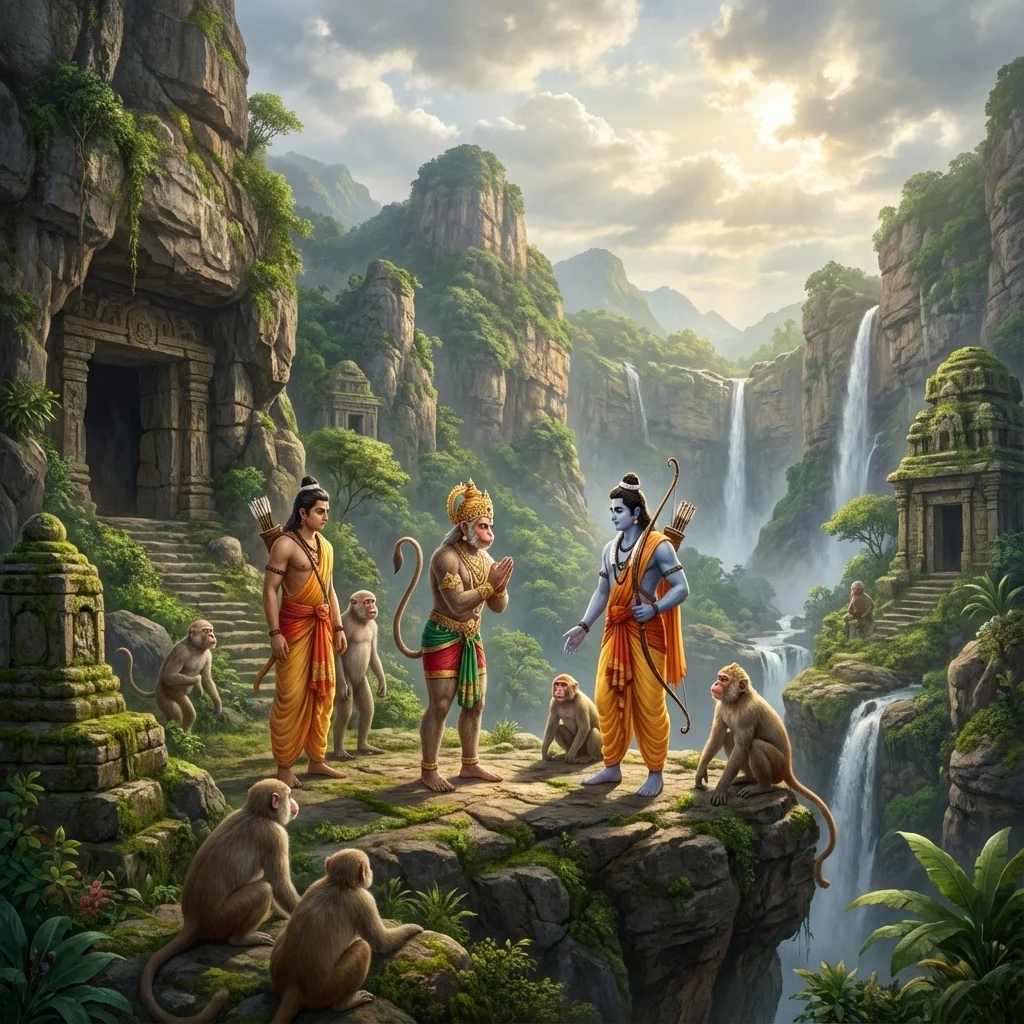
किष्किन्धाकाण्ड
The Kiṣkindhākāṇḍa marks the Ramayana’s decisive shift from solitary forest-wandering to coalition politics and organized action. Opening in an intensely lyrical register, Rama’s grief at separation from Sītā is framed against spring’s sensuous abundance, producing a poignant contrast between nature’s renewal and the hero’s inner desolation. This affective groundwork leads into the encounter with Sugrīva on Ṛśyamūka, mediated by Hanumān’s diplomatic brilliance. Friendship (sakhya) is ritually and ethically grounded: Rama pledges aid against Vālin, while Sugrīva offers intelligence about Sītā’s abduction and commits the Vanara polity to the search. The book’s dramatic center is the morally fraught killing of Vālin from concealment, followed by Vālin’s rebuke and Rama’s dharma-justification in terms of royal jurisdiction and punishment of transgression. The ensuing laments of Tārā and the political transition to Sugrīva’s consecration show Valmiki’s sustained interest in the costs of kingship, the fragility of legitimacy, and the management of grief as a civic duty. The middle sargas juxtapose monsoon imagery and Rama’s impatience with Sugrīva’s lapse into pleasure, culminating in Lakṣmaṇa’s stern embassy and Tārā’s tactful pacification. The final movement is logistical and encyclopedic: Sugrīva’s dispatch of search-parties in the four directions maps a classical “maṇḍala” geography, while the southern expedition’s ordeal (the Vindhya cave episode) and Sampāti’s revelation reorient the quest toward Laṅkā. In the Southern Recension (IIT Kanpur), additional traditional verses often amplify descriptive set-pieces, counsel-speeches, and catalogues, reinforcing the book’s dual identity as both courtly political epic and devotional narrative hinge within the 24,000-verse Ādikāvya.
Rama and Lakṣmaṇa reach Ṛśyamūka, where Hanumān introduces them to the exiled Sugrīva. A friendship pact is formed: Rama will remove Sugrīva’s rival-brother Vālin, and Sugrīva will help locate Sītā. Sugrīva recounts Vālin’s hostility; Rama proves his prowess and later kills Vālin in the duel, prompting debate over dharma and kingship. After funeral rites, Sugrīva is consecrated at Kiṣkindhā. When he delays in pleasure, Lakṣmaṇa confronts him; reconciliation follows and the Vanara hosts are mobilized. Search parties are sent across the world; the southern group meets Sampāti, learns Sītā is in Laṅkā, and Hanumān is recognized as capable of the great leap.
पम्पा-तीर-वर्णनम् / Rama’s Lament at Pampa and the Approach to Rishyamuka
अस्मिन् सर्गे रामः लक्ष्मणेन सह पम्पा-पुष्करिणीं गत्वा, पद्मोत्पल-हंस-कारण्डव-चक्रवाक-समाकीर्णां सरित्-निर्झर-कन्दरायुक्तं वनं निरीक्षते। वसन्त-ऋतुवर्णनं (माधव/चैत्र) पुष्प-वृष्टि, मधुकर-निनाद, कोकिल-रुत, मयूर-नृत्य, तथा लता-वनस्पति-समृद्धि इत्यादिभिः काव्यात्मकं विस्तरं लभते। एषा रम्यता रामस्य शोकं तीव्रयति—वैदेह्या विरहः, जनक-कौसल्या-भरत-सम्बन्धिनः सामाजिक-धर्मसंकटस्य चिन्ता, तथा ‘जीविते प्रयोजनम्’ इति निराशा व्यक्ता। ततः लक्ष्मणः उपदेशं ददाति—संस्तम्भः, शोक-त्यागः, उत्साह-प्रधानता, प्रयत्नेन कार्यसिद्धिः, रावणस्य अनिवार्य-वधः इत्यादि। उपदेशेन रामः धैर्यं प्राप्य पम्पां अतिक्रम्य ऋष्यमूक-समीपे गच्छति। तत्र सुग्रीवः (शाखामृगाधिपः) तौ अद्भुतदर्शनीयौ दृष्ट्वा भय-चिन्तापरीतः विषादं गच्छति, अन्ये हरयः त्रस्ताः आश्रमं शरण्यं प्रविशन्ति—इति वानर-सम्पर्कस्य प्रारम्भ-भूमिका निर्मीयते।
द्वितीयः सर्गः (Sarga 2): Sugriva’s Alarm and Hanuman’s Commission
This chapter stages first-contact tension on Ṛśyamūka: Sugrīva, already traumatized by conflict with Vālī, sees Rāma and Lakṣmaṇa—armed and imposing—and interprets them as possible agents sent in disguise. His fear manifests as restlessness and constant scanning of directions, while his ministers rapidly regroup across mountain peaks, their leaping shaking blossoming trees and alarming wildlife, signaling the vānaras’ martial mobility. Hanumān, characterized as vākya-kovida (skilled in speech), addresses Sugrīva’s agitation, arguing that the Malaya-range refuge removes immediate fear of Vālī and urging composure and discernment. The discourse turns to a technical protocol of intelligence: approach in an ordinary form, read gestures (iṅgita), traits, appearance, and conversation to infer intent; if their demeanor is agreeable, build confidence through measured praise and then inquire their purpose for entering the forest. Sugrīva’s concluding instruction authorizes Hanumān to conduct this diplomatic reconnaissance, and Hanumān accepts, salutes, and proceeds toward Rāma and Lakṣmaṇa—establishing speech as the instrument that converts suspicion into a pathway for alliance.
हनूमत्संवादः / Hanuman’s Diplomatic Approach to Rama and Lakshmana
Sarga 3 stages the first formal contact between the Rāghavas and Sugrīva’s camp. Acting on Sugrīva’s instruction, Hanumān leaps from Ṛṣyamūka and, with tactical discretion, abandons his monkey-form to assume the guise of a mendicant—signaling non-hostility and enabling controlled dialogue. He approaches with ritualized respect (praṇipāta), then delivers a rhetorically ornate appraisal of Rāma and Lakṣmaṇa: lion-like gaze, divine radiance, lotus-petal eyes, broad chests, and weapons described through vivid similes (bows like Indra’s rainbow; quivers like hissing serpents; swords gleaming like shed-skinned snakes). The speech pivots from praise to inquiry (why such sovereign-worthy men are in the forest) and to disclosure: Sugrīva, a righteous vānaraking, has been wronged by his brother and seeks friendship. After Hanumān identifies himself as Sugrīva’s minister and highlights his shape-shifting and mobility, Rāma instructs Lakṣmaṇa to respond gently. Rāma then evaluates Hanumān’s speech as exemplary—implying Vedic training, grammatical mastery, faultless pronunciation, and balanced vocal delivery—framing eloquence as a marker of competence in diplomacy. Lakṣmaṇa accepts the proposal to meet Sugrīva, and Hanumān, pleased, resolves to formalize friendship, setting the alliance in motion.
हनूमद्-दूत्यम् / Hanuman’s Mediation and Lakshmana’s Appeal to Sugriva
This sarga structures an alliance through formal dialogue. Hanumān, pleased after hearing Lakṣmaṇa’s courteous speech, internally anticipates Sugrīva’s restoration (rājyāgama) because Rāma’s arrival signals effective assistance. Hanumān questions the brothers’ purpose in the perilous Pampā-forest region; urged by Rāma, Lakṣmaṇa delivers a compact genealogy-and-virtue discourse: Daśaratha’s dharmic kingship, Rāma’s royal marks and renown, the injustice of exile, and the central crisis—Sītā’s abduction by an unknown shape-shifting rākṣasa. Lakṣmaṇa articulates śaraṇāgati explicitly: he and Rāma seek Sugrīva’s shelter, reversing worldly hierarchy to emphasize moral urgency. A prophetic assurance is introduced via Danu (Diti’s son), cursed into rākṣasa-state, who foretells Sugrīva’s capability to identify the abducting demon. Hanumān replies with polished reassurance: Sugrīva himself is wronged by Vālin, abandoned and dispossessed, therefore disposed to reciprocate help; he promises cooperation in Sītā’s search. The chapter closes with ritual courtesy (Lakṣmaṇa honoring Hanumān), Lakṣmaṇa’s confidence in Hanumān’s truthfulness, and Hanumān physically conveying Rāma and Lakṣmaṇa—abandoning mendicant disguise, assuming vānar-form, and carrying them toward Sugrīva at Ṛśyamūka—signaling the alliance’s imminent formalization.
मैत्रीप्रतिष्ठा (Rama–Sugriva Alliance and Fire-Rite of Friendship)
अस्मिन् सर्गे हनूमान् ऋश्यमूकात् मलयगिरिं गत्वा कपिराजाय (सुग्रीवाय) राघवयोः आगमनं निवेदयति तथा रामस्य कुल-धर्म-गुणान् (इक्ष्वाकुवंश, पितृनिर्देशपालन, सत्यविक्रम) प्रतिपादयति। तदनन्तरं सुग्रीवः भयमपाकरोति, मानुषरूपं कृत्वा मधुरया गिरा रामं प्रत्युवाच, मैत्री-प्रस्तावं करोति—‘बाहुः प्रसारितः, पाणिना पाणिः गृह्यताम्, मर्यादा ध्रुवा बध्यताम्’। रामः प्रसन्नः हस्तपीडनं कृत्वा आलिङ्गनं च करोति। हनूमान् भिक्षुरूपं त्यक्त्वा स्वेन रूपेण काष्ठयोः मन्थनात् पावकं जनयति; पुष्पार्चनया वह्निं सत्कृत्य तयोर्मध्ये स्थापयति। ततः राम-सुग्रीवौ अग्निं प्रदक्षिणं कृत्वा वयस्यत्वं (औपचारिकमैत्रीं) साधयतः। सुग्रीवः स्वदुःखहेतुं (वालिना निकृतत्वं, भार्यापहारः, भयार्दितवनवासः) निवेदयति; रामः धर्मवत्सलः प्रतिजानाति—वालिनं वधिष्ये, अमोघैः सूर्यसङ्काशैः शरैः शीघ्रं निपातयिष्ये। सर्गस्य उपसंहारे सुग्रीवः रामप्रसादेन राज्य-भार्याप्राप्तिं वाञ्छति; तथा एकस्मिन् शकुन-प्रसङ्गे सीता-वालि-रावणानां वामनेत्रस्फुरणं (स्त्री/पुरुष-शकुनभेदेन) सूच्यते, यत् कथायाः आगामी-परिणामान् सूक्ष्मतया द्योतयति।
आभरण-प्रत्यभिज्ञानम् (Recognition of Sītā’s Ornaments)
This sarga concentrates on evidentiary recognition and the psychology of grief. Sugrīva, pleased, reports that Hanumān has explained to him the cause of Rāma’s arrival in the desolate forest: Sītā’s abduction by a rākṣasa who killed Jaṭāyu while seeking opportunity. Sugrīva then recalls seeing a woman carried away, crying “Rāma, Rāma” and “Lakṣmaṇa,” writhing on Rāvaṇa’s lap like a serpent-bride. She dropped a veil (uttarīya) and auspicious ornaments, which the vānaras preserved. At Rāma’s urgent request, Sugrīva enters a mountain cave and brings the bundle out for identification. The sight of the garments and jewels overwhelms Rāma; he weeps, collapses, and presses the ornaments to his chest, his breath described with a cobra-like intensity. Rāma shows the items to Lakṣmaṇa; Lakṣmaṇa states he cannot recognize armlets or earrings but recognizes the anklets from daily reverence at Sītā’s feet—an ethical detail foregrounding modesty and service. The chapter ends with Rāma demanding directional intelligence: where the fierce rākṣasa took Sītā, where he dwells, and declaring exterminatory resolve as righteous retaliation.
काकुत्स्थस्य शोकनिग्रहः—सुग्रीवसान्त्वनम् (Rama’s Grief Restrained—Sugriva’s Consolation)
Sarga 7 is a tightly argued counsel-scene in which Sugrīva responds to Rāma’s visible distress with folded palms and tear-choked voice, framing grief as a sinkhole that erodes happiness, brilliance (tejas), and even survival. He urges dhairya (steadfastness), restraint of tears, and reflective intelligence in calamity, presenting sorrow as unworthy of the dignified and as practically self-defeating. Sugrīva then converts empathy into commitment: he promises energetic effort to recover Maithilī and even to destroy Rāvaṇa with his clan, grounding assurance in friendship rather than presumption. Rāma, consoled, wipes his tears, regains composure, embraces Sugrīva, and acknowledges the rarity of such a friend in crisis. The scene ends with Rāma requesting concrete assistance in tracing Sītā and Ravana, offering reciprocal duty and reaffirming truthfulness by oath; Sugrīva and his counselors rejoice, and the two meet privately to exchange mutual joys and sorrows—sealing alliance through shared vulnerability and pledged action.
मैत्रीप्रतिज्ञा-वैरकारणप्रश्नः (Friendship Vow and Inquiry into the Cause of Enmity)
अस्मिन् सर्गे सुग्रीवः रामवाक्येन परितुष्टः लक्ष्मणस्य साक्षित्वे रामं प्रति विनयेन वदति, वनप्रदेशे दृष्ट्वा सालवृक्षशाखाभिः आसनव्यवस्था क्रियते—सुग्रीवः रामाय शाखां विस्तीर्य उपविशति, हनूमान् लक्ष्मणं विनीतम् उपवेशयति। ततः सुग्रीवः प्रेम्णा, हर्षव्याकुलवाचा, स्वदुःखकथां निवेदयति: भ्रात्रा वालिना राज्याच्च्युतः, भार्याहरणं कृतं, सुहृदः बद्धाः, बहुशः मद्विनाशार्थं प्रयत्नाः कृताः; भयात् ऋश्यमूकपर्वते वसति, हनूमत्प्रमुखैः कपिभिः रक्षितः। सख्यस्य महत्त्वं (धन-सुख-देहत्यागोऽपि वयस्यार्थे) प्रतिपाद्य, अग्निसाक्षिक-पाणिप्रदानेन मैत्रीं दृढीकृतां स्मारयति। अश्रुपूरितलोचनः क्षणं न भाषितुं शक्नोति, ततः धैर्येण बाष्पं निगृह्य पुनः निवेदयति यत् तद्विनाशादेव दुःखनिवृत्तिः। प्रत्युत्तरतया रामः धर्मज्ञः प्रहसन्निव प्रतिजानाति—मित्रलक्षणं उपकारः, अरिलक्षणं अपकारः; अद्यैव वालिं हनिष्यामि इति, स्वशरान् (काङ्कपत्रपरिच्छन्नान्, महेन्द्राशनिसन्निभान्) वर्णयति। अनन्तरं रामः वैरस्य तत्त्वकारणं श्रोतुमिच्छति, बलाबल-विचारानन्तरं कार्यं करिष्यामीति आश्वासयति; सुग्रीवः प्रहृष्टः वैरकारणाख्यानाय उपचक्रमे।
वालि–मायावी–बिलप्रवेशः (Vali’s Pursuit of Mayavi and the Cave Episode)
In this sarga, Sugriva narrates to Rama the origin of his rupture with Vali through a sequence of politically consequential misunderstandings. He first frames Vali as the elder brother—an enemy-slayer—highly esteemed by their father and by Sugriva himself. The demon Mayavi, son of Dundubhi, arrives at night to Kishkindha’s gate and challenges Vali; Vali rushes out in anger despite attempts by women and Sugriva to restrain him. Sugriva follows out of fraternal affection. Seeing them, Mayavi flees; the chase continues under moonlight until Mayavi enters a grass-covered, hard-to-access cave. Vali orders Sugriva to remain alert at the cave mouth while he enters to kill the enemy, making Sugriva swear obedience. A long time passes—over a year—while Sugriva waits, hearing demonic roars but not Vali’s voice; then blood and foam flow out of the cave. Concluding Vali has died, Sugriva blocks the entrance with a mountain-sized rock, performs funerary water-offerings, and returns to Kishkindha. Ministers, seeking continuity of rule, consecrate Sugriva as king. Vali later returns alive after killing Mayavi, sees Sugriva enthroned, imprisons Sugriva’s ministers, and speaks harshly. Sugriva states he could have resisted but refrained out of reverence; he offers full submission—touching Vali’s feet with his crown—yet Vali remains unappeased. The chapter thus articulates a dharma-problem: governance under uncertainty, the ethics of inference from signs, and the fragility of legitimacy when communication collapses.
सुग्रीवस्य वैरानुकथनम् (Sugriva’s Account of Enmity and Appeal to Rama)
अस्मिन् सर्गे सुग्रीवः रामस्य समक्षं वालिना सह वैरस्य मूल-कारणं क्रमशः निवेदयति। आरम्भे सः भ्रातृ-सम्बन्ध-रक्षणाय वालिं क्रोधसमाविष्टं प्रसादयितुं प्रयत्नं करोति, तथा राज्य-व्यवहारस्य ‘न्यास’ (trusteeship) भावनया राज्यमपि प्रत्यर्पयितुमिच्छति। ततः मायावी-नाम्ना महासुरेण रात्रौ समाह्वाने कृते, सुग्रीव-वालिनौ अनुगच्छतः; असुरः महाबिलं प्रविशति, सुग्रीवः बिलद्वारि प्रतीक्षते, दीर्घकालात् शोणित-प्रवाहं दृष्ट्वा शोक-विषादेन द्वारं शैलशृङ्गेण पिहित्वा किष्किन्धां प्रत्यागच्छति। पौर-मन्त्रि-समूहः ‘राजभावे’ तं बलात् नियोजयति; पुनरपि सुग्रीवः वालिं शिरसा याचमानः क्षमां प्रार्थयते। वालिः तु सभामध्ये निर्भर्त्स्य, सुग्रीवं निर्वासयति, दार-हरणं च करोति; सुग्रीवः भयार्तः ऋष्यमूकं प्रविश्य रामं शरणं गच्छति। अन्ते रामः धर्मसंहितं वचनं दत्त्वा वालि-वधप्रतिज्ञां प्रकाशयति—अमोघ-शर-निपातेन दुष्टवृत्त-निग्रहः, तथा सुग्रीवस्य शोक-सागरात् तारणा इति।
दुन्दुभिवधप्रसङ्गः — The Dundubhi Episode and the Proof of Rama’s Prowess
Sarga 11 frames Sugrīva’s anxiety about confronting Vāli and builds a structured “proof” discourse. After Rāma’s encouraging words, Sugrīva praises him while recounting a precedent narrative: the demon Dundubhi challenges the Ocean, is redirected to Himavān, and is finally sent toward Vāli at Kiṣkindhā. Dundubhi, in buffalo-form, blocks the city gate and provokes Vāli; a fierce duel follows, ending with Vāli killing and hurling the body. Blood drops fall at the hermitage of sage Mataṅga, who—recognizing the offender through tapas—curses Vāli: entry into the protected forest (and its yojana-radius) brings death, compelling Vāli to avoid Ṛśyamūka and enabling Sugrīva’s refuge there. Sugrīva then points to physical “map-markers” of Vāli’s strength (Dundubhi’s bone-heap; seven sāla trees) and requests verification. Rāma responds by effortlessly lifting Dundubhi’s dried body with his toe and flinging it ten yojanas, then prepares to demonstrate further by piercing a sāla tree. The chapter’s thematic lesson is epistemic and ethical: confidence in righteous action is stabilized through demonstrable capability, while violence is bounded by rules of fair combat and by sacred-protected spaces.
द्वादशः सर्गः — Rama’s Proof of Power, the First Duel, and the Identification Mark (Kishkindha Kanda, Sarga 12)
Sarga 12 structures a progression from proof to praxis. First, Rama validates Sugriva’s trust by taking up the bow and demonstrating unparalleled archery: a single gold-adorned arrow pierces seven sāla trees, a mountain mass, and the earth, then returns to the quiver—an evidentiary act (pratyaya) establishing competence and deterrence. Encouraged, Sugriva requests immediate action against Vali; Rama agrees and directs Sugriva to challenge Vali at Kishkindha. The duel begins, described through cosmological similes (sunrise imagery; planetary combat), but Rama withholds the fatal shot due to inability to distinguish the identical brothers in ornaments, form, gait, voice, and valor. Sugriva, defeated and bloodied, retreats to the cursed Matanga-grove where Vali stops short out of fear of the sage’s curse. Sugriva reproaches Rama; Rama responds with ethical justification: killing one who has sought protection is a grave sin, and mistaken identity could destroy their shared objective. Rama renews his promise, instructs Sugriva to fight again, and institutes a practical solution: an identification mark. Lakshmana fastens a blooming gajapuṣpī creeper around Sugriva’s neck, after which Sugriva, radiant and resolute, returns with Rama toward Vali-ruled Kishkindha to resume the decisive confrontation.
Saptajana-āśrama Darśana and the Approach to Kiṣkindhā (Hermitage of Seven Sages; March toward Vāli’s Capital)
Sarga 13 narrates the rapid advance from Ṛṣyamūka toward Kiṣkindhā, framed by detailed ecological observation that functions as both travel-log and ethical atmosphere. Sugrīva and Lakṣmaṇa move ahead of Rāma, with Hanumān, Nala, Nīla, and Tārā following, forming an organized procession. The party observes rivers, lotus-filled tanks, melodious birds, fearless deer, and formidable lone elephants that break embankments—marking the wilderness as both abundant and dangerous. Rāma then notices a cloud-like mass of trees ringed with plantain groves and asks Sugrīva to clarify the site. Sugrīva identifies it as the vast Saptajana hermitage, a fatigue-relieving āśrama rich in roots, fruits, and water, guarded by the tapas of seven ascetics who live on air, practice extreme discipline (head-down, water-immersed), and attain heaven with their bodies. The hermitage is described as ritually potent and perilous to the uninitiated: birds and animals avoid it; those who enter ignorantly do not return; divine sounds, fragrances, and the three sacred fires’ smoke crown the treetops. Following Sugrīva’s counsel, Rāma and Lakṣmaṇa offer mental salutations with folded hands and proceed, eventually beholding the unassailable Kiṣkindhā protected by Vāli’s valor, with weapons readied for the coming confrontation.
किष्किन्धायां सुग्रीवस्य नादः — Sugriva’s War-Cry at Kishkindha
Sarga 14 stages the tactical approach to Kiṣkindhā and formalizes the identification-and-engagement protocol before the duel with Vāli. The party reaches Kiṣkindhā ruled by Vāli and waits concealed in a dense forest behind trees (4.14.1). Sugrīva scans the surroundings and becomes intensely enraged (4.14.2), then issues a terrifying challenge-roar, surrounded by companions, likened to a great cloud driven by wind, as if splitting the sky (4.14.3). Sugrīva reports arrival at Vāli’s fortified capital—marked by golden archways and flags—and urges Rāma to fulfill the earlier vow to kill Vāli when the time is ripe (4.14.5–6). Rāma replies with operational assurances: Lakṣmaṇa has placed a gaja-creeper garland on Sugrīva’s neck as an identification mark in combat (4.14.8–9). Rāma promises to dispel Sugrīva’s fear and enmity with a single arrow (4.14.10), asks Sugrīva to show the ‘enemy in a brother’s form’ (4.14.11), and asserts he will not let Vāli escape alive once in sight—so blame will not attach to Rāma (4.14.12). He cites the prior demonstration of piercing seven sāla trees with one arrow as proof of capability (4.14.13), affirms truthfulness bound to dharma (4.14.14), and vows to make his promise fruitful like Indra’s timely rain (4.14.15). Rāma then instructs Sugrīva to raise the specific summoning cry that will draw out Vāli adorned with a golden garland (4.14.16–17). The text generalizes warrior psychology—heroes do not tolerate a challenge, especially before women (4.14.18). Sugrīva roars accordingly (4.14.19), producing ecological and social imagery: cows scatter like unprotected noblewomen; deer falter like wounded horses; birds drop like merit-exhausted planets (4.14.20–21). The sarga closes with an intensified poetic simile: Sugrīva’s roar resembles thundercloud clusters and wind-whipped ocean waves (4.14.22), preparing the narrative for Vāli’s emergence and the decisive confrontation.
तारोपदेशः — Tara’s Counsel to Vali on Sugriva’s Roar and Rama’s Alliance
This sarga opens with Vālī hearing Sugrīva’s formidable roar from within the inner chambers, a sound described as shaking all beings and jolting Vālī from pride into violent anger. Vālī rushes out with fierce, fire-like imagery, intent on immediate confrontation. Tārā intervenes physically and rhetorically: she embraces him, urges restraint, and recommends delaying combat until morning as a strategic, not cowardly, choice. She then frames a key inferential argument: Sugrīva’s renewed challenge after a prior defeat implies external support; such confidence and insolence must have a cause. Tārā cites intelligence reported by Aṅgada and spies: Rāma and Lakṣmaṇa—Ikṣvāku princes, invincible in war—have allied with Sugrīva. She praises Rāma’s virtues and warns that hostility toward an immeasurable warrior is politically and personally disastrous. Her policy prescription is reconciliation: consecrate Sugrīva, abandon enmity, honor him with gifts, and cultivate friendship with Rāma. The sarga closes with the tragic note that Vālī, overtaken by adverse fate, rejects beneficial counsel at the threshold of destruction.
वालिवधः — The Slaying of Vali
अस्मिन् सर्गे तारा वालिं निवर्तयितुं प्रयत्नं करोति, किन्तु वाली स्वमान-क्षत्रधर्मसदृश-युद्धधर्मं प्रतिपादयन् सुग्रीवस्य गर्जितं ‘अपमान’ इव मन्यते तथा प्रतिज्ञां करोति—सुग्रीवं जित्वा एव निवर्तिष्य इति। तारा प्रियवाक्या सन् परिष्वज्य प्रदक्षिणं कृत्वा स्वस्त्ययन-मन्त्रैः विजयाशंसा च कृत्वा अन्तःपुरं प्रविशति। ततः वाली क्रुद्धः नगरान्निर्गत्य शत्रुदर्शनकाङ्क्षया दिशो विलोकयन् सुग्रीवं ददर्श; उभौ मुष्टिमुद्यम्य, वृक्ष-प्रहारैः नख-मुष्टि-पद-जानु-बाहु-प्रयोगैश्च घोरं युद्धं कुर्वन्तौ वर्ण्येते—वृत्र-वासवयोरिव, चन्द्र-सूर्ययोरिव च उपमानैः। युद्धे वालिना बलवृद्धिः, सुग्रीवस्य हीयमानता च दृश्यते; रामः सुग्रीवस्य संकटं निरीक्ष्य धनुषि आशीविषोपमं शरं सन्धाय, ज्यातलघोषेण वन्यजीवान् त्रासयन्, महाबाणं मुक्त्वा वालिवक्षसि पातयति। तेन वाली रक्तसिक्तः भूमौ पतति—इन्द्रध्वजोपमा, अशोकवृक्षोपमा च पतनवर्णने प्रयुज्यते। सर्गः मित्रधर्म-रणनीति-धर्मसङ्कट-प्रसङ्गस्य निर्णायकबिन्दुं स्थापयति, यतः सुग्रीवराज्यस्थापनाय मार्गः प्रशस्तः भवति।
वालिवधः — Vālī’s Fall and Dharma-Accusation (Kiṣkindhā Sarga 17)
This sarga documents the immediate aftermath of Vālī being struck by Rāma’s arrow: Vālī collapses abruptly “like a felled tree,” and his body is described with sustained heroic imagery—golden ornaments, Indra’s banner simile, and cosmic comparisons (fire without flame, Yayāti fallen from heaven, the Sun cast down at aeon’s end). Rāma, accompanied by Lakṣmaṇa, approaches and observes Vālī’s formidable presence even in defeat. Vālī then delivers an extended, rhetorically sharp dharma-critique: he acknowledges Rāma’s royal lineage and reputed virtues, yet challenges the ethics of being killed while engaged with another (parāṅmukha/indirect killing), framing the act as improper for a kṣatriya and dangerous for royal legitimacy. He contrasts forest-dwelling vānarā life with human kingship, questions motive (land/wealth vs. forest fruits), and invokes norms of punishment, restraint, and truthful governance. Vālī recalls Tārā’s warning (ignored through delusion), asserts he could have recovered Sītā swiftly, and concludes by urging Rāma to reflect and answer. Exhausted and in pain, Vālī falls silent while gazing at Rāma, who is described as radiant like the Sun.
वाली–रामसंवादः (Rama’s Justification to Vali on Rājadharma)
Sarga 18 is a tightly argued juridical-ethical dialogue following Vālī’s mortal wounding. Vālī initially reproaches Rāma for an apparently harsh act; Rāma responds by reframing the event as enforcement of rājadharma under Bharata’s de facto regency, asserting that kings (Ikṣvāku authority) possess nigraha and anugraha (punishment and reward) over beings within their domain. Rāma identifies Vālī’s central transgression as bhrātṛbhāryāvamarśa—sexual appropriation of a brother’s wife—treating it as a grave breach warranting daṇḍa, even vadhā according to smṛti. He further argues from precedent and dharmaśāstra logic: punishment purifies the sinner; failure to punish transfers demerit to the king; and even hunting analogies illustrate the permissibility of striking a ‘śākhāmṛga’ (monkey) irrespective of face-to-face combat conventions. Vālī’s confusion clears; he concedes Rāma’s reasoning, asks forgiveness, and turns to succession ethics—requesting protection for Aṅgada and fair treatment of Tārā under Sugrīva. Rāma consoles Vālī, articulating karmic causality and the inevitability of fate, and assures continuity of care for Aṅgada—closing the chapter with reconciliation grounded in dharma.
ताराविलापः — Tara’s Lament and Counsel after Vali’s Fall
This sarga stages the immediate aftermath of Vāli’s mortal wounding by Rāma’s arrow. Vāli, lying on the ground and nearing death, is unable to respond further to Rāma’s reasoned replies (4.19.1–2), marking a rhetorical closure to the dispute and a transition into public mourning. Tārā hears of Vāli’s death, rushes out with Aṅgada, and witnesses the vanara troops scattering in fear at the sight of bow-bearing Rāma (4.19.3–6). She confronts the fleeing monkeys, questioning their desertion of their king and framing the event within the politics of kingship and fraternal rivalry (4.19.7–9). The vanaras answer with urgent, pragmatic counsel: protect Aṅgada, secure the city gate, and perform consecration to stabilize succession; they also warn of internal disorder from displaced forest-wandering monkeys (4.19.10–16). Tārā rejects purely political consolation, declaring that without her husband neither son, kingdom, nor life has meaning, and she resolves to approach the dying Vāli (4.19.18–20). She then beholds Vāli in a sequence of elevated similes (cloud, lion, chaitya destroyed by Garuḍa), and also sees Rāma, Lakṣmaṇa, and Sugrīva nearby (4.19.21–25). Overcome by grief, she collapses, rises lamenting “Āryaputra,” and her wailing affects Sugrīva, especially as Aṅgada arrives in despair (4.19.26–28). The chapter’s thematic core is the collision of राजधर्म (succession, security) with शोक-धर्म (mourning, conjugal fidelity), presented through dialogue plus high-poetic imagery.
ताराविलापः — Tara’s Lament over Vāli
This sarga presents the immediate aftermath of Vāli’s death by Rāma’s arrow. Tārā, described as moon-faced and dignified, approaches the fallen Vāli and embraces him, initiating an extended vilāpa (lament) marked by sharp imagery (earth as the beloved embraced in death; Vāli compared to an uprooted tree, elephant-like in strength). Her speech blends grief with moral accounting: she notes her own shock that her heart does not shatter; she indicts Vāli’s prior actions against Sugrīva (banishment and seizure of Rūmā) as the causal ‘fruit’ now ripened; and she recalls that her well-meant counsel was earlier despised. She turns to Angada, urging him to look upon his dharma-loving father and to receive final affection and instruction, while also fearing Angada’s future under an anger-deluded uncle. She acknowledges Rāma’s act as fulfillment of his promise to Sugrīva, then addresses Sugrīva directly, conceding that his desire is achieved and the kingdom is his. The chapter closes with collective mourning by Vāli’s other wives, and Tārā’s resolve to undertake prāya (fasting unto death) beside Vāli.
ताराशोकविनोदनम् (Consolation of Tara and Counsel on Succession)
This sarga is structured as a grief-counsel discourse following Vālin’s death. Hanumān, speaking as a senior vānarayūthapa and stabilizing adviser, approaches Tārā—likened to a fallen star—then reframes bereavement through karmaphala reasoning: embodied beings inherit the results of virtue and vice after death, and the body’s fragility makes indiscriminate lamentation philosophically unstable. He then redirects attention to practical dharma: Angada must be protected as the surviving heir, immediate duties must be executed, and auspicious, orderly action is required in a transient world. The counsel turns explicitly political: encourage both Angada and Sugrīva, perform royal funerary/transition rites for the harirāja, and consecrate Angada so Tārā may regain composure by seeing legitimate rule restored. Tārā replies with a counter-ethic of attachment and authority: embracing even the slain king is preferable to future substitutes; she denies her own right to decide kingship, asserting Sugrīva’s primacy in affairs as paternal uncle, and finally expresses a fatalistic resolve to join Vālin, presenting the pyre/resting place of the fallen warrior as her fitting refuge.
वालिविलापः — Vali’s Final Counsel and the Succession Charge
Sarga 22 is a tightly structured deathbed discourse that converts battlefield outcome into constitutional order. Mortally wounded, Vālin first registers Sugrīva’s presence and addresses him with explicit brotherly affect, reframing past wrongdoing as fate-driven delusion and urging reconciliation. He then performs a succession transfer: instructing Sugrīva to accept kingship, to act as father, provider, and protector to Aṅgada, and to rely on Tārā’s crisis-competence and subtle judgment as stable counsel. Vālin binds the new king to external dharma by insisting that Rāghava’s task be executed without hesitation, warning that failure becomes adharma and politically harmful. A symbolic regalia-transfer follows when Vālin gives Sugrīva a divine golden necklace, marking legitimate continuity even amid grief. Vālin next issues a governance manual for Aṅgada: situational awareness of time and place, emotional endurance, loyalty to Sugrīva, avoidance of factional alignment with enemies, and a balanced stance that avoids both excessive intimacy and alienation. Vālin then dies; the vānaras lament, Kishkindhā is described as desolate, Vālin’s feats are recalled (including the prolonged duel with the gandharva Golabha), and Tārā collapses upon Vālin’s body, closing the chapter in elegiac imagery.
ताराविलापः (Tārā’s Lament over Vāli)
This sarga is a concentrated elegy (vilāpa) staged at the battlefield aftermath of Vāli’s death. Tārā approaches the fallen vānararāja, kisses/smells his forehead, and voices a sequence of grief-statements that function as both intimate address and ethical commentary: she recalls his valor and their bond, laments widowhood as a social-spiritual condition regardless of wealth or progeny, and depicts the body lying in blood and dust. She acknowledges the political consequence—Sugrīva’s fear dispelled by Rāma’s single arrow—while also registering her own inability to restrain Vāli from war. The scene shifts from lament to ritualized filial duty when Tārā instructs Aṅgada to salute his departing father bound for Yama’s abode; Aṅgada complies, but the dead king cannot bless him, intensifying the pathos. Nīla then removes the embedded arrow from Vāli’s heart; its blood-wet radiance is described through solar and mountain imagery, followed by torrents of blood from the wounds. The chapter closes with Tārā’s final self-assessment: with Vāli slain, her prosperity and stability collapse, marking the transition from personal loss to dynastic reordering.
वालिवधोत्तरशोकः — Sugriva’s Remorse and Tara’s Lament after Vali’s Death
This sarga is structured around two grief-centered discourses that refine the ethical stakes of Vāli’s death. First, Sugrīva, witnessing Tārā overwhelmed by tears and sorrow, approaches Rāma with a confession of moral collapse: he acknowledges that Vāli’s earlier restraint reflected noble nature, whereas his own passion, anger, and ‘kapitva’ led to fratricidal consequence. He rejects royal enjoyment, questions the legitimacy of honor and regency, and frames his sin through mythic analogy (Indra’s Tvaṣṭṛ-slaying) and extended metaphor (the ‘elephant of sin’ striking him). Sugrīva even requests permission to enter fire as expiation, while affirming the Vānara leaders will continue the search for Sītā. Second, Tārā is lifted from Vāli’s body, beholds Rāma’s regal radiance, and—shaken yet lucid—petitions him to kill her with the same arrow so she may rejoin Vāli, arguing from śāstra that a wife is inseparable from the husband’s self. Rāma responds with consolatory counsel on providence (vidhātṛ), the fixed order of the worlds, and the future welfare of Aṅgada, after which Tārā’s loud wailing subsides. The chapter thus maps grief into governance: remorse is acknowledged, social order is stabilized, and the epic’s mission (Sītā-search) is preserved.
वालिनः और्ध्वदैहिकम् — Vali’s Funeral Rites and the Consolation of the Bereaved
अस्मिन् सर्गे रामः सुग्रीवं, तारां, अङ्गदं च समशोकः सान्त्वयति। शोकपरितापस्य निष्फलत्वं प्रतिपाद्य, नियति-काल-स्वभाव-प्रधानं दार्शनिकं उपदेशं दत्ते—मृतस्य कल्याणं क्रियाकालेन, कर्तव्यपालनेन च साध्यते, न तु विलापेन। ततः लक्ष्मणः विनयेन सुग्रीवं और्ध्वदैहिककर्मणि प्रवर्तयति: काष्ठ-चन्दनादि-संग्रहः, शिबिकायाः सिद्धिः, वहनयोग्य-वानराणां सज्जीकरणम्, अङ्गदस्य समाश्वासनम् इत्यादि। तारा शीघ्रं गुहां प्रविश्य विश्वकर्मनिर्मित-समलङ्कृतां दिव्यां शिबिकां आनयति; रामः ‘क्षिप्रं विनीयतां वाली’ इति आदेशं ददाति। सुग्रीवः अङ्गदेन सह रुदन् वालिनं शिबिकायामारोपयति; राजकीय-समुचितं अन्त्येष्टि-विधानं आज्ञापयति—रत्नवृष्ट्या अग्रगमनं, भर्तृसत्क्रिया च। वानरीगणाः करुणस्वरैः अनुगच्छन्ति; तारा शिबिकातलशायिनं पतिं दृष्ट्वा विलपति, रामरूपेण कालस्य आगमनं निर्दिश्य विधवात्व-दुःखं व्यक्तयति। अन्ते चिता नदीपुलिने सज्जीकृता; अङ्गदः सुग्रीवेण सह पितरं चितामारोपयति, विधिवदग्निदानं कृत्वा अपसव्य-परिक्रमां करोति। दाहसंस्कारानन्तरं वानराः शुभजलायां नदीं गत्वा उदकदानं कुर्वन्ति; रामः समानशोकः प्रेतकार्याणि नियोजयति, तथा सर्गसमाप्तौ शोकात् कर्तव्य-प्रवृत्तेः संक्रमणं सुस्पष्टं भवति।
महाभिषेकः — Sugriva’s Coronation and Angada’s Installation
This sarga stages the transition from mourning to legitimate governance. Vanara chiefs attend the grief-stricken Sugriva still in wet funeral-bath garments, signaling ritual closure and readiness for public duty. Hanuman petitions Rama to enter Kishkindha and formalize royal relations; Rama declines entry into any village/city for fourteen years, citing obedience to his father’s command, yet authorizes the political process: Sugriva should enter the prosperous cave-city and be installed with due rites. Rama further instructs that Angada, as the elder brother’s eldest son and equal in prowess, be consecrated as yuvarāja to secure succession. Rama also provides strategic seasonal policy: with the onset of the four-month rains beginning in Śrāvaṇa, immediate enterprise is unsuitable; preparations for Ravana’s slaying should be undertaken when Kārtika arrives. Sugriva enters Kishkindha, receives public prostrations from subjects, and is crowned by kin and leaders through Vedic fire offerings and abhiṣeka using sanctified waters gathered from rivers, tīrthas, and oceans, stored in golden vessels, and poured through auspicious implements (bull-horns, golden jars). Coronation regalia and ritual substances—white canopy, chamaras, garments, perfumes, jewels, herbs, unguents, and pigments—are enumerated, emphasizing royal legitimacy through ceremonial completeness. After Sugriva’s installation, Angada is installed as prince regent; the city becomes festooned with flags and filled with rejoicing citizens. Sugriva reports the completed mahābhiṣeka to Rama and regains Ruma, likened to Indra’s restored sovereignty.
प्रस्रवणगिरिवासवर्णनम् (Residence on Mount Prasravana; Counsel during the Rains)
After Sugrīva’s consecration and return to the cave-city of Kiṣkindhā, Rāma and Lakṣmaṇa proceed to Mount Prasravaṇa and select a spacious, well-ventilated cave for residence during the rainy season. The sarga foregrounds topographical and ecological mapping: multicolored mineral-strewn peaks, caves and waterfalls, lotus-filled ponds, directional features around the cave (northeast descent, western elevation, wind-sheltered site), and a pure east-flowing river likened to the Jahnavī on Trikūṭa. The riverbanks are catalogued with specific trees and flowering plants, and the soundscape includes birds, peacocks, swans, sārasas, and cakravākas moving in pairs. From a distance, music and drums from Kiṣkindhā are heard, implying Sugrīva’s restored prosperity. Yet the narrative pivots to interiority: despite comfort, Rāma’s joy is minimal as the rising moon intensifies remembrance of Sītā; sleep eludes him. Lakṣmaṇa offers structured consolation—reject despair, cultivate enterprise, wait for autumn after the rains, and then destroy the enemy with firm resolve. Rāma accepts the counsel, commits to seasonal patience, and articulates the ethics of reciprocating assistance (gratitude as a heroic duty).
वर्षावर्णनम् — The Monsoon Description and Rama’s Counsel on Timing
After Vālī’s death and Sugrīva’s consecration, Rāma resides on Mount Mālyavān and addresses Lakṣmaṇa while the rainy season begins. The sarga develops an extended ṛtu-varṇana: clouds as mountain-peaks, lightning as golden whips, thunder as Vedic recitation, waterfalls as pearl-strings, and forests animated by peacocks, frogs, bees, cranes, and swollen rivers. Amid this sensory cartography, Rāma’s inner state surfaces—separation from Sītā, the difficulty of travel in rains, and the looming magnitude of Rāvaṇa. Rāma explains why he does not press Sugrīva immediately: the ally has suffered, has only recently regained domestic stability, and the mission must be pursued with kāla-jñāna (timely judgment). The discourse culminates in a principle of reciprocal obligation: help should be repaid, and ingratitude wounds the virtuous. Lakṣmaṇa respectfully concurs, advising endurance until autumn, when Sugrīva can effectively act.
हनूमता सुग्रीवस्य कालधर्मोपदेशः — Hanuman’s Counsel on Timely Ally-Duty
Sarga 29 opens with a descriptive frame: under a clear, moonlit sky resonant with the calls of birds, Hanumān observes Sugrīva’s complacency after attaining kingship and prosperity. Sugrīva is portrayed as absorbed in pleasure and inattentive to royal messaging, having delegated affairs to ministers without oversight. Hanumān then approaches him with calibrated vākyanīti—sweet, reasoned, and conciliatory speech—choosing a tone that preserves trust while correcting negligence. The discourse crystallizes principles of governance: a king’s rājya, kīrti, and pratāpa grow when he honors allies and understands time; treasury, coercive power (daṇḍa), allies, and self-discipline must be held in balanced regard. Hanumān warns that delayed fulfillment of a friend’s task fails even with later effort, and presses the urgent duty: initiate the search for Vaidehī (Sītā) for Rāma, whose power is immeasurable and whose assistance secured Sugrīva’s throne. Sugrīva, moved by timely counsel, resolves to act—dispatching Nīla to assemble forces from all directions, setting a strict deadline for arrival, and instructing coordination with Angada and the elders—thereby transforming courtly indulgence into organized mobilization.
शरत्प्रवेशे रामविलापः तथा सुग्रीवप्रमादे लक्ष्मणप्रेषणम् (Autumn’s Onset: Rama’s Lament and Lakshmana Sent to Sugriva)
Sarga 30 stages a decisive psychological and strategic turn. With the rains ended and the sky cleared, Rāma—tormented by kāma and śoka in separation from Sītā—contemplates the autumn moon and collapses into a swoon as he realizes time has elapsed while Sugrīva remains absorbed in pleasure. Regaining consciousness, Rāma laments Sītā through a sequence of nature-linked reflections (birds, rivers, lotuses, winds, moonlight), using seasonal imagery to externalize viraha and to mark the shift from varṣā to śarat. Lakṣmaṇa returns, finds Rāma senseless, and counsels him toward kriyābhiyoga (renewed effort), serenity, and strategic follow-through—affirming that Janakī cannot be easily held when protected by Rāma. Rāma accepts the counsel yet insists that the promised timeline has been violated; he instructs Lakṣmaṇa to enter Kiṣkindhā and admonish Sugrīva, warning that failure to honor the pledge invites consequences like Vāli’s fate. The chapter thus binds poetic ṛtu-varṇana to a governance ethic: promises, alliances, and timely action are indispensable for dharma and mission success.
लक्ष्मणक्रोधः सुग्रीवप्रबोधनं च (Lakshmana’s Wrath and the Summoning of Sugriva)
Sarga 31 stages a governance crisis inside the Rama–Sugriva alliance. Lakshmana, seeing Rama grief-stricken and judging Sugriva negligent, is urged by Rama to restrain anger and speak with sāman (conciliation) rather than harshness. Armed with a bow likened to Indra’s and moving like a storm or flood, Lakshmana enters Kishkindha; his furious presence panics the vanara guards, who arm themselves with trees and rocks and then scatter in fear. Angada becomes the diplomatic conduit: Lakshmana instructs him to announce his arrival and invite Sugriva to respond as he chooses. Sugriva, intoxicated and absorbed in pleasure with Tara, initially ignores the warning; ministers Plaksha and Prabhava then brief him on Lakshmana’s approach and the seriousness of dharma and artha at stake. Counsel culminates in practical protocol: Sugriva should go quickly with kin, salute Lakshmana, and avert his anger—reaffirming promises to righteous Rama and restoring the alliance’s moral timetable.
किष्किन्धाकाण्डे द्वात्रिंशः सर्गः — Lakshmana’s Anger Reported; Hanuman Advises Propitiation and Timely Mobilization
This sarga is structured as a crisis-council in Kishkindhā. Angada reports Lakshmana’s anger, prompting Sugriva—described as prudent and skilled in counsel—to consult his ministers and examine causes without panic. Sugriva first frames the problem as a potential misunderstanding fueled by hostile informants, then reflects on the fragility of friendships and his inability to repay Rama’s prior assistance. Hanuman, speaking with deliberate logic in the assembly, rebukes forgetfulness of benefaction and recalls Rama’s act of killing Vali to remove Sugriva’s fear and secure his happiness. He interprets Lakshmana’s mission as Rama’s love-driven displeasure rather than malice, and emphasizes kāla: the auspicious autumn has arrived, skies are clear, and it is the proper season for military endeavor—hence Lakshmana’s appearance signals overdue action. Hanuman further advises that harsh words from a distressed, wife-deprived Rama should be tolerated, and prescribes a concrete remedy: seek Lakshmana’s pardon with folded hands. The counsel culminates in a warning about Rama’s overwhelming capability if angered and a final injunction: Sugriva must not disregard Rama’s or Lakshmana’s command even mentally, honoring the oath like a spouse aligned to the husband’s will—an intense formulation of political fidelity and gratitude.
किष्किन्धाप्रवेशः—लक्ष्मणस्य कोपः, तारासान्त्वम्, सुग्रीवदर्शनम् (Lakshmana Enters Kishkindha: Anger, Tara’s Mediation, and Sugriva Encountered)
रामशासनात् लक्ष्मणः किष्किन्धां प्रविशति, घोरां रत्नमयीं गुहां तथा समृद्धं राजमार्गं च पश्यन् वानरमुख्यानां गृहाणि निरीक्षते। सुग्रीवस्य भवनं शुक्ल-प्रासादशिखरैः, सर्वकामफल-वृक्षैः, शस्त्रपाणि-हरिरक्षकैः च वर्ण्यते। अन्तःपुरे सप्तकक्ष्याः, हैम-राजत-पर्यङ्काः, गान-तन्त्रीस्वराः, युवतिजनसमाकुलता इत्यादि दृश्यते; आभरण-नूपुर-निनादं श्रुत्वा लक्ष्मणः लज्जां रोषं च अनुभवति, ज्यास्वनं कृत्वा आगमनं सूचयति। सुग्रीवः भयात् विचलति; तारां प्रति ‘कोपकारणं’ पृच्छति। तारा मदविह्वला अपि, लक्ष्मणस्य समीपे गत्वा सान्त्वपूर्वं भाषते; लक्ष्मणः सुग्रीवस्य प्रमादं (पान-रति-विहारः, चतुर्मास-प्रमाण-लङ्घनम्) धर्मार्थहानिं च प्रतिपादयति। तारा प्रत्युत्तरं दत्त्वा कामबन्धनस्य बलं, मित्रभावं, तथा वानरसेनासमागमं सूचयति; तदनुज्ञया लक्ष्मणः अभ्यन्तरं प्रविश्य सुग्रीवम् आदित्यसन्निभं स्त्रीसमावृतं च ददर्श, स्वयं च क्रोधेन अन्तकसन्निभः इवाभवत्—इति सर्गस्य नीतिशास्त्रीयः केन्द्रः ‘उत्तरदायित्वं–संयमः–समयपालनम्’ इति।
कृतघ्ननिन्दा तथा सुग्रीवप्रबोधनम् (Condemnation of Ingratitude and Admonition of Sugriva)
Sarga 34 depicts Lakṣmaṇa’s forceful entry into Sugrīva’s royal space and frames the episode as a rājadharma audit. Sugrīva, described as unsettled upon seeing the “unobstructable” and angry Lakṣmaṇa, rises from a golden throne; Rumā and other women stand, forming a courtly tableau likened to stars around the full moon. Lakṣmaṇa addresses Sugrīva while he stands amid women, using a sequence of normative statements: the ideal king is noble-born, compassionate, self-controlled, grateful, and truthful; the king who turns unrighteous toward benefactors and makes false promises is especially culpable. A graded teaching on the moral weight of untruth culminates in a broader indictment: one who benefits first from a friend and fails to reciprocate is kṛtaghna (ungrateful) and worthy of punishment. Lakṣmaṇa cites a widely revered verse attributed to a brāhmaṇa, asserting that expiation exists for grave transgressions (brahmin-killing, drunkenness, theft, vow-breaking) but not for ingratitude. The admonition becomes immediate political pressure: Sugrīva must honor the agreement and undertake earnest efforts to search for Sītā; otherwise Lakṣmaṇa threatens coercive consequences, invoking the precedent of Vāli’s death and the continuing availability of the same path. The sarga thus integrates court scene, ethical instruction, and enforcement of alliance obligations.
तारोपदेशः — Tara’s Counsel to Lakshmana (Restraint, Time, and Mobilization)
Sarga 35 presents Tārā’s carefully structured counsel to Lakṣmaṇa when his brilliance and anger flare at Sugrīva’s perceived delay. She first corrects speech-ethics: harsh words are unfit to be directed at the vānaras’ king, especially from Lakṣmaṇa. She then defends Sugrīva’s character—neither ungrateful nor deceitful—and frames the delay through an instructive exemplum: even the time-wise Viśvāmitra once lost track of time while attached to Ghṛtācī, so ordinary beings may err. Tārā urges forbearance and reflective restraint, stating that men of steadiness do not become instantly subject to anger. She personally appeases Lakṣmaṇa “for Sugrīva’s sake,” asserting Sugrīva’s readiness to renounce kingdom, wealth, and even personal attachments for Rāma’s pleasure. The discourse shifts to strategic realism: Lanka’s rākṣasa multitudes and the necessity of allied strength; Ravana cannot be slain without first overcoming powerful, form-changing demons, and Sugrīva cannot accomplish this alone. She cites Vālī as an informed source (while noting her own report is hearsay) and explains that chiefs have been dispatched to assemble vast forces; Sugrīva waits for their arrival to fulfill Rāghava’s objective. The sarga closes with a social-psychological note: vānarī women, seeing Lakṣmaṇa’s blood-red angry eyes, fear a recurrence of past danger (linked to Vālī’s death) and cannot find peace—reinforcing the ethical necessity of controlled force and measured speech.
किष्किन्धाकाण्डे षट्त्रिंशः सर्गः — सुग्रीवस्य भय-त्यागः, कृतज्ञता, तथा लक्ष्मणेन सान्त्वन-प्रेरणा (Sugriva’s Reassurance and Lakshmana’s Counsel)
अस्मिन् सर्गे तारायाः धर्मसंहितं, प्रश्रितं वचनं सौमित्रिणा (लक्ष्मणेन) स्वीकृतम् (4.36.1) इति सूच्यते; तदनन्तरं सुग्रीवः लक्ष्मणात् उत्पन्नं महाभयं परित्यजति—क्लिन्नवस्त्र-त्यागवत् (4.36.2)। सः मद-शेषं निवर्तयन् कण्ठगतं महन्माल्यं चिच्छेद (4.36.3) इति ‘आत्म-नियमन’स्य चिह्नम्। ततः सुग्रीवः लक्ष्मणं प्रति विनयेन भाषते—रामप्रसादेन राज्य-श्री-कीर्त्यादीनां पुनर्लाभं निर्दिश्य (4.36.5), रामस्य अद्वितीय-पराक्रमं स्मारयति (सप्तद्रुम-भेदनम्, शैल-भेदनम्, धनुर्विष्फार-शब्देन भूमिकम्पः) (4.36.8–9), तथा स्वस्य सहायत्वं केवलं ‘अनुयात्रा’ इति सीम्ना स्थापयति (4.36.10)। समयातिक्रमादि यदि किञ्चिद् दोषः जातः, तर्हि विश्वास-प्रणयजन्यः इति स्वीकृत्य सेवकवत् क्षमा-याचते (4.36.11) तथा पूर्वोक्त-परुष-वचन-क्षमा-प्रार्थनां सूचयति (4.36.20)। एतस्मिन् वाक्यप्रवाहे लक्ष्मणः प्रीतः सन् प्रत्युत्तरं ददाति (4.36.12) — सुग्रीवस्य शिष्टाचारं ‘रामस्य नाथत्व’रूपेण प्रशंसन् (4.36.13), तस्य प्रभाव-शौच-आर्जव-गुणान् राजलक्ष्म्या योग्यत्वेन प्रतिष्ठापयति (4.36.14), तथा रामस्य शीघ्र-शत्रुवध-निश्चयम् सुग्रीव-सहाय्येन दृढयति (4.36.15–16)। अन्ते लक्ष्मणः शीघ्र-प्रस्थानं कृत्वा भार्याहरण-शोकाकुलं रामं सान्त्वयितुं सुग्रीवम् आह्वयति (4.36.19) — कृतज्ञता, क्षमा, समयपालन, तथा कार्य-प्रवर्तनम् इत्येतानि तत्त्वानि एकत्र समन्वयन्ते।
वानरसेनामोचनम् / Mobilization of the Vanara Hosts
In this chapter, Lakshmana’s admonition catalyzes Sugriva’s immediate administrative response: he issues a formal command to Hanuman (his minister) to accelerate and expand the dispatch of messengers, summoning all vanaras—including the complacent and slow—to report promptly. A strict compliance framework is articulated: those who do not arrive within ten days are to be punished as violators of royal ordinance. Sugriva then orders massive, direction-wide deployment of lion-like vanaras, described through vivid cosmic imagery (sky-paths associated with Vishnu’s stride) and a broad geographic catalog of mountains, forests, seashores, caves, rivers, and hermitages. Hanuman operationalizes this order by sending capable teams across all directions; the vanaras, motivated by fear of the king’s sanction and duty to Rama’s cause, assemble rapidly at Kishkindha. The narrative further includes a descriptive interlude on Himavat, recalling a past Maheshvara-sacrifice (yajna) whose havis-born fruits, roots, and herbs are gathered as offerings; the assembled leaders present these gifts to Sugriva, report comprehensive coverage, and Sugriva accepts with satisfaction—closing the sarga with a completed mobilization cycle.
उद्योगप्रवर्तनम् (Mobilization and Counsel on Kingship)
Sarga 38 depicts Sugrīva transitioning from courtly reception to mission-readiness. After accepting gifts offered by the vānaras and dismissing them contentedly, Lakṣmaṇa respectfully urges Sugrīva to depart Kiṣkindhā and meet Rāma. Sugrīva assents, declares his willingness to abide by Lakṣmaṇa’s command, and dismisses Tārā and the palace women. He summons eligible vānaras, orders a palanquin to be prepared, and proceeds in royal procession—umbrella, yak-tail fans, conch-and-drum sounds—surrounded by armed troops. Reaching Rāma’s residence, Sugrīva descends, approaches with folded hands, and is affectionately embraced by Rāma. Rāma then delivers a concise rājanīti instruction: a king must apportion time among dharma, artha, and kāma; exclusive pursuit of pleasure is ruinous; righteous rule includes suppressing enemies, securing friends, and enjoying the fruits of the three aims in due order. He concludes that the time for enterprise has arrived and calls for strategic consultation. Sugrīva responds with gratitude, acknowledging that his lost fortune, fame, and sovereignty were regained by Rāma’s grace, and he reports the vast mustering of vānaras and allied forces capable of defeating Rāvaṇa and recovering Maithilī.
वानरसेनामिलनम् / The Mustering of the Vanara Hosts
This sarga presents a formal consolidation of friendship and a rapid military mobilization. Rama, described as foremost among dharma-upholders, embraces Sugriva and reassures him that returning help to a friend is as natural as cosmic order (rain by Indra, light by Sun and Moon). Rama frames Ravana’s abduction of Vaidehi as self-destructive and vows swift retribution with sharp arrows, using an Indra–Poulomi exemplar to cast the coming conflict in an epic-ethical register. Immediately, the narrative shifts to logistical spectacle: dust clouds obscure the sun’s radiance, directions blur, and the earth seems shaken as innumerable vanaras and bears arrive. A catalogue of leaders and their contingents follows—Satavali, Tara’s father, Ruma’s father (Sugriva’s father-in-law), Kesari (Hanuman’s father), Gavaksha, Dhumra, Panasa, Nila, Gavaya, Darimukha, Mainda and Dvivida, Gaja, Jambavan, Rumanvan, Gandhamadana, Angada, Tara, Indrajanu, Rambha, Durmukha, Hanuman, Nala, Dadhimukha, and others (Sarabha, Kumuda, Vahni, Ramha). The hosts roar and bow, reporting to Sugriva. Sugriva then presents the assembled leaders to Rama and orders the forces to be comfortably encamped by mountain streams, forests, and hills, and to ascertain exact numbers—an explicit epic moment of administration, reconnaissance, and command discipline.
पूर्वदिशि सीतामार्गण-नियोगः (Deployment to the Eastern Quarter for the Search of Sita)
अस्मिन् सर्गे सुग्रीवः रामं वानरसेनासमृद्धिं निवेदयति, तथा रामस्य आज्ञां प्रार्थयते (4.40.1–9)। रामः सुग्रीवं आलिङ्ग्य मुख्यलक्ष्यं निर्दिशति—वैदेह्याः जीवित-अजीवित-निश्चयः तथा रावणनिवास-प्रदेशस्य अधिगमः (4.40.10–12)। ततः रामः नेतृत्वधर्मं सुग्रीवे समर्पयति—वानरसेनायाः आज्ञापनं सुग्रीवस्य एव अधिकारः, न राम-लक्ष्मणयोः (4.40.13–15)। सुग्रीवः विनतं नाम यूथपं समाहूय पूर्वदिशि अन्वेषणार्थं नियोजयति; ‘देश-काल-नय’युक्तं निर्णयकौशलं प्रशंसन् एकलक्ष-वानरैः सह प्रस्थानं आदेशयति (4.40.16–19)। अन्वेषण-मानचित्रे नद्यः, जनपदाः, पर्वताः, द्वीपाः, समुद्राः, तथा अद्भुत-लोकवर्णनं (यवद्वीपः, शिशिरपर्वतः, लोहित-सागरः, क्षीरोदः, जलोदः, जातरूपशिलो, अनन्तः, उदयपर्वतः इत्यादि) विस्तरेण निर्दिष्टम् (4.40.20–67)। अन्ते सुग्रीवः कार्यकाल-सीमा (मासः) तथा उत्तरदायित्वदण्डं (अनागमनं चेत् वध्यत्वम्) स्थिरीकरोति, एवं अन्वेषणं ‘शास्त्रीय-रणनीति’रूपेण नियन्त्रितं भवति (4.40.68–70)।
दक्षिणदिशि सीतान्वेषण-आदेशः (Commissioning the Southern Search for Sītā)
This sarga formalizes Sugrīva’s southern expedition as a structured search-operation. Sugrīva dispatches an elite vānarasena and appoints mighty Aṅgada as field-leader, naming principal captains and specialists (including Hanumān, Nīla, and Jāmbavān) and emphasizing speed, valor, and disciplined execution. He then delivers a route-based brief: the party is to survey mountain-ranges, forests, rivers, cities, and coastal regions, moving through a long chain of toponyms and waterways (e.g., Vindhya, Narmadā, Godāvarī, Kāverī, Tāmraparṇī), and to inspect caves, riverbanks, and hidden places. The narrative escalates from terrestrial geography to liminal and maritime zones: a distant island beyond a hundred yojanas is marked as especially relevant because it is associated with Rāvaṇa’s domain; hazards are specified, including a shadow-seizing rākṣasī (Aṅgārakā/Siṃhikā). Mythic-cosmographic landmarks appear (Mahendra mountain, Pushpitaka mountain, Bhogavatī city of serpents, Gandharva-guarded sandal forests), culminating in a boundary warning about Yama’s capital and the inaccessibility beyond. Sugrīva concludes with operational incentives: return within a month with confirmed news of Sītā and receive prosperity and favor, reinforcing accountability and morale.
पश्चिमदिशि अन्वेषणादेशः (Instructions for the Western Search Party)
In this chapter, Sugriva formalizes the western expedition within the broader, multi-directional search for Sita. After dispatching forces elsewhere, he addresses troop-leaders and assigns a disciplined reconnaissance route through western-flowing rivers, ascetic groves, forests, mountains, deserts, and inaccessible ranges, culminating at the western ocean described as turbulent with aquatic dangers. The discourse functions as a logistical map: it lists regions, towns, and ecological markers (ketaka, tamāla, coconut groves), and then escalates into mytho-geographic nodes—Hemagiri at the Sindhu–ocean confluence, the Pariyātra peak, the Vajra mountain with caves, and Chakravān with Viśvakarmā’s thousand-spoked wheel and Viṣṇu’s recovery of conch and discus. It further names Varāha mountain in the deep sea as Varuṇa’s domain and locates Pragjyotiṣa, home of the demon Naraka. The narrative includes operational cautions (avoid provoking powerful gandharvas; do not take protected fruits), behavioral guidance (remain ‘as normal monkeys’ to avoid conflict), and a strict time boundary: return within one month to the Asta mountain region. The sarga thus integrates ethical restraint, command hierarchy, and a layered sacred geography into a coherent search protocol.
सुग्रीवस्य शतवलि-प्रेषणम् (Sugriva’s Commission to Satavali for the Northern Search)
अस्मिन् सर्गे सुग्रीवः (धर्मज्ञः राजा) शतवलिं नाम वानर-वीरं दिशानियोजनस्य भागरूपेण नियुक्त्वा ‘परिमार्ग’ (systematic search) इति कार्य-नीतिं प्रतिपादयति। आरम्भे शतवलिः पश्चिम-दिशा-प्रेषणस्य प्रसङ्गे निर्दिश्यते, ततः मुख्य-उपदेशः उत्तर-दिशायां (हिमवद्-पर्यन्ते) विस्तीर्ण-भूगोल-सूची-रूपेण प्रवहति—वनदुर्ग, नद्यः, शैलान्तराणि, जनपदानां नामावली (म्लेच्छ, पुलिन्द, शूरसेन, कुरु, काम्बोज, यवन, शक, बाह्लीक, चीन, परमचीन, दरद, इत्यादयः) तथा पर्वत-श्रृङ्खलाः (कैलास, क्रौञ्च, मैनाक, सुदर्शन, देवसख, सोमगिरि) इत्यादि। सुग्रीवः अन्वेषण-प्रोटोकॉलं निर्दिशति—गुहासु, निर्दरेषु, कानन-षण्डेषु, निर्घरेषु ‘रावणः सह वैदेह्या’ इति द्वय-लक्ष्य-निर्देशेन मार्गणीयम्। उत्तरकुरु-देशस्य अद्भुत-समृद्धि-वर्णनं (रत्न, मणि, मुक्ताः, नीलोत्पलवन, दिव्य-भोग्य-वस्तूनि) ‘मिथिक-भूगोल’ इत्यस्य काव्य-मानचित्रं निर्माति, किन्तु स्पष्ट-सीमा-नियमः अपि दत्तः—कुरूणाम् उत्तरेण न गन्तव्यम्; सोमगिरि-पर्यन्तं एव वानरैः शक्यम्। समापनं कृतज्ञता-नीतौ केन्द्रितम्—रामस्य उपकारस्य प्रतिकारः जीवन-साफल्यं, तथा सीता-दर्शन-फलितं रामस्य/सुग्रीवस्य प्रीतिवर्धनम्।
हनूमत्प्रशंसा–अङ्गुलीयकप्रदानम् (Praise of Hanumān and the Gift of the Signet Ring)
Sarga 44 formalizes Hanumān’s commissioning through layered testimony and a ritualized token. Sugrīva, as vānara sovereign, explicitly certifies Hanumān’s unmatched mobility across domains (earth, sky, water), his resemblance to Māruta in speed and brilliance, and his full competence in strength, intellect, situational judgment (deśa-kāla), and statecraft (naya). Rāma, recognizing the strategic inevitability of Hanumān’s success, internalizes Sugrīva’s confidence and experiences anticipatory relief, as though the objective were already achieved. To secure recognition and trust in a hostile environment, Rāma gives Hanumān a ring inscribed with his name as an abhi-jñāna (authentication device) for Sītā. Rāma’s instruction frames mission success as a convergence of Hanumān’s enterprise and courage with Sugrīva’s assurance. Hanumān receives the ring with reverent protocol—placing it on his forehead, saluting, and prostrating—then departs, described poetically as shining among the vānara host like the moon amid stars, while Rāma entrusts the search for Janaka’s daughter to Hanumān’s extraordinary valor.
वानरसेनानिर्गमनम् — Dispatch of the Vanara Search Parties
Sarga 45 depicts Sugrīva’s command-and-control moment after consolidating the vānaras’ resolve. He summons the entire vanara host and reiterates the operational directive: search exactly as instructed for Sītā to accomplish Rāma’s purpose (4.45.1). The troops respond with martial confidence and competitive vows—some proclaiming single-handed victory over Rāvaṇa and rapid recovery of Janakī, others boasting of cosmic-scale strength (splitting mountains, churning seas) and long-distance leaping measured in yojanas (4.45.10–15). The narrative then shifts from rhetoric to execution: having understood the king’s strict order, the monkey forces spread over the earth like locusts (4.45.2). Rāma and Lakṣmaṇa remain stationed at Prasravaṇa, awaiting the month fixed for the search (4.45.3). Finally, the expedition is geographically partitioned: Śatavalī goes north (4.45.4), Vinata goes east (4.45.5), Hanumān (son of the Wind-god) with Aṅgada and others proceeds south associated with Agastya’s region (4.45.5–6), and Suṣeṇa goes west under Varuṇa’s quarter (4.45.7). Sugrīva rejoices after dispatching the principal commanders, while the leaders depart swiftly to their assigned directions (4.45.8–9).
पृथिवीमण्डलपरिज्ञानम् — Sugriva on Surveying the Earth’s Regions
After the Vānara chieftains depart, Rāma asks Sugrīva how he knows the full “maṇḍala” (circular expanse) of the earth (4.46.1). Sugrīva replies with a detailed personal account: during Vāli’s pursuit, originating from the Dundubhi episode at Mount Malaya’s cave, Sugrīva waited at the cave-mouth, inferred Vāli’s death from blood surging out, and sealed the entrance with a massive rock (4.46.3–7). Believing Vāli lost, he returned to Kiṣkindhā and assumed kingship with Tārā and Rumā, but Vāli later returned after killing the demon and reclaimed the kingdom; Sugrīva fled as Vāli, enraged and uncontrolled, chased him with ministers (4.46.8–12). This flight becomes an inadvertent geographic survey: Sugrīva runs east, then south (through Vindhya and sandal forests), then west to the setting-mountain region, then north past Himavān, Meru, and the northern sea, observing rivers, forests, towns, lakes, and notable mountains such as Udaya and the sunset-mountain (4.46.14–20). Finally, Hanūmān recalls Matanga’s curse: Vāli cannot enter Matanga’s āśrama-maṇḍala without his head splitting into a hundred pieces; thus Sugrīva reaches Ṛṣyamūka where Vāli will not enter, securing refuge and concluding that he has directly surveyed the earth’s circle through forced traversal (4.46.21–24). The Southern Recension material here includes duplicative verse numbering/attestation for the Matanga-curse passage (4.46.21–22), reflecting recensional transmission features important for digital collation.
सप्तचत्वारिंशः सर्गः — वानरयूथपानां अन्वेषणवृत्तान्तनिवेदनम् (Search Reports of the Vanara Leaders)
This sarga presents the disciplined execution and subsequent reporting of the vānaras’ month-long search for Vaidehī (Sītā). Commanded by the kapirāja (Sugrīva), troop leaders disperse swiftly in all directions, searching across diverse terrains—tanks, riverbeds, towns, skyward expanses, mountains, forests, caves, vine-choked thickets, and difficult interiors. The narrative emphasizes persistence: daytime reconnaissance, nightly regrouping, and makeshift rest on fruit-bearing trees across varied seasons. After the allotted month, leaders return disappointed: Vinata reports failure in the east, Śatabalī in the north, and Suṣeṇa in the west. Suṣeṇa approaches Sugrīva seated with Rāma on Mount Prasravaṇa, offers salutations, and delivers a comprehensive account of exhaustive searches, including encounters with and slaying of enormous animals in hazardous regions. The chapter closes with a strategic hope and inference: Hanumān, the Vāyusuta, has set out in the very direction Sītā was taken and is uniquely capable of finding her and returning—positioning Hanumān as the pivotal agent for the next narrative turn.
विन्ध्यगुहाविचयः — Searching the Vindhya Caves and the Cursed Forest (Southern Search)
Acting on Sugrīva’s directive, Hanumān proceeds southward accompanied by Tārā and Aṅgada, leading a coordinated search through the Vindhya region’s difficult terrain. The chapter emphasizes systematic reconnaissance: caves, dense interiors, mountain peaks, river-sources, lakes, and thickets are combed, yet Sītā and her abductor remain unseen. The landscape turns progressively anomalous—waterless rivers, leafless and fruitless trees, absence of animals and birds, and lotus growth on dry ground with fragrant blooms strangely devoid of bees—signaling a disruption of natural order. This is explained through the local tradition of Ṛṣi Kaṇḍu: after losing his sixteen-year-old son in the forest, the ascetic curses the entire woodland, rendering it barren and uninhabitable. Entering a creeper-covered dreadful area, the Vānaras confront a wicked asura who charges them; Aṅgada, mistaking him for Rāvaṇa, strikes him down. After searching the mountain-caves extensively and finding no trace of Sītā, the troop exits another terrifying cavern, gathers under a tree in seclusion, and sits dejected—marking a narrative pause that highlights exhaustion, uncertainty, and the discipline required for continued service.
एकोनपञ्चाशः सर्गः (Sarga 49) — Aṅgada Re-energizes the Southern Search Party
This sarga documents a crisis of fatigue in the southern reconnaissance and its resolution through leadership discourse. Aṅgada, described as both exhausted and highly discerning, gathers the vānaras and delivers slow, consoling instructions: they have searched forests, mountains, rivers, forts, dense tracts, caves, and mountain hollows, yet neither Jānakī nor the abductor is seen. He reframes the moment as a test of perseverance under time pressure and under the strict accountability of Sugrīva’s command, urging the abandonment of lethargy, grief, and sleep. The counsel emphasizes actionable virtues—zeal (anirveda), capability (dākṣya), and mental invincibility (aparājaya)—as success-producing conditions, and rejects despair as a form of negligence. He invites dissent or alternative proposals for the group’s welfare, modeling consultative command. Gandhamādana responds, weakened by thirst and exertion, endorsing Aṅgada’s plan as beneficial and favorable. The troop then resumes systematic exploration: re-checking mountains, caverns, forests, desolate zones, and streams; moving through the Vindhya ranges; ascending the “silver mountain” with peaks and caves; surveying the Lodhra grove and saptaparṇa gardens; failing to find Vaidehī; descending, resting briefly under a tree, and restarting the search with Hanumān prominent in the party. The chapter thus functions as a procedural template for mission continuity: rest, regroup, re-scan terrain, and persist within a dharma-governed chain of command.
ऋक्षबिलप्रवेशः — Entry into the Rikshabilam Cave
Sarga 50 records the southern search-party’s encounter with a formidable cave-system in the Vindhya region, marking a narrative of logistics under constraint: time has elapsed, the party is exhausted, and water is scarce. Hanumān, with Aṅgada and Tārā, searches caves and ravines; the vānaras reach the cave called Ṛkṣabilam, fragrant yet difficult to enter, with birds emerging drenched in water—an environmental clue indicating subterranean reservoirs. Despite fear and exhilaration, they enter a lightless, moonless interior where senses fail and movement becomes instinctive. After proceeding about a yojana while clinging together, they discover a luminous inner realm: a forest-like space with golden trees, lotus ponds, jeweled altars, palatial structures of gold and silver, rich furnishings, and stores of perfumes, foods, and valuables. During exploration they see a radiant female ascetic in bark and deer-skin; Hanumān respectfully questions her identity and the ownership of the cave and treasures. Thematically, the chapter juxtaposes peril and providence, emphasizing disciplined inquiry (praśna), environmental inference, and collective perseverance under dharmic leadership.
स्वयंप्रभा-प्रश्नोत्तरम् / Svayamprabha Explains the Golden Forest and Questions the Vanaras
Sarga 51 presents a structured inquiry-and-response sequence inside a dark cave that opens into a dazzling, seemingly impossible “golden forest” (kāñcana vana) with gem-latticed mansions and wondrous flora and fauna. The Vanaras—exhausted by hunger and thirst—confess their sudden entry and, overwhelmed by marvels, ask whose ascetic power or agency produced such phenomena (golden trees, lotuses, fish, and tortoises). Hanumān functions as the principal interlocutor, requesting attribution and explanation. The resident ascetic woman, Svayaṃprabhā—described as righteous and committed to universal welfare—replies with a provenance narrative: the golden forest and mansion were created through māyā by a powerful, deceitful being named Maya; the architectural lineage is linked to Viśvakarmā among the daṇava chiefs; Maya gains boons through long penance to Brahmā and enjoys the site until Indra strikes him with the thunderbolt when he is infatuated with the apsaras Hemā. Brahmā then grants the forest and golden house permanently to Hemā, and Svayaṃprabhā, daughter of Meru Sāvarṇi, is appointed as guardian, boon-protected and authoritative. The chapter closes with her hospitable offer of roots, fruits, and water and her direct questions about the Vanaras’ mission and how they located the inaccessible forest—framing the episode as both marvel-literature and a gateway to mission disclosure.
स्वयंप्रभा-संवादः (Svayamprabha’s Dialogue with the Vanaras)
अस्मिन् सर्गे गुफान्तर्गत-उपाख्यानस्य संवादात्मकं विकासः दृश्यते। विश्रान्तान् हरियूथपान् प्रति धर्मचारिणी तापसी स्वयंप्रभा एकाग्रया वृत्त्या प्रश्नं करोति—फलभक्षणात् खेदः प्रशमितः चेत् स्ववृत्तान्तं कथयन्तु। ततः हनूमान् मारुतात्मजः आर्जवेन यथातत्त्वं निवेदयति: रामः दाशरथिः लक्ष्मणेन वैदेह्या च सह दण्डकारण्यं प्रविष्टः; जनस्थानात् रावणेन सीता बलादपहृता; सुग्रीवः वानरमुख्यानां राजा रामस्य सखा; अङ्गदप्रमुखैः वानरैः दक्षिणदिशि (अगस्त्यचरिता, यमरक्षिता) सीतां रावणं च अन्वेष्टुं प्रेषिताः। अन्वेषणानन्तरं परित्राण-भूख-श्रमाभिभूताः ते चिन्तामहार्णवे मग्ना इव भवन्ति, ततः लतापादपसञ्च्छन्नं तिमिरावृतं बिलं पश्यन्ति; जलक्लिन्नाः हंस-कुरर-सारसादयः पतत्रिणः तस्मात् निष्पतन्ति इति जलसन्निधेः अनुमानं कृत्वा गुफां प्रविशन्ति, परस्परं हस्तग्रहणेन गाढं निपतन्ति। आतिथ्यधर्मेण दत्तानि मूलफलानि स्वयंप्रभया ते उपभुञ्जते; प्रत्युपकारं याचन्तः ‘किं कुर्वन्तु वानराः’ इति पृच्छन्ति। स्वयंप्रभा धर्मवृत्त्या संतुष्टा सती प्रत्याह—धर्मेण चरन्त्याः मम किञ्चित् कार्यं नास्ति; सेवाप्रत्युपकारस्य अपेक्षा न, इति आतिथ्य-धर्मस्वरूपं निष्काम-उपकारभावं च प्रतिपादयति।
स्वयम्प्रभा-विमोचनम् — Svayamprabha Leads the Vanaras Out (Time-Limit Crisis and Counsel)
Sarga 53 stages a transition from entrapment to moral crisis. Hanumān respectfully replies to the hermitess Svayaṃprabhā’s auspicious, dharma-aligned speech, and the vānaras seek refuge, confessing that Sugrīva’s one-month deadline has been exceeded while they wandered within the magical cave-complex attributed to Maya. Svayaṃprabhā, by tapas and niyama, promises deliverance but instructs a ritual-like protocol: the vānaras must close and cover their eyes to exit safely, and she instantaneously brings them out. She then orients them geographically—Vindhya, Prasravaṇa hill, and the great ocean—wishes them well, and re-enters the cave. Outside, the vānaras perceive spring through flowering trees and realize the elapsed time; anxiety escalates into despair. Aṅgada, after deliberation, addresses elders and forest-dwellers, articulating accountability and proposing prāyopaveśana (fasting unto death) to avoid punitive return. Others concur that returning without Sītā’s trace risks execution to satisfy Rāma. Tārā offers an alternative: remain within the inaccessible, provisioned magical cave beyond fear of even Indra, Rāma, or Sugrīva. The group seeks a strategy that avoids punishment while preserving collective survival and duty.
अङ्गद-उपदेशः — Hanuman’s Counsel to Angada on Succession and Strategy
Sarga 54 presents a tightly argued counsel sequence in which Hanuman, after listening to Tārā (likened to the moon in radiance), assesses the political risk that Aṅgada may attempt to seize the kingdom. He simultaneously recognizes Aṅgada’s royal qualifications—enumerated as intellectual endowment, “eight-limbed” competence, fourfold strength, and fourteen kingly qualities—then proceeds to manage a factional crisis through classical nīti. Hanuman explicitly employs bheda (the third of the four upāyas: sāma, dāna, bheda, daṇḍa) to create separation of opinion among the vānaras, and then uses fear-inducing, pragmatic argumentation to redirect Aṅgada away from a doomed stance of withdrawal. The discourse warns that key elders (Jāmbavān, Nīla, Suhotra) will not follow Aṅgada against Sugriva, and that neither persuasion nor coercion can detach the troop from the established king. Hanuman further frames the power asymmetry with Lakshmana as decisive: the “cave” is no refuge, for Lakshmana’s arrows—likened to thunderbolts—can shatter even mountains, and an escaping opponent cannot evade them. The chapter resolves into a constructive political solution: approach Sugriva humbly; by lawful succession (ānupūrvyā) Sugriva will install Aṅgada as heir, since Sugriva is virtuous, promise-true, and without other offspring, and is devoted to pleasing Tārā. The thematic lesson is crisis governance through calibrated rhetoric, legitimate succession, and avoidance of unwinnable conflict.
अङ्गदस्य प्रायोपवेशननिश्चयः (Angada’s Resolve to Fast unto Death)
In this chapter, Hanumān offers measured counsel—humble, dharma-aligned, and explicitly loyal to the king—prompting Aṅgada to respond with a sustained ethical indictment of Sugrīva’s character and statecraft. Aṅgada argues that virtues expected of a ruler (steadfastness, inner purity, compassion, rectitude, valor, patience) are absent in Sugrīva, citing morally suspect acts: appropriating the elder brother’s queen while the brother lived and sealing the cave-mouth during the brother’s combat. He further frames Sugrīva as forgetful of benefaction, acting from fear of Lakṣmaṇa rather than fear of adharma, and therefore unreliable toward allies and heirs. Concluding that returning to Kiṣkindhā risks covert punishment and imprisonment for reasons of succession politics, Aṅgada chooses prāyopaveśana (fasting unto death) as the preferable exit. He issues final messages of respectful greeting to Rāma and Lakṣmaṇa, well-wishes to Sugrīva, and care-instructions regarding his mother Tārā and Rūmā. Aṅgada then lies down on darbha grass; the vānaras, lamenting Sugrīva and praising Vālin, surround him and collectively prepare for the same rite, performing ritual sips of water and seating themselves facing east on the northern shore, while fear of Rāma’s anger and recollection of prior calamities intensify the atmosphere.
सम्पातिदर्शनम् (Encounter with Sampāti) — Angada’s Lament and the Vulture-King’s Response
On a Vindhya mountain plateau, the vānaras sit in prāyopaveśa (fasting unto death), overwhelmed by failure to locate Maithilī and by fear of returning without fulfilling Sugrīva’s command. Sampāti, the long-lived elder brother of Jaṭāyu and a famed gṛdhrarāja, emerges from a cave and initially interprets the motionless vānaras as destined food, speaking in terms of fate and divine arrangement. Aṅgada, deeply dejected, frames the moment as an unforeseen calamity: Rāma’s task remains incomplete, and the troop’s situation has become precarious. The dialogue shifts into an ethical remembrance of Jaṭāyu’s sacrifice—undertaken out of friendship and compassion for Rāma’s welfare—positioning self-giving action as the narrative’s moral standard. Sampāti, hearing this unhappy account and seeing the vānaras fallen to the ground, becomes mentally shaken and responds with pity, setting the stage for his later role as a decisive informant in the search.
सम्पाति–अङ्गदसंवादः / Sampati and Angada: Genealogy, Jatayu, and the Search Vow
This sarga pivots from the Vānara party’s despair to a structured exchange of identity and memory. Hearing Angada’s words, the vulture Sampāti—sharp-beaked and loud-voiced—responds with grief upon the mention of his brother Jatāyu, requesting details of the Janasthāna encounter and asking to be helped down from the mountain due to wings burnt by the sun’s rays. The monkeys initially distrust him, fearing he may devour them while they fast unto death, and even rationalize that being eaten would ‘complete’ their objective by ending fear of returning late. Angada then brings Sampāti down and narrates lineage and alliances: Ṛkṣarāja as ancestral monkey-king; Sugrīva and Vālī as his sons; Angada’s filial link to Vālī; and Rama as the Ikṣvāku scion who entered Daṇḍaka with Lakshmana and Sītā under paternal command. Angada recounts Sītā’s abduction from Janasthāna, Jatāyu’s combat with Rāvaṇa, his death, and Rama’s funerary rites for him, before summarizing Rama’s friendship with Sugrīva, Vālī’s death, Sugrīva’s coronation, and the current search mission whose deadline has been exceeded—explaining why the party has undertaken prāya (fast unto death).
सम्पातिवाक्यम् (Sampāti’s Counsel and the Revelation of Laṅkā)
Sarga 58 opens with the despairing Vānara search-party addressing the loud-voiced vulture Sampāti, who replies with tears upon learning of his younger brother Jaṭāyu’s death. Sampāti recounts the earlier episode in which, during a flight toward the Sun, he shielded Jaṭāyu with his wings and consequently fell to the Vindhya with his wings burnt, living long without news of his brother. Aṅgada and the Vānara leaders then press for actionable intelligence: if Sampāti knows Rāvaṇa’s residence, whether near or far, he must disclose it. Sampāti asserts that though aged and wingless, he can render substantial help through speech and knowledge; he identifies the abducted woman as Sītā from her cries of “Rāma” and “Lakṣmaṇa” and from the ornaments she casts down. He then provides a precise strategic map: Rāvaṇa, son of Viśravas and (half-)brother of Vaiśravaṇa, resides in Laṅkā—an island-city built by Viśvakarmā, situated a full hundred yojanas across the sea, fortified with golden gates, platforms, mansions, and a radiant wall, and surrounded by the ocean. He states Sītā is confined in Rāvaṇa’s inner apartments under rākṣasī guard, and exhorts the Vānaras to cross the salt sea swiftly and prove their strength. The chapter closes with Sampāti’s request to be taken to the ocean to offer water-oblation for Jaṭāyu; the Vānaras carry him, he performs the rite, and they return delighted, now possessing decisive intelligence for the mission.
सम्पातिवाक्यम् (Sampati’s Intelligence Report on Sita’s Abduction)
Sarga 59 pivots from despair to actionable intelligence. The vanara party—reassured and energized—addresses Sampāti, the vulture-king, requesting a full account of Sītā’s whereabouts and the identity of her abductor. Sampāti explains his debilitated state on an inaccessible mountain and introduces his son Suparśva, who sustains him with timely food. Through Suparśva’s report, Sampāti recounts an aerial encounter at the entrance of Mount Mahendra: a dark, formidable figure carrying a radiant woman. Although Suparśva initially intended to seize them for food, the traveler’s courteous request for passage restrained him, illustrating an ethical constraint against harming the polite. After the figure departs with blazing speed, siddhas and sages confirm the abductor as Rāvaṇa and identify the woman as Janaka’s daughter, Rāma’s wife, crying out “Rāma” and “Lakṣmaṇa,” dishevelled and bereft of ornaments. Sampāti admits his inability to act due to being wingless but offers strategic encouragement: the vanaras are capable, Rāma-Lakṣmaṇa’s arrows are world-subduing, and wise agents should not falter over time-pressure—urging resolute continuation of the mission.
सम्पातिवृत्तान्तः — Sampāti’s Account and the Sage Niśākara
After performing water-rites and libations for Jatāyu, the vānaras seat themselves around the vulture Sampāti on a pleasant mountain. Seeing Aṅgada nearby and surrounded by the troop-leaders, Sampāti—now reassured—asks for attentive silence and begins a factual account of how he knows Maithilī (Sītā). He recounts an earlier fall onto the Vindhya peak, scorched by the sun’s rays, regaining consciousness after six nights, and slowly recovering memory by surveying seas, mountains, rivers, lakes, forests, and regions. He identifies the locale as the Vindhya range by the southern ocean and describes a sacred hermitage revered even by gods, belonging to the ascetic sage Niśākara; Sampāti notes that eight thousand years have passed since the sage’s passing, and that he has dwelt there. He narrates descending with difficulty to the plain bristling with sharp darbha grass, approaching the hermitage to seek the sage, and observing the sage’s radiant presence—north-facing, freshly bathed—before whom wild creatures gather and then withdraw. The sage greets Sampāti affectionately, diagnoses his burned wings and wounds, recognizes him and Jatāyu as wind-swift, shape-changing kings of vultures, and is requested to be revered as elder; the sage then inquires into the cause of Sampāti’s disability and punishment, setting up the explanatory discourse that follows.
सूर्यानुगमनवृत्तान्तः — The Account of Following the Sun
This sarga is a retrospective confession delivered to a sage (muni), in which the speaker recounts a rash, pride-driven wager made with Jaṭāyu on Mount Kailāsa: to pursue the Sun along his course until sunset at the western mountain. The narrative shifts into a high-altitude travelogue—cities below appear wheel-sized; music and Vedic recitation are heard; forests resemble green lawns; rivers seem like threads; and great ranges (Himavān, Vindhya, Meru) appear like elephants in a pond. As the pursuit intensifies, physiological and cognitive breakdown occurs: sweat, pain, fear, confusion, darkness, and stupor; directions become indistinguishable, and the world seems like a yuga-ending conflagration. Regaining focus with effort, the Sun is perceived as earth-sized, emphasizing both awe and peril. The episode culminates in descent: Jaṭāyu drops to earth without leave; the narrator follows, shielding Jaṭāyu with his wings but suffering burning and a fall to the Vindhya, bereft of strength. The closing resolves into a death-wish born of loss—kingdom, brother, wings—framing hubris as a catalyst for irreversible diminishment and underscoring restraint as an ethical corrective.
संपाति-उपदेशः / Sampati Instructed and the Search Mission Foretold
Sarga 62 is structured as a counsel-and-prophecy discourse centered on Sampāti’s incapacity (loss of wings) and his future utility to the search for Sītā. After an emotional outburst and brief silent reflection, the sage (addressed as a venerable muni; identified in the closing as a self-realized mahārṣi) assures Sampāti of restoration: new wings, feathers, vision, life, prowess, and strength. The sage then frames this restoration within a larger itihāsa-purāṇa horizon, foreseeing the advent of Daśaratha and the birth of Rāma, Rāma’s forest exile with Lakṣmaṇa, and Rāvaṇa’s abduction of Sītā from Jana-sthāna. Sītā’s refusal of pleasure and food is highlighted, followed by Indra’s provision of nectar-like sustenance; Sītā ritually offers a portion to Rāma upon the earth, voicing a dedication that extends across distance and uncertainty. The sage instructs that vānaras—Rāma’s messengers—will arrive seeking Sītā, and Sampāti must report this knowledge to them; until then, he should remain, await the right time and place, and serve the welfare of the world. The chapter closes with the sage’s personal desire to see Rāma and Lakṣmaṇa yet a detachment from prolonged life, underscoring ascetic renunciation alongside mission-critical guidance.
सम्पातेः पक्षलाभः — Sampāti Regains His Wings and Re-energizes the Search
This sarga centers on Sampāti’s testimony and the restoration of confidence among the vānaras. After praising and dismissing his interlocutor (as narrated in recollection), Sampāti recounts emerging slowly from a cave, climbing Vindhya, and waiting over a hundred years for an appointed convergence of place and time, holding the sage Niśākara’s words in his heart. He describes the sage’s passing and the sorrow that followed, including thoughts of death that are repeatedly checked by the sage’s life-preserving counsel. In a reflective admission of responsibility, Sampāti recalls rebuking his son for failing to protect Maithilī despite knowing Rāvaṇa’s prowess, and he expresses displeasure in view of his friendship with Daśaratha and the suffering of Rāma and Lakṣmaṇa separated from Sītā. As he speaks before the forest-dwellers, his wings visibly reappear with reddish feathers; he experiences unparalleled joy and attributes the regrowth to the grace (prabhāva) of the revered sage. He declares that his renewed youthful strength is a proof-sign (siddhi-pratyaya) for the vānaras’ future success, urges full effort, and then leaps from the mountain peak to test the aerial route. Hearing this, the vānaras become elated and set out toward the Abhijit direction/constellation, motivated by the auspicious association of success, intent on searching for Janaka’s daughter.
अङ्गदोपदेशः समुद्रदर्शन-विषादश्च (Angada’s Counsel and the Vanaras’ Despondency at the Ocean)
सर्गेऽस्मिन् सम्पातेः (गृध्रराजस्य) वचनश्रवणात् वानराः प्रीतियुक्ताः समुत्प्लुत्य विनेदुः, सीतादर्शनकाङ्क्षया सागरं प्रति प्रस्थिताः। दक्षिणसमुद्रस्य उत्तरतीरे ते सन्निवेशं कृत्वा सागरस्य भीषण-स्वरूपं ददृशुः—महाकाय-जलचरैः, ऊर्मि-समाकुलत्वेन, पर्वतमात्र-जलराशिभिः, पातालतल-दानव-सम्बन्धेन च रोमहर्षकरं दृश्यं वर्ण्यते। अस्य दुष्पारत्वं दृष्ट्वा वानरसेना सहसा विषण्णा जाता—‘कथं कार्यम्’ इति चिन्तया स्थगिता। तदा हरिसत्तमः अङ्गदः भयार्तान् आश्वासयति; विषादं “दोषवत्तमम्” इति निरूप्य, विक्रम-समये निराशाया पुरुषार्थ-नाशकत्वं दृष्टान्तेन (क्रुद्धोरगः बालं हन्तीव) बोधयति। रात्र्यतीते हरिवृद्धैः सह पुनर्मन्त्रं कृत्वा, सेनां विश्वासे स्थापयन् अङ्गदः प्रश्न-रूपेण नेतृत्वं आह्वयति—कः सागरं लङ्घयिष्यति, कः सुग्रीवस्य सत्यसन्धत्वं साधयिष्यति, कस्य प्रभावात् सर्वे सिद्धार्थाः गृहान् प्रत्यावर्तिष्यन्ति? अन्ते तस्य वचनं श्रुत्वा सेना स्तिमिता भवति; अङ्गदः पुनः सर्वान् कुल-यशोबल-सम्पन्नान् स्मारयन्, स्वस्व-शक्ति-परिमाणं वक्तुं प्रेरयति—इयं मनोबल-प्रबोधन-रणनीतिः सर्गस्य केन्द्रीय-शिक्षा।
पञ्चषष्टितमः सर्गः — वानराणां प्लवन-पराक्रम-निरूपणम् (Assessment of the Vanaras’ Leaping Capacity; Jambavan Motivates Hanuman)
अस्मिन् सर्गे अङ्गदस्य वचनं श्रुत्वा वानरर्षभाः क्रमशः स्वस्व-प्लवनशक्तिं प्रकाशयन्ति—गजः (१०), गवाक्षः (२०), गवयः (३०), शरभः (४०), गन्धमादनः (५०), मैन्दः (६० अधिकम्), द्विविदः (७०), सुषेणः (८०) योजनपर्यन्तं गन्तुं शक्नुवन्ति इति। ततः वृद्धतमः जाम्बवान् तेषां सामर्थ्यं परिगृह्य स्ववृद्धावस्थां निवेदयति, युवने तु महाबलियज्ञे त्रिविक्रम-विष्णोः प्रदक्षिणीकरण-प्रसङ्गेन स्वपूर्व-बलं स्मारयति; अधुना नवतिं योजनान् गन्तुं शक्नोमि इति वदन् ‘एतावता कार्यसिद्धिः न’ इति नीत्युपदेशं दत्ते। अङ्गदः शतं योजनानि गन्तुं शक्नोमि, परन्तु प्रत्यागमनशक्तिः अनिश्चितेति वदति। जाम्बवान् अङ्गदं प्रेष्यत्वेन न युक्तं मन्यते—अङ्गदः सेनानायकः, ‘कार्यस्य मूलम्’ इति, मूलरक्षण-नयेन तस्य संरक्षणं आवश्यकम् इति प्रतिपादयति। अङ्गदः पुनः कर्तव्य-चापल्यं दर्शयन्, यदि कोऽपि न गच्छति तर्हि प्रायोपवेशनं पुनः इति भीषण-प्रतिज्ञां करोति। अन्ते जाम्बवान् ‘एषः प्रेरयामि’ इति निश्चित्य एकान्ते उपविष्टं प्रसिद्धं प्लवतां वरिष्ठं हनूमन्तमेव उत्साहयितुं गच्छति—अनेन सर्गे हनूमतः लङ्घन-कार्ये नियुक्तेः बीजं स्थापितम्।
हनूमद्बलप्रबोधनम् / Jāmbavān Rekindles Hanūmān’s Power
Sarga 66 is a motivational and genealogical discourse in which Jāmbavān addresses the dejection of the vast vānaravāhinī by awakening Hanūmān’s self-knowledge. He questions Hanūmān’s silence and withdrawal, then establishes a comparative frame by invoking Garuḍa (Vainateya), emphasizing that Hanūmān’s shoulder-strength, speed, and valor are not inferior. Jāmbavān then narrates Hanūmān’s origin: Añjanā (formerly the apsaras Puñjikāsthalā, transformed by a curse) assumes a human form; the Wind-god (Māruta/Pavana) approaches her mentally rather than physically, promising a son endowed with wisdom, courage, and extraordinary leaping. The account continues with Hanūmān’s childhood feat of flying toward the rising sun, Indra’s thunderbolt strike that breaks his left jaw (explaining the name “Hanūmān”), and Vāyu’s cosmic protest by ceasing to blow—prompting the gods to propitiate him. Boons follow: Brahmā grants invulnerability to weapons, and Indra grants death only at Hanūmān’s own choosing. The sarga culminates in direct exhortation to cross the great ocean; stirred by Jāmbavān’s upadeśa, Hanūmān enlarges his body, restoring collective morale and readiness for the leap toward Laṅkā.
हनूमद्विक्रम-प्रशंसा तथा महेन्द्रारोहणम् (Hanuman’s Self-Assertion of Power and Ascent of Mount Mahendra)
This sarga documents the decisive psychological and strategic turning-point before the ocean-crossing to Lanka. Observing Hanuman expand to undertake a hundred-yojanas leap (4.67.1–2), the vanaras abandon grief and praise him; the scene is framed with a Vamana–Trivikrama comparison (4.67.3) and with vivid bodily imagery of expansion and radiance (4.67.4–7). Hanuman rises among the assembly, salutes the elders, and articulates a calibrated catalogue of capacities: his lineage as Maruta’s lawful son (4.67.10), his confidence to circle Meru, agitate or repel the sea, overtake aerial beings, and match Garuda and Wind in speed (4.67.11–14, 17–18, 23–24, 28). He asserts even cosmic-scale feats—approaching the Sun and returning without touching earth, or seizing amrita from Indra’s hand—functioning as rhetorical assurance to stabilize collective morale and mission clarity (4.67.15–16, 29). Jambavan responds with formal blessing and auspicious rites, framing success as supported by sages, elders, and communal dependence (4.67.31–35). Hanuman then chooses the Mahendra mountain as a launch platform, arguing the earth cannot bear his leap’s thrust; he accelerates upon the stable peaks (4.67.36–39). The ascent and contact produce a controlled ‘cosmic tremor’ tableau—rocks scatter, animals flee, gandharvas and vidyadharas depart, serpents hide—depicting the physical consequences of concentrated vīrya (4.67.40–49). The sarga closes with Hanuman fixing his mind on speed and mentally reaching Lanka before the bodily leap, emphasizing disciplined intention (manas-samādhi) as the inner engine of heroic action (4.67.50).