Adhyaya 70: Code of Conduct and Vow-Procedure for Courtesans (Dalbhya’s Instruction after the Dvārakā Crisis)
पण्यस्त्रीणां सदाचारव्रतविधिः (दाल्भ्योपदेशः)
Speaker: Brahmā, Īśvara (the Lord), Dālbhya Ṛṣi, Indra, Śrī Bhagavān (closing voice)
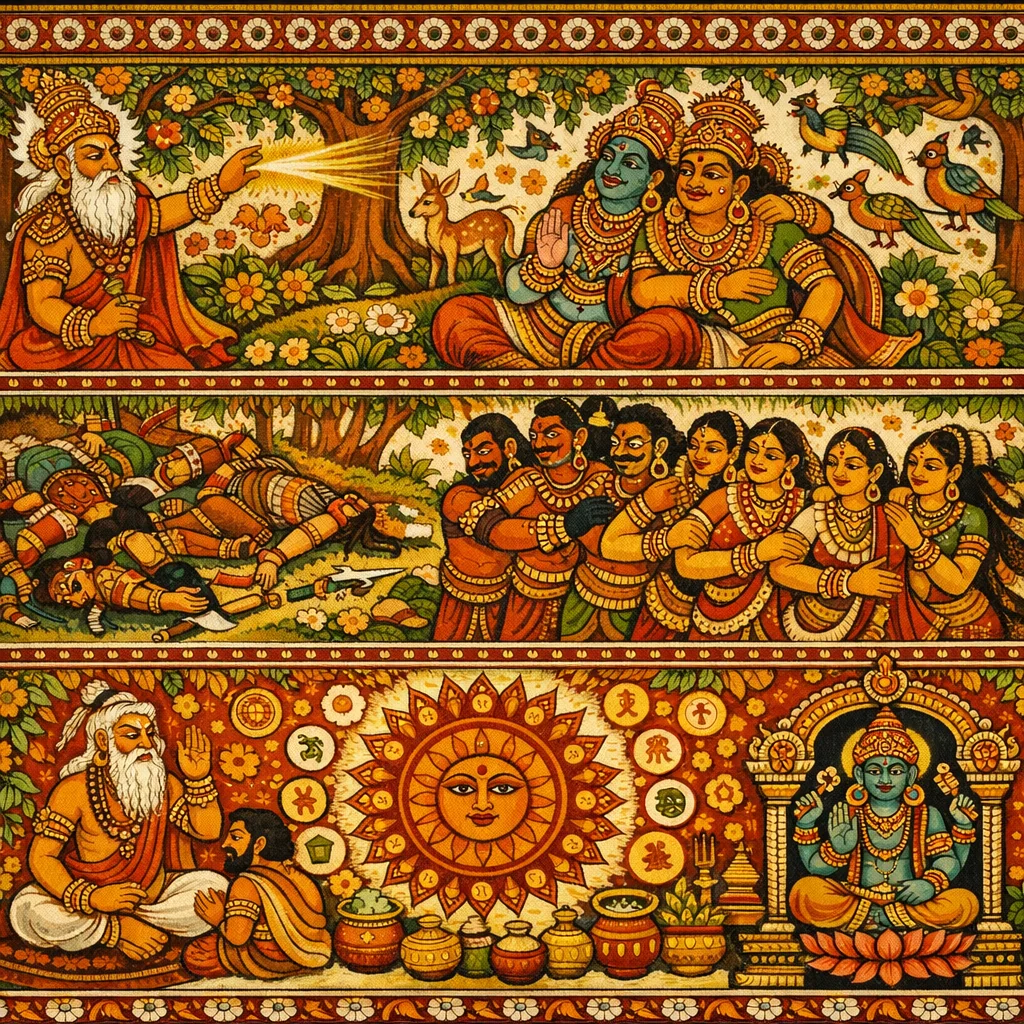
Brahmā asks the Lord for the settled dharma of courtesans. The Lord answers through a future-linked account: many women of Vāsudeva fall into desire, and a curse is uttered that robbers will seize them. After the Yādava line ends and Keśava departs, the abduction occurs; the women, enslaved, seek refuge. The yogin Dālbhya arrives, and they petition him for veśyā-dharma. He explains the karmic backstory—an earlier meeting with Nārada at Mānasa Lake, where pride brought a curse and a conditional boon (Nārāyaṇa as a future husband through specified gifts). Citing Indra’s precedent for women harmed by war and violation, Dālbhya teaches a detailed vrata: Sunday observance under certain nakṣatras, a herbal bath, worship of Puṇḍarīkākṣa/Nārāyaṇa with Kāma-related mantras, honoring a brāhmaṇa, and staged dāna culminating in gifts of a bed/cow and an image. The chapter concludes that this practice removes sin, yields endless fruit, and leads by devayāna to Viṣṇu’s abode.
Key Concepts
Shlokas in Adhyaya 70
Verse 1
*ब्रह्मोवाच वर्णाश्रमाणां प्रभवः पुराणेषु मया श्रुतः सदाचारस्य भगवन् धर्मशास्त्रविनिश्चयः पण्यस्त्रीणां सदाचारं श्रोतुमिच्छामि तत्त्वतः //
Brahmā said: “O Blessed Lord, in the Purāṇas I have heard of the origin of the varṇas and the āśramas, and of the settled determinations of the Dharmaśāstras concerning sadācāra, right conduct. Now I wish to hear, truly and according to the full principle, the proper conduct prescribed for the paṇya-strīs, the courtesans.”
Verse 2
*ईश्वर उवाच तस्मिन्नेव युगे ब्रह्मन् सहस्राणि तु षोडश वासुदेवस्य नारीणां भविष्यन्त्यम्बुजोद्भव //
The Lord said: “In that very age, O Brahman—O lotus-born one—Vāsudeva will have sixteen thousand women as his wives and consorts.”
Verse 3
ताभिर्वसन्तसमये कोकिलालिकुलाकुले पुष्पिते पवनोत्फुल्लकह्लारसरसस्तटे //
With them, in the season of spring—when the groves were alive with cuckoos and swarms of bees, when all was in bloom—he moved along the banks of a lake where kahlāra lotuses had opened, stirred by the breeze.
Verse 4
निर्भरापानगोष्ठीषु प्रसक्ताभिरलंकृतः कुरङ्गनयनः श्रीमान् मालतीकृतशेखरः //
Adorned by women absorbed in lively drinking-feasts and convivial gatherings, he—deer-eyed and resplendent—wore a crest fashioned from mālatī blossoms.
Verse 5
गच्छन्समीपमार्गेण साम्बः परपुरंजयः साक्षात्कन्दर्पो रूपेण सर्वाभरणभूषितः //
Proceeding by the nearby path, Sāmba—conqueror of enemy cities—appeared in form like Kandarpa (Kāma) himself, adorned with every kind of ornament.
Verse 6
अनङ्गशरतप्ताभिः साभिलाषमवेक्षितः प्रवृद्धो मन्मथस्तासां भविष्यति यदात्मनि //
Scorched by the arrows of the Bodiless One (Kāma) and gazed upon with longing, the passion of Manmatha will swell within their very selves.
Verse 7
तदावेक्ष्य जगन्नाथः सर्वतो ज्ञानचक्षुषा शापं वक्ष्यति ताः सर्वा वो हरिष्यन्ति दस्यवः मत्परोक्षं यतः कामलौल्यादीदृग्विधं कृतम् //
Then the Lord of the universe, seeing everything with His all-knowing vision, will pronounce a curse: “Bandits shall carry off all your women,” because, behind My back, such conduct was committed out of lust and fickle craving.
Verse 8
ततः प्रसादितो देव इदं वक्ष्यति शार्ङ्गभृत् ताभिः शापाभितप्ताभिर् भगवान् भूतभावनः //
Then, being graciously appeased, the Lord—bearer of the Śārṅga bow—will declare this: the Blessed One, the Sanctifier of all beings, (moved) by those who were scorched by a curse.
Verse 9
उत्तारभूतं दासत्वं समुद्राद्ब्राह्मणप्रियः उपदेक्ष्यत्यनन्तात्मा भाविकल्याणकारकम् //
The Infinite-Souled One—dear to the brāhmaṇas—will instruct (you) in that servitude which becomes a means of deliverance from the ocean of saṃsāra, and which brings welfare in times to come.
Verse 10
भवतीनाम् ऋषिर्दाल्भ्यो यद्व्रतं कथयिष्यति तदैवोत्तारणायालं दासत्वे ऽपि भविष्यति इत्युक्त्वा ताः परिष्वज्य गतो द्वारवतीश्वरः //
“The sage Dālbhya will teach you the vow (vrata) that is to be observed; that very vow will be sufficient to bring about your deliverance—even though you are in servitude.” Having said this, the Lord of Dvāravatī embraced them and departed.
Verse 11
ततः कालेन महता भारावतरणे कृते निवृत्ते मौसले तद्वत् केशवे दिवमागते //
Then, after a long time—when the descent to lighten the earth’s burden had been fulfilled, when the Mausala destruction had come to an end, and likewise when Keśava had departed to heaven—
Verse 12
शून्ये यदुकुले सर्वैश् चौरैरपि जिते ऽर्जुने हृतासु कृष्णपत्नीषु दासभोग्यासु चाम्बुधौ //
When the Yadu lineage had become empty, and even Arjuna was overcome by all manner of robbers, Kṛṣṇa’s wives were carried off—reduced to the status of slaves and objects of exploitation—amidst the waters of the sea.
Verse 13
तिष्ठन्तीषु च दौर्गत्यसंतप्तासु चतुर्मुख आगमिष्यति योगात्मा दाल्भ्यो नाम महातपाः //
While the Four‑faced One (Brahmā) remained—when beings were scorched by adversity—there arrived a great ascetic named Dālbhya, a yogin of profound spiritual realization.
Verse 14
तास्तमर्घ्येण सम्पूज्य प्रणिपत्य पुनः पुनः लालप्यमाना बहुशो बाष्पपर्याकुलेक्षणाः //
Having duly honored him with an offering of arghya, they bowed down again and again; repeatedly addressing him with plaintive words, their eyes were clouded and overwhelmed with tears.
Verse 15
स्मरन्त्यो विपुलान्भोगान् दिव्यमाल्यानुलेपनान् भर्तारं जगतामीशम् अनन्तमपराजितम् //
They remembered the Lord—enjoyer of abundant delights, adorned with divine garlands and unguents—the Husband and Sovereign of the worlds, the Infinite and Unconquered.
Verse 16
दिव्यभावां तां च पुरीं नानारत्नगृहाणि च द्वारकावासिनः सर्वान् देवरूपान्कुमारकान् प्रश्नमेवं करिष्यन्ति मुनेरभिमुखं स्थिताः //
Standing face to face with the sage, they will ask in this manner—about the city of Dvārakā, wondrous in its nature, with houses adorned with many kinds of jewels, and about all its inhabitants: youthful boys of godlike form.
Verse 17
*स्त्रिय ऊचुः दस्युभिर्भगवान्सर्वाः परिभुक्ता वयं बलात् स्वधर्माच्च्यवने ऽस्माकम् अस्मिन्नः शरणं भव //
The women said: “O Blessed Lord, we have all been violated by robbers by force. Since we have fallen away from our own rightful dharma, be for us a refuge in this plight.”
Verse 18
आदिष्टो ऽसि पुरा ब्रह्मन् केशवेन च धीमता कस्मादीशेन संयोगं प्राप्य वेश्यात्वमागताः //
O Brahmin, you were formerly instructed by the wise Keśava. For what reason, after coming into union with the Lord (Īśa), did you (or they) come to the state of a courtesan?
Verse 19
वेश्यानामपि यो धर्मस् तं नो ब्रूहि तपोधन कथयिष्यत्यतस्तासां स दाल्भ्यश्चैकितायनः //
“O treasure of austerity, tell us what the proper dharma is even for courtesans. Therefore, Dālbhya and Caikitāyana will now explain the duties prescribed for them.”
Verse 20
*दाल्भ्य उवाच जलक्रीडाविहारेषु पुरा सरसि मानसे भवतीनां च सर्वासां नारदो ऽभ्याशमागतः //
Dālbhya said: Formerly, when you all were sporting and delighting in water in the lake Mānasa, Nārada came near to all of you.
Verse 21
हुताशनसुताः सर्वा भवन्त्यो ऽप्सरसः पुरा अप्रणम्यावलेपेन परिपृष्टः स योगवित् कथं नारायणो ऽस्माकं भर्ता स्याद् इत्युपादिश //
Formerly, all of you—the Apsarases, daughters of Hutāśana (Agni)—questioned that knower of Yoga in pride, without first bowing in reverence: “How could Nārāyaṇa ever become our husband?” Thus did you seek instruction.
Verse 22
तस्माद्वरप्रदानं वः शापश्चायमभूत्पुरा शय्याद्वयप्रदानेन मधुमाधवमासयोः //
Therefore a boon was granted to you—and this curse too had arisen earlier—because you bestowed a pair of beds during the months of Madhu and Mādhava.
Verse 23
सुवर्णोपस्करोत्सर्गाद् द्वादश्यां शुक्लपक्षतः भर्ता नारायणो नूनं भविष्यत्यन्यजन्मनि //
By gifting golden articles on the Dvādaśī of the bright fortnight (Śukla-pakṣa), one’s husband will certainly be Nārāyaṇa in a future birth.
Verse 24
यदकृत्वा प्रणामं मे रूपसौभाग्यमत्सरात् परिपृष्टो ऽस्मि तेनाशु वियोगो वो भविष्यति चौरैरपहृताः सर्वा वेश्यात्वं समवाप्स्यथ //
Because, out of envy for my beauty and good fortune, you questioned me without first offering reverence, separation will soon come upon you; and all of you, carried off by thieves, will fall into the condition of courtesans (veśyā).
Verse 25
एवं नारदशापेन केशवस्य च धीमतः वेश्यात्वमागताः सर्वा भवन्त्यः काममोहिताः इदानीमपि यद्वक्ष्ये तच्छृणुध्वं वराङ्गनाः //
Thus, by Nārada’s curse—even in the presence of wise Keśava—all those women, deluded by desire, came to the state of courtesans. And now too, O lovely-limbed women, listen to what I shall declare.
Verse 26
*दाल्भ्य उवाच पुरा देवासुरे युद्धे हतेषु शतशः सुरैः दानवासुरदैत्येषु राक्षसेषु ततस्ततः //
Dalbhya said: Long ago, in the war between the gods and the Asuras, when the Devas had slain hundreds upon hundreds—among the Dānavas, Asuras, Daityas, and Rākṣasas—here and there on every side—
Verse 27
तेषां व्रातसहस्राणि शतान्यपि च योषिताम् परिणीतानि यानि स्युर् बलाद्भुक्तानि यानि वै तानि सर्वाणि देवेशः प्रोवाच वदतां वरः //
Regarding those women—whether the countless vows and even the hundreds of observances they undertook, whether the marriages duly contracted, or the cases where they were violated by force—all these matters the Lord of the gods declared, he who is foremost among speakers.
Verse 28
*इन्द्र उवाच वेश्याधर्मेण वर्तध्वम् अधुना नृपमन्दिरे भक्तिमत्यो वरारोहास् तथा देवकुलेषु च //
Indra said: “Now conduct yourselves in accordance with the dharma of courtesans, remaining devoted, within the king’s palace, and likewise within the precincts of the temples (devakula).”
Verse 29
राजानः स्वामिनस्तुल्याः सुता वापि च तत्समाः भविष्यति च सौभाग्यं सर्वासामपि शक्तितः //
Kings will be comparable to their lords, and their sons too will be of the same stature; and, according to each one’s capacity, good fortune will arise for all.
Verse 30
यः कश्चिच्छुल्कमादाय गृहमेष्यति वः सदा निधनेनोपचार्यो वः स तदान्यत्र दाम्भिकात् //
Whoever, after taking a levy (or fee), comes to your house again and again—he should be dealt with by you through a “payment,” as a decisive settlement; at that time, keep him away elsewhere, for he is a hypocritical deceiver.
Verse 31
देवतानां पितॄणां च पुण्याहे समुपस्थिते गोभूहिरण्यधान्यानि प्रदेयानि स्वशक्तितः ब्राह्मणानां वरारोहाः कार्याणि वचनानि च //
When an auspicious day for the rites of the gods and the ancestors has arrived, one should, according to one’s capacity, give gifts of cows, land, gold, and grain; and, O noble lady, one should also carry out the requests and instructions of the Brāhmaṇas.
Verse 32
यच्चाप्यन्यद्व्रतं सम्यग् उपदेक्ष्याम्यहं ततः अविचारेण सर्वाभिर् अनुष्ठेयं च तत्पुनः //
And whatever other vow I shall next teach you correctly—once it has been taught, it too should again be undertaken by all, without hesitation or second-guessing.
Verse 33
संसारोत्तारणायालम् एतद्वेदविदो विदुः यदा सूर्यदिने हस्तः पुष्यो याथ पुनर्वसुः //
Those who know the Veda understand this to be fully capable of ferrying one across worldly existence: when, on a Sunday, the lunar mansion is Hasta, or Puṣya, or likewise Punarvasu.
Verse 34
भवेत्सर्वौषधीस्नानं सम्यङ्नारी समाचरेत् तदा पञ्चशरस्यापि संनिधातृत्वमेष्यति अर्चयेत्पुण्डरीकाक्षम् अनङ्गस्यानुकीर्तनैः //
A woman should properly perform the bath with all medicinal herbs; then even Pañcaśara (Kāma, the five-arrowed god of love) will come into near presence. She should worship Puṇḍarīkākṣa (Viṣṇu) with recitations that invoke Ananga (Kāma).
Verse 35
कामाय पादौ सम्पूज्य जङ्घे वै मोहकारिणे मेढ्रं कन्दर्पनिधये कीटं प्रीतिमते नमः //
Having duly worshipped the feet as Desire (Kāma), and the shanks as the cause of delusion (Moha), (one venerates) the generative organ as the abode of erotic impulse (Kandarpa); and salutations to the “worm/creature” that delights in pleasure.
Verse 36
नाभिं सौख्यसमुद्राय वामाय च तथोदरम् हृदयं हृदयेशाय स्तनावाह्लादकारिणे //
I offer the navel to the Ocean of bliss; likewise the belly to the Beautiful One; the heart to the Lord of hearts; and the breasts to Her who brings delight.
Verse 37
उत्कण्ठायेति वैकुण्ठम् आस्यमानन्दकारिणे वामाङ्गं पुष्पचापाय पुष्पबाणाय दक्षिणम् //
For “Utkaṇṭhā” (yearning), one should assign Vaikuṇṭha; for “Āsya” (the mouth), the giver of bliss. The left side is to be given to the Flower-bow, and the right to the Flower-arrow.
Verse 38
मानसायेति वै मौलिं विलोलायेति मूर्धजम् सर्वात्मने च सर्वाङ्गं देवदेवस्य पूजयेत् //
Reciting “mānasāya,” one should worship the crown of the Lord; reciting “vilolāya,” one should worship His hair. And with the mantra “sarvātmane,” one should worship the entire body (all the limbs) of Devadeva, the God of gods.
Verse 39
नमः शिवाय शान्ताय पाशाङ्कुशधराय च गदिने पीतवस्त्राय शङ्खचक्रधराय च //
Salutations to Śiva, the tranquil one; and also to him who bears the noose and the goad; to the mace-bearing one clad in yellow garments; and to him who holds the conch and the discus.
Verse 40
नमो नारायणायेति कामदेवात्मने नमः सर्वशान्त्यै नमः प्रीत्यै नमो रत्यै नम श्रियै //
“Salutations—‘Obeisance to Nārāyaṇa!’ Homage to Him whose very nature is Kāma (the divine power of desire). Salutations to universal Peace; salutations to Affection; salutations to Love; salutations to Śrī (Prosperity).”
Verse 41
नमः पुष्ट्यै नमस्तुष्ट्यै नमः सर्वार्थसम्पदे एवं सम्पूज्य देवेशम् अनङ्गात्मकमीश्वरम् गन्धैर्मौल्यैस्तथा धूपैर् नैवेद्येन च कामिनी //
Salutations to Puṣṭi (Nourishment); salutations to Tuṣṭi (Contentment); salutations to the fulfilment of all aims. Thus, having duly worshipped the Lord of gods—the sovereign whose nature is bodiless (subtle, beyond form)—the devoted woman should offer fragrances, garlands, incense, and naivedya (food-offerings).
Verse 42
तत आहूय धर्मज्ञं ब्रह्माणं वेदपारगम् अव्यङ्गावयवं पूज्य गन्धपुष्पार्चनादिभिः //
Then, having summoned Brahmā—the knower of dharma, one who has crossed to the far shore of the Vedas—(the worshipper) should honour that venerable one of flawless limbs with offerings such as fragrant substances, flowers, and acts of worship like arcanā.
Verse 43
शालेयतण्डुलप्रस्थं घृतपात्रेण संयुतम् तस्मै विप्राय सा दद्यान् माधवः प्रीयतामिति //
She should give to that brāhmaṇa one prastha measure of śāleyā rice, together with a vessel of ghee, saying, “May Mādhava (Viṣṇu) be pleased.”
Verse 44
यथेष्टाहारयुक्तं वै तमेव द्विजसत्तमम् रत्यर्थं कामदेवो ऽयम् इति चित्ते ऽवधार्य तम् //
Having provided that excellent dvija with whatever food he desires, one should fix him in the mind, thinking: “For the sake of rati (erotic union), this is Kāmadeva himself.”
Verse 45
यद्यदिच्छति विप्रेन्द्रस् तत्तत्कुर्याद्विलासिनी सर्वभावेन चात्मानम् अर्पयेत्स्मितभाषिणी //
Whatever the foremost brāhmaṇa (her husband) may desire, the graceful wife should do just that; and with her whole being she should offer herself in devoted service, speaking with gentle, smiling words.
Verse 46
एवमादित्यवारेण सर्वमेतत्समाचरेत् तण्डुलप्रस्थदानं च यावन्मासास्त्रयोदश //
Thus, on Sundays one should duly perform all these observances; and one should also donate a prastha-measure of rice, continuing this for thirteen months.
Verse 47
ततस्त्रयोदशे मासि सम्प्राप्ते तस्य भामिनी विप्रस्योपस्करैर्युक्तां शय्यां दद्याद्विलक्षणाम् //
Then, when the thirteenth month arrives, his wife should present to a Brahmin a distinguished bed, complete with its proper furnishings and accessories.
Verse 48
सोपधानकविश्रामां सास्तरावरणां शुभाम् प्रदीपोपानहच्छत्त्रपादुकासनसंयुताम् //
A fine resting-couch furnished with pillows, together with a good bedspread and coverings—complete with a lamp, footwear, an umbrella, sandals, and a seat—should be given as a meritorious gift.
Verse 49
सपत्नीकमलंकृत्य हेमसूत्राङ्गुलीयकैः सूक्ष्मवस्त्रैः सकटकैर् धूपमाल्यानुलेपनैः //
Having adorned the deity together with the consort with golden threads and finger-rings, with fine garments and ornaments, and with incense, garlands, and fragrant unguents, one should proceed with the worship.
Verse 50
कामदेवं सपत्नीकं गुडकुम्भोपरि स्थितम् ताम्रपात्रासनगतं हैमनेत्रपटावृतम् //
He should fashion Kāmadeva together with his consort, placing the image upon a pedestal shaped like a molasses-jar; seating it upon a copper vessel-seat, and covering it with a cloth bearing golden-hued eyes.
Verse 51
सकांस्यभाजनोपेतम् इक्षुदण्डसमन्वितम् दद्यादेतेन मन्त्रेण तथैकां गां पयस्विनीम् //
Accompanied by a bell-metal (kāṃsya) vessel and furnished with a sugarcane staff, one should offer this gift with this mantra; likewise, one should give a single milk-yielding cow.
Verse 52
यथान्तरं न पश्यामि कामकेशवयोः सदा तथैव सर्वकामाप्तिर् अस्तु विष्णो सदा मम //
As I never perceive any difference at all between Kāma and Keśava, so too, O Viṣṇu, may the fulfillment of all my desires ever be mine.
Verse 53
यथा न कमला देहात् प्रयाति तव केशव तथा ममापि देवेश शरीरे स्वे कुरु प्रभो //
O Keśava, just as Kamalā (Lakṣmī) never departs from your body, so too, O Lord of gods—O Master—make (her) abide in my own body as well.
Verse 54
तथा च काञ्चनं देवं प्रतिगृह्णन्द्विजोत्तमः क इदं कस्मा अदादिति वैदिकं मन्त्रमीरयेत् //
Likewise, when the foremost of the twice-born (a Brahmin) accepts the golden deity-image, he should recite the Vedic mantra: “Who is this, and to whom has it been given?”
Verse 55
ततः प्रदक्षिणीकृत्य विसर्ज्य द्विजपुंगवम् शय्यासनादिकं सर्वं ब्राह्मणस्य गृहं नयेत् //
Then, having circumambulated him respectfully and bidding farewell to that foremost of twice-born men, one should have all the gifts—such as a bed, a seat, and the like—taken to the Brahmin’s house.
Verse 56
ततः प्रभृति यो विप्रो रत्यर्थं गृहमागतः स मान्यः सूर्यवारे च स मन्तव्यो भवेत्तदा //
From that time onward, any Brahmin who comes to the house seeking sensual enjoyment is to be honored and treated with respect; and on Sunday as well, at that time, he is to be regarded as worthy of reverence.
Verse 57
एवं त्रयोदशं यावन् मासमेवं द्विजोत्तमान् तर्पयेत यथाकामं प्रोषिते ऽन्यं समाचरेत् //
Thus, for as long as thirteen months, he should—according to his wish and capacity—offer tarpaṇa (water-libations) to the foremost among the twice-born. If the principal person is away on travel, he should perform the rite for another suitable substitute.
Verse 58
तदनुज्ञया रूपवान्यो यावदभ्यागतो भवेत् आत्मनो ऽपि यथाविघ्नं गर्भभूतिकरं प्रियम् //
With her permission, let the man—handsome and well-disposed—approach her at the proper time; and let him do so in a manner free from obstacles even for himself, seeking what is dear and conducive to the well-being and flourishing of the embryo.
Verse 59
दैवं वा मानुषं वा स्याद् अनुरागेण वा ततः साचारानष्टपञ्चाशद् यथाशक्त्या समाचरेत् //
Whether the ensuing result be divine or human, and whether it arises from heartfelt inclination as well, one should, according to one’s capacity, duly practise these fifty-eight observances of right conduct.
Verse 60
एतद्धि कथितं सम्यग् भवतीनां विशेषतः अधर्मो ऽयं ततो न स्याद् वेश्यानामिह सर्वदा //
This has been explained correctly, especially with reference to you. Therefore, for the courtesans (veśyā) here, this should not be regarded as adharma—unrighteousness—at any time.
Verse 61
पुरुहूतेन यत्प्रोक्तं दानवीषु पुरा मया तदिदं साम्प्रतं सर्वं भवतीष्वपि युज्यते //
Whatever I formerly taught—at the instance of Puruhūta (Indra)—concerning the Dānavas, all of that teaching is now wholly applicable to you as well.
Verse 62
सर्वपापप्रशमनम् अनन्तफलदायकम् कल्याणीनां च कथितं तत्कुरुध्वं वराननाः //
It pacifies all sins and bestows endless fruits. This has been taught for the welfare of the virtuous—therefore, O fair-faced ones, do practice it.
Verse 63
करोति याशेषमखण्डमेतत् कल्याणिनी माधवलोकसंस्था सा पूजिता देवगणैर् अशेषैर् आनन्दकृत्स्थानम् उपैति विष्णोः //
She—auspicious and established in Mādhava’s (Vishnu’s) world—brings this whole merit to completion without remainder; and, being worshipped by all the hosts of gods, she attains Vishnu’s abode, the realm that bestows bliss.
Verse 64
*श्रीभगवानुवाच तपोधनः सो ऽप्यभिधाय चैवं तदा च तासां व्रतमङ्गनानाम् स्वस्थानमेष्यत्यनु ताः समस्तं व्रतं करिष्यन्ति च देवयानैः //
The Blessed Lord said: “That ascetic sage, having thus instructed them, will then return to his own abode. Following him, those women will duly complete the entire vow (vrata), and they will proceed by the divine path (devayāna).”
Frequently Asked Questions
It establishes a dharma-path for paṇya-strīs (courtesans) and women fallen into servitude, teaching that a disciplined Sunday vrata—herbal bathing, Viṣṇu/Kāma-inflected worship, honoring a brāhmaṇa, and staged gifts over thirteen months—can purify sin, restore auspiciousness, and lead toward liberation (devayāna and Viṣṇu’s abode).
Primarily Dharma (sadācāra, veśyā-dharma, expiation/merit through vrata and dāna). Genealogical-history appears only as narrative context (the end of the Yādavas, Mausala destruction, Dvārakā aftermath). Vastu/architecture and Rajadharma are not the focus in this chapter.
The text frames the outcome through a curse–boon logic: desire and conduct done ‘behind the Lord’s back’ leads to a curse that robbers will seize them; Dālbhya further links it to an earlier Nārada episode where prideful questioning without reverence resulted in a curse that they would be abducted and fall into veśyātvam.
The vrata is to be performed on Sundays, especially when the nakṣatra is Hasta, Puṣya, or Punarvasu, and continued with rice-dāna for thirteen months, culminating in major gifts (bed, cow, and an image-gift).