Adhyaya 194
Chapter Arc: रणभूमि में शस्त्र-विद्या का सूक्ष्म विधान उद्घाटित होता है—तलवार के मण्डलाकार भ्रमण ‘भ्रान्त’ और बाँह ऊपर उठाकर वही चक्र ‘उदश्रान्त’ कहलाता है; इसी कौशल-प्रदर्शन के बीच युद्ध का रुख अचानक सात्यकि की ओर मुड़ता है। → कृपाचार्य, कर्ण और धृतराष्ट्र-पुत्र तीव्रता से शैनेय सात्यकि पर टूट पड़ते हैं, उसे तीक्ष्ण बाणों से विनिघ्न करने का प्रयत्न करते हैं। उधर युधिष्ठिर, भीम, नकुल-सहदेव सात्यकि को घेरकर रक्षा-चक्र बनाते हैं; रण में रथों की भिड़न्त, शर-वर्षा और व्यूह-प्रतिव्यूह से तनाव बढ़ता जाता है। → द्रोणाचार्य के वध का समाचार/दृश्य युद्ध-हृदय को चीर देता है—‘तथागत’ (गति को प्राप्त) द्रोण को धृष्टद्युम्न के वश गया देख मनुष्य और अमानुष दोनों ‘हाहा’ कर उठते हैं; द्रोण अंतिम क्षण में ‘ॐ’ एकाक्षर ब्रह्म का स्मरण कर परम प्रभु में मन स्थिर करते हैं। → द्रोण के गिरते ही कौरव-सैन्य का उत्साह टूटता है; पाण्डव-सेना वेग से आक्रमण कर उसे चीर देती है। कौरव योद्धा पराजय और परलोक-भय—दोनों से विचलित होकर धैर्य खो बैठते हैं। विजय-उन्माद में भीम और धृष्टद्युम्न रण-मध्य में परस्पर आलिंगन कर नृत्य करते हैं। → द्रोण के पतन से युद्ध का नेतृत्व-शून्य क्षण बनता है—कौरव पक्ष किसके हाथ में ध्वजा सौंपेगा और प्रतिशोध की अग्नि किस रूप में फूटेगी?
Shlokas
Verse 1
नील (0) आप +औअस+- + तलवारको मण्डलाकार घुमाना 'भ्रान्त' कहलाता है। वही कार्य बाँह ऊपर उठाकर किया जाय तो उसे 'उदश्रान्त' कहा गया है। अपने चारों ओर तलवारको घुमाया जाय तो उसे “आविद्ध' कहते हैं। ये तीन कार्य शत्रुके चलाये हुए शस्त्रका निवारण करनेके लिये किये जाते हैं, शत्रुपर आक्रमण करनेके लिये जाना “आप्लुत” माना गया है। तलवारकी नोकसे शत्रुके शरीरका स्पर्श करना 'प्रसृत” कहा गया है। चकमा देकर शत्रुपर शस्त्रका आघात करना 'सृत” बताया गया है। शत्रुके दायें-बायें तलवार चलाना “परिवृत्त” कहा गया है। पीछे हटना “निवृत्त” है। दोनों योद्धाओंका परस्पर आघात- प्रत्याघात 'सम्पात” कहलाता है। अपनी विशेषता स्थापित करना '“समुदीर्ण” है। अंग-प्रत्यंगमें तलवार भाँजना “भारत' माना गया है। विचित्र रीतिसे तलवार चलानेकी कला दिखाना “कौशिक' कहा गया है। अपनेको ढालकी आड़में छिपाकर तलवार चलानेका नाम 'सात्वत' है। द्विनवत्याधेकशततमो< ध्याय: उभयपक्षके श्रेष्ठ महारथियोंका परस्पर सुद्ध धृष्टद्युम्नका आक्रमण, द्रोणाचार्यका अस्त्र त्यागकर योगधारणाके द्वारा ब्रह्मलोक-गमन और धृष्टद्युम्नद्वारा उनके मस्तकका उच्छेद संजय उवाच सात्वतस्य तु तत् कर्म दृष्टवा दुर्योधनादय: । शैनेयं सर्वतः क्रुद्धा वारयामासुरञण्जसा,संजय कहते हैं--राजन्! सात्वतवंशी सात्यकिका वह कर्म देखकर दुर्योधन आदि कौरवयोद्धा कुपित हो उठे और उन्होंने अनायास ही शिनिपौत्रको सब ओरसे घेर लिया
Sanjaya said: “O King, seeing that deed of the Sātvata (Sātyaki), Duryodhana and the other Kaurava warriors flared up in anger and, without difficulty, checked the son of Śini (Sātyaki), surrounding him on all sides.”
Verse 2
कृपकर्णो च समरे पुत्राश्न तव मारिष । शैनेयं त्वरयाभ्येत्य विनिघ्नन् निशितै: शरै:,मान्यवर! समरांगणमें कृपाचार्य, कर्ण और आपके पुत्र तुरंत ही सात्यकिके पास पहुँचकर उन्हें पैने बाणोंसे घायल करने लगे
Sañjaya said: “O revered one, in the thick of battle, Kr̥pa and Karṇa, along with your sons, swiftly rushed up to Śaineya (Sātyaki) and began striking him with sharp arrows.”
Verse 3
युधिष्ठिरस्ततो राजा माद्रीपुत्रौ च पाण्डवौ । भीमसेनश्न बलवान् सात्यकिं पर्यवारयन्,तब राजा युधिष्ठिर, पाण्डुकुमार नकुल-सहदेव तथा बलवान् भीमसेनने सात्यकिकी रक्षाके लिये उन्हें अपने बीचमें कर लिया
Sañjaya said: Then King Yudhiṣṭhira, along with the Pāṇḍava sons of Mādrī, and the mighty Bhīmasena, formed a protective ring around Sātyaki.
Verse 4
कर्णशक्षु शरवर्षेण गौतमश्न महारथ: । दुर्योधनादयस्ते च शैनेयं पर्यवारयन्,कर्ण, महारथी कृपाचार्य और दुर्योधन आदिने बाणोंकी वर्षा करके चारों ओरसे सात्यकिको अवरुद्ध कर दिया
Sañjaya said: Karṇa, the great chariot-warrior Kṛpācārya (of Gautama’s line), and Duryodhana with his followers showered Sātyaki (Śaineya) with volleys of arrows and hemmed him in on every side.
Verse 5
तां वृष्टिं सहसा राजन्नुत्थितां घोररूपिणीम् । वारयामास शैनेयो योधयंस्तान् महारथान्,राजन! उन महारथियोंके साथ युद्ध करते हुए शिनिपौत्र सात्यकिने सहसा उठी हुई उस भयंकर बाण-वर्षाको अपने अस्त्रोंद्वारा रोक दिया
Sañjaya said: O King, as that dreadful shower of arrows suddenly rose, Śaineya Sātyaki—while engaging those great chariot-warriors in battle—checked it at once with his own weapons.
Verse 6
तेषामस्त्राणि दिव्यानि संहितानि महात्मनाम् । वारयामास विधिवद् दिव्यैरस्त्रैमहामृथे,उन्होंने उस महासमरमें विधिपूर्वक दिव्यास्त्रोंका प्रयोग करके उन महामनस्वी वीरोंके छोड़े हुए दिव्य अस्त्रोंका निवारण कर दिया
Sañjaya said: In that great battle, he duly countered the celestial missiles launched by those high-souled warriors, employing celestial weapons in accordance with proper rule. The scene shows that even amid slaughter, mastery is measured not only by power but by disciplined, lawful use of force.
Verse 7
क्रूरमायोधनं जज्ञे तस्मिन् राजसमागमे । रुद्रस्येव हि क्रुद्धस्य निघ्नतस्तान् पशून् पुरा,राजाओंमें वह संघर्ष छिड़ जानेपर उस युद्ध-स्थलमें क्रूरताका ताण्डव होने लगा। जैसे पूर्व (प्रलय) कालमें क्रोधमें भरे हुए रुद्रदेवके द्वारा पशुओं (प्राणियों)-का संहार होते समय निर्दयताका दृश्य उपस्थित हुआ था
Sañjaya said: When the kings had converged and the clash erupted, that battlefield became a scene of ruthless combat. It appeared like the ancient devastation wrought when the wrathful Rudra, in fury, struck down living beings—an image of pitiless slaughter overwhelming all restraint.
Verse 8
हस्तानामुत्तमाड़ानां कार्मुकाणां च भारत । छत्राणां चापविद्धानां चामराणां च संचयै:
Sañjaya said: “O Bhārata, there were heaps and piles of severed hands, of splendid bows, and of umbrellas cast away, along with clusters of fly-whisks—clear signs of the battle’s crushing violence and the sudden fall of royal dignity amid slaughter.”
Verse 9
राशय: सम व्यदृश्यन्त तत्र तत्र रणाजिरे । भारत! कटकर गिरे हुए हाथों, मस्तकों, धनुषों, छत्रों और चँँवरोंके संग्रहोंसे उस समरांगणके विभिन्न प्रदेशोंमें उक्त वस्तुओंके ढेर-के-ढेर दिखायी दे रहे थे ।। भग्नचक्रै रथैश्नापि पातितैश्न महाध्वजै:
Sanjaya said: O Bharata, here and there across the battlefield, heaps were visible—piles formed from fallen hands and severed heads, and from gathered bows, parasols, and yak-tail fans. In many parts of that arena of war, even chariots with broken wheels lay overturned, their great standards cast down—showing the terrible cost and disorder that violence brings.
Verse 10
बाणपातनिकृत्तास्तु योधास्ते कुरुसत्तम
Sañjaya said: “O best of the Kurus, those warriors were cut down by the shower of arrows.”
Verse 11
वर्तमाने तथा युद्धे घोरे देवासुरोपमे
As that dreadful battle raged on—like the primeval clash between gods and demons—Sañjaya cast the scene as a conflict of cosmic scale, stressing the terrifying intensity and moral weight of war when it is driven to such extremes.
Verse 12
अब्रवीत क्षत्रियांस्तत्र धर्मराजो युधिष्ठिर: । अभिद्रवत संयत्ता: कुम्भयोनिं महारथा:
Sañjaya said: There, King Yudhiṣṭhira—the upholder of dharma—addressed the assembled kṣatriya warriors: “Charge forth, fully armed, against Kumbhayoni (Droṇa)!” Thus he urged the great chariot-fighters to advance, casting the battle-command as a duty bound to dharma amid war’s harsh demands.
Verse 13
देवासुर-संग्रामके समान जब वह घोर युद्ध चल रहा था, उस समय धर्मराज युधिष्ठिरने अपने पक्षके क्षत्रिय योद्धाओंसे इस प्रकार कहा--“महारथियो! तुम सब लोग पूर्णतः सावधान होकर द्रोणाचार्यपर धावा करो ।। एषो हि पार्षतो वीरो भारद्वाजेन संगत: । घटते च यथाशक्ति भारद्वाजस्य नाशने,'ये वीर द्रुपदकुमार धृष्टद्युम्न द्रोणाचार्यके साथ जूझ रहे हैं और उनके विनाशके लिये यथाशक्ति चेष्टा कर रहे हैं
Sañjaya said: When that dreadful battle was raging—like the legendary wars between gods and demons—Dharma-king Yudhiṣṭhira addressed the kṣatriya warriors on his side: “Great chariot-fighters, be fully alert and charge at Droṇa.” “For this Pārṣata hero, Dhṛṣṭadyumna, is already engaged with Bhāradvāja’s son (Droṇa) and is striving with all his power to bring about Droṇa’s destruction.” In its ethical tone, the passage shows Yudhiṣṭhira’s reluctant yet resolute shift from restraint to strategic necessity: in a war where adharma has escalated, the commander is urged to act decisively against a formidable teacher-warrior to protect the larger cause.
Verse 14
यादृशानि हि रूपाणि दृश्यन्ते5स्य महारणे । अद्य द्रोणं रणे क्रुद्धो घातयिष्यति पार्षत:
Sañjaya said: “Dreadful and portentous sights are being seen in this great battle. Today, the son of Pṛṣata (Dhṛṣṭadyumna), enraged in combat, will cause Droṇa to be slain.”
Verse 15
युधिष्ठिरसमाज्ञप्ता: सृञजयानां महारथा:
Sañjaya said: The great chariot-warriors of the Sṛñjayas, acting under Yudhiṣṭhira’s command, prepared to carry out his directive—an image of disciplined obedience amid the moral strain of war.
Verse 16
तान् समापतत: सर्वान् भारद्वाजो महारथ:
Sañjaya said: As all of them rushed in together, the great chariot-warrior Bhāradvāja met their onslaught—standing firm in the storm of battle, embodying the Kṣatriya duty of confronting danger without retreat.
Verse 17
अभ्यवर्तत वेगेन मर्तव्यमिति निश्चित: । महारथी द्रोणाचार्यने मरनेका निश्चय करके उन समस्त आक्रमणकारियोंका बड़े वेगसे सामना किया ।। प्रयाते सत्यसंधे तु समकम्पत मेदिनी
Sañjaya said: Having resolved that death was inevitable, the great chariot-warrior Droṇācārya, with firm determination even in the face of dying, rushed forward at great speed to confront all those assailants. And as that truth-bound hero advanced, the very earth seemed to tremble—signaling the moral and cosmic weight of the moment in the war.
Verse 18
ववुर्वाता: सनिर्घातास्त्रासयाना वरूथिनीम् | सत्यप्रतिज्ञ द्रोणाचार्यके आगे बढ़ते ही पृथ्वी काँपने लगी और वज्रपातकी आवाजके साथ ही प्रचण्ड आँधी चलने लगी, जो सारी सेनाको डरा रही थी ।। पपात महती चोल्का आदित्यान्निश्वरन्त्युत
Sañjaya said: With thunderous crashes, fierce winds began to blow, terrifying the assembled host. And a great meteor fell, as though issuing forth from the sun—an ominous portent accompanying Droṇa, the steadfast in his vow, as he advanced, shaking the earth and unsettling the warriors’ hearts.
Verse 19
जज्वलुश्चैव शस्त्राणि भारद्वाजस्य मारिष
Sañjaya said: “O venerable one, the weapons of Bhāradvāja’s son blazed forth—flaring with terrible brilliance—signaling the fierce escalation of the battle and the grave moral weight of violence unleashed.”
Verse 20
हतौजा इव चाप्यासीद् भारद्वाजो महारथ:
Sañjaya said: The great chariot-warrior Bhāradvāja (Droṇa) appeared as though his strength had been slain—his vigor broken and his spirit struck down amid the moral shock of the battle’s unfolding.
Verse 21
प्रास्फुरज्नयनं चास्य वाम॑ बाहुस्तथैव च | महारथी द्रोणाचार्य उस समय तेजोहीन-से हो रहे थे। उनकी बायीं आँख और बायीं भुजा फड़क रही थी ।। विमनाश्वाभवद् युद्धे दृष्टवा पार्षतमग्रत:,वे युद्धमें अपने सामने धृष्टद्युम्मको देखकर मन-ही-मन उदास हो गये। साथ ही ब्रह्मवादी महर्षियोंके ब्रह्मलोकमें चलनेके सम्बन्धमें कहे हुए वचनोंका स्मरण करके उन्होंने उत्तम युद्धके द्वारा अपने प्राणोंको त्याग देनेका विचार किया
Sañjaya said: At that time Droṇācārya, the great chariot-warrior, seemed to lose his radiance. His left eye and left arm began to twitch—omens of misfortune. Seeing Dhṛṣṭadyumna, the son of Drupada, standing before him in battle, he grew inwardly despondent. Remembering the words spoken by brahman-speaking seers about attaining the Brahma-world, he resolved to relinquish his life through a noble death in combat.
Verse 22
ऋषीणां ब्रह्म॒वादानां स्वर्गस्य गमनं प्रति । सुयुद्धेन तत: प्राणानुत्स्रष्टमुपचक्रमे,वे युद्धमें अपने सामने धृष्टद्युम्मको देखकर मन-ही-मन उदास हो गये। साथ ही ब्रह्मवादी महर्षियोंके ब्रह्मलोकमें चलनेके सम्बन्धमें कहे हुए वचनोंका स्मरण करके उन्होंने उत्तम युद्धके द्वारा अपने प्राणोंको त्याग देनेका विचार किया
Sañjaya said: Remembering the declarations of the brahman-speaking seers about the soul’s ascent to heaven, he resolved to relinquish his life through a noble fight. Seeing Dhṛṣṭadyumna before him in the battle, he grew inwardly despondent, and—holding fast to the ideal that a warrior may meet death with purpose rather than despair—he prepared to cast off his life in the best manner, by righteous combat.
Verse 23
ततश्षतुर्दिशं सैन्यैट्रीपदस्पाभिसंवृत: । निर्दहन् क्षत्रियव्रातान् द्रोण: पर्यचरद् रणे,तदनन्तर ट्रुपदकी सेनाओंद्वारा चारों ओरसे घिरे हुए द्रोणाचार्य क्षत्रियसमूहोंको दग्ध करते हुए रणभूमिमें विचरने लगे
Sañjaya said: Then Droṇa, hemmed in on all four sides by the troops of the Trigartas, moved about the battlefield, scorching down masses of kṣatriya warriors—pressing the fight with relentless force amid the moral darkness of war.
Verse 24
हत्वा विंशतिसाहस्रान् क्षत्रियानरिमर्दन: । दशायुतानि करिणामवधीद् विशिखै: शितै:,शत्रुमर्दन द्रोणने वहाँ बीस हजार क्षत्रियोंका संहार करके अपने तीखे बाणोंद्वारा एक लाख हाथियोंका वध कर डाला
Sañjaya said: Having slain twenty thousand Kṣatriya warriors, the enemy-crushing hero then, with his sharp arrows, brought down tens of thousands of elephants. The verse underscores the terrifying scale of destruction in the war—valor expressed as martial efficiency, yet ethically shadowed by the immense loss of life and the dehumanizing momentum of battle.
Verse 25
सो&तिष्ठदाहवे यत्तो विधूमो5ग्निरिव ज्वलन् | क्षत्रियाणामभावाय ब्राद्म॒मस्त्रं समास्थित:,फिर वे क्षत्रियोंका विनाश करनेके लिये ब्रह्मास्त्रका सहारा ले बड़ी सावधानीके साथ युद्धभूमिमें खड़े हो गये और धूमरहित प्रज्वलित अग्निके समान प्रकाशित होने लगे
Then he stood on the field of battle, intent and wary, blazing like a smokeless fire; and for the destruction of the Kṣatriyas he took refuge in the Brahmāstra, Brahmā’s sacred weapon.
Verse 26
पाज्चाल्यं विरथं भीमो हतसर्वायुधं बली । सुविषण्णं महात्मानं त्वरमाण: समभ्ययात्,पांचालराजकुमार धृष्टद्युम्न रथहीन हो गये थे। उनके सारे अस्त्र-शस्त्र नष्ट हो चुके थे और वे भारी विषादमें डूब गये थे। उस अवस्थामें शत्रुमर्दन बलवान् भीमसेन उन महामनस्वी पांचालवीरके पास तुरंत आ पहुँचे और उन्हें अपने रथपर बिठाकर द्रोणाचार्यको निकटसे बाण चलाते देख इस प्रकार बोले---
Sanjaya said: Mighty Bhima hurried to the Panchala warrior—now without a chariot, stripped of all weapons, and sunk in deep despondency. Seeing that noble-hearted prince in such a helpless state amid the press of battle, Bhima rushed up to protect and rally him, so that the fight might continue with courage and purpose rather than collapse into despair.
Verse 27
ततः स्वरथमारोप्य पाञ्चाल्यमरिमर्दन: । अब्रवीदभिसपम्प्रेक्ष्य द्रोणमस्यन्तमन्तिकात्,पांचालराजकुमार धृष्टद्युम्न रथहीन हो गये थे। उनके सारे अस्त्र-शस्त्र नष्ट हो चुके थे और वे भारी विषादमें डूब गये थे। उस अवस्थामें शत्रुमर्दन बलवान् भीमसेन उन महामनस्वी पांचालवीरके पास तुरंत आ पहुँचे और उन्हें अपने रथपर बिठाकर द्रोणाचार्यको निकटसे बाण चलाते देख इस प्रकार बोले---
Sañjaya said: Then the foe-crushing Bhīmasena lifted the Pāñcāla prince onto his own chariot. Seeing Droṇa shooting arrows at close range, he addressed him—framing the moment as a rescue amid the harsh ethics of battle, where protecting an ally who has lost his means of fighting becomes an urgent duty even as the violence continues unabated.
Verse 28
न त्वदन्य इहाचार्य योद्धुमुत्सहते पुमान् त्वरस्व प्राग् वधायैव त्वयि भार: समाहित:
Sañjaya said: “O teacher, here no man other than you has the courage to engage in battle. Make haste—this burden has been placed upon you beforehand, for the very purpose of slaying the foe.”
Verse 29
'धृष्टद्युम्न! यहाँ तुम्हारे सिवा दूसरा कोई ऐसा पुरुष नहीं है, जो आचार्यके साथ जूझनेका साहस कर सके। अतः तुम पहले उनके वधके लिये ही शीघ्रतापूर्वक प्रयत्न करो। तुमपर ही इसका सारा भार रखा गया है' ।। स तथोक्तो महाबाहु: सर्वभारसहं धनु: । अभिपत्याददे क्षिप्रमायुधप्रवरं दृढम्,भीमसेनके ऐसा कहनेपर महाबाहु धृष्टद्युम्नने उछलकर शीघ्रतापूर्वक सारा भार सहन करनेमें समर्थ सुदृढ़ एवं श्रेष्ठ आयुध धनुषको उठा लिया
Sañjaya said: “Dhṛṣṭadyumna, here there is no other man besides you who can dare to grapple with the Ācārya. Therefore, swiftly strive first and foremost for his slaying. The entire burden of this has been placed upon you.” Thus addressed, the mighty-armed Dhṛṣṭadyumna sprang forward and quickly took up his firm, excellent weapon—his bow—capable of bearing every strain.
Verse 30
संरब्धश्न॒ शरानस्यन् द्रोणं दुर्वारणं रणे । विवारयिषुराचार्य शरवर्षैरवाकिरत्,फिर क्रोधमें भरकर बाण चलाते हुए उन्होंने रणभूमिमें कठिनतासे रोके जानेवाले ट्रोणाचार्यको रोक देनेकी इच्छासे उन्हें बाणोंकी वर्षाद्वारा ढक दिया
Sañjaya said: Enraged, he kept shooting arrows and, wishing to check Droṇa—so hard to restrain in battle—he covered the teacher with a rain of shafts. The scene underscores how, in the fury of war, even reverence for an ācārya is strained as combatants pursue their immediate martial duty and strategic necessity.
Verse 31
तौ न्यवारयतां श्रेष्ठी संरब्धौी रणशोभिनौ । उदीरयेतां ब्रह्माणि दिव्यान्यस्त्राण्यनेकश:,संग्रामभूमिमें शोभा पानेवाले वे दोनों श्रेष्ठ वीर कुपित हो नाना प्रकारके दिव्यास्त्र एवं ब्रह्मास्त्र प्रकट करते हुए एक-दूसरेको आगे बढ़नेसे रोकने लगे
Sañjaya said: Those two foremost warriors, blazing with wrath and resplendent on the battlefield, checked one another’s advance. Striving to overpower the other, they again and again unleashed many celestial missiles, including Brahma-weapons—an escalation that shows how anger in war drives even the best of men toward ever more destructive means.
Verse 32
स महास्त्रैर्महाराज द्रोणमाच्छादयदू रणे । निहत्य सर्वाण्यस्त्राणि भारद्वाजस्य पार्षत:,महाराज! धृष्टद्युम्नने रणभूमिमें द्रोणाचार्यके सभी अस्त्रोंको नष्ट करके उन्हें अपने महान् अस्त्रोंद्वारा आच्छादित कर दिया
Sañjaya said: O King, on the battlefield the son of Pṛṣata (Dhṛṣṭadyumna), having struck down and neutralized all the weapons of Bhāradvāja’s son (Droṇa), then overwhelmed Droṇa with his own mighty celestial missiles. The scene underscores the grim ethics of war: mastery and counter-mastery of arms decide fate, even when the opponent is a revered teacher, and the conflict forces warriors to set aside personal reverence in pursuit of their sworn duty and strategic aim.
Verse 33
सवसातीज्थशिबींश्वैव बाह्लीकान् कौरवानपि । रक्षिष्यमाणान् संग्रामे द्रोणं व्यधमदच्युत:,कभी विचलित न होनेवाले पांचालवीरने संग्राममें द्रोणाचार्यकी रक्षा करनेवाले बसाति, शिबि, बाह्नीक और कौरवयोद्धाओंका भी संहार कर डाला
Sañjaya said: In the thick of battle, Acyuta cut down even the Savasātis, the Śibis, the Bāhlīkas, and the Kaurava warriors who were guarding Droṇa—thus breaking the protective ring around the preceptor. The episode underscores how, in war, loyalty and duty to one’s commander can be overwhelmed by a superior warrior’s resolve, raising the ethical tension between reverence for a teacher and the ruthless necessities of combat.
Verse 34
धृष्टद्युम्नस्तथा राजन् गभस्तिभिरिवांशुमान् । बभौ प्रच्छादयन्नाशा: शरजालै: समन्तत:ः,राजन! अपने बाणोंके समूहसे सम्पूर्ण दिशाओंको सब ओरसे आच्छादित करते हुए धृष्टद्युम्न किरणोंद्वारा अंशुमाली सूर्यके समान प्रकाशित हो रहे थे
Sañjaya said: O King, Dṛṣṭadyumna shone like the radiant sun with its rays, as he covered all directions on every side with a dense net of arrows. The image underscores the overwhelming force of disciplined martial skill in battle—power that, when directed by resolve, can dominate the field and shape the fate of many.
Verse 35
तस्य द्रोणो धनुश्छित्त्वा विद्ध्वा चैनं शिलीमुखै: । मर्माण्यभ्यहनद् भूय: स व्यथां परमामगात्,तदनन्तर द्रोणाचार्यने धृष्टद्युम्मनका धनुष काटकर उन्हें बाणोंद्वारा घायल कर दिया और पुनः उनके मर्मस्थानोंको गहरी चोट पहुँचायी; इससे उन्हें बड़ी व्यथा हुई
Then Droṇa cut Dṛṣṭadyumna’s bow and wounded him with arrows; and again he struck deep into his vital points (marmas), so that Dṛṣṭadyumna was seized by intense pain.
Verse 36
ततो भीमो दृढक्रोधो द्रोणस्याश्शलिष्य तं रथम् । शनकैरिव राजेन्द्र द्रोणं वचनमत्रवीत्,राजेन्द्र! तब अपने क्रोधको दृढ़तापूर्वक बनाये रखनेवाले भीमसेन द्रोणाचार्यके उस रथसे सटकर उनसे धीरे-धीरे इस प्रकार बोले--
Sañjaya said: Then Bhīma, his wrath held firm, drew close alongside Droṇa’s chariot. O king, as if with measured slowness, he addressed Droṇa with deliberate words—amid the violence of war, where speech itself becomes a weapon and a test of resolve.
Verse 37
यदि नाम न युध्येरन् शिक्षिता ब्रह्म॒बन्धव: । स्वकर्मभिरसंतुष्टा न स्म क्षत्रं क्षयं ब्रजेत्,“यदि शिक्षित ब्राह्मण अपने कर्मोंसे असंतुष्ट हो परधर्मका आश्रय ले युद्ध न करते तो क्षत्रियोंका यह संहार न होता
Sañjaya said: If those trained men—Brahmins in name only—had not taken to fighting, being dissatisfied with their own ordained duties and resorting to the warrior’s path, then this ruinous destruction of the Kṣatriyas would not have come to pass.
Verse 38
अहिंसां सर्वभूतेषु धर्म ज्यायस्तरं विदु: । तस्य च ब्राह्मणो मूलं भवांश्व ब्रह्मवित्तम:,'प्राणियोंकी हिंसा न करनेको ही सबसे श्रेष्ठ धर्म माना गया है। उसकी जड़ है ब्राह्मण और आप तो जन ब्राह्मणोंमें भी सबसे उत्तम ब्रह्मवेत्ता हैं
Sañjaya said: “Non-violence toward all beings is known as the highest form of dharma. And the very root of that dharma is the Brāhmaṇa; and you, indeed, are the foremost knower of Brahman among Brāhmaṇas.”
Verse 39
श्वपाकवन्म्लेच्छगणान् हत्वा चान्यान् पृथग्विधान् । अज्ञानान्मूढवद् ब्रह्मन् पुत्रदारधनेप्सया,“ब्रह्मन! ब्रह्मवेत्ता होकर भी आपने स्त्री, धन और पुत्रकी लिप्सासे मूर्ख चाण्डालोंके समान कितने ही म्लेच्छों तथा अन्य नाना प्रकारके क्षत्रियसमूहोंका संहार कर डाला है
Sañjaya said: “O Brahmin, though you are a knower of Brahman, driven by craving for son, wife, and wealth, you have—like an ignorant fool, like a low outcaste—slain hosts of mlecchas and many other groups of diverse kinds. How could such violence arise from one who knows the highest truth?”
Verse 40
एकस्यार्थे बहून् हत्वा पुत्रस्याधर्मविद्यया । स्वकर्मस्थान् विकर्मस्थो न व्यपत्रपसे कथम्,“आप अपने एक पुत्रकी जीविकाके लिये विपरीत कर्मका आश्रय ले इस पाप-विद्याके द्वारा स्वधर्मपरायण बहुसंख्यक क्षत्रियोंका वध करके लज्जित कैसे नहीं हो रहे हैं?
Sañjaya said: “For the sake of a single son, having slain many—by means of an unrighteous art—how is it that you, standing in wrongful action, feel no shame after killing so many kṣatriyas who were steadfast in their own duty?”
Verse 41
यस्यार्थे शस्त्रमादाय यमपेक्ष्य च जीवसि । स चाद्य पतित: शेते पृष्ठे नावेदितस्तव
Sañjaya said: “For whose sake you took up weapons, and for whose sake you have lived on—looking even to Death itself—he now lies fallen today, stretched on his back, and you have not been informed.”
Verse 42
एवमुक्तस्ततो द्रोणो भीमेनोत्सृूज्य तद् धनु:
Sañjaya said: Thus addressed, Droṇa—having been released by Bhīma—then let go of that bow.
Verse 43
कर्ण कर्ण महेष्वास कृप दुर्योधनेति च,“कर्ण! कर्ण! महाधनुर्धर कृपाचार्य! और दुर्योधन! अब तुमलोग स्वयं ही युद्धमें विजय पानेके लिये प्रयत्न करो, यही मैं तुमसे बारंबार कहता हूँ। पाण्डवोंसे तुम-लोगोंका कल्याण हो। अब मैं अस्त्र-शस्त्रोंका त्याग कर रहा हूँ!
Sañjaya said: “Karṇa! Karṇa! O great archer! O Kṛpa! And you too, Duryodhana!”—thus he called out, repeatedly urging them to strive for victory by their own effort in the battle. He then declared that he was laying aside his weapons, invoking their welfare even in the face of the Pāṇḍavas.
Verse 44
संग्रामे क्रियतां यत्नो ब्रवीम्येष पुन: पुन: । पाण्डवेभ्य: शिवं वो<स्तु शस्त्रमभ्युत्सूजाम्यहम्,“कर्ण! कर्ण! महाधनुर्धर कृपाचार्य! और दुर्योधन! अब तुमलोग स्वयं ही युद्धमें विजय पानेके लिये प्रयत्न करो, यही मैं तुमसे बारंबार कहता हूँ। पाण्डवोंसे तुम-लोगोंका कल्याण हो। अब मैं अस्त्र-शस्त्रोंका त्याग कर रहा हूँ!
Sañjaya said: “Let effort be made in battle—this is what I tell you again and again. May there be well-being for you even from the Pāṇḍavas. As for me, I now lay down my weapons.”
Verse 45
इति तत्र महाराज प्राक्रोशद् द्रौणिमेव च । उत्सृज्य च रणे शस्त्र रथोपस्थे निविश्य च
Sañjaya said: “Thus, O great king, there in that moment he cried out to Droṇa’s son alone; and, casting aside his weapon in the midst of battle, he sat down upon the chariot-seat.”
Verse 46
तस्य तच्छिद्रमाज्ञाय धृष्टद्युम्न: प्रतापवान्,उनपर प्रहार करनेका वह अच्छा अवसर हाथ लगा जान प्रतापी धृष्टद्युम्मन बाणसहित अपने भयंकर धनुषको रथपर ही रखकर तलवार हाथमें ले उस रथसे उछलकर सहसा द्रोणाचार्यके पास जा पहुँचा
Sañjaya said: Perceiving that opening in Droṇa’s defense, the valiant Dhṛṣṭadyumna recognized a rare and favorable moment to strike. Setting his fearsome bow—still furnished with arrows—upon the chariot, he seized his sword, sprang down from the chariot, and in a sudden rush came close upon Droṇācārya.
Verse 47
सशरं तद् धनुर्घोरें संन्यस्याथ रथे ततः । खड्गी रथादवप्लुत्य सहसा द्रोणमभ्ययात्,उनपर प्रहार करनेका वह अच्छा अवसर हाथ लगा जान प्रतापी धृष्टद्युम्मन बाणसहित अपने भयंकर धनुषको रथपर ही रखकर तलवार हाथमें ले उस रथसे उछलकर सहसा द्रोणाचार्यके पास जा पहुँचा
Sañjaya said: Seizing what he judged to be the fitting moment to strike, the valiant Dhṛṣṭadyumna set down his fearsome bow—still with arrows—upon the chariot. Sword in hand, he leapt down from the chariot and rushed straight at Droṇācārya.
Verse 48
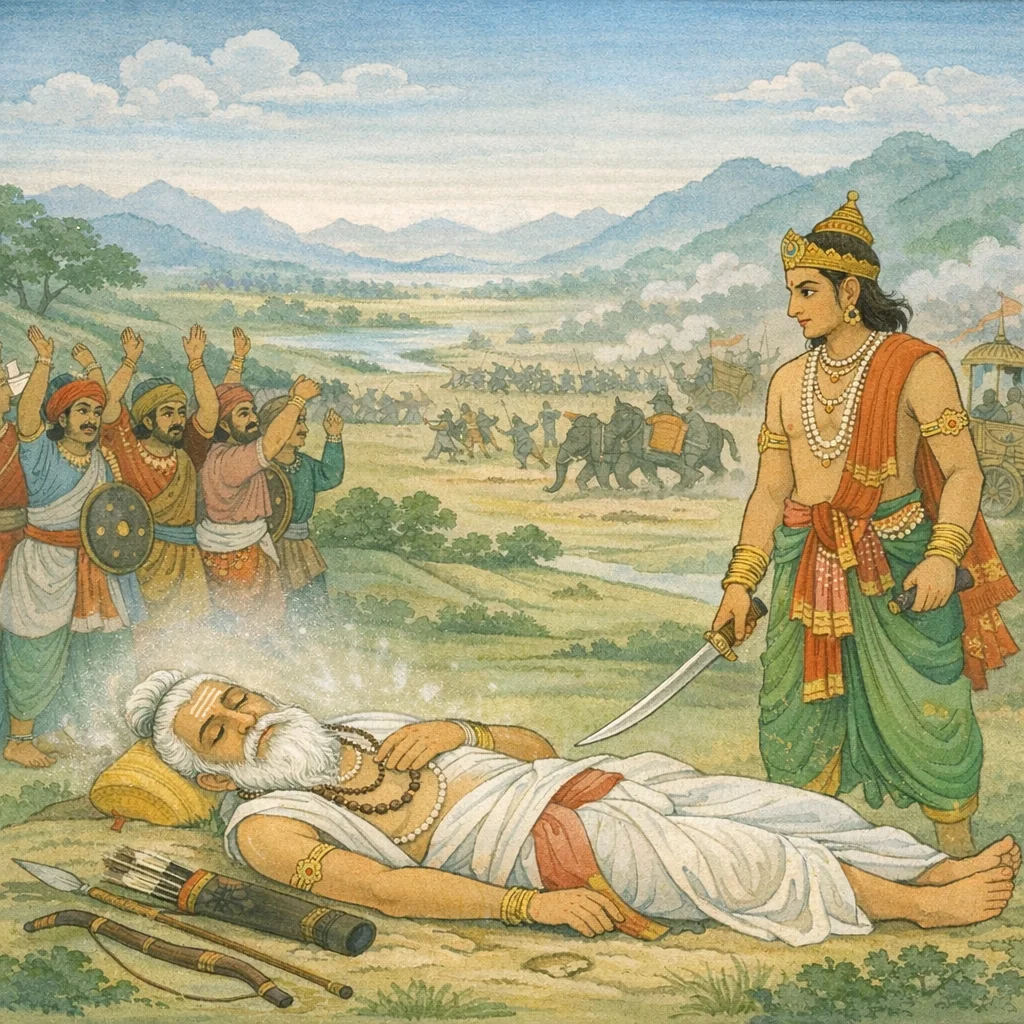
हाहाकृतानि भूतानि मानुषाणीतराणि च । द्रोणं तथागतं दृष्टवा धृष्टद्युम्नवशं गतम्
Sañjaya said: “All beings—human and non-human alike—raised cries of ‘Alas!’ on seeing Droṇa brought to that pass, fallen under the power of Dhṛṣṭadyumna.”
Verse 49
उस अवस्थामें द्रोणाचार्यको धृष्टद्युम्मके अधीन हुआ देख मनुष्य तथा अन्य प्राणी भी हाहाकार कर उठे ।। हाहाकारं भृशं चक्कुहो धिगिति चाब्रुवन् । द्रोणो5पि शस्त्राण्युत्सृज्य परमं सांख्यमास्थित:,वहाँ सबने भारी हाहाकार मचाया और सभी कहने लगे, “अहो! धिक्कार है, धिक्कार है'। इधर आचार्य द्रोण भी शस्त्रोंका परित्याग करके परम ज्ञानस्वरूपमें स्थित हो गये
Sañjaya said: Seeing Droṇa in that condition—brought under the power of Dhṛṣṭadyumna—men and other living beings alike burst into a great outcry. They lamented fiercely and cried, “Alas! Shame, shame!” Meanwhile Droṇa, casting aside his weapons, entered the highest state of Sāṅkhya—settling into supreme knowledge and inner withdrawal even amid the battlefield’s turmoil.
Verse 50
तथोक्त्वा योगमास्थाय ज्योतिर्भूतो महातपा: । पुराणं पुरुषं विष्णुं जगाम मनसा परम्,वे महातपस्वी द्रोण पूर्वोक्त बात कहकर योगका आश्रय ले ज्योतिः:स्वरूप परब्रह्मसे अभिन्नताका अनुभव करते हुए मन-ही-मन सर्वोत्कृष्ट पुराणपुरुष भगवान् विष्णुका ध्यान करने लगे
Sañjaya said: Having spoken thus, the great ascetic took refuge in yoga. Becoming as it were a being of light—realizing identity with the supreme radiance—he turned inward and, in his mind alone, reached the Highest, meditating upon Viṣṇu, the primeval Person.
Verse 51
मुखं किंचित् समुन्नाम्य विष्ट भ्य उरमग्रत: । निमीलिताक्ष: सत्त्वस्थो निश्षिप्य हृदि धारणाम्,दिवमाक्रामदाचार्य: साक्षात् सद्धिर्दुराक्रमाम् । उन्होंने मुँहको कुछ ऊपर उठाकर छातीको आगेकी ओर स्थिर किया। फिर विशुद्ध सत्त्वमें स्थित हो नेत्र बंद करके हृदयमें धारणाको दृढ़तापूर्वक धारण किया। साथ ही “ओम” इस एकाक्षर ब्रह्मका जप करते हुए वे महातपस्वी आचार्य द्रोण प्रणवके अर्थभूत देवदेवेश्वर अविनाशी परम प्रभु परमात्माका चिन्तन करते-करते ज्योतिःस्वरूप हो साक्षात् उस ब्रह्मलोकको चले गये, जहाँ पहुँचना बड़े-बड़े संतोंके लिये भी दुर्लभ है
Sañjaya said: Slightly raising his face and bracing his chest forward, the Teacher (Droṇa) closed his eyes, established himself in pure sattva, and firmly fixed his inner concentration in the heart. Thus he ascended to the heavenly realm—indeed to that state difficult to attain even for the truly good and accomplished.
Verse 52
ओमित्येकाक्षरं ब्रह्म ज्योतिर्भूतो महातपा: । स्मरित्वा देवदेवेशमक्षरं परमं प्रभुम्
Sañjaya said: Having remembered the Lord of lords—the imperishable, supreme Master—while uttering ‘Om’, the single-syllabled Brahman, that great ascetic became one with light.
Verse 53
दौ सूर्याविति नो बुद्धिरासीत् तस्मिंस्तथागते,आचार्य द्रोणके उस प्रकार उत्क्रमण करनेपर हमें ऐसा भान होने लगा, मानो आकाशमें दो सूर्य उदित हो गये हों
Sañjaya said: When that happened, our minds were struck by the thought, “It is as though there are two suns.” As Ācārya Droṇa moved forth in that manner, it seemed to us as if two suns had risen in the sky.
Verse 54
एकाग्रमिव चासीच्च ज्योतिर्भि: पूरितं नभ: । समपद्यत चार्काभे भारद्वाजदिवाकरे,सूर्यके समान तेजस्वी द्रोणाचार्यरूपी दिवाकरके उदित होनेपर सारा आकाश तेजसे परिपूर्ण हो उस ज्योतिके साथ एकाग्र-सा हो रहा था
Sañjaya said: As the sun-like Drona, the Bharadvāja-born luminary, rose forth, the whole sky seemed filled with radiance; it appeared as though the heavens had become single-pointed, gathered into one concentrated blaze.
Verse 55
निमेषमात्रेण च तज्ज्योतिरन्तरधीयत । आसीत् किलकिलाशब्द: प्रह्वशनां दिवौकसाम्
Sañjaya said: In no more than a moment, that radiance vanished from sight. Then there arose a loud, excited clamour—the jubilant cries of the gods, bowing in reverence.
Verse 56
वयमेव तदाद्राक्ष्म पड्च मानुषयोनय:
Sañjaya said: “Then we ourselves beheld five beings born in human form.”
Verse 57
योगयुक्त महात्मानं गच्छन्तं परमां गतिम् । अहं धनंजय: पार्थो कृप: शारद्वतस्तथा
Sañjaya said: “(We beheld) the great-souled one, disciplined in yoga, proceeding toward the highest state. There were also Dhananjaya—Partha (Arjuna)—and Kripa, the son of Sharadvat.”
Verse 58
वासुदेवश्व वार्ष्णेयो धर्मपुत्रश्च पाण्डव: । उस समय मैं, कुन्तीपुत्र अर्जुन, शरद्वानके पुत्र कृपाचार्य, वृष्णिवंशी भगवान् श्रीकृष्ण तथा धर्मपुत्र पाण्डुनन्दन युधिष्ठिर--इन पाँच मनुष्योंने ही योगयुक्त महात्मा द्रोणको परम धामकी ओर जाते देखा था ।। अन््ये तु सर्वे नापश्यन् भारद्वाजस्य धीमत:
Sañjaya said: “Vāsudeva Kṛṣṇa of the Vṛṣṇi line, the Pāṇḍava Yudhiṣṭhira—son of Dharma—together with me, Arjuna the son of Kuntī, and Kṛpa the son of Śaradvat: we five alone saw the great-souled Droṇa, established in yoga, departing toward the supreme abode. All the others did not behold that wise son of Bharadvāja.”
Verse 59
ब्रह्मलोक॑ महद् दिव्यं देवगुह्ं हि तत् परम्
Sañjaya said: “That is the supreme, divine Brahmaloka—vast in scope and hidden even from the gods.”
Verse 60
गति परमिकां प्राप्तमजानन्तो नूयोनय: । नापश्यन् गच्छमान हि त॑ सार्थमृषिपुड्रवै:
Sañjaya said: “Not knowing that he had attained the supreme course, those men lamented. For the foremost of sages did not perceive that leader of the host as he departed—his passing was beyond ordinary sight and understanding.”
Verse 61
आचार्य योगमास्थाय ब्रह्मलोकमरिंदमम् । ब्रह्मलोक महान, दिव्य, देवगुह्ु, उत्कृष्ट तथा परम गतिस्वरूप है। शत्रुदमन आचार्य द्रोण योगका आश्रय लेकर श्रेष्ठ महर्षियोंके साथ उसी ब्रह्मलोकको प्राप्त हुए हैं। अज्ञानी मनुष्योंने उन्हें वहाँ जाते समय नहीं देखा था ।। वितुन्नाड़ंं शख्रातैर्न्यस्तायुधमसृक्ृक्षरम्
Sañjaya said: Entering yogic absorption, the Teacher Droṇa, subduer of foes, attained the Brahma-world. That Brahma-world is vast and divine—hidden even from the gods—supreme, the very form of the highest goal. Taking refuge in yoga, the foe-subduing Droṇa reached it together with the foremost great seers. Ordinary, unknowing people did not see him as he departed.
Verse 62
धिक्कृतः पार्षतस्तं तु सर्वभूतै: परामृशत् । उनका सारा शरीर बाणसमूहोंसे क्षत-विक्षत हो गया था। उससे रक्तकी धारा बह रही थी और वे अपना अस्त्र-शस्त्र नीचे डाल चुके थे। उस दशामें धृष्टद्युम्नने उनके शरीरका स्पर्श किया। उस समय सारे प्राणी उन्हें धिक््कार रहे थे || ६१ $ ।। तस्य मूर्धानमालम्ब्य गतसत्त्वस्य देहिन:
Sañjaya said: Then the son of Pārṣata (Dhṛṣṭadyumna) touched him, even as all beings reviled him. His body had been torn and mangled by clusters of arrows; streams of blood flowed from him, and he had cast down his weapons. In that condition, Dhṛṣṭadyumna laid hands upon him, while the world around condemned him.
Verse 63
हर्षेण महता युक्तो भारद्वाजे निपातिते
Sañjaya said: When the son of Bhāradvāja had been struck down, he became filled with great exhilaration.
Verse 64
आकर्णपलित: श्यामो ववसाशीतिपञ्चक:
Sañjaya said: “He was dark-complexioned, yet grey-haired up to the ears; and he had lived through eighty-five years.”
Verse 65
त्वत्कृते व्यचरत् संख्ये स तु षोडशवर्षवत् । आचार्यके शरीरका रंग साँवला था। उनकी अवस्था चार सौ वर्षकी हो चुकी थी और उनके ऊपरसे लेकर कानतकके बाल सफेद हो गये थे, तो भी आपके हितके लिये वे संग्राममें सोलह वर्षकी उम्रवाले तरुणके समान विचरते थे || ६४ $ ।। उक्तवांश्व महाबाहु: कुन्तीपुत्रो धनंजय:,यद्यपि उस समय महाबाहु कुन्तीकुमार अर्जुनने बहुत कहा--'ओ द्रुपदकुमार! तुम आचार्यको जीते-जी ले आओ। उनका वध न करना।” आपके सैनिक भी बारंबार कहते ही रह गये कि “न मारो, न मारो”
Sañjaya said: For your sake he moved about in the battle as though he were a sixteen-year-old youth. Though his body had grown aged and his hair had turned white, he still fought with youthful vigor, driven by loyalty to your cause.
Verse 66
जीवन्तमानयाचार्य मा वधीर्द्रपदात्मज । न हन्तव्यो न हन्तव्य इति ते सैनिकाश्न ह,यद्यपि उस समय महाबाहु कुन्तीकुमार अर्जुनने बहुत कहा--'ओ द्रुपदकुमार! तुम आचार्यको जीते-जी ले आओ। उनका वध न करना।” आपके सैनिक भी बारंबार कहते ही रह गये कि “न मारो, न मारो”
Sanjaya said: “Bring the Teacher (Drona) alive; do not kill him, O son of Drupada (Dhrishtadyumna). He must not be slain.” Thus Arjuna, the mighty-armed son of Kunti, urged again and again; and your soldiers too kept crying repeatedly, “Do not kill! Do not kill!”
Verse 67
उत्क्रोशन्नर्जुनश्वैव सानुक्रोशस्तमाव्रजत् । क्रोशमाने<र्जुने चैव पार्थिवेषु च सर्वश:
Sanjaya said: Arjuna too, crying out aloud, moved toward him with deep compassion. And as Arjuna lamented, a cry of distress rose everywhere among the kings on all sides.
Verse 68
शोणितेन परिक्लिन्नो रथाद् भूमिमथापतत्
Sanjaya said: Soaked and matted with blood, he then fell from the chariot down onto the ground.
Verse 69
एवं त॑ निहतं संख्ये दद्शे सैनिको जन:,इस प्रकार सब सैनिकोंने द्रोणाचार्यका मारा जाना अपनी आँखोंसे देखा। राजन! महाथनुर्धर धृष्टद्युम्नने द्रोणाचार्यका वह सिर उठा लिया और उसे आपके पुत्रोंके सामने फेंक दिया
Sanjaya said: Thus did the mass of soldiers behold with their own eyes that he had been slain in the press of battle. O king, Dhrishtadyumna, the great archer, lifted up Drona’s head and cast it before your sons.
Verse 70
धृष्टद्युम्नस्तु तद् राजन् भारद्वाजशिरो5हरत् । तावकानां महेष्वास: प्रमुखे तत् समाक्षिपत्,इस प्रकार सब सैनिकोंने द्रोणाचार्यका मारा जाना अपनी आँखोंसे देखा। राजन! महाथनुर्धर धृष्टद्युम्नने द्रोणाचार्यका वह सिर उठा लिया और उसे आपके पुत्रोंके सामने फेंक दिया
Sanjaya said: O king, Dhrishtadyumna took the head of Bharadvaja’s son (Drona); and that great archer cast it before the foremost ranks of your host.
Verse 71
ते तु दृष्टवा शिरो राजन् भारद्वाजस्य तावका: । पलायनकृतोत्साहा दुद्गुवु: सर्वती दिशम्,महाराज! द्रोणाचार्यके उस कटे हुए सिरको देखकर आपके सारे सैनिकोंने केवल भागनेमें ही उत्साह दिखाया और वे सम्पूर्ण दिशाओंमें भाग गये
Sañjaya said: “But when your troops saw the severed head of Bhāradvāja’s son (Droṇa), O King, their courage turned wholly toward flight; in panic they ran off in every direction, O great monarch.”
Verse 72
द्रोणस्तु दिवमास्थाय नक्षत्रपथमाविशत् | अहमेव तठदाद्वाक्ष॑ द्रोणस्प निधनं नृप
Sañjaya said: “Drona, having departed from this world, attained heaven and entered the path of the stars. And I myself then spoke those words to you, O king, announcing Drona’s fall.”
Verse 73
विधूमामिह संयान्तीमुल्कां प्रजज्लितामिव
Sañjaya said: “Here it appeared like a blazing meteor—brightly kindled, yet strangely without smoke—moving swiftly onward.”
Verse 74
हते द्रोणे निरुत्साहान् कुरून् पाण्डवसृञज्जया:
Sañjaya said: “When Droṇa had been slain, the Kuru warriors lost heart; and the Pāṇḍavas, together with the Sṛñjayas, pressed their advantage—turning the enemy’s despair into decisive momentum on the battlefield.”
Verse 75
निहता हतभूयिष्ठा: संग्रामे निशितै: शरै:
Sañjaya said: “In the battle, many were struck down—indeed, the greater part of them were slain—by sharp, keen arrows.”
Verse 76
पराजयमथावाप्य परत्र च महद् भयम्
Sañjaya said: “Having met with defeat, and also facing great fear in the hereafter,”—he points to the double peril of unrighteous warfare: loss in the present and moral-spiritual dread beyond this life.
Verse 77
अन्विच्छन्त: शरीरं तु भारद्वाजस्य पार्थिवा:,नान्वगच्छन् महाराज कबन्धायुतसंकुले । महाराज! हमारे पक्षके राजाओंने द्रोणाचार्यके शरीरको बहुत खोजा, परंतु हजारों लाशोंसे भरे हुए युद्धस्थलमें वे उसे पा न सके
Sañjaya said: “O King, the rulers on our side searched everywhere for the body of Bhāradvāja’s son (Droṇa). Yet, amid that battlefield choked with thousands of headless corpses, they could not find it.”
Verse 78
।। पाण्डवास्तु जयं लब्ध्वा परत्र च महद् यश:
Sañjaya said: Having won victory, the Pāṇḍavas also attain great fame in the world beyond—suggesting that righteous success in a just cause yields both immediate triumph and enduring moral renown.
Verse 79
बाणशड्खरवांक्षक्रु: सिंहनादांश्व पुष्कलान् | पाण्डव इस लोकमें विजय और परलोकमें महान् यश पाकर वे धनुषपर बाण रखकर उसकी टंकार करने, शंख बजाने और बारंबार सिंहनाद करने लगे ।। भीमसेनस्ततो राजन धृष्टद्युम्नश्व पार्षत:
Sañjaya said: Having won victory in this world and gained great renown in the next, the Pāṇḍavas, exultant, set arrows upon their bows, made the bowstrings resound, blew their conches, and again and again raised mighty lion-roars. Then, O King, Bhīmasena and Dhṛṣṭadyumna, the son of Pārṣata, (advanced/acted next).
Verse 80
अब्रवीच्च तदा भीम: पार्षतं शत्रुतापनम्,उस समय भीमसेनने शत्रुओंको संताप देनेवाले धृष्टद्युम्नसे कहा--'ट्रुपदनन्दन! जब सूतपुत्र कर्ण और पापी दुर्योधन मारे जायँगे, उस समय विजयी हुए तुमको मैं फिर इसी प्रकार छातीसे लगाऊँगा'
Sañjaya said: Then Bhīma spoke to Dhṛṣṭadyumna, the son of Pārṣata (Drupada) and a tormentor of foes: “O son of Drupada! When Karṇa, the charioteer’s son, and the sinful Duryodhana are slain, then I shall embrace you again upon my chest in the same victorious manner.” The utterance frames Bhīma’s fierce vow as a moralized war-aim: victory is envisioned not as mere conquest, but as the removal of those he deems unrighteous aggressors, after which fraternal honor and recognition are to be publicly affirmed.
Verse 81
भूयो<हं त्वां विजयिन॑ परिष्वज्यामि पार्षत | सूतपुत्रे हते पापे धार्तराष्ट्रे च संयुगे,उस समय भीमसेनने शत्रुओंको संताप देनेवाले धृष्टद्युम्नसे कहा--'ट्रुपदनन्दन! जब सूतपुत्र कर्ण और पापी दुर्योधन मारे जायँगे, उस समय विजयी हुए तुमको मैं फिर इसी प्रकार छातीसे लगाऊँगा'
Sañjaya said: “O son of Pṛṣata (Dhṛṣṭadyumna), I shall embrace you again as a victor. When the charioteer’s son (Karna) is slain, and when the sinful Dhārtarāṣṭra (Duryodhana) too falls in battle, then I will clasp you to my chest in the same way.”
Verse 82
एतावदुक्त्वा भीमस्तु हर्षेण महता युत: । बाहुशब्देन पृथिवीं कम्पयामास पाण्डव:,इतना कहकर अत्यन्त हर्षमें भरे हुए पाण्डुनन्दन भीमसेन अपनी भुजाओंपर ताल ठोककर पृथ्वीको कम्पित-सी करने लगे
Sañjaya said: Having spoken only this much, Bhīma—the Pāṇḍava—filled with overwhelming joy, began to clap and strike his arms with a thunderous sound, as though making the very earth tremble.
Verse 83
तस्य शब्देन वित्रस्ता: प्राद्रवंस्तावका युधि । क्षत्रधर्म समुत्सूज्य पलायनपरायणा:,उनके उस शब्दसे भयभीत हो आपके सारे सैनिक युद्धसे भाग चले। वे क्षत्रियधर्मको छोड़कर पीठ दिखाने लग गये
At the sound of that (terrible) roar, your troops were struck with fear and fled from the battlefield. Casting aside the warrior’s duty (kṣatriya-dharma), they turned their backs and became intent only on escape.
Verse 84
पाण्डवास्तु जयं लब्ध्वा हृष्टा ह्यासन् विशाम्पते | अरिक्षयं च संग्रामे तेन ते सुखमाप्रुवन्,प्रजानाथ! पाण्डव विजय पाकर हर्षसे खिल उठे। संग्राममें जो शत्रुओंका भारी संहार हुआ था, उससे उन्हें बड़ा सुख मिला
Sañjaya said: “O lord of the people, the Pāṇḍavas, having won victory, were indeed filled with joy. And because in that battle there was a great destruction of their foes, they attained deep satisfaction.”
Verse 96
सादिभिश्न हतै: शूरै: संकीर्णा वसुधाभवत् | टूटे पहियेवाले रथों, गिराये हुए विशाल ध्वजों और मारे गये शूरवीर घुड़सवारोंसे वहाँकी भूमि आच्छादित हो गयी थी
Sañjaya said: The earth there became choked and strewn with the fallen—covered with the wreckage of war and the bodies of slain heroes. Broken chariots with shattered wheels, great standards cast down, and dead mounted warriors lay scattered across the field.
Verse 106
चेष्टन्तो विविधाश्रैष्टा व्यदृश्यन्त महाहवे । कुरुश्रेष्ठ! बाणोंके आघातसे कटे हुए योद्धा उस महासमरमें अनेक प्रकारकी चेष्टाएँ करते और छटपटाते दिखायी देते थे
Sañjaya said: “O best of the Kurus, in that great battle the foremost warriors—cut down by the impact of arrows—were seen making many kinds of involuntary movements, writhing and struggling in agony. The scene laid bare the brutal cost of war, where even the mighty are reduced to helpless suffering.”
Verse 143
ते यूयं सहिता भूत्वा युध्यध्वं कुम्भसम्भवम् | “आज महासमरमें इनके जैसे रूप दिखायी देते हैं, उनसे यह ज्ञात होता है कि रणभूमिमें कुपित हुए धृष्टद्युम्न सब प्रकारसे द्रोणाचार्यका वध कर डालेंगे। इसलिये तुम सब लोग एक साथ होकर कुम्भजन्मा द्रोणाचार्यके साथ युद्ध करो”
“Therefore, all of you, united together, fight Kumbhasambhava—Droṇācārya, the one born of the jar. Today, in this great battle, such signs as are seen make it known that Dhṛṣṭadyumna, wrathful on the field, will slay Droṇa by every means. Hence, all of you, as one, engage in battle alongside Droṇācārya, the jar-born.”
Verse 153
अभ्यद्रवन्त संयत्ता भारद्वाजजिघांसव: । युधिष्ठिरकी यह आज्ञा पाकर सूंजय महारथी द्रोणाचार्यको मार डालनेकी अभिलाषासे पूर्ण सावधान हो उनपर टूट पड़े
Sañjaya said: “Arrayed for battle and intent on the death of Bhāradvāja’s son (Droṇa), they surged forward. Having received Yudhiṣṭhira’s command, the great chariot-warrior Dhṛṣṭadyumna—filled with the resolve to slay Droṇācārya—became fully vigilant and fell upon him. The moment underscores how royal orders and personal vows converge in war, raising the ethical tension between duty to command and the gravity of targeting a revered teacher.”
Verse 186
दीपयन्ती उभे सेने शंसन्तीव महद् भयम् | सूर्यमण्डलसे बड़ी भारी उल्का निकलकर दोनों सेनाओंको प्रकाशित करती और महान् भयकी सूचना-सी देती हुई पृथ्वीपर गिर पड़ी
Sañjaya said: “A great meteor, like the disc of the sun, blazed forth—illumining both armies—and, as though proclaiming a mighty terror, fell down upon the earth. In the moral atmosphere of the war, this portent signals an intensifying descent into adharma and the looming harvest of violence that neither side can escape.”
Verse 192
इति श्रीमहाभारते द्रोणपर्वणि द्रोणवधपर्वणि द्रोणवधे द्विनवत्यधिकशततमो< ध्याय:,इस प्रकार श्रीमहाभारत द्रोणपर्वके अन्तर्गत द्रोणवधपर्वमें द्रोणवधविषयक एक सौ बानबेवाँ अध्याय पूरा हुआ
Sañjaya said: “Thus, in the Śrī Mahābhārata, within the Droṇa Parva, in the section on the slaying of Droṇa, the one-hundred-and-ninety-second chapter concerning Droṇa’s death is concluded.” This colophon marks the formal close of the chapter that narratively frames the fall of a great teacher in war, highlighting the grave ethical weight carried by battlefield decisions and their consequences.
Verse 196
रथा: स्वनन्ति चात्यर्थ हयाश्वाश्रूण्यवासृजन् । माननीय नरेश! द्रोणाचार्यके शस्त्र चलने लगे, रथसे बड़े जोरकी आवाज उठने लगी और घोड़े आँसू बहाने लगे
Sañjaya said: “The chariots began to resound with an overwhelming din, and the horses shed tears. O venerable king, as Droṇācārya’s weapons started to move in action, a thunderous roar rose from the chariot, and the steeds themselves wept—an ominous sign that the battle’s violence was crossing ordinary human measure.”
Verse 413
धर्मराजस्य तद् वाक््यं नाभिशड्कितुमह्सि । “जिसके लिये आपने शस्त्र उठाया, जिसके जीवनकी अभिलाषा रखकर आप जी रहे हैं, वह तो आज पीछे समरभूमिमें गिरकर चिरनिद्रामें सो रहा है और आपको इसकी सूचनातक नहीं दी गयी। धर्मराज युधिष्ठिरके उस कथनपर तो आपको संदेह या अविश्वास नहीं करना चाहिये"
Sanjaya said: You ought not to doubt that statement of Dharmaraja (Yudhishthira). In the moral economy of the epic, Yudhishthira’s word is treated as a benchmark of truthfulness; therefore, when he reports the fall of the one for whose sake you took up arms and for whose life you have been living, his testimony should be accepted without suspicion.
Verse 426
सर्वाण्यस्त्राणि धर्मात्मा हातुकामो5भ्यभाषत । भीमसेनके ऐसा कहनेपर धर्मात्मा द्रोणाचार्य वह धनुष फेंककर अन्य सब अस्त्र- शस्त्रोंको भी त्याग देनेकी इच्छासे इस प्रकार बोले--
Sañjaya said: Wishing to lay aside all his weapons, the righteous one spoke—moved by the resolve to renounce the instruments of violence. In the midst of the battle’s moral strain, his words signal a turning from martial skill toward restraint and the burdened conscience of a warrior-teacher.
Verse 456
अभयं सर्वभूतानां प्रददौ योगमीयिवान् । महाराज! यह कहकर उन्होंने वहाँ अश्वत्थामाका नाम ले-लेकर पुकारा। फिर सारे अस्त्र-शस्त्रोंकी रणभूमिमें फेंककर वे रथके पिछले भागमें जा बैठे। फिर उन्होंने सम्पूर्ण भूतोंको अभयदान दे दिया और समाधि लगा ली
Sanjaya said: The warrior, established in yoga, granted fearlessness to all beings. O King, having spoken thus, he called out to Ashvatthama by name again and again. Then, casting all his weapons onto the battlefield, he sat down at the rear of his chariot. Thereafter, extending a vow of non-harm and safety toward all creatures, he entered deep meditative absorption.
Verse 526
दिवमाक्रामदाचार्य: साक्षात् सद्धिर्दुराक्रमाम् । उन्होंने मुँहको कुछ ऊपर उठाकर छातीको आगेकी ओर स्थिर किया। फिर विशुद्ध सत्त्वमें स्थित हो नेत्र बंद करके हृदयमें धारणाको दृढ़तापूर्वक धारण किया। साथ ही “ओम” इस एकाक्षर ब्रह्मका जप करते हुए वे महातपस्वी आचार्य द्रोण प्रणवके अर्थभूत देवदेवेश्वर अविनाशी परम प्रभु परमात्माका चिन्तन करते-करते ज्योतिःस्वरूप हो साक्षात् उस ब्रह्मलोकको चले गये, जहाँ पहुँचना बड़े-बड़े संतोंके लिये भी दुर्लभ है
Sanjaya said: The preceptor Drona ascended to the hard-to-reach heavenly realm, attainable only by the truly virtuous. Lifting his face slightly and steadying his chest, he entered a state of pure clarity; closing his eyes, he fixed firm concentration in his heart. Repeating the single-syllabled Brahman—‘Om’—the great ascetic contemplated the imperishable Supreme Lord, the God of gods, the Paramatman who is the very meaning of the Pranava. Thus becoming a form of light, he went directly to Brahmaloka, a destination difficult even for great saints to attain.
Verse 553
ब्रह्मलोकगते द्रोणे धृष्टद्युम्ने च मोहिते । पलक मारते-मारते वह ज्योति आकाशमें जाकर अदृश्य हो गयी। द्रोणाचार्यके ब्रह्मलोक चले जाने और धृष्टद्युम्नके अपमानसे मोहित हो जानेपर हर्षोल्लाससे भरे हुए देवताओंका कोलाहल सुनायी देने लगा
Sañjaya said: When Droṇa had departed to Brahmaloka and Dhṛṣṭadyumna stood stunned and confounded, in the blink of an eye that radiance rose into the sky and vanished from sight. With Droṇācārya gone to the world of Brahmā and Dhṛṣṭadyumna overwhelmed by the disgrace of his deed, a tumultuous cry of exultation from the gods was heard—marking the cosmic approval of Droṇa’s release and the moral weight borne by the slayer.
Verse 586
महिमानं महाराज योगयुक्तस्य गच्छत: । महाराज! अन्य सब लोगोंने योगयुक्त हो ऊर्ध्वगतिको जाते हुए बुद्धिमान् द्रोणाचार्यकी महिमाका साक्षात्कार नहीं किया
Sañjaya said: O King, the greatness of wise Droṇācārya—departing in yoga, united with disciplined concentration and moving toward the higher course—was not truly perceived by the others. Even as he rose beyond ordinary sight, the king, the surrounding people failed to recognize the spiritual majesty of one who leaves the world with yogic steadiness.
Verse 626
किंचिदब्रुवत:ः कायाद् विचकर्तासिना शिर: । देहधारी द्रोणके शरीरसे प्राण निकल गये थे, अतः वे कुछ भी बोल नहीं रहे थे। इस अवस्थामें उनके मस्तकका बाल पकड़कर धृष्टद्युम्नने तलवारसे उनके सिरको धड़से काट लिया
Sanjaya said: When Droṇa’s body could no longer utter even a word, Dhṛṣṭadyumna seized him by the hair and, with a sword, severed his head from his trunk. The act marks a grim turning point in the war: a revered teacher, rendered speechless and defenseless, is slain in a manner that raises sharp questions about righteous conduct amid battlefield necessity and vengeance.
Verse 636
सिंहनादरवं चक्रे भ्रामयन् खड्गमाहवे । इस प्रकार द्रोणाचार्यको मार गिरानेपर धृष्टद्युम्नको महान् हर्ष हुआ और वे रणभूमिमें तलवार घुमाते हुए जोर-जोरसे सिंहनाद करने लगे
Sañjaya said: Exulting after bringing down Droṇācārya, Dhṛṣṭadyumna roared like a lion and, whirling his sword on the battlefield, proclaimed his triumph. The moment underscores how victory in war can ignite fierce elation, even when the fallen is a revered teacher—highlighting the Mahābhārata’s tension between martial duty and the ethical weight of killing the venerable.
Verse 676
धृष्टद्युम्नो&वधीद् द्रोणं रथतल्पे नरर्षभम् । अर्जुन तो दयावश चिल्लाते हुए धृष्टद्युम्मके पास आने लगे। परंतु उनके तथा अन्य सब राजाओंके पुकारते रहनेपर भी धृष्टद्युम्नने रथकी बैठकमें नरश्रेष्ठ द्रोणका वध कर ही डाला
Sañjaya said: Dhṛṣṭadyumna slew Droṇa, the bull among men, as he lay upon the chariot-seat. Though Arjuna, moved by compassion, hurried toward Dhṛṣṭadyumna, and though many kings cried out to stop him, Dhṛṣṭadyumna nevertheless carried out the killing of Droṇa on the chariot itself—an act that presses the war’s harsh logic against the claims of mercy and righteous restraint.
Verse 683
लोहिताज् इवादित्यो दुर्धर्ष: समपद्यत । दुर्धर्ष द्रोणाचार्यका शरीर खूनसे लथपथ हो रथसे पृथ्वीपर गिर पड़ा, मानो लाल अंगकान्तिवाले सूर्य डूब गये हों
Sañjaya said: The invincible one met his end like the sun turning red at dusk. Thus Droṇācārya—his body drenched in blood—fell from his chariot onto the earth, as though the crimson-rayed sun had sunk below the horizon. The image underscores the tragic fall of a mighty teacher in war, where prowess and honor are finally overtaken by mortality and the grim consequences of battle.
Verse 723
ऋषे: प्रसादात् कृष्णस्य सत्यवत्या: सुतस्य च । नरेश्वर! द्रोणाचार्य आकाशमें पहुँचकर नक्षत्रोंके पथमें प्रविष्ट हो गये। उस समय सत्यवतीनन्दन महर्षि श्रीकृष्णद्वैपायनके प्रसादसे मैंने भी द्रोणाचार्यकी वह दिव्य मृत्यु प्रत्यक्ष देख ली
Sañjaya said: By the grace of the seer, and by the grace of Kṛṣṇa and of the son of Satyavatī, O king, Droṇācārya rose into the sky and entered the path of the stars. At that time, through the favor of the sage Śrī Kṛṣṇa Dvaipāyana—Satyavatī’s son—I too beheld with my own eyes that divine passing of Droṇa. The episode frames Droṇa’s end not merely as a battlefield death, but as a spiritually charged departure witnessed through higher vision granted by revered sages.
Verse 736
अपश्याम दिवं स्तब्ध्वा गच्छन्तं तं महाद्युतिम् । महातेजस्वी द्रोण जब आकाशको स्तब्ध करके ऊपरको जा रहे थे, उस समय हमलोगोंने यहाँसे उन्हें एक स्थानसे दूसरे स्थानको जाती हुई धूमरहित प्रज्वलित उल्काके समान देखा था
Sañjaya said: We saw that great, radiant one—Droṇa—rise upward as though he had arrested the sky itself. From where we stood, he appeared like a blazing meteor without smoke, moving from one point to another. The scene conveys not merely a warrior’s end, but the awe that attends the departure of a mighty life amid the moral darkness of war.
Verse 743
अभ्यद्रवन् महावेगास्तत:ः सैन्यं व्यदीर्यत । द्रोणाचार्यके मारे जानेपर कौरव-सैनिक युद्धका उत्साह खो बैठे, फिर पाण्डवों और सूंजयोंने उनपर बड़े वेगसे आक्रमण कर दिया। इससे कौरव-सेनामें भगदड़ मच गयी
Sañjaya said: Then the warriors, charging with tremendous speed, fell upon the army, and the Kaurava host was torn apart. With Droṇācārya slain, the Kaurava soldiers lost their will to fight; the Pāṇḍavas and their allies surged forward in a powerful assault, and panic and rout spread through the Kaurava ranks—showing how the fall of a leader can collapse morale and unravel an army’s discipline in war.
Verse 756
तावका निहते द्रोणे गतासव इवाभवन् | युद्धमें आपके बहुत योद्धा तीखे बाणोंद्वारा मारे गये थे और बहुत-से अधमरे हो रहे थे। द्रोणाचार्यके मारे जानेपर वे सभी निष्प्राण-से हो गये
Sañjaya said: When Droṇa had been slain, the Kaurava warriors became as if bereft of life. Already struck down in battle by sharp arrows, with many fallen and many left grievously wounded, the death of their commander drained their remaining spirit and cohesion, revealing how the fall of a leader can collapse an army’s moral strength amid the harsh ethics of war.
Verse 766
उभयेनैव ते हीना नाविन्दन् धृतिमात्मन: । इस लोकमें पराजय और परलोकमें महान् भय पाकर दोनों ही लोकोंसे वंचित हो वे अपने भीतर धैर्य न धारण कर सके
Sañjaya said: Deprived in both ways, they could not find steadiness within themselves. Having met defeat in this world and great fear regarding the next, they were cut off from both realms and failed to sustain inner courage.
Verse 793
वरूथिन्यामनृत्येतां परिष्वज्य परस्परम् | राजन्! तदनन्तर भीमसेन और ट्रुपदकुमार धृष्टद्युम्न एक-दूसरेको हृदयसे लगाकर सेनाके बीचमें हर्षके मारे नाचने लगे
Sañjaya said: “O King, thereafter Bhimasena and Drupada’s son Dhrishtadyumna embraced one another heart to heart, and in the very midst of the army they began to dance, overcome with joy.”