Adhyaya 65
दानफलप्रकरणम् — उपानहदानं, तिलदानं, भूमिदानं, गोदानं, अन्नदानं च (Gifts and Their Stated Results: Footwear, Sesame, Land, Cows, and Food)
Upa-parva: Dāna-Dharma (Charitable Gifts) Discourse — Footwear, Sesame, Land, Cows, and Food
Chapter 13.65 is structured as a question-and-answer exchange. Yudhiṣṭhira first asks Bhīṣma about the result of giving footwear (upānahau) to a brāhmaṇa in distress; Bhīṣma replies with imagery of overcoming thorns and rough terrain, and adds a symbolic reward of conveyances and equipment. The dialogue then broadens: Yudhiṣṭhira requests further clarification on the fruits of tiladāna, bhūmidāna, godāna, and annadāna. Bhīṣma describes sesame as primordial and especially effective for ancestral satisfaction, including time-specific merit (e.g., gifting in Māgha) and warnings against improper motivation. He then narrates a brief cosmological-ritual episode of the gods requesting a sacrificial site from Brahmā, segueing into bhūmidāna: even small land gifts are praised, while unsuitable land and offering śrāddha in another’s land are discouraged; purchasing land for gifting is recommended to secure lasting ritual benefit. Next, godāna is elevated through claims of utility (milk, ghee, dung, hides, etc.), association with higher realms, and strict prohibitions against gifting cows for harmful ends or to unethical recipients; quality criteria for the cow are specified. Finally, annadāna is asserted as primary, linked to hospitality, vitality, and overcoming adversity, with references to exemplary figures (e.g., Rantideva) and a concluding recap of the discussed gift-fruits.
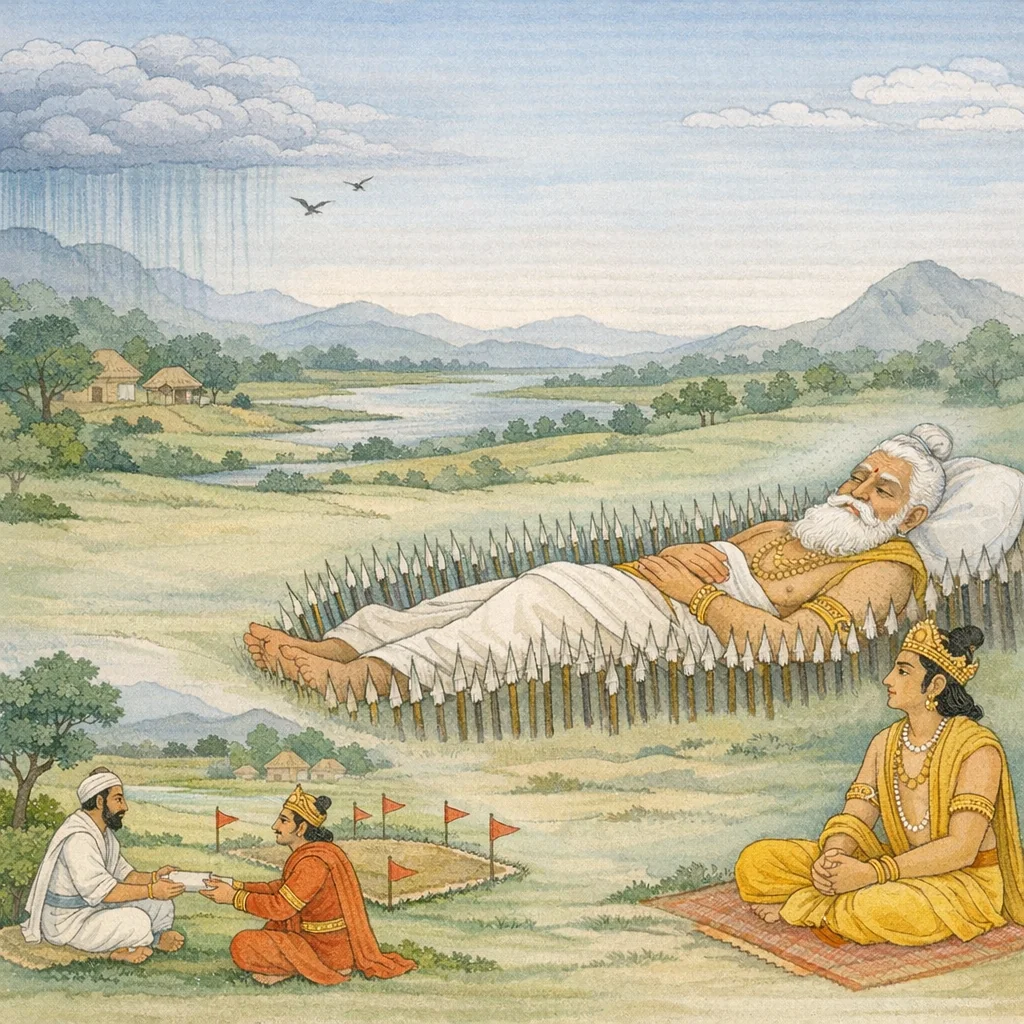
Chapter Arc: शरशय्या पर लेटे भीष्म युधिष्ठिर को दान-धर्म का शिखर दिखाते हैं—सब दानों में ‘पृथ्वीदान’ को अतिदान कहकर, अचल-अक्षय भूमि को इस लोक के उत्तम भोगों की ‘दोग्ध्री’ (दूध देने वाली) बताते हैं। → भीष्म भूमि के महत्त्व को केवल संपत्ति नहीं, जीवन-व्यवस्था के आधार के रूप में स्थापित करते हैं—मनुष्य इह-परत्र अपने कर्म से जीते हैं, और भूमि ‘महादेवी’ होकर दाता को प्रिय बनाती है। फिर वे दान की मात्रा/उद्देश्य के सूक्ष्म भेद उठाते हैं: एक घर के लिए दी गई भूमि से लेकर राज्य-धर्म तक, फल और दण्ड दोनों का विस्तार। → भूमिदान के फल-दण्ड का तीखा शिखर: ‘एकागारकरीं’ भूमि-दान करने वाला दीर्घ पुण्य पाता है, और उतनी ही भूमि का हरण करने वाला उससे भी बढ़कर नरक-यातना भोगता है—दान की महिमा के साथ अपहरण का भयावह प्रतिफल एक साथ उद्घाटित होता है। → भूमिदाता के लिए अभय-प्रतिज्ञा: काल-प्रेरित मृत्यु, दण्ड, तम, दारुण अग्नि और घोर पाश भी भूमिदाता के निकट नहीं आते; और जिस राजा के शुभ राज्य/कर्म से प्रजा योगक्षेम, वृष्टि और स्वकर्म-समृद्धि से बढ़ती है, वह भूमि-धर्म का सामाजिक रूप है। श्राद्ध-प्रसंग में इस माहात्म्य के श्रवण से राक्षस/असुर-भाग का निषेध और पितरों के निमित्त दान की अक्षयता बताकर उपदेश पूर्ण होता है। → भीष्म का समापन-प्रश्न—‘अब और क्या सुनना चाहते हो?’—अगले अध्याय के लिए युधिष्ठिर की जिज्ञासा को खुला छोड़ देता है।
Shlokas
Verse 1
(दाक्षिणात्य अधिक पाठके १६ शलोक मिलाकर कुल ३९३ “लोक हैं) द्विषष्टितमो< ध्याय: सब दानोंसे बढ़कर भूमिदानका महत्त्व तथा उसीके विषयमें इन्द्र और बृहस्पतिका संवाद युधिछिर उवाच इदं देयमिदं देयमितीयं श्रुतिरादरात् । बहुदेयाश्व राजान: किंस्विद् दानमनुत्तमम्,युधिष्ठिरने पूछा--पितामह! यह देना चाहिये, वह देना चाहिये, ऐसा कहकर यह श्रुति बड़े आदरके साथ दानका विधान करती है तथा शास्त्रोंमें रजाओंके लिये बहुत कुछ दान करनेके लिये बात कही गयी है; परंतु मैं यह जानना चाहता हूँ कि सब दानोंमें सर्वोत्तम दान कौन-सा है?
Yudhiṣṭhira said: “Revered Grandsire, the sacred tradition repeatedly enjoins—‘This should be given, that should be given’—and it does so with great insistence. The scriptures also declare that kings ought to give in many ways. Yet I wish to know: among all forms of giving, which gift is truly unsurpassed?”
Verse 2
भीष्म उवाच अतिदानानि सर्वाणि पृथिवीदानमुच्यते । अचला ह्ाक्षया भूमिद्दोग्ध्री कामानिहोत्तमान्
Bhishma said: “Among all gifts, the gift of the earth is declared to be the supreme gift. For the earth is immovable and inexhaustible; here in this world she yields (like a milch-cow) the highest desired enjoyments and benefits.”
Verse 3
भीष्मजीने कहा--बेटा! सब दानोंसे बढ़कर पृथ्वीदान बताया गया है। पृथ्वी अचल और अक्षय है। वह इस लोकमें समस्त उत्तम भोगोंको देनेवाली है ।। दोग्ध्री वासांसि रत्नानि पशून् व्रीहियवांस्तथा । भूमिद: सर्वभूतेषु शाश्वतीरेधते समा:,वस्त्र, रत्न, पशु और धान-जौ आदि नाना प्रकारके अन्न--इन सबको देनेवाली पृथ्वी ही है; अतः पृथ्वीका दान करनेवाला मनुष्य सदा समस्त प्राणियोंमें सबसे अधिक अभ्युदयशील होता है
Bhishma said: “My son, above all gifts the gift of land is proclaimed. The earth is immovable and inexhaustible; in this world she bestows every finest enjoyment. Like a milch-cow she yields garments, jewels, cattle, and grains such as rice and barley. Therefore, the giver of land continually prospers among all beings, attaining enduring and unsurpassed welfare.”
Verse 4
यावद् भूमेरायुरिह तावद् भूमिद एधते । न भूमिदानादस्तीह परं किंचिद् युधिष्ठिर,युधिष्ठिर! इस जगत्में जबतक पृथ्वीकी आयु है, तबतक भूमिदान करनेवाला मनुष्य समृद्धिशाली रहकर सुख भोगता है। अतः यहाँ भूमिदानसे बढ़कर दूसरा कोई दान नहीं है
Bhīṣma said: “So long as the earth endures here, for that very long the giver of land prospers. O Yudhiṣṭhira, in this world there is no gift higher than the gift of land.”
Verse 5
अप्यल्पं प्रददुः सर्वे पृथिव्या इति नः श्रुतम् । भूमिमेव ददुः सर्वे भूमिं ते भुञज्जते जना:,हमने सुना है कि जिन लोगोंने थोड़ी-सी भी पृथ्वी दान की है, वे सब लोग भूमिदानका ही पूर्ण फल पाकर उसका उपभोग करते हैं
Bhishma said: “We have heard that even those who have given only a little piece of land obtain the complete fruit of a land-gift. Indeed, all who give land are regarded as having given ‘the earth’ itself; and people enjoy that very land (in the hereafter) as their reward.”
Verse 6
स्वकर्मवोपजीवन्ति नरा इह परत्र च । भूमिर्भूतिर्महादेवी दातारं कुरुते प्रियम्
Bhishma said: “People sustain themselves by their own rightful work—both in this world and in the next. The Earth, the great goddess who is prosperity itself, makes the giver dear to her.”
Verse 7
मनुष्य इहलोक और परलोकमें अपने कर्मके अनुसार ही जीवन-निर्वाह करते हैं। भूमि ऐश्वर्यस्वरूपा महादेवी है। वह दाताको अपना प्रिय बना लेती है ।। य एतां दक्षिणां दद्यादक्षयां राजसत्तम । पुनर्नरित्वं सम्प्राप्य भवेत् स पृथिवीपति:,नृपश्रेष्ठी जो इस अक्षय भूमिका दान करता है वह दूसरे जन्ममें मनुष्य होकर पृथ्वीका स्वामी होता है
Bhīṣma said: “O best of kings, whoever bestows this inexhaustible gift—land, the great goddess who embodies prosperity—wins her favor. Having attained human birth again, that giver becomes a lord of the earth.”
Verse 8
यथा दानं तथा भोग इति थधर्मेषु निश्चय: । संग्रामे वा तनुं जहायाद् दद्याच्च पृथिवीमिमाम्
Bhīṣma said: “In matters of dharma, this is the settled conclusion: as one gives, so one is entitled to enjoy. Therefore, whether on the battlefield one must even abandon the body, or one must give away this very earth, one should act in accordance with that principle.”
Verse 9
पुनाति दत्ता पृथिवी दातारमिति शुश्रुम,दानमें दी हुई पृथ्वी दाताको पवित्र कर देती है--यह हमने सुना है। कितना ही बड़ा पापाचारी, ब्रह्महत्यारा और असत्यवादी क्यों न हो, दानमें दी हुई पृथ्वी ही दाताके पापको धो बहा देती है और वही उसे सर्वथा पापमुक्त कर देती है
Bhishma said: “We have heard that land, when given away in charity, purifies the giver. Even if a man is a great sinner—guilty of brahmin-slaying and addicted to falsehood—land bestowed as a gift washes away his sin and makes him completely free from wrongdoing.”
Verse 10
अपि पापसमाचारं ब्रह्म॒घ्नमपि चानृतम् । सैव पाप॑ प्लावयति सैव पापात् प्रमोचयेत्,दानमें दी हुई पृथ्वी दाताको पवित्र कर देती है--यह हमने सुना है। कितना ही बड़ा पापाचारी, ब्रह्महत्यारा और असत्यवादी क्यों न हो, दानमें दी हुई पृथ्वी ही दाताके पापको धो बहा देती है और वही उसे सर्वथा पापमुक्त कर देती है
Bhīṣma said: Even if a man is of sinful conduct, even a slayer of a Brāhmaṇa, even one who speaks falsehood—still, that very gift of land washes away his sin and can release him completely from sin. The tradition declares that land given in charity purifies the giver, however grievous his prior wrongdoing.
Verse 11
अपि पापकृतां राज्ञां प्रतिगृह्लन्ति साधव: । पृथिवीं नान्यदिच्छन्ति पावनं जननी यथा,श्रेष्ठ पुरुष पापाचारी राजाओंसे भी पृथ्वीका दान तो ले लेते हैं, किंतु और किसी वस्तुका दान नहीं लेना चाहते। पृथ्वी वैसी ही पावन वस्तु है जैसी माता
Bhīṣma said: Even from kings who commit sinful deeds, the righteous may accept the gift of land; but they do not wish to accept any other kind of gift. For the earth is a purifying gift—pure like a mother herself.
Verse 12
नामास्या: प्रियदत्तेति गुहां देव्या: सनातनम् | दानं वाप्यथवा5<दानं नामास्या: प्रथमं प्रियम्,इस पृथ्वी देवीका सनातन गोपनीय नाम 'प्रियदत्ता” है। इसका दान अथवा ग्रहण दोनों ही दाता और प्रतिग्रहीताको प्रिय हैं; इसीलिये इसका यह प्रथम नाम सबको प्रिय है
Bhīṣma said: “This goddess (the Earth) has a secret, eternal name: ‘Priyadattā’—‘the Beloved Gift.’ Whether one gives her away (as land) or receives her, the act is dear to both giver and recipient; therefore this is her first and most cherished name.”
Verse 13
य एतां विदुषे दद्यात् पृथिवीं पृथिवीपति: । पृथिव्यामेतदिष्टं स राजा राज्यमितो व्रजेत्,जो पृथ्वीपति दिद्वान् ब्राह्मणोंको इस पृथ्वीका दान देता है, वह राजा इस दानके प्रभावसे पुनः राज्य प्राप्त करता है। भूमण्डलमें यह पृथ्वीदान सबको प्रिय है
Bhishma said: If a lord of the earth were to gift this very earth to a learned recipient, then that king—because this gift is held most dear upon the earth—would depart from here having attained (again) his kingship. The teaching emphasizes the extraordinary merit of donating land to a worthy, learned Brahmin and the dharmic belief that such generosity restores prosperity and rightful sovereignty.
Verse 14
पुनश्चासौ जनिं प्राप्पय राजवत् स्यान्न संशय: । तस्मात् प्राप्यैव पृथिवीं दद्यात् विप्राय पार्थिव:,वह पुनर्जन्म पाकर राजाके समान ही होता है, इसमें संशय नहीं है। अतः राजाको चाहिये कि वह पृथ्वीपर अधिकार पाते ही उसमेंसे कुछ ब्राह्मणको दान करे
Bhīṣma said: “And again, having attained birth once more, he becomes like a king—of this there is no doubt. Therefore, as soon as a ruler gains possession of the earth (sovereignty), he should give a portion of it in gift to a brāhmaṇa.”
Verse 15
नाभूमिपतिना भूमिरधिष्ठेया कथंचन । नचापात्रेण वा ग्राह्मा दत्तदाने न चाचरेत्,जो जिस भूमिका स्वामी नहीं है, उसे उसपर किसी तरह अधिकार नहीं करना चाहिये तथा अयोग्य पात्रको भूमिदान नहीं ग्रहण करना चाहिये। जिस भूमिको दानमें दे दिया गया हो, उसे अपने उपयोगमें नहीं लाना चाहिये अक्षयं च भवेद् दत्तं पितृभ्यस्तन्न संशय: । तस्माच्छाद्धेष्विदं विद्वान् भुउ्जत: श्रावयेद् द्विजान्
Bhishma said: One who is not the rightful lord of a piece of land should never, in any manner, take possession of it. Nor should an unworthy recipient accept land that has been given as a gift; and once land has been donated, it should not be taken back into one’s own use. A gift offered to the Pitṛs—the ancestors—becomes imperishable; of this there is no doubt. Therefore, at the śrāddha rites, the wise man should have this principle recited to the dvija, the twice-born Brahmin priests, while the rite is being performed.
Verse 16
ये चान्ये भूमिमिच्छेयु: कुर्युरेवं न संशय: । यः साधोर्भूमिमादत्ते न भूमिं विन्दते तु सः,दूसरे भी जो लोग भावी जन्ममें भूमि पानेकी इच्छा करें, उन्हें भी इस जन्ममें इसी तरह भूमिदान करना चाहिये। इसमें संशय नहीं है। जो छल-बलसे श्रेष्ठ पुरुषकी भूमिका अपहरण कर लेता है, उसे भूमिकी प्राप्ति नहीं होती
Bhishma said: “And others too, who wish to obtain land in a future birth, should in this very life give land in the same manner—there is no doubt about it. But the one who, by deceit or force, seizes the land of a virtuous man does not attain land as a blessed possession; he is deprived of its true gain.”
Verse 17
भूमिं दत्त्वा तु साधुभ्यो विन्दते भूमिमुत्तमाम् । प्रेत्य चेह च धर्मात्मा सम्प्राप्रोति महद् यश:,श्रेष्ठ पुरुषोंको भूमिदान देनेसे दाताको उत्तम भूमिकी प्राप्ति होती है तथा वह धर्मात्मा पुरुष इहलोक और परलोकमें भी महान् यशका भागी होता है
Bhishma said: One who gives land in charity to worthy and virtuous people attains excellent land in return. Such a righteous person, both in this world and after death, comes to share in great renown.
Verse 18
(एकागारकरीं दत्त्वा षष्टिसाहस्रमूर्थध्वग: । तावत्या हरणे पृथ्व्या नरकं द्विगुणोत्तरम् ।।) जो एक घर बनाने भरके लिये भूमि दान करता है, वह साठ हजार वर्षोतक ऊर्ध्वलोकमें निवास करता है। तथा जो उतनी ही पृथ्वीका हरण कर लेता है, उसे उससे दूने अधिक कालतक नरकमें रहना पड़ता है ।। यस्य विप्रास्तु शंसन्ति साधोर्भूमिं सदैव हि । न तस्य शत्रवो राजन् प्रशंसन्ति वसुन्धराम्,राजन! ब्राह्मण जिस श्रेष्ठ पुरुषकी दी हुई भूमिकी सदा ही प्रशंसा करते हैं, उसकी उस भूमिकी राजाके शत्रु प्रशंसा नहीं करते हैं
Bhishma said: “He who donates enough land for the making of a single house rises to the higher worlds and dwells there for sixty thousand years. But one who seizes an equal measure of land must dwell in hell for a period twice as long. O King, the land-gift of that virtuous man which the Brahmins continually praise is not praised by his enemies; thus, the approval of the righteous is the true measure of such merit.”
Verse 19
यत् किंचित् पुरुष: पापं कुरुते वृत्तिकर्शित: । अपि गोचर्ममात्रेण भूमिदानेन पूयते,जीविका न होनेके कारण मनुष्य क्लेशमें पड़कर जो कुछ पाप कर डालता है, वह सारा पाप गोचर्मके बराबर भूमि-दान करनेसे धुल जाता है
Bhishma said: Whatever sin a man commits when he is driven to it by the hardship of earning a livelihood—pressed and worn down by want—can be cleansed away by the gift of land, even if that land is only as much as the measure of a cowhide.
Verse 20
येडपि संकीर्णकर्माणो राजानो रौद्रकर्मिण: । तेभ्य: पवित्रमाख्येयं भूमिदानमनुत्तमम्,जो राजा कठोर कर्म करनेवाले तथा पापपरायण हैं, उन्हें पापोंसे मुक्त होनेके लिये परम पवित्र एवं सबसे उत्तम भूमिदानका उपदेश देना चाहिये
Bhishma said: Even to kings whose deeds are mixed and confused, and who are given to harsh and violent actions, one should proclaim the supremely purifying gift of land—the unsurpassed charity—so that they may be released from sin.
Verse 21
अल्पान्तरमिदं शश्वत् पुराणा मेनिरे जना: । यो यजेताश्वमेधेन दद्याद् वा साधवे महीम्
Bhīṣma said: The ancients have always regarded this as a small matter: whether one performs an Aśvamedha sacrifice, or whether one gives land to a worthy and virtuous person.
Verse 22
प्राचीनकालके लोग सदा यह मानते रहे हैं कि जो अश्वमेधयज्ञ करता है अथवा जो श्रेष्ठ पुरुषको पृथ्वीदान करता है, इन दोनोंमें बहुत कम अन्तर है ।। अपि चेत्सुकृतं कृत्वा शड़्केरन्नपि पण्डिता: । अशड्क््यमेकमेवैतद् भूमिदानमनुत्तमम्,दूसरा कोई पुण्य कर्म करके उसके फलके विषयमें विद्वान् पुरुषोंको भी शंका हो जाय, यह सम्भव है; किंतु एकमात्र यह सर्वोत्तम भूमिदान ही ऐसा सत्कर्म है, जिसके फलके विषयमें किसीको शंका नहीं हो सकती
Bhishma said: Even after performing a meritorious act, it is possible that even learned people may still doubt its resulting fruit. But this one act alone—unsurpassed in excellence, the gift of land—is beyond doubt; no one can reasonably question the fruit it yields. In the older tradition, it is held that performing the Aśvamedha sacrifice and gifting the earth to a worthy man differ only slightly in merit.
Verse 23
सुवर्ण रजतं वस्त्र मणिमुक्तावसूनि च । सर्वमेतन्महाप्राज्ञो ददाति वसुधां ददत्,जो महाबुद्धिमान् पुरुष पृथ्वीका दान करता है, वह सोना, चाँदी, वस्त्र, मणि, मोती तथा रत्न--इन सबका दान कर देता है (अर्थात् इन सभी दानोंका फल प्राप्त कर लेता है।)
Bhīṣma said: “Gold and silver, garments, jewels and pearls, and other valuables as well—one who is truly wise, by giving the earth (land) in charity, is regarded as having given all of these. The gift of land is thus praised as encompassing the merit of many other gifts.”
Verse 24
तपो यज्ञ: श्रुते शीलमलोभ: सत्यसंधता । गुरुदैवतपूजा च एता वर्तन्ति भूमिदम्,पृथ्वीका दान करनेवाले पुरुषको तप, यज्ञ, विद्या, सुशीलता, लोभका अभाव, सत्यवादिता, गुरु-शुश्रूषा और देवाराधन--इन सबका फल प्राप्त हो जाता है
Bhishma said: For the man who gives land, the fruits of austerity, sacrifice, sacred learning, good conduct, freedom from greed, steadfast truthfulness, reverent service to one’s teacher, and worship of the gods—all these come to abide in him. Thus, the gift of land is praised as a comprehensive support of dharma, gathering many virtues into a single meritorious act.
Verse 25
भर्त॒नि:श्रेयसे युक्तास्त्यक्तात्मानो रणे हता: । ब्रह्मलोकगता: सिद्धा नातिक्रामन्ति भूमिदम्,जो अपने स्वामीका भला करनेके लिये रणभूमिमें मारे जाकर शरीर त्याग देते हैं और जो सिद्ध होकर ब्रह्मलोकमें पहुँच जाते हैं, वे भी भूमिदान करनेवाले पुरुषको लाँधकर आगे नहीं बढ़ने पाते
Bhīṣma said: Even those who, devoted to their master’s welfare, renounce their very lives and are slain on the battlefield—and even perfected beings who attain Brahmaloka—do not surpass the merit of a man who gives land in charity (bhūmidāna).
Verse 26
यथा जनित्री स्वं पुत्र क्षीरेण भरते सदा । अनुगृह्नाति दातारं तथा सर्वरसैर्मही,जैसे माता अपने बच्चेको सदा दूध पिलाकर पालती है, उसी प्रकार पृथ्वी सब प्रकारके रस देकर भूमिदातापर अनुग्रह करती है
Bhīṣma said: Just as a mother continually nourishes her own son with milk and sustains him, so too does the Earth, by bestowing every kind of produce and sap, show favor to the one who gives land.
Verse 27
मृत्युरवैकिड्करो दण्डस्तमो वह्नि: सुदारुण: | घोराश्न॒ दारुणा: पाशा नोपसर्पन्ति भूमिदम्,कालकी भेजी हुई मौत, दण्ड, तमोगुण, दारुण अग्नि और अत्यन्त भयंकर पाश--ये भूमिदान करनेवाले पुरुषका स्पर्श नहीं कर सकते हैं
Bhīṣma said: Death sent forth by Kāla, the punitive rod, blinding darkness, the cruel fire, and the most dreadful nooses do not draw near to the man who gives land.
Verse 28
पितृश्व पितृलोकस्थान् देवलोकाच्च देवता: । संतर्पयति शान्तात्मा यो ददाति वसुन्धराम्,जो पृथ्वीका दान करता है, वह शान्ताचित्त पुरुष पितृलोकमें रहनेवाले पितरों तथा देवलोकसे आये हुए देवताओंको भी तृप्त कर देता है
Bhīṣma said: The man of tranquil mind who gives the earth (land) in charity satisfies both the ancestors dwelling in the world of the Pitṛs and the gods of the heavenly realm.
Verse 29
कृशाय मप्रियमाणाय वृत्तिग्लानाय सीदते । भूमिं वृत्तिकरीं दत्त्वा सत्री भवति मानव:,दुर्बल, जीविकाके बिना दुखी और भूखके कष्टसे मरते हुए ब्राह्मणको उपजाऊ भूमिदान करनेवाला मनुष्य यज्ञका फल पाता है
Bhīṣma said: When a man is emaciated, wasting away, and sinking under the exhaustion of having no means of livelihood, the one who gives him fertile, livelihood-producing land becomes as one who has performed a yajña, attaining the merit and fruit of sacrifice.
Verse 30
यथा धावति गौर्वत्सं स्रवन्ती वत्सला पय: । एवमेव महाभाग भूमिर्भवति भूमिदम्,महाभाग! जैसे बछड़ेके प्रति वात्सल्यभावसे भरी हुई गौ अपने थनोंसे दूध बहाती हुई उसे पिलानेके लिये दौड़ती है, उसी प्रकार यह पृथ्वी भूमिदान करनेवालेको सुख पहुँचानेके लिये दौड़ती है
Bhīṣma said: “Just as a cow, overflowing with affection, runs to her calf while her milk streams forth to nourish it, so too—O noble one—does the Earth hasten to bring well-being to the giver of land.”
Verse 31
फालकृष्टां महीं दत्त्वा सबीजां सफलामपि । उदीर्ण वापि शरणं यथा भवति कामद:,जो मनुष्य जोती-बोयी और उपजी हुई खेतीसे भरी भूमिका दान करता है अथवा विशाल भवन बनवाकर देता है, उसकी समस्त कामनाएँ पूर्ण हो जाती हैं
Bhishma said: “If a person donates land that has been ploughed—complete with seed and already bearing produce—or provides a spacious house as shelter, such a gift becomes a fulfiller of desires, bringing the donor’s aims and wishes to completion.”
Verse 32
ब्राह्माणं वृत्तिसम्पन्नमाहिताग्निं शुचिव्रतम् । नर: प्रतिग्राह्म महीं न याति परमापदम्,जो सदाचारी, अग्निहोत्री और उत्तम व्रतमें संलग्न ब्राह्मणको पृथ्वीका दान करता है, वह कभी भारी विपत्तिमें नहीं पड़ता है
Bhishma said: “A man who gives land in charity to a Brahmin—one established in righteous livelihood, who maintains the sacred fires, and who is devoted to pure vows—does not fall into the gravest calamity.”
Verse 33
यथा चन्द्रमसो वृद्धिरहन्यहनि जायते । तथा भूमिकृतं दानं सस्ये सस्ये विवर्धते,जैसे चन्द्रमाकी कला प्रतिदिन बढ़ती है, उसी प्रकार दान की हुई पृथ्वीमें जितनी बार फसल पैदा होती है, उतना ही उसके पृथ्वी-दानका फल बढ़ता जाता है
Bhīṣma said: “Just as the moon’s waxing increases day by day, so too the merit of gifting land keeps multiplying—each time a crop is produced from that land, the fruit of the land-gift grows again.”
Verse 34
अत्र गाथा भूमिगीता: कीर्तयन्ति पुराविद: । या: श्रुत्वा जामदग्न्येन दत्ता भू: काश्यपाय वै,प्राचीन बातोंको जाननेवाले लोग भूमिकी गायी हुई गाथाओंका वर्णन किया करते हैं, जिन्हें सुनकर जमदग्निनन्दन परशुरामने काश्यपजीको सारी पृथ्वी दान कर दी थी
Bhishma said: “Here the sages who know the ancient lore recount the ballads known as the ‘Songs of the Earth’. Having heard those verses, Jamadagni’s son Parashurama indeed bestowed the entire earth as a gift to Kashyapa.”
Verse 35
मामेवादत्त मां दत्त मां दत्त्वा मामवाप्स्थथ | अस्मिल्लॉँके परे चैव तद् दत्तं जायते पुन:,वह गाथा इस प्रकार है--(पृथ्वी कहती है--) “मुझे ही दानमें दो, मुझे ही ग्रहण करो। मुझे देकर ही मुझे पाओगे; क्योंकि मनुष्य इस लोकमें जो कुछ दान करता है, वही उसे इहलोक और परलोकमें भी प्राप्त होता है”
Bhishma said: “Give me alone; accept me alone. By giving me, you will obtain me again. For whatever a person gives in this world, that very gift returns to them—here and in the world beyond.” (In the cited gāthā, the Earth speaks, teaching the ethic of giving: true donation is never lost; it comes back as one’s own welfare in both realms.)
Verse 36
य इमां व्याद्वतिं वेद ब्राह्मणो वेदसम्मिताम् । भ्राद्धस्य क्रियमाणस्य ब्रह्म भूयं स गच्छति,जो ब्राह्मण श्राद्धकालमें पृथ्वीकी गायी हुई वेदसम्मत इस गाथाका पाठ करता है, वह ब्रह्मभावको प्राप्त होता है
Bhīṣma said: The brāhmaṇa who knows and recites this Veda-sanctioned gāthā called “Vyādvatī” at the time when a śrāddha is being performed attains the state of Brahman. The verse underscores that rites for ancestors become spiritually elevating when joined with authorized sacred recitation and right intention, leading beyond mere ritual merit toward liberation-oriented realization.
Verse 37
कृत्यानामधिशस्तानामरिष्टशमनं महत् | प्रायश्षित्तं महीं दत्त्वा पुनात्युभयतो दश,अत्यन्त प्रबल कृत्या (मारणशक्ति) के प्रयोगसे जो भय प्राप्त होता है, उसको शान्त करनेका सबसे महान् साधन पृथ्वीका दान ही है। भूमिदानरूप प्रायश्चित्त करके मनुष्य अपने आगे-पीछेकी दस पीढ़ियोंको पवित्र कर देता है
Bhishma said: For the grave harms arising from malevolent rites and destructive acts, the greatest means of pacifying impending calamity is expiation through the gift of land. By giving the earth as a donation, a person purifies ten generations on both sides—those who came before and those who will come after.
Verse 38
पुनाति य इदं वेद वेदवादं तथैव च । प्रकृति: सर्वभूतानां भूमिर्वैश्वानरी मता,जो वेदवाणीरूप इस भूमिगाथाको जानता है, वह भी अपनी दस पीढ़ियोंको पवित्र कर देता है। यह पृथ्वी सम्पूर्ण प्राणियोंकी उत्पत्तिस्थान है और अग्नि इसका अधिष्ठाता देवता है
Bhishma said: Whoever truly knows this teaching—this Vedic doctrine as well—becomes a purifier. The Earth is regarded as the primal source of all beings, and is held to be ‘Vaiśvānara’, presided over by the universal Fire, Agni. Thus, knowledge of this sacred account is praised as sanctifying, linking ethical purity with reverence for the Earth as the common origin of life and for Agni as its divine governor.
Verse 39
अभिषिच्यैव नृपतिं श्राववेदिममागमम् । यथा श्रुत्वा महीं दद्यान्नादद्यात् साधुतश्न॒ ताम्,राजाको राजसिंहासनपर अभिषिक्त करनेके बाद उसे तत्काल ही पृथ्वीकी गायी हुई यह गाथा सुना देनी चाहिये; जिससे वह भूमिका दान करे और सत्पुरुषोंके हाथसे उन्हें दी हुई भूमि छीन न ले
Bhīṣma said: “Immediately after consecrating a king upon the royal throne, one should have this traditional injunction recited to him, so that, having heard it, he will grant land rightly and will not, through improper conduct, seize back the land that has been given to virtuous people.”
Verse 40
सो<यं कृत्स्नो ब्राह्मणार्थो राजार्थश्वाप्पसंशय: । राजा हि धर्मकुशल: प्रथमं भूतिलक्षणम्,यह सारी कथा ब्राह्मण और क्षत्रियके लिये है। इस विषयमें कोई संदेह नहीं है; क्योंकि राजा धर्ममें कुशल हो, यह प्रजाके ऐश्वर्य (वैभव)-को सूचित करनेवाला प्रथम लक्षण है
Bhīṣma said: “This entire account is meant for the Brahmin’s good and for the king’s good—of this there is no doubt. For a king who is skilled in dharma is the foremost sign that the people’s prosperity and splendor will arise.”
Verse 41
अथ येषामधर्मज्ञो राजा भवति नास्तिक: । न ते सुखं प्रबुध्यन्ति न सुखं प्रस्वपन्ति च
Bhīṣma said: “Where a king is ignorant of dharma and is a denier of right belief, the people under him find no ease—neither waking brings them happiness, nor does sleep grant them peace.”
Verse 42
सदा भवन्न्ति चोद्विग्नास्तस्य दुश्चरितैर्नरा: । योगक्षेमा हि बहवो राष्ट्र नास्थाविशन्ति तत्
Bhīṣma said: “Because of his wicked conduct, people are constantly thrown into anxiety. Indeed, many who seek security and well-being find no stable footing in that kingdom; they cannot settle there in peace.”
Verse 43
जिनका राजा धर्मको न जाननेवाला और नास्तिक होता है, वे लोग न तो सुखसे सोते हैं और न सुखसे जागते ही हैं; अपितु उस राजाके दुराचारसे सदैव उद्विग्न रहते है। ऐसे राजाके राज्यमें बहुधा योगक्षेम नहीं प्राप्त होते ।। अथ येषां पुनः प्राज्ञो राजा भवति धार्मिक: । सुखं ते प्रतिबुध्यन्ते सुसुखं प्रस्वपन्ति च,किंतु जिनका राजा बुद्धिमान् और धार्मिक होता है, वे सुखसे सोते और सुखसे जागते हैं
Bhīṣma said: “Thus, where the king does not know dharma and denies right belief, the people neither sleep in happiness nor wake in happiness; rather, by that king’s misconduct they remain ever anxious. In such a ruler’s realm, yogakṣema—security and welfare—is often not attained. But where the king is wise and devoted to dharma, the people sleep in ease and awaken in ease.”
Verse 44
तस्य राज्ञ: शुभै राज्यै: कर्मभिननिर्वृता नरा: । योगक्षेमेण वृष्टया च विवर्धन्ते स्वकर्मभि:,उस राजाके शुभ राज्य और शुभ कर्मोसे प्रजावर्गके लोग संतुष्ट रहते हैं। उस राज्यमें सबके योगक्षेमका निर्वाह होता है, समयपर वर्षा होती है और प्रजा अपने शुभ कर्मोसे समृद्धिशालिनी होती है
Bhīṣma said: “Under that king—through the auspicious order of his rule and the righteousness of his deeds—the people remain content. In such a realm, their welfare and security are maintained, rains come in due season, and the subjects prosper through their own virtuous work.”
Verse 45
स कुलीन: स पुरुष: स बन्धु: स च पुण्यकृत् । स दाता स च विक्रान्तो यो ददाति वसुन्धराम्,जो पृथ्वीका दान करता है, वही कुलीन, वही पुरुष, वही बन्धु, वही पुण्यात्मा, वही दाता और वही पराक्रमी है
Bhishma declares that the one who gives away the earth—who performs the supreme gift of land—is truly noble by lineage, truly a worthy man, truly a kinsman in spirit, truly a doer of merit. Such a person alone deserves to be called a genuine giver and a valiant one, for this act embodies the highest generosity and steadfast resolve in dharma.
Verse 46
आदित्या इव दीप्यन्ते तेजसा भुवि मानवा: । ददन्ति वसुधां स्फीतां ये वेदविदुषि द्विजे,जो वेदवेत्ता ब्राह्मणको धन-धान्यसे सम्पन्न भूमिदान करते हैं, वे मनुष्य इस पृथ्वीपर अपने तेजसे सूर्यके समान प्रकाशित होते हैं
Bhishma said: “Just as the Adityas blaze with radiance, so do human beings shine upon the earth by their own spiritual and moral splendor—especially those who, recognizing a learned Brahmin who knows the Veda, bestow upon him a fertile and prosperous tract of land. Such generosity, directed toward true Vedic learning, becomes a source of lasting renown and ethical brilliance.”
Verse 47
यथा सस्यानि रोहन्ति प्रकीर्णानि महीतले । तथा कामा: प्ररोहन्ति भूमिदानसमार्जिता:
Bhishma said: “Just as scattered seeds sprout when they lie upon the earth, so do desires spring up again—those that have been gathered and fostered through the merit and prosperity gained by gifting land. The wealth and satisfaction produced by such gifts can, if unchecked, become fresh soil for renewed craving.”
Verse 48
जैसे भूमिमें बोये हुए बीज खेतीके रूपमें अंकुरित होते और अधिक अन्न पैदा करते हैं, उसी प्रकार भूमिदान करनेसे सम्पूर्ण कामनाएँ सफल होती हैं ।। आदित्यो वरुणो विष्णुर्ब्रह्मा सोमो हुताशन: । शूलपाणिश्न भगवान् प्रतिनन्दन्ति भूमिदम्,सूर्य, वरुण, विष्णु, ब्रह्मा, चन्द्रमा, अग्नि और भगवान् शंकर-ये सभी भूमि-दान करनेवाले पुरुषका अभिनन्दन करते हैं
Bhishma said: Just as seeds sown in the earth sprout into a crop and yield abundant grain, so too, by gifting land, all one’s aspirations come to fruition. The Sun, Varuna, Vishnu, Brahma, Soma (the Moon), Agni, and the blessed Shulapani (Shiva) all rejoice in and commend the giver of land.
Verse 49
भूमौ जायन्ति पुरुषा भूमौ निष्ठां व्रजन्ति च | चतुर्विधो हि लोको5यं यो5यं भूमिगुणात्मक:
Bhishma said: Human beings are born upon the earth, and upon the earth they also reach their final resting state. Indeed, this world is fourfold in its condition, shaped by the qualities of the earth itself—reminding one that embodied life begins and ends in the same ground, and that one should live with humility and steadiness in dharma.
Verse 50
सब लोग पृथ्वीपर ही जन्म लेते और पृथ्वीमें ही लीन हो जाते हैं। अण्डज, जरायुज, स्वेदज और उद्धिज्ज--इन चारों प्रकारके प्राणियोंका शरीर पृथ्वीका ही कार्य है ।। एषा माता पिता चैव जगत: पृथिवीपते । नानया सदृशं भूतं किंचिदस्ति जनाधिप
Bhīṣma said: All beings are born upon the earth and, in the end, merge back into the earth. The bodies of the four kinds of living creatures—those born from eggs, from the womb, from sweat, and from sprouts—are all fashioned from earth alone. Therefore, O lord of the earth, this Earth is truly the mother and the father of the world; O ruler of men, nothing else exists that is comparable to her.
Verse 51
पृथ्वीनाथ! नरेश्वर! यह पृथ्वी ही जगत्की माता और पिता है। इसके समान दूसरा कोई भूत नहीं है ।। अत्राप्युदाहरन्तीममितिहासं पुरातनम् । बृहस्पतेश्व॒ संवादमिन्द्रस्य च युधिष्ठिर,युधिष्ठि!! इस विषयमें विज्ञ पुरुष इन्द्र और बृहस्पतिके संवादरूप इस प्राचीन इतिहासका उदाहरण दिया करते हैं
Bhīṣma said: “O lord of the earth, O king! This very Earth is the mother and the father of the world; there is no other being equal to her. In this matter, the wise cite an ancient precedent: the old narrative in the form of a dialogue between Indra and Bṛhaspati, O Yudhiṣṭhira.”
Verse 52
इष्टवा क्रतुशतेनाथ महता दक्षिणावता । मघवा वागििदां श्रेष्ठ पप्रच्छेदं बृहस्पतिम्,इन्द्रने महान् दक्षिणाओंसे युक्त सौ यज्ञोंका अनुष्ठान करनेके पश्चात् वाग्वेत्ताओंमें श्रेष्ठ बृहस्पतिजीसे इस प्रकार पूछा
Bhishma said: After performing a hundred great sacrifices, each accompanied by abundant and fitting gifts (dakṣiṇā), Maghavān (Indra) approached Bṛhaspati—the foremost among the wise in speech—and questioned him about this matter.
Verse 53
मघवोवाच भगवन् केन दानेन स्वर्गत: सुखमेधते । यदक्षयं महार्घ च तद् ब्रूहि वदतां वर,इन्द्र बोले--वक्ताओंमें श्रेष्ठ भगवन्! किस दानके प्रभावसे दाताको स्वर्गसे भी अधिक सुखकी प्राप्ति होती है? जिसका फल अक्षय और अधिक महत्त्वपूर्ण हो, उस दानको ही मुझे बताइये
Maghavan (Indra) said: “O Blessed Lord, by what kind of gift does a giver’s happiness increase even beyond what is found in heaven? Tell me—O best of speakers—of that charity whose reward is imperishable and of the highest worth.”
Verse 54
भीष्म उवाच इत्युक्तः स सुरेन्द्रेण ततो देवपुरोहिता: । बृहस्पतिर्बहत्तेजा: प्रत्युवाच शतक्रतुम्,भीष्मजी कहते हैं--भारत! देवराज इन्द्रके ऐसा कहनेपर देवताओंके पुरोहित महातेजस्वी बृहस्पतिने उन्हें इस प्रकार उत्तर दिया
Bhishma said: When Indra, the lord of the gods, had spoken thus, then the gods’ priest—Brihaspati, radiant with great spiritual power—replied in return to Shatakratu (Indra).
Verse 55
ब॒हस्पतिर्वाच सुवर्णदानं गोदानं भूमिदानं च वृत्रहन् (विद्यादानं च कन्यानां दानं पापहरं परम् ।) दददेतान् महाप्राज्ञ: सर्वपापै: प्रमुच्यते,बृहस्पतिने कहा--वृत्रासुरका वध करनेवाले इन्द्र! सुवर्णदान, गोदान, भूमिदान, विद्यादान और कन्यादान--ये अत्यन्त पापहारी माने गये हैं। जो परम बुद्धिमान् पुरुष इन सब वस्तुओंका दान करता है वह समस्त पापोंसे मुक्त हो जाता है
Bṛhaspati said: “O slayer of Vṛtra (Indra), the gifts of gold, cows, and land—and also the gift of knowledge and the giving of maidens in marriage—are regarded as supremely sin-destroying. The truly wise person who gives these gifts is released from all sins.”
Verse 56
न भूमिदानाद् देवेन्द्र परं किंचिदिति प्रभो । विशिष्टमिति मन्यामि यथा प्राहुर्मनीषिण:,प्रभो! देवेन्द्र! जैसा कि मनीषी पुरुष कहते हैं, मैं भूमिदानसे बढ़कर दूसरे किसी दानको नहीं मानता हूँ
Bhīṣma said: “O Lord, O Indra among kings, I hold that there is nothing superior to the gift of land. This, indeed, is regarded as the most distinguished of gifts, just as the wise declare.”
Verse 57
(ब्राह्माणार्थे गवार्थे वा राष्ट्रघातेडथ स्वामिन: । कुलस्त्रीणां परिभवे मृतास्ते भूमिदै: समा: ।।) जो ब्राह्मणोंके लिये, गौओंके लिये, राष्ट्रके विनाशके अवसरपर स्वामीके लिये तथा जहाँ कुलांगनाओंका अपमान होता हो, वहाँ उन सबकी रक्षाके लिये युद्धमें प्राण त्याग करते हैं, वे ही भूमिदान करनेवालोंके समान पुण्यके भागी होते हैं ।। ये शूरा निहता युद्धे स्वर्याता रणगृद्धिन: । सर्वे ते विबुधश्रेष्ठ नातिक्रामन्ति भूमिदम्
Bhishma said: Those who lay down their lives in battle to protect Brahmins, to protect cows, to defend the realm when it is threatened with ruin, to stand for their lord, and to prevent the dishonor of noble women—such men are equal in merit to those who give land in charity. O best of the wise, all those heroic warriors, slain in war and intent on the battle, attain heaven and do not fall short of the fruit gained by a giver of land.
Verse 58
विबुधश्रेष्ठ! मनमें युद्धके लिये उत्साह रखनेवाले जो शूरवीर रणभूमिमें मारे जाकर स्वर्गलोकमें जाते हैं, वे सब-के-सब भूमिदाताका उल्लंघन नहीं कर सकते ।। भर्तुर्नि:श्रेयसे युक्तास्त्यक्तात्मानो रणे हता: । ब्रद्मलोकगता मुक्ता नातिक्रामन्ति भूमिदम्,स्वामीकी भलाईके लिये उद्यत हो रणभूमिमें मारे जाकर अपने शरीरका परित्याग करनेवाले पुरुष पापोंसे मुक्त हो ब्रह्मलोकमें पहुँच जाते हैं; परंतु वे भी भूमिदातासे आगे नही बढ़ पाते हैं
Bhishma said: Those who, intent on their lord’s highest good, renounce attachment to the body and are slain in battle become freed from sin and attain Brahmaloka; yet even they do not surpass the merit of the giver of land.
Verse 59
पज्च पूर्वा हि पुरुषा: षडन्ये वसुधां गता: । एकादश दददभूमिं परित्रातीह मानव:,इस जगत्में भूमिदान करनेवाला मनुष्य अपनी पाँच पीढ़ीतकके पूर्वजोंका और अन्य छः पीड़ियोंतक पृथ्वीपर आनेवाली संतानोंका--इस प्रकार कुल ग्यारह पीढ़ियोंका उद्धार कर देता है
Bhishma says: A person who gives land as a gift becomes a savior for his lineage—he delivers five generations of ancestors and also six generations of descendants who will come upon the earth. Thus, by the act of land-giving, he brings welfare and uplift to eleven generations in all.
Verse 60
रत्नोपकीर्णा वसुधां यो ददाति पुरंदर | स मुक्त: सर्वकलुषै: स्वर्गलोके महीयते,पुरंदर! जो रत्नयुक्त पृथ्वीका दान करता है, वह समस्त पापोंसे मुक्त होकर स्वर्गलोकमें सम्मानित होता है
Bhishma said: “O Purandara (Indra), whoever gives in charity the earth strewn with jewels is freed from every stain of sin and is honored in the world of heaven.”
Verse 61
इस प्रकार श्रीमह्याभारत अनुशासनपर्वके अन्तर्गत दानधर्मपर्वमें एकसठवाँ अध्याय पूरा हुआ,महीं स्फीतां ददद् राजन् सर्वकामगुणान्विताम् | राजाधिराजो भवति तद्धि दानमनुत्तमम् राजन्! धन-धान्यसे सम्पन्न तथा समस्त मनोवांछित गुणोंसे युक्त पृथ्वीका दान करनेवाला पुरुष दूसरे जन्ममें राजाधिराज होता है; क्योंकि वह सर्वोत्तम दान है
Bhishma said: “O King, one who gives in charity the earth—prosperous and abundant, endowed with all desired excellences—becomes, in a later birth, an emperor among kings. For that gift is declared the unsurpassed form of giving.”
Verse 62
सर्वकामसमायुक्तां काश्यपीं य: प्रयच्छति । सर्वभूतानि मन्यन्ते मां ददातीति वासव,इन्द्र! जो सम्पूर्ण भोगोंसे युक्त पृथ्वीका दान करता है, उसे सब प्राणी यही समझते हैं कि यह मेरा दान कर रहा है इति श्रीमहा भारते अनुशासनपर्वणि दानधर्मपर्वणि इन्द्रबृहस्पतिसंवादे द्विषष्टितमो5 ध्याय: इस प्रकार श्रीमह्याभारत अनुशासनपर्वके अन्तर्गत दानधर्मपर्वमें इन्द्र और बृहस्पतिका संवादविषयक बासठवाँ अध्याय पूरा हुआ
Bhishma said: “O Vāsava (Indra), when someone gives away the earth—Kāśyapī, the all-possessing world endowed with every enjoyment—all beings come to think, ‘He is giving me myself.’”
Verse 63
सर्वकामदुघां धेनुं सर्वकामगुणान्विताम् । ददाति य: सहस्राक्ष स्वर्ग याति स मानव:,सहस्राक्ष! जो सम्पूर्ण कामनाओंको देनेवाली और समस्त मनोवांछित गुणोंसे सम्पन्न कामधेनु-स्वरूपा पृथ्वीका दान करता है, वह मानव स्वर्गलोकमें जाता है
Bhishma said: “O Sahasrākṣa (Indra), the man who gives in charity the Earth—likened to a wish-fulfilling cow that yields every desired object and is endowed with all sought-after excellences—attains heaven.”
Verse 64
मधुसर्पि:प्रवाहिण्य: पयोदधिवहास्तथा । सरितस्तर्पयन्तीह सुरेन्द्र वसुधाप्रदम्,देवेन्द्र! यहाँ पृथ्वीदान करनेवाले पुरुषको परलोकमें मधु, घी, दूध और दहीकी धारा बहानेवाली नदियाँ तृप्त करती हैं
Bhishma said: “O Indra, in the next world the giver of land is satisfied and refreshed by rivers that flow with streams of honey and ghee, and likewise by rivers bearing milk and curds.”
Verse 65
भूमिप्रदानान्नपतिर्मुच्यते सर्वकिल्बिषात् । न हि भूमिप्रदानेन दानमन्यद् विशिष्यते,राजा भूमिदान करनेसे समस्त पापोंसे छुटकारा पा जाता है। भूमिदानसे बढ़कर दूसरा कोई दान नहीं है
Bhishma said: By the gift of land, a king is freed from every taint of sin. Truly, no charity surpasses the donation of land.
Verse 66
ददाति य: समुद्रान्तां पृथिवीं शस्त्रनिर्जिताम् । त॑ जना: कथयन्तीह यावद् भवति गौरियम्,जो समुद्रपर्यना पृथ्वीको शस्त्रोंसे जीतकर दान देता है, उसकी कीर्ति संसारके लोग तबतक गाया करते हैं, जबतक यह पृथ्वी कायम रहती है
Bhishma said: Whoever, having won this ocean-bounded earth by the power of arms, gives it away—his fame is recounted and celebrated by the people of this world for as long as the earth endures.
Verse 67
पुण्यामृद्धिरसां भूमिं यो ददाति पुरंदर । न तस्य लोकाः: क्षीयन्ते भूमिदानगुणान्विता:,पुरंदर! जो परम पवित्र और समृद्धिरूपी रससे भरी हुई पृथ्वीका दान करता है, उसे उस भूदानसम्बन्धी गुणोंसे युक्त अक्षय लोक प्राप्त होते हैं
Bhishma said: O Purandara, whoever gives in charity the earth—holy and rich with the sap of prosperity—wins worlds that do not diminish. Endowed with the merits of land-gift, he attains enduring realms.
Verse 68
सर्वदा पार्थिवेनेह सततं भूतिमिच्छता । भू्देया विधिवच्छक्र पाये सुखमभीप्सुना,इन्द्र! जो राजा सदा ऐश्वर्य चाहता हो और सुख पानेकी इच्छा रखता हो, वह विधिपूर्वक सुपात्रको भूमिदान दे
Bhishma said: O Shakra, in this world a king who ever seeks prosperity and desires happiness should always, in the prescribed manner, bestow the gift of land upon a worthy recipient.
Verse 69
अपि कृत्वा नर: पापं भूमिं दत्त्वा द्विजातये । समुत्सूजति तत् पापं जीर्णा त्वचमिवोरग:,पाप करके भी यदि मनुष्य ब्राह्मणको भूमिदान कर देता है तो वह उस पापको उसी प्रकार त्याग देता है, जैसे सर्प पुरानी केंचुलको
Bhishma said: Even if a man has committed sin, by gifting land to a twice-born (a Brahmin), he casts off that sin as a serpent sheds its worn-out skin.
Verse 70
सागरान् सरित: शैलान् काननानि च सर्वश: । सर्वमेतन्नर: शक्र ददाति वसुधां ददत्
Bhīṣma said: “O Śakra, when a man gives the earth (land) in charity, he is understood to be giving everything along with it—oceans, rivers, mountains, and forests in every respect.”
Verse 71
इन्द्र! मनुष्य पृथ्वीका दान करनेके साथ ही समुद्र, नदी, पर्वत और सम्पूर्ण वन--इन सबका दान कर देता है (अर्थात् इन सबके दानका फल प्राप्त कर लेता है) ।। तडागान्युदपानानि स्रोतांसि च सरांसि च | स्नेहान् सर्वरसांश्चनैव ददाति वसुधां ददत्,इतना ही नहीं, पृथ्वीका दान करनेवाला पुरुष तालाब, कुआँ, झरना, सरोवर, स्नेह (घृत आदि) और सब प्रकारके रसोंके दानका भी फल प्राप्त कर लेता है
Bhishma says: O Indra, when a person gives the earth (land) in charity, he thereby gains the merit as though he had also given the ocean, rivers, mountains, and all forests. Indeed, one who donates land is regarded as having bestowed ponds, wells, springs and streams, lakes, nourishing substances such as ghee, and every kind of ‘taste’ or essence—thus the gift of land is portrayed as a comprehensive gift that supports life and sustenance.
Verse 72
ओषधीर्वीर्यसम्पन्ना नगान् पुष्पफलान्वितान् । काननोपलशैलांश्व ददाति वसुधां ददत्,पृथ्वीका दान करते समय मनुष्य शक्तिशाली ओषधियों, फल और फूलोंसे भरे हुए वृक्षों, वन, प्रस्तर और पर्वतोंका भी दान कर देता है
Bhishma said: “When a person gives the gift of land, he is understood to be giving along with it the potent medicinal herbs, the trees laden with flowers and fruits, the forests, the rocks, and the mountains as well.”
Verse 73
अग्निष्टोमप्र भूतिभिरिष्टवा च स्वाप्तदक्षिणै: । न तत्फलमवाप्रोति भूमिदानाद् यदश्षुते,बहुत-सी दक्षिणाओंसे युक्त अग्निष्टोम आदि यज्ञोंद्वारा यजन करके भी मनुष्य उस फलको नहीं पाता, जो उसे भूमिदानसे मिल जाता है
Bhīṣma said: Even after performing sacrifices such as the Agniṣṭoma, richly endowed with offerings and accompanied by well-bestowed priestly fees, a person does not attain that same reward which he gains through the gift of land.
Verse 74
दाता दशानुगृह्नाति दश हन्ति तथा क्षिपन् | पूर्वदत्ता हरन् भूमिं नरकायोपगच्छति,भूमिका दान करनेवाला मनुष्य अपनी दस पीढ़ियोंका उद्धार करता है तथा देकर छीन लेनेवाला अपनी दस पीढ़ियोंको नरकमें ढकेलता है। जो पहलेकी दी हुई भूमिका अपहरण करता है वह स्वयं भी नरकमें जाता है। जो देनेकी प्रतिज्ञा करके नहीं देता है तथा जो देकर भी फिर ले लेता है वह मृत्युकी आज्ञासे वरुणके पाशमें बँधकर तरह-तरहके कष्ट भोगता है
Bhishma said: “One who gives (land in charity) benefits ten generations; but one who gives and then snatches it back destroys ten generations. He who seizes land that was previously given in gift goes to hell.”
Verse 75
न ददाति प्रतिश्रुत्य दत्त्वापि च हरेत् तु यः । स बद्धो वारुणौ: पाशैस्तप्यते मृत्युशासनात्
Bhīṣma said: Whoever, having promised to give, does not give—or even after giving, takes it back—becomes bound by Varuṇa’s nooses and is made to suffer under the ordinance of Death.
Verse 76
आहितागग्निं सदायज्ञं कृशवृत्तिं प्रियातिथिम् । ये भजन्ति द्विजश्रेष्ठ नोपसर्पन्ति ते यमम्,जो प्रतिदिन अग्निहोत्र करता है, सदा यज्ञके अनुष्ठानमें लगा रहता और अतिथियोंको प्रिय मानता है तथा जिसकी जीविका-वृत्ति नष्ट हो गयी है, ऐसे श्रेष्ठ द्विजकी जो सेवा करते हैं वे यमराजके पास नहीं जाते
Bhīṣma said: Those who honor and serve an excellent brāhmaṇa—one who has established the sacred fires, performs the daily Agnihotra and sacrifices, lives austerely with scant means, and cherishes guests—do not come within the reach of Yama, lord of death.
Verse 77
ब्राह्मणेष्वनृणी भूत: पार्थिव: स्यात् पुरंदर | इतरेषां तु वर्णानां तारयेत् कृशदुर्बलान्,पुरंदर! राजाको चाहिये कि वह ब्राह्मणोंके प्रति उऋ्रण रहे अर्थात् उनकी सेवा करके उन्हें संतुष्ट रखे तथा अन्य वर्णो्में भी जो लोग दीन-दुर्बल हों; उनका संकटसे उद्धार करे
Bhīṣma said: O Purandara, a king should be free of obligation toward the brāhmaṇas—by serving them and keeping them content—and among the other varṇas he should rescue the poor and the weak from distress.
Verse 78
नाच्छिन्द्यात् स्पर्शितां भूमिं परेण त्रिदशाधिप । ब्राह्मणस्य सुरश्रेष्ठ कृशवृत्ते: कदाचन,सुरश्रेष्ठ! देवेश्वर! जिसकी जीविका-वृत्ति नष्ट हो गयी है, ऐसे ब्राह्मणको दूसरेके द्वारा दानमें मिली हुई जो भूमि है, उसको कभी नहीं छीनना चाहिये
Bhīṣma said: O lord of the thirty gods, O best of the gods—one should never, at any time, take away from a brāhmaṇa of impoverished livelihood the land that has been granted to him by another.
Verse 79
यथाश्रु पतितं तेषां दीनानामथ सीदताम् । ब्राह्मणानां द्वते क्षेत्रे हन्यात् त्रिपुरुषं कुलम्,अपना खेत छिन जानेसे दुःखी हुए दीन ब्राह्मण जो आँसू बहाते हैं, वह छीननेवालेकी तीन पीढ़ियोंका नाश कर देता है
Bhīṣma said: The tears that fall from impoverished brāhmaṇas—distressed and sinking in misery because their field has been taken away—destroy the taker’s family line for three generations.
Verse 80
भूमिपालं च्युतं राष्ट्राद् यस्तु संस्थापयेन्नर: । तस्य वास: सहस्राक्ष नाकपृष्ठे महीयते,इन्द्र! जो मनुष्य राज्यसे भ्रष्ट हुए राजाको फिर राजसिंहासनपर बैठा देता है, उसका स्वर्गलोकमें निवास होता है तथा वह वहाँ बड़ा सम्मान पाता है
Bhishma said: “O Indra of a thousand eyes, the man who restores to the throne a king who has fallen from his kingdom wins a dwelling on the heights of heaven and is honored there.”
Verse 81
इक्षुभि: संततां भूमिं यवगोधूमशालिनीम् । गो<श्ववाहनपूर्णा वा बाहुवीर्यादुपार्जिताम्,जो भूमि गन्नेके वृक्षोंसे आच्छादित हो, जिसपर जौ और गेहूँकी खेती लहलहा रही हो अथवा जहाँ बैल और घोड़े आदि वाहन भरे हों, जिसके नीचे खजाना गड़ा हो तथा जो सब प्रकारके रत्नमय उपकरणोंसे अलंकृत हो, ऐसी भूमिको अपने बाहुबलसे जीतकर जो राजा दान कर देता है, उसे अक्षय लोक प्राप्त होते हैं। उसका वह दान भूमियज्ञ कहलाता है
Bhīṣma said: “A tract of land—covered with sugarcane, rich with barley and wheat, or filled with cattle, horses, and vehicles—when a king has won it by the strength of his own arms and then gives it away in charity, he attains imperishable worlds. Such a gift is spoken of as a ‘land-sacrifice’ (bhūmi-yajña), for it turns the fruits of conquest into a righteous offering rather than mere possession.”
Verse 82
निधिगर्भा ददद् भूमिं सर्वरत्नपरिच्छदाम् | अक्षयॉल्लभते लोकान् भूमिंसत्र हि तस्य तत्,जो भूमि गन्नेके वृक्षोंसे आच्छादित हो, जिसपर जौ और गेहूँकी खेती लहलहा रही हो अथवा जहाँ बैल और घोड़े आदि वाहन भरे हों, जिसके नीचे खजाना गड़ा हो तथा जो सब प्रकारके रत्नमय उपकरणोंसे अलंकृत हो, ऐसी भूमिको अपने बाहुबलसे जीतकर जो राजा दान कर देता है, उसे अक्षय लोक प्राप्त होते हैं। उसका वह दान भूमियज्ञ कहलाता है
Bhishma said: “He who gives away land—rich with hidden treasure and furnished with every kind of jewel and valuable equipment—attains imperishable worlds. Indeed, for him that gift becomes a ‘land-sacrifice’ (bhūmi-satra), for land sustains prosperity and supports the welfare of beings.”
Verse 83
इत्येतत् क्षत्रबन्धूनां वदन्ति परमां श्रियम् धर्मशास्त्रोंका सिद्धान्त है कि जैसा दान किया जाता है, वैसा ही भोग मिलता है। संग्राममें शरीरका त्याग करना तथा इस पृथ्वीका दान करना--ये दोनों ही कार्य क्षत्रियोंको उत्तम लक्ष्मीकी प्राप्ति करानेवाले होते हैं,विधूय कलुषं सर्व विरजा: सम्मत: सताम् | लोके महीयते सद्धियों ददाति वसुन्धराम् जो वसुधाका दान करता है, वह अपने सब पापोंका नाश करके निर्मल एवं सत्पुरुषोंके आदरका पात्र हो जाता है तथा लोकमें सज्जन पुरुष सदा ही उसका सत्कार करते हैं
Bhīṣma said: “Thus do they declare the highest prosperity for those of the kṣatriya line. He who gives the earth (land) in gift—having shaken off every stain of sin—becomes stainless, approved by the virtuous, and is honored in the world by good people.”
Verse 84
यथाप्सु पतित: शक्र तैलबिन्दुर्विसर्पति । तथा भूमिकृतं दानं सस्ये सस्ये विवर्धते,इन्द्र! जैसे जलमें गिरी हुई तेलकी एक बूँद सब ओर फैल जाती है; उसी प्रकार दान की हुई भूमिमें जितना-जितना अन्न पैदा होता है, उतना-ही-उतना उसके दानका महत्त्व बढ़ता जाता है
Bhīṣma said: “O Śakra (Indra), just as a single drop of oil, once fallen into water, spreads out in every direction, so too a gift made in the form of land keeps increasing in value—each time crops grow upon that land, the merit and significance of that donation grows correspondingly.”
Verse 85
ये रणाग्रे महीपाला: शूरा: समितिशोभना: । वध्यन्तेडभिमुखा: शक्र ब्रह्मलोकं॑ व्रजन्ति ते,देवराज! युद्धमें शोभा पानेवाले जो शूरवीर भूपाल युद्धके मुहानेपर शत्रुके सम्मुख लड़ते हुए मारे जाते हैं, वे ब्रह्मलोकमें जाते हैं
Bhīṣma declares to Indra: “O king of the gods! Those heroic kings—splendid in the clash of battle—who, at the very forefront of war, face the enemy and are slain while fighting, attain Brahmaloka.”
Verse 86
नृत्यगीतपरा नार्यो दिव्यमाल्यविभूषिता: । उपतिष्ठ न्ति देवेन्द्र तथा भूमिप्रदं दिवि,देवेन्द्र! दिव्य मालाओंसे विभूषित हो नाच और गानमें लगी हुई देवांगनाएँ स्वर्गमें भूमिदाताकी सेवामें उपस्थित होती हैं
Bhīṣma said: “O Indra, celestial women adorned with divine garlands—absorbed in dance and song—attend upon the giver of land in heaven.”
Verse 87
मोदते च सुखं स्वर्गे देवगन्धर्वपूजित: । यो ददाति महीं सम्यग् विधिनेह द्विजातये,जो यहाँ उत्तम विधिसे ब्राह्मणको भूमिका दान करता है, वह स्वर्गमें देवताओं और गन्धर्वोंसे पूजित हो सुख और आनन्द भोगता है
Bhīṣma says: “He who, here in this world, properly and according to prescribed rite gives land to a twice-born (Brahmin), rejoices in happiness in heaven, honored and worshipped by the gods and the Gandharvas.”
Verse 88
शतमप्सरसश्रैव दिव्यमाल्यविभूषिता: । उपतिष्ठ न्ति देवेन्द्र ब्रह्मलोके धराप्रदम्,देवराज! भूदान करनेवाले पुरुषकी सेवामें ब्रह्मलोकमें दिव्य मालाओंसे विभूषित सैकड़ों अप्सराएँ उपस्थित होती हैं
Bhīṣma said: “O Indra, in Brahmaloka hundreds of apsarases, adorned with divine garlands, stand in attendance upon the giver of land.”
Verse 89
उपतिष्ठन्ति पुण्यानि सदा भूमिप्रदं नरम् । शड्खभद्रासनं छत्र॑ वराश्वा वरवाहनम्,भूमिदान करनेवाले मनुष्यके यहाँ सदा पुण्यके फलस्वरूप शंख, सिंहासन, छत्र, उत्तम घोड़े और श्रेष्ठ वाहन उपस्थित होते हैं
Bhīṣma said: “Auspicious merits ever attend the man who gives land. As signs of that merit, there are always present for him a conch, an excellent throne, a royal parasol, fine horses, and superior conveyances.”
Verse 90
भूमिप्रदानात् पुष्पाणि हिरण्यनिचयास्तथा । आज्ञा सदाप्रतिहता जयशब्दा वसूनि च,भूमिदान करनेसे पुरुषको सुन्दर पुष्प, सोनेके भण्डार, कभी प्रतिहत न होनेवाली आज्ञा, जयसूचक शब्द तथा भाँति-भाँतिके धन-रत्न प्राप्त होते हैं
Bhishma said: From the gift of land arise auspicious rewards—flowers (symbols of honor and delight), heaps of gold, authority whose command is never thwarted, cries of victory, and diverse forms of wealth. In the ethical frame of the Anushasana Parva, this verse praises land-giving as a preeminent act of dāna that strengthens social order and the giver’s righteous standing.
Verse 91
भूमिदानस्य पुण्यानि फल स्वर्ग: पुरंदर । हिरण्यपुष्पाश्नौीषध्य: कुशकाञ्चनशाद्धला:,पुरंदर! भूमिदानके जो पुण्य हैं, उनके फलरूपमें स्वर्ग, सुवर्णमय फूल देनेवाली ओषधियाँ तथा सुनहरे कुश और घाससे ढकी हुई भूमि प्राप्त होती हैं
Bhishma said: O Purandara (Indra), the merits of gifting land bear the fruit of heaven. One attains a realm where medicinal plants bloom with golden flowers, and where the sacred kuśa-grass and the very turf appear as if made of gold. Thus, land-gift is praised as a supremely fruitful act of dharma, yielding exalted and auspicious enjoyments as its reward.
Verse 92
अमृतप्रसवां भूमिं प्राप्नोति पुरुषो ददत् । नास्ति भूमिसमं दान॑ नास्ति मातृसमो गुरु: । नास्ति सत्यसमो धर्मो नास्ति दानसमो निधि:,भूमिदान करनेवाला पुरुष अमृत पैदा करनेवाली भूमि पाता है, भूमिके समान कोई दान नहीं है, माताके समान कोई गुरु नहीं है, सत्यके समान कोई धर्म नहीं है और दानके समान कोई निधि नहीं है
Bhīṣma said: “A man who gives (in charity) attains the earth that yields nectar-like abundance. No gift equals the gift of land; no teacher equals one’s mother; no dharma equals truth; and no treasure equals generosity.”
Verse 93
भीष्म उवाच एतदांगिरसाच्छुत्वा वासवो वसुधामिमाम् | वसुरत्नसमाकीर्णा ददावांगिरसे तदा,भीष्मजी कहते हैं--राजन्! बृहस्पतिजीके मुँहसे भूमिदानका यह माहात्म्य सुनकर इन्द्रने धन और रत्नोंसे भरी हुई यह पृथ्वी उन्हें दान कर दी
Bhishma said: O King, having heard from the sage of the Aṅgirasa line (Bṛhaspati) this greatness of gifting the earth, Indra (Vāsava) then bestowed upon him this very earth—strewn with wealth and jewels.
Verse 94
य इदं श्रावयेच्छाद्धे भूमिदानस्य सम्भवम् | न तस्य रक्षसां भागो नासुराणां भवत्युत,जो पुरुष श्राद्धके समय पृथ्वीदानके इस माहात्म्यको सुनता है, उसके श्राद्धकर्ममें अर्पण किये हुए भाग राक्षस और असुर नहीं लेने पाते
Bhishma said: Whoever has this account of the origin and greatness of gifting land recited at the time of the śrāddha, for him no portion of the offering becomes available to rākṣasas or asuras.
Verse 95
पितरोंके निमित्त उसका दिया हुआ सारा दान अक्षय होता है, इसमें संशय नहीं है; इसलिये विद्वान् पुरुषको चाहिये कि वह श्राद्धमें भोजन करते हुए ब्राह्मणोंको यह भूमिदानका माहात्म्य अवश्य सुनाये
Bhishma said: Whatever charity is given with the ancestors in mind becomes imperishable—of this there is no doubt. Therefore, a learned man should certainly have the Brahmins who are eating at the śrāddha hear the greatness of gifting land, so that the rite is joined with right understanding and yields enduring merit.
Verse 96
इत्येतत् सर्वदानानां श्रेष्ठमुक्ते तवानघ । मया भरतशार्दूल कि भूय: श्रोतुमिच्छसि,निष्पाप भरतश्रेष्ठ! इस प्रकार मैंने सब दानोंमें श्रेष्ठ पृथ्वीदानका माहात्म्य तुम्हें बताया है, अब और क्या सुनना चाहते हो?
Bhishma said: “Thus, O sinless one, I have declared to you what is the foremost of all gifts. O tiger among the Bharatas, what more do you wish to hear? O faultless best of the Bharatas!”
Frequently Asked Questions
It examines how specific gifts (footwear, sesame, land, cows, food) are evaluated in dharma discourse—what outcomes are attributed to them and what conditions (intent and recipient) govern their legitimacy.
Dāna is presented as a disciplined practice: give what alleviates real need (e.g., food, shelter, footwear), prioritize ritual-social efficacy (e.g., sesame for pitṛ rites), and avoid gifts that enable harm or violate ethical/ritual propriety.
Yes. It repeatedly states outcomes (e.g., avoiding severe adversity, attaining favorable realms, overcoming obstacles) and ends with an explicit recap that the fruits of annadāna, tiladāna, bhūmidāna, and godāna have been described.