Adhyaya 7
Dakṣa’s Sacrifice Restored: Śiva’s Mercy and Nārāyaṇa’s Appearance
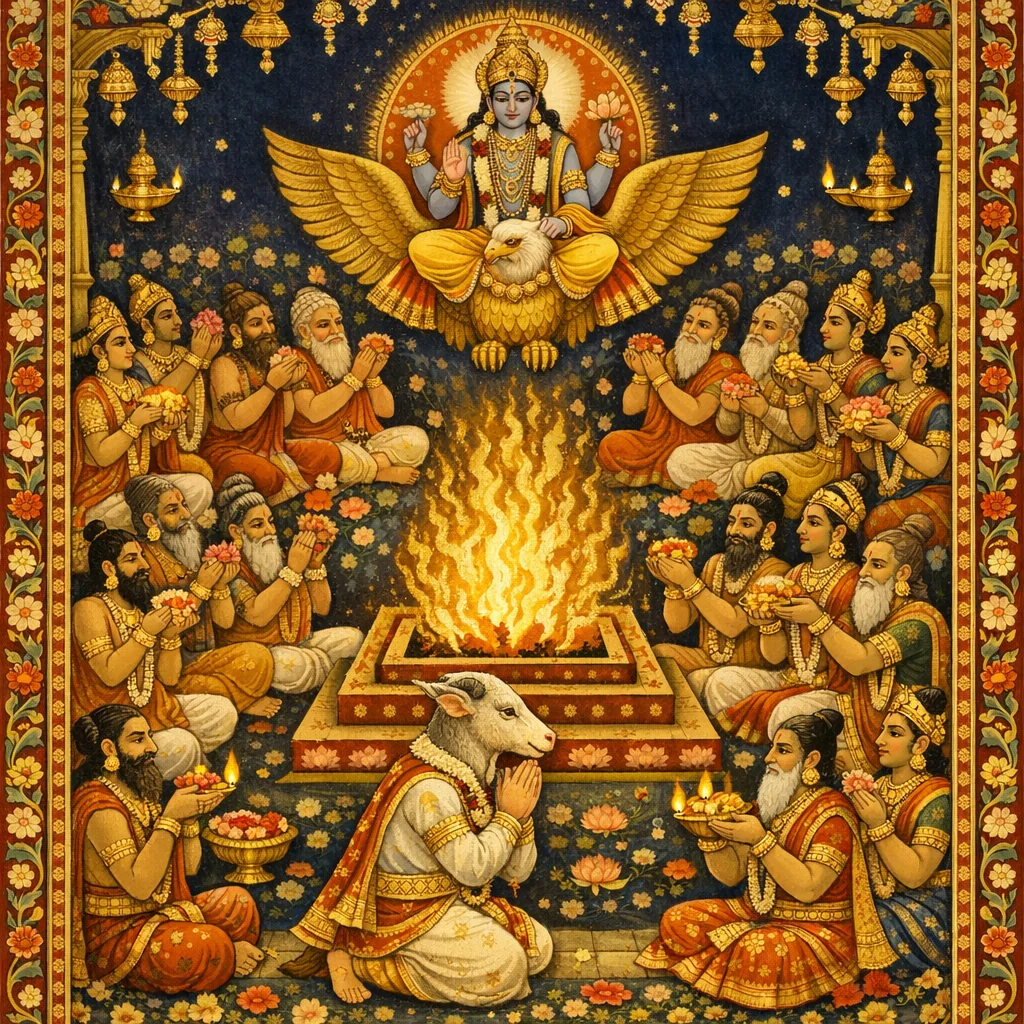
After Vīrabhadra devastates Dakṣa’s yajña, Brahmā pacifies Śiva and asks that the sacrifice be restored. Śiva, embodying kṣamā (forgiveness), ordains remedies for the injured devas and priests and grants Dakṣa a goat’s head, turning punishment into purification. The assembly returns to the sacrificial arena; Dakṣa is revived, his envy cleansed, and he offers repentant prayers to Śiva, honoring him as guardian of brāhmaṇical discipline and dharma. With Brahmā’s approval the rite resumes: the ground is purified and oblations are offered. At the properly sanctified offering, Viṣṇu appears as Nārāyaṇa upon Garuḍa, outshining all. Devas, sages, the Vedas, Agni and others pour forth hymns, establishing Viṣṇu as yajña personified and the supreme shelter. Viṣṇu then teaches a nonsectarian truth: Brahmā, Śiva and Viṣṇu are one in the impersonal sense, yet He remains the original Supreme Person acting through guṇa-based functions. Dakṣa completes worship, order is restored, and the chapter closes by foreshadowing Satī’s rebirth as Pārvatī, linking to the next cycle of divine līlā.
Shlokas
Verse 1
मैत्रेय उवाच इत्यजेनानुनीतेन भवेन परितुष्यता । अभ्यधायि महाबाहो प्रहस्य श्रूयतामिति ॥ १ ॥
Maitreya said: O mighty-armed Vidura, thus pacified by Brahmā’s words, Bhava (Lord Śiva) became satisfied and, smiling, spoke: “Hear now.”
Verse 2
महादेव उवाच नाघं प्रजेश बालानां वर्णये नानुचिन्तये । देवमायाभिभूतानां दण्डस्तत्र धृतो मया ॥ २ ॥
Mahādeva said: Dear Prajāpati Brahmā, I neither magnify the demigods’ offenses nor keep them in my heart. Like children, they are overcome by divine māyā; therefore I punished them only to set them right.
Verse 3
प्रजापतेर्दग्धशीर्ष्णो भवत्वजमुखं शिर: । मित्रस्य चक्षुषेक्षेत भागं स्वं बर्हिषो भग: ॥ ३ ॥
Śiva continued: Since Dakṣa’s head has already been burned to ashes, let him have the head of a goat. And the deva Bhaga shall behold his share of the sacrifice through the eyes of Mitra.
Verse 4
पूषा तु यजमानस्य दद्भिर्जक्षतु पिष्टभुक् । देवा: प्रकृतसर्वाङ्गा ये म उच्छेषणं ददु: ॥ ४ ॥
Śiva said: Pūṣā will be able to chew only with the teeth of the sacrificer’s disciples; if alone, he must be satisfied with dough made of chickpea flour. But the demigods who have agreed to give me my share of the sacrifice shall recover from all injuries and become whole in every limb.
Verse 5
बाहुभ्यामश्विनो: पूष्णो हस्ताभ्यां कृतबाहव: । भवन्त्वध्वर्यवश्चान्ये बस्तश्मश्रुर्भृगुर्भवेत् ॥ ५ ॥
Those whose arms were severed shall work with the arms of the Aśvinī-kumāras, and those whose hands were cut off shall perform their duties with the hands of Pūṣā. The adhvaryu priests too shall act in that same way. As for Bhṛgu, let him receive the beard of a goat’s head.
Verse 6
मैत्रेय उवाच तदा सर्वाणि भूतानि श्रुत्वा मीढुष्टमोदितम् । परितुष्टात्मभिस्तात साधु साध्वित्यथाब्रुवन् ॥ ६ ॥
The great sage Maitreya said: Dear Vidura, upon hearing the words of Bhagavān Rudra (Śiva), the foremost of all bestowers of boons, everyone present felt deep satisfaction in heart and soul and exclaimed, “Sādhu! Sādhu!”
Verse 7
ततो मीढ्वांसमामन्त्र्य शुनासीरा: सहर्षिभि: । भूयस्तद्देवयजनं समीढ्वद्वेधसो ययु: ॥ ७ ॥
Thereafter Śunāsīrā Bhṛgu, along with the sages, invited the gracious Lord Rudra (Śiva) to the sacrificial arena. Thus the demigods, accompanied by the ṛṣis, by Lord Śiva, and by Brahmā, all went to the place where the great yajña was being performed.
Verse 8
विधाय कार्त्स्न्येन च तद्यदाह भगवान् भव: । सन्दधु: कस्य कायेन सवनीयपशो: शिर: ॥ ८ ॥
After everything was carried out in full exactly as Bhagavān Bhava (Śiva) had instructed, Dakṣa’s body was joined to the head of the animal appointed for sacrifice.
Verse 9
सन्धीयमाने शिरसि दक्षो रुद्राभिवीक्षित: । सद्य: सुप्त इवोत्तस्थौ ददृशे चाग्रतो मृडम् ॥ ९ ॥
As the animal’s head was being set upon Dakṣa’s body, Dakṣa—touched by Rudra’s glance—at once regained consciousness, as if waking from sleep, and beheld Mṛḍa (Śiva) standing before him.
Verse 10
तदा वृषध्वजद्वेषकलिलात्मा प्रजापति: । शिवावलोकादभवच्छरद्ध्रद इवामल: ॥ १० ॥
Then, upon seeing Lord Śiva, the bull-bannered Lord, Dakṣa’s heart—polluted by envy of Śiva—was at once cleansed, like a lake made clear by the rains of autumn.
Verse 11
भवस्तवाय कृतधीर्नाशक्नोदनुरागत: । औत्कण्ठ्याद्बाष्पकलया सम्परेतां सुतां स्मरन् ॥ ११ ॥
Dakṣa wished to offer prayers to Lord Śiva, but as he remembered his departed daughter Satī, tears welled up in longing; grief choked his voice, and he could not speak.
Verse 12
कृच्छ्रात्संस्तभ्य च मन: प्रेमविह्वलित: सुधी: । शशंस निर्व्यलीकेन भावेनेशं प्रजापति: ॥ १२ ॥
At that time, though shaken by love and tenderness, the wise Dakṣa with great effort steadied his mind, restrained his feelings, and with pure, guileless consciousness began to offer prayers to Lord Śiva.
Verse 13
दक्ष उवाच भूयाननुग्रह अहो भवता कृतो मे दण्डस्त्वया मयि भृतो यदपि प्रलब्ध: । न ब्रह्मबन्धुषु च वां भगवन्नवज्ञा तुभ्यं हरेश्च कुत एव धृतव्रतेषु ॥ १३ ॥
King Dakṣa said: “O Bhagavān Bhava, Lord Śiva, I committed a grave offense against you; yet you are so merciful that, instead of withdrawing your grace, you have benefited me by punishing me. You and Lord Hari never disdain even unworthy brāhmaṇas—how then would you neglect me, who is engaged in sacrifice, O steadfast one?”
Verse 14
विद्यातपोव्रतधरान् मुखत: स्म विप्रान् ब्रह्मात्मतत्त्वमवितुं प्रथमं त्वमस्राक् । तद्ब्राह्मणान् परम सर्वविपत्सु पासि पाल: पशूनिव विभो प्रगृहीतदण्ड: ॥ १४ ॥
O mighty Lord, you were first manifested from Brahmā’s mouth to protect the brāhmaṇas who uphold learning, austerity, and vows, so they may preserve realization of Brahman and the Self. Thus, in every danger you guard the brāhmaṇas and their disciplines, as a cowherd holds a staff to protect the cows.
Verse 15
योऽसौ मयाविदिततत्त्वदृशा सभायां क्षिप्तो दुरुक्तिविशिखैर्विगणय्य तन्माम् । अर्वाक् पतन्तमर्हत्तमनिन्दयापाद् दृष्टयार्द्रया स भगवान्स्वकृतेन तुष्येत् ॥ १५ ॥
I did not truly know Your glory; therefore, in the assembly I hurled at You arrows of harsh words, and You did not regard them. By disobeying the most venerable Lord, I was falling toward the path of hell, yet You, in compassion, saved me by granting due punishment. May the Lord be pleased by His own mercy, for by my words I cannot satisfy You.
Verse 16
मैत्रेय उवाच क्षमाप्यैवं स मीढ्वांसं ब्रह्मणा चानुमन्त्रित: । कर्म सन्तानयामास सोपाध्यायर्त्विगादिभि: ॥ १६ ॥
Maitreya said: Thus, pardoned by Lord Śiva and with Brahmā’s consent, King Dakṣa again began the performance of the yajña, together with the ācāryas, the ṛtvij priests, and others.
Verse 17
वैष्णवं यज्ञसन्तत्यै त्रिकपालं द्विजोत्तमा: । पुरोडाशं निरवपन् वीरसंसर्गशुद्धये ॥ १७ ॥
Thereafter, to resume the sacrificial rite, the foremost brāhmaṇas first purified the arena from the defilement caused by the touch of Vīrabhadra and Śiva’s ghostly followers; then they offered into the sacred fire the oblation known as puroḍāśa (trikapāla).
Verse 18
अध्वर्युणात्तहविषा यजमानो विशाम्पते । धिया विशुद्धया दध्यौ तथा प्रादुरभूद्धरि: ॥ १८ ॥
O lord of the people, as soon as King Dakṣa, the yajamāna, offered the clarified butter taken up by the adhvaryu with Yajur mantras, in purified meditation, Hari appeared there in His original form as Nārāyaṇa.
Verse 19
तदा स्वप्रभया तेषां द्योतयन्त्या दिशो दश । मुष्णंस्तेज उपानीतस्तार्क्ष्येण स्तोत्रवाजिना ॥ १९ ॥
Then Lord Nārāyaṇa appeared, seated upon the shoulder of Tārkṣya—Garuḍa, bearer of hymns and great wings. By His own radiance He illumined the ten directions, and the splendor of Brahmā and the others present was eclipsed.
Verse 20
श्यामो हिरण्यरशनोऽर्ककिरीटजुष्टो नीलालकभ्रमरमण्डितकुण्डलास्य: । शङ्खाब्जचक्रशरचापगदासिचर्म- व्यग्रैर्हिरण्मयभुजैरिव कर्णिकार: ॥ २० ॥
He was dark-hued, clad in golden-yellow pītāmbara, and crowned with a helmet radiant like the sun. His bluish locks, like black bees, framed a face adorned with earrings. With eight arms He bore the conch, discus, mace, lotus, arrow, bow, shield, and sword, His limbs gleaming with golden bangles and ornaments. His whole form appeared like a flowering tree beautifully decked with blossoms.
Verse 21
वक्षस्यधिश्रितवधूर्वनमाल्युदार हासावलोककलया रमयंश्च विश्वम् । पार्श्वभ्रमद्वयजनचामरराजहंस: श्वेतातपत्रशशिनोपरि रज्यमान: ॥ २१ ॥
With Śrī Lakṣmī and the forest garland resting upon His chest, Lord Viṣṇu appeared supremely beautiful. By the gentle curve of His smile and the charm of His glance He delighted the whole world, especially His devotees. On either side, white cāmara fans waved like royal swans, and above Him a white canopy shone like the moon.
Verse 22
तमुपागतमालक्ष्य सर्वे सुरगणादय: । प्रणेमु: सहसोत्थाय ब्रह्मेन्द्रत्र्यक्षनायका: ॥ २२ ॥
As soon as Lord Viṣṇu became visible, all the celestial beings—Brahmā, Indra, three-eyed Śiva, the Gandharvas, and all who were present—rose at once and immediately fell prostrate, offering Him reverent obeisances.
Verse 23
तत्तेजसा हतरुच: सन्नजिह्वा: ससाध्वसा: । मूर्ध्ना धृताञ्जलिपुटा उपतस्थुरधोक्षजम् ॥ २३ ॥
Before the blazing effulgence of Nārāyaṇa’s bodily splendor, all other radiance faded and every tongue fell silent. Struck with awe and reverence, those present folded their hands, touched them to their heads, and prepared to offer prayers to Adhokṣaja, the Supreme Personality of Godhead beyond the reach of the senses.
Verse 24
अप्यर्वाग्वृत्तयो यस्य महि त्वात्मभुवादय: । यथामति गृणन्ति स्म कृतानुग्रहविग्रहम् ॥ २४ ॥
Though even the mental reach of demigods such as Brahmā cannot fully grasp the Lord’s limitless glories, by His grace they were able to behold the transcendental form of the Supreme Personality of Godhead. Only through that mercy could they offer reverent prayers, each according to his own capacity.
Verse 25
दक्षो गृहीतार्हणसादनोत्तमं यज्ञेश्वरं विश्वसृजां परं गुरुम् । सुनन्दनन्दाद्यनुगैर्वृतं मुदा गृणन् प्रपेदे प्रयत: कृताञ्जलि: ॥ २५ ॥
When Lord Viṣṇu, the master of all yajñas, accepted the oblations of the sacrifice, Prajāpati Dakṣa, with great joy and folded hands, offered reverent prayers to Him—the supreme guru of the Prajāpatis, served even by Nanda and Sunanda.
Verse 26
दक्ष उवाच शुद्धं स्वधाम्न्युपरताखिलबुद्ध्यवस्थं चिन्मात्रमेकमभयं प्रतिषिध्य मायाम् । तिष्ठंस्तयैव पुरुषत्वमुपेत्य तस्या- मास्ते भवानपरिशुद्ध इवात्मतन्त्र: ॥ २६ ॥
Dakṣa said: “O Lord, You are pure in Your own abode, beyond all speculative states of intellect—pure consciousness alone, one and fearless. You restrain māyā, and though You appear within her as the Puruṣa, You remain fully self-sufficient and never touched by material impurity.”
Verse 27
ऋत्विज ऊचु: तत्त्वं न ते वयमनञ्जन रुद्रशापात् कर्मण्यवग्रहधियो भगवन्विदाम: । धर्मोपलक्षणमिदं त्रिवृदध्वराख्यं ज्ञातं यदर्थमधिदैवमदो व्यवस्था: ॥ २७ ॥
The priests said: “O Bhagavān, untouched by contamination, by Rudra’s curse our minds have become entangled in fruitive work, and thus we do not know You in truth. Under the pretext of performing yajña we are absorbed in the injunctions of the three divisions of Vedic knowledge. Yet we know that You have arranged the proper shares for the devas.”
Verse 28
सदस्या ऊचु: उत्पत्त्यध्वन्यशरण उरुक्लेशदुर्गेऽन्तकोग्र व्यालान्विष्टे विषयमृगतृष्यात्मगेहोरुभार: । द्वन्द्वश्वभ्रे खलमृगभये शोकदावेऽज्ञसार्थ: पादौकस्ते शरणद कदा याति कामोपसृष्ट: ॥ २८ ॥
The members of the assembly said: “O giver of shelter, on the road of birth and death You alone are the refuge of the helpless. In this dreadful fortress of suffering, time—like a fierce serpent—ever seeks a chance to strike. The mirage of sense pleasure bewilders, the heavy burden of false ‘home’ crushes; there are pits of so-called joy and grief, fear of savage beasts, and the forest-fire of lamentation. When will these fools, assailed by desire, take shelter of Your lotus feet?”
Verse 29
रुद्र उवाच तव वरद वराङ्घ्रावाशिषेहाखिलार्थे ह्यपि मुनिभिरसक्तैरादरेणार्हणीये । यदि रचितधियं माविद्यलोकोऽपविद्धं जपति न गणये तत्त्वत्परानुग्रहेण ॥ २९ ॥
Lord Śiva said: “O bestower of boons, Your exalted feet are the source of all blessings and the fulfillment of all aims; even liberated sages worship them with reverence. With my mind fixed on Your lotus feet, I do not heed those who revile me as impure. By Your grace toward those devoted to truth, I forgive them with compassion, just as You show compassion to all beings.”
Verse 30
भृगुरुवाच यन्मायया गहनयापहृतात्मबोधा ब्रह्मादयस्तनुभृतस्तमसि स्वपन्त: । नात्मन् श्रितं तव विदन्त्यधुनापि तत्त्वं सोऽयं प्रसीदतु भवान्प्रणतात्मबन्धु: ॥ ३० ॥
Śrī Bhṛgu said: O Lord, by Your unfathomable māyā, from Brahmā down to all embodied beings, their awareness of the self is stolen and they sleep in the darkness of illusion. Even now they do not know the truth of You, who dwell within every being as the Supersoul. Yet You are the eternal friend and protector of surrendered souls; therefore be gracious and forgive our offenses.
Verse 31
ब्रह्मोवाच नैतत्स्वरूपं भवतोऽसौ पदार्थ भेदग्रहै: पुरुषो यावदीक्षेत् । ज्ञानस्य चार्थस्य गुणस्य चाश्रयो मायामयाद्वयतिरिक्तो मतस्त्वम् ॥ ३१ ॥
Lord Brahmā said: O Bhagavān, one who tries to know You through grasping the differences among things cannot understand Your eternal form. Though You are the shelter of knowledge, its aims, and all qualities, You remain beyond māyā-born duality—transcendent, nondual Reality.
Verse 32
इन्द्र उवाच इदमप्यच्युत विश्वभावनं वपुरानन्दकरं मनोदृशाम् । सुरविद्विट्क्षपणैरुदायुधै र्भुजदण्डैरुपपन्नमष्टभि: ॥ ३२ ॥
King Indra said: O Acyuta, nourisher of the universe, Your transcendental form with eight arms, each bearing a weapon, appears for the welfare of all worlds. It delights the mind and the eyes, and ever stands ready to chastise the asuras who envy Your devotees.
Verse 33
पत्न्य ऊचु: यज्ञोऽयं तव यजनाय केन सृष्टो विध्वस्त: पशुपतिनाद्य दक्षकोपात् । तं नस्त्वं शवशयनाभशान्तमेधं यज्ञात्मन्नलिनरुचा दृशा पुनीहि ॥ ३३ ॥
The wives said: O Lord, this sacrifice was arranged for Your worship by Brahmā’s instruction, yet because of Dakṣa’s wrath, Śiva, the Lord of creatures, has devastated the rite. The sacrificial animals lie dead, and the sanctity of the yajña is lost. O Yajñātmā, with the radiant glance of Your lotus eyes, purify this arena once again.
Verse 34
ऋषय ऊचु: अनन्वितं ते भगवन् विचेष्टितं यदात्मना चरसि हि कर्म नाज्यसे । विभूतये यत उपसेदुरीश्वरीं न मन्यते स्वयमनुवर्ततीं भवान् ॥ ३४ ॥
The sages prayed: O Bhagavān, Your deeds are wondrous indeed. Though You accomplish everything through Your various potencies, You are never attached to action. Even Śrī Lakṣmī, whom great devas like Brahmā worship to gain her favor, follows You in service—yet You are not attached even to her.
Verse 35
सिद्धा ऊचु: अयं त्वत्कथामृष्टपीयूषनद्यां मनोवारण: क्लेशदावाग्निदग्ध: । तृषार्तोऽवगाढो न सस्मार दावं न निष्क्रामति ब्रह्मसम्पन्नवन्न: ॥ ३५ ॥
The Siddhas prayed: O Lord, like an elephant scorched by a forest fire that forgets its misery upon entering a river, our minds plunge into the nectarean river of Your transcendental narrations and līlās. Absorbed in that supreme bliss, equal to Brahman’s joy, we never wish to depart.
Verse 36
यजमान्युवाच स्वागतं ते प्रसीदेश तुभ्यं नम: श्रीनिवास श्रिया कान्तया त्राहि न: । त्वामृतेऽधीश नाङ्गैर्मख: शोभते शीर्षहीन: कबन्धो यथा पुरुष: ॥ ३६ ॥
Dakṣa’s wife prayed: Welcome, O Lord; it is our great fortune that You have come to this sacrificial arena. I bow to You, Śrīnivāsa—please be pleased and protect us along with Śrī-Lakṣmī. O Supreme Master, without You the yajña has no beauty, like a body without a head.
Verse 37
लोकपाला ऊचु: दृष्ट: किं नो दृग्भिरसद्ग्रहैस्त्वं प्रत्यग्द्रष्टा दृश्यते येन विश्वम् । माया ह्येषा भवदीया हि भूमन् यस्त्वं षष्ठ: पञ्चभिर्भासि भूतै: ॥ ३७ ॥
The planetary governors said: O Lord, our senses grasp only the unreal and fleeting—have we truly seen You? You are the inward Seer, by whom the universe is seen. O All-pervading One, this is Your māyā: beyond the five elements, You yet shine forth as the sixth principle.
Verse 38
योगेश्वरा ऊचु प्रेयान्न तेऽन्योऽस्त्यमुतस्त्वयि प्रभो विश्वात्मनीक्षेन्न पृथग्य आत्मन: । अथापि भक्त्येश तयोपधावता- मनन्यवृत्त्यानुगृहाण वत्सल ॥ ३८ ॥
The great mystics said: O Lord, those who behold You as the Paramātmā of all beings and see no separation from their own self are surely most dear to You. Yet, O Īśa, in Your tender mercy bless the bhaktas who run to Your shelter with single-minded devotion, for You are ever affectionate.
Verse 39
जगदुद्भवस्थितिलयेषु दैवतो बहुभिद्यमानगुणयात्ममायया । रचितात्मभेदमतये स्वसंस्थया विनिवर्तितभ्रमगुणात्मने नम: ॥ ३९ ॥
We bow to the Supreme Lord, who by His own ātma-māyā arranges the manifold manifestations under the three guṇas, bringing about the creation, maintenance, and dissolution of the cosmos. Yet He Himself is never ruled by external energy: in His personal being He is free from material variegation and from all illusion of false identity.
Verse 40
ब्रह्मोवाच नमस्ते श्रितसत्त्वाय धर्मादीनां च सूतये । निर्गुणाय च यत्काष्ठां नाहं वेदापरेऽपि च ॥ ४० ॥
Brahmā said: O Lord, I offer obeisances unto You, the shelter of sattva and thus the source of dharma, austerity, and penance. You are beyond the material guṇas; neither I nor anyone else fully knows Your true position.
Verse 41
अग्निरुवाच यत्तेजसाहं सुसमिद्धतेजा हव्यं वहे स्वध्वर आज्यसिक्तम् । तं यज्ञियं पञ्चविधं च पञ्चभि: स्विष्टं यजुर्भि: प्रणतोऽस्मि यज्ञम् ॥ ४१ ॥
Agni, the fire-god, said: O Lord, by Your grace I blaze with splendor and carry in sacrifice the offerings anointed with ghee. The five kinds of oblations taught in the Yajur Veda are manifestations of Your energies, and You are worshiped by five kinds of Vedic hymns. In truth, sacrifice means You Yourself, the Supreme Personality of Godhead.
Verse 42
देवा ऊचु: पुरा कल्पापाये स्वकृतमुदरीकृत्य विकृतं त्वमेवाद्यस्तस्मिन् सलिल उरगेन्द्राधिशयने । पुमान्शेषे सिद्धैर्हृदि विमृशिताध्यात्मपदवि: स एवाद्याक्ष्णोर्य: पथि चरसि भृत्यानवसि न: ॥ ४२ ॥
The demigods said: O Lord, in the former devastation You gathered and preserved within Yourself all the energies of material manifestation. Then, as the original Person, You rested upon the waters of pralaya on the bed of Śeṣa, while liberated sages like Sanaka contemplated You within the heart by the path of spiritual realization. Today You are visible before our eyes; we are Your servants—please grant us protection.
Verse 43
गन्धर्वा ऊचु: अंशांशास्ते देव मरीच्यादय एते ब्रह्मेन्द्राद्या देवगणा रुद्रपुरोगा: । क्रीडाभाण्डं विश्वमिदं यस्य विभूमन् तस्मै नित्यं नाथ नमस्ते करवाम ॥ ४३ ॥
The Gandharvas said: O Lord, Marīci and the other sages, along with Brahmā, Indra, and the hosts of devas led by Rudra, are but parts of Your parts. O Almighty One, this whole universe is like a plaything in Your divine līlā. O Master, we ever offer You our obeisances and accept You as the Supreme Personality of Godhead.
Verse 44
विद्याधरा ऊचु: त्वन्माययार्थमभिपद्य कलेवरेऽस्मिन् कृत्वा ममाहमिति दुर्मतिरुत्पथै: स्वै: । क्षिप्तोऽप्यसद्विषयलालस आत्ममोहं युष्मत्कथामृतनिषेवक उद्वयुदस्येत् ॥ ४४ ॥
The Vidyādharas said: O Lord, this human body is meant for attaining the highest perfection, yet, impelled by Your māyā, the living being mistakes the body for the self, thinking “I” and “mine,” and wanders on misguided paths, craving unreal and fleeting pleasures, thus falling into self-delusion. But one who continually serves the nectar of Your narrations—by hearing and chanting Your transcendental deeds—can be delivered from that illusion.
Verse 45
ब्राह्मणा ऊचु: त्वं क्रतुस्त्वं हविस्त्वं हुताश: स्वयंत्वं हि मन्त्र: समिद्दर्भपात्राणि च । त्वं सदस्यर्त्विजो दम्पती देवताअग्निहोत्रं स्वधा सोम आज्यं पशु: ॥ ४५ ॥
The brāhmaṇas said: O Lord, You are yajña itself; You are the oblation (havis), and You are the sacred fire. You are the Vedic mantra, the fuel, the flame, the kuśa grass, and the sacrificial vessels. You are the priests of the rite, the yajamāna couple, the devas headed by Indra, the agnihotra, svadhā, soma, ghee, and the sacrificial animal—whatever is offered is You, or Your own divine energy.
Verse 46
त्वं पुरा गां रसाया महासूकरो दंष्ट्रया पद्मिनीं वारणेन्द्रो यथा । स्तूयमानो नदल्लीलया योगिभि- र्व्युज्जहर्थ त्रयीगात्र यज्ञक्रतु: ॥ ४६ ॥
O Lord, embodiment of the Vedic triad and master of sacrifice: in ages past You appeared as the great Varāha, and with Your tusk You lifted the earth from the waters of Rasātala, as an elephant plucks a lotus from a lake. In that vast boar form You resounded with a transcendental cry, received as a sacrificial hymn; sages and yogīs such as Sanaka meditated upon it and offered prayers to glorify You.
Verse 47
स प्रसीद त्वमस्माकमाकाङ्क्षतां दर्शनं ते परिभ्रष्टसत्कर्मणाम् । कीर्त्यमाने नृभिर्नाम्नि यज्ञेश ते यज्ञविघ्ना: क्षयं यान्ति तस्मै नम: ॥ ४७ ॥
O Lord, Yajñeśa, we longed for Your darśana, for we have fallen from properly performing the yajñas according to Vedic rite. Be pleased with us. When people chant Your holy name, all obstacles to sacrifice are destroyed; therefore, in Your very presence, we offer our respectful obeisances.
Verse 48
मैत्रेय उवाच इति दक्ष: कविर्यज्ञं भद्र रुद्राभिमर्शितम् । कीर्त्यमाने हृषीकेशे सन्निन्ये यज्ञभावने ॥ ४८ ॥
Śrī Maitreya said: O Vidura, when all present had glorified Hṛṣīkeśa, Dakṣa’s consciousness became purified, and he arranged to begin again the yajña that had been devastated by the followers of Lord Śiva.
Verse 49
भगवान् स्वेन भागेन सर्वात्मा सर्वभागभुक् । दक्षं बभाष आभाष्य प्रीयमाण इवानघ ॥ ४९ ॥
Maitreya continued: O sinless Vidura, Lord Viṣṇu is truly the enjoyer of the fruits of all yajñas; yet, as the Paramātmā within every being, He was satisfied with His own allotted share. Thus, in a gracious mood, He addressed Dakṣa with pleasing words.
Verse 50
श्रीभगवानुवाच अहं ब्रह्मा च शर्वश्च जगत: कारणं परम् । आत्मेश्वर उपद्रष्टा स्वयंदृगविशेषण: ॥ ५० ॥
The Supreme Lord said: Brahmā, Śarva (Śiva), and I are the supreme cause of the universe’s manifestation. I am the indwelling Paramātmā, the self-sufficient witness; yet in the impersonal view there is no difference between Brahmā, Śiva, and Me.
Verse 51
आत्ममायां समाविश्य सोऽहं गुणमयीं द्विज । सृजन् रक्षन् हरन् विश्वं दध्रे संज्ञां क्रियोचिताम् ॥ ५१ ॥
My dear Dakṣa, O dvija: entering My own ātma-māyā, the energy of the guṇas, I create, maintain, and withdraw the universe; according to the gradations of activity, My manifestations are known by different names.
Verse 52
तस्मिन् ब्रह्मण्यद्वितीये केवले परमात्मनि । ब्रह्मरुद्रौ च भूतानि भेदेनाज्ञोऽनुपश्यति ॥ ५२ ॥
Within that pure, nondual Brahman—Paramātmā—an ignorant person perceives Brahmā, Rudra (Śiva), and all beings as separate, as though independent.
Verse 53
यथा पुमान्न स्वाङ्गेषु शिर:पाण्यादिषु क्वचित् । पारक्यबुद्धिं कुरुते एवं भूतेषु मत्पर: ॥ ५३ ॥
Just as a person never regards the head, hands, and other limbs of his own body as separate, so My devotee, devoted to Me, sees no division among living beings.
Verse 54
त्रयाणामेकभावानां यो न पश्यति वै भिदाम् । सर्वभूतात्मनां ब्रह्मन् स शान्तिमधिगच्छति ॥ ५४ ॥
O brāhmaṇa: one who sees no difference in the one essence of Brahmā, Viṣṇu, Śiva, and all living beings as the Soul of all, truly knows Brahman and attains peace; others do not.
Verse 55
मैत्रेय उवाच एवं भगवतादिष्ट: प्रजापतिपतिर्हरिम् । अर्चित्वा क्रतुना स्वेन देवानुभयतोऽयजत् ॥ ५५ ॥
Maitreya said: Thus Dakṣa, lord of the Prajāpatis, instructed by the Bhagavān, worshiped Hari (Viṣṇu). Having honored Him through his prescribed sacrifice, he then offered separate worship to Brahmā and to Śiva.
Verse 56
रुद्रं च स्वेन भागेन ह्युपाधावत्समाहित: । कर्मणोदवसानेन सोमपानितरानपि । उदवस्य सहर्त्विग्भि: सस्नाववभृथं तत: ॥ ५६ ॥
With a composed mind, Dakṣa respectfully worshiped Rudra (Śiva) with his allotted share of the yajña remnants. When the ritual acts were completed, he satisfied the other soma-drinking devas and all who had assembled there. Then, together with the priests, he performed the avabhṛtha bath and became fully content.
Verse 57
तस्मा अप्यनुभावेन स्वेनैवावाप्तराधसे । धर्म एव मतिं दत्त्वा त्रिदशास्ते दिवं ययु: ॥ ५७ ॥
Thus, by his own spiritual potency, Dakṣa attained full merit; the assembled devas blessed him, granting him a steadfast mind upon the path of dharma. Then all the Tridaśas departed for heaven.
Verse 58
एवं दाक्षायणी हित्वा सती पूर्वकलेवरम् । जज्ञे हिमवत: क्षेत्रे मेनायामिति शुश्रुम ॥ ५८ ॥
Maitreya said: I have heard from authoritative sources that Dākṣāyaṇī Satī, abandoning the former body she had received from Dakṣa, took birth in the land of Himavat as the daughter of Menā.
Verse 59
तमेव दयितं भूय आवृङ्क्ते पतिमम्बिका । अनन्यभावैकगतिं शक्ति: सुप्तेव पूरुषम् ॥ ५९ ॥
Ambikā (Durgā), known as Dākṣāyaṇī Satī, again accepted that same beloved Śiva as her husband—just as śakti, with single-minded devotion, takes shelter of the Puruṣa (the Supreme Lord) at the dawn of a new creation.
Verse 60
एतद्भगवत: शम्भो: कर्म दक्षाध्वरद्रुह: । श्रुतं भागवताच्छिष्यादुद्धवान्मे बृहस्पते: ॥ ६० ॥
Maitreya said: O Vidura, I heard this account of Dakṣa’s sacrifice—laid waste by Bhagavān Śambhu—from Uddhava, the great devotee and disciple of Bṛhaspati.
Verse 61
इदं पवित्रं परमीशचेष्टितं यशस्यमायुष्यमघौघमर्षणम् । यो नित्यदाकर्ण्य नरोऽनुकीर्तयेद् धुनोत्यघं कौरव भक्तिभावत: ॥ ६१ ॥
This is the supremely purifying narration of the Supreme Lord’s deeds—bestowing fame and long life and destroying heaps of sin. O descendant of Kuru, one who daily hears it and then recounts it with faith and bhakti shakes off all impurity.
Frequently Asked Questions
It is a shāstric symbol of corrective justice: Dakṣa’s arrogance and ritualistic pride led to offense against Śiva and Satī, so his humiliation reforms him without annihilating his administrative role as Prajāpati. The replacement head marks both consequence and mercy—he is restored to life, but with a visible reminder that yajña must be guided by humility and devotion.
Śiva minimizes their culpability as childish ignorance, accepts Brahmā’s request, and restores them with remedial arrangements. This teaches Vaiṣṇava-Śaiva ethics in the Bhāgavata: a great devotee is tolerant, quick to forgive, and uses punishment only to correct—not to nourish resentment—mirroring the Lord’s compassion toward conditioned beings.
A broad cosmic assembly offers prayers: Dakṣa, the priests, sages, Siddhas, Gandharvas, Vidyādharas, planetary governors, Agni (fire-god), the personified Vedas, Indra, Brahmā, Bhṛgu, and Śiva—demonstrating that Viṣṇu is the ultimate recipient and sustainer of all sacrificial and cosmic functions.
Viṣṇu teaches functional nondifference at the level of the single supreme cause and witness (Brahman/Paramātmā perspective), while also affirming personal theism: He remains the original Personality of Godhead who empowers guṇa-based administrative roles for creation (Brahmā), destruction/transformation (Śiva), and maintenance (Viṣṇu). The teaching discourages sectarian rivalry and centers all worship on the Supreme.