Adhyaya 316
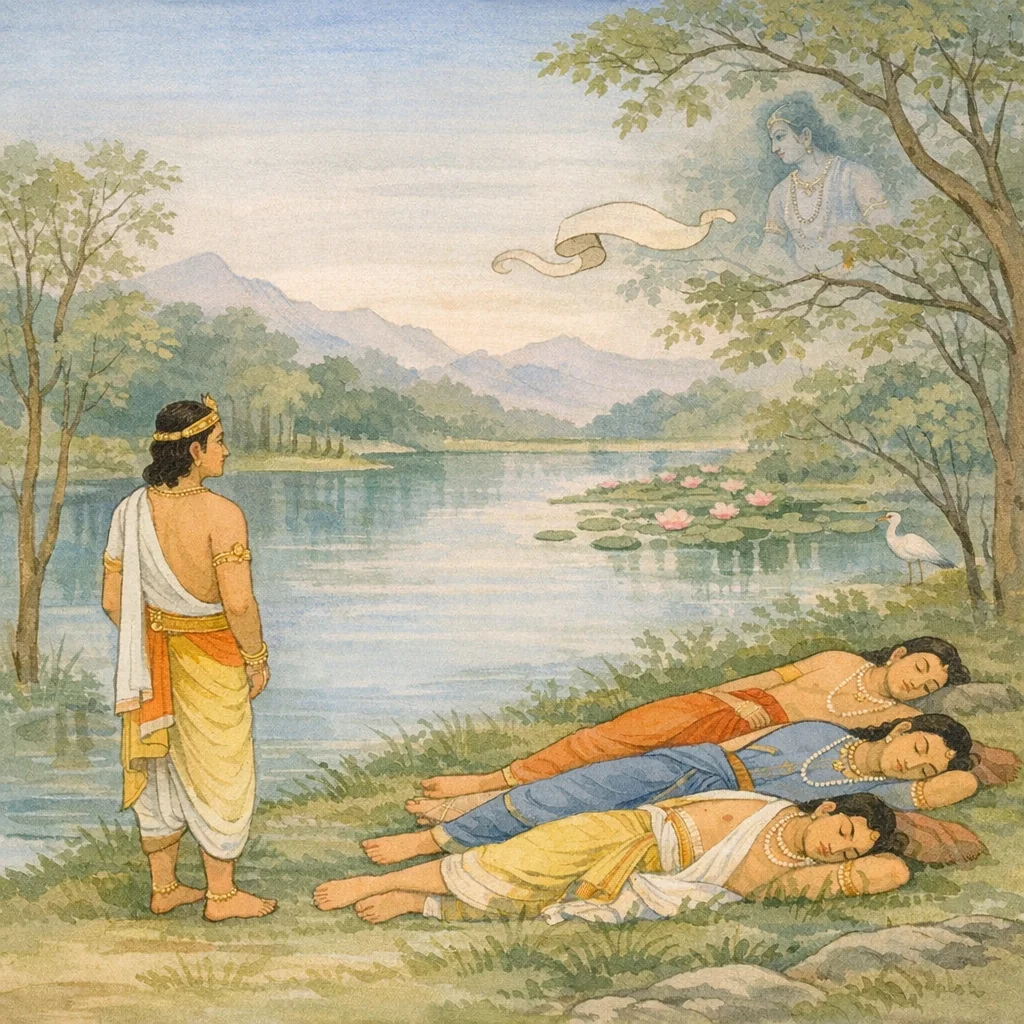
Chapter Arc: Yudhishthira arrives at the forest lake and beholds a dreadful sight: Arjuna’s bow and arrows scattered, and his brothers—Arjuna, Bhima, Nakula, Sahadeva—lying fallen and motionless, as if life has fled them. → Grief-stricken, he searches for signs of wounds and finds none—no weapon-strikes, no footprints—only an uncanny stillness, convincing him that some vast, unseen being has struck them down. A disembodied Yaksha voice asserts dominion over the water and demands that Yudhishthira answer questions before drinking. → The Yaksha unleashes a cascade of riddling questions—about the self, fate, friendship, livelihood, refuge, and the essence of dharma—and Yudhishthira answers with steady clarity, refusing temptation and speaking of compassion, restraint of mind, and the enduring bond of the good. → Pleased, the Yaksha reveals his identity and power, admits he has felled the brothers, and—moved by Yudhishthira’s truthfulness and dharmic insight—grants boons that lead toward the restoration of the fallen brothers and the safeguarding of the Pandavas’ forest-journey. → The Yaksha’s final condition and the precise choice Yudhishthira must make (whom to revive and why) hangs over the scene, testing dharma against affection and strategy.
Shlokas
Verse 1
(दाक्षिणात्य अधिक पाठका ३ श्लोक मिलाकर कुल ४५३६ “लोक हैं।) हू... “+(>9) #:६.# #25-१ त्रयोदशाधिकत्रिशततमो< ध्याय: यक्ष और युधिष्ठिरका प्रश्नोत्तर तथा युधिष्ठिरके उत्तरसे संतुष्ट हुए यक्षका चारों हल जीवित होनेका वरदान ना वैशग्पायन उवाच स ददर्श हतान् भ्रातूँललोकपालानिव च्युतान् | चुगान्ते समनुप्राप्ते शक्रप्रतिमगौरवान्,वैशम्पायनजी कहते हैं--जनमेजय! युधिष्छिरने इन्द्रके समान गौरवशाली अपने भाइयोंको सरोवरके तटपर निर्जीवकी भाँति पड़े हुए देखा; मानो प्रलय-कालमें सम्पूर्ण लोकपाल अपने लोकोससे भ्रष्ट होकर गिर गये हों
Vaiśampāyana said: Yudhiṣṭhira saw his brothers lying slain at the edge of the lake, as though the guardians of the worlds themselves had fallen from their stations at the end of an age. They were men of splendor and dignity like Indra, now cast down and motionless—an image that frames the coming dialogue on restraint, truthfulness, and dharma in the face of grief.
Verse 2
विनिकीर्णभनुर्बाणं दृष्टवा निहतमर्जुनम् । भीमसेनं यमौ चैव निर्विचेष्टान् गतायुष:,धर्मपुत्रो महाबाहुर्विललाप सुविस्तरम् । अर्जुन मरे पड़े थे; उनके धनुष-बाण इधर-उधर बिखरे थे। भीमसेन और नकुल-सहदेव भी प्राणरहित हो निश्रेष्ट हो गये थे। इन सबको देखकर युधिष्ठिर गरम-गरम लंबी साँसें खींचने लगे। उनके नेत्रोंसे शोकके आँसू उमड़कर उन्हें भिगो रहे थे। अपने समस्त भ्राताओंको इस प्रकार धराशायी हुए देख महाबाह धर्मपुत्र युधिष्ठिर गहरी चिन्तामें डूब गये और देरतक विलाप करते रहे--
Vaiśaṃpāyana said: Seeing Arjuna slain, with his bow and arrows scattered about, and seeing Bhīmasena and the twin brothers as well—lifeless and motionless—Dharma’s son, the mighty-armed Yudhiṣṭhira, broke into a long and unrestrained lament. The scene confronts him with the collapse of fraternal duty and royal responsibility at once, and his grief rises from both love for his brothers and the moral shock of their sudden downfall.
Verse 3
स दीर्घमुष्णं नि:श्वस्य शोकबाष्पपरिप्लुत: । तान् दृष्टवा पतितान् भ्रातृन् सर्वाश्विन्तासमन्वितः,धर्मपुत्रो महाबाहुर्विललाप सुविस्तरम् । अर्जुन मरे पड़े थे; उनके धनुष-बाण इधर-उधर बिखरे थे। भीमसेन और नकुल-सहदेव भी प्राणरहित हो निश्रेष्ट हो गये थे। इन सबको देखकर युधिष्ठिर गरम-गरम लंबी साँसें खींचने लगे। उनके नेत्रोंसे शोकके आँसू उमड़कर उन्हें भिगो रहे थे। अपने समस्त भ्राताओंको इस प्रकार धराशायी हुए देख महाबाह धर्मपुत्र युधिष्ठिर गहरी चिन्तामें डूब गये और देरतक विलाप करते रहे--
Having drawn a long, hot breath, drenched in tears born of grief, Dharmaputra Yudhiṣṭhira—mighty-armed—looked upon his brothers lying fallen and, overwhelmed by every kind of anxious thought, lamented at length. The scene underscores the ethical weight of kinship and responsibility: the righteous king’s sorrow is not merely personal loss, but the crushing awareness of duty imperiled when one’s own are struck down.
Verse 4
ननु त्वया महाबाहो प्रतिज्ञातं वृकोदर,धर्मपुत्रो महाबाहुर्विललाप सुविस्तरम् । अर्जुन मरे पड़े थे; उनके धनुष-बाण इधर-उधर बिखरे थे। भीमसेन और नकुल-सहदेव भी प्राणरहित हो निश्रेष्ट हो गये थे। इन सबको देखकर युधिष्ठिर गरम-गरम लंबी साँसें खींचने लगे। उनके नेत्रोंसे शोकके आँसू उमड़कर उन्हें भिगो रहे थे। अपने समस्त भ्राताओंको इस प्रकार धराशायी हुए देख महाबाह धर्मपुत्र युधिष्ठिर गहरी चिन्तामें डूब गये और देरतक विलाप करते रहे-- महात्मनि महाबाहो कुरूणां कीर्तिविर्धने । वे बोले--“महाबाहु वृकोदर! तुमने यह प्रतिज्ञा की थी कि "मैं युद्धमें अपनी गदासे दुर्योधनकी दोनों जाँघें तोड़ डालूँगा। महाबाहो! तुम कुरुकुलकी कीर्ति बढ़ानेवाले थे। तुम्हारा हृदय विशाल था। वीर! आज तुम्हारे गिर जानेसे मेरे लिये वह सब कुछ व्यर्थ हो गया
Vaiśaṃpāyana said: “O mighty-armed Vṛkodara, did you not make that solemn vow?” Thus the mighty-armed Dharmaputra (Yudhiṣṭhira) lamented at length. Seeing his brothers fallen and the warrior’s pledges seemingly rendered futile, he is overwhelmed by grief and anxiety, and his words turn to the moral weight of promises made in the cause of righteousness and kinship honor.
Verse 5
सुयोधनस्य भेत्स्यामि गदया सक्थिनी रणे | व्यर्थ तदद्य मे सर्व त्वयि वीर निपातिते,धर्मपुत्रो महाबाहुर्विललाप सुविस्तरम् । अर्जुन मरे पड़े थे; उनके धनुष-बाण इधर-उधर बिखरे थे। भीमसेन और नकुल-सहदेव भी प्राणरहित हो निश्रेष्ट हो गये थे। इन सबको देखकर युधिष्ठिर गरम-गरम लंबी साँसें खींचने लगे। उनके नेत्रोंसे शोकके आँसू उमड़कर उन्हें भिगो रहे थे। अपने समस्त भ्राताओंको इस प्रकार धराशायी हुए देख महाबाह धर्मपुत्र युधिष्ठिर गहरी चिन्तामें डूब गये और देरतक विलाप करते रहे--
Vaiśaṃpāyana said: “I shall shatter Suyodhana’s thighs with my mace in battle. But today all that resolve of mine has become futile, O hero, now that you have fallen.” Thus the mighty-armed Dharmaputra lamented at length—overcome by grief at the collapse of righteous hope and the seeming triumph of adharma when the valiant are struck down.
Verse 6
मनुष्यसम्भवा वाचो विधर्मिण्य: प्रतिश्रुता:,धर्मपुत्रो महाबाहुर्विललाप सुविस्तरम् । अर्जुन मरे पड़े थे; उनके धनुष-बाण इधर-उधर बिखरे थे। भीमसेन और नकुल-सहदेव भी प्राणरहित हो निश्रेष्ट हो गये थे। इन सबको देखकर युधिष्ठिर गरम-गरम लंबी साँसें खींचने लगे। उनके नेत्रोंसे शोकके आँसू उमड़कर उन्हें भिगो रहे थे। अपने समस्त भ्राताओंको इस प्रकार धराशायी हुए देख महाबाह धर्मपुत्र युधिष्ठिर गहरी चिन्तामें डूब गये और देरतक विलाप करते रहे--
Vaiśaṃpāyana said: “Words born of human frailty—promises that stray from dharma—were spoken. Seeing the calamity before him, Dharmaputra Yudhiṣṭhira, the mighty-armed, sank into grief and lamented at length.”
Verse 7
देवाश्वापि यदावोचन् सूतके त्वां धनंजय,धर्मपुत्रो महाबाहुर्विललाप सुविस्तरम् । अर्जुन मरे पड़े थे; उनके धनुष-बाण इधर-उधर बिखरे थे। भीमसेन और नकुल-सहदेव भी प्राणरहित हो निश्रेष्ट हो गये थे। इन सबको देखकर युधिष्ठिर गरम-गरम लंबी साँसें खींचने लगे। उनके नेत्रोंसे शोकके आँसू उमड़कर उन्हें भिगो रहे थे। अपने समस्त भ्राताओंको इस प्रकार धराशायी हुए देख महाबाह धर्मपुत्र युधिष्ठिर गहरी चिन्तामें डूब गये और देरतक विलाप करते रहे-- “धनंजय! जब तुम्हारा जन्म हुआ था, उस समय देवताओंने भी कहा था कि “कुन्ती! तुम्हारा यह पुत्र सहस्रनेत्रधारी इन्द्रसे किसी बातमें कम न होगा।' उत्तर पारियात्र पर्वतपर सब प्राणियोंने तुम्हारे विषयमें यही कहा था कि “ये अर्जुन शीघ्र ही पाण्डवोंकी खोयी हुई राजलक्ष्मीको पुनः लौटा लायेंगे। युद्धमें कोई भी इनपर विजय पानेवाला न होगा और ये भी किसीको परास्त किये बिना न रहेंगे”
Vaiśaṃpāyana said: “O Dhanaṃjaya, when even the gods spoke of you at the time of your birth-rites, the mighty-armed Dharmaputra lamented at length.” The verse frames Yudhiṣṭhira’s grief as intensified by the remembered divine assurances about Arjuna’s destined greatness—highlighting the ethical tension between faith in foretold virtue and the crushing immediacy of apparent loss.
Verse 8
सहस्राक्षादनवर: कुन्ति पुत्रस्तवेति वै । उत्तरे पारियात्रे च जगुर्भूतानि सर्वश:,धर्मपुत्रो महाबाहुर्विललाप सुविस्तरम् । अर्जुन मरे पड़े थे; उनके धनुष-बाण इधर-उधर बिखरे थे। भीमसेन और नकुल-सहदेव भी प्राणरहित हो निश्रेष्ट हो गये थे। इन सबको देखकर युधिष्ठिर गरम-गरम लंबी साँसें खींचने लगे। उनके नेत्रोंसे शोकके आँसू उमड़कर उन्हें भिगो रहे थे। अपने समस्त भ्राताओंको इस प्रकार धराशायी हुए देख महाबाह धर्मपुत्र युधिष्ठिर गहरी चिन्तामें डूब गये और देरतक विलाप करते रहे-- “धनंजय! जब तुम्हारा जन्म हुआ था, उस समय देवताओंने भी कहा था कि “कुन्ती! तुम्हारा यह पुत्र सहस्रनेत्रधारी इन्द्रसे किसी बातमें कम न होगा।' उत्तर पारियात्र पर्वतपर सब प्राणियोंने तुम्हारे विषयमें यही कहा था कि “ये अर्जुन शीघ्र ही पाण्डवोंकी खोयी हुई राजलक्ष्मीको पुनः लौटा लायेंगे। युद्धमें कोई भी इनपर विजय पानेवाला न होगा और ये भी किसीको परास्त किये बिना न रहेंगे”
Vaiśaṃpāyana said: “Indeed, all beings everywhere proclaimed—both in the northern region of Pāriyātra and beyond—‘This son of Kuntī is in no way inferior to the thousand-eyed Indra.’”
Verse 9
धर्मपुत्रो महाबाहुर्विललाप सुविस्तरम् । अर्जुन मरे पड़े थे; उनके धनुष-बाण इधर-उधर बिखरे थे। भीमसेन और नकुल-सहदेव भी प्राणरहित हो निश्रेष्ट हो गये थे। इन सबको देखकर युधिष्ठिर गरम-गरम लंबी साँसें खींचने लगे। उनके नेत्रोंसे शोकके आँसू उमड़कर उन्हें भिगो रहे थे। अपने समस्त भ्राताओंको इस प्रकार धराशायी हुए देख महाबाह धर्मपुत्र युधिष्ठिर गहरी चिन्तामें डूब गये और देरतक विलाप करते रहे-- “धनंजय! जब तुम्हारा जन्म हुआ था, उस समय देवताओंने भी कहा था कि “कुन्ती! तुम्हारा यह पुत्र सहस्रनेत्रधारी इन्द्रसे किसी बातमें कम न होगा।' उत्तर पारियात्र पर्वतपर सब प्राणियोंने तुम्हारे विषयमें यही कहा था कि “ये अर्जुन शीघ्र ही पाण्डवोंकी खोयी हुई राजलक्ष्मीको पुनः लौटा लायेंगे। युद्धमें कोई भी इनपर विजय पानेवाला न होगा और ये भी किसीको परास्त किये बिना न रहेंगे”
Vaiśaṃpāyana said: The mighty-armed Dharmaputra (Yudhiṣṭhira) lamented at length. Seeing Arjuna fallen as if dead, his bow and arrows scattered, and Bhīmasena as well as Nakula and Sahadeva lying lifeless and inert, Yudhiṣṭhira drew hot, heavy breaths; tears of grief welled up and drenched him. Overwhelmed by anxiety at the sight of all his brothers struck down, he mourned for a long time: “Dhanañjaya! At your birth even the gods declared, ‘Kuntī, this son of yours will be in no way inferior to Indra of the thousand eyes.’ And on the northern Pāriyātra mountain all beings spoke of you thus: ‘This Arjuna will swiftly restore the lost royal fortune of the Pāṇḍavas. In battle none will conquer him, nor will he refrain from conquering others.’”
Verse 10
सो<यं मृत्युवशं यात: कथं जिष्णुर्महाबल: । अयं ममाशां संहत्य शेते भूमौ धनंजय:,धर्मपुत्रो महाबाहुर्विललाप सुविस्तरम् । अर्जुन मरे पड़े थे; उनके धनुष-बाण इधर-उधर बिखरे थे। भीमसेन और नकुल-सहदेव भी प्राणरहित हो निश्रेष्ट हो गये थे। इन सबको देखकर युधिष्ठिर गरम-गरम लंबी साँसें खींचने लगे। उनके नेत्रोंसे शोकके आँसू उमड़कर उन्हें भिगो रहे थे। अपने समस्त भ्राताओंको इस प्रकार धराशायी हुए देख महाबाह धर्मपुत्र युधिष्ठिर गहरी चिन्तामें डूब गये और देरतक विलाप करते रहे--
Vaiśaṃpāyana said: “How has this mighty Jiṣṇu (Arjuna) come under the dominion of death? Here lies Dhanaṃjaya on the ground, as though he has struck down my very hope.” Seeing this, the strong-armed Dharmaputra (Yudhiṣṭhira) lamented at length—his grief rising from the shock that even the most valiant can fall, and from the ethical burden of witnessing the collapse of one’s refuge and duty-bound companions.
Verse 11
रणे प्रमत्तौ वीरौ च सदा शत्रुनिबर्हणी,धर्मपुत्रो महाबाहुर्विललाप सुविस्तरम् । अर्जुन मरे पड़े थे; उनके धनुष-बाण इधर-उधर बिखरे थे। भीमसेन और नकुल-सहदेव भी प्राणरहित हो निश्रेष्ट हो गये थे। इन सबको देखकर युधिष्ठिर गरम-गरम लंबी साँसें खींचने लगे। उनके नेत्रोंसे शोकके आँसू उमड़कर उन्हें भिगो रहे थे। अपने समस्त भ्राताओंको इस प्रकार धराशायी हुए देख महाबाह धर्मपुत्र युधिष्ठिर गहरी चिन्तामें डूब गये और देरतक विलाप करते रहे-- “कुन्तीके ये दोनों महाबली पुत्र भीमसेन और अर्जुन--जो किसी भी अस्त्रसे प्रतिहत न होनेवाले, समरांगणमें उन्मत्त होकर लड़नेवाले तथा सदैव शत्रुओंका संहार करनेवाले वीर थे, वे आज सहसा शत्रुके अधीन कैसे हो गये?
Vaiśaṃpāyana said: Seeing those two heroes—ever intoxicated with battle and always the destroyers of their foes—the mighty-armed Dharmaputra (Yudhiṣṭhira) lamented at length. The verse frames Yudhiṣṭhira’s grief as an ethical shock: warriors famed for invincibility and righteous prowess appear suddenly brought under an enemy’s power, provoking sorrow, reflection, and a crisis of confidence in the order of dharma amid calamity.
Verse 12
कथं रिपुवशं यातौ कुन्तीपुत्रौ महाबलौ । यौ सर्वास्त्राप्रतिहती भीमसेनधनंजयौ,धर्मपुत्रो महाबाहुर्विललाप सुविस्तरम् । अर्जुन मरे पड़े थे; उनके धनुष-बाण इधर-उधर बिखरे थे। भीमसेन और नकुल-सहदेव भी प्राणरहित हो निश्रेष्ट हो गये थे। इन सबको देखकर युधिष्ठिर गरम-गरम लंबी साँसें खींचने लगे। उनके नेत्रोंसे शोकके आँसू उमड़कर उन्हें भिगो रहे थे। अपने समस्त भ्राताओंको इस प्रकार धराशायी हुए देख महाबाह धर्मपुत्र युधिष्ठिर गहरी चिन्तामें डूब गये और देरतक विलाप करते रहे-- “कुन्तीके ये दोनों महाबली पुत्र भीमसेन और अर्जुन--जो किसी भी अस्त्रसे प्रतिहत न होनेवाले, समरांगणमें उन्मत्त होकर लड़नेवाले तथा सदैव शत्रुओंका संहार करनेवाले वीर थे, वे आज सहसा शत्रुके अधीन कैसे हो गये?
Vaiśaṃpāyana said: “How have the mighty sons of Kuntī fallen under the enemy’s power—Bhīmasena and Dhanaṃjaya, who are unassailable by any weapon?” Seeing his brothers laid low, the strong-armed Dharmaputra (Yudhiṣṭhira) was overwhelmed by grief and lamented at length. The passage underscores the shock of apparent defeat of the righteous and the moral anguish of a leader who must face calamity without losing steadiness in dharma.
Verse 13
अश्मसारमयं नून॑ हृदयं मम दुर्हदः । यमौ यदेतौ दृष्टवाद्य पतितौ नावदीर्यते,धर्मपुत्रो महाबाहुर्विललाप सुविस्तरम् । अर्जुन मरे पड़े थे; उनके धनुष-बाण इधर-उधर बिखरे थे। भीमसेन और नकुल-सहदेव भी प्राणरहित हो निश्रेष्ट हो गये थे। इन सबको देखकर युधिष्ठिर गरम-गरम लंबी साँसें खींचने लगे। उनके नेत्रोंसे शोकके आँसू उमड़कर उन्हें भिगो रहे थे। अपने समस्त भ्राताओंको इस प्रकार धराशायी हुए देख महाबाह धर्मपुत्र युधिष्ठिर गहरी चिन्तामें डूब गये और देरतक विलाप करते रहे-- “मुझ दुष्टका हृदय निश्चय ही पत्थर और लोहेका बना हुआ है, जो कि आज इन दोनों भाई नकुल और सहदेवको धरतीपर पड़ा देख विदीर्ण नहीं हो जाता है
Vaiśaṃpāyana said: “Surely my heart—wicked as I am—is made of stone and iron, since even today, on seeing these twin brothers fallen to the ground, it does not split apart.” Thus the mighty-armed Dharmaputra (Yudhiṣṭhira), overwhelmed by grief and self-reproach, lamented at length—his sorrow expressing both fraternal love and the moral shock of witnessing the collapse of those he is bound to protect.
Verse 14
शास्त्रज्ञा देशकालज्ञास्तपोयुक्ता: क्रियान्विता: । अकृत्वा सदृशं कर्म कि शेध्वं पुरुषर्षभा:,धर्मपुत्रो महाबाहुर्विललाप सुविस्तरम् । अर्जुन मरे पड़े थे; उनके धनुष-बाण इधर-उधर बिखरे थे। भीमसेन और नकुल-सहदेव भी प्राणरहित हो निश्रेष्ट हो गये थे। इन सबको देखकर युधिष्ठिर गरम-गरम लंबी साँसें खींचने लगे। उनके नेत्रोंसे शोकके आँसू उमड़कर उन्हें भिगो रहे थे। अपने समस्त भ्राताओंको इस प्रकार धराशायी हुए देख महाबाह धर्मपुत्र युधिष्ठिर गहरी चिन्तामें डूब गये और देरतक विलाप करते रहे-- 'पुरुषसिंह बन्धुओ! तुमलोग शास्त्रोंके विद्वान देशकालको समझनेवाले, तपस्वी और कर्मठ वीर थे। अपने योग्य पराक्रम किये बिना ही तुमलोग (प्राणहीन हो) कैसे सो रहे हो?
Vaiśaṃpāyana said: “O bull-like men, you were learned in the scriptures, discerning of place and time, disciplined in austerity, and steadfast in action. Without performing deeds worthy of your strength, why do you lie thus?” Seeing his brothers fallen and lifeless, Dharmaputra Yudhiṣṭhira—mighty-armed—was overwhelmed by grief and lamented at length, his sorrow sharpened by the ethical shock that such capable, duty-minded warriors should perish before fulfilling their fitting work.
Verse 15
अविक्षतशरीराश्षाप्यप्रमृष्टशरासना: । असंज्ञा भुवि संगम्य कि शेध्वमपराजिता:,धर्मपुत्रो महाबाहुर्विललाप सुविस्तरम् । अर्जुन मरे पड़े थे; उनके धनुष-बाण इधर-उधर बिखरे थे। भीमसेन और नकुल-सहदेव भी प्राणरहित हो निश्रेष्ट हो गये थे। इन सबको देखकर युधिष्ठिर गरम-गरम लंबी साँसें खींचने लगे। उनके नेत्रोंसे शोकके आँसू उमड़कर उन्हें भिगो रहे थे। अपने समस्त भ्राताओंको इस प्रकार धराशायी हुए देख महाबाह धर्मपुत्र युधिष्ठिर गहरी चिन्तामें डूब गये और देरतक विलाप करते रहे-- “तुम्हारे शरीरोंमें कोई घाव नहीं है, तुमने धनुष-बाणका स्पर्शतक नहीं किया है तथा तुम किसीसे परास्त होनेवाले नहीं हो; ऐसी दशामें इस पृथ्वीपर संज्ञाशून्य होकर क्यों पड़े हो?”
Vaiśaṃpāyana said: “Your bodies are uninjured; your bows and arrows have not even been handled; and you are not men to be defeated. Why then do you lie here on the earth, senseless and fallen?” Thus the mighty-armed Dharmaputra (Yudhiṣṭhira), seeing his brothers struck down without visible wounds, sank into anxious grief and lamented at length—his sorrow sharpened by the moral bewilderment of a calamity that seems to have no evident cause.
Verse 16
सानूनिवाद्रे: संसुप्तान् दृष्टवा भ्रातृून् महामति: । सुखं प्रसुप्तान् प्रस्विन्न: खिन्न: कष्टां दशां गत:,धर्मपुत्रो महाबाहुर्विललाप सुविस्तरम् । अर्जुन मरे पड़े थे; उनके धनुष-बाण इधर-उधर बिखरे थे। भीमसेन और नकुल-सहदेव भी प्राणरहित हो निश्रेष्ट हो गये थे। इन सबको देखकर युधिष्ठिर गरम-गरम लंबी साँसें खींचने लगे। उनके नेत्रोंसे शोकके आँसू उमड़कर उन्हें भिगो रहे थे। अपने समस्त भ्राताओंको इस प्रकार धराशायी हुए देख महाबाह धर्मपुत्र युधिष्ठिर गहरी चिन्तामें डूब गये और देरतक विलाप करते रहे-- परम बुद्धिमान् युधिष्ठिर धरतीपर पड़े हुए पर्वत-शिखरोंके समान अपने भाइयोंको इस प्रकार सुखकी नींद सोते देखकर बहुत दुःखी हुए। उनके सारे अंगोंमें पसीना निकल आया और वे अत्यन्त कष्टप्रद अवस्थामें पहुँच गये
Vaiśaṃpāyana said: Seeing his brothers lying as if asleep, like mountain-peaks fallen upon the earth, that great-minded son of Dharma was overwhelmed. Though they seemed to rest in peaceful sleep, he understood the dreadful truth; distressed and drenched in sweat, he drew hot, heavy breaths. Sunk in grief and anxiety, the mighty-armed Yudhiṣṭhira wept and lamented at length, his eyes flooding with sorrow as he beheld all his brothers struck down.
Verse 17
एवमेवेदमित्युक्त्वा धर्मात्मा स नरेश्वर: । शोकसागरमध्यस्थो दध्यौ कारणमाकुल:,धर्मपुत्रो महाबाहुर्विललाप सुविस्तरम् । अर्जुन मरे पड़े थे; उनके धनुष-बाण इधर-उधर बिखरे थे। भीमसेन और नकुल-सहदेव भी प्राणरहित हो निश्रेष्ट हो गये थे। इन सबको देखकर युधिष्ठिर गरम-गरम लंबी साँसें खींचने लगे। उनके नेत्रोंसे शोकके आँसू उमड़कर उन्हें भिगो रहे थे। अपने समस्त भ्राताओंको इस प्रकार धराशायी हुए देख महाबाह धर्मपुत्र युधिष्ठिर गहरी चिन्तामें डूब गये और देरतक विलाप करते रहे-- “यह ऐसी ही होनहार है”, ऐसा कहकर धर्मात्मा राजा युधिष्ठिर शोकसागरमें मग्न तथा व्याकुल होकर भाइयोंकी मृत्युके कारणपर विचार करने लगे
Vaiśaṁpāyana said: Having said, “So it is—this is indeed how it must be,” that righteous king, overwhelmed and agitated, stood as though in the midst of an ocean of grief and pondered the cause. The mighty-armed Dharmaputra (Yudhiṣṭhira) then lamented at length—struck by sorrow and searching for the moral and hidden reason behind the calamity that had befallen his brothers.
Verse 18
इतिकर्तव्यतां चेति देशकालविभागवित् | नाभिपेदे महाबाहुश्चिन्तयानो महामति:,धर्मपुत्रो महाबाहुर्विललाप सुविस्तरम् । अर्जुन मरे पड़े थे; उनके धनुष-बाण इधर-उधर बिखरे थे। भीमसेन और नकुल-सहदेव भी प्राणरहित हो निश्रेष्ट हो गये थे। इन सबको देखकर युधिष्ठिर गरम-गरम लंबी साँसें खींचने लगे। उनके नेत्रोंसे शोकके आँसू उमड़कर उन्हें भिगो रहे थे। अपने समस्त भ्राताओंको इस प्रकार धराशायी हुए देख महाबाह धर्मपुत्र युधिष्ठिर गहरी चिन्तामें डूब गये और देरतक विलाप करते रहे-- वे यह भी सोचने लगे कि “अब क्या करना चाहिये?” महाबुद्धिमान् महाबाहु युधिष्छिर देश और कालके तत्त्वको पृथकृ-पृथक् जाननेवाले थे; तो भी बहुत सोचने-विचारनेपर भी वे किसी निश्चयपर नहीं पहुँच सके
Vaiśaṃpāyana said: Though the mighty-armed, great-minded Dharmaputra (Yudhiṣṭhira) was skilled in discerning what should be done and in judging the divisions of place and time, even after much reflection he could not arrive at any decision. Overwhelmed by grief, he lamented at length—his ethical clarity momentarily eclipsed by the shock of seeing his brothers fallen.
Verse 19
विप्रणष्टां श्रियं चैषामाहर्ता पुनरज्जसा । नास्य जेता रणे कश्चिदजेता नैष कस्यचित्,धर्मपुत्रो महाबाहुर्विललाप सुविस्तरम् । अर्जुन मरे पड़े थे; उनके धनुष-बाण इधर-उधर बिखरे थे। भीमसेन और नकुल-सहदेव भी प्राणरहित हो निश्रेष्ट हो गये थे। इन सबको देखकर युधिष्ठिर गरम-गरम लंबी साँसें खींचने लगे। उनके नेत्रोंसे शोकके आँसू उमड़कर उन्हें भिगो रहे थे। अपने समस्त भ्राताओंको इस प्रकार धराशायी हुए देख महाबाह धर्मपुत्र युधिष्ठिर गहरी चिन्तामें डूब गये और देरतक विलाप करते रहे-- अथ संस्तभ्य धर्मात्मा तदा55त्मानं तपोयुतः । एवं विलप्य बहुथा धर्मपुत्रो युधिष्ठिर: तत्पश्चात् धर्मात्मा और तपस्वी धर्मपुत्र युधिष्ठिर अपने मनको स्थिर करके बहुत विलाप करनेके पश्चात् अपनी बुद्धिद्वारा यह विचार करने लगे--“इन वीरोंको किसने मार गिराया है? इनके शरीरोंमें अस्त्र-शस्त्रोंके आघातका कोई चिह्न नहीं है और न इस स्थानपर किसी दूसरेके पैरोंका निशान ही है। मैं समझता हूँ, अवश्य वह कोई भारी भूत है, जिसने मेरे भाइयोंको मारा है
Vaiśaṃpāyana said: “He will swiftly restore even their lost fortune. In battle there is no one who can conquer him; nor is he ever conquered by anyone.” Having seen his brothers lying fallen, the mighty-armed Dharmaputra (Yudhiṣṭhira) lamented at length. The passage frames Yudhiṣṭhira’s grief not merely as personal sorrow but as a dharmic crisis: the inexplicable collapse of the righteous (with no visible wounds or tracks) forces him to steady his mind, inquire into unseen causes, and seek a response that preserves duty amid bewilderment.
Verse 20
बुद्धया विचिन्तयामास वीरा: केन निपातिता:,धर्मपुत्रो महाबाहुर्विललाप सुविस्तरम् । अर्जुन मरे पड़े थे; उनके धनुष-बाण इधर-उधर बिखरे थे। भीमसेन और नकुल-सहदेव भी प्राणरहित हो निश्रेष्ट हो गये थे। इन सबको देखकर युधिष्ठिर गरम-गरम लंबी साँसें खींचने लगे। उनके नेत्रोंसे शोकके आँसू उमड़कर उन्हें भिगो रहे थे। अपने समस्त भ्राताओंको इस प्रकार धराशायी हुए देख महाबाह धर्मपुत्र युधिष्ठिर गहरी चिन्तामें डूब गये और देरतक विलाप करते रहे-- तत्पश्चात् धर्मात्मा और तपस्वी धर्मपुत्र युधिष्ठिर अपने मनको स्थिर करके बहुत विलाप करनेके पश्चात् अपनी बुद्धिद्वारा यह विचार करने लगे--“इन वीरोंको किसने मार गिराया है? इनके शरीरोंमें अस्त्र-शस्त्रोंके आघातका कोई चिह्न नहीं है और न इस स्थानपर किसी दूसरेके पैरोंका निशान ही है। मैं समझता हूँ, अवश्य वह कोई भारी भूत है, जिसने मेरे भाइयोंको मारा है
Vaiśaṃpāyana said: Then the mighty-armed Dharmaputra (Yudhiṣṭhira), after lamenting at length, began to reflect with steadying intelligence: “By whom have these heroes been struck down?” The scene underscores his grief turning into moral inquiry—seeking a cause that fits both the visible evidence and the demands of dharma, rather than rushing to blind vengeance.
Verse 21
नैषां शस्त्रप्रहारो5स्ति पद नेहास्ति कस्यचित् । भूतं महदिदं मन्ये भ्रातरो येन मे हता:,धर्मपुत्रो महाबाहुर्विललाप सुविस्तरम् । अर्जुन मरे पड़े थे; उनके धनुष-बाण इधर-उधर बिखरे थे। भीमसेन और नकुल-सहदेव भी प्राणरहित हो निश्रेष्ट हो गये थे। इन सबको देखकर युधिष्ठिर गरम-गरम लंबी साँसें खींचने लगे। उनके नेत्रोंसे शोकके आँसू उमड़कर उन्हें भिगो रहे थे। अपने समस्त भ्राताओंको इस प्रकार धराशायी हुए देख महाबाह धर्मपुत्र युधिष्ठिर गहरी चिन्तामें डूब गये और देरतक विलाप करते रहे-- तत्पश्चात् धर्मात्मा और तपस्वी धर्मपुत्र युधिष्ठिर अपने मनको स्थिर करके बहुत विलाप करनेके पश्चात् अपनी बुद्धिद्वारा यह विचार करने लगे--“इन वीरोंको किसने मार गिराया है? इनके शरीरोंमें अस्त्र-शस्त्रोंके आघातका कोई चिह्न नहीं है और न इस स्थानपर किसी दूसरेके पैरोंका निशान ही है। मैं समझता हूँ, अवश्य वह कोई भारी भूत है, जिसने मेरे भाइयोंको मारा है
Vaiśaṃpāyana said: “There is no mark of weapon-strikes upon them, nor is there here any footprint of anyone at all. I think this must be some mighty spirit-being by whom my brothers have been slain.” Thus the strong-armed Dharmaputra (Yudhiṣṭhira) lamented at length—overwhelmed by grief, yet trying to reason ethically and carefully from the signs before him rather than rushing to blame without evidence.
Verse 22
एकाग्रं चिन्तयिष्यामि पीत्वा वेत्स्यामि वा जलम् | स्यात् तु दुर्योधनेनेदमुपांशुविहितं कृतम्,धर्मपुत्रो महाबाहुर्विललाप सुविस्तरम् । अर्जुन मरे पड़े थे; उनके धनुष-बाण इधर-उधर बिखरे थे। भीमसेन और नकुल-सहदेव भी प्राणरहित हो निश्रेष्ट हो गये थे। इन सबको देखकर युधिष्ठिर गरम-गरम लंबी साँसें खींचने लगे। उनके नेत्रोंसे शोकके आँसू उमड़कर उन्हें भिगो रहे थे। अपने समस्त भ्राताओंको इस प्रकार धराशायी हुए देख महाबाह धर्मपुत्र युधिष्ठिर गहरी चिन्तामें डूब गये और देरतक विलाप करते रहे-- “इस विषयमें मैं चित्तको एकाग्र करके फिर सोचूँगा अथवा पानी पीकर इस रहस्यको समझनेकी चेष्टा करूँगा। सम्भव है, दुर्योधनने चुपके-चुपके कोई षड्यन्त्र किया हो
Vaiśaṃpāyana said: “I shall reflect with a single-pointed mind; or, after drinking water, I will try to understand this mystery. It may be that Duryodhana has secretly contrived this.” Seeing his brothers fallen senseless and lifeless, the mighty-armed Dharmaputra Yudhiṣṭhira sank into anxious thought and lamented at length—his grief revealing both his moral caution and his refusal to judge without clarity.
Verse 23
गान्धारराजरचितं सतत जिद्दाबुद्धिना । यस्य कार्यमकार्य वा सममेव भवत्युत,धर्मपुत्रो महाबाहुर्विललाप सुविस्तरम् । अर्जुन मरे पड़े थे; उनके धनुष-बाण इधर-उधर बिखरे थे। भीमसेन और नकुल-सहदेव भी प्राणरहित हो निश्रेष्ट हो गये थे। इन सबको देखकर युधिष्ठिर गरम-गरम लंबी साँसें खींचने लगे। उनके नेत्रोंसे शोकके आँसू उमड़कर उन्हें भिगो रहे थे। अपने समस्त भ्राताओंको इस प्रकार धराशायी हुए देख महाबाह धर्मपुत्र युधिष्ठिर गहरी चिन्तामें डूब गये और देरतक विलाप करते रहे-- “अथवा जिसकी बुद्धिमें सदा कुटिलता ही निवास करती है, उस गान्धारराज शकुनिकी भी यह करतूत हो सकती है। जिसके लिये कर्तव्य और अकर्तव्य दोनों बराबर हैं, उस अजितात्मा पापी शकुनिपर कौन वीर पुरुष विश्वास कर सकता है? अथवा गुप्तरूपसे नियुक्त किये हुए पुरुषोंद्वारा दुरात्मा दुर्योधनने ही यह हिंसात्मक प्रयोग किया होगा”
Vaiśaṃpāyana said: This deed may well have been contrived by the king of Gāndhāra, whose mind is ever bent on crookedness—one for whom what ought to be done and what ought not to be done are equally the same. Seeing his brothers fallen and lifeless, the mighty-armed Dharmaputra (Yudhiṣṭhira) sank into grief and lamented at length, suspecting such a ruthless act from those who disregard the boundary between duty and wrongdoing.
Verse 24
कस्तस्य विश्वसेद् वीरो दुष्कृतेरकृतात्मन: । अथवा पुरुषैर्गूढै: प्रयोगो5यं दुरात्मन:,धर्मपुत्रो महाबाहुर्विललाप सुविस्तरम् । अर्जुन मरे पड़े थे; उनके धनुष-बाण इधर-उधर बिखरे थे। भीमसेन और नकुल-सहदेव भी प्राणरहित हो निश्रेष्ट हो गये थे। इन सबको देखकर युधिष्ठिर गरम-गरम लंबी साँसें खींचने लगे। उनके नेत्रोंसे शोकके आँसू उमड़कर उन्हें भिगो रहे थे। अपने समस्त भ्राताओंको इस प्रकार धराशायी हुए देख महाबाह धर्मपुत्र युधिष्ठिर गहरी चिन्तामें डूब गये और देरतक विलाप करते रहे-- “अथवा जिसकी बुद्धिमें सदा कुटिलता ही निवास करती है, उस गान्धारराज शकुनिकी भी यह करतूत हो सकती है। जिसके लिये कर्तव्य और अकर्तव्य दोनों बराबर हैं, उस अजितात्मा पापी शकुनिपर कौन वीर पुरुष विश्वास कर सकता है? अथवा गुप्तरूपसे नियुक्त किये हुए पुरुषोंद्वारा दुरात्मा दुर्योधनने ही यह हिंसात्मक प्रयोग किया होगा”
Vaiśaṃpāyana said: “What hero could trust such a man—one given to wicked deeds and lacking self-mastery? Or else, this violent stratagem may have been carried out by hidden agents at the prompting of some evil-minded person.” Seeing his brothers fallen and lifeless, Dharmaputra Yudhiṣṭhira, mighty-armed, sank into grief and lamented at length—suspecting treachery and condemning the moral disorder of those for whom right and wrong have become the same.
Verse 25
भवेदिति महाबुद्धिर्बहुधा तदचिन्तयत् | तस्यासीन्न विषेणेदमुदकं दूषितं यथा,धर्मपुत्रो महाबाहुर्विललाप सुविस्तरम् । अर्जुन मरे पड़े थे; उनके धनुष-बाण इधर-उधर बिखरे थे। भीमसेन और नकुल-सहदेव भी प्राणरहित हो निश्रेष्ट हो गये थे। इन सबको देखकर युधिष्ठिर गरम-गरम लंबी साँसें खींचने लगे। उनके नेत्रोंसे शोकके आँसू उमड़कर उन्हें भिगो रहे थे। अपने समस्त भ्राताओंको इस प्रकार धराशायी हुए देख महाबाह धर्मपुत्र युधिष्ठिर गहरी चिन्तामें डूब गये और देरतक विलाप करते रहे-- इस प्रकार परम बुद्धिमान् युधिष्ठिर भाँति-भाँतिकी चिन्ता करने लगे। (परीक्षा करनेपर) उन्हें इस बातका निश्चय हो गया था कि इस सरोवरके जलमें जहर नहीं मिलाया गया है
Vaiśaṃpāyana said: The great-minded (Yudhiṣṭhira) reflected on it in many ways—‘How could this have happened?’ After examining the matter, he became certain that the water here had not been tainted with poison. Yet the mighty-armed Dharmaputra, seeing his brothers fallen, lamented at length—his grief pouring forth as he struggled to understand the cause and to hold fast to discernment amid calamity.
Verse 26
मृतानामपि चैतेषां विकृतं नैव जायते । मुखवर्णा: प्रसन्ना मे ५ 40025 %8 [,धर्मपुत्रो महाबाहुर्विललाप सुविस्तरम् । अर्जुन मरे पड़े थे; उनके धनुष-बाण इधर-उधर बिखरे थे। भीमसेन और नकुल-सहदेव भी प्राणरहित हो निश्रेष्ट हो गये थे। इन सबको देखकर युधिष्ठिर गरम-गरम लंबी साँसें खींचने लगे। उनके नेत्रोंसे शोकके आँसू उमड़कर उन्हें भिगो रहे थे। अपने समस्त भ्राताओंको इस प्रकार धराशायी हुए देख महाबाह धर्मपुत्र युधिष्ठिर गहरी चिन्तामें डूब गये और देरतक विलाप करते रहे-- “क्योंकि मर जानेपर भी मेरे इन भाइयोंके शरीरमें कोई विकृति नहीं उत्पन्न हुई है। अब भी मेरे भाइयोंके मुखकी कान्ति प्रसन्न है।। इस तरह वे सोच-विचारमें ही डूबे रहे
Vaiśaṃpāyana said: “Even though these (my brothers) are dead, no disfigurement or change has arisen in them at all. The complexion and expression of their faces still appear serene to me.” Seeing his brothers fallen yet strangely unaltered, Yudhiṣṭhira’s grief deepens into anxious reflection: the outward calm of the bodies intensifies the moral and spiritual uncertainty about what unseen cause has brought about this calamity.
Verse 27
एकैकशश्लोघबलानिमान् पुरुषसत्तमान् | को<न्य: प्रतिसमासेत कालान्तकयमादृते,धर्मपुत्रो महाबाहुर्विललाप सुविस्तरम् । अर्जुन मरे पड़े थे; उनके धनुष-बाण इधर-उधर बिखरे थे। भीमसेन और नकुल-सहदेव भी प्राणरहित हो निश्रेष्ट हो गये थे। इन सबको देखकर युधिष्ठिर गरम-गरम लंबी साँसें खींचने लगे। उनके नेत्रोंसे शोकके आँसू उमड़कर उन्हें भिगो रहे थे। अपने समस्त भ्राताओंको इस प्रकार धराशायी हुए देख महाबाह धर्मपुत्र युधिष्ठिर गहरी चिन्तामें डूब गये और देरतक विलाप करते रहे-- “मेरे इन पुरुषरत्न भाइयोंमेंसे प्रत्येकके शरीरमें बलका अगाध सिन्धु लहराता था। आयु पूर्ण होनेपर सबका अन्त कर देनेवाले यमराजके सिवा दूसरा कौन इनसे भिड़ सकता था?”
Vaiśaṃpāyana said: “Each of these best of men possessed strength beyond measure; who else could ever stand against them, except Yama—the Ender appointed by Time? Seeing his brothers fallen, the mighty-armed Dharmaputra Yudhiṣṭhira sank into deep grief and lamented at length.”
Verse 28
एतेन व्यवसायेन तत् तोयं व्यवगाढवान् | गाहमानश्न तत् तोयमन्तरिक्षात् स शुश्रुवे,धर्मपुत्रो महाबाहुर्विललाप सुविस्तरम् । अर्जुन मरे पड़े थे; उनके धनुष-बाण इधर-उधर बिखरे थे। भीमसेन और नकुल-सहदेव भी प्राणरहित हो निश्रेष्ट हो गये थे। इन सबको देखकर युधिष्ठिर गरम-गरम लंबी साँसें खींचने लगे। उनके नेत्रोंसे शोकके आँसू उमड़कर उन्हें भिगो रहे थे। अपने समस्त भ्राताओंको इस प्रकार धराशायी हुए देख महाबाह धर्मपुत्र युधिष्ठिर गहरी चिन्तामें डूब गये और देरतक विलाप करते रहे-- इस प्रकार निश्चय करके युधिष्ठिर जलमें उतरे। पानीमें प्रवेश करते ही उनके कानोंमें आकाशवाणी सुनायी दी
Vaiśaṃpāyana said: Having formed this resolve, he descended into that water. As the mighty-armed Dharmaputra waded in, he heard a voice from the sky. Overwhelmed by grief at the sight of his brothers lying fallen, he lamented at length—his sorrow and sense of duty colliding as he moved forward to learn the cause behind their collapse.
Verse 29
यक्ष उवाच अहं बक: शैवलमत्स्यभक्षो नीता मया प्रेतवशं तवानुजा: । त्वं पज्चमो भविता राजपुत्र नचेत् प्रश्नान् पछतो व्याकरोषि,धर्मपुत्रो महाबाहुर्विललाप सुविस्तरम् । अर्जुन मरे पड़े थे; उनके धनुष-बाण इधर-उधर बिखरे थे। भीमसेन और नकुल-सहदेव भी प्राणरहित हो निश्रेष्ट हो गये थे। इन सबको देखकर युधिष्ठिर गरम-गरम लंबी साँसें खींचने लगे। उनके नेत्रोंसे शोकके आँसू उमड़कर उन्हें भिगो रहे थे। अपने समस्त भ्राताओंको इस प्रकार धराशायी हुए देख महाबाह धर्मपुत्र युधिष्ठिर गहरी चिन्तामें डूब गये और देरतक विलाप करते रहे-- यक्ष बोला--राजकुमार! मैं सेवार और मछली खानेवाला बगुला हूँ। मैंने ही तुम्हारे छोटे भाइयोंको यमलोक भेजा है; अतः मेरे पूछनेपर यदि तुम मेरे प्रश्नोंका उत्तर न दोगे, तो तुम भी यमलोकके पाँचवें अतिथि होओगे
The Yaksha said: “I am a heron, feeding on algae and fish. I have sent your younger brothers into the power of Death. O prince, you will be the fifth—unless you answer the questions I ask.” Seeing Arjuna fallen lifeless, his bow and arrows scattered, and Bhima, Nakula, and Sahadeva lying motionless without breath, Yudhishthira drew long, burning sighs. Tears of grief welled up and drenched him. Beholding all his brothers struck down, the mighty-armed son of Dharma sank into deep anxiety and lamented at length. Then the Yaksha spoke again: “Prince, I am a heron that lives on algae and fish. I myself have taken your younger brothers to Yama’s realm; therefore, if you do not reply to my questions when asked, you too will become the fifth guest in the world of Death.”
Verse 30
मा तात साहसं कार्षीमम पूर्वपरिग्रह: । प्रश्नानुक्त्वा तु कौन्तेय तत: पिब हरस्व च,धर्मपुत्रो महाबाहुर्विललाप सुविस्तरम् । अर्जुन मरे पड़े थे; उनके धनुष-बाण इधर-उधर बिखरे थे। भीमसेन और नकुल-सहदेव भी प्राणरहित हो निश्रेष्ट हो गये थे। इन सबको देखकर युधिष्ठिर गरम-गरम लंबी साँसें खींचने लगे। उनके नेत्रोंसे शोकके आँसू उमड़कर उन्हें भिगो रहे थे। अपने समस्त भ्राताओंको इस प्रकार धराशायी हुए देख महाबाह धर्मपुत्र युधिष्ठिर गहरी चिन्तामें डूब गये और देरतक विलाप करते रहे-- तात! जल पीनेका साहस न करना। इसपर मेरा पहलेसे ही अधिकार हो गया है। कुन्तीकुमार! मेरे प्रश्नोंका उत्तर दो और तब जल पीओ और ले भी जाओ
Vaiśaṃpāyana said: “Dear child, do not act rashly. This water has already been claimed by me. O son of Kuntī, answer my questions first; only then may you drink—and take the water as well.” Seeing Arjuna fallen dead with his bow and arrows scattered, and Bhīmasena, Nakula, and Sahadeva likewise lifeless, the mighty-armed Dharmaputra Yudhiṣṭhira drew hot, heavy breaths; tears of grief welled up and drenched his eyes. Overwhelmed by sorrow at the sight of his brothers lying struck down, he sank into deep anxiety and lamented at length.
Verse 31
युधिछिर उवाच रुद्राणां वा वसूनां वा मरुतां वा प्रधानभाक् । पृच्छामि को भवान् देवो नैतच्छकुनिना कृतम्,धर्मपुत्रो महाबाहुर्विललाप सुविस्तरम् । अर्जुन मरे पड़े थे; उनके धनुष-बाण इधर-उधर बिखरे थे। भीमसेन और नकुल-सहदेव भी प्राणरहित हो निश्रेष्ट हो गये थे। इन सबको देखकर युधिष्ठिर गरम-गरम लंबी साँसें खींचने लगे। उनके नेत्रोंसे शोकके आँसू उमड़कर उन्हें भिगो रहे थे। अपने समस्त भ्राताओंको इस प्रकार धराशायी हुए देख महाबाह धर्मपुत्र युधिष्ठिर गहरी चिन्तामें डूब गये और देरतक विलाप करते रहे-- युधिष्ठिर बोले--मैं पूछता हूँ, तुम रुद्रों, वसुओं अथवा मरुद्गणोंमेंसे कौन-से प्रधान देवता हो? बताओ। यह काम किसी पक्षीका किया हुआ नहीं हो सकता?
Yudhiṣṭhira said: “I ask you—are you the foremost among the Rudras, or among the Vasus, or among the Maruts? Tell me, which god are you? This cannot be the work of a mere bird.”
Verse 32
हिमवान् पारियात्रश्न विन्ध्यो मलय एव च । चत्वार: पर्वता: केन पातिता भूरितेजस:,धर्मपुत्रो महाबाहुर्विललाप सुविस्तरम् । अर्जुन मरे पड़े थे; उनके धनुष-बाण इधर-उधर बिखरे थे। भीमसेन और नकुल-सहदेव भी प्राणरहित हो निश्रेष्ट हो गये थे। इन सबको देखकर युधिष्ठिर गरम-गरम लंबी साँसें खींचने लगे। उनके नेत्रोंसे शोकके आँसू उमड़कर उन्हें भिगो रहे थे। अपने समस्त भ्राताओंको इस प्रकार धराशायी हुए देख महाबाह धर्मपुत्र युधिष्ठिर गहरी चिन्तामें डूब गये और देरतक विलाप करते रहे-- मेरे महातेजस्वी भाई हिमवान, पारियात्र, विन्ध्य तथा मलय--इन चारों पर्वतोंके समान हैं। इन्हें किसने मार गिराया है?
Vaiśaṃpāyana said: “Himavān, Pāriyātra, Vindhya, and Malaya—these four mighty mountains: by whom have they been struck down?” Thus, seeing his brothers fallen and lifeless, Dharmaputra Yudhiṣṭhira, overwhelmed by grief, lamented at length, comparing their great splendor and steadfastness to the immovable ranges of the earth and questioning what force could have felled such ‘mountain-like’ heroes.
Verse 33
अतीव ते महत् कर्म कृतं च बलिनां वर । यान् न देवा न गन्धर्वा नासुराश्च न राक्षसा:,धर्मपुत्रो महाबाहुर्विललाप सुविस्तरम् । अर्जुन मरे पड़े थे; उनके धनुष-बाण इधर-उधर बिखरे थे। भीमसेन और नकुल-सहदेव भी प्राणरहित हो निश्रेष्ट हो गये थे। इन सबको देखकर युधिष्ठिर गरम-गरम लंबी साँसें खींचने लगे। उनके नेत्रोंसे शोकके आँसू उमड़कर उन्हें भिगो रहे थे। अपने समस्त भ्राताओंको इस प्रकार धराशायी हुए देख महाबाह धर्मपुत्र युधिष्ठिर गहरी चिन्तामें डूब गये और देरतक विलाप करते रहे--
Vaiśaṃpāyana said: “O best among the mighty, you have accomplished a deed exceedingly great—one that neither the gods, nor the Gandharvas, nor the Asuras, nor the Rākṣasas could achieve.” Seeing Arjuna fallen, his bow and arrows scattered, and Bhīmasena as well as Nakula and Sahadeva lying lifeless and inert, the strong-armed Dharmaputra Yudhiṣṭhira drew burning, heavy breaths. Tears of grief welled up and drenched him; beholding all his brothers struck down, he sank into deep anxiety and lamented at length.
Verse 34
विषहेरन् महायुद्धे कृतं ते तन्महादभुतम् । न ते जानामि यत् कार्य नाभिजानामि काड्क्षितम्
Yudhiṣṭhira said: “To have endured in the great battle—what you have done is truly astonishing. Yet I do not understand what task you intend, nor do I discern what you desire.”
Verse 35
बलवानोंमें श्रेष्ठ वीर! तुमने यह अत्यन्त महान् कर्म किया है। बड़े-बड़े युद्धोंमें जिन वीरों-(के प्रभाव)-को देवता, गन्धर्व, असुर तथा राक्षस भी नहीं सह सकते थे, उन्हें गिराकर तुमने परम अद्भुत पराक्रम किया है। तुम्हारा कार्य क्या है? यह मैं नहीं जानता। तुम क्या चाहते हो? इसका भी मुझे पता नहीं है ।। कौतूहलं महज्जातं साध्वसं चागतं मम । येनास्म्युद्विग्नहरदय: समुत्पन्नशिरोज्वर:,पृच्छामि भगवंस्तस्मात् को भवानिह तिष्ठति । तुम्हारे विषयमें मुझे महान् कौतूहल हो गया है। तुमसे मुझे कुछ भय भी लगने लगा है, जिससे मेरा हृदय उद्विग्न हो उठा है और सिरमें संताप होने लगा है। अतः भगवन! मैं विनयपूर्वक पूछता हूँ, तुम यहाँ कौन विराज रहे हो?
Yudhiṣṭhira said: “O foremost among the mighty, O hero! You have accomplished a deed of extraordinary greatness. In great battles, there were warriors whose power even the gods, Gandharvas, Asuras, and Rākṣasas could not endure—yet you have struck them down, displaying utterly wondrous valor. But what your purpose is, I do not know; nor do I know what you seek. A great curiosity has arisen in me, and also a certain dread; my heart is unsettled and a fever seems to rise in my head. Therefore, O venerable one, I ask with humility: who are you that stand here?”
Verse 36
यक्ष उवाच यक्षो5हमस्मि भद्रं ते नास्मि पक्षी जलेचर:
The Yaksha said: “I am a Yaksha—may good befall you. I am not a bird, nor a creature that moves in the waters.”
Verse 37
वैशग्पायन उवाच ततस्तामशिवां श्र॒ुत्वा वाचं स परुषाक्षराम्
Vaiśaṃpāyana said: Then, upon hearing those inauspicious words—harsh in their very syllables—he responded in the wake of that ominous utterance. The passage underscores how speech, when cruel and ill-omened, can itself become a moral and narrative turning-point, provoking fear, anger, or a decisive change of course.
Verse 38
यक्षस्य ब्रुवतो राजन्नुपक्रम्प तदा स्थित: । विरूपाक्षं महाकायं यक्षं तालसमुच्छुयम्
Vaiśaṃpāyana said: “O King, as the Yakṣa was speaking, he (the listener) then stepped forward and stood near him—beholding the Yakṣa, whose eyes were strange and formidable, whose body was immense, and whose height rose like a palmyra tree.”
Verse 39
ज्वलनार्कप्रतीकाशमधृष्यं पर्वतोपमम् । वृक्षमाश्रित्य तिष्ठन्तं ददर्श भरतर्षभ:
Vaiśaṃpāyana said: The bull among the Bharatas beheld him standing, having taken shelter by a tree—radiant like fire and the sun, unassailable, and towering like a mountain. The scene underscores the presence of a formidable, self-contained power: one whose inner discipline and strength make him difficult to confront, even when he stands alone in the forest.
Verse 40
मेघगम्भीरनादेन तर्जयन्तं महास्वनम् | वैशम्पायनजी कहते हैं--राजन्! तत्पश्चात् उस समय इस प्रकार बोलनेवाले उस यक्षकी वह अमंगलमयी और कठोर वाणी सुनकर भरतश्रेष्ठ राजा युधिष्ठिर उसके पास जाकर खड़े हो गये। उन्होंने देखा, एक विकट नेत्रोंवाला विशालकाय यक्ष वृक्षके ऊपर बैठा है। वह बड़ा ही दुर्धर्ष, ताड़के समान लंबा, अग्नि और सूर्यके समान तेजस्वी तथा पर्वतके समान ऊँचा है। वही अपनी मेघके समान गम्भीर नादयुक्त वाणीसे उन्हें फटकार रहा है। उसकी आवाज बहुत ऊँची है ।। यक्ष उवाच इमे ते भ्रातरो राजन् वार्यमाणा मयासकृत्,यक्षने कहा--राजन्! तुम्हारे इन भाइयोंको मैंने बार-बार रोका था; फिर भी ये बलपूर्वक जल ले जाना चाहते थे; इसीसे मैंने इन्हें मार डाला। महाराज युधिष्छिर! यदि तुम्हें अपने प्राण बचानेकी इच्छा हो, तो वहाँ जल नहीं पीना चाहिये। पार्थ! तुम पानी पीनेका साहस न करना, यह पहलेसे ही मेरे अधिकारकी वस्तु है। कुन्तीनन्दन! पहले मेरे प्रश्नोंका उत्तर दो, उसके बाद जल पीओ और ले भी जाओ
With a voice deep as thunderclouds, the Yaksha roared and threatened in a mighty tone. He declared: “O King, these brothers of yours were repeatedly warned by me, yet they tried to take the water by force; therefore I struck them down. O Yudhiṣṭhira, if you wish to preserve your life, do not drink from this water. O Pārtha, do not dare to drink—this water is under my authority. Son of Kuntī, first answer my questions; only then may you drink and take the water.” The scene frames a moral test: restraint, respect for rightful claim, and the primacy of truthful discernment over impulsive need.
Verse 41
बलात् तोयं जिहीर्षन्तस्ततो वै मृदिता मया | न पेयमुदकं राजन् प्राणानिह परीप्सता,यक्षने कहा--राजन्! तुम्हारे इन भाइयोंको मैंने बार-बार रोका था; फिर भी ये बलपूर्वक जल ले जाना चाहते थे; इसीसे मैंने इन्हें मार डाला। महाराज युधिष्छिर! यदि तुम्हें अपने प्राण बचानेकी इच्छा हो, तो वहाँ जल नहीं पीना चाहिये। पार्थ! तुम पानी पीनेका साहस न करना, यह पहलेसे ही मेरे अधिकारकी वस्तु है। कुन्तीनन्दन! पहले मेरे प्रश्नोंका उत्तर दो, उसके बाद जल पीओ और ले भी जाओ
The Yaksha said: “Because they tried to take the water by force, I struck them down. O King, if you wish to preserve your life here, you must not drink this water. First answer my questions; only then may you drink and take the water.”
Verse 42
पार्थ मा साहसं कार्षीमम पूर्वपरिग्रह: । प्रश्नानुक्त्वा तु कौन्तेय ततः पिब हरस्व च,यक्षने कहा--राजन्! तुम्हारे इन भाइयोंको मैंने बार-बार रोका था; फिर भी ये बलपूर्वक जल ले जाना चाहते थे; इसीसे मैंने इन्हें मार डाला। महाराज युधिष्छिर! यदि तुम्हें अपने प्राण बचानेकी इच्छा हो, तो वहाँ जल नहीं पीना चाहिये। पार्थ! तुम पानी पीनेका साहस न करना, यह पहलेसे ही मेरे अधिकारकी वस्तु है। कुन्तीनन्दन! पहले मेरे प्रश्नोंका उत्तर दो, उसके बाद जल पीओ और ले भी जाओ
The Yakṣa said: “O Pārtha, do not act rashly. This water has been claimed by me beforehand as my rightful possession. O son of Kuntī, first answer my questions; only then may you drink—and take the water as well.”
Verse 43
युधिछिर उवाच न चाहं कामये यक्ष तव पूर्वपरिग्रहम् । काम॑ नैतत् प्रशंसन्ति सन््तो हि पुरुषा: सदा,युधिष्ठिरने कहा--यक्ष! मैं तुम्हारे अधिकारकी वस्तुको नहीं ले जाना चाहता। मैं स्वयं ही अपनी बड़ाई करूँ; इस बातकी सत्पुरुष कभी प्रशंसा नहीं करते। मैं अपनी बुद्धिके अनुसार तुम्हारे प्रश्नोंका उत्तर दूँगा, तुम मुझसे प्रश्न करो
Yudhiṣṭhira said: “O Yakṣa, I do not wish to take what is already under your prior claim. The good do not praise self-advertisement or self-glorification; noble persons avoid it always. I will answer your questions according to my understanding—ask me what you will.”
Verse 44
यदात्मना स्वमात्मान प्रशंसे पुरुषर्षभ । यथाप्रज्ञं तु ते प्रश्नान् प्रतिवक्ष्यामि पूच्छ माम्,युधिष्ठिरने कहा--यक्ष! मैं तुम्हारे अधिकारकी वस्तुको नहीं ले जाना चाहता। मैं स्वयं ही अपनी बड़ाई करूँ; इस बातकी सत्पुरुष कभी प्रशंसा नहीं करते। मैं अपनी बुद्धिके अनुसार तुम्हारे प्रश्नोंका उत्तर दूँगा, तुम मुझसे प्रश्न करो
Yudhiṣṭhira said: “O best of men, if one praises one’s own self by oneself, that is not the kind of praise approved by the truly virtuous. Still, according to my understanding, I shall answer your questions. Ask me.”
Verse 45
यक्ष उवाच कि स्विदादित्यमुन्नयति के च तस्याभितकश्नचरा: । कश्नैनमस्तं नयति कम्मेंश्ष प्रतेतिष्ठति,यक्षने पूछा--सूर्यको कौन ऊपर उठाता (उदित करता) है? उसके चारों ओर कौन चलते हैं? उसे अस्त कौन करता है? और वह किसमें प्रतिष्ठित है?
The Yaksha asked: “By what power is the Sun raised up at dawn? Who are those that move about him on every side? Who causes him to set? And in what does he ultimately rest?” In this riddle-like inquiry, the Yaksha probes Yudhiṣṭhira’s grasp of cosmic order—hinting that true wisdom sees the universe as governed by dharma and by the sustaining principles behind visible phenomena.
Verse 46
युधिछिर उवाच ब्रह्मादित्यमुन्नयति देवास्तस्याभितकश्चरा: । धर्मश्षास्तं नयति च सत्ये च प्रतितिष्ठति,युधिष्ठिर बोले--ब्रह्म सूर्यको ऊपर उठाता (उदित करता) है, देवता उसके चारों ओर चलते हैं, धर्म उसे अस्त करता है और वह सत्यमें प्रतिष्ठित है
Yudhiṣṭhira said: “Brahmā raises the Sun at dawn; the gods move about on every side of him. Dharma leads him to his setting, and he stands established in Truth.”
Verse 47
यक्ष उवाच केनस्विच्छोत्रियो भवति केनस्विद् विन्दते महत् । केनस्विद् द्वितीयवान् भवति राजन् केन च बुद्धिमान्,यक्षने पूछा--राजन्! मनुष्य श्रोत्रिय किससे होता है? महत्पदको किसके द्वारा प्राप्त करता है? वह किसके द्वारा द्वितीयवान् होता है? और किससे बुद्धिमान होता है?
The Yaksha said: “By what does a man become a true śrotriya (one grounded in sacred learning)? By what does he attain greatness? By what does he gain a ‘second’—a dependable companion or support—O king? And by what does he become wise?”
Verse 48
युधिछिर उवाच श्रुतेन श्रोत्रियो भवति तपसा विन्दते महत् | धृत्या द्वितीयवान् भवति बुद्धिमान् वृद्धसेवया,युधिष्ठिर बोले--वेदाध्ययनके द्वारा मनुष्य श्रोत्रिय होता है, तपसे महत्पद प्राप्त करता है, धर्यसे द्वितीयवान् (दूसरे साथीसे युक्त) होता है और वृद्ध पुरुषोंकी सेवासे बुद्धिमान् होता है
Yudhiṣṭhira said: “By learning (sacred study) a person becomes a true śrotriya, grounded in the Veda; by austerity he attains greatness; by steadfastness he gains a ‘second’—support and companionship in adversity; and by serving the elders he becomes wise.”
Verse 49
यक्ष उवाच कि ब्राह्मणानां देवत्वं कश्न धर्म: सतामिव । कश्चैषां मानुषो भाव: किमेषामसतामिव,यक्षने पूछा--्राह्मणोंमें देवत्व क्या है? उनमें सत्पुरुषोंका-सा धर्म क्या है? उनका मनुष्यभाव क्या है? और उनमें असत्पुरुषोंका-सा आचरण क्या है?
The Yakṣa asked: “What is the godlike quality of brāhmaṇas? What is their dharma that resembles the conduct of the virtuous? What in them is simply human? And what in them is like the behavior of the unvirtuous?”
Verse 50
युधिछिर उवाच स्वाध्याय एपषां देवत्वं तप एषां सतामिव । मरणं मानुषो भाव: परिवादोडसतामिव,युधिष्ठिर बोले--वेदोंका स्वाध्याय ही ब्राह्मणोंमें देवत्व है, तप सत्पुरुषोंका-सा धर्म है, मरना मनुष्य-भाव है और निन्दा करना असत्पुरुषोंका-सा आचरण है
Yudhiṣṭhira said: “For these (Brahmins), the very divinity lies in the disciplined recitation and study of the Veda. For the virtuous, austerity is their defining way of life. To die is the condition of being human; but to indulge in slander is the conduct of the wicked.”
Verse 51
यक्ष उवाच कि क्षत्रियाणां देवत्वं कश्न धर्म: सतामिव । कश्नैषां मानुषो भाव: किमेषामसतामिव,यक्षने पूछा-.क्षत्रियोंमें देवत्व क्या है? उनमें सत्पुरुषोंका-सा धर्म क्या है? उनका मनुष्यभाव क्या है? और उनमें असत्पुरुषोंका-सा आचरण क्या है?
The Yakṣa said: “What, in a kṣatriya, is the quality that makes him ‘godlike’? What is the dharma in him that resembles the conduct of the virtuous? What in him is simply human? And what in him resembles the ways of the wicked?”
Verse 52
युधिछिर उवाच इष्वस्त्रमेषां देवत्वं यज्ञ एषां सतामिव । भयं वै मानुषो भाव: परित्यागोडसतामिव,युधिष्ठिर बोले--बाण विद्या क्षत्रियोंका देवत्व है, यज्ञ उनका सत्पुरुषोंका-सा धर्म है, भय मानवीय भाव है और शरणमें आये हुए दु:खियोंका परित्याग कर देना उनमें असत्पुरुषोंका-सा आचरण है
Yudhiṣṭhira said: “For these (kṣatriyas), mastery of the bow and weapons is their very divinity; sacrifice is their dharma, like that of the righteous. Fear is indeed a human impulse; but to abandon those who have sought refuge in distress is conduct befitting the unrighteous.”
Verse 53
यक्ष उवाच किमेकं यज्ञियं साम किमेकं यज्ञियं यजु: । का चैषां वृणुते यज्ञं कां यज्ञो नातिवर्तते,यक्षने पूछा--कौन एक वस्तु यज्ञिय साम है? कौन एक (यज्ञसम्बन्धी) यज्ञिय यजु है? कौन एक वस्तु यज्ञका वरण करती है? और किस एकका यज्ञ अतिक्रमण नहीं करता?
The Yaksha said: “What single thing is the sacrificial Sāman? What single thing is the sacrificial Yajus? Which one among these chooses (or accepts) the sacrifice? And which single thing does the sacrifice never overstep?”
Verse 54
युधिछिर उवाच प्राणो वै यज्ञियं साम मनो वै यज्ञियं यजु: । ऋगेका वृणुते यज्ञ तां यज्ञो नातिवर्तते,युधिष्ठिर बोले--प्राण ही यज्ञिय साम है, मन ही यज्ञसम्बन्धी यजु है, एकमात्र ऋचा ही यज्ञका वरण करती है और उसीका यज्ञ अतिक्रमण नहीं करता
Yudhiṣṭhira said: “Breath itself is the Sāman fit for sacrifice; the mind itself is the Yajus fit for sacrifice. It is the single Ṛk-verse that chooses (and upholds) the sacrifice, and the sacrifice does not transgress that (Ṛk).” In ethical sense, he points to an inner yajña: disciplined life-breath and a steady mind are the true ritual supports, and sacred truth (ṛc/ṛk as right utterance and insight) sets the boundary that action must not overstep.
Verse 55
यक्ष उवाच किंस्विदावपतां श्रेष्ठ किंस्विन्निवपतां वरम् | किंस्वित् प्रतिष्ठमानानां किंस्वित् प्रसवतां वरम्
The Yaksha said: “What is the best among those who sow? What is the finest among those who reap? What is the best support for those who seek to stand firm? And what is the best among those who bring forth (or produce)?”
Verse 56
यक्षने पूछा--खेती करनेवालोंके लिये कौन-सी वस्तु श्रेष्ठ है? बिखेरने (बोने) वालोंके लिये क्या श्रेष्ठ है? प्रतिष्ठाप्राप्त धनियोंके लिये कौन-सी वस्तु श्रेष्ठ है? तथा संतानोत्पादन करनेवालोंके लिये क्या श्रेष्ठ है? ।। युधिछिर उवाच वर्षमावपतां श्रेष्ठ बीज॑ निवपतां वरम् | गाव: प्रतिष्ठमानानां पुत्र: प्रसवतां वर:,महात्मनि महाबाहो कुरूणां कीर्तिविर्धने । वे बोले--“महाबाहु वृकोदर! तुमने यह प्रतिज्ञा की थी कि "मैं युद्धमें अपनी गदासे दुर्योधनकी दोनों जाँघें तोड़ डालूँगा। महाबाहो! तुम कुरुकुलकी कीर्ति बढ़ानेवाले थे। तुम्हारा हृदय विशाल था। वीर! आज तुम्हारे गिर जानेसे मेरे लिये वह सब कुछ व्यर्थ हो गया युधिष्ठिर बोले--खेती करनेवालोंके लिये वर्षा श्रेष्ठ है। बिखेरने (बोने) वालोंके लिये बीज श्रेष्ठ है। प्रतिष्ठाप्राप्त धनियोंके लिये गौ (का पालन-पोषण और संग्रह) श्रेष्ठ है और संतानोत्पादन करनेवालोंके लिये पुत्र श्रेष्ठ है
The Yakṣa asked: “For those who till the soil, what is best? For those who sow by scattering seed, what is best? For wealthy men established in status, what is best? And for those who seek to beget offspring, what is best?” Yudhiṣṭhira replied: “For cultivators, rain is the highest good; for sowers, seed is the best. For men of established prosperity, cattle are the best support; and for those who desire progeny, a son is the best.” In ethical terms, the answer ties each human aim to its proper sustaining cause—recognizing dependence on nature (rain), right means (seed), stable wealth and social standing (cattle), and continuity of lineage and duty (a son).
Verse 57
यक्ष उवाच इन्द्रियार्थाननु भवन् बुद्धिमाँलल्लोकपूजित: । सम्मत: सर्वभूतानामुच्छवसन् को न जीवति,यक्षने पूछा--ऐसा कौन पुरुष है, जो बुद्धिमान, लोकमें सम्मानित और सब प्राणियोंका माननीय होकर एवं इन्द्रियोंक विषयोंको अनुभव करते तथा श्वास लेते हुए भी वास्तवमें जीवित नहीं है?
The Yaksha said: “Who is that person who, though intelligent, honored by the world, esteemed by all beings, and even while experiencing the objects of the senses and drawing breath, is in truth not living?”
Verse 58
युधिछिर उवाच देवतातिथिभृत्यानां पितृणामात्मनश्न यः । न निर्वपति पज्चानामुच्छवसन् न स जीवति
Yudhiṣṭhira said: “One who does not duly offer the fivefold shares—owed to the gods, guests, dependents/servants, the ancestors, and to oneself—though he may still be breathing, is not truly living.”
Verse 59
युधिष्ठिरने कहा--जो देवता, अतिथि, भरणीय कुटुम्बीजन, पितर और आत्मा--इन पाँचोंका पोषण नहीं करता, वह श्वास लेनेपर भी जीवित नहीं है ।। यक्ष उवाच किंस्विद् गुरुतरं भूमे: किंस्विदुच्चतरं च खात् । किंस्विच्छीघ्रतरं वायो: किंस्विद् बहुतरं तृणात्,यक्षने पूछा--पृथ्वीसे भी भारी क्या है? आकाशसे भी ऊँचा क्या है? वायुसे भी तेज चलनेवाला क्या है? और तिनकोंसे भी अधिक (असंख्य) क्या है?
The Yaksha said: “What is heavier than the earth? What is higher than the sky? What is swifter than the wind? And what is more numerous than blades of grass?” In the larger ethical frame of the Yaksha’s interrogation, these riddling questions test Yudhiṣṭhira’s discernment of dharma—probing not mere physical facts, but the moral and existential realities that outweigh, surpass, outpace, and outnumber the visible world.
Verse 60
युधिछ्िर उवाच माता गुरुतरा भूमे: खातू् पितोच्चतरस्तथा । मन: शीघ्रतरं वाताच्चिन्ता बहुतरी तृणात्,युधिष्ठिर बोले--माताका गौरव पृथ्वीसे भी अधिक है। पिता आकाशसे भी ऊँचा है। मन वायुसे भी तेज चलनेवाला है और चिन्ता तिनकोंसे भी अधिक असंख्य एवं अनन्त है
Yudhiṣṭhira said: “A mother is weightier—more venerable—than the earth itself. A father is higher than the sky. The mind moves swifter than the wind, and anxiety is more numerous and pervasive than blades of grass.”
Verse 61
यक्ष उवाच किंस्वित् सुप्तं न निमिषति किंस्विज्जातं न चोपति | कस्यस्विद्धृदयं नास्ति किंस्विद् वेगेन वर्धते,यक्षने पूछा--कौन सोनेपर भी आँखें नहीं मूँदता? उत्पन्न होकर भी कौन चेष्टा नहीं करता? किसमें हृदय नहीं है? और कौन वेगसे बढ़ता है
The Yakṣa said: “What is it that, though asleep, does not blink? What is it that, though born, makes no effort? Who is it that has no heart? And what is it that grows swiftly with speed?”
Verse 62
युधिछिर उवाच मत्स्य: सुप्तो न निमिषत्यण्डं जातं न चोपति । अश्मनो हृदयं नास्ति नदी वेगेन वर्धते,युधिष्ठिर बोले--मछली सोनेपर भी आँखें नहीं मूँदती, अण्डा उत्पन्न होकर भी चेष्टा नहीं करता, पत्थरमें हृदय नहीं है और नदी वेगसे बढ़ती है
Yudhiṣṭhira said: “A fish, even while asleep, does not blink; an egg, though brought into being, makes no effort; a stone has no heart; and a river swells by the force of its current.” In this reflective utterance, he points to striking natural contrasts—wakefulness without blinking, life-potential without agency, hardness without feeling, and growth driven by momentum—inviting contemplation on what truly constitutes awareness, effort, compassion, and the forces that carry beings forward.
Verse 63
यक्ष उवाच किंस्वित् प्रवसतो मित्र किंस्विन्मित्रं गृहे सतः । आतुरस्य च किं मित्र किंस्विन्मित्रं मरिष्यत:,यक्षने पूछा--प्रवासी (परदेशके यात्री)-का मित्र कौन है? गृहवासी (गृहस्थ)-का मित्र कौन है? रोगीका मित्र कौन है? और मृत्युके समीप पहुँचे हुए पुरुषका मित्र कौन है?
Verse 64
युधिछिर उवाच सार्थ: प्रवसतो मित्र भार्या मित्र गृहे सतः । आतुरस्य भिषड्मित्र दानं मित्र मरिष्यत:,युधिष्ठिर बोले--सहयात्रियोंका समुदाय अथवा साथमें यात्रा करनेवाला साथी ही प्रवासीका मित्र है, पत्नी गृहवासीका मित्र है, वैद्य रोगीका मित्र है और दान मुमूर्षु (अर्थात् मरनेवाले) मनुष्यका मित्र है
Yudhiṣṭhira said: For one who is traveling abroad, the caravan and fellow-travellers are his friends; for one who remains at home, a wife is the friend; for the sick, the physician is the friend; and for a man nearing death, the true friend is charity (the meritorious gift that supports him beyond this life).
Verse 65
यक्ष उवाच को35तिथि: सर्वभूतानां किंस्विद् धर्म सनातनम् | अमृतं किंस्विद् राजेन्द्र किंस्वित् सर्वमिदं जगत्,यक्षने पूछा--राजेन्द्र! समस्त प्राणियोंका अतिथि कौन है? सनातन धर्म कया है? अमृत क्या है? और यह सारा जगत् क्या है?
The Yaksha said: “O king, who is the guest of all beings? What indeed is the eternal Dharma? What is called ‘immortality’ (amṛta)? And what, in truth, is this entire world?”
Verse 66
भवतां दिव्यवाचस्तु ता भवन्तु कथं मृषा । “साधारण मनुष्योंकी बातें तथा उनकी प्रतिज्ञाएँ तो झूठी निकल जाती हैं; परंतु तुमलोगोंके सम्बन्धमें जो दिव्य वाणियाँ हुई थीं, वे कैसे मिथ्या हो सकती हैं?,युधिछिर उवाच अतिथि: सर्वभूतानामग्नि: सोमो गवामृतम् | सनातनोअमृतो धर्मो वायु: सर्वमिदं जगत् युधिष्ठिर बोले--अग्नि समस्त प्राणियोंका अतिथि है, गौका दूध अमृत है, अविनाशी नित्य धर्म ही सनातन धर्म है और वायु यह सारा जगत् है
Vaiśaṃpāyana said: “How could those divine utterances spoken about you ever turn out to be false? Ordinary people’s words and vows may fail, but how could the heavenly prophecies concerning you be untrue?” Yudhiṣṭhira said: “Fire is the guest of all beings; the cow’s milk is nectar; the deathless, eternal Dharma is the Sanātana Dharma; and the Wind pervades—indeed, it is this entire world.”
Verse 67
यक्ष उवाच किंस्विदेको विचरते जात: को जायते पुन: । किंस्विद्धिमस्य भैषज्यं किंस्विदावपनं महत्
The Yakṣa said: “What is it that moves about alone? Who is it that is born again and again? What is the remedy for this (condition)? And what is the great ‘sowing’ (the supreme act that yields the highest fruit)?”
Verse 68
यक्षने पूछा--अकेला कौन विचरता है? एक बार उत्पन्न होकर पुन: कौन उत्पन्न होता है? शीतकी ओषधि क्या है? और महान् आवपन (क्षेत्र) क्या है? ।। युधिछिर उवाच सूर्य एको विचरते चन्द्रमा जायते पुनः । अग्निर्हिमस्य भैषज्यं भूमिरावपनं महत्,युधिष्ठिर बोले--सूर्य अकेला विचरता है, चन्द्रमा एक बार जन्म लेकर पुनः जन्म लेता है, अग्नि शीतकी ओषधि है और पृथ्वी बड़ा भारी आवपन है
Yudhiṣṭhira said: “The Sun moves alone. The Moon, having been born once, is born again. Fire is the remedy for cold. And the Earth is the great field of sowing.” In these replies, he points to the solitary course of the sun, the moon’s recurring ‘rebirth’ through its waxing cycle, the ethical practicality of fire as protection against cold, and the earth as the vast ground where all actions and their fruits are ‘sown’ and borne.
Verse 69
यक्ष उवाच किंस्विदेकपदं धर्म्य किंस्विदेकपर्द यश: । किंस्विदेकपदं स्वर्ग्य किंस्विदेकप्दं सुखम्,यक्षने पूछा--धर्मका मुख्य स्थान क्या है? यशका मुख्य स्थान क्या है? स्वर्गका मुख्य स्थान क्या है? और सुखका मुख्य स्थान क्या है?
The Yaksha said: “What is that single foundation which makes one truly righteous? What is the single foundation of fame? What is the single foundation that leads to heaven? And what is the single foundation of happiness?”
Verse 70
युधिछिर उवाच दाक्ष्यमेकपद धर्म्य दानमेकपर्द यश: । सत्यमेकपदं स्वर्ग्य शीलमेकपदं सुखम्,युधिछिर बोले--धर्मका मुख्य स्थान दक्षता है, यशका मुख्य स्थान दान है, स्वर्गका मुख्य स्थान सत्य है और सुखका मुख्य स्थान शील है
Yudhiṣṭhira said: “Skillful competence is the chief foundation of dharma; generosity is the chief foundation of fame. Truth is the chief foundation of heaven, and good conduct is the chief foundation of happiness.”
Verse 71
यक्ष उवाच किंस्विदात्मा मनुष्यस्य किंस्विद् दैवकृत: सखा । उपजीवनं किंस्विदस्य किंस्विदस्य परायणम्
The Yakṣa said: “What, truly, is a man’s own self? What companion is granted by destiny? What is his means of livelihood? And what is his highest refuge and final resort?”
Verse 72
यक्षने पूछा--मनुष्यकी आत्मा क्या है? इसका दैवकृत सखा कौन है? इसका उपजीवन (जीवनका सहारा) क्या है? और इसका परम आश्रय क्या है? ।। युधिछिर उवाच पुत्र आत्मा मनुष्यस्य भार्या दैवकृतः सखा | उपजीवनं च पर्जन्यो दानमस्य परायणम्,युधिष्ठिर बोले--पुत्र मनुष्यकी आत्मा है, स्त्री इसकी दैवकृत सहचरी है, मेघ उपजीवन है और दान इसका परम आश्रय है
Yudhiṣṭhira said: “A son is a man’s very self; a wife is the companion ordained by fate. Rain-bearing clouds are his means of livelihood, and generosity is his highest refuge.” In the ethical frame of the Yakṣa’s questioning, the verse defines what truly sustains human life—continuity through offspring, partnership through marriage, material support through rain (the basis of agrarian prosperity), and ultimate security through the dharmic act of giving.
Verse 73
यक्ष उवाच धन्यानामुत्तमं किंस्विद् धनानां स्यात् किमुत्तमम् | लाभानामुत्तमं कि स्यात् सुखानां स्यात् किमुत्तमम्,यक्षने पूछा--धन्यवादके योग्य पुरुषोंमें उत्तम गुण क्या है? धनोंमें उत्तम धन क्या है? लाभोंमें प्रधान लाभ क्या है? और सुखोंमें उत्तम सुख क्या है?
Verse 74
युधिछिर उवाच धन्यानामुत्तमं दाक्ष्यं धनानामुत्तमं श्रुतम् । लाभानां श्रेय आरोग्यं सुखानां तुष्टिरुत्तमा,युधिष्ठिर बोले--धन्य पुरुषोंमें दक्षता ही उत्तम गुण है, धनोंमें शास्त्रज्ञान प्रधान है, लाभोंमें आरोग्य श्रेष्ठ है और सुखोंमें संतोष ही उत्तम सुख है
Verse 75
यक्ष उवाच कश्च धर्म: परो लोके कश्न धर्म: सदाफल: । कि नयम्य न शोचन्ति कैश्नल संधिर्न जीर्यते,यक्षने पूछा--लोकमें श्रेष्ठ धर्म क्या है? नित्य फलवाला धर्म क्या है? किसको वशमें रखनेसे मनुष्य शोक नहीं करते? और किनके साथ की हुई मित्रता नष्ट नहीं होती?
The Yaksha said: “What is the highest dharma in this world? What dharma bears unfailing fruit? By restraining what do people become free from sorrow? And with whom does a friendship, once made, never decay?”
Verse 76
युधिछिर उवाच आनुशंस्यं परो धर्मस्त्रयी धर्म: सदाफल: । मनो यम्य न शोचन्ति संधि: सदभिर्न जीर्यते,युधिष्ठिर बोले--लोकमें दया श्रेष्ठ धर्म है, वेदोक्त धर्म नित्य फलवाला है, मनको वशभमें रखनेसे मनुष्य शोक नहीं करते और सत्पुरुषोंके साथ की हुई मित्रता नष्ट नहीं होती
Verse 77
यक्ष उवाच कि नु हित्वा प्रियो भवति कि नु हित्वा न शोचति । कि नु हित्वार्थवान् भवति कि नु हित्वा सुखी भवेत्,यक्षने पूछा--किस वस्तुको त्यागकर मनुष्य प्रिय होता है? किसको त्यागकर शोक नहीं करता? किसको त्यागकर वह अर्थवान् होता है? और किसको त्यागकर सुखी होता है?
The Yakṣa said: “By abandoning what does a person become dear to others? By abandoning what does one grieve no more? By abandoning what does one become truly prosperous? And by abandoning what does one become happy?”
Verse 78
युधिछिर उवाच मान हित्वा प्रियो भवति क्रोधं हित्वा न शोचति । काम हित्वार्थवान् भवति लोभ हित्वा सुखी भवेत्,युधिष्ठिर बोले--मानको त्याग देनेपर मनुष्य प्रिय होता है, क्रोधको त्यागकर शोक नहीं करता, कामको त्यागकर वह अर्थवान् होता है और लोभको त्यागकर सुखी होता है
Verse 79
यक्ष उवाच किमर्थ ब्राह्मणे दानं किमर्थ नटनर्तके । किमर्थ चैव भृत्येषु किमर्थ चैव राजसु,यक्षने पूछा--ब्राह्मणको किसलिये दान दिया जाता है? नट और नर्तकोंको क्यों दान देते हैं? सेवकोंको दान देनेका क्या प्रयोजन है? और राजाओंको क्यों दान दिया जाता है?
The Yaksha said: “For what purpose is a gift given to a Brahmin? For what purpose is it given to actors and dancers? What is the reason for giving to servants? And why are gifts given to kings?”
Verse 80
युधिछिर उवाच धर्मार्थ ब्राह्मणे दानं यशो<र्थ नटनर्तके । भृत्येषु भरणार्थ वै भयार्थ चैव राजसु,युधिष्ठिर बोले--ब्राह्मणको धर्मके लिये दान दिया जाता है, नट-नर्तकोंको यशके लिये दान (धन) देते हैं, सेवकोंको उनके भरण-पोषणके लिये दान (वेतन) दिया जाता है और राजाओंको भयके कारण दान (कर) देते हैं
Yudhiṣṭhira said: “Gifts to a brāhmaṇa are made for the sake of dharma; gifts to actors and dancers are given for the sake of fame and public regard. Payments to servants are given for their maintenance; and to kings one gives out of fear—like a tax or tribute.”
Verse 81
यक्ष उवाच केनस्विदावृतो लोक: केनस्विन्न प्रकाशते । केन त्यजति मित्राणि केन स्वर्ग न गच्छति,यक्षने पूछा--जगत् किस वस्तुसे ढका हुआ है? किसके कारण वह प्रकाशित नहीं होता? मनुष्य मित्रोंको किसलिये त्याग देता है? और स्वर्गमें किस कारण नहीं जाता?
The Yakṣa said: “By what, indeed, is the world veiled? By what does it fail to shine forth? For what reason does a person abandon friends? And because of what does one not attain heaven?”
Verse 82
युधिछिर उवाच अज्ञानेनावृतो लोकस्तमसा न प्रकाशते । लोभात् त्यजति मित्राणि संगात् स्वर्ग न गच्छति,युधिष्ठिर बोले--जगत् अज्ञानसे ढका हुआ है, तमोगुणके कारण वह प्रकाशित नहीं होता, लोभके कारण मनुष्य मित्रोंको त्याग देता है और आसक्तिके कारण स्वर्गमें नहीं जाता
Verse 83
यक्ष उवाच मृतः कथं स्यात् पुरुष: कथ॑ राष्ट्र मृतं भवेत् । श्राद्ध मृतं कथं वा स्यात् कथं यज्ञों मृतो भवेत्
The Yakṣa said: “In what way is a man said to be ‘dead’? In what way can a kingdom be called ‘dead’? When is a śrāddha (rite for the ancestors) considered ‘dead’—and when is a sacrifice (yajña) said to be ‘dead’?”
Verse 84
यक्षने पूछा--पुरुष किस प्रकार मरा हुआ कहा जाता है? राष्ट्र किस प्रकार मर जाता है? श्राद्ध किस प्रकार मृत हो जाता है? और यज्ञ कैसे नष्ट हो जाता है? ।। युधिछिर उवाच मृतो दरिद्र: पुरुषो मृतं राष्ट्रमराजकम् मृतमश्रोत्रियं श्राद्ध मृतो यज्ञस्त्वदक्षिण:
Yudhiṣṭhira said: “A man is said to be ‘dead’ when he is reduced to destitution. A kingdom is ‘dead’ when it is without a king. A śrāddha is ‘dead’ when it is offered to one who is not a true śrotriya (a properly learned and qualified recipient). And a sacrifice is ‘dead’ when it is performed without the due sacrificial fee (dakṣiṇā).”
Verse 85
युधिष्ठिर बोले--दरिद्र पुरुष मरा हुआ है यानी मरे हुएके समान है, बिना राजाका राज्य मर जाता है यानी नष्ट हो जाता है, श्रोत्रिय ब्राह्मणके बिना श्राद्ध मृत हो जाता है और बिना दक्षिणाका यज्ञ नष्ट हो जाता है ।। यक्ष उवाच का दिक् किमुदकं प्रोक्त किमन्नं किं च वै विषम् | श्राद्धस्य कालमाख्याहि तत: पिब हरस्व च,यक्षने पूछा--दिशा क्या है? जल क्या है? अन्न क्या है? विष क्या है? और श्राद्धका समय क्या है? यह बताओ। इसके बाद जल पीओ और ले भी जाओ
The Yaksha said: “What is called a ‘direction’? What is ‘water’? What is ‘food’? And what indeed is ‘poison’? Tell me also the proper time for performing the śrāddha rites. Then you may drink—and you may take the water away as well.”
Verse 86
युधिछिर उवाच सन््तो दिग् जलमाकाशं गौरन्न प्रार्थना विषम् | श्राद्धस्य ब्राह्मण: काल: कथं वा यक्ष मन्यसे,युधिष्ठिर बोले--सत्पुरुष दिशा हैं, आकाश जल है, पृथ्वी अन्न है, प्रार्थना (कामना) विष है और ब्राह्मण ही श्राद्धका समय है अथवा यक्ष! इस विषयमें तुम्हारी क्या मान्यता है?
Yudhiṣṭhira said: “The virtuous are the true ‘directions’; the sky is water; the earth is food; craving (self-seeking petition) is poison; and for the śrāddha rite, the Brāhmaṇa is the very ‘time’ (the decisive occasion). O Yakṣa, what is your understanding of this?”
Verse 87
यक्ष उवाच तप: कि लक्षणं प्रोक्तं को दमश्न प्रकीर्तित: । क्षमा च का परा प्रोक्ता का च ह्वी: परिकीर्तिता,यक्षने पूछा--तपका क्या लक्षण बताया गया है? दम किसे कहा गया है? उत्तम क्षमा क्या बतायी गयी है? और लज्जा किसको कहा गया है?
The Yaksha said: “What has been declared to be the defining mark of austerity? What is praised as self-control? What is taught as the highest form of forgiveness? And what is called modesty (a sense of shame)?”
Verse 88
युधिछिर उवाच तप: स्वधर्मवर्तित्वं मनसो दमनं दम: । क्षमा द्न्द्सहिष्णुत्वं ह्वीरकार्यनिवर्तनम्,युधिष्ठिर बोले--अपने धर्ममें तत्पर रहना तप है, मनके दमनका ही नाम दम है, सर्दी- गरमी आदि द्वन्दोंको सहन करना क्षमा है तथा न करने योग्य कामसे दूर रहना लज्जा है
Yudhiṣṭhira said: Steadfast adherence to one’s own duty is austerity (tapas). The restraint of the mind is self-control (dama). Enduring the pairs of opposites—such as cold and heat—is forbearance (kṣamā). And modesty (hrī) is the turning away from actions that ought not to be done.
Verse 89
यक्ष उवाच किं ज्ञानं प्रोच्यते राजन् कः शमश्रन प्रकीर्तित: | दया च का परा प्रोक्ता कि चार्जवमुदाहतम्,यक्षने पूछा--राजन्! ज्ञान किसे कहते हैं? शम क्या कहलाता है? उत्तम दया किसका नाम है? और आर्जव (सरलता) किसे कहते हैं?
The Yaksha said: “O King, what is called true knowledge? What is proclaimed as self-control (śama)? What is said to be the highest compassion? And what is declared to be straightforwardness (ārjava)?”
Verse 90
युधिछिर उवाच ज्ञान तत्त्वार्थसम्बोध: शमक्षित्तप्रशान्तता | दया सर्वसुखैषित्वमार्जवं समचित्तता,युधिष्ठिर बोले--परमात्मतत्त्वका यथार्थ बोध ही ज्ञान है, चित्तकी शान्ति ही शम है, सबके सुखकी इच्छा रखना ही उत्तम दया है और समचित्त होना ही आर्जव (सरलता) है
Yudhiṣṭhira said: “True knowledge is the accurate awakening to the real nature and meaning of reality. Self-control (śama) is the settling and pacification of the mind. Compassion is the wish for the happiness of all beings. And straightforwardness (ārjava) is an evenness of mind in all situations.”
Verse 91
यक्ष उवाच कः शत्रुर्दुर्जय: पुंसां कश्न व्याधिरनन्तक: । कीदृशश्च स्मृतः साधुरसाधु: कीदृश: स्मृत:,यक्षने पूछा--मनुष्योंका दुर्जय शत्रु कौन है? अनन्त व्याधि कया है? साधु कौन माना जाता है? और असाधु किसे कहते हैं?
The Yaksha said: “What is the unconquerable enemy of human beings? What is the endless disease that consumes them? What kind of person is remembered as a good man, and what kind is remembered as a bad man?”
Verse 92
युधिछिर उवाच क्रोध: सुदुर्जय: शत्रुलोंभो व्याधिरनन्तक: । सर्वभूतहित: साधुरसाधुर्निर्देय: स्मृत:,युधिष्ठिर बोले--क्रोध दुर्जय शत्रु है, लोभ अनन्त व्याधि है तथा जो समस्त प्राणियोंका हित करनेवाला हो, वही साधु है और निर्दयी पुरुषको ही असाधु माना गया है
Yudhiṣṭhira said: “Anger is an enemy that is exceedingly hard to conquer; greed is a disease that leads without end. One who seeks the welfare of all beings is called a good person; the cruel and merciless man is remembered as the bad.”
Verse 93
यक्ष उवाच को मोह: प्रोच्यते राजन् कश्च मान: प्रकीर्तित: । किमालस्यं च विज्ञेयं कक्ष शोक: प्रकीर्तितः:,यक्षने पूछा--राजन्! मोह किसे कहते हैं? मान क्या कहलाता है? आलस्य किसे जानना चाहिये? और शोक किसे कहते हैं?
The Yakṣa said: “O King, what is called delusion? And what is spoken of as pride? What should be understood as laziness? And what is described as grief?”
Verse 94
युधिछिर उवाच मोहो हि धर्ममूढत्वं मानस्त्वात्माभिमानिता । धर्मनिष्क्रियता55लस्यं शोकस्त्वज्ञानमुच्यते,युधिष्ठिर बोले--धर्ममूढ़ता ही मोह है, आत्माभिमान ही मान है, धर्मका पालन न करना आलस्य है और अज्ञानको ही शोक कहते हैं
Yudhiṣṭhira said: “Delusion is, in truth, the bewilderment that makes one lose sight of dharma. Pride is the self’s conceit. Laziness is the refusal to act in accordance with dharma. And what people call ‘grief’ is, in essence, ignorance.”
Verse 95
यक्ष उवाच कि स्थैर्यमृषिश्रि: प्रोक्ते कि च धैर्यमुदाह्तम् । स््नान॑ च किं पर प्रोक्तं दानं च किमिहोच्यते,यक्षने पूछा--ऋषियोंने स्थिरता किसे कहा है? धैर्य क्या कहलाता है? परम स्नान किसे कहते हैं? और दान किसका नाम है?
The Yaksha said: “What do the sages call steadfastness? And what is declared to be fortitude? What is spoken of as the highest ‘bath’ (true purification)? And what, here, is said to be ‘gift-giving’ (true charity)?”
Verse 96
युधिछिर उवाच स्वधर्मे स्थिरता स्थैर्य धेर्यमिन्द्रियनिग्रह: । स्नान मनोमलत्यागो दान वै भूतरक्षणम्
Yudhiṣṭhira said: Steadfastness in one’s own duty, firmness, courage, restraint of the senses, purity through bathing, casting off the mind’s impurities, giving in charity, and indeed the protection of living beings—these are the marks of righteous conduct.
Verse 97
युधिष्ठिर बोले--अपने धर्ममें स्थिर रहना ही स्थिरता है, इन्द्रियनिग्रह धैर्य है, मानसिक मलोंका त्याग करना परम स्नान है और प्राणियोंकी रक्षा करना ही दान है ।। यक्ष उवाच कः: पण्डित:ः पुमान् ज्ञेयो नास्तिक: कश्न उच्यते । को मूर्ख: कश्न काम: स्यात् को मत्सर इति स्मृतः,यक्षने पूछा--किस पुरुषको पण्डित समझना चाहिये, नास्तिक कौन कहलाता है? मूर्ख कौन है? काम क्या है? तथा मत्सर किसे कहते हैं?
The Yakṣa said: “Which man should be recognized as truly learned? Who is called an unbeliever? Who is a fool? What is desire? And what is meant by envy?” In the ongoing dialogue that tests Yudhiṣṭhira’s discernment, the Yakṣa presses for precise ethical definitions—probing not ritual knowledge but the inner marks by which character and conduct are judged.
Verse 98
युधिछ्िर उवाच धर्मज्ञ: पण्डितो ज्ञेयो नास्तिको मूर्ख उच्यते । काम: संसारहेतुश्न हृत्तापो मत्सर: स्मृत:,युधिष्ठिर बोले--धर्मज्ञको पण्डित समझना चाहिये, मूर्ख नास्तिक कहलाता है और नास्तिक मूर्ख है तथा जो जन्म-मरणरूप संसारका कारण है, वह वासना काम है और हृदयकी जलन ही मत्सर है
Yudhiṣṭhira said: “One who knows dharma should be recognized as truly learned; the unbeliever is called a fool. Desire (kāma) is the cause that keeps beings bound to the cycle of birth and death, and the burning pain within the heart is what is remembered as envy (matsara).”
Verse 99
यक्ष उवाच को5हड्कार इति प्रोक्त: कश्न दम्भ: प्रकीर्तित: । कि तद् दैवं परं प्रोक्त कि तत् पैशुन्यमुच्यते,यक्षने पूछा--अहंकार किसे कहते हैं? दम्भ क्या कहलाता है? जिसे परम दैव कहते हैं, वह क्या है? और पैशुन्य किसका नाम है?
The Yaksha said: “What is called egoism? And what is spoken of as hypocrisy or ostentatious pride? What is declared to be the supreme ‘divine’ principle? And what is termed slander—malicious backbiting?”
Verse 100
युधिछिर उवाच महाज्ञानमहड्कारो दम्भो धर्मो ध्वजोच्छूय: । दैवं दानफल प्रोक्तं पैशुन्यं परदूषणम्,युधिष्ठिर बोले--महान् अज्ञान अहंकार है, अपनेको झूठ-मूठ बड़ा धर्मात्मा प्रसिद्ध करना दम्भ है, दानका फल दैव कहलाता है और दूसरोंको दोष लगाना पैशुन्य (चुगली) है
Yudhiṣṭhira said: “Pride is (in truth) great ignorance. Hypocrisy is the act of parading oneself as highly righteous. The fruit of giving is called ‘daiva’ (a providential result). And ‘paiśunya’—malicious tale-bearing—is the fault-finding and defamation of others.”
Verse 101
यक्ष उवाच धर्मश्चार्थक्ष॒ कामश्ष॒ परस्परविरोधिन: । एषां नित्यविरुद्धानां कथमेकत्र संगम:,यक्षने पूछा--धर्म, अर्थ और काम--ये सब परस्पर विरोधी हैं। इन नित्य-विरुद्ध पुरुषार्थोका एक स्थानपर कैसे संयोग हो सकता है?
The Yaksha said: ‘Dharma, artha, and kāma are mutually opposed. Since these human aims are perpetually in tension with one another, how can they ever be brought together in a single course of life?’
Verse 102
युधिषछ्िर उवाच यदा धर्मश्न भार्या च परस्परवशानुगौ । तदा धर्मार्थकामानां त्रयाणामपि संगम:,युधिछ्िर बोले--जब धर्म और भार्या-ये दोनों परस्पर अविरोधी होकर मनुष्यके वशमें हो जाते हैं, उस समय धर्म, अर्थ और काम--इन तीनों परस्पर विरोधियोंका भी एक साथ रहना सहज हो जाता है-
Verse 103
यक्ष उवाच अक्षयो नरक: केन प्राप्यते भरतर्षभ । एतनमे मृच्छत: प्रश्ननं तच्छीघ्र॑ वक्तुमहसि,यक्षने पूछा--भरतश्रेष्ठ) अक्षय नरक किस पुरुषको प्राप्त होता है? मेरे इस प्रश्नका शीघ्र ही उत्तर दो
The Yaksha said: “O bull among the Bharatas, by what conduct does one incur the unending hell? You must answer this question of mine without delay.”
Verse 104
युधिछिर उवाच ब्राह्मणं स््वयमाहूय याचमानमकिज्चनम् । पश्चान्नास्तीति यो ब्रूयात् सो$क्षयं नरक॑ व्रजेत्,युधिष्ठिर बोले--जो पुरुष भिक्षा माँगनेवाले किसी अकिज्चन ब्राह्मणको स्वयं बुलाकर फिर उसे “नाहीं' कर देता है, वह अक्षय नरकमें जाता है
Yudhiṣṭhira said: “If a man himself calls a Brahmin who is begging and utterly destitute, and then afterward tells him, ‘There is nothing (for you),’ such a person goes to an unending hell.”
Verse 105
वेदेषु धर्मशास्त्रेषु मिथ्या यो वै द्विजातिषु । देवेषु पितृधर्मेषु सो$क्षयं नरकं॑ व्रजेत्,जो पुरुष वेद, धर्मशास्त्र, ब्राह्मण, देवता और पितृधर्मोमें मिथ्याबुद्धि रखता है, वह अक्षय नरकको प्राप्त होता है
Yudhiṣṭhira said: “Whoever harbors a false or contemptuous judgment regarding the Vedas and the Dharmaśāstras, regarding the twice-born (Brahmins), and regarding the gods and the rites owed to the ancestors—such a person goes to an imperishable hell.”
Verse 106
आश्रित्य यं वयं नाथ दुःखान्येतानि सेहिम । “वे ही महाबली अर्जुन आज मृत्युके अधीन कैसे हो गये? ये वे ही धनंजय मेरी आशालताको छिजन्न-भिन्न करके धरतीपर पड़े हैं; जिन्हें अपना रक्षक बनाकर और जिनका ही भारी भरोसा करके हमलोग ये सारे दुःख सहते आये हैं,विद्यमाने धने लोभाद् दानभोगविवर्जित: । पश्चान्नास्तीति यो ब्रूयात् सो$क्षयं नरकं॑ व्रजेत् धन पास रहते हुए भी जो लोभवश दान और भोगसे रहित है तथा (माँगनेवाले ब्राह्मणादिको एवं न्याययुक्त भोगके लिये स्त्री-पुत्रादिको) पीछेसे यह कह देता है कि मेरे पास कुछ नहीं है, वह अक्षय नरकमें जाता है
Vaiśaṃpāyana said: “O lord, relying on him we have endured these sufferings. But if, even while wealth is present, a person—out of greed—refrains from both giving (charity) and rightful enjoyment, and later tells those who ask or those entitled, ‘There is nothing with me,’ such a one goes to an imperishable hell.”
Verse 107
यक्ष उवाच राजन् कुलेन वृत्तेन स्वाध्यायेन श्रुतेन वा । ब्राह्म॒ण्यं केन भवति प्रब्रूहीतत् सुनिश्चितम्,यक्षने पूछा--राजन्! कुल, आचार, स्वाध्याय और शास्त्रश्रवण--इनमेंसे किसके द्वारा ब्राह्मणत्व सिद्ध होता है? यह बात निश्चय करके बताओ
The Yaksha said: “O King, is one’s Brahminhood established by birth in a lineage, by personal conduct, by self-study of sacred texts, or by learning gained through hearing? Tell me decisively—by which of these is true Brahmin status attained?”
Verse 108
युधिछिर उवाच शृणु यक्ष कुलं तात न स्वाध्यायो न च श्रुतम् । कारणं हि द्विजत्वे च वृत्तमेव न संशय:
Yudhiṣṭhira said: “Listen, O Yakṣa, dear one: neither Vedic self-study nor mere learning by hearing is the true cause of brahminhood. The real ground of being a ‘twice-born’ is conduct alone—of this there is no doubt.”
Verse 109
युधिष्ठिर बोले--तात यक्ष! सुनो न तो कुल ब्राह्मणत्वमें कारण है न स्वाध्याय और न शास्त्रश्रवण। ब्राह्मणत्वका हेतु आचार ही है, इसमें संशय नहीं है ।। वृत्तं यत्नेन संरक्ष्यं ब्राह्मणेन विशेषत: । अक्षीणवृत्तो न क्षीणो वृत्ततस्तु हतो हत:,इसलिये प्रयत्नपूर्वक सदाचारकी ही रक्षा करनी चाहिये। ब्राह्मणको तो उसपर विशेषरूपसे दृष्टि रखनी जरूरी है; क्योंकि जिसका सदाचार अक्षुण्ण है, उसका ब्राह्मणत्व भी बना हुआ है और जिसका आचार नष्ट हो गया, वह तो स्वयं भी नष्ट हो गया
Yudhiṣṭhira said: “Dear Yakṣa, listen. Neither birth in a family, nor self-study, nor even hearing the scriptures is the true cause of Brahminhood. The real ground of Brahminhood is conduct alone—of this there is no doubt. Therefore one must guard one’s upright way of life with effort, and a Brahmin especially must keep watch over it. For one whose conduct remains unbroken is not diminished; but one who is ruined in conduct is ruined altogether.”
Verse 110
पठका: पाठकाश्ैव ये चान्ये शास्त्रचिन्तका: । सर्वे व्यसनिनो मूर्खा यः क्रियावान् स पण्डित:,पढ़नेवाले, पढ़ानेवाले तथा शास्त्रका विचार करनेवाले--ये सब तो व्यसनी और मूर्ख ही हैं। पण्डित तो वही है, जो अपने (शास्त्रोक्त) कर्तव्यका पालन करता है
Yudhiṣṭhira said: “Those who merely read, those who teach, and even those who only deliberate upon the śāstras—such people, if they stop at words alone, are all addicted (to disputation and display) and are foolish. The truly learned person is the one who is devoted to right action—who actually performs the duties enjoined by the śāstra.”
Verse 111
चतुर्वेदो<पि दुर्वत्त: स शूद्रादतिरिच्यते । योडग्निहोत्रपरो दान्तः स ब्राह्मण इति स्मृत:
Yudhiṣṭhira said: “Even one who has mastered the four Vedas, if his conduct is corrupt, is reckoned no better than a Śūdra. But the one who is devoted to the Agnihotra, self-restrained, and disciplined—he is remembered as a true Brāhmaṇa.”
Verse 112
चारों वेद पढ़ा होनेपर भी जो दुराचारी है, वह अधमतामें शूद्रसे भी बढ़कर है। जो (नित्य) अग्निहोत्रमें तत्पर और जितेन्द्रिय है, वही “ब्राह्मण” कहा जाता है ।। यक्ष उवाच प्रियवचनवादी कि लभते विमृशितकार्यकर: कि लभते । बहुमित्रकर: किं लभते धर्मरत: कि लभते कथय,यक्षने पूछा--बताओ; मधुर वचन बोलनेवालेको क्या मिलता है? सोच-विचारकर काम करनेवाला क्या पा लेता है? जो बहुत-से मित्र बना लेता है, उसे क्या लाभ होता है? और जो धर्मनिष्ठ है, उसे क्या मिलता है?
The Yaksha asked: “Tell me—what does one gain by speaking pleasing words? What does one gain by acting only after careful reflection? What benefit comes to the one who makes many friends? And what does the person devoted to dharma attain?” In the ethical testing of Yudhiṣṭhira, the Yaksha frames virtue not as mere learning or status, but as lived conduct whose fruits are seen in trust, safety, social harmony, and ultimate well-being.
Verse 113
युधिषछ्िर उवाच प्रियवचनवादी प्रियो भवति विमृशितकार्यकरोडथिकं जयति । बहुमित्रकर: सुखं वसते यश्ष धर्मरत: स गतिं लभते,युधिष्ठिर बोले--मधुर वचन बोलनेवाला सबको प्रिय होता है, सोच-विचारकर काम करनेवालेको अधिकतर सफलता मिलती है एवं जो बहुत-से मित्र बना लेता है, वह सुखसे रहता है और जो धर्मनिष्ठ है, वह सदगति पाता है
Yudhiṣṭhira said: “One who speaks pleasing words becomes dear to others. One who acts after careful reflection wins success more often. One who makes many friends lives happily; and one devoted to dharma attains the highest course (a good destiny).”
Verse 114
यक्ष उवाच को मोदते किमाश्चर्य क: पन्था: का च वार्तिका । ममैतांश्वतुरः प्रश्नान् कथयित्वा जलं पिब,यक्षने पूछा--सुखी कौन है? आश्वर्य क्या है? मार्ग क्या है और वार्ता क्या है? मेरे इन चार प्रश्नोंका उत्तर देकर जल पीओ
The Yakṣa said: “Who is truly content? What is the greatest wonder? What is the path? And what is proper discourse? Answer these four questions of mine, and then drink the water.”
Verse 115
युधिछिर उवाच पजञ्चमे5हनि षष्ठे वा शाकं पचति स्वे गृहे । अनृणी चाप्रवासी च स वारिचर मोदते,युधिष्ठिर बोले--जलचर यक्ष! जिस पुरुषपर ऋण नहीं है और जो परदेशमें नहीं है, वह भले ही पाँचवें या छठे दिन अपने घरके भीतर साग-पात ही पकाकर खाता हो, तो भी वही सुखी है
Yudhiṣṭhira said: “O water-dwelling Yakṣa! That man who is free from debt and not living away from home—even if on the fifth day or the sixth he cooks only simple greens in his own house—he alone truly rejoices.”
Verse 116
अहन्यहनि भूतानि गच्छन्तीह यमालयम् | शेषा: स्थावरमिच्छन्ति किमाश्चर्यमत: परम्,संसारसे रोज-रोज प्राणी यमलोकमें जा रहे हैं; किंतु जो बचे हुए हैं, वे सर्वदा जीते रहनेकी इच्छा करते हैं; इससे बढ़कर आश्चर्य और क्या होगा?
Yudhiṣṭhira said: 'Day after day, beings depart from this world to Yama’s abode. Yet those who remain behind still long to be permanent and to go on living. What could be more astonishing than this?'
Verse 117
तर्कोउप्रतिष्ठ: श्रुतयो विभिन्ना नैको ऋषिर्यस्य मतं प्रमाणम् । धर्मस्य तत्त्वं निहित॑ गुहायां महाजनो येन गत: स पन्था:,तर्ककी कहीं स्थिति नहीं है, श्रुतियाँ भी भिन्न-भिन्न हैं, एक ही ऋषि नहीं है कि जिसका मत प्रमाण माना जाय तथा धर्मका तत्त्व गुहामें निहित है अर्थात् अत्यन्य गूढ़ है; अत: जिससे महापुरुष जाते रहे हैं, वही मार्ग है
Yudhiṣṭhira said: “Reasoning has no firm foundation, and the scriptural traditions are many and mutually divergent. There is no single sage whose opinion can be accepted as the final authority. The true essence of dharma lies hidden in a secret depth—exceedingly subtle. Therefore, the path to follow is the one that the great and noble have themselves walked.”
Verse 118
अस्मिन् महामोहमये कटाहे सूर्याग्निना रात्रिदिवेन्धनेन । मारसत्दर्वीपरिघट्टनेन भूतानि काल: पचतीति वार्ता,इस महामोहरूपी कड़ाहेमें भगवान् काल समस्त प्राणियोंको मास और ऋतुरूप करछीसे उलट-पलटकर सूर्यरूप अग्नि और रात-दिनरूप ईंधनके द्वारा राँध रहे हैं, यही वार्ता है
Verse 119
यक्ष उवाच व्याख्याता मे त्वया प्रश्ना याथातथ्यं परंतप । पुरुष त्विदानीं व्याख्याहि यश्च सर्वधनी नर:
The Yaksha said: “You have explained my questions to me truthfully and as they really are, O scorcher of foes. Now explain, in turn, what kind of man is truly ‘possessed of all wealth’.”
Verse 120
यक्षने पूछा--परंतप! तुमने मेरे सब प्रश्नोंके उत्तर ठीक-ठीक दे दिये, अब तुम पुरुषकी भी व्याख्या कर दो और यह बताओ कि सबसे बड़ा धनी कौन है? ।। युधिछिर उवाच दिवं स्पृशति भूमिं च शब्द: पुण्येन कर्मणा । यावत् स शब्दो भवति तावत् पुरुष उच्यते,युधिष्ठिर बोले--जिस व्यक्तिके पुण्यकर्मोकी कीर्तिका शब्द जबतक स्वर्ग और भूमिको स्पर्श करता है, तबतक वह पुरुष कहलाता है
Yudhiṣṭhira said: “A person’s good name—born of meritorious deeds—touches both heaven and earth. So long as that fame endures, so long is one truly called a ‘person’ (puruṣa).”
Verse 121
तुल्ये प्रियाप्रिये यस्य सुखदुःखे तथैव च । अतीतानागते चोभे स वै सर्वधनी नर:,जो मनुष्य प्रिय-अप्रिय, सुख-दुःख और भूत-भविष्यत्--इन द्वद्धोंमें सम है, वही सबसे बड़ा धनी है
Yudhiṣṭhira said: “That person is truly the richest who remains even-minded in what is dear and what is not dear, in pleasure and in pain, and likewise toward both the past and the future.”
Verse 122
(भूतभव्यभविष्येषु नि:स्पूह: शान्तमानस: । सुप्रसन्न: सदा योगी स वै सर्वधनी श्वरः ।।) जो भूत, वर्तमान और भविष्य सभी विषयोंकी ओरसे निःस्पृह, शान्तचित्त, सुप्रसन्न और सदा योगयुक्त है, वही सब धनियोंका स्वामी है ।। यक्ष उवाच व्याख्यात: पुरुषो राजन् यश्च सर्वधनी नर: । तस्मात् त्वमेकं भ्रातृणां यमिच्छसि स जीवतु,यक्षने कहा--राजन्! जो सबसे बढ़कर धनी पुरुष है, उसकी तुमने ठीक-ठीक व्याख्या कर दी; इसलिये अपने भाइयोंमेंसे जिस एकको तुम चाहो, वही जीवित हो सकता है
He who is free from craving toward what is past, present, and yet to come—whose mind is tranquil, whose disposition is ever clear and gracious, and who remains constantly established in yoga—he alone is truly the lord of all wealth. The Yakṣa said: “O King, you have correctly explained who the supremely wealthy man is. Therefore, among your brothers, whichever one you choose—let that one live.”
Verse 123
युधिछिर उवाच श्यामो य एष रक्ताक्षो बृहच्छाल इवोत्थित: । व्यूढोरस्को महाबाहुर्नकुलो यक्ष जीवतु,युधिष्ठिर बोले--यक्ष! यह जो श्यामवर्ण, अरुणनयन, सुविशाल शालवृक्षके समान ऊँचा और चौड़ी छातीवाला महाबाहु नकुल है, वही जीवित हो जाय
Yudhiṣṭhira said: “O Yakṣa, let Nakula live—this dark-complexioned hero with reddish eyes, towering like a great śāla tree, broad-chested and mighty-armed.”
Verse 124
यक्ष उवाच प्रियस्ते भीमसेनो5यमर्जुनो व: परायणम् | स कस्मान्नकुलं राजन् सापत्नं जीवमिच्छसि,यक्षने कहा--राजन्! यह तुम्हारा प्रिय भीमसेन है और यह तुमलोगोंका सबसे बड़ा सहारा अर्जुन है; इन्हें छोड़कर तुम किसलिये सौतेले भाई नकुलको जिलाना चाहते हो?
The Yaksha said: “O king, this Bhimasena is dear to you, and this Arjuna is your greatest refuge. Leaving them aside, why do you wish to restore to life Nakula—your half-brother, born of a different mother?”
Verse 125
यस्य नागसहस्रेण दशसंख्येन वै बलम् | तुल्यं त॑ भीममुत्सूज्य नकुलं जीवमिच्छसि,जिसमें दस हजार हाथियोंके समान बल है, उस भीमको छोड़कर तुम नकुलको ही क्यों जिलाना चाहते हो?
The Yakṣa said: “He whose strength is equal to that of ten thousand elephants—leaving aside such Bhīma, why do you wish to restore Nakula to life instead?”
Verse 126
तथैनं मनुजाः प्राहुर्भीमसेनं प्रियं तव । अथ केनानुभावेन सापत्नं जीवमिच्छसि,सभी मनुष्य भीमसेनको तुम्हारा प्रिय बतलाते हैं; उसे छोड़कर भला सौतेले भाई नकुलमें तुम कौन-सा सामर्थ्य देखकर उसे जिलाना चाहते हो?
“So people say that Bhīmasena is the one most dear to you. Then, by what strength or excellence do you wish to restore to life Nakula—your rival brother—leaving him aside?”
Verse 127
यस्य बाहुबलं सर्वे पाण्डवा: समुपासते । अर्जुनं तमपाहाय नकुलं जीवमिच्छसि,जिसके बाहुबलका सभी पाण्डवोंको पूरा भरोसा है, उस अर्जुनको भी छोड़कर तुम्हें नकुलको जिला देनेकी इच्छा क्यों है?
The Yakṣa said: “All the Pāṇḍavas rely upon the strength of whose arms—leaving aside that Arjuna, why do you wish to restore Nakula to life?”
Verse 128
युधिछिर उवाच धर्म एव हतो हन्ति धर्मो रक्षति रक्षित: । तस्माद् धर्म न त्यजामि मा नो धर्मो हतोडवधीत्,युधिष्ठिर बोले--यदि धर्मका नाश किया जाय, तो वह नष्ट हुआ धर्म ही कर्ताको भी नष्ट कर देता है और यदि उसकी रक्षा की जाय, तो वही कर्ताकी भी रक्षा कर लेता है। इसीसे मैं धर्मका त्याग नहीं करता कि कहीं नष्ट होकर वह धर्म मेरा ही नाश न कर दे
Yudhiṣṭhira said: “Dharma, when violated, strikes back and destroys the violator; dharma, when protected, protects the protector. Therefore I do not abandon dharma—lest dharma, once ruined, should in turn ruin me.”
Verse 129
आनुशंस्यं परो धर्म: परमार्थाच्च मे मतम् | आनृशंस्यं चिकीर्षामि नकुलो यक्ष जीवतु,यक्ष! मेरा ऐसा विचार है कि वस्तुतः अनृशंसता (दया तथा समता) ही परम धर्म है। यही सोचकर मैं सबके प्रति दया और समानभाव रखना चाहता हूँ; इसलिये नकुल ही जीवित हो जाय
Yudhiṣṭhira said: “Compassion is the highest dharma—this is my settled conviction, grounded in the highest good. I wish to act with non-cruelty and kindness; therefore, O Yakṣa, let Nakula live.”
Verse 130
धर्मशील: सदा राजा इति मां मानवा विदु: । स्वधर्मान्न चलिष्यामि नकुलो यक्ष जीवतु,यक्ष! लोग मेरे विषयमें ऐसा समझते हैं कि राजा युधिष्ठिर धर्मात्मा हैं; अतएव मैं अपने धर्मसे विचलित नहीं होऊँगा। मेरा भाई नकुल जीवित हो जाय
Yudhiṣṭhira said: “People know me as a king who is ever devoted to dharma. Therefore I will not swerve from my own righteous duty. O Yakṣa, let Nakula live.”
Verse 131
कुन्ती चैव तु माद्री च द्वे भायें तु पितुर्मम । उभे सपुत्रे स्थातां वै इति मे धीयते मति:,मेरे पिताके कुन्ती और माद्री नामकी दो भार्याएँ रहीं। वे दोनों ही पुत्रवती बनी रहें, ऐसा मेरा विचार है
Yudhiṣṭhira said: “My father had two wives—Kuntī and Mādrī. It is my settled conviction that both of them should remain blessed with sons.”
Verse 132
यथा कुन्ती तथा माद्री विशेषो नास्ति मे तयो: । मातृभ्यां सममिच्छामि नकुलो यक्ष जीवतु,यक्ष! मेरे लिये जैसी कुन्ती है, वैसी ही माद्री। उन दोनोंमें कोई अन्तर नहीं है। मैं दोनों माताओंके प्रति समानभाव ही रखना चाहता हूँ। इसलिये नकुल ही जीवित हो
Yudhiṣṭhira said: “As Kuntī is to me, so is Mādrī; I see no difference between the two. I wish to hold equal regard for both my mothers. Therefore, O Yakṣa, let Nakula be the one who lives.”
Verse 133
यक्ष उवाच तस्य ते<र्थाच्च कामाच्च आनृशंस्यं परं मतम् | तस्मात् ते भ्रातर: सर्वे जीवन्तु भरतर्षभ,यक्षने कहा--भरतगश्रेष्ठ! तुमने अर्थ और कामसे भी अधिक दया और समताका आदर किया है, इसलिये तुम्हारे सभी भाई जीवित हो जायेँ
The Yaksha said: 'O bull among the Bharatas, you have held compassion and fairness to be superior even to the pursuits of wealth and pleasure. Therefore, let all your brothers live.'
Verse 312
इस प्रकार श्रीमह्याभारत वनपर्वके अन्तर्गत आरणेयपर्वमें नकुल आदि चारों भाइयोंके मूर्च्छित होकर गिरनेसे सम्बन्ध रखनेवाला तीन सौ बारहवाँ अध्याय प्रा हुआ ॥/
Thus, in the Vana Parva of the Śrī Mahābhārata—within the Āraṇeya section—begins the three-hundred-and-twelfth chapter, connected with the episode in which Nakula and the other four brothers, overcome and fainting, fall to the ground. The line functions as a narrative colophon, marking the chapter’s place and its moral setting: a forest ordeal that tests restraint, discernment, and fidelity to dharma.
Verse 313
इति श्रीमहाभारते वनपर्वणि आरणेयपर्वणि यक्षप्रश्नने त्रयोदशाधिकत्रिशततमो< ध्याय:,इस प्रकार श्रीमहद्या भारत वनप्वके अन्तर्गत आरणेयपर्वमें यक्षप्रश्रविषयक तीन सौ तेरहवाँ अध्याय पूरा हुआ
Thus, in the Śrī Mahābhārata, within the Vana Parva, in the Āraṇeya section, the chapter concerning the Yakṣa’s questions—being the three-hundred-and-thirteenth chapter—comes to an end. This closing colophon marks the completion of the ethical dialogue in which the Yakṣa tests the principles of dharma through probing questions and answers.
Verse 363
मयैते निहता:ः सर्वे भ्रातरस्ते महौजस: । यक्षने कहा--तुम्हारा कल्याण हो। मैं जलचर पक्षी नहीं हूँ, यक्ष हूँ। तुम्हारे ये सभी महान् तेजस्वी भाई मेरे द्वारा ही मारे गये हैं
The Yaksha said: “All these brothers of yours, mighty in strength and splendor, have been slain by me.” In the moral frame of the episode, this declaration is not mere threat but a disclosure meant to awaken responsibility: life is not reclaimed by force, but through truthfulness, self-restraint, and right understanding (dharma) in the trial that follows.