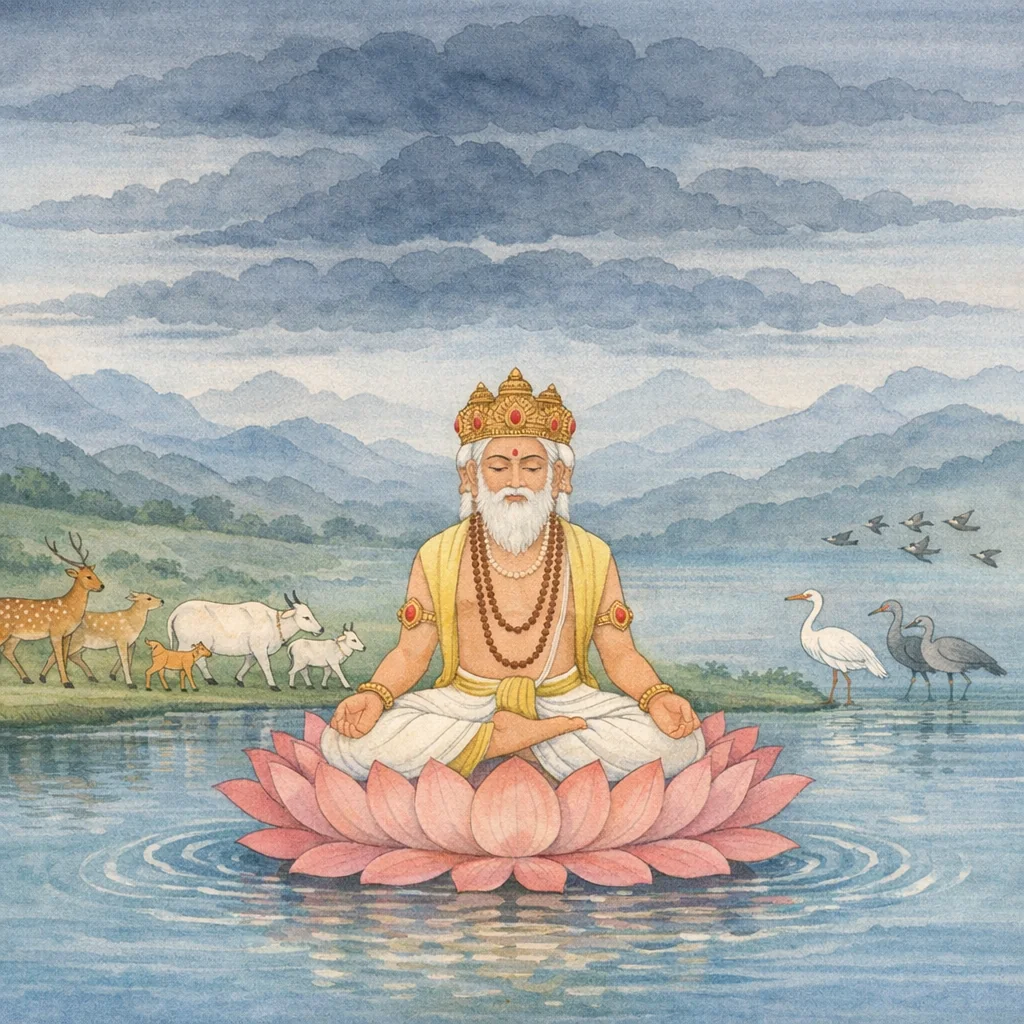
Adhyaya 5
सर्गभेदाः — अविद्या, स्रोतोभेदाः, नव सर्गाः, देवासुरादिसृष्टिः, वेद-यज्ञप्रादुर्भावः
Maitreya asks Parāśara to describe the universe’s earliest form, nature, and qualities at the dawn of creation. Parāśara explains that first arose a tamasic, non-discriminative manifestation marked by fivefold avidyā—tamas, moha, mahāmoha, tāmisra, and andha—called the ‘primary’ or immovable creation. Seeing it ineffective, Brahmā, moved by Śrī Viṣṇu’s divine impetus, brings forth successive srotas: tiryak-srotas (animals, tamas-heavy), ūrdhva-srotas (devas, sāttvika and radiant), and arvāk-srotas (humans, rajas-dominant with tamas, sorrowful yet capable of sādhana). He then classifies creation as prākṛta and vaikṛta, culminating in Prajāpati’s nine sargas. Parāśara further recounts the rise of asuras, devas, pitṛs, humans, and of night, day, twilight, and moonlight as Brahmā’s guṇa-based ‘bodies,’ followed by yakṣas, rākṣasas, serpents, piśācas, gandharvas, birds, animals, and plants. He concludes by affirming karmic continuity across cycles, the establishment of nāma-rūpa and duties from Vedic sound, and repeated kalpa-by-kalpa re-creation under the lordship of Śrī Viṣṇu.
Shlokas
Verse 1
यथा ससर्ज देवो ऽसौ देवर्षिपितृदानवान् मनुष्यतिर्यग्वृक्षादीन् भूव्योमसलिलौकसः
Now hear how that very Lord brought forth creation: the gods, the divine seer-sages, the Fathers (Pitṛs) and the Dānavas; and also humans, animals, and trees—indeed all who dwell upon the earth, in the heavens, and in the waters.
Verse 2
यद्गुणं यत्स्वभावं च यद्रूपं च जगद् द्विज सर्गादौ सृष्टवान् ब्रह्मा तन् ममाचक्ष्व विस्तरात्
O twice-born sage, tell me in full detail: what were the qualities, the intrinsic nature, and the form of that universe which Brahmā brought forth at the very beginning of creation? Explain it to me expansively.
Verse 3
मैत्रेय कथयाम्य् एष शृणुष्व सुसमाहितः यथा ससर्ज देवो ऽसौ देवादीन् अखिलान् विभुः
O Maitreya, I shall now declare it—listen with steady, collected attention—how that Divine Lord, the all-pervading Sovereign, brought forth the entire order of beings, beginning with the gods.
Verse 4
सृष्टिं चिन्तयतस् तस्य कल्पादिषु यथा पुरा अबुद्धिपूर्वकः सर्गः प्रादुर्भूतस् तमोमयः
As he contemplated creation—just as in former ages at the beginnings of kalpas—there manifested a first emanation, born without clear discriminative intelligence, a creation steeped in darkness (tamas).
Verse 5
तमो मोहो महामोहस् तामिस्रो ह्य् अन्धसंज्ञितः अविद्या पञ्चपर्वैषा प्रादुर्भूता महात्मनः
From that great-souled source there arose Ignorance (avidyā) with five joints: darkness (tamas), delusion (moha), great delusion (mahāmoha), blinding gloom (tāmisra), and that which is called sheer blindness (andha).
Verse 6
पञ्चधावस्थितः सर्गो ध्यायतो ऽप्रतिबोधवान् बहिर् अन्तश् चाप्रकाशः संवृतात्मा नगात्मकः
Creation remained set in a fivefold state—though, as it were, contemplated, it was yet unawakened; without light outwardly or inwardly, its essence veiled, inert and unmoving like a mountain.
Verse 7
मुख्या नगा यतश् चोक्ता मुख्यसर्गस् ततस् त्व् अयम्
Since the foremost mountains have been declared, this is therefore called the “primary creation”—the principal ordering of the world.
Verse 8
तं दृष्ट्वासाधकं सर्गम् अमन्यद् अपरं पुनः
Beholding that creation to be ineffectual—unable to fulfill its intended end—he again conceived another mode of emanation.
Verse 9
तस्याभिध्यायतः सर्गं तिर्यक्स्रोतो ऽभ्यवर्तत यस्मात् तिर्यक्प्रवृत्तः स तिर्यक्स्रोतस् ततः स्मृतः
As he contemplated the act of emanation, the current of creation called “tiryak-srotas” came forth. And because it proceeds in a lateral (horizontal) course, it is therefore remembered by the name “tiryak-srotas.”
Verse 10
पश्वादयस् ते विख्यातास् तमःप्राया ह्य् अवेदिनः उत्पथग्राहिणश् चैव ते ऽज्ञाने ज्ञानमानिनः
Such beings—known from beasts onward—are dominated by darkness (tamas) and lack true discernment. They seize the wrong path and, abiding in ignorance, imagine themselves to be wise.
Verse 11
अहंकृता अहंमाना अष्टाविंशद्वधात्मकाः अन्तःप्रकाशास् ते सर्वे आवृताश् च परस्परम्
Ego-making and ego-sense—together forming the twenty-eight principles—are each luminous within; yet all are mutually veiled, each in turn covering the other.
Verse 12
तम् अप्य् असाधकं मत्वा ध्यायतो ऽन्यस् ततो ऽभवत् ऊर्ध्वस्रोतस् तृतीयस् तु सात्त्विकोर्ध्वम् अवर्तत
Deeming even that state unfit for the intended attainment, as he continued to contemplate another condition arose thereafter. The third, called ‘ūrdhvasrotas’ (upward-flowing), sāttvika in nature, moved upward toward the higher order of being.
Verse 13
ते सुखप्रीतिबहुला बहिर् अन्तश् च नावृताः प्रकाशा बहिर् अन्तश् च ऊर्ध्वस्रोतोद्भवाः स्मृताः
They abound in happiness and inward delight; unobstructed, unveiled both outwardly and within. Luminous in outer and inner being, they are remembered as born of the upward-flowing current (ūrdhvasrotas).
Verse 14
तुष्ट्यात्मकस् तृतीयस् तु देवसर्गस् तु स स्मृतः तस्मिन् सर्गे ऽभवत् प्रीतिर् निष्पन्ने ब्रह्मणस् तथा
The third creation is remembered as the Deva-sarga, whose very nature is tuṣṭi—contented fulfillment. When that creation was completed, prīti, a settled delight, likewise arose within Brahmā.
Verse 15
ततो ऽन्यं स तदा दध्यौ साधकं सर्गम् उत्तमम् असाधकांस् तु ताञ् ज्ञात्वा मुख्यसर्गादिसंभवान्
Then, knowing those earlier emanations—arising from the primary creation and its first stages—to be incapable of fulfilling the purpose, he contemplated another, superior creation: a ‘sādhaka’ sarga, truly able to accomplish the cosmic aim.
Verse 16
तथाभिध्यायतस् तस्य सत्याभिध्यायिनस् ततः प्रादुर्भूतस् तदाव्यक्ताद् अर्वाक्स्रोतस् तु साधकः
As He contemplated—His contemplation unfailingly true—there manifested from the Unmanifest (avyakta) the ‘arvāksrotas’, the downward-flowing current: the operative principle that sets embodied creation into motion.
Verse 17
यस्माद् अर्वाग् व्यवर्तन्त ततो ऽर्वाक्स्रोतसस् तु ते ते च प्रकाशबहुलास् तमोउद्रिक्ता रजोऽधिकाः
From that source they turned downward; therefore they are called the ‘arvāksrotas’, the downward-flowing streams of creation. In them light is abundant, yet darkness rises strongly and rajas predominates; their nature is mixed—driven by rajas and veiled by tamas.
Verse 18
तस्मात् ते दुःखबहुला भूयो भूयश् च कारिणः प्रकाशा बहिर् अन्तश् च मनुष्याः साधकास् तु ते
Therefore they are laden with sorrow, again and again driven into fresh rounds of action. Outwardly and inwardly they seem bright, yet they remain human; still, they are indeed sādhakas—practitioners who press onward in disciplined effort.
Verse 19
इत्य् एते कथिताः सर्गाः षड् अत्र मुनिसत्तम प्रथमो महतः सर्गो विज्ञेयो ब्रह्मणस् तु सः
Thus, O best of sages, the six kinds of creation have been declared here. Know that the first among them is the creation of Mahat—indeed, it is the creation pertaining to Brahman, the Supreme Reality.
Verse 20
तन्मात्राणां द्वितीयश् च भूतसर्गस् तु स स्मृतः वैकारिकस् तृतीयस् तु सर्ग ऐन्द्रियकः स्मृतः
The second creation is declared to be that of the subtle elements (tanmātras). Next is remembered the bhūtasarga, the creation of the gross elemental beings. The third is known as the vaikārika creation, also called the aindriyaka sarga—the arising of the senses.
Verse 21
इत्य् एष प्राकृतः सर्गः संभूतो बुद्धिपूर्वकः मुख्यसर्गश् चतुर्थस् तु मुख्या वै स्थावराः स्मृताः
Thus the Prākṛta (material) creation arises in due order, with intelligence going before it. And among the principal creations, the fourth is declared foremost—the immovable beings (sthāvara), the fixed orders of life, are remembered as primary.
Verse 22
पञ्चमस् तु च यः प्रोक्तस् तैर्यग्योन्यः स उच्यते ततोर्ध्वस्रोतसां षष्ठो देवसर्गस् तु स स्मृतः
The fifth creation is declared to be the tairyag-yoni—the birth of beings that move horizontally, the animal orders. Above that is remembered the sixth: the creation of those whose current rises upward, the gods—the deva-sarga.
Verse 23
ततो ऽर्वाक्स्रोतसां सर्गः सप्तमः स तु मानुषः
Thereafter comes the creation of those whose current flows downward; this is the seventh creation, the human order.
Verse 24
अष्टमो ऽनुग्रहः सर्गः सात्त्विकस् तामसश् च सः पञ्चैते वैकृताः सर्गाः प्राकृतास् तु त्रयः स्मृताः
The eighth creation is called Anugraha—grace and guidance—appearing in both sāttvika and tāmasa modes. These five are known as the vaikṛta (derivative) creations, while the prākṛta (primordial) creations are remembered as three.
Verse 25
प्राकृतो वैकृतश् चैव कौमारो नवमः स्मृतः इत्य् एते वै समाख्याता नव सर्गाः प्रजापतेः
The Prākṛta creation and the Vaikṛta creation, and the Kumāra creation remembered as the ninth—thus are declared the nine creations of Prajāpati, Lord of progeny.
Verse 26
प्राकृता वैकृताश् चैव जगतो मूलहेतवः सृजतो जगदीशस्य किम् अन्यच् छ्रोतुम् इच्छसि
The primal (prakṛta) and derivative (vaikṛta) causes are indeed the root-causes of the universe, set in motion by the Lord of the cosmos as He creates. What else do you wish to hear?
Verse 27
संक्षेपात् कथितः सर्गो देवादीनां मुने त्वया विस्तराच् छ्रोतुम् इच्छामि त्वत्तो मुनिवरोत्तम
O sage, you have told in brief of the creation of the gods and the rest; yet I long to hear it in full detail from you, O best among ascetics.
Verse 28
कर्मभिर् भाविताः पूर्वैः कुशलाकुशलैस् तु ताः ख्यात्या तया ह्य् अनिर्मुक्ताः संहारे ऽप्य् उपसंहृताः
Conditioned by former deeds, wholesome and unwholesome, beings remain bound to that acquired disposition; not released from it, they are gathered up even at the time of dissolution.
Verse 29
स्थावरान्ताः सुराद्यास् तु प्रजा ब्रह्मंश् चतुर्विधाः ब्रह्मणः कुर्वतः सृष्टिं जज्ञिरे मानसास् तु ताः
O Brahmin, these progeny—from the gods down to the immovable—are fourfold. As Brahmā wrought creation, they first arose as mind-born (mānasa) emanations.
Verse 30
ततो देवासुरपितॄन् मनुष्यांश् च चतुष्टयम् सिसृक्षुर् अम्भांस्य् एतानि स्वम् आत्मानम् अयूयुजत्
Then, desiring to bring forth the fourfold order—gods, asuras, the ancestral fathers (pitṛs), and humans—he united these waters with his own Self, so that creation might proceed.
Verse 31
युक्तात्मनस् तमोमात्रा उद्रिक्ताभूत् प्रजापतेः सिसृक्षोर् जघनात् पूर्वम् असुरा जज्ञिरे ततः
When Prajāpati, disciplined in mind and intent on creation, found the element of darkness (tamas) rising to predominance, then from the hinder part of that Creator the Asuras were born first.
Verse 32
उत्ससर्ज ततस् तां तु तमोमात्रात्मिकां तनुम् सा तु त्यक्ता ततस् तेन मैत्रेयाभूद् विभावरी
Then he emitted that body whose very essence was darkness (tamas). When he cast it off, O Maitreya, that discarded form became the Night—Vibhāvarī.
Verse 33
सिसृक्षुर् अन्यदेहस्थः प्रीतिम् आप ततः सुराः सत्त्वोद्रिक्ताः समुद्भूता मुखतो ब्रह्मणो द्विज
Then, desiring to create while established in another body, Brahmā attained satisfaction; and from his mouth, O twice-born, arose the gods, in whom sattva predominated.
Verse 34
त्यक्ता सापि तनुस् तेन सत्त्वप्रायम् अभूद् दिनम् ततो हि बलिनो रात्राव् असुरा देवता दिवा
When that body, too, was cast off by him, the day became predominantly sāttvika. From then on the Asuras were powerful by night, while the Devas prevailed by day.
Verse 35
सत्त्वमात्रात्मिकाम् एव ततो ऽन्यां जगृहे तनुम् पितृवन् मन्यमानस्य पितरस् तस्य जज्ञिरे
Thereafter he assumed yet another body, constituted purely of sattva. And when he regarded himself in the manner of a father, from him the Pitṛs—the ancestral Fathers—were born.
Verse 36
उत्ससर्ज पितॄन् सृष्ट्वा ततस् ताम् अपि स प्रभुः सा चोत्सृष्टाभवत् संध्या दिननक्तान्तरस्थिता
Having first brought forth the Pitṛs, the Sovereign Lord then released her as well; and she, once emanated, became Sandhyā—the twilight abiding at the juncture of day and night.
Verse 37
रजोमात्रात्मिकाम् अन्यां जगृहे स तनुं ततः रजोमात्रोत्कटा जाता मनुष्या द्विजसत्तम
Then he assumed yet another body, constituted solely of rajas. From that rajas-dominant embodiment, O best of the twice-born, human beings came into manifestation—driven by activity and restless striving.
Verse 38
ताम् अप्य् आशु स तत्याज तनुं सद्यः प्रजापतिः ज्योत्स्ना समभवत् सापि प्राक्संध्या याभिधीयते
Even that form, too, Prajāpati swiftly cast off; and from it arose jyotsnā, the moonlight. That radiance is also spoken of as Prāk-sandhyā—the earlier twilight before dawn.
Verse 39
ज्योत्स्नागमे तु बलिनो मनुष्याः पितरस् तथा मैत्रेय संध्यासमये तस्माद् एते भवन्ति वै
When moonlight arrives, human beings become vigorous, and so too do the Pitṛs. Therefore, O Maitreya, at the time of sandhyā these presences are indeed especially manifest.
Verse 40
ज्योत्स्ना रात्र्यहनी संध्या चत्वार्य् एतानि वै विभोः ब्रह्मणस् तु शरीराणि त्रिगुणोपाश्रयाणि तु
Moonlight, night, day, and twilight—these four, O mighty one, are indeed the bodies (manifest forms) of Brahmā; and they rest upon the three guṇas, being constituted through their interplay.
Verse 41
रजोमात्रात्मिकाम् एव ततो ऽन्यां जगृहे तनुम् ततः क्षुद् ब्रह्मणो जाता जज्ञे कोपस् तया ततः
Then Brahmā assumed yet another form, made solely of rajas. From it arose Hunger, and from that Hunger, in turn, Wrath was born.
Verse 42
क्षुत्क्षामान् अन्धकारे ऽथ सो ऽसृजद् भगवान् प्रभुः विरूपाः श्मश्रुला जातास् ते ऽभ्यधावन्त तं प्रभुम्
Then, from the principle of darkness (tamas), the Blessed Lord, sovereign over all, brought forth beings tormented by hunger and thirst. Misshapen and bearded as they arose, they rushed upon that very Lord.
Verse 43
मैवं भो रक्ष्यताम् एष यैर् उक्तं राक्षसास् तु ते ऊचुः खादाम इत्य् अन्ये ये ते यक्षास् तु जक्षणात्
“Not so, sirs—let him be protected!” Those who spoke thus were called Rākṣasas. But others cried, “Let us eat him!” and those who hungered to devour were remembered as Yakṣas.
Verse 44
अप्रियान् अथ तान् दृष्ट्वा केशाः शीर्यन्त वेधसः हीनाश् च शिरसो भूयः समारोहन्त तच्छिरः
But on seeing those unwelcome forms, the Creator (Vedhas) found his hairs falling away; yet the hairs that had dropped from his head rose again and rejoined that very head.
Verse 45
सर्पणात् ते ऽभवन् सर्पा हीनत्वाद् अहयः स्मृताः ततः क्रुद्धो जगत्स्रष्टा क्रोधात्मानो विनिर्ममे वर्णेन कपिशेनोग्रा भूतास् ते पिशिताशनाः
Because they moved by creeping, they came to be known as serpents; and because they were diminished and fallen, they were remembered as ‘ahayaḥ’. Then the Creator of the worlds, stirred to wrath, brought forth beings made of anger itself—fierce, tawny in hue—those flesh-eating spirits.
Verse 46
ध्यायतो ऽङ्गात् समुद्भूता गन्धर्वास् तस्य तत्क्षणात् पिबन्तो जज्ञिरे वाचं गन्धर्वास् तेन ते द्विज
O twice-born, as he contemplated, the Gandharvas sprang forth at that very instant from his limbs; and because they were born as drinkers of speech—imbibing sound itself—they are therefore called “Gandharvas.”
Verse 47
एतानि सृष्ट्वा भगवान् ब्रह्मा तच्छक्तिचोदितः ततः स्वच्छन्दतो ऽन्यानि वयांसि वयसो ऽसृजत्
Having thus brought these into being, the Blessed Brahmā—impelled by that divine power—then, of his own accord, generated other classes of birds, each according to its kind and stage of life.
Verse 48
अवयो वक्षसश् चक्रे मुखतो ऽजाः स सृष्टवान् सृष्टवान् उदराद् गाश् च पार्श्वाभ्यां च प्रजापतिः
That Prajāpati brought forth sheep from his chest; from his mouth he manifested goats. From his belly he produced cows, and from his flanks as well he set diverse creatures into being.
Verse 49
पद्भ्यां चाश्वान् समातङ्गान् रासभान् गवयान् मृगान् उष्ट्रान् अश्वतरांश् चैव न्यङ्कून् अन्याश् च जातयः
And from the feet arose the swift horse; the mighty elephants; the donkey; the gavaya (wild ox); the deer and other beasts of the forest; the camel; the mule; the nyaṅku; and many other kinds besides.
Verse 50
ओषध्यः फलमूलिन्यो रोमभ्यस् तस्य जज्ञिरे त्रेतायुगमुखे ब्रह्मा कल्पस्यादौ द्विजोत्तम सृष्ट्वा पश्वोषधीः सम्यग् युयोज स तदाध्वरे
From his very hairs were born the plants—those bearing fruits and those yielding roots. At the dawn of the Tretā age, O best of twice-born, Brahmā, at the beginning of the kalpa, having duly brought forth beasts and herbs, properly yoked them to that sacred rite of sacrifice, establishing the ordered course of the yajña.
Verse 51
गौर् अजः पुरुषो मेषा अश्वाश्वतरगर्दभाः एतान् ग्राम्यान् पशून् आहुर् आरण्यांश् च निबोध मे
The cow, the goat, man, the sheep, the horse, the mule, and the donkey—these are proclaimed as domestic animals; now learn from me also of those that dwell in the wild.
Verse 52
श्वापदो द्विखुरो हस्ती वानरः पक्षिपञ्चमाः औदकाः पशवः षष्ठाः सप्तमास् तु सरीसृपाः
Among embodied orders of life, the carnivores are one; the cloven-hoofed are another; the elephant-kind another; and the monkey-kind yet another. Birds are reckoned as the fifth, aquatic creatures as the sixth, and the crawling, creeping beings as the seventh—thus the Lord’s ordered creation shines in many forms.
Verse 53
गायत्रं च ऋचश् चैव त्रिवृत्साम रथन्तरम् अग्निष्टोमं च यज्ञानां निर्ममे प्रथमान् मुखात्
From that primal mouth, the Lord first fashioned the Gāyatrī metre and the Ṛk-verses; He brought forth the Trivṛt Sāman and the Rathantara chant, and He ordained the Agniṣṭoma—foremost among sacrifices—so that the order of yajña might stand at the beginning of creation.
Verse 54
यजूंषि त्रैष्टुभं छन्दः स्तोमं पञ्चदशं तथा बृहत् साम तथोक्थं च दक्षिणाद् असृजन् मुखात्
From the right side of that cosmic mouth there issued the Yajus hymns, the Triṣṭubh metre, the fifteenfold stoma, the Bṛhat Sāman, and the Uktha—thus the forms of Vedic sound and sacrificial order arose as the Supreme’s manifested speech.
Verse 55
सामानि जगतीछन्दः स्तोमं सप्तदशं तथा वैरूपम् अतिरात्रं च पश्चिमाद् असृजन् मुखात्
From the western face, He brought forth the Sāman-chants, the Jagatī metre, the seventeenfold stoma, and also the Vairūpa and Atirātra rites—thus did sacred sound and sacrificial order arise from the Supreme Person’s own mouth.
Verse 56
एकविंशम् अथर्वाणम् आप्तोर्यामाणम् एव च अनुष्टुभं स वैराजम् उत्तराद् असृजन् मुखात्
From his northern face he brought forth the twenty-first sacred lore, the Atharva-Veda, together with the Āptoryāma rite; and he manifested the Anuṣṭubh meter and the Vairāja cosmic order as well.
Verse 57
उच्चावचानि भूतानि गात्रेभ्यस् तस्य जज्ञिरे देवासुरपितॄन् सृष्ट्वा मनुष्यांश् च प्रजापतिः
From his very limbs arose beings of many kinds, higher and lower. Having created the gods, the asuras, and the Pitṛs, Prajāpati also brought forth humankind.
Verse 58
ततः पुनः ससर्जादौ स कल्पस्य पितामहः यक्षान् पिशाचान् गन्धर्वान् तथैवाप्सरसां गणान्
Then again, at the dawn of creation, that Grandfather of the age (Brahmā) brought forth in due order the Yakṣas, the Piśācas, the Gandharvas, and likewise the hosts of the Apsarases.
Verse 59
नरकिंनररक्षांसि वयःपशुमृगोरगान् अव्ययं च व्ययं चैव यद् इदं स्थाणुजङ्गमम्
Hell-beings, kinnara, and rākṣasas; birds, cattle, wild beasts, and serpents—whatever is here, unmoving and moving, imperishable and perishable—all of it is encompassed within Him.
Verse 60
तत् ससर्ज तदा ब्रह्मा भगवान् आदिकृद् विभुः तेषां ये यानि कर्माणि प्राक्सृष्ट्यां प्रतिपेदिरे तान्य् एव प्रतिपद्यन्ते सृज्यमानाः पुनः पुनः
Then Brahmā—the Blessed Lord, primal maker and all-pervading ruler—brought them forth. Whatever karmas they had assumed in the former creation, those same tendencies they take up again, being created time after time.
Verse 61
हिंस्राहिंस्रे मृदुक्रूरे धर्माधर्माव् ऋतानृते तद्भाविताः प्रपद्यन्ते तस्मात् तत् तस्य रोचते
Whether in violence or non-violence, in gentleness or cruelty, in dharma or adharma, in truth or falsehood—beings turn toward the very mode by which their inner nature has been shaped; therefore what accords with their formed disposition becomes pleasing to them.
Verse 62
इन्द्रियार्थेषु भूतेषु शरीरेषु च स प्रभुः नानात्वं विनियोगांश् च धातैवं व्यसृजत् स्वयम्
That Supreme Lord, Himself the Ordainer, brought forth diversity within the objects of the senses, within the elements, and within embodied forms; and He Himself assigned their distinct applications and functions, establishing each in its proper place.
Verse 63
नामरूपं च भूतानां कृत्यानां च प्रपञ्चनम् वेदशब्देभ्य एवादौ देवादीनां चकार सः
From the very beginning, out of the Vedic sounds themselves, He brought forth the differentiation of name and form for all beings, the manifold ordering of their functions, and the establishment of the gods and the rest.
Verse 64
ऋषीणां नामधेयानि यथा वेदश्रुतानि वै यथा नियोगयोग्यानि सर्वेषाम् अपि सो ऽकरोत्
He arranged the sages’ names exactly as they are heard in the Veda, and He assigned to all of them their proper sacred appointments, each according to fitness for the commission.
Verse 65
यथर्तुष्व् ऋतुलिङ्गानि नानारूपाणि पर्यये दृश्यन्ते तानि तान्य् एव तथा भावा युगादिषु
Just as, in the succession of seasons, the distinctive signs of each season appear in many changing forms, so too the conditions of existence manifest again and again through the Yugas and the other divisions of time.
Verse 66
करोत्य् एवंविधां सृष्टिं कल्पादौ स पुनः पुनः सिसृक्षाशक्तियुक्तो ऽसौ सृज्यशक्तिप्रचोदितः
Thus, at the dawn of each kalpa, He again and again brings forth creation of this very kind—endowed with the will and power to create, and impelled by the potency that sets the created order in motion.
Frequently Asked Questions
The chapter lists five modes of ignorance: tamas (darkness), moha (delusion), mahāmoha (great delusion), tāmisra (blinding gloom), and andha (sheer blindness). They characterize the earliest, obstructed phase of manifestation.
They are ‘currents’ of manifestation: tiryak-srotas moves laterally and corresponds to animal orders dominated by tamas; ūrdhvasrotas moves upward and corresponds to devas marked by sattva and inner/outer luminosity; arvāksrotas turns downward and corresponds to humans, rajas-led with tamas admixture—capable of disciplined striving (sādhana) amid sorrow and action.
It states that differentiation of nāma-rūpa and functions is established from veda-śabda, and it enumerates meters, chants, and key sacrifices as emanating from the cosmic mouth—presenting ritual sound-order as integral to cosmogenesis.