Adhyaya 2
वासुदेवस्वरूपनिरूपणं—सर्गक्रमश्च (Vāsudeva’s Nature and the Ordered Process of Creation)
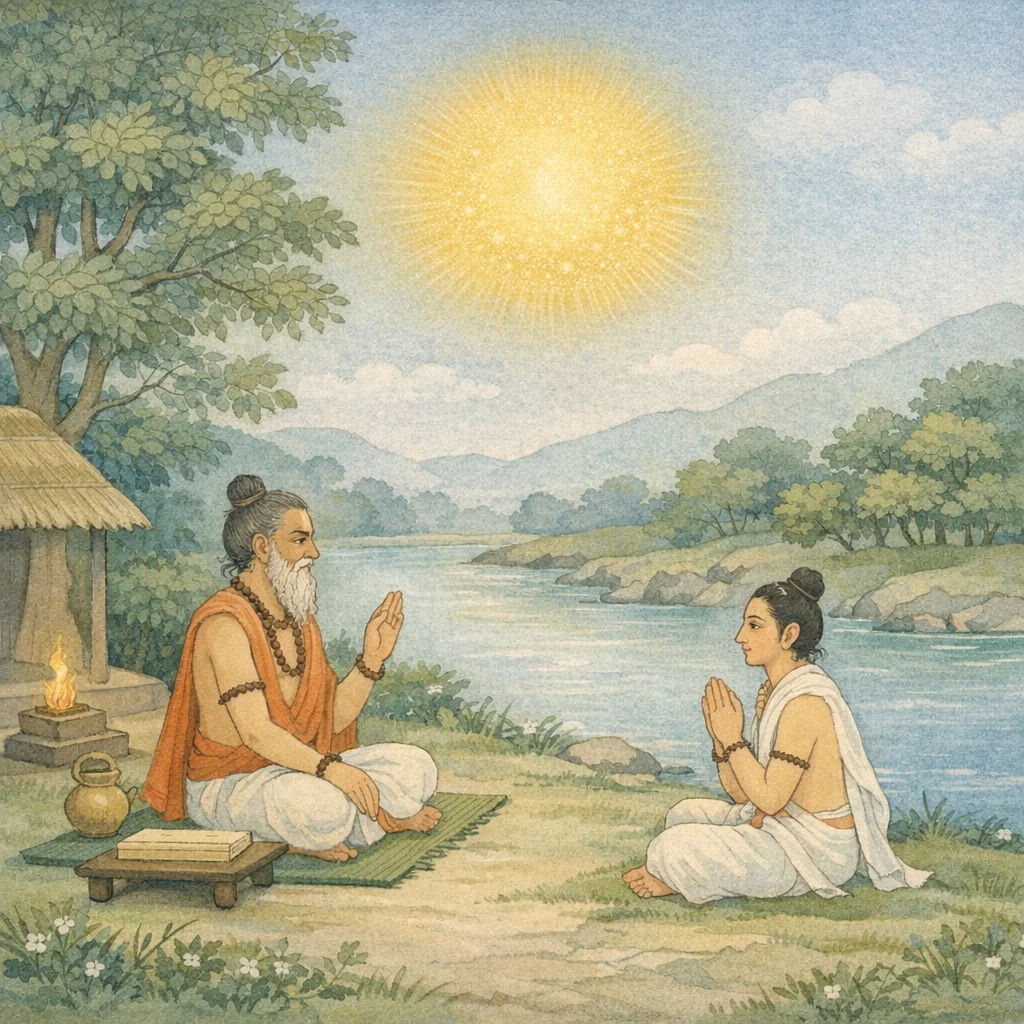
Parāśara begins with reverent invocations to Viṣṇu as the pure, eternal Paramātman, the power behind creation, preservation, and dissolution, praised also as Hiraṇyagarbha, Hari, and Śaṅkara—names unified in Vāsudeva. He then grounds his teaching in a received lineage: from Brahmā to the sages, to Purukutsa, to Sārasvata, and finally to himself. Viṣṇu is taught as beyond all attributes, describable only as “He ever is,” yet present as the manifest and unmanifest, as Puruṣa and as Kāla. The chapter outlines a Sāṅkhya-like cosmogenesis: from Pradhāna arises Mahat; from Mahat, threefold Ahaṃkāra; from the tāmasa stream come tanmātras and the five bhūtas (ākāśa to pṛthivī) with their qualities; from the rājasa and sāttvika streams arise the senses, their presiding deities, and manas as the eleventh. Under Puruṣa’s presiding, the elements combine into the Brahmāṇḍa, enclosed by seven coverings. Viṣṇu assumes rajas as Brahmā for creation, sattva for preservation, and tamas as Rudra for dissolution, while remaining the one Janārdana in all three functions.
Shlokas
Verse 1
अविकाराय शुद्धाय नित्याय परमात्मने सदैकरूपरूपाय विष्णवे सर्वजिष्णवे
Salutation to Viṣṇu—unchanging, perfectly pure, eternal; the Supreme Self—ever of one undivided essence and form; the all-pervading Lord, victorious over all.
Verse 2
नमो हिरण्यगर्भाय हरये शंकराय च वासुदेवाय ताराय सर्गस्थित्यन्तकारिणे
Salutations to Hiraṇyagarbha; salutations to Hari; and also to Śaṅkara—indeed to Vāsudeva, the guiding Deliverer, who brings about creation, sustains the worlds, and, at the end, draws them back into Himself.
Verse 3
एकानेकस्वरूपाय स्थूलसूक्ष्मात्मने नमः अव्यक्तव्यक्तरूपाय विष्णवे मुक्तिहेतवे
Salutations to Viṣṇu—whose being is at once one and many; who is the Self of both the gross and the subtle; who appears as the unmanifest and as the manifest; and who stands as the very cause of liberation.
Verse 4
सर्गस्थितिविनाशानां जगतो यो जगन्मयः मूलभूतो नमस् तस्मै विष्णवे परमात्मने
Salutations to that Viṣṇu, the Supreme Self—who, pervading the universe as its very essence, stands as the primordial ground of this world’s creation, continuance, and dissolution.
Verse 5
आधारभूतं विश्वस्याप्य् अणीयांसम् अणीयसाम् प्रणम्य सर्वभूतस्थम् अच्युतं पुरुषोत्तमम्
Having bowed to Acyuta, the Supreme Person—foundation of the universe, subtler than the subtlest, abiding within all beings—I begin this sacred narration.
Verse 6
ज्ञानस्वरूपम् अत्यन्तनिर्मलं परमार्थतः तम् एवार्थस्वरूपेण भ्रान्तिदर्शनतः स्थितम्
In ultimate truth, He is pure consciousness itself—utterly stainless; yet, through the vision of delusion, that very One appears as though established in the form of objects.
Verse 7
विष्णुं ग्रसिष्णुं विश्वस्य स्थितिसर्गे तथा प्रभुम् प्रणम्य जगताम् ईशम् अजम् अक्षयम् अव्ययम्
Having bowed to Viṣṇu—He who reabsorbs all, sovereign Lord of the universe in preservation and creation—I offer homage to the Ruler of all worlds: the Unborn, the Imperishable, the Undiminishing, the Unchanging.
Verse 8
कथयामि यथापूर्वं दक्षाद्यैर् मुनिसत्तमैः पृष्टः प्रोवाच भगवान् अब्जयोनिः पितामहः
I shall recount it exactly as it was told before: when the foremost sages—beginning with Dakṣa—questioned him, the Blessed Grandfather, Brahmā the lotus-born, answered and declared it.
Verse 9
तैश् चोक्तं पुरुकुत्साय भूभुजे नर्मदातटे सारस्वताय तेनापि मम सारस्वतेन च
On the bank of the Narmadā, those sages spoke this to Purukutsa, ruler of the earth; he in turn declared it to Sārasvata, and through the Sārasvata lineage it was conveyed to me as well.
Verse 10
परः पराणां परमः परमात्मात्मसंस्थितः रूपवर्णादिनिर्देशविशेषणविवर्जितः
He is the Supreme beyond all the supreme—the highest of the high; the Paramātman abiding in His own Self. He is free from every limiting description and qualifying mark—beyond form, beyond colour, and beyond all definable attributes.
Verse 11
अपक्षयविनाशाभ्यां परिणामर्द्धिजन्मभिः वर्जितः शक्यते वक्तुं यः सदास्तीति केवलम्
That Supreme can be spoken of only in this single way—“He ever is”—for He is untouched by decline or destruction, and free from transformation, increase, or birth.
Verse 12
सर्वत्रासौ समस्तं च वसत्य् अत्रेति वै यतः ततः स वासुदेवेति विद्वद्भिः परिपठ्यते
Because He abides everywhere, and because the entirety of all that exists dwells in Him—therefore the wise recite and know Him as “Vāsudeva.”
Verse 13
तद् ब्रह्म परमं नित्यम् अजम् अक्षयम् अव्ययम् एकस्वरूपं च सदा हेयाभावाच् च निर्मलम्
That Supreme Brahman is eternal—unborn, imperishable, and undecaying; ever of one undivided nature, and, because no defect can belong to It, forever stainless and pure.
Verse 14
तद् एव सर्वम् एवैतद् व्यक्ताव्यक्तस्वरूपवत् तथा पुरुषरूपेण कालरूपेण च स्थितम्
That alone is all this—endowed with the nature of both the manifest and the unmanifest; and It abides also as the Person (Puruṣa) and as Time (Kāla).
Verse 15
परस्य ब्रह्मणो रूपं पुरुषः प्रथमं द्विज व्यक्ताव्यक्ते तथैवान्ये रूपे कालस् तथापरम्
O twice-born one, the first form of the Supreme Brahman is the Puruṣa, the Cosmic Person. He is likewise known as both the manifest and the unmanifest, and in yet another distinct form as Kāla, Time.
Verse 16
प्रधानपुरुषव्यक्तकालानां परमं हि यत् पश्यन्ति सूरयः शुद्धं तद् विष्णोः परमं पदम्
That pure Reality which the seers behold as the Supreme—higher than Pradhāna, Puruṣa, the manifest, and even Time—this indeed is the highest station of Viṣṇu.
Verse 17
प्रधानपुरुषव्यक्तकालास् तु प्रविभागशः रूपाणि स्थितिसर्गान्तव्यक्तिसद्भावहेतवः
Pradhāna, Puruṣa, the manifest world, and Kāla—distinguished by their respective functions—are operative principles that become the causes of preservation, creation, dissolution, the unmanifest state, and the very possibility of existence.
Verse 18
व्यक्तं विष्णुस् तथाव्यक्तं पुरुषः काल एव च क्रीडतो बालकस्येव चेष्टां तस्य निशामय
Know that Viṣṇu is both the manifest and the unmanifest; He is the Puruṣa, and He alone is Kāla, Time. Behold His activity—like the play of a child—spontaneous, sovereign, and effortless.
Verse 19
अव्यक्तं कारणं यत् तत् प्रधानम् ऋषिसत्तमैः प्रोच्यते प्रकृतिः सूक्ष्मा नित्या सदसदात्मिका
That causal principle which is unmanifest is declared by the best of sages to be Pradhāna—subtle, eternal Prakṛti, whose nature partakes of both being and non-being.
Verse 20
अक्षयं नान्यदाधारम् अमेयम् अजरं ध्रुवम् शब्दस्पर्शविहीनं तद् रूपादिभिर् असंहतम्
He is imperishable, supported by none other; immeasurable, unaging, and ever steadfast. Free from sound and touch, He is not compounded by form and the other sensory qualities.
Verse 21
त्रिगुणं तज् जगद्योनिर् अनादिप्रभवाव्ययम् तेनाग्रे सर्वम् एवासीद् व्याप्तं वै प्रलयाद् अनु
That Reality, constituted of the three guṇas and the womb of the universe, is beginningless, the source of all arising, and imperishable. By That, in the beginning after dissolution, everything existed, wholly pervaded.
Verse 22
वेदवादविदो विद्वन् नियता ब्रह्मवादिनः पठन्ति चैतम् एवार्थं प्रधानप्रतिपादकम्
O wise one, the learned interpreters of the Veda—disciplined exponents of Brahman—recite precisely this teaching, for it sets forth the meaning of Pradhāna, the primordial ground of manifestation.
Verse 23
नाहो न रात्रिर् न नभो न भूमिर् नासीत् तमो ज्योतिर् अभून् न चान्यत् श्रोत्रादिबुद्ध्यानुपलभ्यम् एकं प्राधानिकं ब्रह्म पुमांस् तदासीत्
Then there was neither day nor night, neither sky nor earth; neither darkness nor light—nor anything else besides. Only the One remained: the primal Brahman, the supreme Puruṣa, beyond the mind’s instruments such as hearing and the rest; that foundational Reality alone was.
Verse 24
विष्णोः स्वरूपात् परतो हि ते ऽन्ये रूपे प्रधानं पुरुषश् च विप्र तस्यैव ते ऽन्येन धृते वियुक्ते रूपान्तरं तद् द्विज कालसंज्ञम्
O brāhmaṇa, beyond the essential nature of Viṣṇu two other forms are spoken of: Pradhāna, primordial matter, and Puruṣa, the conscious principle. And there is yet another aspect of that same Reality: when upheld as a distinct, separate mode, O twice-born, that form is known as Time (Kāla).
Verse 25
प्रकृतौ च स्थितं व्यक्तम् अतीतप्रलये तु यत् तस्मात् प्राकृतसंज्ञो ऽयम् उच्यते प्रतिसंचरः
That manifest universe which, at dissolution, passes beyond differentiation and comes to rest in Prakṛti—therefore this re-absorption is called the “Prākṛta” (material) return.
Verse 26
अनादिर् भगवान् कालो नान्तो ऽस्य द्विज विद्यते अव्युच्छिन्नास् ततस् त्व् एते सर्गस्थित्यन्तसंयमाः
O twice-born, Time—revered as a divine power—is without beginning, and no end of it is known; therefore creation, continuance, dissolution, and restraint proceed without interruption.
Verse 27
गुणसाम्ये ततस् तस्मिन् पृथक् पुंसि व्यवस्थिते कालस्वरूपं तद् विष्णोर् मैत्रेय परिवर्तते
When the equilibrium of the guṇas is established and the Puruṣa stands apart in His own separateness—then, O Maitreya, that very Viṣṇu assumes the form of Time (Kāla).
Verse 28
ततस् तत् परमं ब्रह्म परमात्मा जगन्मयः सर्वगः सर्वभूतेशः सर्वात्मा परमेश्वरः
Therefore, That is the Supreme Brahman—the Supreme Self—pervading the entire universe; all-pervading, the Lord of all beings, the inner Self of all, the highest Sovereign.
Verse 29
प्रधानं पुरुषं चापि प्रविश्यात्मेच्छया हरिः क्षोभयाम् आस संप्राप्ते सर्गकाले व्ययाव्ययौ
When the time for creation arrived, Hari—by His own sovereign will—entered both Pradhāna and Puruṣa and stirred those two: the perishable and the imperishable.
Verse 30
यथा संनिधिमात्रेण गन्धः क्षोभाय जायते मनसो नोपकर्तृत्वात् तथासौ परमेश्वरः
Just as mere proximity to a fragrance can stir and agitate the mind—though it does not intend to serve the mind—so the Supreme Lord (Parameśvara) sets the universe in motion simply by His presence.
Verse 31
स एव क्षोभको ब्रह्मन् क्षोभ्यश् च पुरुषोत्तमः स संकोचविकासाभ्यां प्रधानत्वे ऽपि च स्थितः
O Brahmin, that very Puruṣottama is both the one who initiates the cosmic stirring and that which is stirred. Even while abiding as Pradhāna, He remains present through contraction and expansion, drawing the universe in and unfolding it again.
Verse 32
विकासाणुस्वरूपैश् च ब्रह्मरूपादिभिस् तथा व्यक्तस्वरूपश् च तथा विष्णुः सर्वेश्वरेश्वरः
Vishnu—Lord over even the lords—is present as the subtle principle behind expansion and atomic minuteness; present as Brahmā and the other cosmic forms; and present also as the fully manifest, perceptible reality.
Verse 33
गुणसाम्यात् ततस् तस्मात् क्षेत्रज्ञाधिष्ठितान् मुने गुणव्यञ्जनसंभूतिः सर्गकाले द्विजोत्तम
Then, O sage—when the guṇas come into equilibrium and thereafter are presided over by the kṣetrajña, the conscious Knower of the Field—there arises, at the time of creation, the manifestation and differentiation of the guṇas, O best of the twice-born.
Verse 34
प्रधानतत्त्वम् उद्भूतं महान्तं तत् समावृणोत् सात्त्विको राजसश् चैव तामसश् च त्रिधा महान् प्रधानतत्त्वेन समं त्वचा बीजम् इवावृतम्
When the Great Principle (Mahat) arose from Pradhāna, it was enveloped by that very Pradhāna. The Mahat is threefold—sāttvika, rājasa, and tāmasa—and, united with the primal substance, it lay covered over, like a seed sheathed within its skin.
Verse 35
वैकारिकस् तैजसश् च भूतादिश् चैव तामसः त्रिविधो ऽयम् अहंकारो महत्तत्त्वाद् अजायत
From Mahat-tattva arose Ahaṃkāra, threefold in nature: the sāttvika called Vaikārika, the rājasa called Taijasa, and the tāmasa termed Bhūtādi—the seed from which the elements proceed.
Verse 36
भूतेन्द्रियाणां हेतुः स त्रिगुणत्वान् महामुने यथा प्रधानेन महान् महता स तथावृतः
O great sage, being constituted of the three guṇas, he becomes the causal ground of the elements and the senses; and just as Mahat is veiled by Pradhāna, so too is he, in the same manner, enveloped by Mahat.
Verse 37
भूतादिस् तु विकुर्वाणः शब्दतन्मात्रकं ततः ससर्ज शब्दतन्मात्राद् आकाशं शब्दलक्षणम्
Then Bhūtādi, as it underwent transformation, brought forth the subtle essence of sound. From that very sound–tanmātra it produced ākāśa (ether), whose defining attribute is sound.
Verse 38
शब्दमात्रं तथाकाशं भूतादिः स समावृणोत् आकाशस् तु विकुर्वाणः स्पर्शमात्रं ससर्ज ह
Then Bhūtādi enveloped ākāśa together with its subtle essence—sound alone. And ākāśa, being transformed onward, brought forth the subtle essence of touch.
Verse 39
बलवान् अभवद् वायुस् तस्य स्पर्शो गुणो मतः आकाशं शब्दमात्रं तु स्पर्शमात्रं समावृणोत्
Then Vāyu became potent; its distinctive attribute is held to be touch. And Ākāśa, whose nature is sound alone, was enveloped by touch alone.
Verse 40
ततो वायुर् विकुर्वाणो रूपमात्रं ससर्ज ह ज्योतिर् उत्पद्यते वायोस् तद् रूपगुणम् उच्यते
Then Vāyu, undergoing transformation, brought forth only the subtle principle of form (rūpa-tanmātra). From that air arises tejas, light—declared to be the form-quality (rūpa-guṇa) associated with Vāyu.
Verse 41
स्पर्शमात्रस् ततो वायू रूपमात्रं समावृणोत् ज्योतिश् चापि विकुर्वाणं रसमात्रं ससर्ज ह
Then Vāyu, whose essence is touch alone, enveloped the subtle principle of form; and Jyotis (Fire), further transforming, brought forth the subtle principle of taste (rasa-tanmātra).
Verse 42
संभवन्ति ततो ऽम्भांसि रसाधाराणि तानि च रसमात्राणि चाम्भांसि रूपमात्रं समावृणोत्
Thereafter the Waters came into being, as the support of taste; and the Waters themselves are of the nature of taste alone (rasa-tanmātra). Then the mere principle of Form (rūpa-mātra) enveloped them.
Verse 43
विकुर्वाणानि चाम्भांसि गन्धमात्रं ससर्जिरे संघातो जायते तस्मात् तस्य गन्धो गुणो मतः
And the waters, undergoing transformation, brought forth only the subtle principle of smell (gandha-tanmātra). From that arises aggregation and compactness; therefore smell is held to be the defining quality of earth.
Verse 44
तस्मिंस् तस्मिंस् तु तन्मात्रा तेन तन्मात्रता स्मृता तन्मात्राण्य् अविशेषाणि अविशेषास् ततो हि ते
In each succeeding principle, the corresponding tanmātra is present; therefore it is said to bear the nature of that tanmātra. And those tanmātras are themselves undifferentiated (aviśeṣa), for from them arise the undifferentiated principles.
Verse 45
न शान्ता नापि घोरास् ते न मूढाश् चाविशेषिणः भूततन्मात्रसर्गो ऽयम् अहंकारात् तु तामसात्
From the tamasic ahaṃkāra arises this distinct evolution—the manifestation of the tanmātras and the bhūtas. Its products are neither serene and luminous nor fiercely terrible; nor are they dull and indiscriminate, for their nature is shaped by the tamas from which they proceed.
Verse 46
तैजसानीन्द्रियाण्य् आहुर् देवा वैकारिका दश एकादशं मनश् चात्र देवा वैकारिकाः स्मृताः
The sense-faculties are declared to be taijasa; and their presiding deities are remembered as the ten vaikārika (sāttvika) gods—while, as the eleventh, the mind (manas) too is counted here among the vaikārika.
Verse 47
त्वक् चक्षुर् नासिका जिह्वा श्रोत्रम् अत्र च पञ्चमम् शब्दादीनाम् अवाप्त्यर्थं बुद्धियुक्तानि वै द्विज
Skin, eyes, nose, tongue—and here as the fifth, the ear: O twice-born, these are the instruments of knowing. Guided by buddhi, they are fashioned to apprehend sound and the other sense-objects.
Verse 48
पायूपस्थौ करौ पादौ वाक् च मैत्रेय पञ्चमी विसर्गशिल्पगत्युक्ति कर्म तेषां च कथ्यते
O Maitreya, the anus and the generative organ, the hands and the feet, and speech—these are the five organs of action. Their functions are said to be, in order: excretion, procreation, craft and work, movement, and utterance.
Verse 49
आकाशवायुतेजांसि सलिलं पृथिवी तथा शब्दादिभिर् गुणैर् ब्रह्मन् संयुक्तान्य् उत्तरोत्तरैः
O Brahmin, ether, wind, fire, water, and earth are each endowed with qualities beginning with sound; and in the successive elements these qualities increase step by step, each later one bearing those of the former and more besides.
Verse 50
शान्ता घोराश् च मूढाश् च विशेषास् तेन ते स्मृताः
Thus, in accord with the principle of the guṇas, they are remembered as distinct kinds: the serene, the fierce, and the deluded.
Verse 51
नानावीर्याः पृथग्भूतास् ततस् ते संहतिं विना नाशक्नुवन् प्रजाः स्रष्टुम् असमागम्य कृत्स्नशः
Though endowed with diverse powers, remaining separate, they were therefore unable—without uniting together—to bring forth living beings in their fullness.
Verse 52
समेत्यान्योन्यसंयोगं परस्परसमाश्रयाः एकसंघातलक्ष्याश् च संप्राप्यैक्यम् अशेषतः
Coming together in mutual conjunction, each resting upon the other, they appear as a single aggregate and, without remainder, attain complete unity.
Verse 53
पुरुषाधिष्ठितत्वाच् च अव्यक्तानुग्रहेण च महदाद्या विशेषान्ता ह्य् अण्डम् उत्पादयन्ति ते
Presided over by Puruṣa, and sanctioned by the Unmanifest (Avyakta), those principles—from Mahat to the particularized elements—bring forth the cosmic egg (Brahmāṇḍa).
Verse 54
तत् क्रमेण विवृद्धं तु जलबुद्बुदवत् समम् भूतेभ्यो ऽण्डं महाबुद्धे बृहत् तद् उदकेशयम् प्राकृतं ब्रह्मरूपस्य विष्णोः स्थानम् अनुत्तमम्
Then it grew gradually and spread evenly, like a bubble upon the waters. O great-minded one, from the elements arose the vast cosmic egg, resting upon the waters—a primordial (prākṛta) formation. This is the unsurpassed station of Viṣṇu, who, as Brahmā, assumes the form of creation.
Verse 55
तत्राव्यक्तस्वरूपो ऽसौ व्यक्तरूपी जगत्पतिः विष्णुर् ब्रह्मस्वरूपेण स्वयम् एव व्यवस्थितः
There the Lord of the universe—Vishnu—abides by Himself as Brahman: unmanifest in His own essential nature, yet appearing in manifest form as the ruler and support of the world.
Verse 56
मेरुर् उल्बम् अभूत् तस्य जरायुश् च महीधराः गर्भोदकं समुद्राश् च तस्यासन् सुमहात्मनः
For that Great-Souled One’s cosmic embryo, Meru became its outer membrane; the mountain-ranges were its enclosing sheath; and the oceans were the waters within the womb—thus the universe took on its ordered form.
Verse 57
साद्रिद्वीपसमुद्राश् च सज्योतिर् लोकसंग्रहः तस्मिन्न् अण्डे ऽभवद् विप्र सदेवासुरमानुषः
Within that cosmic Egg, O brahmin, the whole ordered assemblage of worlds came into being—complete with mountains, continents, and oceans, and illumined by the heavenly lights—together with gods, asuras, and humankind.
Verse 58
वारिवह्न्यनिलाकाशैस् ततो भूतादिना बहिः वृतं दशगुणैर् अण्डं भूतादिर् महता तथा
Then the cosmic Egg was enclosed outwardly by water, fire, wind, and ether; and beyond these it was encircled by Bhūtādi (the principle of the elements), each sheath tenfold greater than the one within—Bhūtādi itself being likewise encompassed by Mahat (the Great Principle).
Verse 59
अव्यक्तेनावृतो ब्रह्मंस् तैः सर्वैः सहितो महान् एभिर् आवरणैर् अण्डं सप्तभिः प्राकृतैर् वृतम् नालिकेरफलस्यान्तर् बीजं बाह्यदलैर् इव
O Brahmin, the Great (Cosmic Principle) together with all those constituents lies veiled by the Unmanifest. In this way the cosmic egg is enclosed by seven material coverings—just as, within a coconut, the seed is wrapped round by its outer layers.
Verse 60
जुषन् रजोगुणं तत्र स्वयं विश्वेश्वरो हरिः ब्रह्मा भूत्वास्य जगतो विसृष्टौ संप्रवर्तते
There, Hari Himself—the Sovereign Lord of the universe—embraces the guna of rajas; and, becoming Brahmā, He sets in motion the emanation and ordered projection of this world.
Verse 61
सृष्टं च पात्य् अनुयुगं यावत् कल्पविकल्पना सत्त्वभृद् भगवान् विष्णुर् अप्रमेयपराक्रमः
Having brought forth the created order, the Blessed Lord Vishnu—upholding all beings, of immeasurable might—preserves it age after age for as long as the cosmic arrangement of a kalpa endures.
Verse 62
तमोउद्रेकी च कल्पान्ते रुद्ररूपी जनार्दनः मैत्रेयाखिलभूतानि भक्षयत्य् अतिभीषणः
And when the aeon draws to its end and darkness swells to dominance, Janārdana—assuming the form of Rudra—becomes exceedingly terrible; then, O Maitreya, He consumes all beings without remainder.
Verse 63
संभक्षयित्वा भूतानि जगत्य् एकार्णवीकृते नागपर्यङ्कशयने शेते ऽसौ परमेश्वरः
Having reabsorbed and consumed all beings, when the world has become a single, undivided ocean, that Supreme Lord reclines in yogic repose upon the serpent-couch.
Verse 64
प्रबुद्धश् च पुनः सृष्टिं करोति ब्रह्मरूपधृक्
And when He awakens again, assuming the form of Brahmā, He once more brings forth creation.
Verse 65
सृष्टिस्थित्यन्तकरणाद् ब्रह्मविष्णुशिवात्मिकाम् स संज्ञां याति भगवान् एक एव जनार्दनः
Because He is the cause of creation, preservation, and dissolution, the Blessed Lord Janārdana—though One alone—assumes the names and forms of Brahmā, Viṣṇu, and Śiva as His own.
Verse 66
स्रष्टा सृजति चात्मानं विष्णुः पाल्यं च पाति च उपसंहरते चान्ते संहर्ता च स्वयं प्रभुः
As Creator, Viṣṇu brings forth even Himself as the manifest cosmos; as Protector, He safeguards all that is to be sustained; and at the end, as Dissolver, He draws everything back into Himself—He alone is the sovereign Lord.
Verse 67
पृथिव्य् आपस् तथा तेजो वायुर् आकाशम् एव च सर्वेन्द्रियान्तःकरणं पुरुषाख्यं हि यज् जगत्
Earth, water, fire, wind, and also ether—together with all the senses and the inner organ of mind—this entire universe is, in truth, what is called the Puruṣa, the Supreme Person.
Verse 68
स एव सर्वभूतेशो विश्वरूपो यतो ऽव्ययः सर्गादिकं ततो ऽस्यैव भूतस्थम् उपकारकम्
He alone is the Lord of all beings—whose form is the universe, imperishable. From Him proceed creation and all that follows; and He Himself, dwelling within all creatures, becomes their sustaining aid and beneficent support.
Verse 69
स एव सृज्यः स च सर्गकर्ता स एव पात्य् अत्ति च पाल्यते च ब्रह्माद्यवस्थाभिर् अशेषमूर्तिर् विष्णुर् वरिष्ठो वरदो वरेण्यः
He alone is what is brought forth, and He alone is the maker of creation. He alone protects; He alone consumes; and He alone sustains what is protected. Assuming every form—beginning with the state of Brahmā—Viṣṇu is the highest, the giver of boons, and the One most worthy of worship.
Frequently Asked Questions
Vāsudeva is defined as the all-pervading Supreme beyond form and qualification, describable only as eternally existent, yet also the ground in which all beings abide and by which all beings are contained—hence the name ‘Vāsudeva’.
Pradhāna is the unmanifest primordial Nature (prakṛti); Puruṣa is the conscious principle/knower presiding; Kāla is the divine power of time by which change and manifestation proceed—presented as forms or modes related to Viṣṇu’s own cosmic functioning.
Pradhāna → Mahat → threefold Ahaṃkāra; from the tāmasa stream: tanmātras and the five elements (ākāśa, vāyu, tejas, āpas, pṛthivī) with accumulating qualities; from other streams: senses and mind; then aggregation under Puruṣa produces the Brahmāṇḍa, enclosed by successive coverings.
It explicitly teaches one Supreme Lord (Janārdana/Viṣṇu) who, due to the functions of creation, preservation, and dissolution, is designated as Brahmā, Viṣṇu, and Śiva/Rudra—functional manifestations rather than independent ultimates.