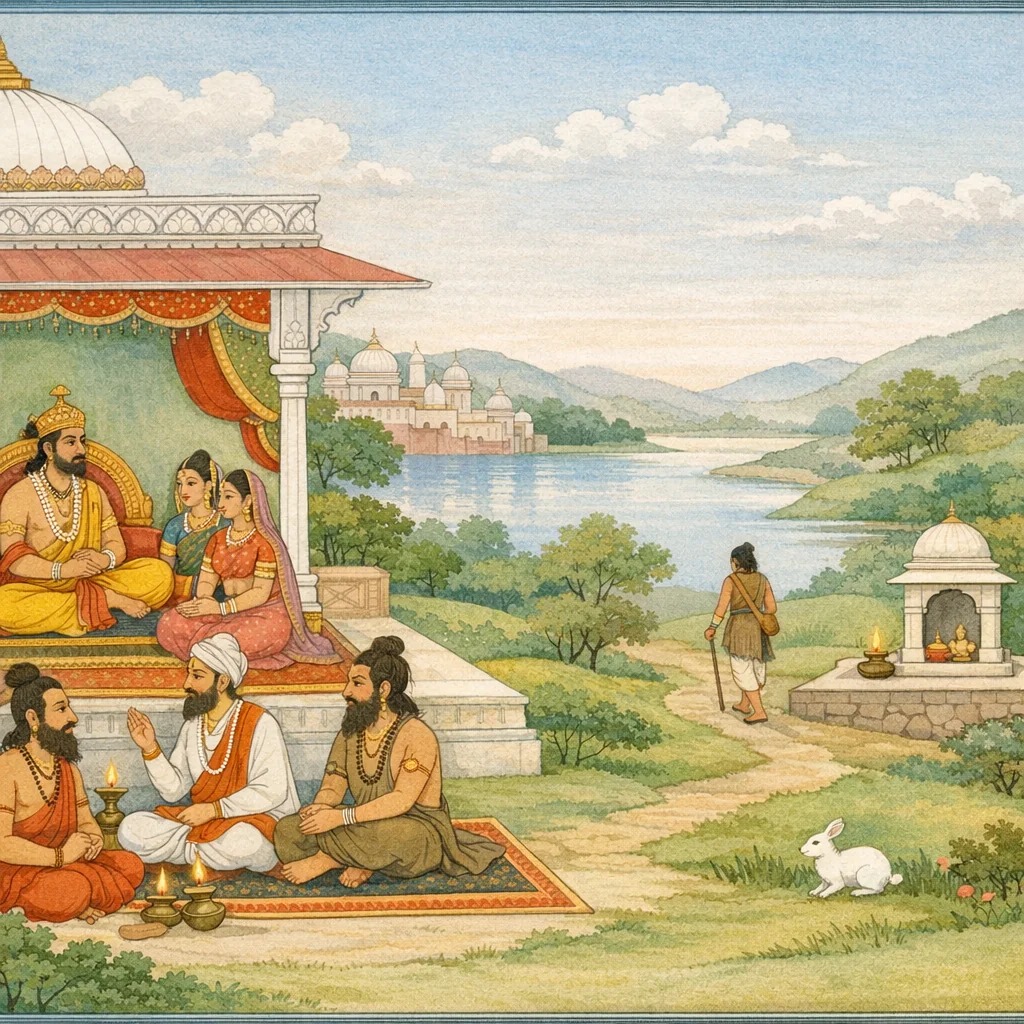
Ikṣvāku-vaṃśa-prasaṅgaḥ — Genealogy of the Ikṣvāku Line and Exempla of Royal Dharma
Set within a purāṇic dialogue frame (with Sūta as chief narrator), this adhyāya turns to a vaṃśānucarita, beginning with Ikṣvāku, son of Manu. It lists the successors and collateral figures linked with Āryāvarta and Ayodhyā, grounding royal legitimacy in remembered lineage. Amid the genealogy it inserts a dharma-illustration in a śrāddha setting: a transgression—eating a hare—brings stigma and exile, showing how ritual propriety and the ethics of kingship are intertwined. The account then proceeds through notable names such as Kakutstha and later descendants, reaching the context of the famed Kuvalāśva (Dhuṃdhumāra) episode, with emphasis on martial prowess and the increase of heirs. In deeper intent, the chapter serves as a cultural-ritual ledger, mapping how dharma, ancestral rites, and royal authority are preserved in the wider Śaiva purāṇic world, preparing the reader to see social order as compatible with—and ideally supportive of—devotion to Śiva.
Shlokas
Verse 1
सूत उवाच । पूर्वतस्तु मनोर्जज्ञे इक्ष्वाकुर्घ्राणतस्सुतः । तस्य पुत्रशतं त्वासीदिक्ष्वाकोर्भूरिदक्षिणम्
Sūta said: In former times, from Manu was born Ikṣvāku, a son brought forth from (Manu’s) nostril. Ikṣvāku had a hundred sons, and he was exceedingly generous in gifts and offerings.
Verse 2
तेषां पुरस्तादभवन्नार्य्यावर्ते नृपा द्विजाः । तेषां विकुक्षिर्ज्येष्ठस्तु सोऽयोध्यायां नृपोऽभवत्
Before them, in Āryāvarta there arose kings who were also twice-born, upholders of Vedic dharma. Among them the eldest was Vikukṣi; he became the ruler in Ayodhyā.
Verse 3
तत्कर्म शृणु तत्प्रीत्या यज्जातं वंशतो विधेः । श्राद्धकर्म्मणि चोद्दिष्टो ह्यकृते श्राद्धकर्मणि
Listen with devotion to that rite, born from the lineage of the Ordainer (Brahmā). It is enjoined for the Śrāddha ceremony, and is prescribed even when the Śrāddha rite has not been performed.
Verse 4
भक्षयित्वा शशं शीघ्रं शशादत्वमतो गतः । इक्ष्वाकुणा परित्यक्तश्शशादो वनमाविशत
Having quickly devoured a hare, he thereby came to be known as “Śaśāda” (hare-eater). Abandoned by King Ikṣvāku, Śaśāda entered the forest.
Verse 5
इक्ष्वाकौ संस्थिते राजा वसिष्ठवचनादभूत् । शकुनिप्रमुखास्तस्य पुत्राः पञ्चदश स्मृताः
When Ikṣvāku was firmly established, in accordance with the word of Vasiṣṭha he became king. He is remembered as having fifteen sons, with Śakuni foremost among them.
Verse 6
उत्तरापथदेशस्य रक्षितारो महीक्षितः । अयोधस्य तु दायादः ककुत्स्थो नाम वीर्य्यवान्
The kings who guarded the land of the Northern Route, Uttarāpatha, were mighty rulers upon the earth. From Ayodhyā’s lineage arose a valiant heir named Kakutstha.
Verse 7
अरिनाभः ककुत्स्थस्य पृथुरेतस्य वै सुतः । विष्टराश्वः पृथोः पुत्रस्तस्मादिंद्रः प्रजापतिः
Arinābha was the son of Kakutstha, and Pṛthuretā was indeed his son. Viṣṭarāśva was the son of Pṛthu, and from him was born Indra, the Prajāpati, lord of progeny.
Verse 8
इंद्रस्य युवनाश्वस्तु श्रावस्तस्य प्रजापतिः । जज्ञे श्रावस्तकः प्राज्ञः श्रावस्ती येन निर्मिता । श्रावस्तस्य तु दायादो बृहदश्वो महायशाः
From Indra was born Yuvanāśva; from Śrāvasta was born the Prajāpati. Then the wise Śrāvastaka was born—he by whom the city of Śrāvastī was founded. And the illustrious Bṛhadaśva, famed far and wide, was the heir of Śrāvasta.
Verse 9
युवनाश्वस्सुतस्तस्य कुवलाश्वश्च तत्सुतः । स हि धुंधुवधाद्भूतो धुंधुमारो नृपोत्तमः
Yuvanāśva was his son, and Kuvalāśva was Yuvanāśva’s son. Indeed, by slaying Dhundhu, that excellent king became renowned as Dhundhumāra.
Verse 10
कुवलाश्वस्य पुत्राणां शतमुत्तमधन्विनाम् । बभूवात्र पिता राज्ये कुवलाश्वं न्ययोजयत्
Kuvalāśva had a hundred sons, all excellent archers. In this realm, his father appointed Kuvalāśva to the kingship.
Verse 11
पुत्रसंक्रामितश्रीको वनं राजा समाविशत् । तमुत्तंकोऽथ राजर्षि प्रयांतं प्रत्यवारयत्
Having transferred his royal fortune and sovereignty to his son, the king entered the forest. Then the royal sage Uttanka stopped him as he was setting out.
Verse 12
उत्तंक उवाच । भवता रक्षणं कार्यं पृथिव्या धर्मतः शृणु । त्वया हि पृथिवी राजन्रक्ष्यमाणा महात्मना
Uttaṃka said: “It is your duty to protect the earth in accordance with dharma—listen. For, O king, when the earth is protected by you, the great-souled one, she is truly safeguarded.”
Verse 13
भविष्यति निरुद्विग्ना नारण्यं गंतुमर्हसि । ममाश्रमसमीपे तु हिमेषु मरुधन्वसु
“You will be free from anxiety; you may go to the forest. Indeed, near my hermitage—amid the snowy tracts and wind-swept lands—you shall dwell in peace.”
Verse 14
समुद्रवालुकापूर्णो दानवो बलदर्पितः । देवतानामवध्यो हि महाकायो महाबलः
That Dānava, as though filled with the sands of the ocean and swollen with the pride of strength, was indeed invulnerable to the gods—of colossal form and immense might.
Verse 15
अंतर्भूभिगतस्तत्र वालुकांतर्हितः स्थितः । राक्षसस्य मधोः पुत्रो धुंधुनामा सुदारुणः
There, having gone beneath the earth, he remained concealed within the sands—Dhundhu by name, exceedingly fierce, the son of the rākṣasa Madhu.
Verse 16
शेते लोकविनाशाय तप आस्थाय दारुणम् । संवत्सरस्य पर्यन्ते स निश्वासं विमुंचति
For the destruction of the worlds, he lies absorbed in fierce austerity; and at the end of a year, he releases his breath—one single out-breath—forth.
Verse 17
यदा तदा भूश्चलति सशैलवनकानना । सविस्फुलिंगं सांगारं सधूममपि वारुणम्
At that very moment, the earth began to tremble—together with its mountains, forests, and groves; and even the watery realm was thrown into agitation, appearing with sparks, burning embers, and smoke.
Verse 18
तेन रायन्न शक्नोमि तस्मिंस्स्थातुं स्व आश्रमे । तं वारय महाबाहो लोकानां हितकाम्यया
Because of him, O King, I am unable to remain in my own hermitage. Therefore, O mighty-armed one, restrain him, out of a desire for the welfare of all people.
Verse 19
लोकास्स्वस्था भवंत्वद्य तस्मिन्विनिहते त्वया । त्वं हि तस्य वधायैव समर्थः पृथवीपते
“May all the worlds be at peace today, when he has been slain by you. For you alone, O lord of the earth, are truly capable of killing him.”
Verse 20
विष्णुना च वरो दत्तो महान्पूर्व युगेऽनघ । तेजसा स्वेन ते विष्णुस्तेज आप्याययिष्यति
O sinless one, in a former age a great boon was granted by Viṣṇu; and by his own divine radiance, that Viṣṇu will nourish and increase your tejas—your spiritual splendor.
Verse 21
पालने हि महाधर्मः प्रजानामिह दृश्यते । न तथा दृश्यतेऽरण्ये मा तेऽभूद्बुद्धिरीदृशी
Indeed, the great dharma is seen here in protecting and governing the people. Such dharma is not seen in the forest; therefore, let not such a notion arise in you.
Verse 22
ईदृशो नहि राजेन्द्र क्वचिद्धर्मः प्रविद्यते । प्रजानां पालने यादृक् पुरा राजर्षिभिः कृतः
O king of kings, such a dharma is found nowhere else—the very dharma practiced of old by the royal seers in guarding and sustaining their subjects.
Verse 23
स एवमुक्तो राजर्षिरुत्तंकेन महात्मना । कुवलाश्वः सुतं प्रादात्तस्मै धुन्धुनिवारणे
Thus addressed by the great-souled sage Uttanka, the royal seer Kuvalāśva gave his son to him, for the purpose of checking (and destroying) Dhundhu.
Verse 24
भगवन्न्यस्तशस्त्रोहमयं तु तनयो मम । भविष्यति द्विजश्रेष्ठ धुन्धुमारो न संशयः
O Blessed One, I have laid down my weapons. This son of mine, O best of the twice-born, will indeed become Dhundhumāra—of this there is no doubt.
Verse 25
इत्युक्त्वा पुत्रमादिश्य ययौ स तपसे नृपः । कुवलाश्वश्च सोत्तङ्को ययौ धुन्धुविनिग्रहे
Having spoken thus and instructing his son, the king departed to undertake austerities. And Kuvalāśva, together with the sage Uttanka, set out to subdue and destroy Dhundhu.
Verse 26
तमाविशत्तदा विष्णुर्भगवांस्तेजसा प्रभुः । उत्तंकस्य नियोगाद्वै लोकानां हितकाम्यया
Then Lord Viṣṇu—the majestic, sovereign one—entered him by the power of his divine radiance, indeed at Uttanka’s behest, out of a wish for the welfare of the worlds.
Verse 27
तस्मिन्प्रयाते दुर्द्धर्षे दिवि शब्दो महानभूत् । एष श्रीमान्नृपसुतो धुन्धुमारो भविष्यति
When that invincible one had departed, a great proclamation resounded in heaven: “This illustrious prince shall become known as Dhundhumāra.”
Verse 28
दिव्यैर्माल्यैश्च तं देवास्समंतात्समवारयन् । प्रशंसां चक्रिरे तस्य जय जीवेति वादिनः
The gods surrounded him on every side with celestial garlands, and they sang his praises, proclaiming, “Victory! May you live long!”
Verse 29
स गत्वा जयतां श्रेष्ठस्तनयैस्सह पार्थिवः । समुद्रं खनयामास वालुकार्णवमध्यतः
Then that king—foremost among the victorious—went there together with his sons and dug out the sea from the midst of the ocean of sand.
Verse 30
नारायणस्य विप्रर्षेस्तेजसाप्यायितस्तु सः । बभूव सुमहातेजा भूयो बलसमन्वितः
O brahmin-sage, nourished and strengthened by the sacred tejas of Nārāyaṇa, he became exceedingly radiant, endowed once again with even greater power.
Verse 31
तस्य पुत्रैः खनद्भिस्तु वालुकांतर्गतस्तु सः । धुन्धुरासादितो ब्रह्मन्दिशमाश्रित्य पश्चि माम्
As his sons were digging, he was indeed buried within the sand. Then, assailed by Dhundhu, O Brahman, he took refuge by turning toward the western direction.
Verse 32
मुखजेनाग्निना क्रोधाल्लोकान्संवर्तयन्निव । वारि सुस्राव वेगेन विधोः कधिरिवोदये
With the fire issuing from his mouth—like one, in wrath, bringing the worlds to dissolution—water suddenly streamed forth with force, as if from the Creator at the arising of creation.
Verse 33
ततोऽनलैरभिहतं दग्धं पुत्रशतं हि तत् । त्रय एवावशिष्टाश्च तेषु मध्ये मुनीश्वर
Then, struck by flames, that entire hundred sons were burned; only three remained among them, O lordly sage.
Verse 34
ततस्स राजा विप्रेन्द्र राक्षसं तं महाबलम् । आससाद महातेजा धुन्धुं विप्रविनाशनम्
Then, O best of Brāhmaṇas, the mighty and radiant king advanced to confront that powerful rākṣasa—Dhundhu, the destroyer of brāhmaṇas.
Verse 35
तस्य वारिमयं वेगमापीय स नराधिपः । वह्निबाणेन वह्निं तु शमयामास वारिणा
Having absorbed that rushing surge of water, the king then, by means of a fire-weapon, quenched the fire with water.
Verse 36
तं निहत्य महाकायं बलेनोदकराक्षसम् । उत्तंकस्येक्षयामास कृतं कर्म नराधिपः
After slaying that huge-bodied water-demon by his strength, the king (lord of men) showed Uttanka that the deed had been accomplished.
Verse 37
इति श्रीशिवमहापुराणे पञ्चम्यामुमासंहितायां मनुवंशवर्णनंनाम सप्तत्रिंशोऽध्यायः
Thus ends the thirty-seventh chapter, titled “Description of the Lineage of the Manus,” in the fifth section of the Śrī Śiva Mahāpurāṇa, within the Umāsaṃhitā.
Verse 38
धर्मे मतिं च सततं स्वर्गे वासं तथाक्षयम् । पुत्राणां चाक्षयं लोकं रक्षसा ये तु संहताः
Those who are slain by a rākṣasa are granted an unwavering inclination toward dharma, an imperishable abode in heaven, and for their sons too an unperishing world—a secure and enduring state of welfare.
Verse 39
तस्य पुत्रास्त्रयश्शिष्टाः दृढाश्वः श्रेष्ठ उच्यते । हंसाश्वकपिलाश्वौ च कुमारौ तत्कनीयसौ
He had three remaining sons. Among them, Dṛḍhāśva is said to be the foremost; and Haṁsāśva and Kapilāśva were the two younger princes.
Verse 40
धौंधुमारिर्दृढाश्वो यो हर्य्यश्वस्तस्य चात्मजः । हर्यश्वस्य निकुंभोभूत्पुत्रो धर्मरतस्सदा
Dhauṃdhumāri was (also known as) Dṛḍhāśva, and he was the son of Haryyaśva. From Haryyaśva was born a son named Nikuṃbha, who was always devoted to dharma.
Verse 41
संहताश्वो निकुंभस्य पुत्रो रणविशारदः । अक्षाश्वश्च कृताश्वश्च संहताश्वसुतोऽभवत
Saṃhatāśva, the son of Nikumbha, was a warrior skilled in battle. And Akṣāśva and Kṛtāśva were born as the sons of Saṃhatāśva.
Verse 42
तस्य हैमवती कन्या सतां मान्या वृषद्वती । विख्याता त्रिषु लोकेषु पुत्रस्तस्याः प्रसेनजित्
From him was born a daughter of the Himalayan line, named Vṛṣadvatī, honoured by the virtuous. She became renowned in the three worlds, and her son was Prasenajit.
Verse 43
लेभे प्रसेनजिद्भार्यां गौरीं नाम पतिव्रताम् । अभिशप्ता तु सा भर्त्रा नदी सा बाहुदा कृता
He took as his wife Gaurī, a devoted and faithful spouse. But when she was cursed by her husband, she was transformed into a river known as Bāhudā.
Verse 44
तस्य पुत्रो महानासीद्युवनाश्वो महीपतिः । मांधाता युवनाश्वस्य त्रिषु लोकेषु विश्रुतः
His son was the great king Yuvanāśva, a sovereign of the earth. From Yuvanāśva was born Māndhātā, renowned throughout the three worlds.
Verse 45
तस्य चैत्ररथी भार्या शशबिंदुसुता ऽभवत् । पतिव्रता च ज्येष्ठा च भ्रातॄणामयुतं च सः
His wife was Caitrarathī, the daughter of Śaśabindu. She was devoted to her husband and the eldest (among the wives). And he had ten thousand brothers.
Verse 46
तस्यामुत्पादयामास मान्धाता द्वौ सुतौ तदा । पुरुकुत्सं च धर्मज्ञं मुचुकुंदं च धार्मिकम्
In her, then, King Māndhātā begot two sons—Purukutsa, a knower of dharma, and Mucukunda, steadfast in righteousness.
Verse 47
पुरुकुत्ससुतस्त्वासीद्विद्वांस्त्रय्यारुणिः कविः । तस्य सत्यव्रतो नाम कुमारोऽभून्महाबली
Trayyāruṇi, the wise poet-sage, was the son of Purukutsa. To him was born a son named Satyavrata, a youth of great strength.
Verse 48
पाणिग्रहणमंत्राणां विघ्रं चक्रे महात्मभिः । येन भार्य्या हृता पूर्वं कृतोद्वाहः परस्य वै
He created an obstruction to the hand-taking (marriage) mantras through those great souls—by whom, in former times, the wife of another man, though duly married, had indeed been abducted.
Verse 49
बलात्कामाच्च मोहाच्च संहर्षाच्च यदोत्कटात् । जहार कन्यां कामाच्च कस्यचित्पुरवासिनः
Driven by force, lust, delusion, and an intense surge of passion, he—out of desire—abducted the maiden of a certain city-dweller.
Verse 50
अधर्मसंगिनं तं तु राजा त्रय्यारुणिस्त्यजन् । अपध्वंसेति बहुशोऽवदत्क्रोधसमन्वितः
But King Trayyāruṇi, abandoning that man who kept company with adharma, repeatedly cried out, “Perish! Be gone!”, filled with anger.
Verse 51
पितरं सोऽब्रवीन्मुक्तः क्व गच्छामीति वै तदा । वस श्वपाकनिकटे राजा प्राहेति तं तदा
Then, once released, he said to his father, “Where shall I go now?” At that time the king replied, “Live near the dwelling of the śvapāka (an outcaste).”
Verse 52
स हि सत्यव्रतस्तेन श्वपाकवसथांतिके । पित्रा त्यक्तोऽवसद्वीरो धर्मपालेन भूभुजा
For he was a hero steadfast in the vow of truth. Therefore, cast off by his father, he lived near the dwelling of the caṇḍālas, protected by the righteous king Dharmapāla, guardian of Dharma.
Verse 53
ततस्त्रय्यारुणी राजा विरक्तः पुत्रकर्मणा । स शंकरतपः कर्त्तुं सर्वं त्यक्त्वा वनं ययौ
Then King Trayyāruṇī, becoming dispassionate because of his son’s conduct, renounced everything and went to the forest to undertake austerities for Lord Śaṅkara.
Verse 54
ततस्तस्य स्व विषये नावर्षत्पाकशासनः । समा द्वादश विप्रर्षे तेनाधर्मेण वै तदा
Then, because of that unrighteousness, Pākaśāsana (Indra) did not send rain upon his own realm; and for twelve years, O best of sages, there was no rainfall at that time.
Verse 55
दारां तस्य तु विषये विश्वामित्रो महातपाः । संत्यज्य सागरानूपे चचार विपुलं तपः
But regarding his wife, the great ascetic Viśvāmitra—abandoning her—went to the seashore and undertook extensive austerities.
Verse 56
तस्य पत्नी गले बद्ध्वा मध्यमं पुत्रमौरसम् । शेषस्य भरणार्थाय व्यक्रीणाद्गोशतेन च
Then his wife, tying their middle son—her own natural-born child—by the neck, sold him for a hundred cows in order to maintain the remaining family.
Verse 57
तां तु दृष्ट्वा गले बद्धं विक्रीणंती स्वमात्मजम् । महर्षिपुत्रं धर्म्मात्मा मोचयामास तं तदा
Seeing her selling her own son—his neck bound—then that righteous-souled one immediately set the boy free, the son of a great sage.
Verse 59
तदारभ्य स पुत्रस्तु विश्वामित्रस्य वै मुनेः । अभवद्गालवो नाम गलबंधान्महातपाः
From that time onward, the sage Viśvāmitra’s son came to be known as Gālava—so named because of the bondage upon his neck—he being a great ascetic.
Verse 578
सत्यव्रतो महाबाहुर्भरणं तस्य चाकरोत् । विश्वामित्रस्य तुष्ट्यर्थमनुक्रोशार्थमेव च
The mighty-armed Satyavrata provided him sustenance, both to please Viśvāmitra and out of compassion as well.
Frequently Asked Questions
A dynastic narration of the Ikṣvāku line is presented, including the Vikukṣi/Śaśāda incident linked to a śrāddha setting, where a breach of ritual-ethical conduct leads to social and royal consequence (reproach and withdrawal/exile), reinforcing dharma through narrative causality.
Genealogy functions as a purāṇic ‘index of legitimacy’: names, cities (Ayodhyā, Śrāvastī), and rites (śrāddha) symbolize continuity of order. The śrāddha frame underscores that ancestral obligation is not merely social but metaphysical—linking memory, merit, and authority to ritual correctness.
No distinct Śiva or Umā manifestation is foregrounded in the sampled narrative; the chapter’s emphasis is contextual—embedding dharma, śrāddha discipline, and royal exempla within the broader Shaiva purāṇic corpus rather than presenting a specific Śiva/Umā form (svarūpa).