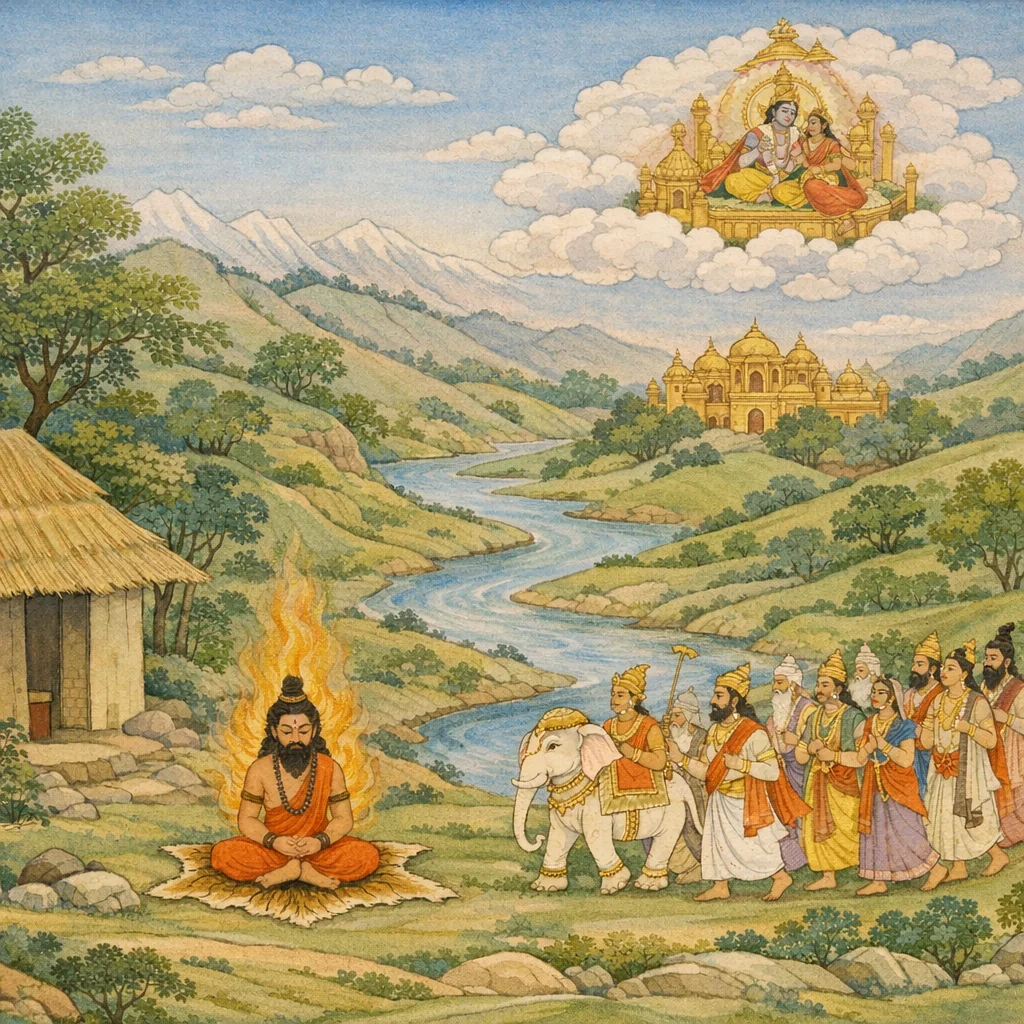
दुर्वाससः तपः-प्रभावः तथा देवाः ब्रह्म-विष्ण्वोः शरणागमनम् | Durvāsā’s Tapas and the Devas’ Appeal to Brahmā and Viṣṇu
This adhyāya opens with Nandīśvara recounting an additional episode to a great sage, introducing Durvāsā—an ascetic born of Brahmā, famed for extreme tapas and unwavering obedience to Brahmā’s command. Seeking the boon of progeny, Durvāsā and his wife go to a mountain linked with the Tryakṣa lineage and perform long austerities on the bank of the Nirvindhyā river, practicing breath-restraint and strict observances. The heat of his tapas appears as a purified, blazing flame that torments worlds, ṛṣis, and devas (including Indra), leaving the cosmos “nearly burnt.” The devas and sages then assemble and rush to Brahmā’s abode with their distress; Brahmā accompanies them to Viṣṇu’s realm and formally petitions Viṣṇu, explaining the crisis. The esoteric lesson, in a Śaiva key, teaches that tapas is a real, world-affecting power that requires divine oversight so spiritual striving remains aligned with dharma and does not destabilize the cosmic order.
Shlokas
Verse 1
नन्दीश्वर उवाच । अथान्यच्चरितं शम्भो श्शृणु प्रीत्या महामुने । यथा बभूव दुर्वासाश्शंकरो धर्महेतवे
Nandīśvara said: Now, O great sage, listen with devotion to another sacred episode concerning Śambhu—how Śaṅkara manifested as Durvāsā for the purpose of establishing and protecting Dharma.
Verse 2
ब्रह्मपुत्रो वभूवातितपस्वी ब्रह्मवित्प्रभुः । अनसूयापति र्धीमान्ब्रह्माज्ञाप्रतिपालकः
He was born as Brahmā’s son—an exceedingly austere sage, a knower of Brahman and a powerful lord. He became the husband of Anasūyā, wise in discernment, and steadfast in carrying out Brahmā’s command.
Verse 3
सुनिर्देशाद्ब्रह्मणो हि सस्त्रीकः पुत्रकाम्यया । स त्र्यक्षकुलनामानं ययौ च तपसे गिरिम्
By Brahmā’s precise instruction, he—together with his wife and desiring a son—went to the mountain renowned as Tryakṣa-kula, in order to undertake austerities.
Verse 4
प्राणानायम्य विधिवन्निर्विन्ध्यातटिनीतटे । तपश्चचार सुमहदद्वन्द्वोऽब्दशतम्मुनिः
Having regulated his life-breath through prāṇāyāma according to the prescribed discipline, the sage performed exceedingly great austerities on the bank of the river Nirvindhyā—free from the pairs of opposites—for a full hundred years.
Verse 5
य एक ईश्वरः कश्चिदविकारो महाप्रभुः । स मे पुत्रवरं दद्यादिति निश्चितमानसः
With a mind firmly resolved, he thought: “That One Lord—the changeless, supremely mighty Master—may He grant me the boon of a noble son.”
Verse 6
बहुकालो व्यतीयाय तस्मिंस्तपति सत्तपः । आविर्बभूव तत्कात्तु शुचिर्ज्वाला महीयसी
After a long time had passed while that noble ascetic continued his intense austerities, from that very ardor there manifested a vast, pure, and radiant flame—an auspicious epiphany born of tapas, revealing the Lord’s power responding to steadfast discipline.
Verse 7
तया सन्निखिला लोका दग्धप्राया मुनीश्वराः । तथा सुरर्षयः सर्वे पीडिता वासवादयः
By that overpowering manifestation, all the worlds seemed scorched; the great sages were nearly consumed. Likewise, all the divine seers—and the gods beginning with Vāsava (Indra)—were afflicted and tormented.
Verse 8
अथ सर्वे वासवाद्या सुराश्च मुनयो मुने । ब्रह्मस्थानं ययुश्शीघ्रं तज्ज्वालातिप्रपीडिताः
Then, O sage, all the gods beginning with Vāsava (Indra), and the seers as well—oppressed by the intense flames from that radiance—swiftly went to Brahmā’s abode, seeking refuge and counsel.
Verse 9
नत्वा नुत्वा विधिन्देवास्तत्स्वदुःखन्न्यवेदयन् । ब्रह्मा सह सुरैस्तात विष्णुलोकं ययावरम्
Having bowed down and offered praises to Vidhi (Brahmā), the gods submitted their sorrowful plight. Then Brahmā—together with the devas, O dear one—set out for Viṣṇu’s realm.
Verse 10
तत्र गत्वा रमानाथं नत्वा नुत्वा विधिस्सुरैः । स्वदुःखन्तत्समाचख्यौ विष्णवेऽनन्तकं मुने
Having gone there, Brahmā—together with the gods—bowed down and, according to due rite, praised Rāmānātha (Lord Viṣṇu). Then, O sage, he explained to Viṣṇu the very grief and distress that had befallen him.
Verse 11
विष्णुश्च विधिना देवै रुद्रस्थानं ययौ द्रुतम् । हरं प्रणम्य तत्रेत्य तुष्टाव परमेश्वरम्
Then Viṣṇu, accompanied by Brahmā and the other gods, swiftly went to Rudra’s sacred abode. Arriving there, he bowed to Hara (Śiva) and praised that Supreme Lord, Parameśvara.
Verse 12
स्तुत्वा बहुतया विष्णुं स्वदुःखं च न्यवेदयत् । शर्वं ज्वालासमुद्भूतमत्रेश्च तपसः परम्
After praising Viṣṇu at length, he laid before Him his own sorrow. He spoke of Śarva (Śiva) who had arisen as a blazing fire, and of the sage Atri’s supreme austerity.
Verse 13
अथ तत्र समेस्तास्तु ब्रह्मविष्णुमहेश्वराः । मुने संमन्त्रयाञ्चक्रुरन्योन्यं जगतां हितम्
Then, O sage, Brahmā, Viṣṇu, and Maheśvara (Śiva) assembled there and, consulting one another, deliberated for the welfare of the worlds.
Verse 14
तदा ब्रह्मादयो देवास्त्रयस्ते वरदर्षभाः । जग्मुस्तदाश्रमं शीघ्रं वरन्दातुन्तदर्षये
Then those three gods, beginning with Brahmā—bestowers of boons and foremost among the devas—quickly went to that hermitage to grant a boon to that sage.
Verse 15
स्वचिह्नचिह्नितांस्तान्स दृष्ट्वात्रिर्मुनिसत्तमः । प्रणनाम च तुष्टाव वाग्भिरिष्टाभिरादरात्
Seeing them marked with their own distinctive signs, the great sage Atri—best among seers—bowed down and, with reverent affection, praised them in words dear and fitting.
Verse 16
ततस्स विस्मितो विप्रस्तानुवाच कृताञ्जलिः । ब्रह्मपुत्रो विनीतात्मा ब्रह्मविष्णुहराभिधान्
Then that brāhmaṇa, filled with wonder, addressed them with folded hands. The humble-souled son of Brahmā spoke to those who bore the names of Brahmā, Viṣṇu, and Hara.
Verse 17
अत्रिरुवाच । हे ब्रह्मन् हे हरे रुद्र पूज्यास्त्रिजगताम्मताः । प्रभवश्चेश्वराः सृष्टिरक्षासंहारकारकाः
Atri said: “O Brahman! O Hari! O Rudra! The three worlds hold You to be worthy of worship. You are the divine Lords—the sources—who bring about creation, protection, and dissolution.”
Verse 18
एक एव मया ध्यात ईश्वरः पुत्रहेतवे । यः कश्चिदीश्वरः ख्यातो जगतां स्वस्त्रिया सह
For the sake of obtaining a son, I meditated on the one Lord alone—on that very Īśvara renowned as the Sovereign of the worlds, together with His own divine Consort.
Verse 19
इति श्रीशिवमहापुराणे तृतीयायां शतरुद्रसंहितायां दुर्वासश्चरित्रवर्णनं नामैकोनविंशोऽध्यायः
Thus, in the revered Śiva Mahāpurāṇa, in the Third Book, the Śatarudra-saṃhitā, concludes the nineteenth chapter entitled “The Description of the Life and Deeds of Durvāsā.”
Verse 20
इति श्रुत्वा वचस्तस्य प्रत्यूचुस्ते सुरास्त्रयः । यादृक्कृतस्ते संकल्पस्तथैवाभून्मुनीश्वर
Hearing his words, the three gods replied: “O lord among sages, just as your resolve was formed, so indeed it has come to pass.”
Verse 21
वयं त्रयो भवेशानास्समाना वरदर्षभाः । अस्मदंशभवास्तस्माद्भविष्यन्ति सुतास्त्रयः
We three are equal—lords of existence, O best among the givers of boons. Therefore, from our own portions will be born three sons.
Verse 22
विदिता भुवने सर्वे पित्रोः कीर्तिविवर्द्धनाः । इत्युक्तास्ते त्रयो देवास्स्वधामानि ययुर्मुदा
“You three are renowned throughout the worlds as enhancers of your parents’ fame.” Thus addressed, those three divine ones joyfully departed to their own celestial abodes.
Verse 23
वरं लब्ध्वा मुनिस्सोऽथ जगाम स्वाश्रमं मुदा । युतोऽनुसूयया प्रीतो ब्रह्मानंदप्रदो मुने
Having obtained the boon, the sage then went joyfully to his own hermitage. Accompanied by Anasūyā and filled with delight, he became a bestower of Brahman-bliss, O sage.
Verse 24
अथ ब्रह्मा हरिश्शम्भुरवतेरुः स्त्रियां ततः । पुत्ररूपैः प्रसन्नात्मनानालीला प्रकाशकाः
Then Brahmā, Hari (Viṣṇu), and Śambhu (Śiva) descended into that woman; and, taking the forms of sons, those serene-souled Lords revealed their many divine līlās, sacred play-acts.
Verse 25
विधेरंशाद्विधुर्जज्ञेऽनसूयायां मुनीश्वरात् । आविर्बभूवोदधितः शिप्तो देवेस्स एव हि
From a portion of Brahmā, the Ordainer, the Moon-god (Vidhū) was born of the great sage Atri in Anasūyā’s womb. Indeed, that very Lord of the gods later manifested from the ocean, having been cursed.
Verse 26
विष्णोरंशात्स्त्रियान्तस्यामत्रेर्दत्तो व्यजायत । संन्यासपद्धतिर्येन वर्द्धिता परमा मुने
O supreme sage, from a portion of Viṣṇu, Dattātreya was born to Atri’s wife; through him the highest discipline of saṃnyāsa, holy renunciation, was greatly established and expanded.
Verse 27
दुर्वासा मुनिशार्दूलः शिवांशान्मुनिसत्तमः । जज्ञे तस्यां स्त्रियामत्रेर्वरधर्मप्रवर्तकः
From a portion of Lord Śiva was born Durvāsā, the tiger among sages and the best of ascetics. He took birth from that woman, Atri’s wife, and became a promoter of excellent dharma.
Verse 28
भूत्वा रुद्रश्च दुर्वासा ब्रह्मतेजोविवर्द्धनः । चक्रे धर्मपरीक्षाञ्च बहूनां स दयापरः
Becoming Rudra as the sage Durvāsā—one who augments the splendor of brahmanical spiritual power—he tested the righteousness of many; yet he remained ever intent on compassion.
Verse 29
सूर्यवंशे समुत्पन्नो योऽम्बरीषो नृपोऽभवत् । तत्परीक्षामकार्षीत्स तां शृणु त्वं मुनीश्वर
In the Solar dynasty there arose a king named Ambarīṣa. He undertook a test; hear that account, O lordly sage.
Verse 30
सोऽम्बरीषो नृपवरः सप्तद्वीपरसापतिः । नियमं हि चकारासावेकादश्या व्रते दृढम्
That noble king Ambarīṣa, sovereign over the lands of the seven continents, undertook a strict discipline, firmly established in the sacred vow of Ekādaśī.
Verse 31
एकादश्या व्रतं कृत्वा द्वादश्यां चैव पारणाम् । करिष्यामीति सुदृढसंकल्पस्तु नराधिपः
Having observed the vow on Ekādaśī and intending to perform the proper pāraṇa—the breaking of the fast—on Dvādaśī, the king formed an unshakable resolve: “I shall surely do it.”
Verse 32
ज्ञात्वा तन्नियमन्तस्य दुर्वासा मुनिसत्तमः । तदन्तिकं गतश्शिष्यैर्बहुभिश्शंकरांशजः
Knowing his observance and discipline, the eminent sage Durvāsā—an incarnation born from a portion of Śaṅkara—went near him, accompanied by many disciples.
Verse 33
पारणे द्वादशीं स्वल्पां ज्ञात्वा यावत्स भोजनम् । कर्त्तुं व्यवसितस्तावदागतं स न्यमन्त्रयत्
Knowing that only a little of Dvādaśī remained for the pāraṇa, and resolved to take his meal within that limited time, he at that very moment invited the one who had arrived.
Verse 34
ततः स्नानार्थमगमद्दुर्वासाः शिष्यसंयुतः । विलम्बं कृतवांस्तत्र परीक्षार्थं मुनिर्बहु
Then Durvāsā, accompanied by his disciples, went there to bathe. That sage deliberately lingered there for a long while, intending to test (them).
Verse 35
धर्मविघ्नं तदा ज्ञात्वा स नृपः शास्त्रशासनात् । जलम्प्राश्यास्थितस्तत्र तदागमनकांक्षया
Then, understanding that a hindrance to dharma had arisen, the king—guided by the injunctions of the śāstras—sipped water for purification and remained there, longing and waiting for their arrival.
Verse 36
एतस्मिन्नन्तरे तत्र दुर्वासा मुनिरागतः । कृताशनं नृपं ज्ञात्वा परीक्षार्थं धृताकृतिः
Just then, at that very moment, the sage Durvāsā arrived there. Learning that the king had already eaten, he deliberately assumed a guise, intending to test him.
Verse 37
चुक्रोधाति नृपे तस्मिन्परीक्षार्थं वृषस्य सः । प्रोवाच वचनन्तूग्रं स मुनिश्शंकरांशजः
To test the steadfastness of Vṛṣa (Dharma), that sage—an emanation of Śaṅkara—grew wrathful toward the king and spoke harsh, fierce words.
Verse 38
दुर्वासा उवाच । मां निमन्त्र्य नृपाभोज्य जलं पीतन्त्वयाधम । दर्शयामि फलं तस्य दुष्टदण्डधरो ह्यहम्
Durvāsā said: “O vile one! After inviting me, you have drunk the water meant for the king’s offering. Now I shall show you the fruit of that deed—for I am indeed the bearer of punishment for the wicked.”
Verse 39
इत्युक्त्वा क्रोधताम्राक्षो नृपं दग्धुं समुद्यतः । समुत्तस्थौ द्रुतं चक्रं तत्स्थं रक्षार्थमैश्वरम्
Having spoken thus, with eyes reddened by anger, he rose up, intent on burning the king. At once, for the king’s protection, the Lord’s sovereign discus swiftly sprang forth and stood poised there.
Verse 40
प्रजज्वालाति तं चक्रं मुनिं दग्धुं सुदर्शनम् । शिवरूपं तमज्ञात्वा शिवमायाविमोहितम्
Deluded by Śiva’s māyā and not recognizing that sage as the very form of Śiva, the Sudarśana discus blazed forth to burn him.
Verse 41
एतस्मिन्नन्तरे व्योमवाण्युवाचाशरीरिणी । अम्बरीषम्महात्मानं ब्रह्मभक्तं च वैष्णवम्
Just then, a bodiless voice from the sky spoke, praising King Ambarīṣa—the great-souled one—declaring him a devoted worshipper of Brahman and also a true Vaiṣṇava.
Verse 42
व्योमवाण्युवाच । सुदर्शनमिदं चक्रं हरये शम्भुनार्पितम् । शांतं कुरु प्रज्वलितमद्य दुर्वाससे नृप
Vyomavāṇī said: “O king, this Sudarśana discus—bestowed by Śambhu upon Hari—has today flared up in blazing fury. Pacify it at once, for the sake of the sage Durvāsā.”
Verse 43
दुर्वासायं शिवः साक्षात्स चक्रं हरयेऽर्पितम् । एवं साधारणमुनिं न जानीहि नृपोत्तम
Durvāsā is verily Śiva Himself in manifest form; it was he who bestowed the discus upon Hari. Therefore, O best of kings, do not regard such a sage as ordinary.
Verse 44
तव धर्मपरीक्षार्थमागतोऽयं मुनीश्वरः । शरणं याहि तस्याशु भविष्यत्यन्यथा लयः
This lord among sages has come to test the truth of your dharma. Quickly take refuge in him; otherwise, destruction will surely befall you.
Verse 45
नन्दीश्वर उवाच । इत्युक्त्वा च नभोवाणी विरराम मुनीश्वर । अस्तावीत्स हरांशं तमम्बरीषोऽपि चादरात्
Nandīśvara said: “Having spoken thus, O best of sages, the celestial voice fell silent. Then King Ambarīṣa too, with reverent devotion, praised that portion (aṁśa) of Hara—Lord Śiva.”
Verse 46
अम्बरीष उवाच । यद्यस्ति दत्तमिष्टं च स्वधर्मो वा स्वनुष्ठितः । कुलं नो विप्रदैवं चेद्धरेरस्त्रं प्रशाम्यतु
Ambarīṣa said: “If there is any merit in my gifts and sacrifices, or in my faithfully performed personal duty—if the Brahmins are truly the divine guardians of our lineage—then may Hari’s weapon be pacified.”
Verse 47
यदि नो भगवान्प्रीतो मद्भक्तो भक्तवत्सलः । सुदर्शनमिदं चास्त्रं प्रशाम्यतु विशेषतः
If the Blessed Lord is pleased with us—He who is my devotee and ever tender to His devotees—then may this Sudarśana weapon, this divine missile, be pacified, above all.
Verse 48
नन्दीश्वर उवाच । इति स्तुवति रुद्राग्रे शैवं चक्रं सुदर्शनम् । अशाम्यत्सर्वथा ज्ञात्वा तं शिवांशं सुलब्धधीः
Nandīśvara said: Thus, while (he) was praising before Rudra, the auspicious Śaiva discus Sudarśana did not become pacified at all. Knowing this completely, the wise one understood it to be a portion (emanation) of Śiva.
Verse 49
अथाम्बरीषस्स नृपः प्रणनाम च तं मुनिम् । शिवावतारं संज्ञाय स्वपरीक्षार्थमागतम्
Then King Ambarīṣa bowed down to that sage. Recognizing him as an incarnation of Śiva who had come to test him, the king offered reverent obeisance.
Verse 50
सुप्रसन्नो बभूवाथ स मुनिः शंकरांशजः । भुक्त्वा तस्मै वरं दत्त्वा स्वाभीष्टं स्वालयं ययौ
Then that sage—born of an emanation of Śaṅkara—became exceedingly pleased. Having accepted the hospitality, he granted him a boon according to his desire and departed to his own cherished abode.
Verse 51
अम्बरीषपरीक्षायां दुर्वासश्चरितम्मुने । प्रोक्तामन्यच्चरित्रन्त्वं शृणु तस्य मुनीश्वर
O sage, in the account of King Ambarīṣa’s testing, the conduct of Durvāsā has already been described. Now, O lord among sages, listen as I relate another episode concerning him.
Verse 52
पुनर्दाशरथेश्चक्रे परीक्षां नियमेन वै । मुनिरूपेण कालेन यः कृतो नियमो मुने
Again, he tested Rāma, the lord of Daśaratha, according to the ordained rule. O sage, that very regulation which Time (Kāla) had established—assuming the form of a muni—was thus carried out.
Verse 53
तदैव मुनिना तेन सौमित्रिः प्रेषितो हठात् । तन्तत्याज द्रुतं रामो बन्धुं पणवशान्मुने
At that very moment, that sage abruptly dispatched Saumitri (Lakṣmaṇa). Then Rāma swiftly abandoned that kinsman, O muni, compelled by the power of destiny.
Verse 54
सा कथा विहिता लोके मुनिभिर्बहुधोदिता । नातो मे विस्तरात्प्रोक्ता ज्ञाता यत्सर्वधा बुधैः
That sacred account is well established in the world and has been proclaimed in many ways by the sages. Therefore I have not narrated it here at length, for it is ever known to the wise.
Verse 55
नियमं सुदृढं दृष्ट्वा सुप्रसन्नोऽभवन्मुनिः । दुर्वासास्सुप्रसन्नात्मा वरन्तस्मै प्रदत्तवान्
Seeing his firm and well-established observance of sacred discipline, the sage became exceedingly pleased. The great Durvāsā, serene and fully gratified at heart, then granted him a boon.
Verse 56
श्रीकृष्णनियमस्यापि परीक्षां स चकार ह । तां शृणु त्वं मुनिश्रेष्ठ कथयामि कथां च ताम्
He also put Śrī Kṛṣṇa’s sacred vow to the test. O best of sages, listen— I shall now recount that very episode to you.
Verse 57
ब्रह्मप्रार्थनया विष्णुर्वसुदेवसुतोऽभवत् । धराभारावतारार्थं साधूनां रक्षणाय च
By Brahmā’s supplication, Viṣṇu became the son of Vasudeva, taking descent to remove the burden of the earth and to protect the righteous.
Verse 58
हत्वा दुष्टान्महापापान् ब्रह्मद्रोहकरान्मलान् । ररक्ष निखिलान्साधून्ब्राह्मणान्कृष्णनामभाक्
Having slain the wicked—steeped in great sin, hostile to the Brahmins, and impure in conduct—he protected all the righteous and safeguarded the Brahmins, for he bore the sacred name “Kṛṣṇa.”
Verse 59
ब्रह्मभक्तिं चकाराति स कृष्णो वसुदेवजः । नित्यं हि भोजयामास सुरसान्ब्राह्मणान्बहून्
Kṛṣṇa, the son of Vasudeva, practiced devotion to Brahman, the Supreme Reality; and indeed, every day he fed many eminent brāhmaṇas, revered like the gods. Thus, through steady worship and sacred hospitality, he upheld dharma—conduct that, in a Śaiva understanding, accords with honoring Śiva as the Supreme Brahman and serving His devotees.
Verse 60
ब्रह्मभक्तो विशेषेण कृष्णश्चेति प्रथामगात । संद्रष्टुकामस्स मुनिः कृष्णान्तिकमगान्मुने
He became renowned as “Kṛṣṇa,” and especially as a devoted worshipper of Brahmā. Wishing to see him, that sage went near Kṛṣṇa, O sage.
Verse 61
रुक्मणीसहितं कृष्णं सन्नं कृत्वा रथे स्वयम् । संयोज्य संस्थितो वाहं सुप्रसन्न उवाह तम्
Having seated Kṛṣṇa together with Rukmiṇī in the chariot, I myself took up the reins; duly harnessed and standing ready, I—fully pleased—drove them onward.
Verse 62
मुनी रथात्समुत्तीर्य दृष्ट्वा तां दृढताम्पराम् । तस्मै भूत्वा सुप्रसन्नो वज्राङ्गत्ववरन्ददौ
Seeing that supreme steadfastness, the sage descended from the chariot; and becoming exceedingly pleased with him, he granted him the boon of a body as firm as a thunderbolt.
Verse 63
द्युनद्यामेकदा स्नानं कुर्वन्नग्नो बभूव ह । लज्जितोभून्मुनिश्रेष्ठो दुर्वासाः कौतुकी मुने
Once, in the celestial river, as he was bathing, the great sage Durvāsā suddenly became naked. Embarrassed, that best of ascetics—ever playful in his wondrous ways—thus appeared, O sage.
Verse 64
तज्ज्ञात्वा द्रौपदी स्नानं कुर्वती तत्र चादरात् । तल्लज्जां छादयामास भिन्नस्वाञ्चलदानतः
Knowing this, Draupadī, bathing there with reverent care, covered her modesty by offering and adjusting her loosened upper cloth.
Verse 65
तदादाय प्रवाहेनागतं स्वनिकटं मुनिः । तेनाच्छाद्य स्वगुह्यं च तस्यै तुष्टो बभूव सः
Taking that cloth which the current had brought near him, the sage drew it close. With it he covered his private parts, and he became pleased with her.
Verse 66
द्रौपद्यै च वरम्प्रादात्तदञ्चलविवर्द्धनम् । पाण्डवान्सुखिनश्चक्रे द्रौपदी तद्वरात्पुनः
He granted Draupadī a boon: that the hem of her garment would increase unfailingly. By the power of that boon, Draupadī again made the Pāṇḍavas secure and joyful.
Verse 67
हंसडिम्भौ नृपौ कौचित्सावमानकरौ खलौ । दत्त्वा निदेशं च हरेर्नाशयामास स प्रभुः
Those two kings, Haṃsa and Ḍimbha—base men who trafficked in contempt—were destroyed by that Lord, after He had issued an instruction to Hari.
Verse 68
ब्रह्मतेजोविशेषेण स्थापयामास भूतले । संन्यासपद्धतिञ्चैव यथाशास्त्र विधिक्रमम्
Endowed with a distinctive radiance born of Brahman’s tejas, he established it upon the earth; and he also set in place the discipline of saṃnyāsa, exactly according to the śāstras, in the proper order of rites and rules.
Verse 69
बहूनुद्धारयामास सूपदेशं विबोध्य च । ज्ञानं दत्त्वा विशेषेण बहून्मुक्तांश्चकार सः
He uplifted many, awakening them through excellent instruction; and by specially bestowing spiritual knowledge, he enabled many to attain mokṣa—liberation.
Verse 70
इत्थं चक्रे स दुर्वासा विचित्रं चरितम्बहु । धन्यं यशस्यमायुष्यं शृण्वतस्सर्वकामदम्
Thus did the sage Durvāsā perform many wondrous deeds. This sacred account is auspicious, fame-bestowing, and life-enhancing; for one who listens to it with devotion, it grants the fulfillment of all righteous desires.
Verse 71
य इदं शृणुयाद्भक्त्या दुर्वासश्चरितम्मुदा । श्रावयेद्वा परां यश्च स सुखीह परत्र च
Whoever, with devotion and gladness, listens to this account of Durvāsā—and whoever also causes others to hear it—becomes happy in this world and in the world beyond.
Frequently Asked Questions
It narrates Durvāsā’s prolonged austerities undertaken for a पुत्र-वर (boon of progeny), the emergence of a destructive tapas-born flame that afflicts all worlds, and the consequent administrative response: devas and sages report to Brahmā, who then approaches Viṣṇu for resolution.
The ‘jvālā’ (flame) signifies tapas-tejas—spiritual heat as an objective, world-acting force. Its near-cosmic conflagration encodes a doctrinal caution: ascetic potency must be ethically and theologically contained (dharma-niyama), otherwise even “pure” practice becomes destabilizing for creation.
No explicit named manifestation (svarūpa) of Śiva or Gaurī appears in the sample verses; the chapter primarily foregrounds Śiva’s governance indirectly via Nandīśvara’s authority and the broader Shaiva premise that ultimate regulation of tapas and cosmic balance culminates in Śiva-tattva.