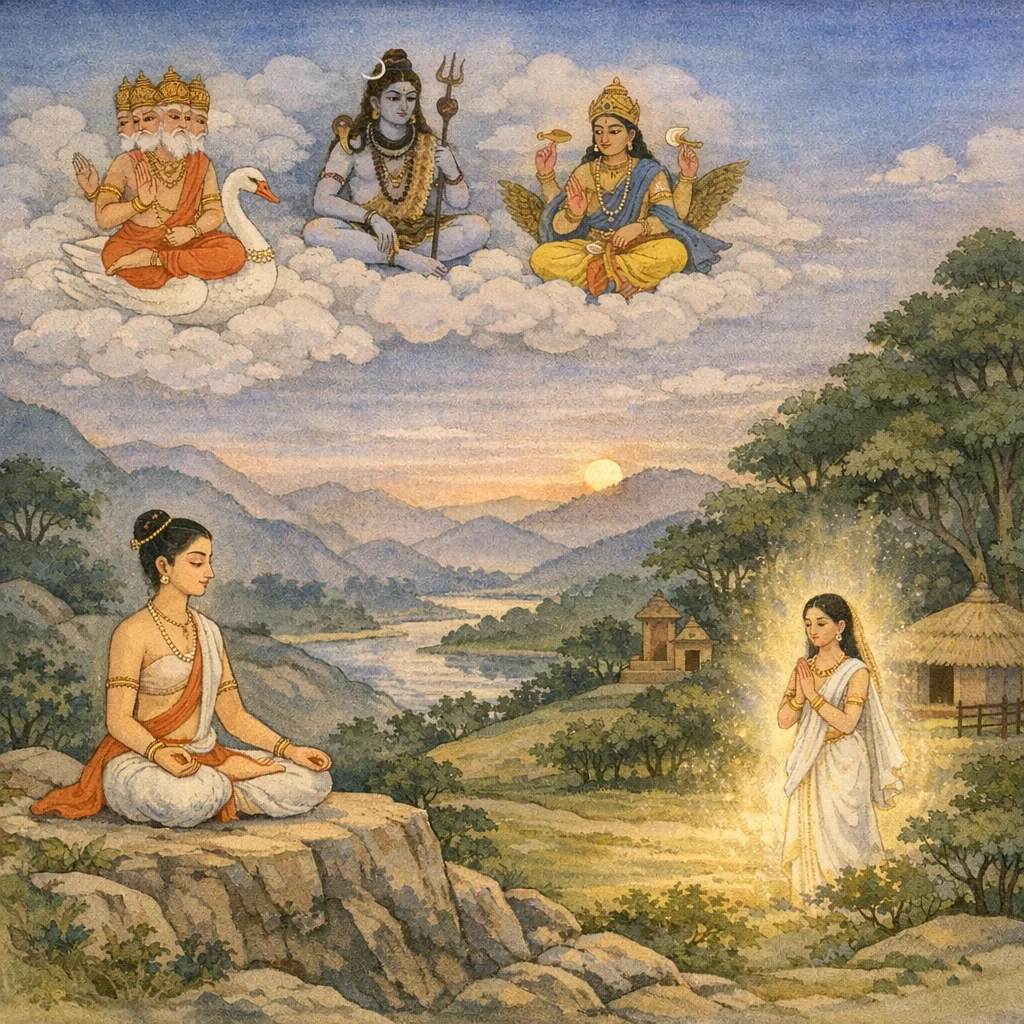
संध्याचरित्रवर्णनम् (Sandhyā-caritra-varṇana) — “Account of Sandhyā’s Story”
Adhyāya 5 is framed by Sūta’s narration of a dialogue in which Nārada, having heard the earlier events, questions Brahmā. Nārada asks specifically about Sandhyā—where she went after the mānasaputras departed to their own abodes, what she did thereafter, and to whom she was married. Brahmā, speaking as a knower of truth (tattvavit) and invoking Śaṅkara, gives a genealogical and doctrinal account: Sandhyā, Brahmā’s mind-born daughter, performed tapas, relinquished her body, and was reborn as Arundhatī. The chapter thus shifts from inquiry to an origin-narrative, linking the primordial Sandhyā to the later ideal of the pativratā, Arundhatī, and grounding this transformation in ascetic practice and divine ordinance under the directives of Brahmā–Viṣṇu–Maheśa.
Shlokas
Verse 1
सूत उवाच । इत्याकर्ण्य वचस्तस्य ब्रह्मणो मुनिसत्तमः । स मुदोवाच संस्मृत्य शंकरं प्रीतमानसः
Sūta said: Having thus heard the words of Brahmā, the best of sages—his mind lovingly pleased—remembered Śaṅkara and then spoke with joy.
Verse 2
नारद उवाच । ब्रह्मन् विधे महाभाग विष्णुशिष्य महामते । अद्भुता कथिता लीला त्वया च शशिमौलिनः
Nārada said: “O Brahman, O Vidhe the Creator, O greatly fortunate one—O wise disciple of Viṣṇu—an astonishing divine play (līlā) of the Moon-crested Lord (Śiva) has indeed been narrated by you.”
Verse 3
गृहीतदारे मदने हृष्टे हि स्वगृहे गते । दक्षे च स्वगृहं याते तथा हि त्वयि कर्तरि
When Kāma (Madanā), delighted after taking up his task, returned to his own abode, and when Dakṣa too went back to his home—so also, O Doer (Śiva), You remained the sovereign agent behind all that occurred.
Verse 4
मानसेषु च पुत्रेषु गतेषु स्वस्वधामसु । संध्या कुत्र गता सा च ब्रह्मपुत्री पितृप्रसूः
When the mind-born sons had departed to their own abodes, Brahmā wondered: “Where has Sandhyā gone—she who is Brahmā’s daughter and the mother of the Pitṛs?”
Verse 5
इति श्रीशिवमहापुराणे द्वितीयायां रुद्रसंहितायां द्वितीये सतीखण्डे संध्याचरित्रवर्णनो नाम पंचमोऽध्यायः
Thus ends the fifth chapter, called “The Description of the Narrative of Sandhyā,” in the second Rudra Saṃhitā of the Śrī Śiva Mahāpurāṇa, within the second section known as the Satī Khaṇḍa.
Verse 6
सूत उवाच । इत्याकर्ण्य वचस्तस्य ब्रह्मपुत्रश्च धीमतः । संस्मृत्य शंकरं सक्त्या ब्रह्मा प्रोवाच तत्त्ववित्
Sūta said: Hearing those words, the wise son of Brahmā (Nārada) recalled Śaṅkara with focused inner power; then Brahmā, the knower of truth, spoke.
Verse 7
ब्रह्मोवाच । शृणु त्वं च मुने सर्वं संध्यायाश्चरितं शुभम् । यच्छ्रुत्वा सर्वकामिन्यस्साध्व्यस्स्युस्सर्वदा मुने
Brahmā said: O sage, listen to the entire auspicious account of Sandhyā. Hearing it, O sage, women of every aspiration become ever virtuous and steadfast in dharma.
Verse 8
सा च संध्या सुता मे हि मनोजाता पुराऽ भवत् । तपस्तप्त्वा तनुं त्यक्त्वा सैव जाता त्वरुंधती
“That Sandhyā was indeed my daughter, formerly born from my mind. Having performed austerities and then relinquished that body, she herself was born again as the chaste Arundhatī.”
Verse 9
मेधातिथेस्सुता भूत्वा मुनिश्रेष्ठस्य धीमती । ब्रह्मविष्णुमहेशानवचनाच्चरितव्रता
Becoming the wise daughter of the foremost sage Medhātithi, she faithfully undertook her vowed observances in accordance with the instruction of Brahmā, Viṣṇu, and Maheśāna (Śiva).
Verse 10
वव्रे पतिं महात्मानं वसिष्ठं शंसितव्रतम् । पतिव्रता च मुख्याऽभूद्वंद्या पूज्या त्वभीषणा
She chose as her husband the great-souled Vasiṣṭha, renowned for his praised observances. Becoming foremost among devoted wives (pativratā), she became worthy of reverence and worship, and formidable in spiritual power.
Verse 12
नारद उवाच । कथं तया तपस्तप्तं किमर्थं कुत्र संध्यया । कथं शरीरं सा त्यक्त्वाऽभवन्मेधातिथेः सुता । कथं वा विहितं देवैर्ब्रह्मविष्णुशिवैः पतिम् । वसिष्ठं तु महात्मानं संवव्रे शंसितव्रतम्
Nārada said: “How did she perform austerity, for what purpose, and at which sacred sandhyā (junction-time/place)? How did she abandon her body and become the daughter of Medhātithi? And how did the gods—Brahmā, Viṣṇu, and Śiva—ordain a husband for her, so that she chose the great-souled Vasiṣṭha, renowned for his praised vows?”
Verse 13
एतन्मे श्रोष्यमाणाय विस्तरेण पितामह । कौतूहलमरुंधत्याश्चरितं ब्रूहि तत्त्वतः
O Grandfather, as I am eager to hear, please narrate to me in detail, in accordance with the truth, the wondrous account of Arundhatī that has arisen as a matter of great curiosity.
Verse 14
ब्रह्मोवाच । अहं स्वतनयां संध्यां दृष्ट्वा पूर्वमथात्मनः । कामायाशु मनोऽकार्षं त्यक्त्वा शिवभयाच्च सा
Brahmā said: “Earlier, on seeing my own daughter Sandhyā, my mind—alas—was quickly drawn toward desire. But she, out of fear of Śiva, abandoned that situation and withdrew.”
Verse 15
संध्यायाश्चलितं चित्तं कामबाणविलोडितम् । ऋषीणामपि संरुद्धमानसानां महात्मनाम्
At twilight (sandhyā), the mind, churned and stirred by the arrows of Kāma, can become unsteady—even in great-souled sages whose inner faculties are well restrained.
Verse 16
भर्गस्य वचनं श्रुत्वा सोपहासं च मां प्रति । आत्मनश्चलितत्वं वै ह्यमर्यादमृषीन्प्रति
Hearing Bharga’s words—uttered with ridicule toward me—I perceived within myself a wavering of composure, and I saw a breach of propriety in the manner the sages were being treated.
Verse 17
कामस्य तादृशं भावं मुनिमोहकरं मुहुः । दृष्ट्वा संध्या स्वयं तत्रोपयमायातिदुःखिता
Seeing again and again such a state of Kāma—one that could bewilder even sages—Saṃdhyā herself, distressed, came there and sought refuge, asking for protection.
Verse 18
ततस्तु ब्रह्मणा शप्ते मदने च मया मुने । अंतर्भूते मयि शिवे गते चापि निजास्पदे
Then, O sage, when Kāma had been cursed by Brahmā and also by me, he entered into me; and I, Śiva, returned to my own abode.
Verse 19
आमर्षवशमापन्ना सा संध्या मुनिसत्तम । मम पुत्री विचार्यैवं तदा ध्यानपराऽभवत्
O best of sages, that Sandhyā, overcome by indignation, reflected in this way; and then my daughter became wholly intent on meditation.
Verse 20
ध्यायंती क्षणमेवाशु पूर्वं वृत्तं मनस्विनी । इदं विममृशे संध्या तस्मिन्काले यथोचितम्
The resolute lady Satī quickly contemplated for a moment what had happened earlier; then, at that very time, she thoughtfully decided upon what was proper and fitting to do.
Verse 21
संध्योवाच । उत्पन्नमात्रां मां दृष्ट्वा युवतीं मदनेरितः । अकार्षित्सानुरागोयमभिलाषं पिता मम
Sandhyā said: “The very moment I came into being, my father—stirred by Kāma, the god of desire—beheld me as a young woman and was seized by a longing laden with attachment.”
Verse 22
पश्यतां मानसानां च मुनीनां भावितात्मनाम् । दृष्ट्वैव माममर्यादं सकाममभवन्मनः
Even as those sages—masters of disciplined mind and inward contemplation—looked on, the instant they saw me acting without due restraint, their minds were stirred by desire.
Verse 24
फलमेतस्य पापस्य मदनस्स्वयमाप्तवान् । यस्तं शशाप कुपितः शंभोरग्रे पितामहः
Kāma (Madana) himself received the fruit of this sinful act; for Pitāmaha (Brahmā), angered in the presence of Śambhu (Śiva), pronounced a curse upon him.
Verse 26
यन्मां पिता भ्रातरश्च सकाममपरोक्षतः । दृष्ट्वा चक्रुस्स्पृहां तस्मान्न मत्तः पापकृत्परा
Seeing me directly, my father and my brothers—stirred by worldly desire—began to gaze upon me with covetous intent. Therefore, none is more sinful than I.
Verse 27
ममापि कामभावोभूदमर्यादं समीक्ष्य तान् । पत्या इव स्वकेताते सर्वेषु सहजेष्वषि
Seeing them act without restraint, desire arose even within me; and as though they were my own husbands, my heart turned inwardly toward all those companions as well.
Verse 28
करिष्यारम्यस्य पापस्य प्रायश्चित्तमहं स्वयम् । आत्मानमग्नौ होष्यामि वेदमार्गानुसारत
“For the sin I am about to commit, I myself shall be the expiation. Following the path enjoined by the Vedas, I shall offer my own self into the sacred fire.”
Verse 29
किं त्वेकां स्थापयिष्यामि मर्यादामिह भूतले । उत्पन्नमात्रा न यथा सकामास्स्युश्शरीरिणः
Yet I shall establish one boundary here upon the earth: that embodied beings, the moment they are born, should not become driven by desire and pleasure-seeking.
Verse 30
एतदर्थमहं कृत्वा तपः परम दारुणम् । मर्यादां स्थापयिष्यामि पश्चात्त्यक्षामि जीवितम्
“For this very purpose I shall perform exceedingly fierce austerities. I will establish the proper boundary of dharma, and thereafter I shall relinquish this life.”
Verse 31
यस्मिञ्च्छरीरे पित्रा मे ह्यभिलाषस्स्वयं कृतः । भातृभिस्तेन कायेन किंचिन्नास्ति प्रयोजनम्
This very body—toward which my father himself has conceived desire—what use have I for that body, or for a life sustained by it, among my brothers?
Verse 32
मया येन शरीरेण तातेषु सहजेषु च । उद्भावितः कामभावो न तत्सुकृतसाधनम्
That body of mine by which, even among those naturally related to me, the passion of desire was stirred—such a thing is no means of merit (puṇya) at all.
Verse 33
इति संचित्य मनसा संध्या शैलवरं ततः । जगाम चन्द्रभागाख्यं चन्द्रभागापगा यतः
Having thus resolved in her mind, Sandhyā then departed from that excellent mountain and went to the place called Candrabhāgā—where the river Candrabhāgā flows.
Verse 34
अथ तत्र गतां ज्ञात्वा संध्यां गिरिवरं प्रति । तपसे नियतात्मानं ब्रह्मावोचमहं सुतम्
Then Brahmā, learning that Sandhyā had gone there toward the foremost mountain—her mind restrained and intent on austerity—spoke to me, his son.
Verse 35
वशिष्ठं संयतात्मानं सर्वज्ञं ज्ञानयोगिनम् । समीपे स्वे समासीनं वेदवेदाङ्गपारगम्
Nearby sat Vasiṣṭha—self-controlled, all-knowing, a yogin established in the path of knowledge—seated close at hand, and fully accomplished in the Vedas and their ancillary sciences.
Verse 36
ब्रह्मोवाच । वसिष्ठ पुत्र गच्छ त्वं संध्यां जातां मनस्विनीम् । तपसे धृतकामां च दीक्षस्वैनां यथा विधि
Brahmā said: “O son of Vasiṣṭha, go to Sandhyā—now resolute and strong-minded, who has firmly chosen the path of tapas. Initiate her for austerity according to the prescribed rite.”
Verse 37
मंदाक्षमभवत्तस्याः पुरा दृष्ट्वैव कामुकान् । युष्मान्मां च तथात्मानं सकामां मुनिसत्तम
O best of sages, formerly—on merely seeing those driven by lust—her gaze would fall; and she regarded you, me, and even her own self as still tainted by desire.
Verse 38
अभूतपूर्वं तत्कर्म पूर्व मृत्युं विमृश्य सा । युष्माकमात्मनश्चापि प्राणान्संत्यक्तुमिच्छति
Having reflected on that deed as something unprecedented, and having already contemplated death beforehand, she now wishes to abandon her life-breath—also because of your very selves.
Verse 39
समर्यादेषु मर्यादां तपसा स्थापयिष्यति । तपः कर्तुं गता साध्वी चन्द्रभागाख्यभूधरे
To uphold the sacred order among those who honor propriety, the virtuous Satī resolved to establish the rightful bounds through austerity; and to perform tapas she went to the mountain called Chandrabhāgā.
Verse 40
न भावं तपसस्तात सानुजानाति कंचन । तस्माद्यथोपदेशात्सा प्राप्नोत्विष्टं तथा कुरु
O dear one, no one can truly authorize or determine the inner intent and fruit of another’s austerity. Therefore, act exactly as you have been instructed, so that she may attain her desired aim.
Verse 41
इदं रूपं परित्यज्य निजं रूपांतरं मुने । परिगृह्यांतिके तस्यास्तपश्चर्यां निदर्शयन्
O sage, abandoning this form and assuming another form of His own, He stayed near her and demonstrated the disciplined power of tapas—revealing, through ascetic observance, the Śaiva path by which the soul is ripened toward Śiva’s grace.
Verse 42
इदं स्वरूपं भवतो दृष्ट्वा पूर्वं यथात्र वाम् । नाप्नुयात्साऽथ किंचिद्वै ततो रूपांतरं कुरु
Since she has already seen this very form of yours here before, she would gain nothing new from it now; therefore, assume another form.
Verse 43
ब्रह्मोवाच नारदेत्थं वसिष्ठो मे समाज्ञप्तो दयावता । यथाऽस्विति च मां प्रोच्य ययौ संध्यांतिकं मुनिः
Brahmā said: “O Nārada, thus was I instructed by the compassionate Vasiṣṭha. Having told me, ‘So be it,’ that sage then departed to perform the twilight rites (saṃdhyā).”
Verse 44
तत्र देवसरः पूर्णं गुणैर्मानससंमितम् । ददर्श स वसिष्टोथ संध्यां तत्तीरगामपि
There he beheld a divine lake, complete in auspicious qualities and comparable to the sacred Mānasa lake. Then Vasiṣṭha also saw Sandhyā, the goddess of twilight, moving along its bank.
Verse 45
तीरस्थया तया रेजे तत्सरः कमलोज्ज्वलम् । उद्यदिंदुसुनक्षत्र प्रदोषे गगनं यथा
Standing upon the bank, she made that lotus-bright lake shine forth—just as, at twilight, the sky gleams with the rising moon and the beautiful host of stars.
Verse 46
मुनिर्दृष्ट्वाथ तां तत्र सुसंभावां स कौतुकी । वीक्षांचक्रे सरस्तत्र बृहल्लोहितसंज्ञकम्
Seeing her there—so auspicious and filled with noble signs—the sage, stirred by wonder, looked about and beheld a lake known as Bṛhallohita.
Verse 47
चन्द्रभागा नदी तस्मात्प्राकाराद्दक्षिणांबुधिम् । यांती सा चैव ददृशे तेन सानुगिरेर्महत्
From that rampart, the river Candrabhāgā flowed southward toward the ocean. As it went, she beheld—together with the surrounding mountains—a vast and majestic landscape.
Verse 48
निर्भिद्य पश्चिमं सा तु चन्द्रभागस्य सा नदी । यथा हिमवतो गंगा तथा गच्छति सागरम्
Breaking through toward the western direction, that river—Candrabhāgā—flows onward. Just as the Gaṅgā that springs from Himavat reaches the ocean, so too does she proceed to the sea.
Verse 49
तस्मिन् गिरौ चन्द्रभागे बृहल्लोहिततीरगाम् । संध्यां दृष्ट्वाथ पप्रच्छ वसिष्ठस्सादरं तदा
There, on that mountain in the region called Candrabhāgā, Vasiṣṭha saw Sandhyā approaching from the bank of the river Bṛhallohita; and then, with reverence, he questioned her.
Verse 50
वशिष्ठ उवाच । किमर्थमागता भद्रे निर्जनं त्वं महीधरम् । कस्य वा तनया किं वा भवत्यापि चिकीर्षितम्
Vasiṣṭha said: “O auspicious lady, for what purpose have you come to this solitary mountain? Whose daughter are you, and what indeed do you intend to do?”
Verse 51
एतदिच्छाम्यहं श्रोतुं वद गुह्यं न चेद्भवेत् । वदनं पूर्णचन्द्राभं निश्चेष्टं वा कथं तव
I long to hear this—tell me, if it is not to be kept secret. How has your face, radiant like the full moon, become still, unmoving, and without expression?
Verse 52
ब्रह्मोवाच । तच्छ्रुत्वा वचनं तस्य वशिष्ठस्य महात्मनः । दृष्ट्वा च तं महात्मानं ज्वलंतमिव पावकम्
Brahmā said: Having heard the words of the great-souled Vasiṣṭha, and seeing that noble sage blazing like fire, they were filled with awe and listened with rapt attention.
Verse 53
शरीरधृग्ब्रह्मचर्यं विलसंतं जटाधरम् । सादरं प्रणिपत्याथ संध्योवाच तपोधनम्
Seeing that ascetic—radiant in the vow of brahmacarya, bearing matted locks, and sustaining the body with disciplined restraint—Sandhyā bowed down with reverence to that treasure-house of austerity, and then spoke.
Verse 54
संध्योवाच । यदर्थमागता शैलं सिद्धं तन्मे निबोध ह । तव दर्शनमात्रेण यन्मे सेत्स्यति वा विभो
Sandhyā said: “O mighty Lord, please tell me clearly what purpose has brought you to this accomplished mountain. By the mere sight of you, what is it that will now be fulfilled for me, O Vibhū?”
Verse 55
तपश्चर्तुमहं ब्रह्मन्निर्जनं शैलमागता । ब्रह्मणोहं सुता जाता नाम्ना संध्येति विश्रुता
“O Brahman, I have come to this solitary mountain to perform austerities (tapas). I am born as the daughter of Brahmā, and I am renowned by the name Sandhyā.”
Verse 56
यदि ते युज्यते सह्यं मां त्वं समुपदेशय । एतच्चिकीर्षितं गुह्यं नान्यैः किंचन विद्यते
If it is fitting and acceptable to you, then instruct me fully. This intention of mine is secret—nothing of it is known to others.
Verse 57
अज्ञात्वा तपसो भावं तपोवनमुपाश्रिता । चिंतया परिशुष्येहं वेपते हि मनो मम
Not understanding the true spirit of austerity, I have taken refuge in this forest of penance. Yet here I wither away through anxious thought, and my mind indeed trembles.
Verse 58
ब्रह्मोवाच । आकर्ण्य तस्या वचनं वसिष्ठो ब्रह्मवित्तमः । स्वयं च सर्वकृत्यज्ञो नान्यत्किंचन पृष्टवान्
Brahmā said: Having heard her words, Vasiṣṭha—foremost among the knowers of Brahman—himself fully versed in all duties and rites, asked her nothing further.
Verse 59
अथ तां नियतात्मानं तपसेति धृतोद्यमाम् । प्रोवाच मनसा स्मृत्वा शंकरं भक्तवत्सलम्
Then, seeing her self-controlled and firmly resolved to undertake austerities, Dakṣa spoke—after inwardly remembering Śaṅkara, the Lord ever tender to His devotees.
Verse 60
वसिष्ठ उवाच । परमं यो महत्तेजः परमं यो महत्तपः । परमः परमाराध्यः शम्भुर्मनसि धार्यताम्
Vasiṣṭha said: Let Śambhu be held within the mind—He who is supremely radiant, supremely austere, the Highest, and the One most worthy of all worship.
Verse 61
धर्मार्थकाममोक्षाणां य एकस्त्वादिकारणम् । तमेकं जगतामाद्यं भजस्व पुरुषोत्तमम्
Worship that one Supreme Person, the sole primordial cause of dharma, artha, kāma, and mokṣa—He who is the single, original source of all worlds.
Verse 62
मंत्रेणानेन देवेशं शम्भुं भज शुभानने । तेन ते सकला वाप्तिर्भविष्यति न संशयः
O fair-faced one, worship Śambhu—the Lord of the gods—by this very mantra. Through it, you will surely attain complete fulfilment and all desired attainments; of this there is no doubt.
Verse 63
ॐ नमश्शंकरायेति ओंमित्यंतेन सन्ततम् । मौनतपस्याप्रारंम्भं तन्मे निगदतः शृणु
“‘Om—obeisance to Śaṅkara’: with ‘Om’ as the concluding seal, repeat it continually. Now listen as I declare to you the commencement of the austerity of silence (mauna-tapas), by which the mind becomes fit for Śiva’s grace.”
Verse 64
स्नानं मौनेन कर्तव्यं मौनेन हरपूजनम् । द्वयोः पूर्णजलाहारं प्रथमं षष्ठकालयोः
Bathing should be performed in silence, and in silence the worship of Hara (Śiva) should be done. On both (occasions), one should take only a complete water-diet—at the first and at the sixth time-periods (of the day).
Verse 65
तृतीये षष्ठकाले तु ह्युपवासपरो भवेत् । एवं तपस्समाप्तौ वा षष्ठे काले क्रिया भवेत्
In the third phase, at the sixth appointed time, one should be devoted to fasting. Thus, when the discipline of austerity is concluded, the ritual observance should be performed at the sixth time as well.
Verse 66
एवं मौनतपस्याख्या ब्रह्मचर्यफलप्रदा । सर्वाभीष्टप्रदा देवि सत्यंसत्यं न संशयः
Thus, O Goddess, this discipline known as the austerity of silence bestows the fruit of brahmacarya—chaste self-restraint. It grants every cherished aim; this is truth—truth indeed—there is no doubt.
Verse 67
एवं चित्ते समुद्दिश्य कामं चिंतय शंकरम् । स ते प्रसन्न इष्टार्थमचिरादेव दास्यति
Thus, steady your mind in this way, set aside worldly desire, and contemplate Śaṅkara. When He is pleased with you, He will swiftly grant your cherished aim.
Verse 68
ब्रह्मोवाच । उपविश्य वसिष्ठोथ संध्यायै तपसः क्रियाम् । तामाभाष्य यथान्यायं तत्रैवांतर्दधे मुनिः
Brahmā said: Then Vasiṣṭha, having sat down, performed the austerity-laden rite of the Sandhyā (twilight worship). Having duly instructed (her) in that practice according to proper rule, the sage disappeared from that very place.
Frequently Asked Questions
The chapter explains Sandhyā’s subsequent fate and identity-change: after tapas and relinquishing her body, she is said to be reborn as Arundhatī, establishing an etiological link between primordial Sandhyā and the later exemplary wife-figure.
It presents tapas as a mechanism of ontological refinement and re-situation: a being’s form and role can be reconfigured to embody dharmic exemplarity, with divine sanction (Brahmā–Viṣṇu–Maheśa) anchoring the transformation.
Śiva is highlighted through epithets (Śaṅkara, Śaśimauli) and as the devotional reference-point invoked before authoritative teaching; Brahmā appears as the tattvavit narrator; Nārada functions as the epistemic catalyst through questioning.