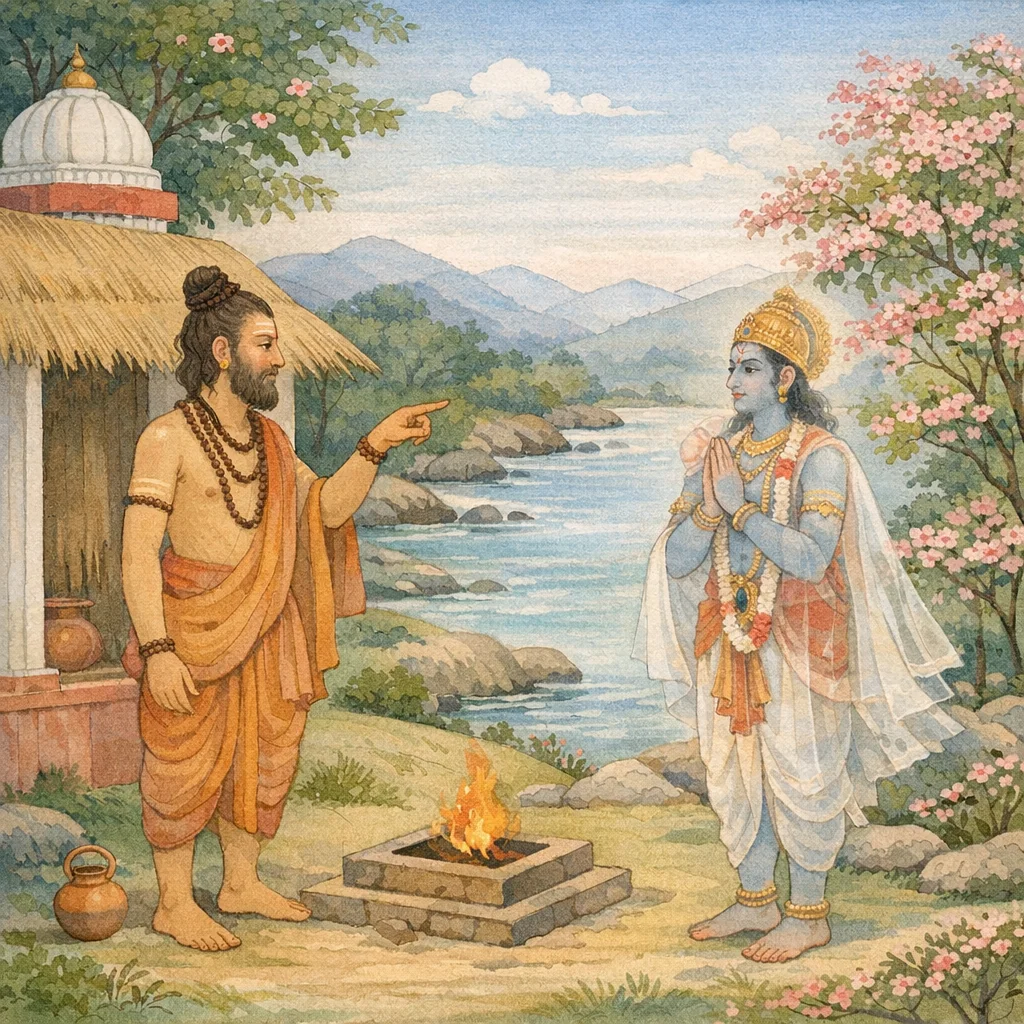
दधीचाश्रमगमनम् — Viṣṇu’s Disguise and Dadhīca’s Fearlessness (Kṣu’s Request)
Adhyāya 39 recounts a dialogue at the āśrama of the sage Dadhīca. Brahmā explains that, in connection with the affair of King Kṣu, a deity comes to Dadhīca disguised as a brāhmaṇa—an instance of divine chala, strategic concealment. The visitor is Viṣṇu (Janārdana/Hari), who asks for a boon. Dadhīca, foremost among Śaiva devotees, immediately perceives the disguise and exposes it through Rudra’s grace and knowledge of the three times (past, present, future). He urges Viṣṇu to abandon deception, reveal his true form, and remember Śaṅkara. Dadhīca then frames the encounter as a test of fear and integrity: devoted to Śiva’s worship and remembrance, he declares himself fearless even before gods and daityas, and invites the visitor to state any apprehension truthfully. The chapter contrasts political expediency (Kṣu’s “khalabuddhi”) with the spiritual authority of a Śaiva ṛṣi whose jñāna and abhaya arise from Rudra’s prasāda, preparing for the ensuing boon-discussion and its ethical-theological implications.
Shlokas
Verse 1
ब्रह्मोवाच । क्षुवस्य हितकृत्येन दधीचस्याश्रमं ययौ । विप्ररूपमथास्थाय भगवान् भक्तवत्सलः
Brahmā said: For the welfare of Kṣuva, the Blessed Lord—ever tender toward His devotees—went to the hermitage of Dadhīci, assuming the form of a brāhmaṇa.
Verse 2
दधीचं प्राह विप्रर्षिमभिवंद्य जगद्गुरुः । क्षुवकार्य्यार्थमुद्युक्तश्शैवेन्द्रं छलमाश्रितः
Having respectfully saluted the brahmin-sage Dadhīci, the Jagadguru addressed him. Intent on accomplishing his own purpose, Indra—foe of the Daityas—resorted to a stratagem.
Verse 3
विष्णुरुवाच । भो भो दधीच विप्रर्षे भवार्चनरताव्यय । वरमेकं वृणे त्वत्तस्तद्भवान् दातुमर्हति
Viṣṇu said: “O revered sage Dadhīci, O best of brāhmaṇas—ever steadfast and unwavering in the worship of Bhava (Lord Śiva)—I ask of you one boon. May you be pleased to grant it to me.”
Verse 4
ब्रह्मोवाच । याचितो देवदेवेन दधीचश्शैवसत्तमः । क्षुवकार्यार्थिना शीघ्रं जगाद वचनं हरिम्
Brahmā said: When the best of Śaivas, the sage Dadhīci, was entreated by the God of gods, he swiftly spoke words to Hari (Viṣṇu), who had come seeking help for the task at hand.
Verse 5
दधीच उवाच । ज्ञातं तवेप्सितं विप्र क्षुवकार्यार्थमागतः । भगवान् विप्ररूपेण मायी त्वमसि वै हरिः
Dadhīca said: “O Brahmin, I have understood what you seek—you have come here for the barber’s task. Truly, you are Bhagavān Hari (Viṣṇu) himself, the wondrous wielder of māyā, appearing in the form of a Brahmin.”
Verse 6
भूतं भविष्यं देवेश वर्तमानं जनार्दन । ज्ञानं प्रसादाद्रुद्रस्य सदा त्रैकालिकं मम
O Lord of the gods, O Janārdana—through the grace of Rudra, my knowledge is ever threefold in time: it comprehends the past, the future, and the present.
Verse 7
त्वां जानेहं हरिं विष्णुं द्विजत्वं त्यज सुव्रत । आराधितोऽसि भूपेन क्षुवेण खलबुद्धिना
“I know you to be Hari—Vishnu. O man of good vows, give up this guise of a brāhmaṇa. You have been propitiated and summoned by the king Kṣuva, whose mind is wicked.”
Verse 8
जाने तवैव भगवन् भक्तवत्सलतां हरे । छलं त्यज स्वरूपं हि स्वीकुरु स्मर शंकरम्
O Lord, O Hari, I know well Your tender love for Your devotees. Therefore abandon this disguise; truly assume Your own form and remember Śaṅkara.
Verse 9
अस्ति चेत्कस्यचिद्भीतिर्भवार्चनरतस्य मे । वक्तुमर्हसि यत्नेन सत्यधारणपूर्वकम्
If there is any fear at all for me—who am devoted to the worship of Bhava (Lord Śiva)—then you should tell it to me with care, first grounding your words in truth and steadfastness.
Verse 10
वदामि न मृषा क्वापि शिवस्मरणसक्तधीः । न बिभेमि जगत्यस्मिन्देवदैत्यादिकादपि
I speak no falsehood at any time. With my mind absorbed in remembrance of Śiva, I fear nothing in this world—not even gods, demons, and the like.
Verse 11
विष्णुरुवाच । भयं दधीच सर्वत्र नष्टं च तव सुव्रत । भवार्चनरतो यस्माद्भवान्सर्वज्ञ एव च
Viṣṇu said: “O Dadhīca, man of noble vow—your fear has been dispelled everywhere. Since you are devoted to the worship of Bhava (Lord Śiva), you are indeed all-knowing.”
Verse 12
बिभेमीति सकृद्वक्तुमर्हसि त्वं नमस्तव । नियोगान्मम राजेन्द्र क्षुवात् प्रतिसहस्य च
“You need only say once, ‘I am afraid’—I bow to you. O king of lords, it is because of my appointed duty, and also due to the sneeze and the laughter that arose.”
Verse 13
ब्रह्मोवाच । एवं श्रुत्वापि तद्वाक्यं विष्णोस्स तु महामुनिः । विहस्य निर्भयः प्राह दधीचश्शैवसत्तमः
Brahmā said: Even after hearing those words of Viṣṇu, the great sage Dadhīca—best among the devotees of Śiva—laughed, and, fearless, spoke.
Verse 14
दधीच उवाच । न बिभेमि सदा क्वापि कुतश्चिदपि किंचन । प्रभावाद्देवदेवस्य शंभोस्साक्षात्पिनाकिनः
Dadhīca said: “I never fear anything—anywhere, at any time, from anyone—because of the manifest might of Śambhu, the God of gods, the very Pinākin, bearer of the bow Pināka.”
Verse 15
ब्रह्मोवाच । ततस्तस्य मुनेः श्रुत्वा वचनं कुपितो हरिः । चक्रमुद्यम्य संतस्थौ दिधक्षुमुनिसत्तमम्
Brahmā said: Then, having heard the words of that sage, Hari (Viṣṇu) became enraged. Lifting up his discus, he stood poised, intent on burning the excellent sage.
Verse 16
अभवत्कुंठितं तत्र विप्रे चक्रं सुदारुणम् । प्रभावाच्च तदीशस्य नृपतेस्संनिधावपि
O brāhmaṇa, there even that exceedingly fierce discus became blunted—such was the overpowering might of that Lord—even in the very presence of the king.
Verse 17
दृष्ट्वा तं कुंठितास्यं तच्चक्रं विष्णुं जगाद ह । दधीचस्सस्मितं साक्षात्सदसद्व्यक्ति कारणम्
Seeing Viṣṇu with his discus and his face fallen in frustration, the sage Dadhīca—smiling—addressed him. In truth, Dadhīca was the manifest instrument through which the Supreme Cause brings forth both the existent and the non-existent (the seen and the unseen).
Verse 18
दधीच उवाच । भगवन् भवता लब्धं पुरातीव सुदारुणम् । सुदर्शनमिति ख्यातं चक्रं विष्णोः प्रयत्नतः । भवस्य तच्छुभं चक्रं न जिघांसति मामिह
Dadhīci said: “O revered one, long ago you obtained—by great effort—the exceedingly formidable discus of Viṣṇu, famed as Sudarśana. Yet that auspicious discus, belonging to Bhava (Lord Śiva), will not slay me here.”
Verse 19
भगवानथ क्रुद्धोऽस्मै सर्वास्त्राणि क्रमाद्धरिः । ब्रह्मास्त्राद्यैः शरैश्चास्त्रैः प्रयत्नं कर्तुमर्हसि
Then the Blessed Lord Hari, angered at him, successively employed all divine missiles—beginning with the Brahmāstra—along with weapon-like arrows, striving with full effort to subdue him.
Verse 20
ब्रह्मोवाच । स तस्य वचनं श्रुत्वा दृष्ट्वा नि्र्वीर्य्यमानुषम् । ससर्जाथ क्रुधा तस्मै सर्वास्त्राणि क्रमाद्धरिः
Brahmā said: Hearing his words and seeing that man bereft of strength, Hari (Viṣṇu), in anger, then released against him—one after another—all his divine weapons.
Verse 21
चक्रुर्देवास्ततस्तस्य विष्णोस्साहाय्यमादरात् । द्विजेनैकेन संयोद्धुं प्रसृतस्य विबुद्धयः
Then the gods, those enlightened ones, reverently sought the aid of Viṣṇu, to meet in battle that brāhmaṇa who had advanced forth to fight.
Verse 22
चिक्षिपुः स्वानि स्वान्याशु शस्त्राण्यस्त्राणि सर्वतः । दधीचोपरि वेगेन शक्राद्या हरिपाक्षिकाः
Then Śakra (Indra) and the other gods—aligned with Hari’s side—swiftly hurled their own weapons and missiles from every direction, surging with force toward Dadhīci.
Verse 23
कुशमुष्टिमथादाय दधीचस्संस्मरन् शिवम् । ससर्ज सर्वदेवेभ्यो वज्रास्थि सर्वतो वशी
Then Dadhīca, taking a fistful of kuśa grass and remembering Lord Śiva, the sage who had mastered himself, bestowed upon all the gods his own bones—fit to become the vajra, the thunderbolt.
Verse 24
शंकरस्य प्रभावात्तु कुशमुष्टिर्मुनेर्हि सा । दिव्यं त्रिशूलमभवत् कालाग्निसदृशं मुने
But through Śaṅkara’s divine power, that fistful of the sage’s kuśa grass became a celestial trident, blazing like the fire of Time (kālāgni), O sage.
Verse 25
दग्धुं देवान् मतिं चक्रे सायुधं सशिखं च तत् । प्रज्वलत्सर्वतश्शैवं युगांताग्र्यधिकप्रभम्
He resolved to burn the gods. That Śaiva power then became armed and flame-crested, blazing on every side with a radiance surpassing even the foremost fire at the end of the age.
Verse 26
नारायणेन्दुमुख्यैस्तु देवैः क्षिप्तानि यानि च । आयुधानि समस्तानि प्रणेमुस्त्रिशिखं च तत्
Then all the weapons hurled by the gods—led by Nārāyaṇa and Indu—bowed down in reverence; and that tri-pointed emblem, the Triśikha, likewise paid obeisance.
Verse 27
देवाश्च दुद्रुवुस्सर्वे ध्वस्तवीर्या दिवौकसः । तस्थौ तत्र हरिर्भीतः केवलं मायिनां वरः
All the gods—heaven-dwellers whose prowess had been shattered—fled in rout. There, Hari (Viṣṇu) alone remained, standing in fear, though famed as the foremost among those who wield māyā.
Verse 28
ससर्ज भगवान् विष्णुः स्वदेहात्पुरुषोत्तमः । आत्मनस्सदृशान् दिव्यान् लक्षलक्षायुतान् गणान्
Then Bhagavān Viṣṇu, the Supreme Person (Puruṣottama), emanated from his own body vast hosts of divine attendants—multitudes upon multitudes—each resembling him in form and splendor.
Verse 29
ते चापि युयुधुस्तत्र वीरा विष्णुगणास्ततः । मुनिनैकेन देवर्षे दधीचेन शिवात्मना
There, those heroic attendants of Viṣṇu also fought. Yet they were opposed by a single sage—the divine seer Dadhīci—whose very self was established in Śiva.
Verse 30
ततो विष्णुगणान् तान्वै नियुध्य बहुशो रणे । ददाह सहसा सर्वान् दधी चश्शैव सत्तमः
Then, after repeatedly engaging those attendants of Viṣṇu in battle, the foremost among the Śaivas suddenly burned them all, reducing them to ashes.
Verse 31
ततस्तद्विस्मयाथाय दधीचेस्य मुनेर्हरिः । विश्वमूर्तिरभूच्छीघ्रं महामायाविशारदः
Then, to awaken wonder in the sage Dadhīci, Hari—adept in the workings of the great Māyā—swiftly assumed the form of the universe itself, manifesting as Viśvarūpa.
Verse 32
तस्य देहे हरेः साक्षादपश्यद्द्विजसत्तमः । दधीचो देवतादीनां जीवानां च सहस्रकम्
Within Hari’s very body, Dadhīci—the foremost of brāhmaṇas—directly beheld Hari Himself, and also a thousand living beings, beginning with the gods.
Verse 33
भूतानां कोटयश्चैव गणानां कोटयस्तथा । अंडानां कोटयश्चैव विश्वमूतस्तनौ तदा
At that time, within His very body were crores upon crores of beings, crores upon crores of Śiva’s gaṇas, and crores upon crores of cosmic eggs (universes)—indeed, the whole universe was contained in Him.
Verse 34
दृष्ट्वैतदखिलं तत्र च्यावनिस्सततं तदा । विष्णुमाह जगन्नाथं जगत्स्तु वमजं विभुम्
Having seen all this, the sage Cyāvana continually addressed Viṣṇu—Jagannātha, Lord of the universe—the mighty, unborn One, the subtle foundation in which the world abides.
Verse 35
दधीच उवाच । मायां त्यज महाबाहो प्रतिभासो विचारतः । विज्ञातानि सहस्राणि दुर्विज्ञेयानि माधव
Dadhīci said: “O mighty-armed one, abandon Māyā. On careful inquiry, the world is seen to be only an appearance. O Mādhava, though thousands of things may be ‘known’, the truly subtle truth remains difficult to know.”
Verse 36
मयि पश्य जगत्सर्वं त्वया युक्तमतंद्रितः । ब्रह्माणं च तथा रुद्रं दिव्यां दृष्टिं ददामि ते
Be united with Me and, without negligence, behold the entire universe within Me. I grant you the divine vision by which you shall also perceive Brahmā and Rudra.
Verse 37
ब्रह्मोवाच । इत्युक्त्वा दर्शयामास स्वतनौ निखिलं मुनिः । ब्रह्मांडं च्यावनिश्शंभुतेजसा पूर्णदेहकः
Brahmā said: Having spoken thus, the sage then revealed, within his own body, the entire cosmos. And by the radiance of Śambhu, he caused the Brahmāṇḍa (cosmic egg) to move and shift—he whose body had become complete, filled with that divine power.
Verse 38
ददाह विष्णुं देवेशं दधीचश्शैवसत्तमः । संस्मरञ् शंकरं चित्ते विहसन् विभयस्सुधीः
That best of Śaivas, the sage Dadhīca, burned even Viṣṇu—the Lord of the gods—while remembering Śaṅkara within his heart; the wise one laughed, utterly fearless.
Verse 39
इति श्रीशिवमहापुराणे द्वितीयायां रुद्रसंहितायां द्वितीये सतीखण्डे विष्णुदधीचयुद्धवर्णनो नाम नवत्रिंशोऽध्यायः
Thus ends the thirty-ninth chapter, called “The Description of the Battle between Viṣṇu and Dadhīci,” in the second section of the Śrī Śiva Mahāpurāṇa—within the second (Rudra) Saṃhitā, in the second subdivision known as the Satī Khaṇḍa.
Verse 40
ब्रह्मोवाच । एतच्छुत्वा मुनेस्तस्य वचनं निर्भयस्तदा । शंभुतेजोमयं विष्णुश्चुकोपातीव तं मुनिम्
Brahmā said: Hearing the words spoken by that sage, Viṣṇu—then fearless and filled with the fiery splendour of Śambhu (Śiva)—became exceedingly angry with the muni.
Verse 41
देवाश्च दुद्रुवुर्भूयो देवं नारायणं च तम् । योद्धुकामाश्च मुनिना दधीचेन प्रतापिना
Then the gods again hurried to that Lord Nārāyaṇa, for they desired to wage battle against the mighty sage Dadhīci, blazing with spiritual power.
Verse 42
एतस्मिन्नंतरे तत्रागमन्मत्संगतः क्षुवः । अवारयंतं निश्चेष्टं पद्मयोनिं हरिं सुरान्
Meanwhile, at that very moment, Kṣuva—who was in my company—arrived there. He restrained them: the lotus-born Brahmā, Hari (Viṣṇu), and the gods, who had become motionless and powerless.
Verse 43
निशम्य वचनं मे हि ब्राह्मणो न विनिर्जितः । जगाम निकटं तस्य प्रणनाम मुनिं हरिः
Hearing my words, that brāhmaṇa was not overcome by pride or agitation. Then Hari went close to him and bowed down to the sage.
Verse 44
क्षुवो दीनतरो भूत्वा गत्वा तत्र मुनीश्वरम् । दधीचमभिवाद्यैव प्रार्थयामास विक्लवः
Kṣuva, becoming even more distressed, went there to the lordly sage. Having bowed at once to Dadhīci, he began to implore him, shaken and anxious.
Verse 45
क्षुव उवाच । प्रसीद मुनिशार्दूल शिवभक्तशिरोमणे । प्रसीद परमेशान दुर्लक्ष्ये दुर्जनैस्सह
Kṣuva said: “Be gracious, O tiger among sages, O crest-jewel among the devotees of Śiva. Be gracious, O Parameśāna, Supreme Lord—hard to be perceived, even amid the company of the wicked.”
Verse 46
ब्रह्मोवाच । इत्याकर्ण्य वचस्तस्य राज्ञस्सुरगणस्य हि । अनुजग्राह तं विप्रो दधीचस्तपसां निधिः
Brahmā said: Hearing the words of that king, lord of the hosts of gods, the brāhmaṇa-sage Dadhīca—an inexhaustible treasury of austerity—showed him favour and graciously assented.
Verse 47
अथ दृष्ट्वा रमेशादीन् क्रोधविह्वलितो मुनिः । हृदि स्मृत्वा शिवं विष्णुं शशाप च सुरानपि
Then, on seeing Rameśa and the others, the sage—overwhelmed by wrath—remembered Śiva and Viṣṇu within his heart, and even pronounced a curse upon the gods.
Verse 48
दधीच उवाच । रुद्रकोपाग्निना देवास्सदेवेंद्रा मुनीश्वराः । ध्वस्ता भवंतु देवेन विष्णुना च समं गणैः
Dadhīca said: “May the gods—together with Indra—and the great sages be consumed by the fire born of Rudra’s wrath; and may Viṣṇu also, along with his attendant hosts, be utterly destroyed.”
Verse 49
ब्रह्मोवाच । एवं शप्त्वा सुरान् प्रेक्ष्य क्षुवमाह ततो मुनिः । देवैश्च पूज्यो राजेन्द्र नृपैश्चैव द्विजोत्तमः
Brahmā said: Having thus cursed the gods and looking upon them, the sage then spoke to Kṣuva: “O best of kings, this foremost Brāhmaṇa is truly worthy of worship—by the gods and by kings as well.”
Verse 50
ब्राह्मणा एव राजेन्द्र बलिनः प्रभविष्णवः । इत्युक्त्वा स स्फुट विप्रः प्रविवेश निजाश्रमम्
“O king, it is indeed the Brāhmaṇas who are truly powerful and able to accomplish great ends.” Having spoken thus plainly, that Brāhmaṇa entered his own hermitage.
Verse 51
दधीचमभिवंद्यैव क्षुवो निजगृहं गतः । विष्णुर्जगाम स्वं लोकं सुरैस्सह यथागतम्
Having duly paid reverence to Dadhīci, Kṣu then returned to his own home. Viṣṇu too departed for his own divine realm, accompanied by the gods, just as they had come.
Verse 52
तदेवं तीर्थमभवत् स्थानेश्वर इति स्मृतम् । स्थानेश्वरमनुप्राप्य शिवसायुज्यमाप्नुयात्
Thus that sacred ford became renowned as “Sthāneśvara.” Having reached Sthāneśvara, a devotee attains sāyujya—union with Lord Śiva.
Verse 53
कथितस्तव संक्षेपाद्वादः क्षुवदधीचयोः । नृपाप्तशापयोस्तात ब्रह्मविष्ण्वोः शिवं विना
O dear one, I have briefly related to you the dispute between Kṣuvada and Dadhīca, and also the king’s curse that befell Brahmā and Viṣṇu—showing that, apart from Śiva, there is no final refuge or resolution.
Verse 54
य इदं कीत्तयेन्नित्यं वादं क्षुवदधीचयोः । जित्वापमृत्युं देहान्ते ब्रह्मलोकं प्रयाति सः
Whoever regularly recites this account of the debate between Kṣuva and Dadhīca conquers untimely death; and at the end of the body’s life, he attains Brahmaloka.
Verse 55
रणे यः कीर्तयित्वेदं प्रविशेत्तस्य सर्वदा । मृत्युभीतिभवेन्नैव विजयी च भविष्यति
Whoever, having recited this, enters the battlefield will never at any time be seized by the fear of death, and he will become victorious.
Frequently Asked Questions
Viṣṇu, adopting a brāhmaṇa-disguise, visits the sage Dadhīca’s āśrama to request a boon connected with the king Kṣu; Dadhīca immediately recognizes Viṣṇu and challenges the deception.
It exemplifies tri-temporal discernment (traikālika-jñāna) arising from Rudra’s prasāda, implying that Shaiva grace confers spiritual authority that penetrates māyā/chala and prioritizes satya over expediency.
Abhaya (fearlessness) grounded in Śiva-smaraṇa: Dadhīca asserts that a mind fixed on remembering Śiva does not fear devas, daityas, or worldly threats, establishing devotion as a protective metaphysical stance.