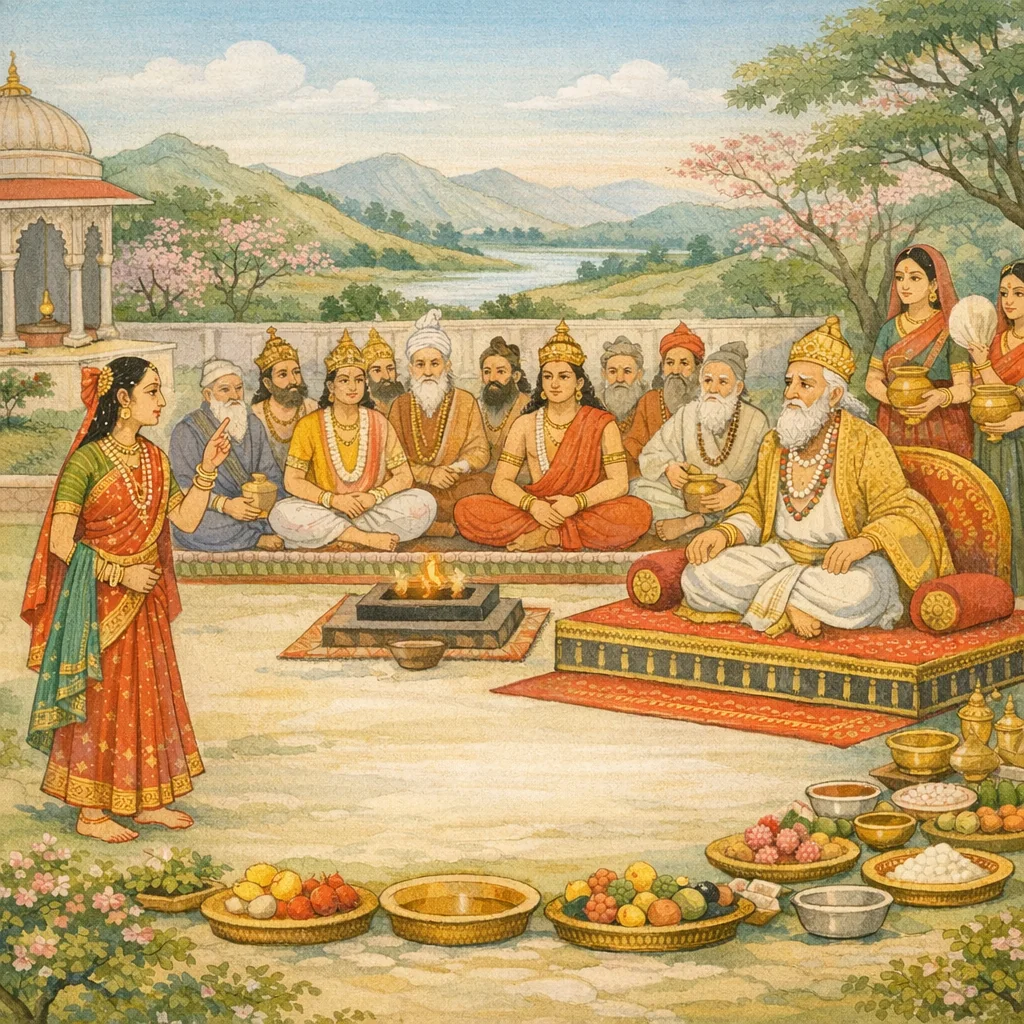
दक्षयज्ञे सत्या अपमानबोधः — Satī Encounters Disrespect at Dakṣa’s Sacrifice
Adhyāya 29 describes Satī’s arrival at Dakṣa’s magnificent yajña, attended by devas, asuras, and sages. She beholds the splendor of the sacrificial arena and the gathered divine ṛṣi community, dismounts at the threshold, and enters swiftly, yet the welcome is uneven: her mother Asiknī and her sisters honor her properly, while Dakṣa pointedly withholds respect and others, confused by Śiva’s māyā or restrained by fear, remain silent. Though Satī offers obeisance to her parents, she is wounded to see that shares are being allotted to the gods but none to Śiva. This omission becomes the chapter’s ethical and doctrinal pivot. Rising in anger, Satī sharply questions Dakṣa: why is Śambhu, the purifier of the entire moving and unmoving universe, not invited? She then sets forth a Śaiva ritual theology—Śiva is the supreme knower of yajña, its limbs, its dakṣiṇā, and its true performer—therefore a sacrifice without him is inherently defective. The chapter frames the yajña not merely as a social spectacle but as a test of spiritual legitimacy, showing how ritual grandeur collapses when severed from recognition of the supreme divine principle.
Shlokas
Verse 1
ब्रह्मोवाच । दाक्षायणी गता तत्र तत्र यज्ञो महाप्रभः । सुरासुरमुनीन्द्रादिकुतूहलसमन्वितः
Brahmā said: Dākṣāyaṇī (Satī) went there; and there that great and splendid sacrificial rite was in progress, attended by the eager curiosity of the gods, the asuras, and the foremost of sages and others.
Verse 2
स्वपितुर्भवनं तत्र नानाश्चर्यसमन्वितम् । ददर्श सुप्रभं चारु सुरर्षिगण संयुतम्
There she beheld her father’s mansion—filled with many marvels—radiant with splendor and beauty, and attended by hosts of gods and divine seers.
Verse 3
द्वारि स्थिता तदा देवी ह्यवरुह्य निजासनात् । नन्दिनोऽभ्यंतरं शीघ्रमेकैवागच्छदध्वरम्
Then the Goddess, standing at the doorway, rose from her own seat and, all alone, swiftly entered within Nandin’s enclosure—the sacred precinct of the rite.
Verse 4
आगतां च सतीं दृष्ट्वाऽसिक्नी माता यशस्विनी । अकरोदादरं तस्या भगिन्यश्च यथोचितम्
Seeing Satī arrive, her illustrious mother Asiknī showed her due honor and affectionate regard; and her sisters too received her in a fitting manner.
Verse 5
नाकरोदादरं दक्षो दृष्ट्वा तामपि किंचन । नान्योपि तद्भयात्तत्र शिवमायाविमोहितः
Even upon seeing her, Daksha showed her not the slightest respect. And no one else there dared to honour her either, for they were afraid of him—bewildered on that occasion by Shiva’s māyā.
Verse 6
अथ सा मातरं देवी पितरं च सती मुने । अनमद्विस्मितात्यंतं सर्वलोक पराभवात्
Then the Goddess Satī, O sage, bowed to her mother and to her father. Yet, because the worlds had been utterly disgraced, she remained intensely astonished and inwardly unappeased.
Verse 7
भागानपश्यद्देवानां हर्यादीनां तदध्वरे । न शंभुभागमकरोत् क्रोधं दुर्विषहं सती
Satī saw that, in that sacrifice, the gods—Hari and the others—were receiving their allotted shares; but no share had been assigned to Śambhu. Seeing this disrespect toward the Lord, Satī was seized by an unbearable wrath.
Verse 8
सत्युवाच । तदा दक्षं दहन्तीव रुषा पूर्णा सती भृशम् । क्रूरदृष्ट्या विलोक्यैव सर्वानप्यपमानिता
Satī said: Then, filled with intense wrath, Satī looked at Dakṣa as though she would burn him. With a fierce gaze—having been insulted—she looked upon all of them as well.
Verse 9
सत्युवाच । अनाहूतस्त्वया कस्माच्छंभुः परमशोभनः । येन पूतमिदं विश्वं समग्रं सचराचरम्
Satī said: “Why has Śambhu—supremely radiant—been left uninvited by you? He is the One by whom this entire universe, in its fullness, with all that moves and all that does not move, is sanctified and made pure.”
Verse 10
यज्ञो यज्ञविदां श्रेष्ठो यज्ञांगो यज्ञदक्षिणः । यज्ञकर्ता च यश्शंभुस्तं विना च कथं मखः
He is the Yajña—the highest goal known to the knowers of sacrifice. He is the very limb of the sacrifice and its sacred fee (dakṣiṇā). He alone is the performer of the sacrifice—Śambhu. Without Him, how can any ritual offering (makha) truly take place?
Verse 11
यस्य स्मरणमात्रेण सर्वं पूतं भवत्यहो । विना तेन कृतं सर्वमपवित्रं भविष्यति
Ah! By the mere remembrance of Him, everything becomes purified. But whatever is done without Him becomes wholly impure.
Verse 12
द्रव्यमंत्रादिकं सर्वं हव्यं कव्यं च यन्मयम् । शंभुना हि विना तेन कथं यज्ञः प्रवर्तितः
All ritual substances, the mantras and their allied rites—indeed every offering for the gods (havya) and for the ancestors (kavya)—are pervaded by Him. Therefore, without Śambhu (Śiva), how could the sacrifice (yajña) ever be rightly set in motion and sustained?
Verse 13
किं शिवं सुरसामान्यं मत्याकार्षीरनादरम् । भ्रष्टबुद्धिर्भवानद्य जातोसि जनकाधम
Why have you shown disrespect to Śiva—who is beyond the ordinary gods—taking Him to be merely like the other devas? Today your understanding has fallen into ruin; you have become a disgrace among fathers.
Verse 14
विष्णुब्रह्मादयो देवा यं संसेव्य महेश्वरम् । प्राप्ताः स्वपदवीं सर्वे तं न जानासि रे हरम्
Viṣṇu, Brahmā, and the other gods, by devotedly serving that Great Lord, Maheśvara, have all attained their own exalted stations. Yet you do not recognize Him—Hara, the Lord who removes all bondage.
Verse 15
एते कथं समायाता विष्णुब्रह्मादयस्सुराः । तव यज्ञे विना शंभुं स्वप्रभुं मुनयस्तथा
How have these gods—Viṣṇu, Brahmā, and the others—come here to your sacrifice? And how have the sages, too, arrived at your yajña without Śambhu, their own Lord?
Verse 16
ब्रह्मोवाच । इत्युक्त्वा परमेशानी विष्ण्वादीन्सकलान् प्रति । पृथक्पृथगवोचत्सा भर्त्सयंती भवात्मिका
Brahmā said: Having spoken thus, Parameśānī (Satī), the very embodiment of Bhavā, the Divine Mother, then addressed them all—Viṣṇu and the other gods—one by one, reproving them.
Verse 17
सत्युवाच । हे विष्णो त्वं महादेवं किं न जानासि तत्त्वतः । सगुणं निर्गुणं चापि श्रुतयो यं वदंति ह
Satī said: “O Viṣṇu, do you not truly know Mahādeva in His real principle? The Vedas indeed proclaim Him as both saguṇa, with attributes, and nirguṇa, beyond all attributes.”
Verse 18
यद्यपि त्वां करं दत्त्वा बहुवारं महेश्वरः । अशिक्षयत्पुरा शाल्वप्रमुखाकृतिभिर्हरे
O Hari (Viṣṇu), although Maheśvara, taking you by the hand again and again, instructed and trained you in former times—assuming forms such as Śālva and others—still, this present situation has arisen.
Verse 19
तदपि ज्ञानमायातं न ते चेतसि दुर्मते । भागार्थी दक्षयज्ञेस्मिन् शिवं स्वस्वामिनं विना
Even that understanding has not entered your mind, O wicked-minded one: in this sacrifice of Dakṣa, you seek a share while excluding Śiva—your own Lord and true Master.
Verse 20
पुरा पंचमुखो भूत्वा गर्वितोऽसि सदाशिवम् । कृतश्चतुर्मुखस्तेन विस्मृतोसि तदद्भुतम्
Formerly, having assumed a five-faced form, you became proud before Sadāśiva. Therefore He made you four-faced—yet you have forgotten that wondrous act.
Verse 21
इन्द्र त्वं किं न जानासि महादेवस्य विक्रमम् । भस्मी कृतः पविस्ते हि हरेण क्रूरकर्मणा
O Indra, do you not know the mighty prowess of Mahādeva? Indeed, your Vajra was reduced to ashes by Hara, whose deed was fierce and irresistible.
Verse 22
हे सुराः किन्न जानीथ महादेवस्य विक्रमम् । अत्रे वसिष्ठ मुनयो युष्माभिः किं कृतं त्विह
O gods, do you not know the mighty prowess of Mahādeva? O sages Atri and Vasiṣṭha—what, indeed, has been done here by you all?
Verse 23
भिक्षाटनं च कृतवान् पुरा दारुवने विभुः । शप्तो यद्भिक्षुको रुद्रो भवद्भिर्मुनिभिस्तदा
Formerly, the all-pervading Lord performed the divine act of going for alms in the Dāruvana forest; and at that time Rudra, appearing as a mendicant, was cursed by you sages.
Verse 24
शप्तेनापि च रुद्रेण यत्कृतं विस्मृतं कथम् । तल्लिंगेनाखिलं दग्धं भुवनं सचराचरम्
How could what was done—even under Rudra’s curse—be forgotten? By that very Liṅga, the entire world, with all that moves and all that is unmoving, was burned up completely.
Verse 25
सर्वे मूढाश्च संजाता विष्णुब्रह्मादयस्सुराः । मुनयोऽन्ये विना शंभुमागता यदिहाध्वरे
All of them became deluded—Vishnu, Brahma, and the other gods. Other sages too came here to this sacrifice, but without Śambhu (Lord Shiva).
Verse 26
सर्वे वेदाश्च संभूताः सांगाश्शास्त्राणि वाग्यतः । योसौ वेदांतगश्शम्भुः कैश्चिज्ज्ञातुं न पार्यते
From Him indeed arose all the Vedas, together with their auxiliaries, and the scriptures born of sacred speech. Yet that Śambhu—who is the very goal and culmination of the Vedānta—cannot be fully known by some whose knowing is limited.
Verse 27
ब्रह्मोवाच । इत्यनेकविधा वाणीरगदज्जगदम्बिका । कोपान्विता सती तत्र हृदयेन विदूयता
Brahmā said: Having thus spoken in many ways, Jagadambikā (Satī), filled with anger, remained there—her heart burning within.
Verse 28
विष्ण्वादयोखिला देवा मुनयो ये च तद्वचः । मौनीभूतास्तदाकर्ण्य भयव्याकुलमानसाः
On hearing those words, Viṣṇu and all the other gods, and the sages as well, fell silent—their minds shaken and distressed by fear.
Verse 29
इतिश्रीशिवमहापुराणे द्वितीयायां रुद्रसंहितायां द्वितीये सतीखंडे सतीवाक्यवर्णनं नामैकोनत्रिंशोऽध्यायः
Thus, in the revered Śiva Mahāpurāṇa—within the Second Book, the Rudra Saṃhitā, in the second section called the Satī Khaṇḍa—ends the twenty-ninth chapter entitled “The Description of Satī’s Words.”
Verse 30
दक्ष उवाच । तव किं बहुनोक्तेन कार्यं नास्तीह सांप्रतम् । गच्छ वा तिष्ठ वा भद्रे कस्मात्त्वं हि समागता
Dakṣa said: “What is the use of speaking at length? There is no purpose for you here at present. O auspicious one, either go or stay as you wish—why have you come here at all?”
Verse 31
अमंगलस्तु ते भर्ता शिवोसौ गम्यते बुधैः । अकुलीको वेदबाह्यो भूतप्रेतपिशाचराट्
“Your husband—this Śiva—is indeed considered inauspicious, so the learned deem. He is outside the clan-bound norms, beyond the Vedic social codes, and is the lord who rules over bhūtas, pretas, and piśācas.”
Verse 32
तस्मान्नाह्वारितो रुद्रो यज्ञार्थं सुकुवेषभृत् । देवर्षिसंसदि मया ज्ञात्वा पुत्रि विपश्चिता
Therefore Rudra was not invited to the sacrifice, even though He had assumed a proper and auspicious appearance for the rite. O wise daughter, I understood this clearly in the assembly of the gods and sages.
Verse 33
विधिना प्रेरितेन त्वं दत्ता मंदेन पापिना । रुद्रायाविदितार्थाय चोद्धताय दुरात्मने
Driven by fate, you were given away by that dull-witted sinner—to Rudra, who (as he seemed) knew not what was proper, and who was deemed arrogant and wicked at heart.
Verse 34
तस्मात्कोपं परित्यज्य स्वस्था भव शुचिस्मिते । यद्यागतासि यज्ञेस्मिन् दायं गृह्णीष्व चात्मना
Therefore, abandon your anger and become calm, O woman of pure smile. Since you have come to this sacrifice, accept your rightful share yourself with a composed mind.
Verse 35
ब्रह्मोवाच । दक्षेणोक्तेति सा पुत्री सती त्रैलोक्यपू जिता । निंदायुक्तं स्वपितरं दृष्ट्वासीद्रुषिता भृशम्
Brahmā said: When Dakṣa had spoken thus, his daughter Satī—revered throughout the three worlds—seeing her own father filled with slander, became intensely enraged.
Verse 36
अर्चितयत्तदा सेति कथं यास्यामि शंकरम् । शंकरं द्रष्टुकामाहं पृष्टा वक्ष्ये किमुत्तरम्
“‘Worship Him then,’ she says—yet how am I to go to Śaṅkara? I long to behold Śaṅkara; if I am questioned, what reply shall I give?”
Verse 37
अथ प्रोवाच पितरं दक्षं तं दुष्टमानसम् । निश्श्वसंती रुषाविष्टा सा सती त्रिजगत्प्रसूः
Then Satī, the Mother of the three worlds, heaving deep sighs and seized by righteous anger, spoke to her father Dakṣa, whose mind had turned wicked.
Verse 38
सत्युवाच । यो निंदति महादेवं निंद्यमानं शृणोति वा । तावुभौ नरकं यातौ यावच्चन्द्रदिवाकरौ
Satī said: “Whoever reviles Mahādeva, or even listens while He is being reviled—both of them go to hell for as long as the moon and the sun endure.”
Verse 39
तस्मात्त्यक्ष्याम्यहं देवं प्रवेक्ष्यामि हुताशनम् । किं जीवितेन मे तात शृण्वंत्यानादरं प्रभोः
“Therefore I shall abandon this body and enter the sacred fire. O dear father, what use is life to me, when I must listen to the disrespect shown to my Lord (Śiva)?”
Verse 40
यदि शक्तस्स्वयं शंभोर्निंदकस्य विशेषतः । छिंद्यात् प्रसह्य रसनां तदा शुद्ध्येन्न संशयः
If one has the strength—especially in the case of a blasphemer of Śambhu (Lord Śiva)—one should forcibly cut out that person’s tongue; then one becomes purified—of this there is no doubt.
Verse 41
यद्यशक्तो जनस्तत्र निरयात्सुपिधाय वै । कर्णौ धीमान् ततश्शुद्ध्येद्वदंतीदं बुधान्वरान्
If a person there is unable (to bear hearing it), the wise one should indeed cover his ears and move away. Then he becomes purified—so declare the best of the learned sages.
Verse 42
ब्रह्मोवाच । इत्थमुक्त्वा धर्मनीतिं पश्चात्तापमवाप सा । अस्मरच्छांकरं वाक्यं दूयमानेन चेतसा
Brahmā said: Having thus spoken the righteous code of conduct, she was seized by remorse. With a heart burning in anguish, she remembered the words of Śaṅkara (Lord Śiva).
Verse 43
ततस्संकुद्ध्य सा दक्षं निश्शंकं प्राह तानपि । सर्वान्विष्ण्वादिकान्देवान्मुनीनपि सती ध्रुवम्
Then Satī, inflamed with anger, fearlessly addressed Dakṣa—and also all those present—indeed, all the gods beginning with Viṣṇu and even the sages, speaking with firm resolve.
Verse 44
सत्युवाच । तात त्वं निंदकश्शंभोः पश्चात्तापं गमिष्यसि । इह भुक्त्वा महादुःखमंते यास्यसि यातनाम्
Satī said: “Dear one, because you are a reviler of Śambhu (Lord Śiva), you will surely fall into remorse. Having suffered great misery here in this world, in the end you will go to torment (in the realms of punishment).”
Verse 45
यस्य लोकेऽप्रियो नास्ति प्रियश्चैव परात्मनः । तस्मिन्नवैरे शर्वेस्मिन् त्वां विना कः प्रतीपकः
In this world, for Him who hates none and is truly dear to the Supreme Self—when Śarva (Śiva) is thus without enmity toward all, who, other than you, could ever stand opposed to Him?
Verse 46
महद्विनिंदा नाश्चर्यं सर्वदाऽसत्सु सेर्ष्यकम् । महदंघ्रिरजो ध्वस्ततमस्सु सैव शोभना
The disparagement of the great is no wonder—among the false and impure it is ever joined with envy. But for those whose darkness has been destroyed by the dust of the Great Lord’s feet, that very circumstance becomes an adornment, for it only magnifies their steadfast devotion.
Verse 47
शिवेति द्व्यक्षरं यस्य नृणां नाम गिरेरितम् । सकृत्प्रसंगात्सकलमघमाशु विहंति तत्
For those people whose name is uttered as the two-syllabled “Śiva”—spoken aloud even once, even in mere passing—that utterance swiftly destroys the entirety of their sin.
Verse 48
पवित्रकीर्तितमलं भवान् द्वेष्टि शिवेतरः । अलंघ्यशासनं शंभुमहो सर्वेश्वरं खलः
O you who are hostile to Śiva—though His fame is purifying and stainless—you still hate Śambhu, whose command none can transgress. Alas, what a wicked person you are, for you bear malice toward the Lord of all.
Verse 49
यत्पादपद्मं महतां मनोऽलिसुनिषेवितम् । सर्वार्थदं ब्रह्मरसैः सर्वार्थिभिरथादरात्
That lotus of His feet—diligently served by the bee-like minds of the great—bestows every worthy aim; therefore all seekers, tasting the bliss of Brahman, revere it with devoted care.
Verse 50
यद्वर्षत्यर्थिनश्शीघ्रं लोकस्य शिवआदरात् । भवान् द्रुह्यति मूर्खत्वात्तस्मै चाशेषबंधवे
Because he swiftly showers (boons) upon the supplicants of the world out of reverence for Śiva, you—through folly—are acting with hostility toward him, even though he is a universal kinsman and benefactor to all.
Verse 51
किंवा शिवाख्यमशिवं त्वदन्ये न विदुर्बुधाः । ब्रह्मादयस्तं मुनयस्सनकाद्यास्तथापरे
Or else, apart from You, even the wise do not truly know that One who is called Śiva—who is beyond all that is inauspicious. Brahmā and the other gods, the sages, and even Sanaka and the rest likewise (do not fully know Him).
Verse 52
अवकीर्य जटाभूतैश्श्मशाने स कपालधृक् । तन्माल्यभस्म वा ज्ञात्वा प्रीत्यावसदुदारधीः
Having scattered (those offerings) in the cremation-ground among the spirit-beings attendant upon his matted locks, that skull-bearing Lord—recognizing them as his garlands and sacred ash—dwelt there with delight, being noble-minded.
Verse 53
ये मूर्द्धभिर्दधति तच्चरणोत्सृष्टमाराद् । निर्माल्यं मुनयो देवास्स शिवः परमेश्वरः
That sacred remnant cast off from His feet—His nirmālya—which the sages and the gods reverently place upon their heads: He alone is Śiva, the Supreme Lord.
Verse 54
प्रवृत्तं च निवृत्तं च द्विविधं कर्मचोदि तम् । वेदे विविच्य वृत्तं च तद्विचार्यं मनीषिभिः
Action enjoined by scripture is twofold—pravṛtti (engagement) and nivṛtti (withdrawal). Having discerned their proper scope as taught in the Veda, the wise should reflect and choose rightly, so that duty becomes a means of purification and, at last, liberation under the Lord (Pati), Śiva.
Verse 55
विरोधियौगपद्यैककर्तृके च तथा द्वयम् । परब्रह्मणि शंभो तु कर्मर्च्छंति न किंचन
In Śambhu, the Supreme Brahman, there is no scope whatsoever for karma to take hold—whether one speaks of contradictory attributes, simultaneous action, a single doer, or even duality; none of these apply to Him.
Verse 56
मा वः पदव्यस्स्म पितर्या अस्मदास्थितास्सदा । यज्ञशालासु वो धूम्रवर्त्मभुक्तोज्झिताः परम्
Do not remain upon that course of conduct in which you stand with my father. In your sacrificial halls you have become those who feed upon the “smoke-path”—clinging only to outward rites—and thus you are utterly cast away from the Supreme, Śiva.
Verse 57
नोऽव्यक्तलिंगस्सततमवधूतसुसेवितः । अभिमानमतो न त्वं कुरु तात कुबुद्धिधृक्
He is not one whose mark is the unmanifest Liṅga alone; he is ever well served by the avadhūtas, the detached ascetics. Therefore, dear one, do not act from pride—such conceit is the stance of a misguided intellect.
Verse 58
किंबहूक्तेन वचसा दुष्टस्त्वं सर्वथा कुधीः । त्वदुद्भवेन देहेन न मे किंचित्प्रयोजनम्
What is the use of saying much? You are utterly wicked and of perverse understanding. With this body that has arisen from you, I have no need for anything at all.
Verse 59
तज्जन्म धिग्यो महतां सर्वथावद्यकृत्खलः । परित्याज्यो विशेषेण तत्संबंधो विपश्चिता
Cursed is such a birth, for that wicked one—who ever commits blameworthy deeds—brings disgrace even upon the great. Therefore, the wise should especially abandon all association and relationship with him.
Verse 60
गोत्रं त्वदीयं भगवान् यदाह वृषभध्वजः । दाक्षायणीति सहसाहं भवामि सुदुर्मनाः
When the Blessed Lord—Śiva, whose banner bears the bull—speaks of your lineage and suddenly calls me “Dākṣāyaṇī” (Dakṣa’s daughter), my heart becomes deeply distressed at once.
Verse 61
तस्मात्त्वदंगजं देहं कुणपं गर्हितं सदा । व्युत्सृज्य नूनमधुना भविष्यामि सुखावहा
Therefore, this body—born of your limbs—ever condemned as a mere carcass, I shall now surely cast it off; and, having abandoned it, I shall become the bringer of peace and well-being.
Verse 62
हे सुरा मुनयस्सर्वे यूयं शृणुत मद्वचः । सर्वथानुचितं कर्म युष्माकं दुष्टचेतसाम्
O gods and all you sages, listen to my words. This action of yours—born of a corrupted intent—is in every way improper.
Verse 63
सर्वे यूयं विमूढा हि शिवनिंदाः कलिप्रियाः । प्राप्स्यंति दण्डं नियतमखिलं च हराद्ध्रुवम्
All of you are indeed deluded—revilers of Śiva and lovers of adharma (Kali’s ways). Certainly, from Hara (Lord Śiva) you shall unfailingly receive the fixed and complete punishment.
Verse 64
ब्रह्मोवाच । दक्षमुक्त्वाध्वरे तांश्च व्यरमत्सा सती तदा । अनूद्य चेतसा शम्भुमस्मरत्प्राणवल्लभम्
Brahmā said: Having spoken to Dakṣa and to those assembled at the sacrifice, Satī then fell silent. Turning within, she remembered in her heart Śambhu—Lord Śiva, beloved as her very life-breath.
Frequently Asked Questions
Satī’s arrival at Dakṣa’s yajña, her reception by family and assembly, and her confrontation over Dakṣa’s failure to honor Śiva and allot him a sacrificial share.
It articulates a Śaiva ritual theology: Śiva is the purifier and true agent of yajña; therefore, a sacrifice performed in pride and exclusion—without honoring Śiva—is structurally invalid, regardless of external magnificence.
Śiva is highlighted as Śambhu—the cosmic sanctifier—and as yajña’s internal principle (yajñavidāṃ śreṣṭha, yajñāṅga, yajñadakṣiṇā, yajñakartā), while Satī embodies righteous indignation against adharma within ritual space.