शिवसतीविवाहोत्तरलीला — Post‑marital Līlā of Śiva and Satī
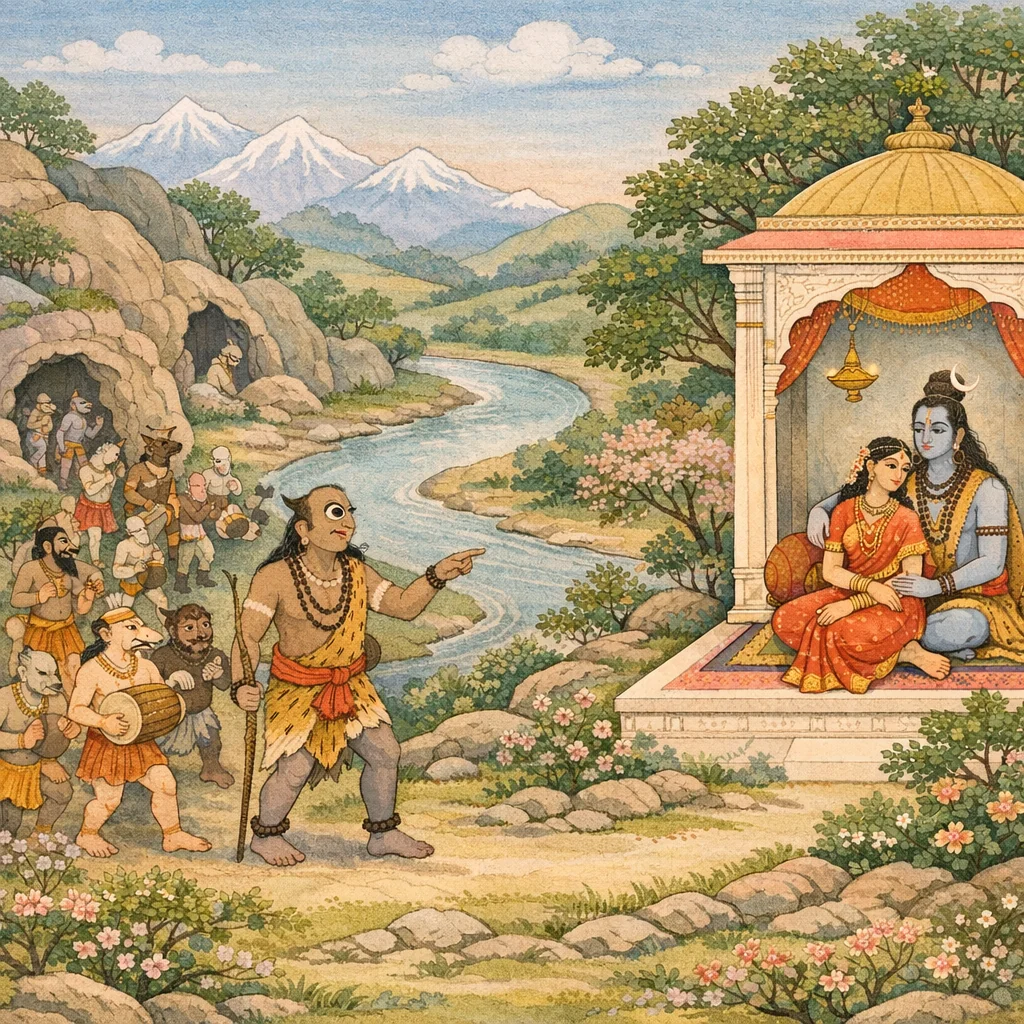
Adhyāya 21 continues the dialogue: Nārada asks for more detail about Śiva and Satī’s auspicious conduct after their marriage. Brahmā shifts from the wedding narrative to post‑marital events—Śiva returns to his own abode with the gaṇas and delights in proper bhavācāra, highlighting the social and ritual texture of divine life. The chapter then depicts gaṇa dynamics: Virūpākṣa approaches Dākṣāyaṇī (Satī) and organizes or directs attendant groups such as Nandī and others from natural settings like caves and rivers, suggesting a reordering of Śiva’s retinue around the newly wedded Goddess. Śiva, an ocean of compassion, addresses the attendants in accordance with laukika etiquette, teaching that sacred order may be conveyed through culturally intelligible speech and conventional social forms.
Shlokas
Verse 1
नारद उवाच । समीचीनं वचस्तात सर्वज्ञस्य तवाऽनघ । महाद्भुतं श्रुतं नो वै चरितं शिवयोश्शुभम्
Nārada said: “O dear one, O sinless and all-knowing sage, your words are most fitting. Indeed, we have heard the supremely wondrous and auspicious sacred account of Śiva and (Satī).”
Verse 2
विवाहश्च श्रुतस्सम्यक् सर्वमोहापहारकः । परमज्ञानसंपन्नो मंगलालय उत्तमः
It has been rightly heard that the sacred rite of marriage removes every delusion. It is endowed with the highest spiritual wisdom and is the supreme abode of auspiciousness.
Verse 3
कदाचिद्वन्य पुष्पाणि समाहृत्य मनोहराम् । मालां विधाय सत्यास्तु हारस्थाने स योजयत्
Once, gathering lovely wild flowers, he fashioned a beautiful garland and placed it upon Satī’s neck as a necklace.
Verse 4
ब्रह्मोवाच । सम्यक्कारुणिकस्यैव मुने ते विचिकित्सितम् । यदहं नोदितस्सौम्य शिवलीलानुवर्णने
Brahmā said: “O sage, your doubt is indeed worthy of one who is truly compassionate. O gentle one, until now I have not been prompted to describe and recount the divine play (līlā) of Lord Śiva.”
Verse 5
विवाह्य दक्षजां देवीं सतीं त्रैलोक्यमातरम् । गत्वा स्वधाम सुप्रीत्या यदकार्षीन्निबोध मे
Having married the goddess Satī—Dakṣa’s daughter, the Mother of the three worlds—Śiva returned with great delight to His own abode. Now understand from me what He then did.
Verse 6
ततो हरस्स स्वगणस्स्वस्थानं प्राप्य मोदनम । देवर्षे तत्र वृषभादवातरदतिप्रियात्
Then Hara, accompanied by His own gaṇas, returned to His own abode and rejoiced. O divine seer, there—out of great affection—He descended from the bull Vṛṣabha, His vāhana.
Verse 7
यथायोग्यं निजस्थानं प्रविश्य स सतीसखः । मुमुदेऽतीव देवर्षे भवाचारकरश्शिवः
O divine sage, entering his own abode as was proper, Shiva—the intimate companion of Sati, the Lord who establishes righteous conduct in worldly life—rejoiced exceedingly.
Verse 8
ततो विरूपाक्ष इमां प्राप्य दाक्षायणीं गणान् । स्वीयानिर्यापयामास नद्यादीन् गिरिकंदरात्
Then Vīrūpākṣa, having reached this Dakṣāyaṇī (Satī), sent forth his own gaṇas, driving them out from the mountain-caves and ravines, along with the rivers and the rest.
Verse 9
उवाच चैतास्तान् सर्वान्नंद्यादीनतिसूनृतम् । लौकिकीं रीतिमाश्रित्य करुणासागरः प्रभुः
Then the Lord—an ocean of compassion—addressed all of them, beginning with Nandin, speaking exceedingly gentle and gracious words, conforming to the courteous ways of the world.
Verse 10
महेश उवाच । यदाहं च स्मराम्यत्र स्मरणादरमानसाः । समागमिष्यथ तदा मत्पार्श्वं मे गणा द्रुतम्
Mahesha said: “Whenever I remember you here, you—whose minds are intent on honoring that remembrance—shall then come swiftly to my side, O my gaṇas.”
Verse 11
इत्युक्ते वामदेवेन नद्याद्यास्स्वगणाश्च ते । महावेगा महावीरा नानास्थानेषु संययुः
When Vāmadeva had spoken thus, those (divine forces) beginning with the rivers, along with his own gaṇas, swift in their movement and heroic in power, proceeded and gathered at various places.
Verse 12
ईश्वरोपि तया सार्द्धं तेषु यातेषु विभ्रमी । दाक्षायण्या समं रेमे रहस्ये मुदितो भृशम्
When the others had departed, the Lord too—free and sportive—remained with her; and with Dakṣa’s daughter (Satī) he delighted in a secret, private place, rejoicing greatly.
Verse 14
कदाचिद्दर्पणे चैव वीक्षतीमात्मनस्सतीम् । अनुगम्य हरो वक्त्रम् स्वीयमप्यवलोकयत
Once, as Satī gazed at her own reflection in a mirror, Hara (Śiva) followed her and also looked upon his own face.
Verse 15
कदाचित्कुंडलं तस्या उल्लास्योल्लास्य संगतः । बध्नाति मोचयत्येव सा स्वयं मार्जयत्यपि
At times, joyfully drawing near again and again, she would fasten his earring and then loosen it; she herself would also polish and clean it.
Verse 16
सरागौ चरणावस्याः पावकेनोज्ज्वलेन च । निसर्गरक्तौ कुरुते पूर्णरागौ वृषध्वजः
The Bull-bannered Lord (Śiva), by a blazing fire, made her feet—already tinged with love—become naturally crimson, and caused them to be fully suffused with divine passion and auspicious radiance.
Verse 17
उच्चैरपि यदाख्येयमन्येषां पुरतो बहु । तत कर्णे कथयत्त्यस्याहरो द्रष्टुं तदाननम्
Even what ought to be spoken aloud—much of it in the presence of others—she instead whispered into his ear, while he kept gazing upon her face.
Verse 18
न दूरमपि गन्तासौ समागत्य प्रयत्नतः । अनुबध्नाति नामाक्षी पृष्ठदेशेन्यमानसाम्
Even if she does not go far, she draws near with deliberate effort; that lotus-eyed lady then follows after them—those whose minds are being drawn away—keeping to their rear.
Verse 19
अंतर्हितस्तु तत्रैव मायया वृषभध्वजः । तामालिलिंग भीत्या स्वं चकिता व्याकुलाऽभवत्
Then, right there, the Bull-bannered Lord (Śiva) vanished by His own Māyā. Out of fear she clung to Him, and she herself became startled and deeply agitated.
Verse 20
सौवर्णपद्मकलिकातुल्ये तस्या कुचद्वये । चकार भ्रमराकारं मृगनाभिविशेषकम्
Upon her two breasts—comparable to buds of a golden lotus—he fashioned a special ornament of musk, shaped like a bumblebee.
Verse 21
इति श्रीशिवमहापुराणे द्वितीयायां रुद्रसंहि तायां द्वितीये सतीखंडे सतीशिवक्रीडावर्णनं नामैकविंशोध्यायः
Thus, in the Śrī Śiva Mahāpurāṇa—within the Second Saṃhitā, the Rudra Saṃhitā—this is the twenty-first chapter of the Second section, the Satī Khaṇḍa, entitled “The Description of the Divine Play of Satī and Śiva.”
Verse 22
अंगदान्वलयानूर्मान्विश्लेष्य च पुनः पुनः । तत्स्थानात्पुनरेवासौ तत्स्थाने प्रत्ययोजयत्
Again and again he removed the armlets, bracelets, and rings; then, taking them back from where they had been set, he placed them once more in their proper positions.
Verse 23
कालिकेति समायाति सवर्णा ते सखी त्विमाम् । यास्यत्वस्यास्तथेक्षंत्याः प्रोत्तुंगौ साहसं कुचौ
“O Kālikā!”—so she called and came near. This friend of yours, of similar complexion, has arrived here. As she watched her about to depart, her bold, high breasts rose prominently with emotion.
Verse 24
कदाचिन्मदनोन्मादचेतनः प्रमथाधिपः । चकार नर्म शर्माणि तथाकृत्प्रियया मुदा
Once, the lord of the Pramathas, his mind stirred by love-maddened exhilaration, playfully indulged in jests and gentle delights, rejoicing with his beloved who answered in the same spirit.
Verse 25
आहृत्य पद्मपुष्पाणि रम्यपुष्पाणि शंकरः । सर्वांगेषु करोति स्म पुष्पाभरणमादरात्
Gathering lotus flowers and other lovely blossoms, Śaṅkara reverently adorned all his limbs with ornaments made of flowers.
Verse 26
गिरिकुंजेषु रम्येषु सत्या सह महेश्वरः । विजहार समस्तेषु प्रियया भक्तवत्सलः
In the lovely mountain groves, Mahādeva—ever tender toward his devotees—wandered playfully everywhere together with Satī, his beloved.
Verse 27
तया विना स्म नो याति नास्थितो न स्म चेष्टते । तया विना क्षममपि शर्म लेभे न शंकरः
Without her, he could not go forward; he neither stood firm nor set his hand to any deed. Without her, even the capable Śaṅkara could not attain peace and well-being.
Verse 28
विहृत्य सुचिरं कालं कैलासगिरिकुंजरे । अगमद्धिमवत्प्रस्थं सस्मार स्वेच्छया स्मरन्
After sporting for a very long time in the lofty groves of Mount Kailāsa, he went to the slopes of Himavat; and, of his own free will, remembering her, he became inwardly mindful of Love’s stirring.
Verse 29
तस्मिन्प्रविष्टे कामे तु वसंतश्शंकरांतिके । वितस्तार निजं भावं हार्दं विज्ञाय यत्प्रभो
When Kāma had thus entered upon his mission, Vasantā came near Śaṅkara; and, knowing the Lord’s inward disposition of the heart, he then unfolded his own intent.
Verse 30
सर्वे च पुष्पिता वृक्षा लताश्चान्याश्च पुष्पिताः । अंभांसि फुल्लपद्मानि पद्मास्सभ्रमरास्तथा
All the trees were in full bloom, and the creepers and other plants too were flowering. The waters were adorned with fully blossomed lotuses, and those lotuses were accompanied by hovering bees as well.
Verse 31
प्रविष्टे तत्र सदृतौ ववौ स मलयो मरुत् । सुगंधिगंधपुष्पेण मोदकश्च सुगंधियुक्
When that auspicious season set in there, the Malaya breeze began to blow, bearing the fragrance of sweet-smelling flowers; and the delight of the atmosphere too became filled with perfume.
Verse 32
संध्यार्द्रचन्द्रसंकाशाः पलाशाश्च विरेजिरे । कामास्त्रवत्सुमनसः प्रमोदात्पादपाधरः
Palāśa blossoms gleamed, like the moon softened by twilight. In delight, those lovely flowers—like Kāma’s arrows—adorned the trees and their branches.
Verse 33
बभुः पंकजपुष्पाणि सरस्सु संकलाञ्जनान् । संमोहयितुमुद्युक्ता सुमुखी वायुदेवता
In the lakes, lotus-flowers appeared, darkened as though smeared with collyrium, while the fair-faced Wind-goddess set herself to the task of bewildering and distracting the mind.
Verse 34
नागकेशरवृक्षाश्च स्वर्णवर्णैः प्रसूनकैः । बभुर्मदनकेत्वाभा मनोज्ञाश्शंकरांतिके
Near Śaṅkara, nāgakeśara trees—adorned with golden-hued blossoms—shone forth, delightful to behold, radiant like the banner of Kāma, the god of love.
Verse 35
लवंगवल्लीसुरभिगंधेनोद्वास्य मारुतम् । मोहयामास चेतांसि भृशं कामिजने पुरा
Perfuming the wind with the fragrant scent of clove-creepers, she once greatly bewildered the minds of people driven by desire.
Verse 36
चारु पावकचर्चित्सु सुस्वराश्चूतशालिनः । बभुर्मदनबाणौघपर्यंकमदनावृताः
In those lovely groves, touched by the gentle warmth of firelight and filled with melodious sounds, rich with mango trees, the very air seemed spread with couches made of Cupid’s countless arrows—everything veiled and pervaded by the power of desire.
Verse 37
अंभांसि मलहीनानि रेजुः फुल्लकुशाशयाः । मुनीनामिव चेतांसि प्रव्यक्तज्योतिरुद्गमम्
The waters, free from all impurity, shone—adorned with fully blossomed beds of kuśa grass—like the minds of sages, radiant with the clear uprising of inner light.
Verse 38
तुषारास्सूर्यरश्मीनां संगमादगमन् बहिः । प्रमत्वानीक्ष्यतेक्षाश्च सलिलीहृदयास्तदा
When the sun’s rays met the frost, it melted and flowed outward. Then the earth, appearing as if stunned, was seen with waters welling up—its very heart becoming watery.
Verse 39
प्रसन्नास्सह चन्द्रेण ननिषारास्तदाऽभवन् । विभावर्यः प्रियेणैवं कामिन्यस्तु मनोहराः
Then the nights, together with the moon, became serene and bright. In this way, when united with the beloved, the nights themselves appeared charming—like enamoured women made beautiful by love.
Verse 40
तस्मिन्काले महादेवस्सह सत्या धरोत्तमे । रेमे स सुचिरं छन्दं निकुंजेषु नदीषु च
At that time, Mahādeva, together with Satī, delighted for a long while—freely and by His own will—upon that most excellent sacred ground, amid the groves and along the rivers.
Verse 41
तथा तेन समं रेजे तदा दाक्षायिणि मुने । यथा हरः क्षणमपि शांतिमाप तया विना
O sage, at that time Dakṣa’s daughter (Satī) shone with an equal radiance alongside him; for Hara (Śiva) did not attain peace even for a single moment when he was without her.
Verse 42
संभोगविषये देवी सती तस्य मनः प्रिया । विशतीव हरस्यांगे पाययन्निव तद्रसम्
In matters of conjugal union, the Goddess Satī—dear to his very mind—seemed, as it were, to enter into Hara’s body, as though making him drink the very essence of that bliss.
Verse 43
तस्या कुसुममालाभिर्भूषयन्सकलां तनुम् । स्वहस्तरचिताभिस्तु नवशर्माकरोच्च सः
Adorning her entire body with garlands of flowers—garlands woven by his own hands—Śiva awakened in her ever-new delight and auspicious joy.
Verse 44
आलापैर्वीक्षितैर्हास्यैस्तथा संभाषणैर्हरः । तस्यादिदेश गिरिजां सपतीवात्मसंविदम्
With affectionate talk, glances, gentle laughter, and intimate conversation, Lord Hara instructed Girijā—almost as though she were His own consort—in the inner knowledge born of His very Self-awareness.
Verse 45
तद्वक्त्रचंद्र पीयूषपानस्थिरतनुर्हरः । नानावैशेषिकीं तन्वीमवस्थां स कदाचन
Having steadied His body by drinking the nectar-like ambrosia of the moon of her face, Hara (Śiva) never at any time assumed a gross embodied condition of varied, particularized states.
Verse 46
तद्वक्त्राम्बुजवासेन तत्सौन्दर्य्यैश्च नर्मभिः । गुणैरिव महादंती बद्धो नान्यविचेष्टितः
By dwelling upon the lotus of her face, and by her beauty and playful, affectionate words, He became bound—like a mighty elephant tied fast by a mere cord of good qualities—and could not act otherwise.
Verse 47
इति हिमगिरिकुंजप्रस्थभागे दरीषु प्रतिदिनमभिरेमे दक्षपुत्र्या महेशः । क्रतुभुजपरिमाणैः क्रीडतस्तस्य जाता दश दश च सुरर्षे वत्सराः पंच चान्ये
Thus, in the glens and mountain-caves along the slopes of Himālaya’s wooded ridges, Maheśa delighted every day with Dakṣa’s daughter, Satī. And as he sported there—by the reckoning of the enjoyers of the sacrifice, the gods—O best of sages, twice ten years, and five more besides, passed away.
Frequently Asked Questions
The narrative shift to events after Śiva and Satī’s marriage: Śiva returns to his abode with his gaṇas, and attendants such as Virūpākṣa and Nandī are addressed/organized in relation to Dākṣāyaṇī (Satī).
The chapter explicitly frames the vivāha narrative as sarva-moha-apahāraka—hearing it is portrayed as knowledge-bearing (paramajñāna-saṃpanna) and auspicious (maṅgalālaya), functioning as a doctrinal tool for purification and insight.
Śiva is highlighted as karuṇāsāgara (ocean of compassion) and as one who aligns divine governance with laukika rīti (worldly etiquette), indicating compassionate authority expressed through accessible social norms.