पार्वतीजन्मवर्णनम् / Description of Pārvatī’s Birth
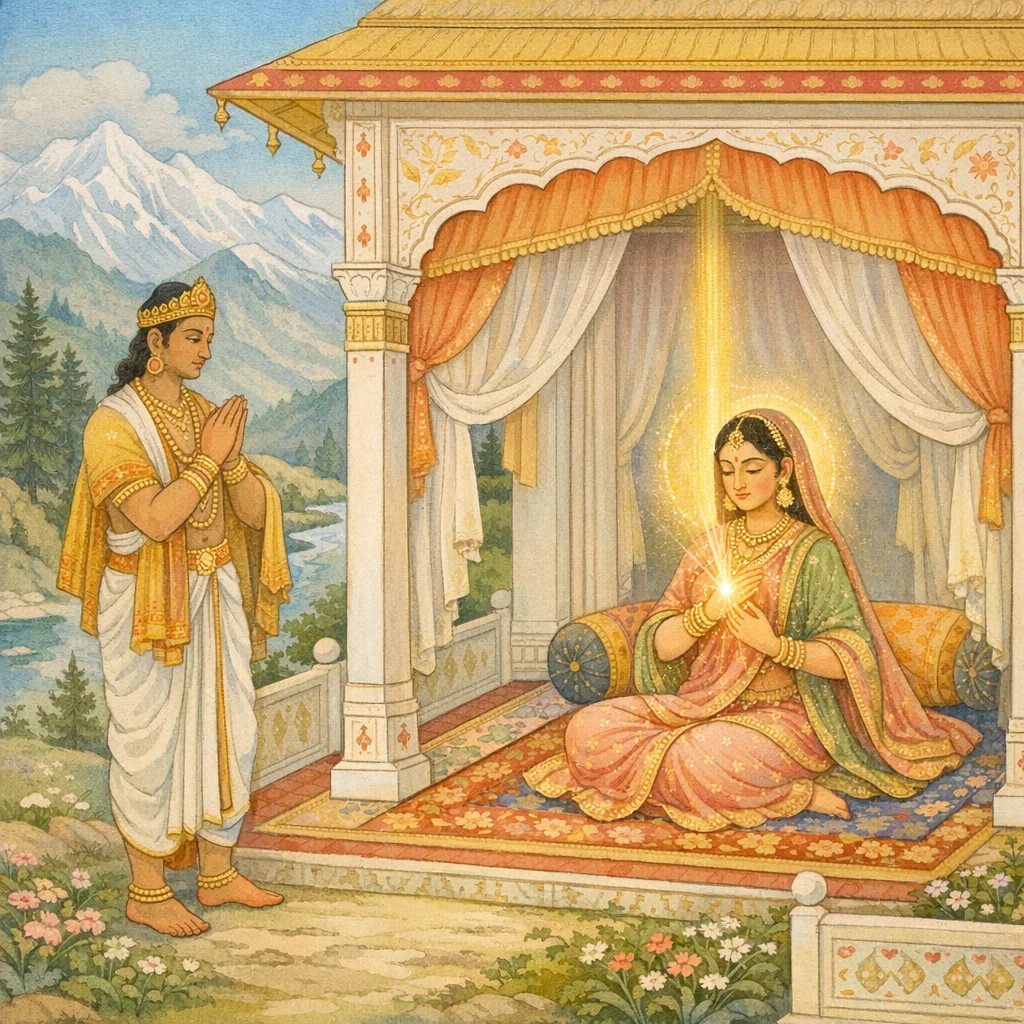
Adhyāya 6 explains the cause and process of Devī’s descent into the Himalayan household. Brahmā tells how the divine couple Himavat and Menā, seeking progeny and the fulfillment of a divine task (devakārya), remember Bhavāmbikā with devoted bhakti. In response, Caṇḍikā—who had earlier relinquished a body—wills to take embodiment again. Mahādevī, intent on making her former true word effective and granting auspicious aims, enters Menā’s mind and heart as a full portion (pūrṇāṃśa). The pregnancy is portrayed as radiant and extraordinary: Menā is encircled by a halo-like brilliance (tejomaṇḍala) and shows auspicious cravings and signs (dauhṛda-lakṣaṇa), marking divine gestation. Conception and birth are framed not as ordinary biology but as a sacralized descent: Śiva’s share is established in due time, and the Goddess’s grace becomes the proximate cause that fulfills the womb. Thus bhakti, truthful vow/word (satya-vacana), and cosmic necessity converge toward the imminent birth of Pārvatī.
Shlokas
Verse 1
ब्रह्मोवाच । अथ संस्मरतुर्भक्त्या दम्पती तौ भवाम्बिकाम् । प्रसूतिहेतवे तत्र देवकार्यार्थमादरात्
Brahmā said: Then that husband and wife, with devotion and reverent intent, remembered Bhavāmbikā there—so that conception might occur, for the sake of fulfilling the gods’ purpose.
Verse 2
ततस्सा चण्डिका योगात्त्यक्तदेहा पुरा पितुः । ईहया भतितुं भूयस्समैच्छद्रिरिदारतः
Thereupon the Goddess Caṇḍikā—who had formerly abandoned her body through yogic power at her father’s abode—again desired, by her own deliberate will, to assume and sustain a bodily form, taking refuge in this mountain here.
Verse 3
सत्यं विधातुं स्ववचः प्रसन्नाखिलकामदा । पूर्णांशाच्छैलचित्ते सा विवेशाथ महेश्वरी
To make her own word come true, that gracious Goddess—who bestows all desired boons—then entered, by her full divine portion, into the mind of the Mountain (Himālaya), becoming present there as Maheśvarī.
Verse 4
विरराज ततस्सोतिप्रमदोपूर्वसुद्युतिः । हुताशन इवाधृष्यस्तेजोराशिर्महामनाः
Then that radiant being shone forth—surpassing his former splendor—an invincible mass of spiritual fire, like the sacred flame itself, and great-souled in nature.
Verse 5
ततो गिरिस्स्वप्रियायां परिपूर्णं शिवांशकम् । समाधिमत्वात्समये समधत्त सुशंकरे
Then, because Śaṅkara was established in samādhi, at the proper time he placed within his beloved—the daughter of the Mountain—a fully complete portion of his own divine essence.
Verse 6
इति श्रीशिवमहापुराणे द्वितीयायां रुद्रसंहितायां तृतीये पार्वतीखण्डे पार्वतीजन्मवर्णनं नाम षष्टोऽध्यायः
Thus ends the sixth chapter, entitled “The Description of Pārvatī’s Birth,” in the Pārvatī-khaṇḍa (third section) of the Rudra-saṃhitā (second book) of the Śrī Śiva Mahāpurāṇa.
Verse 7
गिरिप्रिया सर्वजगन्निवासासंश्रयाधिकम् । विरेजे सुतरां मेना तेजोमण्डलगा सदा
Menā shone exceedingly—ever abiding within a circle of radiance—because she was the mother and foremost refuge of Giripriyā (Pārvatī), who is herself the supporting shelter and dwelling-place of the entire world.
Verse 8
सुखोदयं स्वभर्तुश्च मेना दौहृदलक्षणम् । दधौ निदानन्देवानामानन्दस्येप्सितं शुभम्
Menā perceived, in her own husband, the rise of happiness; and she herself bore the auspicious signs of pregnancy—an excellent and desired cause of joy for the gods, the very source of delight.
Verse 9
देह सादादसंपूर्णभूषणा लोध्रसंमुखा । स्वल्पभेन्दुक्षये कालं विचेष्यर्क्षा विभावरी
Her body was languid, and her ornaments were not yet fully set in place. With her face turned toward the lodhra tree, the star-marked night seemed to linger awhile, as the moon waned to a slender remnant.
Verse 10
तदाननं मृत्सुरभिनायं तृप्तिं गिरीश्वरः । मुने रहस्युपाघ्राय प्रेमाधिक्यं बभूव तत्
O sage, then Girīśvara (Lord Śiva), drawing near in secret and inhaling the earth-scented fragrance of her face, felt a deep contentment; and from that, His love for her increased all the more.
Verse 11
मेना स्पृहावती केषु न मे शंसति वस्तुषु । किंचिदिष्टं ह्रियापृच्छदनुवेलं सखी गिरिः
Menā, though full of longing, did not tell me what she desired. Yet my friend Girī, again and again, shyly asked me about whatever I might wish for.
Verse 12
उपेत्य दौहदं शल्यं यद्वव्रेऽपश्यदाशु तत् । आनीतं नेष्टमस्याद्धा नासाध्यं त्रिदिवैऽपि हि
Approaching her, he swiftly perceived the painful thorn of her longing—the very wish she had chosen within her heart. Indeed, what was dear to her was brought at once; for to those who serve the Divine purpose, nothing is truly impossible, even for the gods of the three heavens.
Verse 13
प्रचीयमानावयवा निस्तीर्य दोहदव्यथाम् । रेजे मेना बाललता नद्धपत्राधिका यथा
Having recovered from the painful strain of her pregnancy and with her limbs regaining fullness, Menā shone—like a tender young creeper newly adorned with fresh leaves.
Verse 14
गिरिस्सगर्भां महिषीममंस्त धरणीमिव । निधानगर्भामभ्यन्तर्लीनवह्निं शमीमिव
They considered that queen to be like the earth bearing mountains in her womb—like Dharaṇī herself who upholds all. They deemed her to be like the śamī tree, holding a hidden treasure within, with fire concealed inside.
Verse 15
प्रियाप्रीतेश्च मनसः स्वार्जितद्रविणस्य च । समुन्नतैः श्रुतेः प्राज्ञः क्रियाश्चक्रे यथोचिताः
With a mind delighted by what was dear, and with wealth earned by his own efforts, the wise one performed the prescribed rites in a fitting manner, in accordance with the elevated injunctions of the Śruti—the Vedas.
Verse 16
ददर्श काले मेनां स प्रतीतः प्रसवोन्मुखीम् । अभ्रितां च दिवं गर्भगृहे भिषगधिष्ठिते
In due time he beheld Menā, radiant and ready for childbirth, carefully tended in the lying-in chamber with physicians in attendance, as though the very heavens were upheld there.
Verse 17
दृष्ट्वा प्रियां शुभाङ्गी वै मुमोदातिगिरीश्वरः । गर्भस्थजगदम्बां हि महातेजोवतीन्तदा
Seeing his beloved—auspicious-limbed Pārvatī—Giriśvara (Lord Śiva) rejoiced greatly. For at that time the Mother of the universe, though still within the womb, was radiant with immense spiritual splendor.
Verse 18
तस्मिन्नवसरे देवा मुने विष्ण्वादयस्तथा । मुनयश्च समागम्य गर्भस्थां तुष्टुवुश्शिवाम्
At that very time, O sage, the gods—Vishnu and the others—and the seers assembled together and offered praises to Śivā, who was abiding within the womb.
Verse 19
देवा ऊचुः । दुर्गे जय जय प्राज्ञे जगदम्ब महेश्वरि । सत्यव्रते सत्यपरे त्रिसत्ये सत्यरूपिणी
The Devas said: “Victory, victory to you, O Durgā—O wise One, O Mother of the universe, O great Sovereign Lady. O you whose vow is Truth, who is devoted to Truth, who is the threefold Truth, and whose very form is Truth.”
Verse 20
सत्यस्थे सत्यसुप्रीते सत्ययोने च सत्यतः । सत्यसत्ये सत्यनेत्रे प्रपन्नाः शरणं च ते
O Devi who abides in Truth, who is greatly pleased with Truth, whose very source is Truth, and who is truly of the nature of Truth; O embodiment of Truth, O one whose eyes are Truth—unto you we have surrendered; you indeed are our refuge.
Verse 21
शिवप्रिये महेशानि देवदुःखक्षयंकरि । त्रैलोक्यमाता शर्वाणी व्यापिनी भक्तवत्सला
O beloved of Śiva, O Maheśānī—O you who bring about the ending of the gods’ sorrows! Mother of the three worlds, Śarvāṇī, all-pervading One, you are tenderly affectionate to your devotees.
Verse 22
आविर्भूय त्रिलोकेशि देवकार्यं कुरुष्व ह । सनाथाः कृपया ते हि वयं सर्वे महेश्वरि
O Lady who rules the three worlds, please manifest yourself and accomplish the work of the gods. By your compassion, O Maheśvarī, we all become protected and no longer helpless.
Verse 23
त्वत्तः सर्वे च सुखिनो लभन्ते सुखमुत्तमम् । त्वाम्विना न हि किंचिद्वै शोभते त्रिभवेष्वपि
From you alone all beings become happy and attain the highest bliss. Without you, indeed, nothing whatsoever shines or holds true beauty—even across the three worlds.
Verse 24
ब्रह्मोवाच । इत्थं कृत्वा महेशान्या गर्भस्थाया बहुस्तुतिम् । प्रसन्नमनसो देवास्स्वं स्वं धाम ययुस्तदा
Brahmā said: Having thus offered abundant praises to Maheśānī while she was with child, the gods—their minds made serene and satisfied—then departed, each to his own abode.
Verse 25
व्यतीते नवमे मासे दशमे मासि पूर्णतः । गर्भस्थाया गतिन्द्रध्रे कालिका जगदम्बिका
When the ninth month had passed and the tenth month was fully come, Kālīkā—the Jagadambikā, the Mother of the universe—moved on from her state within the womb, in accordance with the ordained course of time.
Verse 26
तदा सुसमयश्चासीच्छान्तभग्रहतारकः । नभः प्रसन्नतां यातं प्रकाशस्सर्वदिक्षु हि
Then an auspicious season arose: the sky grew calm, and the radiance of the sun, the planets, and the stars was gently stilled. The firmament became serene and clear, and light indeed spread in all directions.
Verse 27
मही मंगलभूयिष्ठा सवनग्रामसागरा । सरस्स्रवन्तीवापीषु पुफुल्लुः पंकजानि वै
The earth became exceedingly auspicious—adorned with forests, villages, and oceans; and in its lakes, flowing rivers, and ponds, the lotuses indeed blossomed forth.
Verse 28
ववुश्च विविधा वातास्सुखस्पर्शा मुनीश्वर । मुमुदुस्साधवस्सर्वेऽसतान्दुःखमभूद्द्रुतम्
O lord among sages, many kinds of winds began to blow, pleasant to the touch. All the virtuous were filled with joy, while the suffering of the unrighteous quickly arose.
Verse 29
दुन्दुभीन्वादयामासुर्नभस्यागत्य निर्जराः । पुष्पवृष्टिरभूत्तत्र जगुर्गन्धर्वसत्तमाः
Descending from the sky, the deathless devas sounded the dundubhi kettledrums; there a rain of flowers fell, and the foremost Gandharvas sang in joyous celebration.
Verse 30
विद्याधरस्त्रियो व्योम्नि ननृतुश्चाप्सरास्तथा । तदोत्सवो महानासीद्देवादीनां नभःस्थले
In the sky, the women of the Vidyādharas danced, and the Apsarās as well. That celebration became a grand festival for the gods and other celestial beings in the vast expanse of heaven.
Verse 31
तस्मिन्नवसरे देवी पूर्वशक्तिश्शिवा सती । आविर्बभूव पुरतो मेनाया निजरूपतः
At that very moment, the Goddess—Satī, the former divine Śakti of Śiva—manifested directly before Menā, revealing herself in her own true form.
Verse 32
वसंतर्तौ मधौ मासे नवम्यां मृगधिष्ण्यके । अर्द्धरात्रे समुत्पन्ना गंगेव शशिमण्डलात्
In the spring season, in the month of Madhu, on the ninth lunar day when the Moon was in Mṛga (Mṛgaśīrṣa) asterism, at midnight she manifested—like the Gaṅgā emerging from the circle of the Moon.
Verse 33
समये तत्स्वरूपेण मेनका जठराच्छिवा । समुद्भूय समुत्पन्ना सा लक्ष्मीरिव सागरात्
At the destined time, Śivā—manifesting in that very form—arose from Menakā’s womb, appearing forth and being born, like Lakṣmī emerging from the ocean.
Verse 34
ततस्तस्यां तु जातायां प्रसन्नोऽभूत्तदा भवः । अनुकूलो ववौ वायुर्गम्भीरो गंधयुक्शुभः
Then, when she was born, Bhava (Lord Śiva) became pleased. A favorable wind began to blow—deep and steady, fragrant, and auspicious—signaling divine approval.
Verse 35
बभूव पुष्पवृष्टिश्च तोयवृष्टि पुरस्सरम् । जज्वलुश्चाग्नयः शान्ता जगर्जुश्च तदा घनाः
Then there was a rain of flowers, preceded by a shower of water. The fires—though calm and gentle—blazed forth, and at that time the clouds thundered loudly.
Verse 36
तस्यां तु जायमानायां सर्वस्वं समपद्यत । हिमवन्नगरे तत्र सर्व दुःखं क्षयं गतम्
But when she was born, all became wholly auspicious and complete. In the city of Himavān, every sorrow came to its end.
Verse 37
तस्मिन्नवसरे तत्र विष्ण्वाद्यास्सकलास्सुराः । आजग्मुः सुखिनः प्रीत्या ददृशुर्जगदम्बिकाम्
At that very moment, all the gods—led by Viṣṇu—arrived there, joyful and filled with affection, and beheld Jagadambikā, the Mother of the universe.
Verse 38
तुष्टुवुस्तां शिवामम्बां कालिकां शिवकामिनीम् । दिव्यारूपां महामायां शिवलोकनिवासिनीम्
They praised that Divine Mother—Śivā, Ambā, Kālī, the beloved of Lord Śiva—of radiant celestial form, the Great Māyā-Śakti, who abides in Śiva’s own realm.
Verse 39
देवा ऊचुः । जगदम्ब महादेवि सर्वसिद्धिविधायिनि । देवकार्यकरी त्वं हि सदातस्त्वां नमामहे
The gods said: “O Mother of the universe, O Great Goddess—bestower of all perfections—indeed you are ever the accomplisher of the gods’ purposes; therefore, we constantly bow to you.”
Verse 40
सर्वथा कुरु कल्याणं देवानां भक्तवत्सले । मेनामनोरथः पूर्णः कृतः कुरु हरस्य च
O affectionate one, ever tender to the devotees of the gods, bring about auspiciousness in every way. Fulfil Mena’s cherished wish, and accomplish it also for Hara (Lord Śiva).
Verse 41
ब्रह्मोवाच । इत्थं स्तुत्वा शिवां देवीं विष्ण्वाद्या सुप्रणम्य ताम् । स्वंस्वं धाम ययुः प्रीताश्शंसन्तस्तद्गतिं पराम्
Brahmā said: Having thus praised Devī Śivā and bowing to Her with deep reverence, Viṣṇu and the other gods—filled with joy—departed to their respective abodes, proclaiming Her supreme state and highest destiny.
Verse 42
तान्तु दृष्ट्वा तथा जातां नीलोत्पलदलप्रभाम । श्यामा सा मेनका देवी मुदमापाति नारद
Seeing her thus born, radiant like the petals of a blue lotus, the goddess Menakā—dark-hued (śyāmā)—was filled with joy, O Nārada.
Verse 43
दिव्यरूपं विलोक्यानु ज्ञानमाप गिरिप्रिया । विज्ञाय परमेशानीं तुष्टावातिप्रहर्षिता
Beholding that divine form, Giripriyā (Pārvatī) attained clear understanding. Recognizing the Supreme Goddess (Parameśānī), she—filled with great joy—offered praises with a satisfied heart.
Verse 44
मेनोवाच । जगदम्ब महेशानि कृतातिकरुणा त्वया । आविर्भूता मम पुरो विलसन्ती यदम्बिके
Menā said: O Mother of the universe, O Maheśānī, great Queen of Maheśa! You have shown compassion beyond measure—indeed, O Ambikā, you have manifested before me, shining in radiant splendor.
Verse 45
त्वमाद्या सर्वशक्तीनां त्रिलोकजननी शिवे । शिवप्रिया सदा देवी सर्वदेवस्तुता परा
O Śivā, you are the primordial source of all powers, the Mother who brings forth the three worlds. Ever beloved of Lord Śiva, you are the eternal Goddess—supreme, and praised by all the gods.
Verse 46
कृपां कुरु महेशानि मम ध्यानस्थिता भव । एतद्रूपेण प्रत्यक्षं रूपं धेहि सुतासमम्
O Maheśānī, show me compassion—abide within my meditation. In this very form, please assume a visible manifestation, appearing to me as a daughter.
Verse 47
ब्रह्मोवाच । इत्याकर्ण्य वचस्तस्या मेनाया भूधरस्त्रियाः । प्रत्युवाच शिवा देवी सुप्रसवामअरिप्रियाम्
Brahmā said: Hearing these words of Menā—the wife of the Mountain—Śivā Devī replied to her, the auspicious mother, beloved of the gods.
Verse 48
देव्युवाच । हे मेने त्वं पुरा मां च सुसेवितवती रता । त्वद्भक्त्या सुप्रसन्नाहं वरन्दातुं गतान्तिकम्
The Goddess said: “O Menā, formerly you served and worshipped Me with deep devotion and loving earnestness. Pleased greatly by your bhakti, I have now come near to you to grant a boon.”
Verse 49
वरं ब्रूहीति मद्वाणीं श्रुत्वा ते तद्वरो वृतः । सुता भव महादेवी सा मे देवहितं कुरु
Hearing my words, “Speak your boon,” you chose that very boon: “O Mahādevī, become my daughter; and by that, accomplish what is beneficial for the gods.”
Verse 50
तथा दत्त्वा वरं तेऽहं गता स्वम्पदमादरात् । समयं प्राप्य तनया भवन्ते गिरिकामिनि
“Thus, having granted you the boon, I returned respectfully to my own abode. And when the destined time arrives, O beloved daughter of the Mountain, you shall indeed become a mother of sons.”
Verse 51
दिव्यरूपं धृतं मेद्य यत्ते मत्स्मरणं भवेत् । अन्यथा मर्त्यभावेन तवाज्ञानं भवेन्मयि
I have assumed this pure, divine form so that remembrance of Me may arise in you. Otherwise, through a merely mortal outlook, ignorance about Me would arise in you.
Verse 52
युवां मां पुत्रिभावेन दिव्यभावेन वा सकृत् । चिन्तयन्तौ कृतस्नेहौ यातास्स्थो मद्गतिम्पराम्
By remembering Me even once—either with the tender feeling of parents toward a daughter, or with a divine attitude of devotion—you two, filled with loving attachment, have indeed attained My supreme state, the highest refuge in Me.
Verse 53
देवकार्यं करिष्यामि लीलां कृत्वा द्भुतां क्षितौ । शम्भुपत्नी भविष्यामि तारयिष्यामि सज्जनान्
I shall accomplish the gods’ purpose, performing a wondrous divine play (līlā) upon the earth. I shall become the consort of Śambhu, and I shall carry the virtuous across the ocean of saṃsāra.
Verse 54
ब्रह्मोवाच । इत्युक्त्वासीच्छिवा तूष्णीमम्बिका स्वात्त्ममायया । पश्यन्त्यां मातरि प्रीत्या सद्योऽऽभूत्तनया तनुः
Brahmā said: Having spoken thus, Ambikā (Pārvatī) at once became silent, by her own self-born divine power (māyā). As the mother looked on with affection, the daughter’s body immediately came into being.
Frequently Asked Questions
The divine descent leading to Pārvatī’s conception: Bhavāmbikā/Mahādevī enters Menā (Himavān’s wife), producing an auspicious, radiant pregnancy oriented toward fulfilling divine work.
It signals that embodiment is intentional and consciousness-led: the Goddess manifests through inner assent and śakti, not merely through physical causation, making the womb a sanctified locus of divine presence.
Bhavāmbikā and Caṇḍikā are invoked alongside Mahādevī/Maheśvarī, emphasizing both benevolent motherhood (Ambikā) and potent divine agency (Caṇḍikā) in the act of descent.