पार्वत्याः यात्रासंस्कारः तथा पातिव्रत्योपदेशः / Preparations for Girijā’s Auspicious Journey and the Teaching on Pātivratya
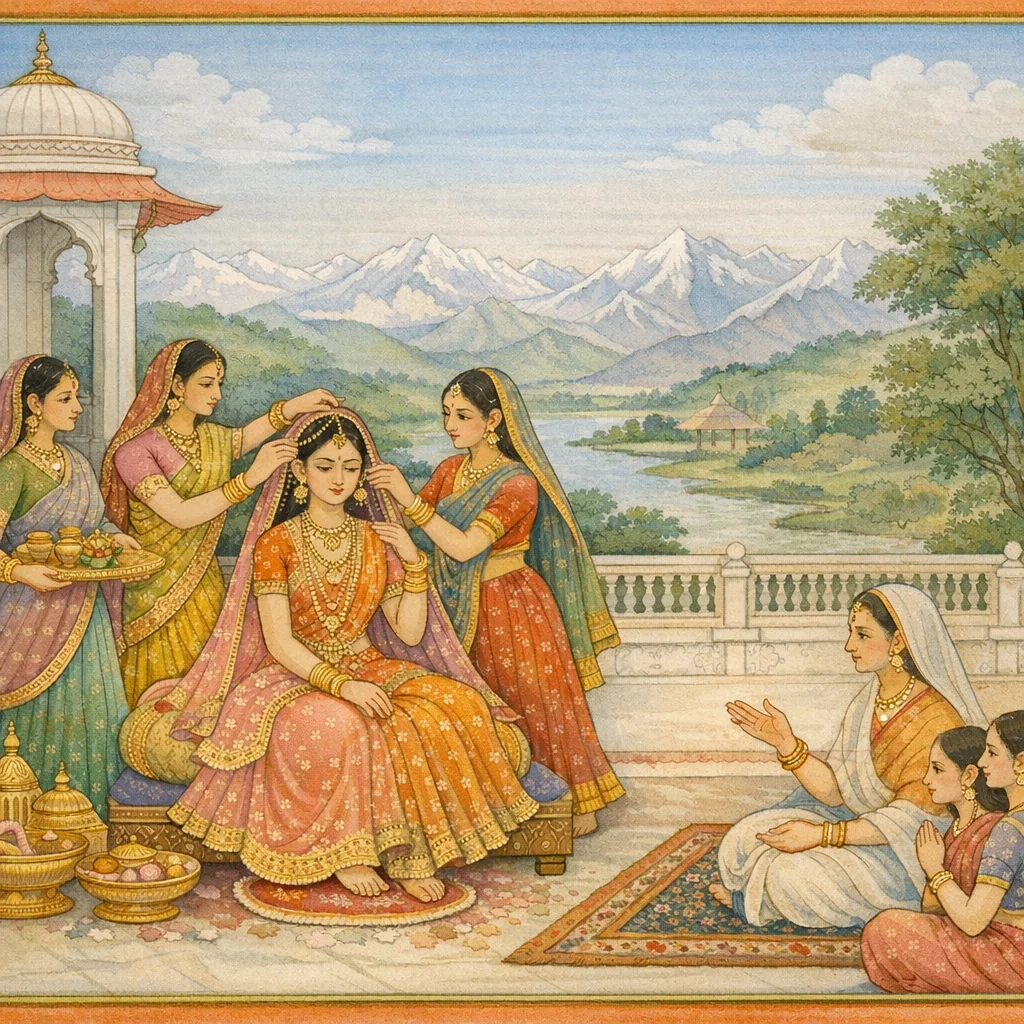
Adhyāya 54 begins with Brahmā recounting how the Saptarṣis approach Himagiri (Himālaya) and urge him to arrange a fitting journey or ceremonial outing for his daughter, the goddess Girijā. Feeling the sharp pain of separation (viraha) and stirred by deep affection, Himagiri is downcast for a time, then regains composure and agrees. He sends word to Menā, who responds with mingled joy and sorrow and prepares to act. Following śruti and ancestral custom, Menā organizes various festivities and rites and adorns Girijā with fine garments, jewels, and a complete set of ornaments befitting royal dignity. Perceiving Menā’s intent, a virtuous brahmin woman (dvija-patnī) undertakes Girijā’s instruction, teaching the supreme vow of pātivratya. She then delivers a dharma-centered exhortation: Girijā should listen with affection to words that increase dharma and bring happiness in this world and the next. She praises the pātivratā woman as uniquely worthy of worship, purifying the worlds and destroying accumulated sin, and declares that a wife who lovingly serves her husband—regarding him as Parameśvara—enjoys worldly prosperity and ultimately attains Śiva’s state together with her husband. The chapter (to v.84) continues this ceremonial and didactic arc, framing the impending marital-divine destiny through dharma and disciplined devotion.
Shlokas
Verse 1
ब्रह्मोवाच । अथ सप्तर्षयस्ते च प्रोचुर्हिमगिरीश्वरम् । कारय स्वात्मजा देव्या यात्रामद्योचितां गिरे
Brahmā said: Then those Seven Sages addressed the lord of Himālaya, saying, “O mountain-king, arrange at once the fitting pilgrimage-journey for your own daughter, the Goddess.”
Verse 2
इति श्रुत्वा गिरीशो हि बुद्ध्वा तद्विरहम्परम् । विषण्णोभून्महाप्रेम्णा कियत्कालं मुनीश्वर
O lord of sages, hearing this and realizing the extremity of that separation, Girīśa (Lord Śiva) became sorrowful; out of His great love, He remained so for some time.
Verse 3
कियत्कालेन सम्प्राप्य चेतनां शैलराट् ततः । तथास्त्विति गिरामुक्त्वा मेनां सन्देशमब्रवीत्
After some time, the lord of mountains (Himālaya) regained consciousness. Saying, “So be it,” and giving his assent in words, he then conveyed a message to Menā.
Verse 4
शैलसन्देशमाकर्ण्य हर्षशोकवशा मुने । मेना संयापयामास कर्त्तुमासीत्समुद्यता
O sage, hearing the message sent by the Mountain (Himālaya), Menā—swayed by alternating joy and sorrow—began to soothe her own heart and became ready to act as the situation required.
Verse 5
श्रुतिस्वकुलजाचारं चचार विधिवन्मुने । उत्सवम्विविधन्तत्र सा मेना क्षितिभृत्प्रिया
O sage, beloved Menā, the dear wife of the mountain-king, duly followed the sacred ordinances of the Vedas and the righteous customs of her lineage; and there she conducted various auspicious festivals in proper manner.
Verse 6
गिरिजाम्भूषयामास नानारत्नांशुकैर्वरैः । द्वादशाभरणैश्चैव शृंगारैर्नृपसम्मितैः
He adorned Girijā (Pārvatī) with excellent garments set with many kinds of jewels, and also with twelve ornaments—finely arranged adornments befitting a queen.
Verse 7
मेनामनोगम्बुद्ध्वा साध्व्येका द्विजकामिनी । गिरिजां शिक्षयामास पातिव्रत्यव्रतम्परम्
Understanding Menā’s noble and earnest intention, that virtuous lady—who cherished the welfare of the twice-born—began instructing Girijā in the supreme vow of devoted fidelity to one’s husband (pātivratya).
Verse 8
द्विजपत्न्युवाच । गिरिजे शृणु सुप्रीत्या मद्वचो धर्मवर्द्धनम् । इहामुत्रानन्दकरं शृण्वतां च सुखप्रदम्
The brahmin’s wife said: “O Girijā, listen with glad attention to my words, which nourish dharma. They bestow joy both in this world and the next, and they grant happiness to all who hear them.”
Verse 9
धन्या पतिव्रता नारी नान्या पूज्या विशेषतः । पावनी सर्वलोकानां सर्वपापौघनाशिनी
Blessed indeed is the wife devoted to her husband; none other is more especially worthy of reverent worship. She purifies all worlds and destroys the accumulated flood of sins.
Verse 10
सेवते या पतिम्प्रेम्णा परमेश्वरवच्छिवे । इह भुक्त्वाखिलाम्भोगान न्ते पत्या शिवां गतिम्
O Śivā, she who serves her husband with loving devotion, regarding him as the Supreme Lord, enjoys all worthy fulfillments in this world and, in the end, attains—together with her husband—the auspicious state that leads to Śiva.
Verse 11
पतिव्रता च सावित्री लोपामुद्रा ह्यरुन्धती । शाण्डिल्या शतरूपानुसूया लक्ष्मीस्स्वधा सती
Sāvitrī, Lopāmudrā, and Arundhatī are renowned as pativratās—wives of consecrated fidelity. So too are Śāṇḍilyā, Śatarūpā, Anasūyā, Lakṣmī, Svadhā, and Satī, celebrated for steadfast devotion and purity of conduct.
Verse 12
संज्ञा च सुमतिश्श्रद्धा मेना स्वाहा तथैव च । अन्या बह्व्योऽपि साध्व्यो हि नोक्ता विस्तरजाद्भयात्
Saṁjñā, Sumati, Śraddhā, Menā, and likewise Svāhā—these virtuous women were named. Many other righteous ladies are not mentioned, for fear that the account would become overly extensive.
Verse 13
पातिव्रत्यवृषेणैव ता गतास्सर्वपूज्यताम् । ब्रह्मविष्णुहरैश्चापि मान्या जाता मुनीश्वरैः
By the very power of their steadfast wifely devotion (pātivratya), they attained the state of being worthy of worship by all. Even Brahmā, Viṣṇu, and Hara (Śiva), along with the lordly sages, came to honor them.
Verse 14
सेव्यस्त्वया पतिस्तस्मात्सर्वदा शङ्करः प्रभुः । दीनानुग्रहकर्ता च सर्वसेव्यस्सतां गतिः
Therefore, your Lord and husband, Śaṅkara—the sovereign Master—should always be served by you. He is the giver of grace to the afflicted, worthy of service by all, and the refuge and final goal of the virtuous.
Verse 15
महान्पतिव्रताधर्म्मश्श्रुतिस्मृतिषु नोदितः । यथैष वर्ण्यते श्रेष्ठो न तथान्योऽस्ति निश्चितम्
This great dharma of pativratā—devoted fidelity to one’s husband—is not enjoined in the Śrutis and Smṛtis in the same manner. As it is described here as the most excellent, surely there is no other dharma equal to it.
Verse 16
भुंज्याद्भुक्ते प्रिये पत्यौ पातिव्रत्यपरायणा । तिष्ठेत्तस्मिंञ्छिवे नारी सर्वथा सति तिष्ठति
A devoted wife, wholly intent on the vow of pativratā, should eat only after her beloved husband has eaten. Established in Śiva present in her husband, the woman abides in the state of Satī in every way—steadfast in virtue and auspiciousness.
Verse 17
स्वप्यात्स्वपिति सा नित्यं बुध्येत्तु प्रथमं सुधीः । सर्वदा तद्धितं कुर्यादकैतवगतिः प्रिया
Whether she is asleep or awake, the wise man should always be the first to rise and remain watchful. At all times he should act for the welfare of his beloved, whose nature and conduct are free from deceit.
Verse 18
अनलंकृतमात्मानन्दर्शयेन्न क्वचिच्छिवे । कार्यार्थम्प्रोषिते तस्मिन्भवेन्मण्डनवर्जिता
O Śivā (Pārvatī), when her husband has gone away on some duty, a virtuous wife should not display herself anywhere in a decorated manner; she should remain without adornments.
Verse 19
पत्युर्नाम न गृह्णीयात् कदाचन पतिव्रता । आक्रुष्टापि न चाक्रोशेत्प्रसीदेत्ताडितापि च । हन्यतामिति च ब्रूयात्स्वामिन्निति कृपां कुरु
A devoted wife should never utter her husband’s name with disrespect. Even if abused, she should not abuse in return; even if struck, she should remain gentle and appeasing. If he says, “Let her be killed,” she should still plead, “My lord, show compassion.”
Verse 20
आहूता गृह कार्याणि त्यक्त्वा गच्छेत्तदन्तिकम् । सत्वरं साञ्जलिः प्रीत्यां सुप्रणम्य वदेदिति
When summoned, one should set aside household tasks and go at once into the presence of that revered person. Quickly, with joined palms and loving devotion, one should bow properly and then speak as is fitting.
Verse 21
किमर्थं व्याहृता नाथ स प्रसादो विधीयताम् । तदादिष्टा चरेत्कर्म सुप्रसन्नेन चेतसा
“For what purpose was I addressed thus, O Lord? Please bestow that grace. Commanded by You, I shall perform the prescribed action with a heart made wholly serene by Your favor.”
Verse 22
चिरन्तिष्ठेन्न च द्वारे गच्छेन्नैव परालये । आदाय तत्त्वं यत्किंचित्कस्मै चिन्नार्पयेत्क्वचित्
One should not linger long at the doorway, nor should one go to another’s private inner quarters. Having taken hold of any essential matter or confidential truth, one should not hand it over anywhere to just anyone.
Verse 23
पूजोपकरणं सर्वमनुक्ता साधयेत्स्वयम् । प्रतीक्षमाणावसरं यथाकालोचितं हितम्
Without being instructed, she herself prepared all the requisites for worship, patiently awaiting the proper opportunity—doing what was beneficial and appropriate to the right time.
Verse 24
न गच्छेत्तीर्थयात्रां वै पत्याज्ञां न विना क्वचित् । दूरतो वर्जयेत्सा हि समाजोत्सवदर्शनम्
She should not undertake a pilgrimage to sacred tīrthas anywhere without her husband’s permission. Indeed, she should also keep far away from the sight of public gatherings and festive assemblies.
Verse 25
तीर्थार्थिनी तु या नारी पतिपादोदकम्पिबेत् । तस्मिन्सर्वाणि तीर्थानि क्षेत्राणि च न संशयः
A woman who seeks the merit of pilgrimage—if she drinks the water that has washed her husband’s feet—then, without doubt, in that act are contained all sacred fords (tīrthas) and holy sanctuaries (kṣetras).
Verse 26
भुंज्यात्सा भर्तुरुच्छिष्टमिष्टमन्नादिकं च यत् । महाप्रसाद इत्युक्त्वा पतिदत्तम्पतिव्रता
The devoted wife (pativratā) should partake of whatever food and the like remains from her husband’s meal, regarding it as “mahāprasāda,” and thus receive what her husband gives with reverent devotion.
Verse 27
अविभज्य न चाश्नीयाद्देव पित्रतिथिष्वपि । परिचारकवर्गेषु गोषु भिक्षुकुलेषु च
One should not eat without first making a proper distribution—even when the offerings are meant for the Devas, the Pitṛs, and guests. One should also duly apportion food and service among attendants and dependents, to cows, and to the community of mendicants.
Verse 28
संयतोपस्करा दक्षा हृष्टा व्ययपराङ्मुखी । भवेत्सा सर्वदा देवी पतिव्रतपरायणा
She should keep her household means and possessions well regulated, be capable and diligent, remain cheerful, and turn away from wasteful expense. Thus, that noble lady becomes ever devoted to the vow of fidelity to her husband (pativratā).
Verse 29
कुर्यात्पत्यननुज्ञाता नोपवासव्रतादिकम् । अन्यथा तत्फलं नास्ति परत्र नरकम्व्रजेत्
A wife should not undertake fasts, vows (vrata), and similar religious observances without her husband’s permission. Otherwise, their fruit is lost, and in the hereafter she would go to hell.
Verse 30
सुखपूर्वं सुखासीनं रममाणं यदृच्छया । आन्तरेष्वपि कार्येषु पतिं नोत्थापयेत्क्वचित्
When the husband is happily seated and at ease, delighting naturally, the wife should never rouse him—even for intervening household tasks.
Verse 31
क्लीबम्वा दुरवस्थम्वा व्याधितं वृद्धमेव च । सुखितं दुःखितं वापि पतिमेकं न लंघयेत्
Whether the husband is impotent, fallen into misfortune, diseased, or aged—whether he is joyful or afflicted—a wife should not transgress the one husband to whom she is vowed, but remain faithful to him alone.
Verse 32
स्त्रीधर्मिणी त्रिरात्रं च स्वमुखं नैव दर्शयेत् । स्ववाक्यं श्रावयेन्नापि यावत्स्नानान्न शुध्यति
A woman during her monthly period should, for three nights, neither show her face nor let her words be heard, until she is purified by bathing.
Verse 33
सुस्नाता भर्तृवदनमीक्षेतान्यस्य न क्वचित् । अथवा मनसि ध्यात्वा पतिम्भानुम्विलोकयेत
After bathing well, she should look only upon her husband’s face and nowhere else. Or, having meditated upon her lord—her husband—within the mind, she should gaze upon the Sun, holding her husband as the inner object of contemplation.
Verse 34
हरिद्राकुङ्कुमं चैव सिन्दूरं कज्जलादिकम् । कूर्पासकञ्च ताम्बूलं मांगल्याभरणादिकम्
Turmeric and kuṅkuma, sindūra (vermilion), collyrium and the like; cotton as well; preparations of tāmbūla (betel); and auspicious ornaments and similar items—these are to be arranged/offered in the sacred observances of Devī’s worship, performed in devotion to Śiva’s divine household.
Verse 35
केशसंस्कारकबरीकरकर्णादिभूषणम् । भर्तुरायुष्यमिच्छन्ती दूरयेन्न पतिव्रता
A devoted wife (pativratā), desiring her husband’s longevity, should not indulge in elaborate hair-dress and adornments—such as kabarī (coiffure/locks), ornaments for the hands, ears, and the like—but should keep such embellishments at a distance.
Verse 36
न रजक्या न बन्धक्या तथा श्रवणया न च । न च दुर्भगया क्वापि सखित्वं कारयेत्क्वचित्
At no time should one form a bond of friendship with a woman of impure conduct, nor with one who is deceitful, nor with one known only through hearsay and gossip; and nowhere should one cultivate intimacy with one ill-fated or of inauspicious disposition.
Verse 37
पतिविद्वेषिणीं नारीं न सा संभाषयेत्क्वचित् । नैकाकिनी क्वचित्तिष्ठेन्नग्ना स्नायान्न च क्वचित्
She should never converse with a woman who harbors hatred toward her husband. Nor should she remain anywhere entirely alone; and she should never bathe naked at any time.
Verse 38
नोलूखले न मुसले न वर्द्धन्यां दृषद्यपि । न यंत्रके न देहल्यां सती च प्रवसेत्क्वचित्
A virtuous woman should never sit or remain upon an oil-press, a pestle, a winnowing basket, or even a grinding-stone; nor upon a press or machine, nor upon a threshold—she should not stay upon such places at any time.
Verse 39
विना व्यवायसमयं प्रागल्भ्यं नाचरेत्क्वचित् । यत्रयत्र रुचिर्भर्तुस्तत्र प्रेमवती भवेत्
Except at the proper time for conjugal union, she should never behave with forwardness. Wherever her husband’s liking inclines, there she should become loving and devoted.
Verse 40
हृष्टाहृष्टे विषण्णा स्याद्विषण्णास्ये प्रिये प्रिया । पतिव्रता भवेद्देवी सदा पतिहितैषिणी
When her beloved husband is not delighted, she should feel sorrow; when his face is sorrowful, she should become most dear to him by comforting him. Thus the Goddess is truly pativratā—ever seeking her husband’s welfare—showing that devoted service to Pati, the Lord, is itself a sacred vow that steadies dharma and purifies the heart toward liberation.
Verse 41
एकरूपा भवेत्पुण्या संपत्सु च विपत्सु च । विकृतिं स्वात्मनः क्वापि न कुर्याद्धैर्य्यधारिणी
A virtuous woman should remain of one temper in prosperity and in adversity alike. Steady in fortitude, she should never, in any circumstance, allow her own inner nature to be distorted.
Verse 42
सर्पिर्लवणतैलादिक्षयेपि च पतिव्रता । पतिं नास्तीति न ब्रूयादायासेषु न योजयेत्
Even if ghee, salt, oil, and other household provisions are exhausted, a devoted wife (pativratā) should not say, “My husband is of no use / is not there for me.” Nor should she press him into exhausting labours; thus she preserves harmony and dharma within the home.
Verse 43
विधेर्विष्णोर्हराद्वापि पतिरेकोधिको मतः । पतिव्रताया देवेशि स्वपतिश्शिव एव च
Even among Brahmā (the Ordainer), Viṣṇu, or Hara, it is held that the husband alone is supreme. O Goddess, for the chaste and devoted wife, her own husband is verily Śiva Himself.
Verse 44
व्रतोपवासनियमम्पतिमुल्लंघ्य या चरेत् । आयुष्यं हरते भर्तुर्मृता निरयमृच्छति
A woman who, transgressing her husband’s authority, undertakes vows (vrata), fasts, and religious observances by her own will is said to diminish her husband’s lifespan; and after death she falls into hellish states. Therefore discipline should be practiced in harmony with marital dharma.
Verse 45
उक्ता प्रत्युत्तरन्दद्याद्या नारी क्रोधतत्परा । सरमा जायते ग्रामे शृगाली निर्जने वने
A woman who, when addressed, gives a sharp retort and remains intent on anger is said to be born as a village dog in a settlement, and as a jackal in a lonely forest.
Verse 46
उच्चासनं न सेवेत न व्रजेद्दुष्टसन्निधौ । न च कातरवाक्यानि वदेन्नारी पतिं क्वचित्
A wife should not take a seat higher than her husband, nor should she go into the company of the wicked. And she should never speak timid, wavering words to her husband at any time.
Verse 47
अपवादं न च ब्रूयात्कलहं दूरतस्त्यजेत् । गुरूणां सन्निधौ क्वापि नोच्चैर्ब्रूयान्न वै हसेत्
One should not utter slander and should keep far from quarrel. In the presence of the Gurus, one should neither speak loudly anywhere nor indulge in laughter.
Verse 48
बाह्यादायान्तमालोक्य त्वरितान्नजलाशनैः । ताम्बूलैर्वसनैश्चापि पादसम्वाहनादिभिः
Seeing him return from outside, they hastened to serve him—offering food and water, presenting betel, providing garments, and attending to him with foot-massage and other acts of devoted hospitality.
Verse 49
तथैव चाटुवचनैः स्वेदसन्नोदनैः परैः । या प्रियं प्रीणयेत्प्रीता त्रिलोकी प्रीणता तया
Likewise, by sweet, affectionate words and by other intimate services—such as soothing the perspiration—she who, being herself delighted, pleases her beloved; through her, the three worlds themselves become pleased.
Verse 50
मितन्ददाति जनको मितं भ्राता मितं सुतः । अमितस्य हि दातारं भर्तारम्पूजयेत्सदा
A father gives only in measure; a brother gives only in measure; a son too gives only in measure. Therefore, one should always worship the husband—he who truly becomes the boundless giver and the steadfast sustainer.
Verse 51
भर्ता देवो गुरुर्भर्ता धर्मतीर्थव्रतानि च । तस्मात्सर्वम्परित्यज्य पतिमेकं समर्चयेत्
For a wife, the husband is to be regarded as her deity; the husband is her guru; and the husband is her dharma, her pilgrimages, and her vows. Therefore, setting aside everything else, she should worship her husband alone with wholehearted reverence.
Verse 52
या भर्तारम्परित्यज्य रहश्चरति दुर्मतिः । उलूकी जायते क्रूरा वृक्ष कोटरशायिनी
A woman of perverse understanding who abandons her husband and moves about in secret is born in a later birth as a cruel she-owl, dwelling in the hollows of trees.
Verse 53
ताडिता ताडितुं चेच्छेत्सा व्याघ्री वृषदंशिका । कटाक्षयति यान्यम्वै केकराक्षी तु सा भवेत्
If, when struck, a woman wishes to strike back, she is known as a tigress—one who bites like a bull. But she who casts her sidelong glance at another is indeed called “kekarākṣī” (a woman of wandering/crossed eyes).
Verse 54
या भर्तारम्परित्यज्य मिष्टमश्नाति केवलम् । ग्रामे वा सूकरी भूयाद्वल्गुर्वापि स्वविड्भुजा
A woman who forsakes her husband and lives only for sweet pleasures is reborn in a village as a sow, or else as a base scavenging creature that feeds upon its own filth.
Verse 55
या तुकृत्य प्रियम्ब्रूयान्मूका सा जायते खलु । या सपत्नी सदेर्ष्येत दुर्भगा सा पुनः पुनः
But she who, resorting to a harmful rite (kṛtyā), seeks to make a man speak sweetly is indeed born mute. And she who continually envies a co-wife becomes unfortunate again and again.
Verse 56
दृष्टिम्विलुप्य भर्त्तुर्या कश्चिदन्यं समीक्षते । काणा च विमुखी चापि कुरूपापि च जायते
If a woman, turning away from her husband, casts her gaze upon another man, she loses the rightness of her sight; she may become one-eyed, her face may turn away (crooked), and she may even become ill-formed in appearance.
Verse 57
जीवहीनो यथा देहः क्षणादशुचिताम्व्रजेत् । भर्तृहीना तथा योषित्सुस्नाताप्यशुचिस्सदा
Just as a body, bereft of life, becomes impure in a moment, so too a woman without her husband is regarded as ever impure, even if she has bathed well.
Verse 58
सा धन्या जननी लोके स धन्यो जनकः पिता । धन्यस्स च पतिर्यस्य गृहे देवी पतिव्रता
Blessed indeed in this world is that mother; blessed is that father who begets her. And blessed too is that husband in whose home the Goddess dwells as a devoted, vow-bound wife—steadfast in dharma and in loving service to her lord.
Verse 59
पितृवंश्याः मातृवंश्याः पतिवंश्यास्त्रयस्त्रयः । पतिव्रतायाः पुण्येन स्वर्गे सौख्यानि भुंजते
By the merit of a devoted wife’s pativratā-dharma, three generations from her father’s line, three from her mother’s line, and three from her husband’s line enjoy heavenly happiness in Svarga.
Verse 60
शीलभङ्गेन दुर्वृत्ताः पातयन्ति कुलत्रयम् । पितुर्मातुस्तथा पत्युरिहामुत्रापि दुःखिताः
By breaking right conduct, the wicked and ill-behaved bring ruin upon three lineages; and they become a cause of sorrow to father, mother, and husband—here in this world and in the world beyond as well.
Verse 61
पतिव्रतायाश्चरणो यत्र यत्र स्पृशेद्भुवम् । तत्र तत्र भवेत्सा हि पापहन्त्री सुपावनी
Wherever the foot of a devoted, chaste wife (pativratā) touches the earth, that very spot becomes supremely purifying, for she is indeed a destroyer of sin and a most holy purifier.
Verse 62
विभुः पतिव्रतास्पर्शं कुरुते भानुमानपि । सोमो गन्धवहश्चापि स्वपावित्र्याय नान्यथा
That all-pervading Lord (Vibhu) even makes the Sun seek the touch of a devoted, chaste wife (pativratā); the Moon and the Wind as well do so—not for any other reason, but to partake of her purifying sanctity.
Verse 63
आपः पतिव्रतास्पर्शमभिलष्यन्ति सर्वदा । अद्य जाड्यविनाशो नो जातस्त्वद्यान्यपावनाः
The waters ever yearn for the touch of a pativratā, a devoted and faithful wife. Today our dullness has been destroyed, for by you we have been purified.
Verse 64
भार्या मूलं गृहस्थास्य भार्या मूलं सुखस्य च । भार्या धर्मफलावाप्त्यै भार्या सन्तानवृद्धये
A wife is the very foundation of the householder’s life, and the foundation of happiness as well. Through the wife one attains the fruits of dharma, and through her the lineage is increased.
Verse 65
गृहे गृहे न किं नार्य्यो रूपलावण्यगर्विताः । परम्विश्वेशभक्त्यैव लभ्यते स्त्री पतिव्रता
In every household, are there not women proud of their beauty and charm? Yet a true pativratā, a devoted wife, is attained only through supreme devotion to Parama-Viśveśa (Lord Śiva), the Lord of the universe.
Verse 66
परलोकस्त्वयं लोको जीयते भार्य या द्वयम् । देवपित्रतिथीज्यादि नाभार्यः कर्म चार्हति
Both this world and the next are sustained through one’s wife. Without a wife, one is not fit to duly perform the rites of worship for the gods, the ancestors, the guests, and related sacred duties.
Verse 67
गृहस्थस्स हि विज्ञेयो यस्य गेहे पतिव्रता । ग्रस्यतेऽन्यान्प्रतिदिनं राक्षस्या जरया यथा
He alone should truly be known as a householder, in whose home there is a devoted, faithful wife (pativratā); for she, like a demoness called Old Age, consumes others day after day.
Verse 68
यथा गंगावगाहेन शरीरं पावनं भवेत् । तथा पतिव्रतां दृष्ट्वा सकलम्पावनं भवेत्
Just as by bathing in the Gaṅgā the body becomes purified, so too, upon beholding a devoted chaste wife (pativratā), one’s entire being becomes purified.
Verse 69
न गङ्गाया तया भेदो या नारी पतिदेवता । उमाशिवसमौ साक्षात्तस्मात्तौ पूजयेद्बुधः
That woman who regards her husband as her very deity (pati-devatā) is in no way different from the Goddess Gaṅgā. Indeed, she is directly equal to Umā and Śiva; therefore, the wise should worship that couple.
Verse 70
तारः पतिश्श्रुतिर्नारी क्षमा सा स स्वयन्तपः । फलम्पतिः सत्क्रिया सा धन्यौ तौ दम्पती शिवे
In Śiva’s sacred way, the husband is “tāra,” a saviour, and the wife is “śruti” itself; she is forbearance, and he is self-austerity. He is the fruit of life, she is righteous conduct; blessed indeed is that couple in Śiva.
Verse 71
एवम्पतिव्रताधर्मो वर्णितस्ते गिरीन्द्रजे । तद्भेदाञ् शृणु सुप्रीत्या सावधानतयाऽद्य मे
Thus, O daughter of the Lord of mountains, I have described to you the dharma of the devoted wife (pativratā). Now, with gladness and careful attention, listen today from me to its various divisions.
Verse 72
चतुर्विधास्ताः कथिता नार्यो देवि पतिव्रताः । उत्तमादिविभेदेन स्मरतां पापहारिकाः
O Goddess, the devoted wives (pativratās) have thus been described as fourfold, distinguished as the highest and so on; for those who remember them, they become destroyers of sin.
Verse 73
उत्तमा मध्यमा चैव निकृष्टातिनिकृष्टिका । ब्रुवे तासां लक्षणानि सावधानतया शृणु
“(They are) the best, the middling, the inferior, and the very inferior. I shall describe their distinguishing marks—listen with careful attention.”
Verse 74
स्वप्नेपि यन्मनो नित्यं स्वपतिं पश्यति ध्रुवम् । नान्यम्परपतिं भद्रे उत्तमा सा प्रकीर्तिता
Even in dreams, she whose mind ever and unfailingly beholds only her own husband—and not another’s husband, O auspicious one—is declared to be the highest.
Verse 75
या पितृभ्रातृसुतवत् परम्पश्यति सद्धिया । मध्यमा सा हि कथिता शैलजे वै पतिव्रता
O Daughter of the Mountain, that devoted wife who, with pure and discerning understanding, regards other men as she would her father, brother, or son—she is indeed declared to be of the middling (madhyamā) grade of pativratā.
Verse 76
बुद्ध्वा स्वधर्मं मनसा व्यभिचारं करोति न । निकृष्टा कथिता सा हि सुचरित्रा च पार्वति
Knowing her own dharma, she does not commit even a mental transgression against it. Such a woman is said to be not base; indeed, O Pārvatī, she is of noble conduct and good character.
Verse 77
पत्युः कुलस्य च भयाद्व्यभिचारं करोति न । पतिव्रताऽधमा सा हि कथिता पूर्वसूरिभिः
Out of fear of her husband and of his family’s honour, she does not commit adultery; such a woman has been described by the sages of old as the lowest kind of pativratā.
Verse 78
चतुर्विधा अपि शिवे पापहन्त्र्यः पतिव्रताः । पावनास्सर्वलोकानामिहामुत्रापि हर्षिताः
O Śivā (Pārvatī), those devoted wives—though of four kinds—are destroyers of sin. They sanctify all the worlds, and they remain joyful both here in this life and in the life to come.
Verse 79
पातिव्रत्यप्रभावेणात्रिस्त्रिया त्रिसुरार्थनात् । जीवितो विप्र एको हि मृतो वाराहशापतः
By the power of her perfect wifely devotion, and by that lady of Atri’s lineage entreating the three gods, one Brahmin indeed was restored to life—though he had died due to the curse connected with Varāha, the Boar incarnation.
Verse 80
एवं ज्ञात्वा शिवे नित्यं कर्तव्यम्पतिसेवनम् । त्वया शैलात्मज प्रीत्या सर्वकामप्रदं सदा
Thus, O Śivā (Devī), having understood this, you should ever render devoted service to your husband. O daughter of the Mountain, such service, done with loving sincerity, ever becomes the bestower of all worthy desires.
Verse 81
जगदम्बा महेशी त्वं शिवस्साक्षात्पतिस्तव । तव स्मरणतो नार्यो भवन्ति हि पतिव्रताः
You are Jagadambā, the great Queen (Maheśī). Śiva Himself is truly your Lord. By the mere remembrance of you, women indeed become pativratā—steadfast in the vow of devotion to their husbands.
Verse 82
त्वदग्रे कथनेनानेन किं देवि प्रयोजनम् । तथापि कथितं मेऽद्य जगदाचारतः शिवे
O Goddess, what purpose is served by recounting all this in your presence? Yet even so, O auspicious Śivā, today I have spoken it to you in accordance with the proper conduct and tradition of the world.
Verse 83
ब्रह्मोवाच । इत्युक्त्वा विररामासौ द्विजस्त्री सुप्रणम्य ताम् । शिवा मुदमतिप्राप पार्वती शङ्करप्रिया
Brahmā said: Having spoken thus, that brāhmaṇa lady bowed deeply to her and then fell silent. Thereupon Śivā—Pārvatī, beloved of Śaṅkara—attained overflowing joy.
Frequently Asked Questions
The Saptarṣis’ prompting of Himālaya to arrange Girijā’s appropriate yātrā/ceremonial preparation, followed by Menā’s organization of rites and Girijā’s adornment, setting the stage for her destined marital-divine transition.
It reframes household fidelity as a Shaiva soteriology: service to the husband with Parameśvara-bhāva becomes an embodied form of bhakti that purifies karma and culminates in śiva-gati (attainment of Śiva’s state).
Girijā is presented as the ideal recipient of dharmic formation; the pātivratā is elevated as world-purifying; and Parameśvara/Śiva is invoked as the archetype through whom marital devotion is sacralized.