अनरण्यसुता–पिप्पलादचरितम् / The Episode of Anaraṇya’s Daughter and Sage Pippalāda
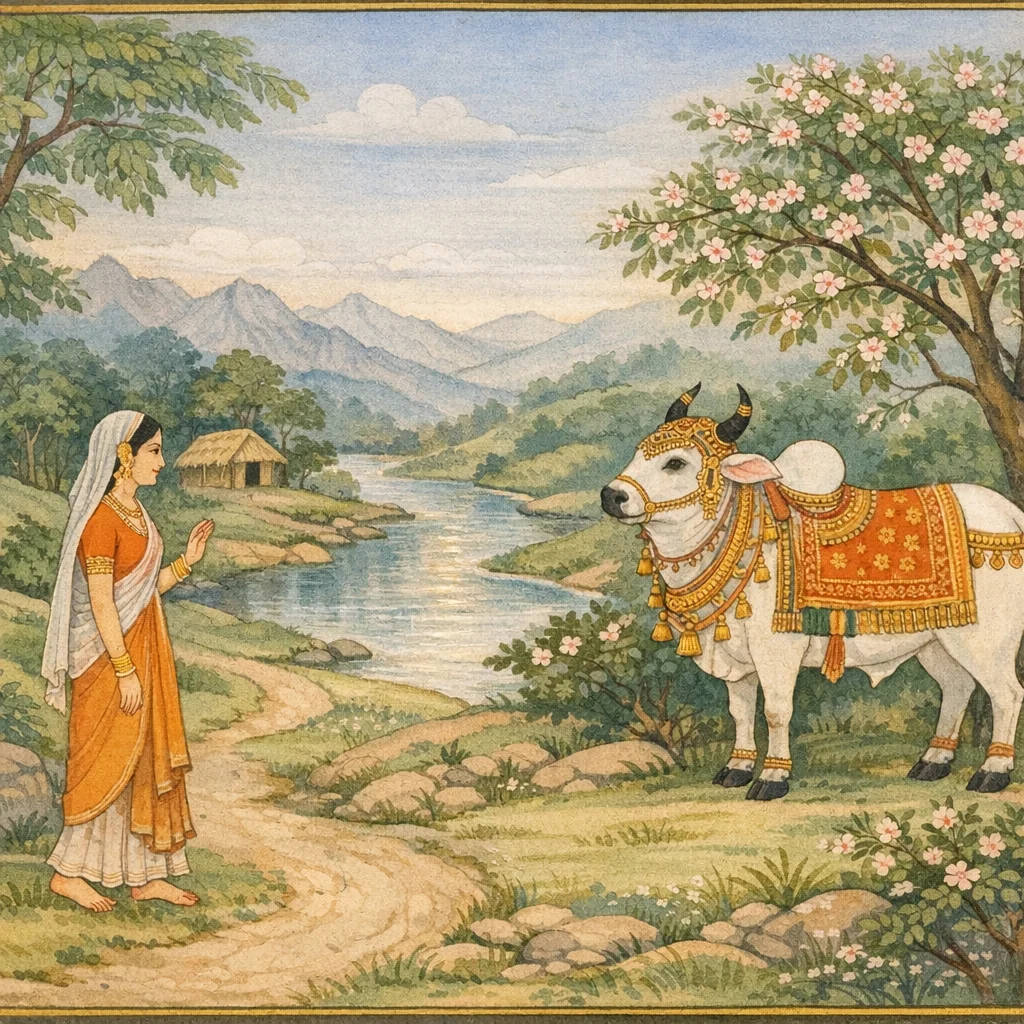
The chapter unfolds through nested dialogue. Nārada asks Brahmā what followed the Anaraṇya episode in which a daughter was given in marriage. Brahmā relates that Girivara/Śaileśa, the lord of the mountain, respectfully questions Vasiṣṭha about the wondrous conclusion—especially what Anaraṇya’s daughter did after gaining Sage Pippalāda as her husband. Vasiṣṭha portrays Pippalāda as an aged, disciplined ascetic, free from lust, living contentedly with her in his forest āśrama; the wife serves him with exemplary devotion in deed, mind, and speech, like Lakṣmī serving Nārāyaṇa. Then a dharma-test begins: as she goes to bathe in the river Svarṇadī, Dharma, by māyā, appears as a splendidly adorned bull with youthful radiance to discern the inner bhāva of the sage’s wife; the remaining verses are set to unfold the test and its moral-theological resolution.
Shlokas
Verse 1
नारद उवाच । अनरण्यस्य चरितं सुतादानसमन्वितम् । श्रुत्वा गिरिवरस्तात किं चकार च तद्वद
Nārada said: O dear one, having heard the account of Anaraṇya—together with the gift of a son—what did the best of mountains, Himālaya, do thereafter? Please tell me.
Verse 2
ब्रह्मोवाच । अनरण्यस्य चरितं कन्यादानसमन्वितम् । श्रुत्वा पप्रच्छ शैलेशो वसिष्ठं साञ्जलिः पुनः
Brahmā said: Having heard the account of Anaraṇya—together with the rite of giving his daughter in marriage—Śaileśa, Lord of the Mountains, again questioned Vasiṣṭha with folded hands.
Verse 3
शैलेश उवाच । वसिष्ठ मुनिशार्दूल ब्रह्मपुत्र कृपानिधे । अनरण्यचरित्रन्ते कथितं परमाद्भुतम्
Śaileśa said: “O Vasiṣṭha—tiger among sages, son of Brahmā, ocean of compassion—you have narrated to me the supremely wondrous account of Anaraṇya.”
Verse 4
अनरण्यसुता यस्मात् पिप्पलादं मुनिं पतिम् । सम्प्राप्य किमकार्षीत्सा तच्चरित्रं मुदावहम्
Since Anaraṇyā’s daughter attained the sage Pippalāda as her husband, what did she then do? That auspicious, joy-bestowing account now deserves to be told.
Verse 5
वसि । पिप्पलादो मुनिवरो वयसा जर्जरोधिकः । गत्वा निजाश्रमं नार्याऽनरण्यसुतया तया
“O Vasi, the excellent sage Pippalāda, greatly worn with age, went to his own hermitage along with that woman, the daughter of Anaraṇya.”
Verse 6
उवास तत्र सुप्रीत्या तपस्वी नातिलम्पटः । तत्रारण्ये गिरिवर स नित्यं निजधर्मकृत्
O best of mountains, he lived there with gladness—an austere ascetic, not given to sensual indulgence. In that forest he remained ever steadfast, continually performing his own rightful duties (dharma).
Verse 7
अथानरण्यकन्या सा सिषेवे भक्तितो मुनिम् । कर्मणा मनसा वाचा लक्ष्मीनारायणं यथा
Then that maiden of the forest served the sage with devotion—by her actions, by her mind, and by her speech—just as Lakṣmī serves Nārāyaṇa.
Verse 8
एकदा स्वर्णदीं स्नातुं गच्छन्तीं सुस्मितां च ताम् । ददर्श पथि धर्मश्च मायया वृषरूपधृक्
Once, as she—smiling gently—was going to bathe in the Svarṇadī river, Dharma saw her on the path, having assumed by his divine power the form of a bull.
Verse 9
चारुरत्नरथस्थश्च नानालं कारभूषितः । नवीनयौवनश्श्रीमान्कामदेवसभप्रभः
Mounted upon a splendid jewel-studded chariot and adorned with many ornaments, he appeared in the freshness of youth—radiant and resplendent, like Kāma-deva in his own assembly.
Verse 10
दृष्ट्वा तां सुन्दरीं पद्मामुवाच स वृषो विभुः । विज्ञातुं भावमन्तःस्थं तस्याश्च मुनियोषितः
Seeing the beautiful Padmā, the mighty Bull Nandin, the all-powerful one, spoke—wishing to know the feeling hidden within her heart, for she was the wife of a sage.
Verse 11
धर्म उवाच । अयि सुन्दरि लक्ष्मीर्वै राजयोग्ये मनोहरे । अतीव यौवनस्थे च कामिनि स्थिरयौवने
Dharma said: “O beautiful one, Lakṣmī-like lady, fit to be a queen, truly enchanting! O beloved, abiding in the fullness of youth, possessed of steady, unfading youthfulness.”
Verse 12
जरातुरस्य वृद्धस्य पिप्पलादस्य वै मुनेः । सत्यं वदामि तन्वंगि समीपे नैव राजसे
“Truly I tell you, O slender-limbed one: in the presence of the aged, infirm sage Pippalāda, you do not shine with kingly splendour.”
Verse 13
विप्रं तपस्सु निरतं निर्घृणं मरणोन्मुखम् । त्वक्त्वा मां पश्य राजेन्द्रं रतिशूरं स्मरातुरम्
“Leaving me aside, O king, look upon that brāhmaṇa—absorbed in tapas, pitiless, and facing death. Behold him: a hero in rati, tormented by desire.”
Verse 14
प्राप्नोति सुन्दरी पुण्यात्सौन्दर्य्यं पूर्वजन्मनः । सफलं तद्भवेत्सर्वं रसिकालिंगनेन च
By the merit of that sacred act, the beautiful woman attains the beauty earned in a former birth; and all of it is truly fulfilled through the loving embrace of the rasika, her discerning beloved.
Verse 15
सहस्रसुन्दरीकान्तं कामशास्त्रविशारदम् । किंकरं कुरु मां कान्ते सम्परित्यज्य तं पतिम्
“O beloved, abandon that husband and make me your servant—me, the darling of a thousand beauties, and one thoroughly skilled in the Kāmaśāstra, the science of love.”
Verse 16
निर्जने कानने रम्ये शैले शैले नदीतटे । विहरस्व मया सार्द्धं जन्मेदं सफलं कुरु
In a lonely, delightful forest—on the mountain slopes and along the riverbank—sport with me. Make this life truly fruitful.
Verse 17
वसिष्ठ उवाच । इत्येवमुक्तवन्तं सा स्वरथादवरुह्य च । ग्रहीतुमुत्सुकं हस्ते तमुवाच पतिव्रता
Vasiṣṭha said: When he had spoken thus, that devoted wife (pativratā) descended from her own chariot and, eager to take him by the hand, addressed him.
Verse 18
पद्मो वाच । गच्छ दूरं गच्छ दूरं पापिष्ठस्त्वं नराधिप । मां चेत्पश्यसि कामेन सद्यो नष्टो भविष्यसि
Padma said: “Go far away—go far away, O king. You are most sinful. If you look upon me with lust, you will be ruined at once.”
Verse 19
पिप्पलादं मुनि श्रेष्ठं तपसा पूतविग्रहम् । त्यक्त्वा कथं भजेयं त्वां स्त्रीजितं रतिलम्पटम्
“Having abandoned the foremost sage Pippalāda—whose very body has been purified by austerity—how could I worship you, one conquered by a woman and greedy for sensual pleasure?”
Verse 20
स्त्रीजितस्पर्शमात्रेण सर्वं पुण्यं प्रणश्यति । स्त्रीजितः परपापी च तद्दर्शनमघावहम्
By the mere touch of one conquered by lust for women, all accumulated merit is said to perish. Such a man becomes a grievous sinner toward others, and even the sight of him is regarded as a bringer of sin.
Verse 21
सत्क्रियो ह्यशुचिर्नित्यं स पुमान् यः स्त्रिया जितः । निन्दन्ति पितरो देवा मान वास्सकलाश्च तम्
Even if he performs outwardly proper rites, that man who is overpowered by a woman remains ever impure in conduct; the Pitṛs, the Devas, and all people censure him.
Verse 22
तस्य किं ज्ञान सुतपो जपहोमप्रपूजनैः । विद्यया दानतः किम्वा स्त्रीभिर्यस्य मनो हृतम्
What use are spiritual knowledge, severe austerities, japa, homa, and elaborate worship for one whose mind has been stolen away by attachment to women? Of what avail are learning and charity to him either, when his inner awareness is carried off by sensual fascination?
Verse 23
मातरं मां स्त्रियो भावं कृत्वा येन ब्रवीषि ह । भविष्यति क्षयस्तेन कालेन मम शापतः
“Since you addressed me by calling me ‘mother’, as though making me assume the condition of a woman, by my curse, in due time you shall meet with decline and ruin.”
Verse 24
वसिष्ठ उवाच । श्रुत्वा धर्मस्सतीशापं नृप मूर्तिं विहाय च । धृत्वा स्वमूर्तिं देवेशः कम्पमान उवाच सः
Vasiṣṭha said: “O King, having heard Satī’s curse upon Dharma, the Lord of the gods cast aside that assumed form. Taking up His own true form again, trembling, He spoke.”
Verse 25
धर्म उवाच । मातर्जानीहि मां धर्मं ज्ञानिनाञ्च गुरो र्गुरुम् । परस्त्रीमातृबुद्धिश्च कुव्वर्न्तं सततं सति
Dharma said: “Mother, know me as Dharma—the preceptor of the wise, the guru even of gurus. O virtuous one, I am ever established in the attitude that regards another’s wife as a mother.”
Verse 26
अहं तवान्तरं ज्ञातुमागतस्तव सन्निधिम् । तवाहञ्च मनो जाने तथापि विधिनोदितः
I have come into your presence to know what is within you. I already understand your mind as well; yet, being impelled by the ordinance of destiny and the divine order, I speak and inquire.
Verse 27
कृतं मे दमनं साध्वि न विरुद्धं यथोचितम् । शास्तिः समुत्पथस्थानामीश्वरेण विनिर्मिता
O virtuous lady, the restraint you have exercised over me is neither improper nor contrary to what is fitting. For the Lord Īśvara has Himself ordained chastisement for those who stand upon the path of deviation.
Verse 28
स्वयं प्रदाता सर्वेभ्यः सुखदुःखवरान्क्षमः । सम्पदं विपदं यो हि नमस्तस्मै शिवाय हि
Salutations indeed to that Śiva—who Himself is the giver to all, who can bestow boons as happiness and as sorrow, and who truly dispenses both prosperity and adversity.
Verse 29
शत्रुं मित्रं सम्विधातुं प्रीतिञ्च कलहं क्षमः । स्रष्टुं नष्टुं च यस्सृष्टिं नमस्तस्मै शिवाय हि
Salutations indeed to that Lord Śiva, who can turn an enemy into a friend, who can bring about love as well as conflict, and who—being the Lord of creation—can both create the universe and dissolve it.
Verse 30
येन शुक्लीकृतं क्षीरं जले शैत्यं कृतम्पुरा । दाहीकृतो हुता शश्च नमस्तस्मै शिवाय हि
Salutations indeed to that Lord Śiva—by whom milk was made white, by whom water was endowed with coolness in ancient times, and by whom the sacrificial fire (Hutāśa) was made to blaze with burning power.
Verse 31
प्रकृतिर्निर्मिता येन तप्त्वाति महदादितः । ब्रह्मविष्णुमहेशाद्या नमस्तस्मै शिवाय हि
Salutations indeed to that auspicious Lord Śiva—by whom Prakṛti (the primordial Nature) is fashioned, and from whom, after the great heat of tapas, the principle of Mahat and the rest unfold; and from whom arise Brahmā, Viṣṇu, Maheśa and the other divine powers.
Verse 32
ब्रह्मोवाचः । इत्युक्त्वा पुरतस्तस्यास्तस्थौ धर्मो जगद्गुरुः । किञ्चिन्नोवाच चकितस्तत्पातिव्रत्य तोषितः
Brahmā said: Having spoken thus, Dharma—the preceptor of the world—stood before her. Astonished, and pleased by her unwavering fidelity as a devoted wife, he did not speak anything further.
Verse 33
पद्मापि नृपकन्या सा पिप्पलादप्रिसा तदा । साध्वी तं धर्ममाज्ञाय विस्मितोवाच पर्वत
Then the virtuous royal maiden Padmā—dear to Pippalāda—having understood the righteous path of Dharma, was filled with wonder; and Parvata spoke in amazement.
Verse 34
पद्मोवाच । त्वमेव धर्म सर्वेषां साक्षी निखिलकर्मणाम् । कथं मनो मे विज्ञातुं विडम्बयसि मां विभो
Padmā said: “You alone are Dharma itself—the inner witness of all beings and the all-seeing knower of every deed. O all-pervading Lord, how can You pretend not to know my mind and thus tease me?”
Verse 35
यत्तत्सर्वं कृतं ब्रह्मन् नापराधो बभूव मे । त्वञ्च शप्तो मयाऽज्ञानात्स्त्रीस्वभा वाद्वृथा वृष
“O Brahmā, in all that has occurred, truly there was no fault on my part. Yet, out of ignorance—through the impulsiveness natural to a woman—I cursed you without proper cause, O Lord of the bull-banner.”
Verse 36
का व्यवस्था भवेत्तस्य चिन्तयामीति साम्प्रतम् । चित्ते स्फुरतु सा बुद्धिर्यया शं संल्लभामि वै
“What discipline will lead me to Him?—this I now contemplate. May that very discernment flash forth within my heart, by which I may truly attain Śiva, the Bestower of auspiciousness.”
Verse 37
आकाशोसौ दिशस्सर्वा यदि नश्यन्तु वायवः । तथापि साध्वीशापस्तु न नश्यति कदाचन
Even if the sky itself, all the directions, and the winds were to perish, still the curse uttered by a chaste and righteous woman never perishes at any time.
Verse 38
सत्ये पूर्णश्चतुष्पादः पौर्ण मास्यां यथा शशी । विराजसे देवराज सर्वकालं दिवानिशम्
In the Satya-yuga you are complete, standing firm on all four quarters, like the moon on the night of the full moon. O Lord of the gods, you shine in splendour at all times, by day and by night.
Verse 39
त्वञ्च नष्टो भवसि चेत्सृष्टिनाशो भवेत्तदा । इति कर्तव्यतामूढा वृथापि च वदाम्यहम्
If you were to be destroyed, then the dissolution of the created order would occur. Deluded by the thought of “what must be done,” I speak—even if it is in vain.
Verse 40
पादक्षयश्च भविता त्रेतायां च सुरोत्तम । पादोपरे द्वापरे च तृतीयोऽपि कलौ विभो
O best of the gods, in the Tretā age there will be a diminution of one quarter (of dharma). In the Dvāpara, another quarter will be lost; and in the Kali age, O mighty one, the third quarter too will decline.
Verse 41
कलिशेषेऽखिलाश्छिन्ना भविष्यन्ति तवांघ्रयः । पुनस्सत्ये समायाते परिपूर्णो भविष्यसि
At the close of the Kali age, all your limbs shall be severed. But when the Satya age returns again, you shall become whole and complete once more.
Verse 42
सत्ये सर्वव्यापकस्त्वं तदन्येषु च कु त्रचित् । युगव्यवस्थया स त्वं भविष्यसि तथा तथा
In the Satya-yuga you are all-pervading; but in the other ages you are perceived only in some particular way. According to the ordering of the yugas, you will manifest accordingly—each time in that fitting manner.
Verse 43
इत्येवं वचनं सत्यं ममास्तु सुखदं तव । याम्यहं पतिसेवायै गच्छ त्वं स्वगृहं विभो
“So be it—let these words be true. May it be auspicious and happiness-giving for you. I shall go now to the service of my husband; you, O mighty one (vibho), go to your own home.”
Verse 44
ब्रह्मोवाच । इत्याकर्ण्य वचस्तस्यास्सन्तुष्टोभूद्वृषस्स वै । तदेवंवादिनीं साध्वीमुवाच विधिनन्दन
Brahmā said: Hearing her words, that bull (Dharma) was indeed pleased. Then the son of the Ordainer (Brahmā), addressing that virtuous lady who spoke thus, replied to her.
Verse 45
धर्म उवाच । धन्यासि पतिभक्तासि स्वस्ति तेस्तु पतिव्रते । वरं गृहाण त्वत्स्वामी त्वत्परित्राणकारणात्
Dharma said: “Blessed are you—devoted to your husband. Auspiciousness be yours, O pativratā. Receive a boon, for your lord, your husband, has become the cause of your protection.”
Verse 46
युवा भवतु ते भर्ता रतिशूरश्च धार्मिकः । रूपवान् गुणवान्वाग्मी संततस्थिरयौवनः
“May your husband be ever youthful—valiant in love and steadfast in dharma; handsome, endowed with virtues, eloquent in speech, and possessed of unbroken, steady youth.”
Verse 47
चिरञ्जीवी स भवतु मार्कण्डेयात्प रश्शुभे । कुबेराद्धनवांश्चैव शक्रादैश्वर्य्यवानपि
O auspicious one, may he be long-lived like Mārkaṇḍeya; may he be wealthy like Kubera; and may he also be endowed with sovereignty and lordly power like Śakra (Indra).
Verse 48
शिवभक्तो हरिसमस्सिद्धस्तु कपिलात्परः । बुद्ध्या बृहस्पतिसमस्समत्वेन विधेस्समः
A devotee of Śiva becomes accomplished like Hari (Viṣṇu), surpassing even Kapila; in intelligence he becomes like Bṛhaspati, and in even-minded equanimity he becomes like Vidhi (Brahmā).
Verse 49
स्वामिसौभाग्यसंयुक्ता भव त्वं जीवनावधि । तथा च सुभगे देवि त्वं भव स्थिरयौवना
“May you remain endowed with the good fortune of your husband until the end of your life. And, O auspicious Goddess, may you abide in steady, unfading youth.”
Verse 50
माता त्वं दशपुत्राणां गुणिनां चिरजीविनाम् । स्वभर्तुरधिकानां च भविष्यसि न संशयः
You shall surely become the mother of ten sons—virtuous and long-lived—who will even surpass your own husband in excellence; of this there is no doubt.
Verse 51
गृहा भवन्तु ते साध्वि सर्वसम्पत्सम न्विताः । प्रकाशमन्तस्सततं कुबेरभवनाधिकाः
O virtuous lady, may your homes be endowed with every prosperity; may they ever be filled with inner radiance—surpassing even the splendid mansions of Kubera.
Verse 52
वसिष्ठ उवाच । इत्येवमुक्ता सन्तस्थौ धर्मस्स गिरिसत्तम । सा तं प्रदक्षिणीकृत्य प्रणम्य स्वगृहं ययौ
Vasiṣṭha said: Thus instructed, Dharma—O best of mountains—stood firm. She then circumambulated him in pradakṣiṇā, bowed in reverence, and returned to her own home.
Verse 53
धर्मस्तथाशिषो दत्वा जगाम निजमन्दिरम् । प्रशशंस च तां प्रात्या पद्मां संसदि संसदि
Thus Dharma, having bestowed his blessings, departed to his own abode. And on returning, he praised Padmā again and again in every assembly.
Verse 54
सा रेमे स्वामिना सार्द्धं यूना रहसि सन्ततम् । पश्चाद्बभूवुऽस्सत्पुत्रास्तद्भर्तुरधिका गुणैः
She delighted continually in secret with her youthful Lord. Thereafter, excellent sons were born—endowed with virtues even surpassing those of their father.
Verse 55
बभूव सकला सम्पद्दम्पत्योः सुखवर्द्धिनी । सर्वानन्दवृद्धिकरी परत्रेह च शर्मणे
All prosperity arose for the divine couple, increasing their happiness—expanding every joy and granting peace and well-being both here in this world and in the hereafter.
Verse 56
शैलेन्द्र कथितं सर्वमितिहासं पुरातनम् । दम्पत्योश्च तयोः प्रीत्या श्रुतं ते परमादरात्
“O Śailendra, thus the entire ancient sacred narrative spoken by Śailendra was heard by you with the utmost reverence—by that loving divine couple, in mutual affection.”
Verse 57
बुद्ध्वा तत्त्वं सुतां देहि पार्वतीमीश्वराय च । कुरुषं त्यज शैलेन्द्र मेनया स्वस्त्रिया सह
Having understood the tattva, give your daughter Pārvatī to the Lord Īśvara (Śiva). O king of mountains, abandon this harshness and relent, together with your wife Menā.
Verse 58
सप्ताहे समतीते तु दुर्लभेति शुभे क्षणे । लग्नाधिपे च लग्नस्थे चन्द्रेस्वत्नयान्विते
When a week had passed, at that auspicious and rare moment—when the lord of the ascendant was established in the ascendant, and the Moon was conjoined with its own offspring—the destined event came to pass.
Verse 59
मुदिते रोहिणीयुक्ते विशुद्धे चन्द्रतारके । मार्गमासे चन्द्रवारे सर्वदोषविवर्जिते
When the Moon is auspicious and joined with Rohiṇī, when the lunar asterism is pure and radiant, and when it is the month of Mārgaśīrṣa on a Monday—such a time is said to be free from all inauspicious blemishes.
Verse 60
सर्वसद्ग्रहसंसृष्टऽसद्ग्रहदृष्टिवर्जिते । सदपत्यप्रदे जीवे पतिसौभाग्यदायिनि
O living Goddess, woven of all auspicious influences and untouched by the gaze of inauspicious graspings—O granter of noble progeny, O bestower of a husband’s good fortune and the blessedness of marriage.
Verse 61
जगदम्बां जगत्पित्रे मूलप्रकृतिमीश्वरीम् । कन्यां प्रदाय गिरिजां कृती त्वं भव पर्वत
O Mountain (Himālaya), by giving your daughter Girijā—Mother of the universe, sovereign Goddess, the very Root-Prakṛti—to the Father of the universe (Śiva), you shall indeed become blessed and accomplished.
Verse 62
ब्रह्मोवाच । इत्युक्त्वा मुनिशार्दूलो वसिष्ठो ज्ञानिसत्तमः । विरराम शिवं स्मृत्वा नानालीलाकरं प्रभुम्
Brahmā said: Having spoken thus, Vasiṣṭha—the tiger among sages, the foremost of the wise—paused, remembering Lord Śiva, the supreme Master who manifests countless divine līlās.
Frequently Asked Questions
A dharma-test narrative begins: Anaraṇya’s daughter, devoted wife of the ascetic Pippalāda, is encountered on the way to bathe at Svarṇadī by Dharma appearing through māyā in bull form to assess her inner disposition.
The episode foregrounds bhāva (inner intention) as the decisive criterion of virtue: outward conduct is validated by inner purity, and divine disguises function as instruments to reveal the subtle truth of character.
Dharma’s māyā-based manifestation as a vṛṣa (bull-form) with splendor and adornment; additionally, the idealized devotional archetype is invoked via the Lakṣmī–Nārāyaṇa comparison.