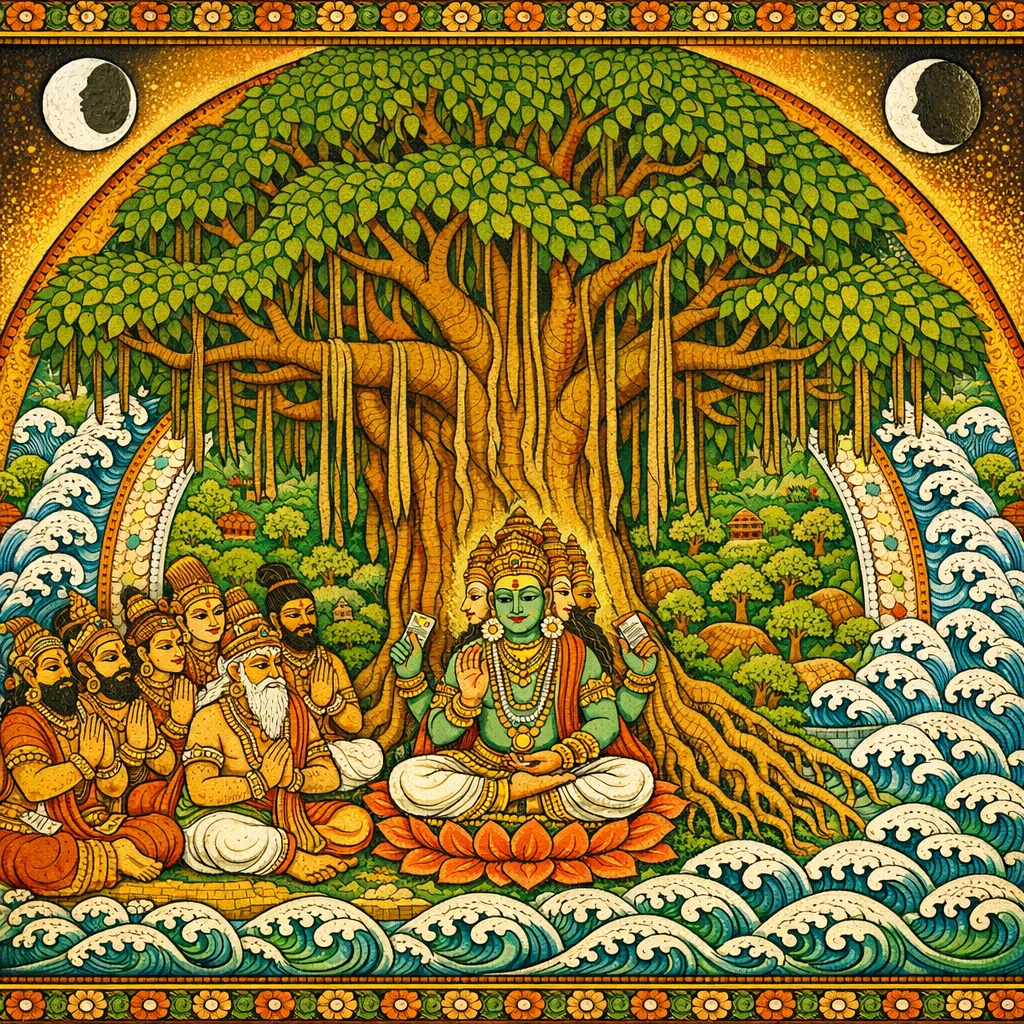
Adhyaya 123: Description of Gomedaka and Puṣkara Dvīpas; the Lokāloka Boundary; Ocean Tides and Elemental Hierarchy
गोमेदक-पुष्करद्वीपवर्णनं लोकालोकविवेचनं च
Speaker: Sūta, Ascetics (Tapodhana Ṛṣis)
Replying to the sages’ continuing cosmological questions, Sūta describes the sixth dvīpa, Gomedaka, with the encircling Surodaka ocean, names its mountains, and divides its land into the southern Dhātakīkhaṇḍa and the northern Kumuda. He then presents the seventh dvīpa, Puṣkara, its chief mountains Citrasānu and Mānasā, the sweet-water ocean, and the remarkable human condition there—long life, equality, and the absence of social strife and dividing institutions. The teaching widens to natural law, explaining tides as linked to the moon’s waxing and waning, and to definitional etymologies of dvīpa and odadhi and other named features across the dvīpas. Sūta places Brahmā at the Nyagrodha on Puṣkara and concludes with the Lokāloka boundary and a graded tenfold series of enclosing elements culminating in avyakta, presenting this ordered layout as saṃniveśa, the proper arrangement of the world’s vast expanse.
Key Concepts
Shlokas in Adhyaya 123
Verse 1
*सूत उवाच गोमेदकं प्रवक्ष्यामि षष्ठं द्वीपं तपोधनाः सुरोदकसमुद्रस्तु गोमेदेन समावृतः //
Sūta said: “I shall now describe Gomedaka, the sixth dvīpa, O ascetics rich in austerity. The ocean called Surodaka, the sea of sacred waters, is encircled by Gomedaka.”
Verse 2
शाल्मलस्य तु विस्ताराद् द्विगुणस्तस्य विस्तरः तस्मिन्द्वीपे तु विज्ञेयौ पर्वतौ द्वौ समाहितौ //
But that dvīpa’s extent is said to be twice the breadth of Śālmaladvīpa; and within that dvīpa, two mountains are to be understood as situated together.
Verse 3
प्रथमः सुमना नाम जात्यञ्जनमयो गिरिः द्वितीयः कुमुदो नाम सर्वौषधिसमन्वितः //
The first mountain is named Sumanā, a peak formed of jasmine and the mineral añjana, akin to collyrium. The second is called Kumuda, endowed with every kind of medicinal herb.
Verse 4
शातकौम्भमयः श्रीमान् विज्ञेयः सुमहाचितः समुद्रेक्षुरसोदेन वृतो गोमेदकश्च सः //
He should be understood as resplendent, fashioned of pure gold and richly adorned; and that ornament or setting is encircled with an ocean-born lustre like sugarcane juice, and also with gomeda gems.
Verse 5
षष्ठेन तु समुद्रेण सुरोदाद्द्विगुणेन च धातकीकुमुदश्चैव हव्यपुत्रौ सुविस्तृतौ //
And then, beyond it, there is the sixth ocean, called Surodā, twice the extent of the preceding one; and there lie the vast lands Dhātakī and Kumuda, the two sons of Havya, spread out widely.
Verse 6
सौमनं प्रथमं वर्षं धातकीखण्डमुच्यते धातकिनः स्मृतं तद्वै प्रथमं प्रथमस्य तु //
In the Dhātakīkhaṇḍa, the first varṣa (region) is called Saumana; and that is remembered as Dhātakina—the foremost division of that first section.
Verse 7
गोमेदं यत्स्मृतं वर्षं नाम्ना सर्वसुखं तु तत् कुमुदस्य द्वितीयस्य द्वितीयं कुमुदं ततः //
That varṣa (region) remembered as Gomeda is also known by the name “Sarvasukha” (“All-Delight”). And then, within the second division of Kumuda, there is again a second sub-region called Kumuda.
Verse 8
एतौ द्वौ पर्वतौ वृत्तौ शेषौ सर्वसमुच्छ्रितौ पूर्वेण तस्य द्वीपस्य सुमनाः पर्वतः स्थितः //
These two mountains are circular in form; the remaining ones are lofty and rise high above all. To the east of that island stands the mountain named Sumanas.
Verse 9
प्राक्पश्चिमायतैः पादैर् आसमुद्रादिति स्थितः पश्चार्धे कुमुदस्तस्य एवमेव स्थितस्तु वै //
With his feet extended along the east–west axis, he is stationed in the division called Āsamudra; in its western half, Kumuda is likewise situated.
Verse 10
एतैः पर्वतपादैस्तु स देशो वै द्विधाकृतः दक्षिणार्धं तु द्वीपस्य धातकीखण्डमुच्यते //
By these mountain-foot ranges, that region is indeed divided into two. The southern half of the island-continent is called Dhātakīkhaṇḍa.
Verse 11
कुमुदं तूत्तरे तस्य द्वितीयं वर्षमुत्तमम् एतौ जनपदौ द्वौ तु गोमेदस्य तु विस्तृतौ //
To its north lies Kumuda, the second and excellent varṣa. These two are the broad and extensive janapadas of Gomeda.
Verse 12
अतः परं प्रवक्ष्यामि सप्तमं द्वीपमुत्तमम् समुद्रेक्षुरसं चैव गोमेदाद्द्विगुणं हि सः //
Now I shall describe the seventh and most excellent continent, and also the ocean of sugarcane-juice; it is indeed twice the extent of Gomeda.
Verse 13
आवृत्य तिष्ठति द्वीपः पुष्करः पुष्करैर्वृतः पुष्करेण वृतः श्रीमांश् चित्रसानुमहागिरिः //
Encircling the central region, the island-continent named Puṣkara stands, surrounded by lotus-like expanses; and within Puṣkara, the splendid great mountain called Citrasānu is likewise enclosed.
Verse 14
कूटैश्चित्रैर्मणिमयैः शिलाजालसमुद्भवैः द्वीपस्यैव तु पूर्वार्धे चित्रसानुः स्थितो महान् //
In the eastern half of the island stands the great mountain Citrāsānu, whose many-peaked summits are wondrous—gem-like and variegated—rising from a network of rocky strata.
Verse 15
परिमण्डलसहस्राणि विस्तीर्णः सप्तविंशतिः ऊर्ध्वं स वै चतुर्विंशद्योजनानां महाबलः //
It extends across thousands of circular measures; its breadth is twenty-seven yojanas, and upward it rises to twenty-four yojanas—mighty in its vast proportions.
Verse 16
द्वीपार्धस्य परिक्षिप्तः पश्चिमे मानसो गिरिः स्थितो वेलासमीपे तु पूर्वचन्द्र इवोदितः //
On the western side, the Mānasā mountain lies encircling half of the island-region; and near the seashore it stands forth, rising like the moon appearing in the east.
Verse 17
योजनानां सहस्राणि सार्धं पञ्चाशदुच्छ्रितः तस्य पुत्रो महावीतः पश्चिमार्धस्य रक्षिता //
He rose to a height of one thousand yojanas and fifty more; his son, Mahāvīta, became the protector of the western region.
Verse 18
पूर्वार्धे पर्वतस्यापि द्विधा देशस्तु स स्मृतः स्वादूदकेनोदधिना पुष्करः परिवारितः //
On the eastern half of the mountain, that region is said to be divided into two; Puṣkara is encircled by an ocean of sweet water.
Verse 19
विस्तारान्मण्डलाच्चैव गोमेदाद्द्विगुणेन तु त्रिंशद्वर्षसहस्राणि तेषु जीवन्ति मानवाः //
In extent it is twice that of Maṇḍala and likewise of Gomeda; and the humans who dwell in those regions live for thirty thousand years.
Verse 20
विपर्ययो न तेष्वस्ति एतत्स्वाभाविकं स्मृतम् आरोग्यं सुखबाहुल्यं मानसीं सिद्धिमास्थिताः //
For them there is no reversal or decline; this is remembered as their natural condition—abundant health, a plenitude of happiness, and the attainment of inner (mental) perfection.
Verse 21
सुखमायुश्च रूपं च त्रिषु द्वीपेषु सर्वशः अधमोत्तमौ न तेष्वास्तां तुल्यास्ते वीर्यरूपतः //
In those three islands, happiness, lifespan, and beauty are found everywhere. Among them there is no distinction of lowest and highest; they are all alike in vigor and in form.
Verse 22
न तत्र वध्यवधकौ नेर्ष्यासूया भयं तथा न लोभो न च दम्भो वा न च द्वेषः परिग्रहः //
There, neither the condemned nor the executioner exists; nor are envy, malice, or fear found. There is no greed, no hypocrisy, nor even hatred or possessive hoarding.
Verse 23
सत्यानृते न तेष्वास्तां धर्माधर्मौ तथैव च वर्णाश्रमाणां वार्त्ता च पाशुपाल्यं वणिक्कृषिः //
Among them, neither truth nor untruth prevailed; likewise, neither dharma nor adharma was established. The social order of the varṇas and āśramas, and the customary livelihoods—cattle-herding, trade, and agriculture—also did not exist.
Verse 24
त्रयीविद्या दण्डनीतिः शुश्रूषा दण्ड एव च न तत्र वर्षं नद्यो वा शीतोष्णं च न विद्यते //
There, the threefold sacred knowledge of the Vedas, the science of governance and punishment (daṇḍanīti), service and obedience (śuśrūṣā), and even punishment itself are absent; there is neither rainfall nor rivers, and neither cold nor heat exists.
Verse 25
उद्भिदान्युदकानि स्युर् गिरिप्रस्रवणानि च तुल्योत्तरकुरूणां तु कालस्तत्र तु सर्वदा //
There, the waters are those that arise from the earth, and there are also streams flowing down from the mountains; and for the people of Uttarakuru, time remains ever the same—uniform and unchanging.
Verse 26
सर्वतः सुखकालो ऽसौ जराक्लेशविवर्जितः सर्गस्तु धातकीखण्डे महावीते तथैव च //
There, on all sides, time itself is an age of happiness, free from old age and affliction. Such indeed is the order of creation (sarga) in Dhātakīkhaṇḍa, and likewise in Mahāvīta.
Verse 27
एवं द्वीपाः समुद्रैस्तु सप्त सप्तभिरावृताः द्वीपस्यानन्तरो यस्तु समुद्रस्तत्समस्तु वै //
Thus the continents (dvīpas) are enclosed by seven oceans, each in a set of seven; and the ocean that immediately follows (surrounds) a given continent is to be understood as corresponding to it in due order.
Verse 28
एवं द्वीपसमुद्राणां वृद्धिर्ज्ञेया परस्परम् अपां चैव समुद्रेकात् समुद्र इति संज्ञितः //
Thus, the successive expansion of the continents and the oceans is to be understood as increasing in relation to one another; and because it is a single continuous body of waters, it is designated by the name “ocean.”
Verse 29
ऋषद्वसन्त्यो वर्षेषु प्रजा यत्र चतुर्विधाः ऋषिरत्येव रमणे वर्षन्त्वेतेन तेषु वै //
In those varṣa-regions where seasons such as spring prevail, beings are of four kinds. There the ṛṣi delights greatly in enjoyment; and by that very condition they indeed prosper there.
Verse 30
उदयतीन्दौ पूर्वे तु समुद्रः पूर्यते सदा प्रक्षीयमाने बहुले क्षीयते ऽस्तमिते च वै //
When the Moon rises in the east, the ocean is continually filled and swells. When the Moon wanes—indeed, in the dark fortnight—it diminishes; and it also diminishes when the Moon has set.
Verse 31
आपूर्यमाणो ह्युदधिर् आत्मनैवाभिपूर्यते ततो वै क्षीयमाणे तु स्वात्मन्येव ह्य् अपां क्षयः //
For the ocean, even while it is being filled, is truly filled by its own nature alone; and when it begins to diminish, the depletion of the waters likewise occurs within itself—by its own intrinsic cause.
Verse 32
उदयात्पयसां योगात् पुष्पन्त्य् आपो यथा स्वयम् तथा स तु समुद्रो ऽपि वर्धते शशिनोदये //
Just as waters, by their own nature, seem to “blossom” (swell and rise) through conjunction with a milky essence at its rising, so too the ocean itself increases when the Moon rises.
Verse 33
अन्यूनानतिरिक्तात्मा वर्धन्त्यापो ह्रसन्ति च उदये ऽस्तमये चेन्दोः पक्षयोः शुक्लकृष्णयोः //
Neither deficient nor excessive in its own nature, the waters increase and also diminish according to the Moon’s rising and setting, through the bright and dark fortnights.
Verse 34
क्षयवृद्धी समुद्रस्य शशिवृद्धिक्षये तथा दशोत्तराणि पञ्चाहुर् अङ्गुलानां शतानि च //
They declare that the ocean’s ebb and flow correspond to the moon’s waxing and waning; and that the measure involved is five hundred and ten aṅgulas.
Verse 35
अपां वृद्धिः क्षयो दृष्टः समुद्राणां तु पर्वसु द्विरापत्वात् स्मृतो द्वीपो दधनाच्चोदधिः स्मृतः //
An increase and a decrease of the waters is observed in the oceans at their ‘parvas’ (periodic junctures). Because it is ‘twice-watered’ it is called a dvīpa (island/continent); and because it bears and holds the waters, it is called the odadhi (ocean).
Verse 36
निगीर्णत्वाच्च गिरयः पर्वबन्धाच्च पर्वताः शाकद्वीपे तु वै शाकः पर्वतस्तेन चोच्यते //
They are called ‘girayaḥ’ (mountains) because they have been ‘swallowed/engulfed’; and they are called ‘parvatāḥ’ because they are ‘bound with joints/knots’ (parva-bandha). In Śākadvīpa, indeed, there is a mountain named Śāka; therefore it is spoken of by that name.
Verse 37
कुशद्वीपे कुशस्तम्बो मध्ये जनपदस्य तु क्रौञ्चद्वीपे गिरिः क्रौञ्चस् तस्य नाम्ना निगद्यते //
In Kuśadvīpa, the Kuśa-stalk (Kuśastamba) stands at the center of the realm; and in Krauñcadvīpa there is the mountain named Krauñca—so it is spoken of by that very name.
Verse 38
शाल्मलिः शाल्मलद्वीपे पूज्यते स महाद्रुमः गोमेदके तु गोमेदः पर्वतस्तेन चोच्यते //
In Śālmaladvīpa, the great tree Śālmali is revered and worshipped. And in Gomeda-dvīpa, there is the mountain called Gomeda—thus it is named.
Verse 39
न्यग्रोधः पुष्करद्वीपे पद्मवत्तेन स स्मृतः पूज्यते स महादेवैर् ब्रह्मांशो ऽव्यक्तसम्भवः //
In Puṣkara-dvīpa, the banyan tree Nyagrodha is remembered as being like a lotus. It is worshipped by the great deities; it is a portion of Brahmā, arising from the Unmanifest (Avyakta).
Verse 40
तस्मिन्स वसति ब्रह्मा साध्यैः सार्धं प्रजापतिः तत्र देवा उपासन्ते त्रयस्त्रिंशन्महर्षिभिः //
There Brahmā, the Prajāpati, dwells together with the Sādhyas. In that place the gods offer worship, along with the thirty-three great sages (mahārṣis).
Verse 41
स तत्र पूज्यते देवो देवैर्महर्षिसत्तमैः जम्बूद्वीपात्प्रवर्तन्ते रत्नानि विविधानि च //
There that Deity is worshipped by the gods and by the foremost among the great sages; and from Jambūdvīpa there also arise and become available many kinds of precious gems.
Verse 42
द्वीपेषु तेषु सर्वेषु प्रजानां क्रमशस्तु वै आर्जवाद्ब्रह्मचर्येण सत्येन च दमेन च //
In all those continents (dvīpas), the people—each in due order—are sustained and prosper through straightforwardness (ārjava), the discipline of brahmacarya, truthfulness (satya), and self-restraint (dama).
Verse 43
आरोग्यायुःप्रमाणाभ्यां द्विगुणं द्विगुणं ततः द्वीपेषु तेषु सर्वेषु यथोक्तं वर्षकेषु च //
In health, lifespan, and bodily measure, it is doubled and then doubled again, in all those continents (dvīpas) and likewise in the regions (varṣas) that have been described.
Verse 44
गोपायन्ते प्रजास्तत्र सर्वैः सहजपण्डितैः भोजनं चाप्रयत्नेन सदा स्वयमुपस्थितम् //
There, all people are safeguarded by those wise by nature; and food is ever at hand without exertion, as though it appears of its own accord.
Verse 45
षड्रसं तन्महावीर्यं तत्र ते भुञ्जते जनाः परेण पुष्करस्याथ आवृत्यावस्थितो महान् //
There, people partake of that mighty essence, endowed with the six tastes. And beyond Puṣkara, the Great One remains stationed, having encompassed the region on every side.
Verse 46
स्वादूदकसमुद्रस्तु स समन्ताद् अवेष्टयत् स्वादूदकस्य परितः शैलस्तु परिमण्डलः //
That ocean of fresh water encircled it on every side; and around that fresh-water ocean there is a circular ring of mountains.
Verse 47
प्रकाशश्चाप्रकाशश्च लोकालोकः स उच्यते आलोकस्तत्र चार्वाक्च निरालोकस्ततः परम् //
That (cosmic boundary) is called Lokāloka, for it is both luminous and non-luminous. On this side there is light extending up to its limit, but beyond it there is utter absence of light.
Verse 48
लोकविस्तारमात्रं तु पृथिव्यर्धं तु बाह्यतः प्रतिच्छिन्नं समन्तात्तु उदकेनावृतं महत् //
The Earth’s outer half, extending only as far as the world’s breadth, is cut off on all sides and covered over by the vast waters.
Verse 49
भूमेर्दशगुणाश्चापः समन्तात्पालयन्ति गाम् अद्भ्यो दशगुणश्चाग्निः सर्वतो धारयत्य् अपः //
The waters, tenfold in measure compared to the earth, encircle and protect, sustaining the world. From the waters arises fire—again tenfold—which on every side upholds and bears those waters.
Verse 50
अग्नेर्दशगुणो वायुर् धारयञ्ज्योतिरास्थितः तिर्यक्च मण्डलो वायुर् भूतान्यावेष्ट्य धारयन् //
Air (Vāyu) is declared tenfold more potent than fire; established in the principle of light, it sustains that light. Moving crosswise as a circular current, that very Wind encloses beings and supports them.
Verse 51
दशाधिकं तथाकाशं वायोर्भूतान्यधारयत् भूतादिर्धारयन्व्योम तस्माद्दशगुणस्तु वै //
Space (ākāśa) is likewise tenfold greater; it supports the beings/elements of air (vāyu). The primal source of the elements (bhūtādi), which upholds space itself, is therefore said to be ten times greater.
Verse 52
भूतादितो दशगुणं महद्भूतान्यधारयत् महत्तत्त्वं ह्यनन्तेन अव्यक्तेन तु धार्यते //
Tenfold beyond the bhūtādi, the Great Principle (mahat) sustained the gross elements; and that Mahat-tattva, in turn, is upheld by the Infinite—namely, the Unmanifest (avyakta).
Verse 53
आधाराधेयभावेन विकारास्ते विकारिणाम् पृथ्व्यादयो विकारास्ते परिच्छिन्नाः परस्परम् //
Through the relation of supporter and supported (substratum and dependent), these modifications belong to that which undergoes modification. The elements beginning with earth are such modifications, mutually delimited and defined in relation to one another.
Verse 54
परस्पराधिकाश्चैव प्रविष्टाश्च परस्परम् एवं परस्परोत्पन्ना धार्यन्ते च परस्परम् //
Each is superior to the other in its own manner, and they enter into one another. Thus, arising mutually from one another, they also sustain one another.
Verse 55
यस्मात्प्रविष्टास्ते ऽन्योन्यं तस्मात्ते स्थिरतां गताः आसंस्ते ह्यविशेषाश्च विशेषा अन्यवेशनात् //
Because they entered into one another, therefore they attained stability. Indeed, at first they were without distinction; differentiation arose due to their mutual interpenetration.
Verse 56
पृथ्व्यादयस्तु वाय्वन्ताः परिच्छिन्नास्तु तत्र ते भूतेभ्यः परतस् तेभ्यो ह्य् अलोकः सर्वतः स्मृतः //
Earth and the other elements, up to and including wind, are held to be bounded there. Beyond those elements, on every side, lies what is remembered as ‘Aloka’—the lightless region.
Verse 57
तथा ह्यालोक आकाशे परिच्छिन्नानि सर्वशः पात्रे महति पात्राणि यथा ह्यन्तर्गतानि च //
So indeed, within the luminous sky (the expanse of light), all things appear as though bounded on every side—just as smaller vessels, though distinct, are contained within a single great vessel.
Verse 58
भवन्त्यन्योन्यहीनानि परस्परसमाश्रयात् तथा ह्यालोक आकाशे भेदास्त्वन्तर्गतागताः //
Because they mutually depend upon one another, each becomes ‘incomplete’ when taken in isolation. So too, in the case of light and space, the distinctions are not absolute—those differences arise within them and pass back into them.
Verse 59
कृतान्येतानि तत्त्वानि अन्योन्यस्याधिकानि च यावदेतानि तत्त्वानि तावदुत्पत्तिरुच्यते //
Thus these principles (tattvas) have been set forth, each surpassing the other in scope and potency; and so long as these tattvas are enumerated in this manner, that very extent is what is called “creation” (utpatti).
Verse 60
जन्तूनामिह संस्कारो भूतेष्वन्तर्गतेषु वै प्रत्याख्यायेह भूतानि कार्योत्पत्तिर् न विद्यते //
Here, the formative conditioning (saṃskāra) of living beings indeed lies latent within the elements; if the elements are denied here as causal reality, then the arising of any effect is not possible.
Verse 61
तस्मात्परिमिता भेदाः स्मृताः कार्यात्मकास्तु वै ते कारणात्मकाश्चैव स्युर्भेदा महदादयः //
Therefore, the distinct categories are said to be limited in number. Some are of the nature of effects; and those categories beginning with Mahat are also of the nature of causes.
Verse 62
इत्येवं संनिवेशो ऽयं पृथ्व्याक्रान्तस्तु भागशः सप्तद्वीपसमुद्राणां याथातथ्येन वै मया //
Thus, in due order, I have described—part by part—the arrangement of the earth’s expanse, namely the seven continents and their oceans, exactly as it truly is.
Verse 63
विस्तारान्मण्डलाच्चैव प्रसंख्यानेन चैव हि विश्वरूपं प्रधानस्य परिमाणैकदेशिनः //
Indeed, by describing its extent, its circular sphere, and also by numerical enumeration, one can set forth the universe-form (viśvarūpa) as a partial measure of Pradhāna, the primordial material principle.
Verse 64
एतावत्संनिवेशस्तु मया सम्यक्प्रकाशितः एतावदेव श्रोतव्यं संनिवेशस्य पार्थिव //
O king, thus far I have correctly set forth the principles of settlement-planning (saṃniveśa). Concerning the layout of a settlement, only this much is to be heard and retained.
Frequently Asked Questions
It teaches the ordered structure of the world (saṃniveśa) by mapping Gomedaka and Puṣkara dvīpas, their oceans, mountains, and divisions, then grounding that map in cosmic law: Lokāloka as the boundary of light and a tenfold hierarchy of enclosing elements culminating in avyakta. The chapter frames cosmography as a measured, layered layout—an architectural way of thinking applied to the universe.
The chapter is primarily Creation/Cosmography (sapta-dvīpa, sapta-samudra, Lokāloka) with a Vāstu-like emphasis on saṃniveśa (spatial arrangement, measures, boundaries). It also includes a dharma-anthropology contrast by describing regions where daṇḍa, varṇa-āśrama, and social institutions do not operate. Genealogy is not a focus in this adhyāya.