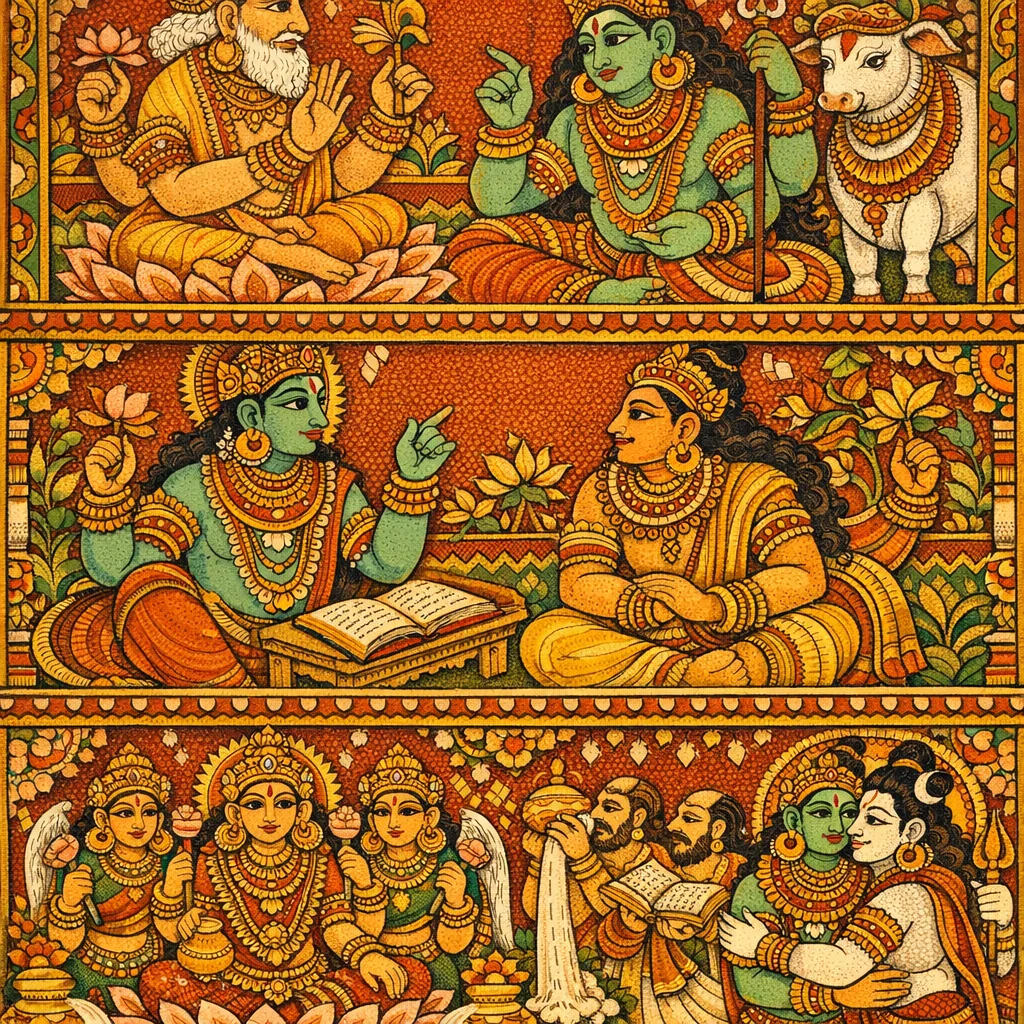
Adhyaya 69: Bhīma-Dvādaśī (Kalyāṇinī) Vow: Procedure, Merit, and Hari–Hara Concord
भीमद्वादशी (कल्याणिनी) व्रतविधानम्
Speaker: Matsya, Brahmā, Mahādeva (Śiva/Umāpati), Vāsudeva (Kṛṣṇa), Bhīmasena (Vṛkodara)
Matsya recounts a setting in an earlier kalpa where Brahmā asks Śiva how ārogya, aiśvarya, and mokṣa may be gained through small tapas. Śiva foretells that in the Vaivasvata age Vāsudeva will teach Bhīma a superior observance, fit even for those unable to fast. Vāsudeva then gives the vrata-vidhi: Māgha preparations; worship formulas and body-part epithets; night-vigil and regulated diet; next-day sandhyā and pitṛ rites; building a maṇḍapa, vedī, and toraṇa; kalaśa rites with continuous streams of water and milk; a Vaiṣṇava homa with Vedic brāhmaṇa priests; honoraria and dāna (beds, cows); feeding brāhmaṇas; and a concluding prayer affirming the non-difference of Hari and Hara. The teaching ends by naming the rite Bhīma-Dvādaśī (formerly Kalyāṇinī) and praising its vast merit and power to liberate ancestors.
Key Concepts
Shlokas in Adhyaya 69
Verse 1
*मत्स्य उवाच पुरा रथंतरे कल्पे परिपृष्टो महात्मना मन्दरस्थो महादेवः पिनाकी ब्रह्मणा स्वयम् //
Matsya said: Formerly, in the Rathantara Kalpa, the great Lord—Mahādeva, bearer of the Pināka bow—abiding on Mount Mandara, was questioned in person by the great-souled Brahmā.
Verse 2
*ब्रह्मोवाच कथमारोग्यमैश्वर्यम् अनन्तममरेश्वर स्वल्पेन तपसा देव भवेन्मोक्षो ऽथवा नृणाम् //
Brahmā said: O Lord of the immortals, O Infinite One—how may unfailing health and sovereignty be attained? And, O God, can liberation (mokṣa) for human beings arise through only a small measure of austerity (tapas)?
Verse 3
किमज्ञातं महादेव त्वत्प्रसादादधोक्षज स्वल्पकेनाथ तपसा महत्फलमिहोच्यताम् //
O Great Lord, O Adhokṣaja—what remains unknown for one who has your grace? Yet, O Master, please declare here what great result is obtained even by a small measure of austerity (tapas).
Verse 4
*मत्स्य उवाच एवं पृष्टः स विश्वात्मा ब्रह्मणा लोकभावनः उमापतिरुवाचेदं मनसः प्रीतिकारकम् //
Matsya said: Thus questioned, Brahmā—the Universal Self, nourisher of the worlds—then spoke. Umāpati (Śiva) too uttered these words, pleasing to the mind.
Verse 5
*ईश्वर उवाच अस्माद्रथंतरात्कल्पात् त्रयोविंशात् पुनर्यदा वाराहो भविता कल्पस् तस्य मन्वन्तरे शुभे //
The Lord said: When, after the twenty-third cycle from this Rathantara Kalpa, the Varāha Kalpa comes again, then, in the auspicious Manvantara of that Kalpa…
Verse 6
वैवस्वताख्ये संजाते सप्तमे सप्तलोककृत् द्वापराख्यं युगं तद्वद् अष्टाविंशतिमं जगुः //
When the seventh Manvantara, known as Vaivasvata, had arisen, the Maker of the seven worlds likewise declared that the Dvāpara Yuga there is the twenty-eighth in the count.
Verse 7
तस्यान्ते स महादेवो वासुदेवो जनार्दनः भारावतरणार्थाय त्रिधा विष्णुर्भविष्यति //
At the end of that period, the Great Lord—Vāsudeva, Janārdana—Viṣṇu will manifest in a threefold manner in order to lighten the Earth’s burden.
Verse 8
द्वैपायन ऋषिस्तद्वद् रौहिणेयो ऽथ केशवः कंसादिदर्पमथनः केशवः क्लेशनाशनः //
Likewise, the sage Dvaipāyana (Vyāsa) and also Rauhiṇeya (Balarāma) are to be revered; and Keśava—who crushed the pride of Kaṃsa and others—Keśava is the destroyer of afflictions.
Verse 9
पुरीं द्वारवतीं नाम साम्प्रतं या कुशस्थली दिव्यानुभावसंयुक्ताम् अधिवासाय शार्ङ्गिणः त्वष्टा ममाज्ञया तद्वत् करिष्यति जगत्पतेः //
That city which is now called Kuśasthalī shall be made into the city named Dvāravatī—endowed with divine splendor—for the residence of Śārṅgin (Lord Viṣṇu, bearer of the Śārṅga bow). By my command, Tvaṣṭṛ will fashion it accordingly for the Lord of the universe.
Verse 10
तस्यां कदाचिदासीनः सभायाममितद्युतिः भार्याभिर्वृष्णिभिश्चैव भूभृद्भिर् भूरिदक्षिणैः //
Once, while seated in the royal assembly in that city, the Lord of boundless splendor sat surrounded by his queens, by the Vṛṣṇi heroes, and by many kings renowned for their abundant gifts and generosity.
Verse 11
कुरुभिर्देवगन्धर्वैर् अभितः कैटभार्दनः प्रवृत्तासु पुराणीषु धर्मसम्बन्धिनीषु च //
Surrounded by the Kurus, and likewise by Devas and Gandharvas, the Slayer of Kaiṭabha (Viṣṇu) was present as the Purāṇas—discourses connected with Dharma—were set in motion, recited, and propagated.
Verse 12
कथान्ते भीमसेनेन परिपृष्टः प्रतापवान् त्वया पृष्टस्य धर्मस्य रहस्यस्यास्य भेदकृत् //
At the end of the discourse, the mighty and valorous one—questioned by Bhīmasena—set forth the distinguishing explanation of this secret teaching of Dharma, just as you have asked.
Verse 13
भविता स तदा ब्रह्मन् कर्ता चैव वृकोदरः प्रवर्तको ऽस्य धर्मस्य पाण्डुपुत्रो महाबलः //
O Brahmin, at that time Vṛkodara (Bhīma), the mighty son of Pāṇḍu, will become the executor and the chief promoter of this Dharma.
Verse 14
यस्य तीक्ष्णो वृको नाम जठरे हव्यवाहनः मया दत्तः स धर्मात्मा तेन चासौ वृकोदरः //
He of righteous soul, in whose belly I placed the fierce fire named Vṛka—the carrier of oblations (havyavāhana)—is therefore called Vṛkodara, “Vṛka-bellied (wolf-bellied)”.
Verse 15
मतिमान्मानशीलश्च नागायुतबलो महान् भविष्यत्यजरः श्रीमान् कन्दर्प इव रूपवान् //
He will be intelligent and dignified in conduct; great, with the strength of ten thousand elephants. He will become ageless and prosperous, handsome like Kāma (Kandarpa) himself.
Verse 16
धार्मिकस्याप्यशक्तस्य तीव्राग्नित्वादुपोषणे इदं व्रतमशेषाणां व्रतानामधिकं यतः //
Even for a righteous person who cannot undertake fasting because the digestive fire is intense, this observance is regarded as superior to all other vows.
Verse 17
कथयिष्यति विश्वात्मा वासुदेवो जगद्गुरुः अशेषयज्ञफलदम् अशेषाघविनाशनम् //
Vāsudeva—the Universal Self, the Guru of the world—will expound this: He bestows the fruits of all sacrifices and destroys every sin without remainder.
Verse 18
अशेषदुष्टशमनम् अशेषसुरपूजितम् पवित्राणां पवित्रं च मङ्गलानां च मङ्गलम् भविष्यं च भविष्याणां पुराणानां पुरातनम् //
It removes all wickedness and is revered by all the gods; it is the purest among purifiers and the most auspicious among auspicious things. It is the “future” even of all that is yet to come, and the most ancient among the Purāṇas.
Verse 19
*वासुदेव उवाच यद्यष्टमीचतुर्दश्योर् द्वादशीष्वथ भारत अन्येष्वपि दिनर्क्षेषु न शक्तस्त्वम् उपोषितुम् //
Vāsudeva said: O Bhārata, if you are not able to fast on the eighth and the fourteenth lunar days, or on the twelfth, or even on other specially marked days and lunar asterisms, then follow the suitable alternative discipline that will be taught.
Verse 20
ततः पुण्यां तिथिमिमां सर्वपापप्रणाशिनीम् उपोष्य विधिनानेन गच्छ विष्णोः परं पदम् //
Thereafter, by fasting on this sacred lunar day—which destroys all sins—according to this prescribed method, you shall go to Viṣṇu’s supreme abode.
Verse 21
माघमासस्य दशमी यदा शुक्ला भवेत्तदा घृतेनाभ्यञ्जनं कृत्वा तिलैः स्नानं समाचरेत् //
In the month of Māgha, when the tenth lunar day occurs in the bright fortnight, one should anoint the body with ghee and duly perform a bath using sesame (tila) preparations.
Verse 22
तथैव विष्णुमभ्यर्च्य नभो नारायणेति च कृष्णाय पादौ सम्पूज्य शिरः सर्वात्मने नमः //
In the same manner, having duly worshipped Viṣṇu, one should offer to the sky the salutation, “O Nārāyaṇa”; and, after fully worshipping the feet for Kṛṣṇa, one should bow the head, uttering, “Homage to the All-Self.”
Verse 23
वैकुण्ठायेति वैकुण्ठम् उरः श्रीवत्सधारिणे शङ्खिने चक्रिणे तद्वद् गदिने वरदाय वै सर्वे नारायणस्यैवं संपूज्या बाहवः क्रमात् //
Reciting “To Vaikuṇṭha,” one should worship Vaikuṇṭha (the Lord). Then one should worship the chest that bears the Śrīvatsa mark; likewise the arms bearing the conch and the discus, and similarly the mace and the boon‑granting hand. Thus, in due order, all the arms of Nārāyaṇa are to be fully worshipped.
Verse 24
दामोदरायेत्युदरं मेढ्रं पञ्चशराय वै ऊरू सौभाग्यनाथाय जानुनी भूतधारिणे //
“(One should assign) the belly to ‘Dāmodara’; the generative organ to ‘Pañcaśara’; the thighs to ‘Saubhāgyanātha’; and the knees to ‘Bhūtadhārin’.”
Verse 25
नमो नीलाय वै जङ्घे पादौ विश्वसृजे नमः नमो देव्यै नमः शान्त्यै नमो लक्ष्म्यै नमः श्रियै //
Salutations to the blue-hued one—indeed, to her shanks; salutations to her feet, the creatress of the universe. Salutations to the Goddess; salutations to Peace (Śānti); salutations to Lakṣmī; salutations to Śrī (prosperity and splendor).
Verse 26
नमः पुष्ट्यै नमस्तुष्ट्यै धृष्ट्यै हृष्ट्यै नमो नमः नमो विहंगनाथाय वायुवेगाय पक्षिणे विषप्रमाथिने नित्यं गरुडं चाभिपूजयेत् //
Salutations to Puṣṭi (Nourishment); salutations to Tuṣṭi (Contentment); salutations to Dhṛṣṭi (Courage) and to Hṛṣṭi (Joy)—again and again, salutations. Salutations to the Lord of birds, swift as the wind, the winged one who crushes poison. One should continually worship Garuḍa.
Verse 27
एवं सम्पूज्य गोविन्दम् उमापतिविनायकौ गन्धैर्माल्यैस्तथा धूपैर् भक्ष्यैर्नानाविधैरपि //
Thus, having duly worshipped Govinda, one should also worship Umāpati (Śiva) and Vināyaka (Gaṇeśa) with perfumes, garlands, incense, and with various kinds of edible offerings as well.
Verse 28
गव्येन पयसा सिद्धां कृसरामथ वाग्यतः सर्पिषा सह भुक्त्वा च गत्वा शतपदं बुधः //
Having prepared kṛsarā (a rice-and-pulse dish) with cow’s milk, and keeping his speech restrained, the wise man should eat it together with ghee; then, after eating, he should walk a hundred steps.
Verse 29
नैयग्रोधं दन्तकाष्ठम् अथवा खादिरं बुधः गृहीत्वा धावयेद्दन्तान् आचान्तः प्रागुदङ्मुखः //
After performing ācāmana (purificatory sipping of water), a wise person should take a toothbrush-stick of nyagrodha (banyan) or khadira (acacia catechu) and clean the teeth while facing east or north.
Verse 30
ब्रूयात् सायन्तनीं कृत्वा संध्यामस्तमिते रवौ नमो नारायणायेति त्वामहं शरणं गतः //
Having performed the evening Sandhyā at sunset, one should recite: “Obeisance to Nārāyaṇa—O Lord, I have taken refuge in You.”
Verse 31
एकादश्यां निराहारः समभ्यर्च्य च केशवम् रात्रिं च सकलां स्थित्वा स्नानं च पयसा तथा //
On the Ekādaśī day, one should fast completely, duly worship Keśava (Viṣṇu), keep vigil through the entire night, and then perform bathing with milk as well.
Verse 32
सर्पिषा चापि दहनं हुत्वा ब्राह्मणपुंगवैः सहैव पुण्डरीकाक्ष द्वादश्यां क्षीरभोजनम् //
O lotus-eyed Lord, having also offered the fire-oblation with ghee together with the foremost of brāhmaṇas, one should on the Dvādaśī day take food consisting of milk.
Verse 33
करिष्यामि यतात्माहं निर्विघ्नेनास्तु तच्च मे एवमुक्त्वा स्वपेद्भूमाव् इतिहासकथां पुनः //
“I shall do it with self-control; may that undertaking of mine be free from obstacles.” Having spoken thus, he lay down and slept upon the ground, and then the text resumes the narrative of the ancient account once again.
Verse 34
श्रुत्वा प्रभाते संजाते नदीं गत्वा विशां पते स्नानं कृत्वा मृदा तद्वत् पाषण्डान् अभिवर्जयेत् //
Having listened to the prescribed recitation when morning has arisen, O lord of the people, one should go to the river and bathe; then, using cleansing earth (clay) likewise, one should completely avoid the pāṣaṇḍas (heretical, anti-Vedic sectarians).
Verse 35
उपास्य संध्यां विधिवत् कृत्वा च पितृतर्पणम् प्रणम्य च हृषीकेशं सप्तलोकैकमीश्वरम् //
Having duly performed the Sandhyā worship, and having also carried out the libations for the ancestors (pitṛ-tarpaṇa), one should bow to Hṛṣīkeśa—the one sovereign Lord of the seven worlds.
Verse 36
गृहस्य पुरतो भक्त्या मण्डपं कारयेद्बुधः दशहस्तमथाष्टौ वा करान्कुर्याद्विशां पते //
In front of the house, the wise man should, with devotion, have a maṇḍapa constructed; let it be made either ten hastas in measure, or else eight hastas, O lord of the people.
Verse 37
चतुर्हस्तां शुभां कुर्याद् वेदीमरिनिषूदन चतुर्हस्तप्रमाणं च विन्यसेत्तत्र तोरणम् //
O slayer of enemies, one should construct an auspicious vedī (altar) of four hastas in measure, and there one should also set up a toraṇa (gateway-arch) measuring four hastas.
Verse 38
आरोप्य कलशं तत्र दिक्पालान्पूजयेत्ततः छिद्रेण जलसम्पूर्णम् अथ कृष्णाजिनस्थितः तस्य धारां च शिरसा धारयेत्सकलां निशाम् //
Having installed a kalaśa (ritual water-pot) there, he should then worship the Dikpālas, the guardians of the directions. Next, through a small aperture, the pot should be made full of water; seated upon a black antelope-skin, he should bear that stream upon his head throughout the entire night.
Verse 39
तथैव विष्णोः शिरसि क्षीरधारां प्रपातयेत् अरत्निमात्रं कुण्डं च कुर्यात्तत्र त्रिमेखलम् //
In the same manner, one should pour a continuous stream of milk upon the head of Viṣṇu. And one should also construct there a kuṇḍa (fire-pit) of the measure of one aratni (forearm), furnished with three enclosing girdles (tri-mekhalā).
Verse 40
योनिवक्त्रं च तत्कृत्वा ब्राह्मणैः यवसर्पिषी तिलांश्च विष्णुदेवत्यैर् मन्त्रैरेकाग्निवत्तदा //
Then, having fashioned its mouth in the prescribed yoni-form (yoni-vaktra), one should, together with brāhmaṇas, offer barley with ghee and also sesame—at that time—using mantras addressed to Viṣṇu, performing the rite as in the one-fire (ekāgni) procedure.
Verse 41
हुत्वा च वैष्णवं सम्यक् चरुं गोक्षीरसंयुतम् निष्पावार्धप्रमाणां वै धारामाज्यस्य पातयेत् //
Having properly offered the Vaiṣṇava oblation—namely the cooked porridge (caru) mixed with cow’s milk—one should then pour a stream of ghee in a measure equal to half a niṣpāva.
Verse 42
जलकुम्भान्महावीर्य स्थापयित्वा त्रयोदश भक्ष्यैर्नानाविधैर्युक्तान् सितवस्त्रैरलंकृतान् //
O mighty one, having set up thirteen water-jars, he should arrange them with various kinds of food-offerings and adorn them with white cloths.
Verse 43
युक्तानौदुम्बरैः पात्रैः पञ्चरत्नसमन्वितान् चतुर्भिर्बह्वृचैर्होमस् तत्र कार्य उदङ्मुखैः //
There, the homa should be performed facing north, using properly arranged udumbara-wood vessels furnished with the five gems, and carried out with four Bahvṛca (Ṛgvedic) priests.
Verse 44
रुद्रजापश्चतुर्भिश्च यजुर्वेदपरायणैः वैष्णवानि तु सामानि चतुरः सामवेदिनः अरिष्टवर्गसहितान्य् अभितः परिपाठयेत् //
Let four priests devoted to the Yajurveda perform the Rudra-japa; and let four Sāmaveda chanters recite the Vaiṣṇava Sāman hymns. Together with the protective (ariṣṭa) formulas, these should be chanted all around the site as a complete circumambient recitation.
Verse 45
एवं द्वादश तान्विप्रान् वस्त्रमाल्यानुलेपनैः पूजयेदङ्गुलीयैश्च कटकैर्हेमसूत्रकैः //
Thus, one should honour those twelve brāhmaṇas with garments, garlands, and fragrant unguents, and also with rings, bracelets, and golden threads (necklets/cords).
Verse 46
वासोभिः शयनीयैश्च वित्तशाठ्यविवर्जितः एवं क्षपातिवाह्या च गीतमङ्गलनिःस्वनैः //
With garments and bedding offered, and with no deceit concerning wealth—thus should the night be passed, accompanied by songs and the resonant sounds of auspicious benedictions.
Verse 47
उपाध्यायस्य च पुनर् द्विगुणं सर्वमेव तु ततः प्रभाते विमले समुत्थाय त्रयोदश //
And again, for the preceptor (upādhyāya), all of that should be given in double. Then, rising at the pure dawn, one should thereafter perform the thirteen (rites/offerings).
Verse 48
गा वै दद्यात्कुरुश्रेष्ठ सौवर्णमुखसंयुताः पयस्विनीः शीलवतीः कांस्यदोहसमन्विताः //
One should indeed gift cows, O best of the Kurus—cows fitted with golden muzzles, rich in milk, gentle and well-natured, and provided with a bronze milking-vessel.
Verse 49
रौप्यखुराः सवस्त्राश्च चन्दनेनाभिषेचिताः तास्तु तेषां ततो भक्त्या भक्ष्यभोज्यान्नतर्पितान् //
With hooves plated in silver, draped in cloth, and anointed with sandal paste, those cows were then, with devotion, offered by them—along with satisfaction through foods to be eaten and enjoyed, and with cooked rice as nourishment.
Verse 50
कृत्वा वै ब्राह्मणान् सर्वान् अन्नैर्नानाविधैस्तथा भुक्त्वा चाक्षारलवणम् आत्मना च विसर्जयेत् //
After duly feeding all the brāhmaṇas with various kinds of foods, and having himself eaten alkaline salt as well, he should then dismiss them respectfully.
Verse 51
अनुगम्य पदान्यष्टौ पुत्रभार्यासमन्वितः प्रीयतामत्र देवेशः केशवः क्लेशनाशनः //
Having followed eight steps, accompanied by his sons and wife, (he prays): “May the Lord of the gods—Keśava, the destroyer of afflictions—be pleased here.”
Verse 52
शिवस्य हृदये विष्णुर् विष्णोश्च हृदये शिवः यथान्तरं न पश्यामि तथा मे स्वस्ति चायुषः //
Viṣṇu dwells in the heart of Śiva, and Śiva dwells in the heart of Viṣṇu. Since I perceive no difference between them, may there be well-being for me—and long life as well.
Verse 53
एवमुच्चार्य तान्कुम्भान् गाश्चैव शयनानि च वासांसि चैव सर्वेषां गृहाणि प्रापयेद्बुधः //
Having recited the formulae in this manner, the wise man should then cause those water-pots, as well as the cows, the beds, and the garments, to be delivered to the respective homes of all (the intended recipients).
Verse 54
अभावे बहुशय्यानाम् एकामपि सुसंस्कृताम् शय्यां दद्याद्द्विजातेश्च सर्वोपस्करसंयुताम् //
If one cannot give many beds, one should at least donate a single well-prepared bed—fully furnished with all its accessories—to a twice-born (dvija) as well.
Verse 55
इतिहासपुराणानि वाचयित्वातिवाहयेत् तद्दिनं नरशार्दूल य इच्छेद्विपुलां श्रियम् //
O tiger among men, one who desires abundant prosperity should spend that day by having the Itihāsas and Purāṇas recited (or by reciting them) and thus pass the time in their hearing.
Verse 56
तस्मात्त्वं सत्त्वमालम्ब्य भीमसेन विमत्सरः कुरु व्रतमिदं सम्यक् स्नेहात्तव मयेरितम् //
Therefore, O Bhīmasena, taking refuge in sattva (purity and steadiness) and free from envy, perform this vow properly—this instruction has been spoken by me out of affection for you.
Verse 57
त्वया कृतमिदं वीर त्वन्नामाख्यं भविष्यति सा भीमद्वादशी ह्येषा सर्वपापहरा शुभा या तु कल्याणिनी नाम पुरा कल्पेषु पठ्यते //
O hero, since this has been performed by you, it will become renowned by your very name. Indeed, this is the auspicious Bhīma-Dvādaśī, the remover of all sins—formerly recited in earlier aeons as the vow called ‘Kalyāṇinī.’
Verse 58
त्वमादिकर्ता भव सौकरे ऽस्मिन् कल्पे महावीरवरप्रधान यस्याः स्मरन्कीर्तनमप्यशेषं विनष्टपापस्त्रिदशाधिपः स्यात् //
In this Saukara Kalpa, be the primordial initiator—O foremost among the greatest heroes. By remembering Her and even singing Her praise, one’s sins are entirely destroyed, and one may become the lord of the thirty gods (Indra).
Verse 59
कृत्वा च यामप्सरसाम् अधीशा वेश्या कृता ह्यन्यभवान्तरेषु आभीरकन्यातिकुतूहलेन सैवोर्वशी सम्प्रति नाकपृष्ठे //
And she—who became a foremost lady among the Apsarases—had in other births been made to live as a courtesan; yet, through a special curiosity (and longing) as a cowherd maiden, that very one is now Urvaśī, dwelling upon the heights of heaven.
Verse 60
जाताथवा वैश्यकुलोद्भवापि पुलोमकन्या पुरुहूतपत्नी तत्रापि तस्याः परिचारिकेयं मम प्रिया सम्प्रति सत्यभामा //
Whether she was indeed high-born, or even born in a Vaiśya family—she was Pulomā’s daughter, the wife of Puruhūta (Indra). Even there, she served as that lady’s attendant; and she is now my beloved, Satyabhāmā.
Verse 61
स्नातः पुरा मण्डलमेष तद्वत् तेजोमयं वेदशरीरमाप अस्यां च कल्याणतिथौ विवस्वान् सहस्रधारेण सहस्ररश्मिः //
In former times, after performing the ritual bath, this one attained that very solar orb—a body of Vedic essence made of radiance. And on this auspicious tithi, Vivasvān (the Sun), with a thousand streams and a thousand rays, manifests forth.
Verse 62
इदमेव कृतं महेन्द्रमुख्यैर् वसुभिर्देवसुरारिभिस्तथा तु फलमस्य न शक्यते ऽभिवक्तुं यदि जिह्वायुतकोटयो मुखे स्युः //
This very deed was performed by Mahendra (Indra) and the foremost gods, by the Vasus, and even by the enemies of the gods, the Asuras. Yet its fruit cannot be fully expressed—even if one had tens of millions of tongues within one’s mouth.
Verse 63
कलिकलुषविदारिणीमनन्ताम् इति कथयिष्यति यादवेन्द्रसूनुः अपि नरकगतान्पितॄन् अशेषान् अलमुद्धर्तुमिहैव यः करोति //
He who, here and now, causes this praise to be proclaimed—“(She/This) is Anantā, the endless one who rends the defilement of Kali”—is indeed able to lift up, without remainder, even those ancestors who have fallen into hell; thus declares the son of the lord of the Yādavas.
Verse 64
य इदमघविदारणं शृणोति भक्त्या परिपठतीह परोपकारहेतोः तिथिमिह सकलार्थभाङ्नरेन्द्रस् तव चतुरानन साम्यतामुपैति //
Whoever, with devotion, listens to this “Sin-destroying” hymn and recites it here for the sake of benefiting others—such a king, endowed with every prosperity in this world, attains equality with the Four-faced (Brahmā) through your grace.
Verse 65
कल्याणिनी नाम पुरा बभूव या द्वादशी माघदिनेषु पूज्या सा पाण्डुपुत्रेण कृता भविष्यत्य् अनन्तपुण्यानघ भीमपूर्वा //
Formerly there was a sacred observance known as Kalyāṇinī, a Dvādaśī (the twelfth lunar day) to be worshipped during the days of Māgha. That very rite was performed by the son of Pāṇḍu—Bhīma; and, O sinless one, it will become a source of endless merit.
Frequently Asked Questions
The chapter teaches the Bhīma-Dvādaśī (also called Kalyāṇinī) vow as a powerful, sin-destroying observance that can grant health, prosperity, and high spiritual merit—even for people who cannot perform harsh fasting. It emphasizes disciplined worship of Nārāyaṇa, homa, gifts and feeding of brāhmaṇas, and concludes with the theological instruction that Śiva and Viṣṇu are mutually indwelling and non-different in essence.
Primarily Dharma: detailed vrata-vidhi for Māgha Ekādaśī–Dvādaśī, pūjā, homa, dāna, and phalaśruti (including uplift of ancestors). Vāstu appears in micro-form through ritual construction specifications for the maṇḍapa, vedī, toraṇa, and kuṇḍa. Genealogy is not the focus, though epic-personage framing (Bhīma, Pāṇḍu lineage) and divine identifications (Vāsudeva/Keśava) provide narrative anchoring.
A maṇḍapa is to be built in front of the house measuring either 10 or 8 hastas; an auspicious vedī of 4 hastas; a toraṇa of 4 hastas; and a fire-pit (kuṇḍa) of one aratni with three enclosing girdles (tri-mekhalā), fashioned with a yoni-shaped mouth as specified for the rite.
It states that Viṣṇu resides in Śiva’s heart and Śiva resides in Viṣṇu’s heart; since the practitioner perceives no difference between them, he prays for well-being and long life. This functions as a doctrinal seal on the vrata, integrating Vaiṣṇava worship with reverence for Śiva.