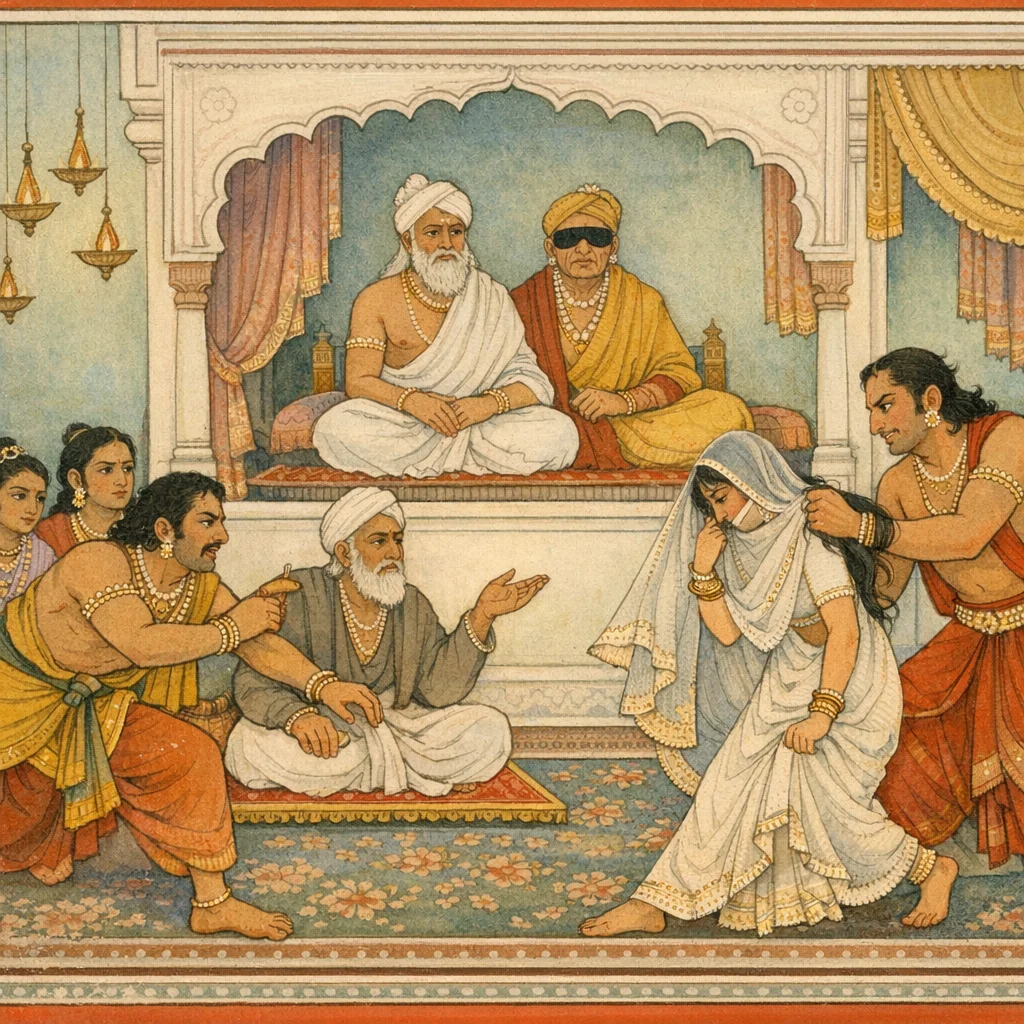
Adhyaya 68
Sabhā Parva, Adhyāya 68 — Pāṇḍavānāṃ Vanavāsa-prasthānaḥ; Duḥśāsana-nindā; Pāṇḍava-pratijñāḥ
Upa-parva: Dyūta–Anuvyāhāra / Vanavāsa-prasthāna (Exile Departure Sequence)
Vaiśaṃpāyana reports that the defeated Pāṇḍavas resolve upon forest exile and don deer-skins in sequence, marking their juridical displacement from kingship. Observing them depart, Duḥśāsana delivers a sustained taunt: he frames the Kaurava ascendancy as providential, ridicules the Pāṇḍavas’ former confidence, and uses demeaning comparisons to deny their worth. He also attempts to destabilize Draupadī’s marital allegiance by suggesting she choose among the Kauravas, thereby extending humiliation from political loss to social identity. Bhīma, provoked yet deliberate, rebukes Duḥśāsana’s boast as ill-gained and issues explicit vows of future retribution consistent with kṣatra-dharma. Duryodhana mockingly imitates Bhīma’s gait, intensifying the public affront. As the Pāṇḍavas exit the assembly, they formalize a set of distributed commitments: Bhīma vows to kill Duryodhana and drink Duḥśāsana’s blood; Arjuna vows to slay Karṇa and allied challengers; Sahadeva vows to kill Śakuni; Nakula vows broader punitive outcomes against the Dhṛtarāṣṭras under Dharmarāja’s direction. The chapter functions as a narrative “contract layer,” converting humiliation into witnessed vows that structure later causality.
Chapter Arc: सभामण्डप में जुए की कुटिल विजय के बाद पाण्डवों के राज्य, धन, अस्त्र-शस्त्र और मान—सब ‘कैतव’ से हरण हो चुके हैं; भीमसेन का क्रोध धधक उठता है और वह प्रतिज्ञा-सी भाषा बोलने लगता है। → भीम द्रौपदी के अपमान का भार युधिष्ठिर पर रखकर उग्र वचन कहता है—क्रोध को वहीं गिराने की घोषणा करता है; सभा में भीष्म, धृतराष्ट्र और विदुर जैसे वृद्ध-श्रेष्ठ उपस्थित होकर भी निर्णायक रोक नहीं लगा पाते। विदुर नीति-वचन और साक्ष्य/सत्य की मर्यादा का स्मरण कराते हैं, पर दुर्योधन-पक्ष की हठधर्मिता बढ़ती जाती है। → कर्ण और दुःशासन का आदेश/उकसावा चरम पर पहुँचता है—‘कृष्णा को दासी कहकर गृह में ले जाओ’; और दुःशासन काँपती, लज्जित, पाण्डवों को पुकारती द्रौपदी को सभा के बीच घसीटता है। → अर्जुन भीम के उन्मत्त प्रतिशोध को तत्काल शान्त करने का प्रयत्न करता है ताकि पाण्डव आवेश में आकर उसी क्षण विनाशकारी कदम न उठा लें; विदुर का धर्मोपदेश सभा के सामने सत्य-धर्म की कसौटी रख देता है, यद्यपि दुष्टों का मन नहीं बदलता। → द्रौपदी का अपमान सार्वजनिक रूप से आरम्भ हो चुका है; पाण्डवों का संयम टूटे या धर्म की कोई अदृश्य रक्षा प्रकट हो—सभा उसी अनिश्चितता में आगे बढ़ती है।
Shlokas
Verse 1
(दाक्षिणात्य अधिक पाठके २ श्लोक मिलाकर कुल ५६ श्लोक हैं) ऑपन--माजल बक। अकाल अष्टषष्टितमो< ध्याय: भीमसेनका क्रोध एवं अर्जुनका उन्हें शान्त करना, विकर्णकी धर्मसंगत बातका कर्णके द्वारा विरोध, द्रौपदीका चीरहरण एवं भगवान॒द्वारा उसकी लज्जारक्षा तथा विदुरके द्वारा प्रह्नादका उदाहरण देकर सभासदोंको विरोधके लिये प्रेरित करना भीम उवाच भवन्ति गेहे बन्धक्य: कितवानां युधिष्ठिर । न ताभिरुत दीव्यन्ति दया चैवास्ति तास्वपि,भीमसेन बोले--भैया युधिष्ठिर! जुआरियोंके घरमें प्रायः कुलटा स्त्रियाँ रहती हैं, किंतु वे भी उन्हें दाँवपर लगाकर जूआ नहीं खेलते। उन कुलटाओंके प्रति भी उनके हृदयमें दया रहती है
Bhima said: “Yudhiṣṭhira, in the houses of gamblers there are often women of loose conduct; yet even those men do not gamble by staking them. Even toward such women, they still retain a measure of pity. How then can you allow Draupadī—your lawful wife—to be treated as a wager?”
Verse 2
काश्यो यद् धनमाहार्षीद् द्रव्यं यच्चान्यदुत्तमम् । तथान्ये पृथिवीपाला यानि रत्नान्युपाहरन्,काशिराजने जो धन उपहारमें दिया था एवं और भी जो उत्तम द्रव्य वे हमारे लिये लाये थे तथा अन्य राजाओंने भी जो रत्न हमें भेंट किये थे, उन सबको और हमारे वाहनों, वैभवों, कवचों, आयुधों, राज्य, आपके शरीर तथा हम सब भाइयोंको भी शत्रुओंने जूएके दाँवपर रखवाकर अपने अधिकारमें कर लिया
Bhīma said: “The wealth that the king of Kāśī brought, and whatever other excellent valuables he offered, and likewise the jewels that other rulers of the earth presented—those too, along with our vehicles, splendor, armors, weapons, our kingdom, your very person, and all of us brothers—were made to be staked by the enemies in the gambling match and were brought under their control.”
Verse 3
वाहनानि धनं चैव कवचान्यायुधानि च । राज्यमात्मा वयं चैव कैतवेन हृतं परै:,काशिराजने जो धन उपहारमें दिया था एवं और भी जो उत्तम द्रव्य वे हमारे लिये लाये थे तथा अन्य राजाओंने भी जो रत्न हमें भेंट किये थे, उन सबको और हमारे वाहनों, वैभवों, कवचों, आयुधों, राज्य, आपके शरीर तथा हम सब भाइयोंको भी शत्रुओंने जूएके दाँवपर रखवाकर अपने अधिकारमें कर लिया
Bhima said: “Our vehicles and wealth, our armours and weapons—our kingdom, even your very person, and we ourselves—have all been taken by others through deceitful gambling.”
Verse 4
नच मे तत्र कोपो5भूत् सर्वस्येशो हि नो भवान् । इमं त्वतिक्रमं मन्ये द्रौपदी यत्र पण्यते,किंतु इसके लिये मेरे मनमें क्रोध नहीं हुआ; क्योंकि आप हमारे सर्वस्वके स्वामी हैं। पर द्रौपदीको जो दाँवपर लगाया गया, इसे मैं बहुत ही अनुचित मानता हूँ
“Even then, no anger arose in my heart, for you are indeed the lord of all that is ours. Yet I deem this a grave transgression—that Draupadī was staked as a wager.”
Verse 5
एषा हानर्हती बाला पाण्डवान् प्राप्प कौरवै: । त्वत्कृते क्लिश्यते क्षुद्रैनशंसैरकृतात्मभि:,यह भोली-भाली अबला पाण्डवोंको पतिरूपमें पाकर इस प्रकार अपमानित होनेके योग्य नहीं थी, परंतु आपके कारण ये नीच, नृशंस और अजितेन्द्रिय कौरव इसे नाना प्रकारके कष्ट दे रहे हैं
“She is a young and innocent woman; having gained the Pāṇḍavas as her husbands, she did not deserve such humiliation. Yet because of you, those base, ruthless Kauravas—men without self-mastery—are subjecting her to many kinds of suffering.”
Verse 6
अस्या: कृते मन्युरयं त्वयि राजन् निपात्यते । बाहू ते सम्प्रधक्ष्यामि सहदेवाग्निमानय,राजन! द्रौपदीकी इस दुर्दशाके लिये मैं आपपर ही अपना क्रोध छोड़ता हूँ। आपकी दोनों बाहें जला डालूँगा। सहदेव! आग ले आओ
Bhima declares that, for Draupadi’s sake, he is directing his wrath squarely at the king. In a fierce vow born of outrage at injustice, he threatens to burn the king’s arms and commands Sahadeva to bring fire—an explosive moment that exposes the moral collapse of the court and the Pandavas’ simmering resolve to answer humiliation with retributive justice.
Verse 7
अजुन उवाच न पुरा भीमसेन त्वमीदृशीर्वदिता गिर: । परैस्ते नाशितं नून॑ नृशंसैर्धर्मगौरवम्,अर्जुन बोले--भैया भीमसेन! तुमने पहले कभी ऐसी बातें नहीं कही थीं। निश्चय ही क्रूरकर्मा शत्रुओंने तुम्हारी धर्मविषयक गौरवबुद्धिको नष्ट कर दिया है
Arjuna said: “Never before, Bhimasena, have you spoken words like these. Surely the ruthless enemies have now destroyed your reverence for dharma—your sense of moral honor.”
Verse 8
न सकामा: परे कार्या धर्ममेवाचरोत्तमम् । भ्रातरं धार्मिकं ज्येष्ठं को$तिवर्तितुमरहति,भैया! शत्रुओंकी कामना सफल न करो; उत्तम धर्मका ही आचरण करो। भला, अपने धर्मात्मा ज्येष्ठ भ्राताका अपमान कौन कर सकता है?
Arjuna said: “Do not act out of desire, nor in a way that serves the designs of others. Practice dharma alone—the highest course. Who could rightly overstep or dishonor one’s own eldest brother, a man devoted to righteousness? Do not let the enemies’ wishes be fulfilled; hold fast to the noblest conduct.”
Verse 9
आहूतो हि परै राजाक्षात्र॑ व्रतमनुस्मरन् । दीव्यते परकामेन तन्न: कीर्तिकरं महत्,महाराज युधिष्ठिरको शत्रुओंने द्यूतके लिये बुलाया है; अतः ये क्षत्रियव्रतको ध्यानमें रखकर दूसरोंकी इच्छासे जूआ खेलते हैं। यह हमारे महान् यशका विस्तार करनेवाला है
Arjuna said: “When a king is challenged and summoned by others, remembering the warrior’s code, he plays at dice in compliance with the opponent’s wish. For us, O King Yudhiṣṭhira, this is held to be a great occasion for the increase of fame—yet it also binds us to a perilous custom where honor is measured by accepting a reckless invitation.”
Verse 10
भीमसेन उवाच एवमस्मिन् कृतं विद्यां यदि नाहं धनंजय । दीप्ते5ग्नौ सहितौ बाहू निर्दहेयं बलादिव,भीमसेनने कहा--अर्जुन! यदि मैं इस विषयमें यह न जानता कि इनका यह कार्य क्षत्रियधर्मके अनुकूल ही है, तो बलपूर्वक प्रज्वलित अग्निमें इनकी दोनों बाँहोंको एक साथ ही जलाकर राख कर डालता
Bhima said: “O Dhananjaya (Arjuna), if I did not understand that what has been done in this matter accords with the accepted code of kshatriya conduct, then I would, by sheer force, burn both his arms together in a blazing fire.”
Verse 11
वैशम्पायन उवाच तथा तान् दु:ःखितान् दृष्टवा पाण्डवान् धृतराष्ट्रज: । कृष्यमाणां च पाज्चालीं विकर्ण इदमब्रवीत्,वैशम्पायनजी कहते हैं--जनमेजय! पाण्डवोंको दुःखी और पांचालराजकुमारी द्रौोपदीको घसीटी जाती हुई देख धृतराष्ट्रनन्दन विकर्णने यह कहा--
Vaiśampāyana said: Seeing the Pāṇḍavas stricken with grief, and Pāñcālī (Draupadī) being dragged away, Vikarna, the son of Dhṛtarāṣṭra, spoke these words.
Verse 12
याज्ञसेन्या यदुक्तं तद् वाक््यं विब्रूत पार्थिवा: । अविवेकेन वाक्यस्य नरक: सद्य एव न:,'भूमिपालो! द्रौपदीने जो प्रश्न उपस्थित किया है, उसका आपलोग उत्तर दें। यदि इसके प्रश्बषका ठीक-ठीक विवेचन नहीं किया गया, तो हमें शीघ्र ही नरक भोगना पड़ेगा
“O kings, give a clear reply to the words spoken by Yājñasenī (Draupadī). If her speech is not examined and answered with proper discernment, we shall at once incur hell.”
Verse 13
भीष्मश्न धृतराष्ट्रश्न कुरुवृद्धतमावुभौ । समेत्य नाहतु: किंचिद् विदुरश्च महामति:,“पितामह भीष्म और पिता धृतराष्ट्र--ये दोनों कुरुवंशके सबसे वृद्ध पुरुष हैं। ये तथा परम बुद्धिमान् विदुरजी मिलकर कुछ उत्तर क्यों नहीं देते?”
Vaiśampāyana said: “Bhīṣma and Dhṛtarāṣṭra—both the eldest among the Kurus—together with the highly discerning Vidura, are assembled; why do they not offer any reply at all?”
Verse 14
भारद्वाजश्च सर्वेषामाचार्य: कृप एव च । कुत एतावपि प्रश्न॑ नाहतुर्द्धिजसत्तमौ
Vaiśampāyana said: “Bhāradvāja (Droṇa) was the preceptor of them all, and so too was Kṛpa. How is it, then, that even these two best of Brahmins did not raise this question?”
Verse 15
“हम सबके आचार्य भरद्वाजनन्दन द्रोणाचार्य और कृपाचार्य ये दोनों ब्राह्मणकुलके श्रेष्ठ पुरुष हैं। ये दोनों भी इस प्रश्नपर अपने विचार क्यों नहीं प्रकट करते? ।। ये त्वन्ये पृथिवीपाला: समेता: सर्वतो दिश: । कामक्रोधौ समुत्सृज्य ते ब्रुवन्तु यथामति,“जो दूसरे राजालोग चारों दिशाओंसे यहाँ पधारे हैं, वे सभी काम और क्रोधको त्यागकर अपनी बुद्धिके अनुसार इस प्रश्नका उत्तर दें
Vaiśampāyana said: “Our teachers—Droṇa, the son of Bharadvāja, and Kṛpa—are both foremost men of the Brahmin line. Why do even these two not declare their judgment on this question? Let the other kings who have assembled here from every direction, casting aside desire and anger, speak on this matter according to their understanding.”
Verse 16
यदिदं द्रौपदीवाक्यमुक्तवत्यसकृच्छुभा । विमृश्य कस्य कः पक्ष: पार्थिवा वदतोत्तरम्,राजाओ! कल्याणी द्रौपदीने बार-बार जिस प्रश्नको दुहराया है, उसपर विचार करके आपलोग उत्तर दें, जिससे मालूम हो जाय कि इस विषयमें किसका क्या पक्ष (विचार) है!
Vaiśampāyana said: “Reflect carefully on the words spoken by the auspicious Draupadī—words she has repeated again and again. Then, O kings, give your reply, so that it may become clear in this matter what position each of you holds.”
Verse 17
एवं स बहुश: सर्वनुक्तवांस्तानू सभासद: । न च ते पृथिवीपालास्तमूचु: साध्वसाधु वा,इस प्रकार विकर्णने उन सब सभासदोंसे बार-बार अनुरोध किया; परंतु उन नरेशोंने उस विषयमें उससे भला-बुरा कुछ नहीं कहा
Thus Vikarna repeatedly addressed all those members of the royal assembly; yet those kings did not reply to him on that matter—neither approving it as right nor condemning it as wrong. Their silence, in the face of an ethical appeal, signaled a failure of moral courage within the court.
Verse 18
उक्त्वा सकृत् तथा सर्वान् विकर्ण: पृथिवीपतीन् । पाणौ पार्णिं विनिष्पिष्य नि:श्व॒सन्निदमब्रवीत्,उन सब राजाओंसे बार-बार आग्रह करनेपर भी जब कुछ उत्तर नहीं मिला, तब विकर्णने हाथ-पर-हाथ मलते हुए लंबी साँस खींचकर कहा--
Vaiśampāyana said: Having thus addressed all those kings once again, Vikarna—finding no reply despite repeated urging—rubbed his hands together, drew a long sigh, and spoke these words, signaling both his frustration and his moral resolve amid the assembly’s silence.
Verse 19
विब्रूत पृथिवीपाला वाक््यं मा वा कथंचन । मन्ये न्याय्यं यदत्राहं तद्धि वक्ष्यामि कौरवा:
Vaiśampāyana said: “O kings, do not distort my words in any way. I shall state here what I consider just and proper—listen, O Kauravas.”
Verse 20
“कौरवों तथा अन्य भूमिपालो! आपलोग द्रौपदीके प्रश्नपर किसी प्रकारका विचार प्रकट करें या न करें, मैं इस विषयमें जो न्यायसंगत समझता हूँ, वह कहता हूँ ।। चत्वार्याहर्नरश्रेष्ठा व्यसनानि महीक्षिताम् । मृगयां पानमक्षांश्ष ग्राम्ये चैवातिरक्तताम्,“नरश्रेष्ठ भूपालो! राजाओंके चार दुर्व्यसन बताये गये हैं--शिकार, मदिरापान, जूआ तथा विषयभोगमें अत्यन्त आसक्ति
Vaiśampāyana said: “O Kauravas and other rulers of the earth! Whether you choose to express an opinion on Draupadī’s question or not, I will state what seems just to me in this matter. The wise have declared four ruinous vices for kings: hunting, drinking, gambling with dice, and excessive addiction to sensual pleasures.”
Verse 21
एतेषु हि नर: सक्तो धर्ममुत्सृज्य वर्तते | यथायुक्तेन च कृतां क्रियां लोको न मन्यते,“इन दुर्व्यसनोंमें आसक्त मनुष्य धर्मकी अवहेलना करके मनमाना बर्ताव करने लगता है। इस प्रकार व्यसनासक्त पुरुषके द्वारा किये हुए किसी भी कार्यको लोग सम्मान नहीं देते हैं
Indeed, a man ensnared by these vices casts aside dharma and behaves as he pleases. And whatever deed is done without due propriety, in a manner not fitting to what is right, the world does not esteem.
Verse 22
तदयं पाण्डुपुत्रेण व्यसने वर्तता भृशम् । समाहूतेन कितवैरास्थितो द्रौपदीपण:,'ये पाण्डुनन्दन युधिष्ठिर द्यूतरूपी दुर्व्यसनमें अत्यन्त आसक्त हैं। इन्होंने धूर्त जुआरियोंसे प्रेरित होकर द्रौपदीको दाँवपर लगा दिया है
Vaiśampāyana said: Thus this son of Pāṇḍu, sunk deeply in a grievous vice, was drawn in by the summoned gamblers and came to stake Draupadī as a wager.
Verse 23
साधारणी च सर्वेषां पाण्डवानामनिन्दिता । जितेन पूर्व चानेन पाण्डवेन कृत: पण:,'सती-साध्वी द्रौपदी समस्त पाण्डवोंकी समानरूपसे पत्नी है, केवल युधिष्ठिरकी ही नहीं है। इसके सिवा, पाण्डुकुमार युधिष्ठिर पहले अपने-आपको हार चुके थे, उसके बाद उन्होंने द्रौपदीको दाँवपर रखा है
Draupadī, blameless and virtuous, is the common wife of all the Pāṇḍavas, not of Yudhiṣṭhira alone. Moreover, that Pāṇḍava had already lost himself first, and only afterward did he stake Draupadī as a wager.
Verse 24
इयं च कीर्तिता कृष्णा सौबलेन पणार्थिना । एतत् सर्व विचार्याहं मन्ये न विजितामिमाम्,“सब दाँवोंको जीतनेकी इच्छावाले सुबलपुत्र शकुनिने ही द्रौपदीको दाँवपर लगानेकी बात उठायी है। इन सब बातोंपर विचार करके मैं ट्रुपदकुमारी कृष्णाको जीती हुई नहीं मानता”
And it was Śakuni, son of Subala, eager to win every stake, who raised the proposal to set Kṛṣṇā (Draupadī) as the wager. Having weighed all these matters, I hold that Kṛṣṇā, daughter of Drupada, has not been won.
Verse 25
एतच्छुत्वा महान् नाद: सभ्यानामुदतिष्ठत । विकर्ण शंसमानानां सौबलं चापि निन्दतान्,यह सुनकर सभी सभासद विकर्णकी प्रशंसा और सुबलपुत्र शकुनिकी निन््दा करने लगे। उस समय वहाँ बड़ा कोलाहल मच गया
Hearing this, a great uproar arose among the members of the assembly. They began praising Vikarṇa and, at the same time, censuring Saubala (Śakuni), the son of Subala, so that the hall resounded with commotion.
Verse 26
तस्मिन्नुपरते शब्दे राधेय: क्रोधमूर्च्छित: । प्रगृह्म रुचिरं बाहुमिदं वचनमत्रवीत्
When that outcry had subsided, Rādheya (Karna)—overwhelmed and blinded by anger—raised his handsome arm and spoke these words.
Verse 27
उस कोलाहलके शान्त होनेपर राधानन्दन कर्ण क्रोधसे मूर्च्छिंत हो उसकी सुन्दर बाँह पकड़कर इस प्रकार बोला ।। कर्ण उवाच दृश्यन्ते वै विकर्णेह वैकृतानि बहून्यपि । तज्जातस्तद्विनाशाय यथाग्निररणिप्रज:,कर्णने कहा-विकर्ण! इस जगतमें बहुत-सी वस्तुएँ विपरीत परिणाम उत्पन्न करनेवाली देखी जाती हैं। जैसे अरणिसे उत्पन्न हुई अग्नि उसीको जला देती है, उसी प्रकार कोई-कोई मनुष्य जिस कुलमें उत्पन्न होता है, उसीका विनाश करनेवाला बन जाता है
Karna said: “Vikarna, in this world many things are seen to yield perverse and harmful outcomes. Just as fire born from the araṇi-sticks ends up consuming those very sticks, so too a man may arise within a family only to become the cause of that family’s ruin.”
Verse 28
(व्याधिर्बलं नाशयते शरीरस्थोडपि सम्भृत: । तृणानि पशवो घ्नन्ति स्वपक्षं चैव कौरव: ।। द्रोणो भीष्म: कृपो द्रौणिर्विदुरश्ष महामतिः । धृतराष्ट्रमश्न गान्धारी भवतः: प्राज्ञवत्तरा: ।।) रोग यद्यपि शरीरमें ही पलता है, तथापि वह शरीरके ही बलका नाश करता है। पशु घासको ही चरते हैं, फिर भी उसे पैरोंसे कुचल डालते हैं। उसी प्रकार कुरुकुलमें उत्पन्न होकर भी तुम अपने ही पक्षको हानि पहुँचाना चाहते हो। विकर्ण! द्रोण, भीष्म, कृप, अश्वत्थामा, महाबुद्धिमान् विदुर, धृतराष्ट्र तथा गान्धारी--ये तुमसे अधिक बुद्धिमान हैं। एते न किंचिदप्याहुश्वोदिता हापि कृष्णया । धर्मेण विजितामेतां मन्यन्ते द्रुपदात्मजाम्
Karna said: “A disease, though it grows within the body itself, destroys the body’s strength. Cattle feed on grass, yet trample it underfoot. In the same way, though born in the Kuru line, you seek to harm your own side, O Kaurava. Drona, Bhishma, Kripa, Drona’s son Ashvatthama, the great-minded Vidura, and also Dhritarashtra and Gandhari—these are wiser than you. Though Draupadi (Krishnaa) is distressed, they say nothing; they deem the daughter of Drupada to have been overcome according to ‘dharma’.”
Verse 29
द्रौपदीने बार-बार प्रेरित किया है, तो भी ये सभासद कुछ भी नहीं बोलते हैं; क्योंकि ये सब लोग द्रुपदकुमारीको धर्मके अनुसार जीती हुई समझते हैं ।। त्वं तु केवलबाल्येन धार्तराष्ट्र विदीर्यसे । यद् ब्रवीषि सभामध्ये बाल: स्थविरभाषितम्
Karna said: “O Dhritarashtra’s son, it is only childishness that makes you break out in this way. For in the midst of the royal assembly you speak like a boy, repeating words fit for elders.”
Verse 30
धृतराष्ट्रकुमार! तुम केवल अपनी मूर्खताके कारण आप ही अपने पैरोंमें कुल्हाड़ी मार रहे हो; क्योंकि तुम बालक होकर भी भरी सभामें वृद्धोंकी-सी बातें करते हो ।। न च धर्म यथावत् त्वं वेत्सि दुर्योधनावर । यद् ब्रवीषि जितां कृष्णां न जितेति सुमन्दधी:
Karna said: “O son of Dhritarashtra, through sheer folly you are striking the axe upon your own feet. Though still a boy, you speak in the full assembly as if you were an elder. You do not truly understand dharma, O Duryodhana’s follower; and with a very dull mind you declare that Krishna (Draupadi), though won, was not won.”
Verse 31
दुर्योधनके छोटे भाई! तुम्हें धर्मके विषयमें यथार्थ ज्ञान नहीं है। तुम जो जीती हुई द्रौपदीको नहीं जीती हुई बता रहे हो, इससे तुम्हारे मन्दबुद्धि होनेका परिचय मिलता है ।। कथं हाविजितां कृष्णां मन्यसे धृतराष्ट्रज । यदा सभायां सर्वस्वं न्यस्तवान् पाण्डवाग्रज:
Karna said: “O younger brother of Duryodhana, you have no true understanding of dharma. By claiming that Draupadī—who has been won—has not been won, you reveal your dullness. How can you, son of Dhṛtarāṣṭra, think that Kṛṣṇā (Draupadī) has not been conquered, when in the assembly the eldest of the Pāṇḍavas staked everything?”
Verse 32
धृतराष्ट्रकुमार! तुम कृष्णाको नहीं जीती हुई कैसे मानते हो? जब कि पाण्डवोंके बड़े भाई युधिष्ठिरने द्यूतसभाके बीच अपना सर्वस्व दाँवपर लगा दिया है ।। अभ्यन्तरा च सर्वस्वे द्रौपदी भरतर्षभ । एवं धर्मजितां कृष्णां मन्यसे न जितां कथम्,भरतश्रेष्ठ! द्रौपदी भी तो सर्वस्वके भीतर ही है। इस प्रकार जब कृष्णाको धर्मपूर्वक जीत लिया गया है, तब तुम उसे नहीं जीती हुई क्यों समझते हो?
Karna said: “O son of Dhritarashtra, how can you regard Krishna (Draupadi) as not won? In the very midst of the gambling hall, Yudhishthira—the eldest of the Pandavas—staked his entire wealth and self. And Draupadi too, O bull among the Bharatas, falls within that ‘all.’ Thus, if Krishna has been won according to the rules of the game, why do you consider her not won?”
Verse 33
कीर्तिता द्रौपदी वाचा अनुज्ञाता च पाण्डवै: । भवत्यविजिता केन हेतुनैषा मता तव
Karna said: “Draupadī has been spoken of (as a stake) by words, and the Pāṇḍavas too have given their consent. By whom, then, is she ‘not won’? For what reason do you hold this view?”
Verse 34
युधिष्ठिरने अपनी वाणीद्वारा कहकर द्रौपदीको दाँवपर रखा और शेष पाण्डवोंने मौन रहकर उसका अनुमोदन किया। फिर किस कारणसे तुम उसे नहीं जीती हुई मानते हो? ।। मन्यसे वा सभामेतामानीतामेकवाससम् । अधर्मेणेति तत्रापि शृणु मे वाक्यमुत्तमम्,अथवा यदि तुम्हारी यह राय हो कि एकद्स्त्रा द्रौपदीको इस सभामें अधर्मपूर्वक लाया गया है तो इसके उत्तरमें भी मेरी उत्तम बात सुनो
Karna says: “Yudhiṣṭhira himself, by his own spoken word, declared Draupadī as the stake, and the remaining Pāṇḍavas, by keeping silent, gave their consent. For what reason, then, do you refuse to regard her as won? And if you think that Draupadī—clad in a single garment—was brought into this assembly unlawfully, then even on that point listen to my decisive reply.”
Verse 35
एको भर्ता स्त्रिया देवैरविहित: कुरुनन्दन । इयं त्वनेकवशगा बन्धकीति विनिश्चिता,कुरुनन्दन! देवताओंने स्त्रीके लिये एक ही पतिका विधान किया है; परंतु यह द्रौपदी अनेक पतियोंके अधीन है, अतः यह निश्चय ही वेश्या है। इसका सभामें लाया जाना कोई अनोखी बात नहीं है। यह एकवस्त्रा अथवा नंगी हो तो भी यहाँ लायी जा सकती है, यह मेरा स्पष्ट मत है
Karna said: “O joy of the Kurus, the gods have ordained for a woman only one husband. But this Draupadī is subject to many men; therefore she is decisively to be regarded as a courtesan. Hence, bringing her into the assembly is nothing extraordinary. Whether she is clothed in a single garment or even unclothed, she may be brought here—this is my clear opinion.”
Verse 36
अस्या: सभामानयनं न चित्रमिति मे मति: । एकाम्बरधरत्वं वाप्यथ वापि विवस्त्रता,कुरुनन्दन! देवताओंने स्त्रीके लिये एक ही पतिका विधान किया है; परंतु यह द्रौपदी अनेक पतियोंके अधीन है, अतः यह निश्चय ही वेश्या है। इसका सभामें लाया जाना कोई अनोखी बात नहीं है। यह एकवस्त्रा अथवा नंगी हो तो भी यहाँ लायी जा सकती है, यह मेरा स्पष्ट मत है
Karna said: “In my view, there is nothing extraordinary in bringing her into the assembly. Whether she is clad in a single garment or even unclothed, she may be brought here, O joy of the Kurus. The gods have ordained for a woman only one husband; but this Draupadi is subject to many husbands—therefore, she is certainly a courtesan. Hence, her being brought into the hall is no marvel.”
Verse 37
यच्चैषां द्रविणं किंचिद् या चैषा ये च पाण्डवा: । सौबलेनेह तत् सर्व धर्मेण विजितं वसु,इन पाण्डवोंके पास जो कुछ धन है, जो यह द्रौपदी है तथा जो ये पाण्डव हैं, इन सबको सुबलपुत्र शकुनिने यहाँ जूएके धनके रूपमें धर्मपूर्वक जीता है
“And whatever wealth they possess, and this woman (Draupadī), and these Pāṇḍavas themselves—all of that has here been won by Saubala (Śakuni), as lawful winnings in the game, in accordance with dharma.”
Verse 38
दुःशासन सुबालो<यं विकर्ण: प्राज्ञवादिक: । पाण्डवानां च वासांसि द्रौपद्याश्चाप्युपाहर,दुःशासन! यह विकर्ण अत्यन्त मूढ़ है, तथापि विद्वानोंकी-सी बातें बनाता है। तुम पाण्डवोंके और द्रौपदीके भी वस्त्र उतार लो
Karna said: “Duḥśāsana, this Vikarna is a mere boy—yet he speaks as though he were wise. Go, bring and strip away the garments of the Pāṇḍavas, and of Draupadī as well.”
Verse 39
तच्छुत्वा पाण्डवा: सर्वे स्वानि वासांसि भारत । अवकीर्योत्तरीयाणि सभायां समुपाविशन्,वैशम्पायनजी कहते हैं-जनमेजय! कर्णकी बात सुनकर समस्त पाण्डव अपने- अपने उत्तरीय वस्त्र उतारकर सभामें बैठ गये
Hearing those words, all the Pāṇḍavas—O Bhārata—cast aside their own upper garments and sat down in the assembly hall.
Verse 40
ततो दुःशासनो राजन द्रौपद्या वसनं बलात् | सभामध्ये समाक्षिप्य व्यपाक्रष्ठूं प्रचक्रमे,राजन्! तब दुःशासनने उस भरी सभामें द्रौपदीका वस्त्र बलपूर्वक पकड़कर खींचना प्रारम्भ किया
Then, O King, Duḥśāsana, having seized Draupadī’s garment by force in the midst of the assembly, began to drag it away.
Verse 41
वैशम्पायन उवाच आकृष्यमाणे वसने द्रौपद्याश्चिन्तितो हरि: । वैशम्पायनजी कहते हैं-जनमेजय! जब वस्त्र खींचा जाने लगा, तब द्रौपदीने भगवान् श्रीकृष्णका स्मरण किया ।। (्रौपह्ुुवाच ज्ञातं मया वसिष्ठेन पुरा गीत॑ महात्मना । महत्यापदि सम्प्राप्ते स्मर्तव्यो भगवान् हरि: ।। द्रौपदीने मन-ही-मन कहा--मैंने पूर्वकालमें महात्मा वसिष्ठजीकी बतायी हुई इस बातको अच्छी तरह समझा है कि भारी विपत्ति पड़नेपर भगवान् श्रीहरिका स्मरण करना चाहिये। वैशम्पायन उवाच गोविन्देति समाभाष्य कृष्णेति च पुन: पुनः । मनसा चिन्तयामास देवं नारायण प्रभुम् ।। आपत्स्वभयदं कृष्णं लोकानां प्रपितामहम् ।) वैशम्पायनजी कहते हैं--जनमेजय! ऐसा विचारकर द्रौपदीने बारंबार “गोविन्द” और “कृष्ण” का नाम लेकर पुकारा और आपत्तिकालमें अभय देनेवाले लोकप्रपितामह नारायण-स्वरूप भगवान् श्रीकृष्णका मन-ही-मन चिन्तन किया। गोविन्द द्वारकावासिन् कृष्ण गोपीजनप्रिय,'हे गोविन्द! हे द्वारकावासी श्रीकृष्ण! हे गोपांगनाओंके प्राणवललभ केशव! कौरव मेरा अपमान कर रहे हैं, क्या आप नहीं जानते? हे नाथ! हे रमानाथ! हे व्रजनाथ! हे संकटनाशन जानार्दन! मैं कौरवरूप समुद्रमें डूबी जा रही हूँ, मेरा उद्धार कीजिये
Vaiśampāyana said: As Draupadī’s garment was being pulled away, she turned her mind to Hari (Śrī Kṛṣṇa). In the face of public humiliation and helplessness, her response is not retaliation but remembrance—an ethical pivot from human power to divine refuge, showing that in extreme crisis one should seek protection through dharma and devotion rather than despair or violence.
Verse 42
कौरवै: परिभूतां मां कि न जानासि केशव । हे नाथ हे रमानाथ व्रजनाथार्तिनाशन । कौरवार्णवमग्नां मामुद्धरस्व जनार्दन,'हे गोविन्द! हे द्वारकावासी श्रीकृष्ण! हे गोपांगनाओंके प्राणवललभ केशव! कौरव मेरा अपमान कर रहे हैं, क्या आप नहीं जानते? हे नाथ! हे रमानाथ! हे व्रजनाथ! हे संकटनाशन जानार्दन! मैं कौरवरूप समुद्रमें डूबी जा रही हूँ, मेरा उद्धार कीजिये
Vaiśampāyana said: “Keshava, the Kauravas are humiliating me—do you not know it? O Lord, O beloved of Ramā, O Lord of Vraja, destroyer of the afflicted! I am sinking in the ocean that is the Kauravas; O Janārdana, rescue me.”
Verse 43
कृष्ण कृष्ण महायोगिन् विश्वात्मन् विश्वभावन । प्रपन्नां पाहि गोविन्द कुरुमध्येडवसीदतीम्,'सच्चिदानन्दस्वरूप श्रीकृष्ण। महायोगिन! विश्वात्मन! विश्वभावन! गोविन्द! कौरवोंके बीचमें कष्ट पाती हुई मुझ शरणागत अबलाकी रक्षा कीजिये'
Vaiśampāyana said: “Kṛṣṇa, Kṛṣṇa—O great master of yoga, Soul of the universe, and sustainer of all! O Govinda, protect me who have taken refuge in you, as I am sinking in distress amid the Kauravas.”
Verse 44
इत्यनुस्मृत्य कृष्णं सा हरिं त्रिभुवने श्वरम् । प्रारुदद् दु:खिता राजन् मुखमाच्छाद्य भामिनी,राजन! इस प्रकार तीनों लोकोंके स्वामी श्यामसुन्दर श्रीकृष्णका बार-बार चिन्तन करके मानिनी द्रौपदी दुःखी हो अंचलसे मुँह ढककर जोर-जोरसे रोने लगी
Remembering again and again Kṛṣṇa—Hari, the Lord of the three worlds—Draupadī, overcome with sorrow, covered her face with her garment and began to weep aloud, O King.
Verse 45
याज्ञसेन्या वच:ः श्रुत्वा कृष्णो गह्दरितो5भवत् | त्यक्त्वा शय्या55सनं पदभ्यां कृपालु: कृपयाभ्यगात्,द्रपदनन्दिनीकी वह करुण पुकार सुनकर कृपालु श्रीकृष्ण गदगद हो गये तथा शय्या और आसन छोड़कर दयासे द्रवित हो पैदल ही दौड़ पड़े। यज्ञसेनकुमारी कृष्णा अपनी रक्षाके लिये श्रीकृष्ण, विष्णु हरि और नर आदि भगवतन्नामोंको जोर-जोरसे पुकार रही थी। इसी समय धर्मस्वरूप महात्मा श्रीकृष्णने अव्यक्तरूपसे उसके वस्त्रमें प्रवेश करके भाँति- भाँतिके सुन्दर वस्त्रोंद्वारा द्रोपदीको आच्छादित कर लिया
Vaiśampāyana said: Hearing the words of Yājñasenī (Draupadī), Kṛṣṇa was overcome with emotion. The compassionate one, moved by pity, rose at once—leaving bed and seat behind—and hurried on foot. In the ethical frame of the episode, Draupadī’s anguished appeal becomes a test of dharma: when human assemblies fail to protect the vulnerable, the righteous are bound to respond, and divine protection is invoked through steadfast remembrance and surrender.
Verse 46
कृष्णं च विष्णुं च हरिं नरं च त्राणाय विक्रोशति याज्ञसेनी । ततस्तु धर्मो5न्तरितो महात्मा समावृणोद् वै विविधै: सुवस्त्रै:,द्रपदनन्दिनीकी वह करुण पुकार सुनकर कृपालु श्रीकृष्ण गदगद हो गये तथा शय्या और आसन छोड़कर दयासे द्रवित हो पैदल ही दौड़ पड़े। यज्ञसेनकुमारी कृष्णा अपनी रक्षाके लिये श्रीकृष्ण, विष्णु हरि और नर आदि भगवतन्नामोंको जोर-जोरसे पुकार रही थी। इसी समय धर्मस्वरूप महात्मा श्रीकृष्णने अव्यक्तरूपसे उसके वस्त्रमें प्रवेश करके भाँति- भाँतिके सुन्दर वस्त्रोंद्वारा द्रोपदीको आच्छादित कर लिया
Vaiśampāyana said: Yājñasenī (Draupadī), crying out for protection, loudly invoked the divine names—Kṛṣṇa, Viṣṇu, Hari, and Nara. Then the great-souled Lord, Dharma itself, though remaining unseen, covered her on every side with many kinds of beautiful garments. In the midst of public humiliation, her refuge is not force or retaliation but surrender to the divine; the narrative frames her rescue as the triumph of dharma over adharma and the safeguarding of a woman’s dignity when human institutions fail.
Verse 47
आकृष्यमाणे वसने द्रौपद्यास्तु विशाम्पते । तद्गरूपमपरं वस्त्र प्रादुगसीदनेकश:,जनमेजय! द्रौपदीके वस्त्र खींचे जाते समय उसी तरहके दूसरे-दूसरे अनेक वस्त्र प्रकट होने लगे
Vaiśampāyana said: O lord of the people, as Draupadī’s garment was being pulled away, another cloth of the same kind kept appearing again and again, O Janamejaya. In this moment the epic underscores that outrage against a woman (strī-apamāna) is adharma, and that a higher moral order can intervene to protect the dignity of one who is wronged.
Verse 48
नानारागविरागाणि वसनान्यथ वै प्रभो । प्रादुर्भवन्ति शतशो धर्मस्य परिपालनात्,राजन! धर्मपालनके प्रभावसे वहाँ भाँति-भाँतिके सैकड़ों रंग-बिरंगे वस्त्र प्रकट होते रहे
Vaiśampāyana said: “O lord, O king—by the faithful observance and protection of dharma, hundreds of garments of many kinds, in varied hues and patterns, kept manifesting again and again.”
Verse 49
ततो हलहलाशब्दस्तत्रासीद् घोरदर्शन: । तदद्भुततमं लोको वीक्ष्य सर्वे महीभूत: । शशंसुद्रौपदीं तत्र कुत्सन्तो धृतराष्ट्रजम्,उस समय वहाँ बड़ा भयंकर कोलाहल मच गया। जगतमें यह अद्भुत दृश्य देखकर सब राजा द्रौपदीकी प्रशंसा और दुःशासनकी निन्दा करने लगे। उस समय वहाँ समस्त राजाओंके बीच हाथ-पर-हाथ मलते हुए भीमसेनने क्रोधसे फड़कते हुए ओठोंद्वारा भयंकर गर्जनाके साथ यह शाप दिया (प्रतिज्ञा की)
Then a dreadful uproar arose there. Seeing that most astonishing spectacle, all the kings were struck with shock; they praised Draupadī and, condemning Dhṛtarāṣṭra’s son (Duḥśāsana), voiced their censure. In that charged moment, amid the assembled rulers, Bhīmasena—wringing his hands, his lips quivering with anger—let out a terrifying roar and made a solemn vow of retribution.
Verse 50
शशाप तत्र भीमस्तु राजमध्ये बृहत्स्वन: । क्रोधाद् विस्फुरमाणौष्ठो विनिष्पिष्य करे करम्,उस समय वहाँ बड़ा भयंकर कोलाहल मच गया। जगतमें यह अद्भुत दृश्य देखकर सब राजा द्रौपदीकी प्रशंसा और दुःशासनकी निन्दा करने लगे। उस समय वहाँ समस्त राजाओंके बीच हाथ-पर-हाथ मलते हुए भीमसेनने क्रोधसे फड़कते हुए ओठोंद्वारा भयंकर गर्जनाके साथ यह शाप दिया (प्रतिज्ञा की)
Vaiśampāyana said: Then, in the midst of the assembled kings, Bhīma—raising a thunderous voice—uttered a curse, his lips quivering with anger, grinding one hand against the other. The scene underscores a public moral rupture: the outrage of the righteous at an act of humiliation, and the resolve to answer adharma with a vowed retribution that will later shape the course of war.
Verse 51
भीम उवाच इदं मे वाक्यमाददध्वं क्षत्रिया लोकवासिन: । नोक्तपूर्व नरैरन्यैर्न चान्यो यद् वदिष्यति
Bhima said: “Kshatriyas who dwell in this world, take up and heed this statement of mine. It is something not spoken before by other men, nor will anyone else speak what I am about to say.”
Verse 52
भीमसेनने कहा--देश-देशान्तरके निवासी क्षत्रियो! आपलोग मेरी इस बातपर ध्यान दें। ऐसी बात आजसे पहले न तो किसीने कही होगी और न दूसरा कोई कहेगा ही ।। यद्येतदेवमुक्त्वाहं न कुर्या पृथिवीश्वरा: । पितामहानां पूर्वेषां नाहं गतिमवाप्लुयाम्,भूमिपालो! यह खोटी बुद्धिवाला दुःशासन भरतवंशके लिये कलंक है। मैं युद्धमें बलपूर्वक इस पापीकी छाती फाड़कर इसका रक्त पीऊँगा। यदि न पीऊँ अर्थात्--अपनी कही हुई उस बातको पूरा न करूँ, तो मुझे अपने पूर्वज बाप-दादोंकी श्रेष्ठ गति न मिले
Bhima said: “Kshatriyas dwelling in many lands, attend to my words. Such a vow has never been spoken before today, nor will anyone else speak it. If, having declared this, I do not carry it out, then, O lords of the earth, may I fail to attain the blessed destiny won by my grandsires and forefathers. O king, this Duhshasana—base-minded and a stain upon the Bharata line—I will, in battle, tear open the chest of this sinner by sheer force and drink his blood. If I do not drink it—if I do not fulfill what I have proclaimed—then let me be denied the highest path of my ancestors.”
Verse 53
अस्य पापस्य दुर्बुद्धरर्भारतापसदस्य च । न पिबेयं बलाद् वक्षो भिनत्त्वा चेद् रुधिरं युधि,भूमिपालो! यह खोटी बुद्धिवाला दुःशासन भरतवंशके लिये कलंक है। मैं युद्धमें बलपूर्वक इस पापीकी छाती फाड़कर इसका रक्त पीऊँगा। यदि न पीऊँ अर्थात्--अपनी कही हुई उस बातको पूरा न करूँ, तो मुझे अपने पूर्वज बाप-दादोंकी श्रेष्ठ गति न मिले
Bhima said: “This sinner, this evil-minded one—Duhshasana, a disgrace to the Bharata line—on the battlefield I will, by force, tear open his chest and drink his blood. O king, if I do not drink it—if I fail to fulfill the vow I have spoken—then may I not attain the noble destiny of my forefathers.”
Verse 54
वैशम्पायन उवाच तस्य ते तद् वच: श्रुत्वा रौद्रं लोमप्रहर्षणम् । प्रचक्रुर्बहुलां पूजां कुत्सन्तो धृतराष्ट्रजम्,वैशम्पायनजी कहते हैं--जनमेजय! भीमसेनकी यह रोंगटे खड़े कर देनेवाली भयंकर बात सुनकर वहाँ बैठे हुए राजाओंने धृतराष्ट्रपुत्र दःशासनकी निन्दा करते हुए भीमसेनकी भूरि-भूरि प्रशंसा की
Vaiśampāyana said: Hearing those fierce words of his—words that made the hair stand on end—the kings seated there offered abundant honor, while censuring the son of Dhṛtarāṣṭra (Duḥśāsana). The scene underscores a moral judgment by the assembly: public esteem turns toward the one perceived as defending justice, and public blame falls upon the one seen as acting with cruelty and adharma.
Verse 55
यदा तु वाससां राशि: सभामध्ये समाचित: । ततो दुःशासन: श्रान्तो ब्रीडित: समुपाविशत्,जब सभामें वस्त्रोंका ढेर लग गया, तब दुःशासन थककर लज्जित हो चुपचाप बैठ गया
When a heap of garments had accumulated in the midst of the royal assembly, Duḥśāsana—exhausted and overcome with shame—fell silent and sat down. The scene underscores how public wrongdoing, pursued with obstinacy, ends not in triumph but in visible moral collapse before the very court that witnessed the outrage.
Verse 56
धिक्शब्दस्तु ततस्तत्र समभूल्लोमहर्षण: । सभ्यानां नरदेवानां दृष्टवा कुन्तीसुतांस्तथा,उस समय कुन्तीपुत्रोंकी ओर देखकर सभामें उपस्थित नरेशोंकी ओरसे दुःशासनपर रोमांचकारी शब्दोंमें धिक्कारकी बौछार होने लगी
Vaiśampāyana said: Then and there, a hair-raising cry of “Shame!” arose in that assembly. Seeing the sons of Kuntī in such a plight, the kings present in the hall poured out their condemnation—directed against Duḥśāsana—through words that made the listeners shudder.
Verse 57
न विन्लुवन्ति कौरव्या: प्रश्रमेतमिति सम ह । स जन: क्रोशति स्मात्र धृतराष्ट्र विगर्हयन्,कौरव द्रौपदीके पूर्वोक्त प्रश्नपर स्पष्ट विवेचन नहीं कर रहे थे, अतः वहाँ बैठे हुए लोग राजा धृतराष्ट्रकी निन््दा करते हुए उन्हें कोसने लगे
Vaiśampāyana said: “The Kauravas did not desist, thinking, ‘Let him be worn down (by exertion).’ Thereupon the people present began to cry out, censuring Dhṛtarāṣṭra—condemning him for allowing such wrongdoing to proceed without restraint.”
Verse 58
ततो बाहू समुच्छित्य निवार्य च सभासद: । विदुर: सर्वधर्मज्ञ इदं वचनमत्रवीत्
Then, raising his arms and restraining the members of the royal assembly, Vidura—knower of all dharma—spoke these words.
Verse 59
तब सम्पूर्ण धर्मोंके ज्ञाता विदुरजीने अपनी दोनों भुजाएँ ऊपर उठाकर सभासदोंको चुप कराया और इस प्रकार कहा ।। विदुर उवाच द्रौपदी प्रश्नमुक्त्वैवं रोरवीति हनाथवत् । नच विश्रूत त॑ प्रश्न॑ सभ्या धर्मोत्र पीड्यते
Vidura said: “Having thus spoken her question, Draupadī cried out like one bereft of protection. Yet that question was not properly heard in the assembly; and here, in this very court, dharma itself is being oppressed.”
Verse 60
विदुरजी बोले--इस सभामें पधारे हुए भूपालगण! ट्रुपदकुमारी कृष्णा यहाँ अपना प्रश्न उपस्थित करके इस तरह अनाथकी भाँति रो रही है; परंतु आपलोग उसका विवेचन नहीं करते, अतः यहाँ धर्मकी हानि हो रही है ।। सभां प्रपद्यते हार्त: प्रज्वलन्निव हव्यवाट् । त॑ वै सत्येन धर्मेण सभ्या: प्रशमयन्त्युत
Vidura said: “O elders of the assembly and gathered kings! Here Draupadī, Kṛṣṇā, has placed her question before you and is weeping like one without protection; yet you do not deliberate upon it. Therefore, in this very court, dharma is being diminished. A wounded, anguished person comes to the assembly like a sacrificial fire blazing up; it is for the members of the court to soothe and settle that distress through truth and righteousness.”
Verse 61
संकटमें पड़ा हुआ मनुष्य अग्निकी भाँति चिन्तासे प्रज्वलित हुआ सभाकी शरण लेता है, उस समय सभासदगण धर्म और सत्यका आश्रय लेकर अपने वचनोंद्वारा उसे शान्त करते हैं ।। धर्मप्रश्नमतो ब्रूयादार्य: सत्येन मानव: । विब्रूयुस्तत्र तं प्रश्न कामक्रोधबलातिगा:,अतः: श्रेष्ठ मनुष्यको उचित है कि वह धर्मानुकूल प्रश्नको सचाईके साथ उपस्थित करे और सभासदोंको चाहिये कि वे काम-क्रोधके वेगसे ऊपर उठकर उस प्रश्नका ठीक-ठीक विवेचन करें
Vidura says: When a person falls into distress, he burns with anxiety like fire and seeks refuge in the assembly. Then the members of the assembly, standing upon dharma and truth, soothe him with their words. Therefore a noble person should present a question of dharma truthfully; and the councillors should examine it precisely, rising above the force of desire and anger.
Verse 62
विकर्णेन यथाप्रज्ञमुक्त: प्रश्नो नराधिपा: । भवन्तो5पि हि त॑ प्रश्न॑ विब्रुवन्तु यथामति,द्रौोपदी-चीर-हरण राजाओ! विकर्णने अपनी बुद्धिके अनुसार इस प्रश्नका उत्तर दिया है, अब आपलोग भी अपनी-अपनी बुद्धिके अनुसार उस प्रश्नका निर्णय करें
O kings, the question has been answered by Vikarṇa according to his understanding. Now you too should each state, according to your own judgment, what the right decision is regarding that very question—raised amid Draupadī’s outrage and the attempted stripping of her garment.
Verse 63
यो हि प्रश्न॑ न विब्रूयाद् धर्मदर्शी सभां गतः । अनृते या फलावाप्तिस्तस्या: सो<र्थ समश्षुते,जो धर्मज्ञ पुरुष सभामें जाकर वहाँ उपस्थित हुए प्रश्नका उत्तर नहीं देता, वह झूठ बोलनेके आधे फलका भागी होता है
Vidura says: If a person who can discern dharma enters an assembly and yet does not answer a question put before him, he incurs a share of the consequence that belongs to falsehood—he partakes, as it were, in half the fruit of lying.
Verse 64
यः पुनर्वितथं ब्रूयाद् धर्मदर्शी सभां गत: । अनृतस्य फल कृत्स्नं सम्प्राप्रोतीति निश्चय:,इसी प्रकार जो धर्मज्ञ मानव सभामें जाकर किसी प्रश्नपर झूठा निर्णय देता है, वह निश्चय ही असत्यभाषण-का पूरा फल (दण्ड) पाता है
Vidura declares that if a person who knows what is right enters the royal assembly and nevertheless speaks falsely—delivering an untrue judgment on a matter—he certainly incurs the entire consequence of falsehood.
Verse 65
अत्राप्युदाहरन्तीममितिहासं पुरातनम् । प्रह्नलादस्य च संवादं मुनेराड्धिरसस्य च,इस विषयमें विज्ञपुरुष प्रह्नमाद और अंगिराकुमार मुनि सुधन्वाके संवादरूप इस प्राचीन इतिहासका उदाहरण दिया करते हैं
Here too, the wise cite an ancient precedent: the old narrative in the form of a dialogue between Prahlāda and the sage of the Aṅgirasa lineage—an illustrative example brought forward to clarify this very matter.
Verse 66
प्रह्नादो नाम दैत्येन्द्रस्तस्य पुत्रो विरोचन: । कन्याहेतोराज्धिरसं सुधन्वानमुपाद्रवत्,दैत्यराज प्रह्लादके एक पुत्र था विरोचन। उसका केशिनी नामवाली एक कन्याकी प्राप्तिके लिये अंगिराके पुत्र सुधन्वाके साथ विवाद हो गया
Vidura said: There was a Daitya lord named Prahlāda; his son was Virocana. Seeking to obtain a maiden in marriage, Virocana entered into a hostile quarrel and attacked Sudhanvan, the son of Aṅgiras.
Verse 67
इस प्रकार श्रीमह्ााभारत सभापव॑के अन्तर्गत झ्यूतपर्वमें द्रौपदीप्रश्नविषयक सरसठवाँ अध्याय पूरा हुआ,अहं ज्यायानहं ज्यायानिति कन्येप्सया तदा । तयोर्देवनमत्रासीत् प्राणयोरिति नः श्रुतम्
Vaiśampāyana said: “At that time, driven by the desire to win the maiden, each of the two kept declaring, ‘I am the superior, I am the superior.’ Thus, as we have heard, a contest of skill took place there between those two champions, as though their very lives were at stake.”
Verse 68
दोनों ही उस कन्याको पानेकी इच्छासे “मैं श्रेष्ठ हूँ, मैं श्रेष्ठ हूँ ऐसा कहने लगे। मेरे सुननेमें आया है कि उन दोनोंने अपनी बात सत्य करनेके लिये प्राणोंकी बाजी लगा दी ।। तयो: प्रश्नविवादो<भूत् प्रह्लादं तावपृच्छताम् | ज्यायान् क आवयोरेक: प्रश्न॑ प्रत्रूहि मा मृषा,श्रेष्ठताके प्रश्कको लेकर जब उनका विवाद बहुत बढ़ गया, तब उन्होंने दैत्यराज प्रह्नमादसे जाकर पूछा--“हम दोनोंमें कौन श्रेष्ठ है? आप इस प्रश्नका ठीक-ठीक उत्तर दीजिये, झूठ न बोलियेगा” द्रौपदी लज्जामें डूबी हुई थर-थर काँपती और पाण्डवोंको पुकारती थी। उस दशामें दुःशासनने उस भरी सभाके बीच उस बेचारी दुःखिया तपस्विनीको घसीटना आरम्भ किया ।। इति श्रीमहा भारते सभापर्वणि द्यूतपर्वणि द्रौपद्याकर्षणेडष्टपष्टितमोडध्याय:
Driven by a shared desire to win the maiden, the two rivals fell into a dispute of questions and counter-questions about who was superior. When their quarrel over pre-eminence grew intense, they approached Prahlāda and asked: “Which one of us is the greater? Speak the truth in answer to this question—do not speak falsely.”
Verse 69
स वै विवदनाद् भीत: सुधन्वानं विलोकयन् । त॑ सुधन्वाब्रवीत् क्रुद्धो ब्रह्म॒दण्ड इव ज्वलन्,प्रह्नाद उस विवादसे भयभीत हो सुधन््वाकी ओर देखने लगे, तब सुधन्वाने प्रज्वलित ब्रह्मदण्डके समान कुपित होकर कहा--
Frightened by the dispute, Prahlāda kept looking toward Sudhanvan. Then Sudhanvan, inflamed with anger like the blazing rod of Brahmā’s punishment, spoke out—
Verse 70
यदि वै वक्ष्यसि मृषा प्रह्लादाथ न वक्ष्यसि । शतधा ते शिरो वज्री वज्नेण प्रहरिष्पति,'प्रह्नाद! यदि तुम इस प्रश्नके उत्तरमें झूठ बोलोगे अथवा मौन रह जाओगे तो वज्रधारी इन्द्र अपने वज्द्वारा तुम्हारे सिरके सैकड़ों टुकड़े कर देगा”
“Prahlāda! If you answer this question with a lie—or if you refuse to answer and remain silent—Indra, the wielder of the vajra, will strike you with his thunderbolt and shatter your head into a hundred pieces.”
Verse 71
सुधन्वना तथोक्तः सन् व्यथितो<श्वत्थपर्णवत् । जगाम कश्यपं दैत्य: परिप्रष्ठं महौजसम्,सुधन्वाके ऐसा कहनेपर प्रह्लाद व्यथित हो पीपलके पत्तेकी तरह काँपने लगे और इसके विषयमें कुछ पूछनेके लिये वे महातेजस्वी कश्यपजीके पास गये
Thus addressed by Sudhanvan, the Daitya (Prahlāda) was deeply distressed, trembling like a leaf of the aśvattha tree. Seeking clarity in the matter, he went to the mighty and radiant sage Kaśyapa to question him.
Verse 72
प्रह्माद उवाच त्वं वै धर्मस्य विज्ञाता दैवस्येहासुरस्य च | ब्राह्मणस्य महा भाग धर्मकृच्छूमिदं शूणु,प्रह्नमाद बोले--महाभाग! आप देवताओं, असुरों तथा ब्राह्मणके भी धर्मको जानते हैं। मुझपर एक धर्मसंकट उपस्थित हुआ है, उसे सुनिये
Prahlāda said: “You are truly a knower of dharma—of the gods and of the asuras here, and also of the Brahmins. O greatly fortunate one, a grave dilemma concerning dharma has arisen for me; please listen to it.”
Verse 73
यो वैप्रश्न॑ न विब्रूयाद् वितथं चैव निर्दिशेत् । के वै तस्य परे लोकास्तन्ममाचक्ष्व पृच्छत:,मैं पूछता हूँ कि जो प्रश्नका उत्तर ही न दे अथवा असत्य उत्तर दे दे, उसे परलोकमें कौन-से लोक प्राप्त होते हैं? यह मुझे बताइये
Prahlāda said: “If a person, when questioned, either does not give an answer at all or deliberately points to what is false, what realms does he attain in the world beyond? Tell me this, for I ask you.”
Verse 74
कश्यप उवाच जानन्नविन्वुवन् प्रश्नान् कामात् क्रोधाद् भयात् तथा | सहस्र॑ वारुणान् पाशानात्मनि प्रतिमुज्चति,कश्यपजीने कहा--जो जानते हुए भी काम, क्रोध तथा भयसे प्रश्नोंका उत्तर नहीं देता, वह अपने ऊपर वरुणदेवताके सहस्रों पाश डाल लेता है
Kaśyapa said: “A person who, though knowing, fails to respond to questions—whether out of desire, anger, or fear—casts upon himself a thousand nooses of Varuṇa, binding his own self.”
Verse 75
साक्षी वा विन्लुवन् साक्ष्यं गोकर्णशिथिल श्चरन् । सहस्र॑ वारुणान् पाशानात्मनि प्रतिमुज्चति,जो गवाह गाय-बैलके ढीले-ढाले कानोंकी तरह शिथिल हो दोनों पक्षोंसे सम्बन्ध बनाये रखकर गवाही नहीं देता, वह भी अपनेको वरुणदेवताके सहस्रों पाशोंसे बाँध लेता है
Kaśyapa said: “A witness who, wavering and unreliable like a loose-eared cow, withholds or distorts testimony—trying to keep ties with both sides and thus not speaking the truth—thereby fastens upon himself a thousand nooses of Varuṇa.”
Verse 76
तस्य संवत्सरे पूर्णे पाश एक: प्रमुच्यते । तस्मात् सत्य॑ तु वक्तव्यं जानता सत्यमज्जसा,एक वर्ष पूरा होनेपर उसका एक पाश खुलता है, अतः सच्ची बात जाननेवाले पुरुषको यथार्थरूपसे सत्य ही बोलना चाहिये
When a full year is completed, one of his nooses is released. Therefore, one who knows what is true should speak the truth plainly, without distortion—this is the course of dharma being urged.
Verse 77
विद्धो धर्मो हाधर्मेण सभां यत्रोपपद्यते । न चास्य शल्यं कृन्तन्ति विद्धास्तत्र सभासद:
When Dharma has been pierced by Adharma, and a royal assembly is convened upon that wound, the members of the court—though aware of the injury—do not cut out the barb. In such a sabhā, knowing silence becomes complicity, and justice remains afflicted because no one dares to remove the cause of wrongdoing.
Verse 78
जहाँ धर्म अधर्मसे विद्ध होकर सभामें उपस्थित होता है, उसके काँटेको उससे बिंधे हुए सभासदलोग नहीं काट पाते (अर्थात् उनको पापका फल भोगना ही पड़ता है) ।। अर्ध हरति वै श्रेष्ठ; पादो भवति कर्तृषु पादश्चैव सभासत्सु ये न निन्दन्ति निन्दितम्,सभामें जो अधर्म होता है, उसका आधा भाग स्वयं सभापति ले लेता है, एक चौथाई भाग करनेवालोंको मिलता है और एक चतुर्थाश उन सभासदोंको प्राप्त होता है जो निन्दनीय पुरुषकी निन्दा नहीं करते
When dharma enters an assembly wounded and pierced by adharma, the members of that court cannot cut out the thorn lodged in it; therefore they must inevitably partake of the fruit of sin. In a court where wrongdoing occurs, the presiding chief takes one half of the blame; one quarter falls upon those who commit the act; and one quarter comes to those members who, though present, do not censure the person who deserves censure.
Verse 79
अनेना भवति श्रेष्ठो मुच्यन्ते च सभासद: । एनो गच्छति कर्तरिं निन्दाहों यत्र निन्द्यते
Kāśyapa said: “By this conduct one becomes the best among men, and the members of the assembly are freed from blame. The sin goes to the doer; and the reproach falls where reproach is truly due.”
Verse 80
जिस सभामें निनन््दाके योग्य मनुष्यकी निन्दा की जाती है, वहाँ सभापति निष्पाप हो जाता है, सभासद भी पापसे मुक्त हो जाते हैं और सारा पाप करनेवालेको ही लगता है ।। वितथं तु वदेयुरयें धर्म प्रह्मलाद पृच्छते । इष्टापूर्त च ते घ्नन्ति सप्त सप्त परावरान्,प्रह्नमाद! जो लोग धर्मविषयक प्रश्न पूछनेवालेको झूठा उत्तर देते हैं, वे अपने इष्टापूर्त धर्मका नाश तो करते ही हैं आगे-पीछेकी सात-सात पीढ़ियोंके भी पुण्योंका वे हनन करते हैं
Kāśyapa said: “In an assembly where a person truly deserving of blame is censured, the presiding judge incurs no sin; the members of the assembly too are freed from fault, and the entire burden of sin falls only upon the wrongdoer. But those who give a false answer to one who asks about dharma—O Prahlāda—destroy their own merit gained from sacrifices and public benefactions, and they also strike down the accumulated merit of seven generations before and seven generations after.”
Verse 81
हृतस्वस्य हि यद् दुःखं हतपुत्रस्य चैव यत् । ऋणिन: प्रति यच्चैव स्वार्थाद् भ्रष्टस्य चैव यत्
Kāśyapa said: “The grief of one whose wealth has been taken, the grief of one whose son has been slain, the distress of one pressed by creditors, and the anguish of one fallen away from his rightful interest and purpose—these are sufferings severe and consuming.”
Verse 82
स्त्रिया: पत्या विहीनाया राज्ञा ग्रस्तस्य चैव यत् । अपुत्रायाश्व यद् दुःखं व्याप्राप्रातस्य चैव यत्
Kāśyapa said: “Consider the sorrow of a woman bereft of her husband; the distress of a king overwhelmed and brought under another’s power; the grief of a woman without a son; and the suffering of one who strives yet fails to attain his aim.”
Verse 83
अध्यूढायाश्व यद् दुःखं साक्षिभिविहतस्य च । एतानि वै समान्याहुर्दु:खानि त्रिदिवेश्वरा:
Kāśyapa said: “The anguish of a woman forcibly taken as a bride, and the anguish of one struck down in the presence of witnesses—these, the lords of heaven declare, are alike in their nature as sufferings.”
Verse 84
जिसका सर्वस्व छीन लिया गया हो, उसे जो दुःख होता है, जिसका पुत्र मर गया हो, उसे जो शोक होता है, ऋणग्रस्त और स्वार्थसे वंचित मनुष्यको जो क्लेश होता है, पतिसे विहीन होनेपर स्त्रीको तथा राजाके कोपभाजन मनुष्यको जो कष्ट उठाना पड़ता है, पुत्रहीना नारीको जो संताप होता है, शेरके चंगुलमें फँसे हुए प्राणीको जो व्याकुलता होती है, सौतवाली स्त्रीको जो दुःख होता है, साक्षियोंने जिसे धोखा दिया हो, उस मनुष्यको जो महान् क्लेश होता है--इन सभी प्रकारके दुःखोंको देवताओंने समान बतलाया है || ८१-- ८३ || तानि सर्वाणि दु:खानि प्राप्रोति वितथं ब्रुवन् । समक्षदर्शनात् साक्षी श्रवणाच्चेति धारणात्
Kāśyapa said: “One who speaks falsely incurs all those sufferings that the wise compare with the worst human afflictions. For a witness is established by direct seeing and by hearing; and when such testimony is upheld and relied upon, false speech before witnesses becomes a grave violation of dharma, drawing upon the liar the full weight of those pains.”
Verse 85
कश्यपस्य वच: श्र॒त्वा प्रह्नाद: पुत्रमब्रवीत्,कश्यपजीकी यह बात सुनकर प्रह्नलादने अपने पुत्रसे कहा--
Having heard Kāśyapa’s words, Prahlāda then addressed his son—signaling the shift from receiving counsel to passing it onward, as instruction and responsibility move from elder to younger within the order of dharma.
Verse 86
श्रेयान् सुधन्वा त्वत्तो वै मत्त: श्रेयांस्तथाज्िरा: । माता सुधन्वनश्वापि मातृतः श्रेयसी तव । विरोचन सुधन्वायं प्राणानामी श्वरस्तव,“विरोचन! सुधन्वा तुमसे श्रेष्ठ है, उसके पिता अंगिरा मुझसे श्रेष्ठ हैं और सुधन्वाकी माता तुम्हारी मातासे श्रेष्ठ है। अब यह सुधन्वा ही तुम्हारे प्राणोंका स्वामी है!
Kāśyapa said: “Sudhanvā is indeed superior to you; and his father, Aṅgirā, is superior to me. Sudhanvā’s mother too is superior to your mother. Therefore, O Virocana, this Sudhanvā is the lord over your very life-breaths.”
Verse 87
युधन्वोवाच पुत्रसस््नेहं परित्यज्य यस्त्वं धर्मे व्यवस्थित: । अनुजानामि ते पुत्र जीवत्वेष शतं समा:
Yudhanva said: “Since you have set aside attachment born of love for your son and have remained firmly established in dharma, I grant your son leave to live for a full hundred years.”
Verse 88
सुधन्वाने कहा--दैत्यराज! तुम पुत्रस्नेहकी परवा न करके जो धर्मपर डटे रह गये, इससे प्रसन्न होकर मैं तुम्हारे पुत्रको यह आज्ञा देता हूँ कि यह सौ वर्षोतक जीवित रहे ।। विदुर उवाच एवं वै परमं धर्म श्रुत्वा सर्वे सभासद: । यथाप्रश्न॑ तु कृष्णाया मन्यध्वं तत्र कि परम्,विदुरजी कहते हैं--सभासदो! इस प्रकार इस उत्तम धर्ममय प्रसंगको सुनकर आप सब लोग द्रौपदीके प्रश्नके अनुसार यह बतावें कि उसके सम्बन्धमें आपकी क्या मान्यता है?
Sudhanvā said: “O king of the Daityas! Since you set aside attachment born of love for your son and stood firm in dharma, I am pleased and command that your son live for a full hundred years.” Vidura said: “O members of the assembly! Having heard this supreme principle of dharma, state now—exactly in accordance with Kṛṣṇā (Draupadī)’s question—what your considered judgment is in this matter. What higher duty remains than to answer rightly when dharma itself is being tested?”
Verse 89
वैशम्पायन उवाच विदुरस्य वच: श्रुत्वा नोचु: किंचन पार्थिवा: । कर्णो दुःशासन त्वाह कृष्णां दासीं गृहान्ू नय,वैशम्पायनजी कहते हैं-जनमेजय! विदुरकी यह बात सुनकर भी सब राजालोग कुछ न बोले। उस समय कर्णने दुःशासनसे कहा--“इस दासी द्रौपदीको अपने घर ले जाओ'
Vaiśampāyana said: “O Janamejaya! Though they heard Vidura’s words, the kings spoke nothing at all. Then Karṇa said to Duḥśāsana, ‘Take Kṛṣṇā—now called a slave-girl—away to the inner apartments.’”
Verse 90
तां वेपमानां सव्रीडां प्रलपन्ती सम पाण्डवान् | दुःशासन: सभामध्ये विचकर्ष तपस्विनीम्
Vaiśampāyana said: “Trembling and overcome with shame, she cried out, appealing to the Pāṇḍavas. In the very midst of the royal assembly, Duḥśāsana dragged that virtuous woman.”
Verse 843
तस्मात् सत्यं ब्रुवन् साक्षी धर्मार्थाभ्यां न हीयते । झूठ बोलनेवाला मनुष्य उन सभी दु:खोंका भागी होता है। समक्ष दर्शन, श्रवण और धारणसे साक्षी संज्ञा होती है, अतः सत्य बोलनेवाला साक्षी कभी धर्म और अर्थसे वंचित नहीं होता
Therefore, a witness who speaks the truth does not fall away from dharma and artha. The one who speaks falsely becomes a sharer in all those sufferings; for ‘witness’ is so called because of direct seeing, hearing, and retaining—hence the truth-speaking witness is never deprived of righteousness or rightful prosperity.
Frequently Asked Questions
The tension lies between accepting an imposed legal outcome (exile after dyūta) and resisting the attempt to convert that outcome into total moral defeat through public humiliation; the Pāṇḍavas maintain restraint while preserving future claims via witnessed vows.
The chapter underscores that speech can be ethically formative: boast and insult aim to erase the opponent’s dignity, while disciplined speech-as-vow preserves agency, memory, and responsibility, converting suffering into structured intention rather than despair.
No explicit phalaśruti is stated here; the meta-function is narrative-legal—publicly articulated vows operate as a binding framework that later episodes repeatedly recall to measure truthfulness, duty, and the moral weight of promised action.