Adhyaya 162
द्रोणपर्व — अध्याय १६२: प्रातःसंध्यायां युद्धप्रवृत्तिः तथा रजोमेघे संमूढता
Upa-parva: Prātaḥkālīya Tumula-yuddha (Dawn Resumption of the Close-Quarter Battle)
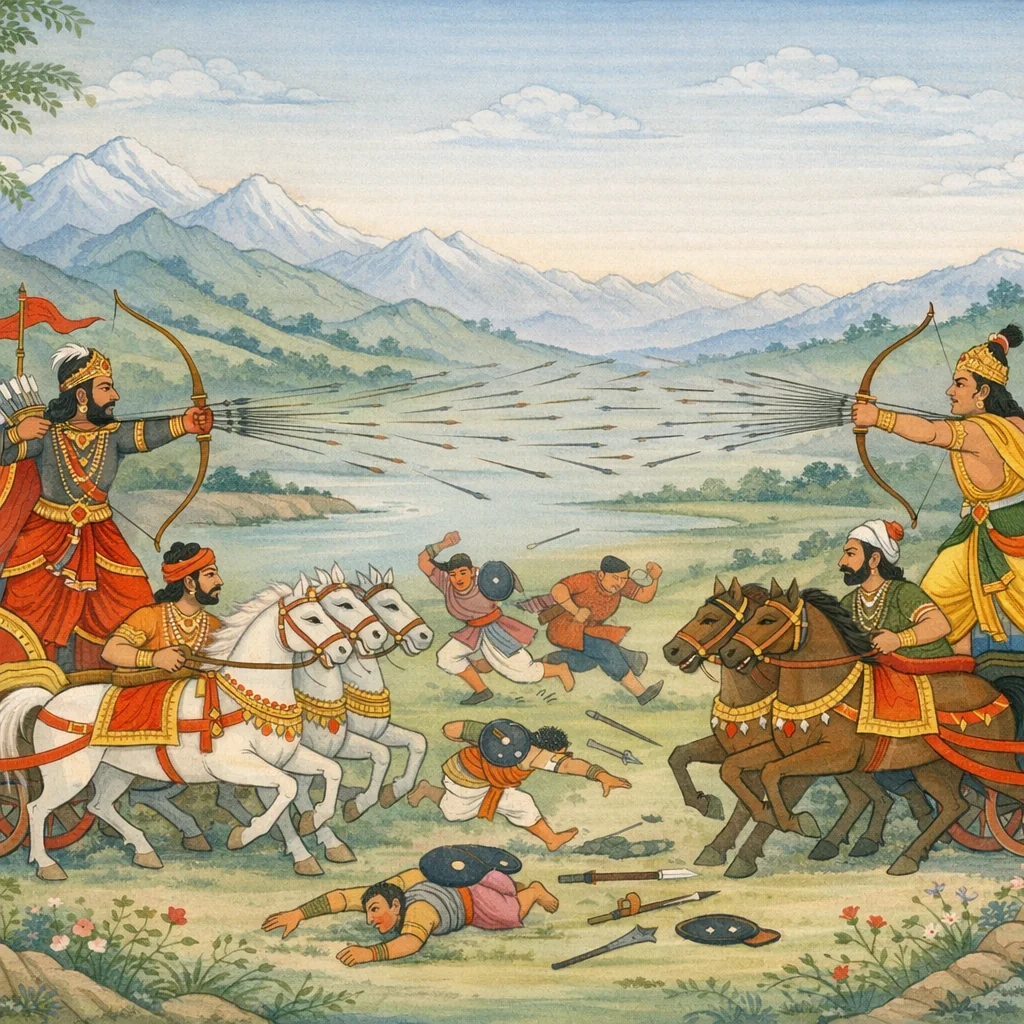
Saṃjaya reports that at dawn the combatants, already engaged from before sunrise, resume fighting as the sun illuminates the worlds. Previously locked duels reattach; chariots, horses, elephants, and infantry collide in mixed formations. The chapter emphasizes sensory intensity: conches, kettledrums, elephant roars, bowstrings, and cries create a sky-reaching tumult; the ground is filled with the sounds of falling and wounded. In the melee, units interpenetrate and strike without reliable identification, producing a state where Kauravas, Pāñcālas, and Pāṇḍavas cannot be distinguished amid a dust-cloud likened to a second night. The imagery becomes technical and material: broken chariots, fallen standards, scattered weapons, and ornaments make the battlefield resemble a field of stars. As dust settles with wind and blood-spray, leading chariot-warriors re-emerge into clearer confrontation; the narration moves toward named pairings, including Nakula’s tactical circling (apasavya) engagement with Duryodhana and the verbal challenge that follows.
Chapter Arc: दुर्योधन के उपालम्भ और आश्वासन-भरे वचनों के बाद रणदुर्मद अश्वत्थामा प्रतिज्ञा-सा संकल्प लेकर शत्रुवध के लिए उठ खड़ा होता है—मानो इन्द्र दैत्य-वध को उद्यत हो। → अश्वत्थामा पाण्डवों के प्रति अपने स्नेह का स्मरण कराते हुए भी युद्ध-धर्म की कठोरता स्वीकार करता है और समस्त धनुर्धरों को त्रस्त करता हुआ पांचाल-सेना की ओर बढ़ता है; लक्ष्य स्पष्ट होता जाता है—धृष्टद्युम्न और पांचालों का संहार। → धृष्टद्युम्न (पार्षत) और द्रोणपुत्र आमने-सामने आकर अमर्ष में भरकर चारों ओर से शरवृष्टि करते हैं; अश्वत्थामा अपने जन्म-प्रयोजन और प्रतिज्ञा का उद्घोष करते हुए (द्रोण-वध का प्रतिशोध) भीषण पराक्रम दिखाता है और पांचाल-पंक्तियों को तोड़ देता है। → अश्वत्थामा के इन्द्र-सदृश कर्म को देखकर पाण्डव-पक्ष की सेना व्यथित होती है; द्रोणकुमार क्रमशः अनेक पांचाल योद्धाओं का वध करता है, रथ-ध्वजाएँ बिखरती हैं और शेष सैनिक भयभीत होकर तितर-बितर होने लगते हैं। → पांचाल और सूंजय सैनिक मारे जाते हुए अश्वत्थामा को छोड़कर भागते हैं—अब प्रश्न यह रह जाता है कि धृष्टद्युम्न का अंत किस प्रकार और कितनी शीघ्रता से होगा।
Shlokas
Verse 1
ऑपन--मा_ज बक। जज: षष्टयाधेकशततमो< ध्याय: अश्वत्थामाका दुर्योधनको उपालम्भपूर्ण आश्वासन देकर पांचालोंके सा करते हुए धृष्टद्युम्नके रथसहित सारथिको नष्ट उसकी सेनाको भगाकर अद्भुत पराक्रम दिखाना संजय उवाच दुर्योधनेनैवमुक्तो द्रौणिराहवर्दुर्मद: । चकारारिवधे यत्नमिन्द्रो दैत्यवथे यथा
Sañjaya said: Thus addressed by Duryodhana, Droṇa’s son Aśvatthāmā—fierce and intoxicated with battle—set himself to the task of destroying the enemy in the fight, just as Indra once strove to slay the Daityas.
Verse 2
संजय कहते हैं--राजन! दुर्योधनके ऐसा कहनेपर रणदुर्मद अश्व॒त्थामाने उसी प्रकार शत्रुवधके लिये प्रयत्न आरम्भ किया, जैसे इन्द्र दैत्यवधके लिये यत्न करते हैं ।। प्रत्युवाच महाबाहुस्तव पुत्रमिदं वच: । सत्यमेतन्महाबाहो यथा वदसि कौरव,उस समय महाबाहु अअश्वत्थामाने आपके पुत्रसे यह वचन कहा--“महाबाहु कौरवनन्दन! तुम जैसा कहते हो, यही ठीक है
Sañjaya said: “O King! When Duryodhana spoke thus, Ashvatthama—intoxicated with the fury of battle—at once set himself to the task of slaying the foes, just as Indra strives to destroy the Daityas. Then the mighty-armed Ashvatthama replied to your son with these words: ‘Mighty-armed Kaurava, what you say is true.’”
Verse 3
प्रिया हि पाण्डवा नित्यं मम चापि पितुश्न मे । तथैवावां प्रियौ तेषां न तु युद्धे कुरूद्वह,“कुरुश्रेष्ठ! पाण्डव मुझे तथा मेरे पिताजीको भी बहुत प्रिय हैं। इसी प्रकार उनको भी हम दोनों पिता-पुत्र प्रिय हैं, किंतु युद्धस्थलमें हमारा यह भाव नहीं रहता
Sañjaya said: “The Pāṇḍavas are always dear to me, and to my father as well. In the same way, we—father and son—are dear to them. Yet, O bull among the Kurus, on the battlefield this feeling does not prevail.”
Verse 4
शक्तितस्तात युध्यामस्त्यक्त्वा प्राणानभीतवत् | अहं कर्णश्न शल्यश्न कृपो हार्दिक्य एव च । निमेषात् पाण्डवीं सेनां क्षपयेम नृपोत्तम,“तात! हम अपने प्राणोंका मोह छोड़कर निर्भय-से होकर यथाशक्ति युद्ध करते हैं। नृपश्रेष्ठ! मैं, कर्ण, शल्य, कृप और कृतवर्मा पलक मारते-मारते पाण्डव-सेनाका संहार कर सकते हैं
Sañjaya said: “Dear son, casting off attachment to life, we fight fearlessly to the best of our strength. O best of kings, I, Karṇa, Śalya, Kṛpa, and Hārdikya (Kṛtavarmā) could, in the blink of an eye, annihilate the Pāṇḍava army.”
Verse 5
ते चापि कौरवीं सेनां निमेषार्धात् कुरूद्वह । क्षपयेयुर्महाबाहो न स्याम यदि संयुगे,“महाबाहु कुरुश्रेष्ठ) यदि युद्धस्थलमें हमलोग न रहें, तो पाण्डव भी आधे निमेषयमें ही कौरव-सेनाका संहार कर सकते हैं
Sañjaya said: “O best of the Kurus, O mighty-armed one—if we were not present in the battle, then the Pāṇḍavas too could destroy the Kaurava army in but half a blink.”
Verse 6
युध्यतां पाण्डवान् शक््त्या तेषां चास्मान् युयुत्सताम् । तेजस्तेज: समासाद्य प्रशमं याति भारत,“हम यथाशक्ति पाण्डवोंसे युद्ध करते हैं और वे हमलोगोंसे युद्ध करना चाहते हैं। भारत! इस प्रकार हमारा तेज परस्पर एक-दूसरेसे टकराकर शान्त हो जाता है
Sañjaya said: “As far as our strength allows, we fight the Pāṇḍavas, and they in turn are eager to fight us. O Bhārata, when our energies meet and clash against one another, their fierce force is spent and subsides into calm.”
Verse 7
अशक्या तरसा जेतुं पाण्डवानामनीकिनी । जीवत्सु पाण्डुपुत्रेषु तद्धि सत्यं ब्रवीमि ते
Sañjaya said: The Pāṇḍavas’ army cannot be conquered by mere impetuous force so long as the sons of Pāṇḍu still live. This, indeed, is the truth I tell you.
Verse 8
“राजन! मैं तुमसे सत्य कहता हूँ कि पाण्डवोंके जीते-जी उनकी सेनाको बलपूर्वक जीतना असम्भव है ।। आत्मार्थ युध्यमानास्ते समर्था: पाण्डुनन्दना: । किमर्थ तव सैन्यानि न हनिष्यन्ति भारत,“भरतनन्दन! पाण्डव शक्तिशाली हैं और अपने लिये युद्ध करते हैं, फिर वे किसलिये तुम्हारी सेनाओंका संहार नहीं करेंगे?
Sañjaya said: O King, I tell you the truth: so long as the Pāṇḍavas live, it is impossible to overpower their army by sheer force. Those sons of Pāṇḍu are capable and fight for their own cause; why, then, would they not strike down your forces, O Bhārata?
Verse 9
त्वं तु लुब्धतमो राजन् निकृतिज्ञश्व कौरव । सर्वाभिशड्की मानी च ततो5स्मानभिशड्कसे
Sañjaya said: “But you, O King—O Kaurava—are exceedingly greedy, skilled in deceit, ever suspicious, and proud; therefore you suspect even us.”
Verse 10
“कौरवनरेश! तुम तो लोभी और छल-कपटकी विद्याको जाननेवाले हो। सबपर संदेह करनेवाले और अभिमानी हो; इसलिये हमलोगोंपर भी शंका करते हो ।। मन्ये त्वं कुत्सितो राजन् पापात्मा पापपुरुष । अन्यानपि स न: क्षुद्र शड़कसे पापभावित:,“राजन! मेरी मान्यता है कि तुम निन्दित, पापात्मा एवं पापपुरुष हो।' क्षुद्र नरेश! तुम्हारा अन्तःकरण पापभावनासे ही पूर्ण है, इसीलिये तुम हमपर तथा दूसरोंपर भी संदेह करते हो
Sañjaya said: “O king, I deem you base and contemptible—sinful in heart and sinful in conduct. Petty-minded and driven by wicked intent, you suspect not only us but others as well.”
Verse 11
अहं तु यत्नमास्थाय त्वदर्थ त्यक्तजीवित: । एष गच्छामि संग्रामं त्वत्कृते कुरुनन्दन
Sañjaya said: “But I, having taken up every effort, and counting my life as already relinquished for your sake, now go to the battle—on your account, O joy of the Kurus.”
Verse 12
“कुरुनन्दन! मैं अभी तुम्हारे लिये जीवनका मोह छोड़कर पूरा प्रयत्न करके संग्रामभूमिमें जा रहा हूँ ।। योत्स्ये5हं शत्रुभि: सार्थ जेष्यामि च वरान् वरान् | पज्चालै: सह योत्स्यामि सोमकै: केकयैस्तथा
O joy of the Kurus, for your sake I now cast aside attachment to life and, exerting myself with all my strength, go to the battlefield. I will fight alongside the warriors against the enemies, and I will win the best of victories. I will wage war together with the Pāñcālas, with the Somakas, and likewise with the Kekayas.
Verse 13
अद्य मद्वाणनिर्दग्धा: पजचाला: सोमकास्तथा
Sañjaya said: “Today the Pañcālas—and likewise the Somakas—have been scorched by my arrows.”
Verse 14
अद्य धर्मसुतो राजा दृष्टवा मम पराक्रमम्
Sañjaya said: “Today, having witnessed my prowess, King Dharmasuta (Yudhiṣṭhira)…”
Verse 15
आगमिष्यति निर्वेदं धर्मपुत्रो युधिष्ठिर:
Sañjaya said: Yudhiṣṭhira, the son of Dharma, will fall into deep remorse and dispassion—his conscience turning inward beneath the moral weight of the war’s consequences.
Verse 16
ये मां युद्धेडभियोत्स्यन्ति तान् हनिष्यामि भारत
Sañjaya said: “O Bhārata, those who will advance against me in battle—those I shall strike down.”
Verse 17
एवमुक्त्वा महाबाहु: पुत्र दुर्योधनं तव,आपके पुत्र दुर्योधनसे ऐसा कहकर महाबाहु अश्वत्थामा समस्त धनुर्धरोंको त्रास देता हुआ युद्धके लिये शत्रुओंके सामने डट गया। प्राणियोंमें श्रेष्ठ अश्वत्थामा आपके पुत्रोंका प्रिय करना चाहता था
Sañjaya said: Having spoken thus to your son Duryodhana, the mighty-armed Aśvatthāmā—striking fear into all the bowmen—stood firm before the enemy, ready for battle. That foremost of living warriors sought to do what was pleasing to your sons, driven by loyalty even amid the moral darkness of war.
Verse 18
अभ्यवर्तत युद्धाय त्रासयन् सर्वधन्विन: । चिकीर्षुस्तव पुत्राणां प्रियं प्राणभूतां वर:,आपके पुत्र दुर्योधनसे ऐसा कहकर महाबाहु अश्वत्थामा समस्त धनुर्धरोंको त्रास देता हुआ युद्धके लिये शत्रुओंके सामने डट गया। प्राणियोंमें श्रेष्ठ अश्वत्थामा आपके पुत्रोंका प्रिय करना चाहता था
Sañjaya said: Having spoken thus to your son Duryodhana, the mighty-armed Aśvatthāmā advanced to battle, terrifying all the bowmen, and stood firm before the foes. That best of warriors, dear as life itself to your sons, sought to do what would please them—driven by loyalty amid the harsh demands of war.
Verse 19
ततो<ब्रवीत् सकैकेयान् पज्चालान् गौतमीसुतः । प्रहरध्वमित: सर्वे मम गात्रे महारथा:
Then Gautamī’s son addressed the Kekayas and the Pāñcālas: “All you great chariot-warriors, strike me here—upon my very body.”
Verse 20
एवमुक्तास्तु ते सर्वे शस्त्रवृष्टीरपातयन्
Sañjaya said: Thus addressed, all of them at once unleashed a rain of weapons.
Verse 21
तान् निहत्य शरान्द्रौणिदेश वीरानपोथयत्
Sañjaya said: Having slain them with his arrows, the son of Droṇa struck down the warriors in that region, crushing their resistance in the press of battle.
Verse 22
ते हन्यमाना: समरे पठ्चाला: सोमकास्तथा
Sañjaya said: In the thick of battle, the Pañcālas and the Somakas were being cut down.
Verse 23
परित्यज्य रणे दौ्णिं व्यद्रवन्त दिशो दश | समरांगणमें मारे जाते हुए पांचाल और सोमक द्रोणपुत्र अश्वत्थामाको छोड़कर दसों दिशाओंमें भाग गये ।। तान् दृष्टवा द्रवतः शूरान् पज्चालान् सहसोमकान्
Sañjaya said: Abandoning Drauṇi (Aśvatthāmā) in the midst of battle, the Pāñcālas and the Somakas—though valiant—fled in all ten directions as they were being cut down on the field. Seeing those heroes of Pāñcāla, together with the Somakas, running away in panic…
Verse 24
धृष्टद्युम्नो महाराज द्रौणिमभ्यद्रवद् रणे । महाराज! शूरवीर पांचालों और सोमकोंको भागते देख धूष्टद्युम्नने रणक्षेत्रमें अश्व॒त्थामापर धावा किया ।। ततः काञ्चनचित्राणां सजलाम्बुदनादिनाम्
Sanjaya said: O King, in the midst of battle Dhṛṣṭadyumna charged straight at Droṇa’s son, Aśvatthāman. Seeing the valiant Pāñcālas and the Somakas in flight, Dhṛṣṭadyumna rushed upon Aśvatthāman on the battlefield. Thereupon—amid glittering war-gear adorned with gold, and a deep roar like thunder from rain-laden clouds…
Verse 25
वृतः शतेन शूराणां रथानामनिवर्तिनाम् | पुत्र: पाउ्चालराजस्य धृष्टद्युम्नो महारथ:
Sanjaya said: Dhṛṣṭadyumna, the great chariot-warrior, son of the king of the Pāñcālas, was surrounded by a hundred valiant, unyielding chariot-fighters.
Verse 26
द्रोणिमित्यब्रवीद् वाक््य॑ दृष्टवा योधान् निपातितान् । तदनन्तर सुवर्णचित्रित, सजल जलधरके समान गम्भीर घोष करनेवाले तथा युद्धसे कभी पीठ न दिखानेवाले सौ रथों एवं शूरवीर रथियोंसे घिरे हुए पांचाल-राजकुमार महारथी धृष्टद्यम्नने अपने योद्धाओंको मारा गया देख द्रोणकुमार अश्वत्थामासे इस प्रकार कहा-- ।। आचार्यपुत्र दुर्बुद्धे किमन्यै्निहतैस्तव,“खोटी बुद्धिवाले आचार्यपुत्र! दूसरोंको मारनेसे तुम्हें क्या लाभ है? यदि शूरमा हो तो रणक्षेत्रमें मेरे साथ भिड़ जाओ। इस समय मेरे सामने खड़े तो हो जाओ, मैं अभी तुम्हें मार डालूँगा'
Sanjaya said: Seeing the warriors struck down, Dhṛṣṭadyumna addressed Droṇa’s son. Then the Pāñcāla prince—himself a great chariot-warrior—surrounded by a hundred chariots and valiant fighters, their cars gleaming with gold and their roar deep like rain-laden clouds, men who never turned their backs in battle, beheld his own troops slain and spoke to Aśvatthāman, the son of Droṇa: “O teacher’s son, you of perverse judgment—what do you gain by killing others? If you are truly a hero, then fight with me on this battlefield. Stand before me now; I will slay you this very moment.”
Verse 27
समागच्छ मया सार्ध यदि शूरो5सि संयुगे | अहं त्वां निहनिष्यामि तिष्ठेदानीं ममाग्रत:,“खोटी बुद्धिवाले आचार्यपुत्र! दूसरोंको मारनेसे तुम्हें क्या लाभ है? यदि शूरमा हो तो रणक्षेत्रमें मेरे साथ भिड़ जाओ। इस समय मेरे सामने खड़े तो हो जाओ, मैं अभी तुम्हें मार डालूँगा'
“Come, join battle with me if you are a hero in war. I will slay you—stand before me now!”
Verse 28
ततस्तमाचार्यसुतं धृष्टद्युम्न: प्रतापवान् । मर्मभिद्धि: शरैस्ती3क्ष्णर्णघान भरतर्षभ,भरतश्रेष्ठ ऐसा कहकर प्रतापी धृष्टद्युम्नने मर्मभेदी एवं पैने बाणोंद्वारा आचार्यपुत्रको घायल कर दिया
Sanjaya said: Then the valiant Dhṛṣṭadyumna—O bull among the Bharatas—struck the preceptor’s son with sharp arrows that pierced the vital points, wounding him in the midst of battle.
Verse 29
ते तु पद्धक्तीकृता द्रौणिं शरा विविशुराशुगा: । रुक्मपुड्खा: प्रसन्नाग्रा: सर्वकायावदारणा:
Sañjaya said: But those swift arrows, shot in a well-ordered formation, quickly entered Droṇa’s son (Aśvatthāman). With golden fletching and keen, well-tempered points, they tore through his entire body—an image of war’s relentless momentum, where disciplined skill becomes an instrument of grievous harm.
Verse 30
सोडतिविद्धो भृशं क्रुद्ध: पदाक्रान्त इवोरग:
Sañjaya said: Though pierced by a spear, he became fiercely enraged—like a serpent trampled underfoot—his pain turning at once into a dangerous, retaliatory fury amid the moral chaos of battle.
Verse 31
मानी द्रौणिरसम्भ्रानन््तो बाणपाणिरभाषत । उन बाणोंसे अत्यन्त घायल होकर मानी द्रोणकुमार पैरोंसे कुचले गये सर्पके समान अत्यन्त कुपित हो उठा और हाथमें बाण लेकर संभ्रमरहित हो इस प्रकार बोला-- ।। धृष्टय्युम्न स्थिरो भूत्वा मुहूर्त प्रतिपालय
Sañjaya said: The proud son of Droṇa, unshaken and holding his arrows in hand, spoke. “Dhṛṣṭadyumna, stand firm and hold your ground for a moment.” The scene underscores how wounded pride and rage can harden into resolve on the battlefield, even as the call to ‘stand steady’ invokes the warrior’s ethic of composure amid chaos.
Verse 32
द्रौणिरेवमथाभाष्य पार्षतं परवीरहा
Sañjaya said: Having spoken thus, Droṇa’s son—slayer of enemy-heroes—addressed Pārṣata (Dhṛṣṭadyumna), continuing the fierce exchange amid the moral strain of war.
Verse 33
स बाध्यमान: समरे द्रौणिना युद्धदुर्मद:
Sañjaya said: In the thick of battle, he—made reckless by the intoxication of war—was being hard-pressed by Drauṇi.
Verse 34
न जानीषे प्रतिज्ञां मे विप्रोत्पत्ति तथैव च
Sañjaya said: “You do not know my vow, nor do you know the circumstances of my brahmin birth as well.”
Verse 35
ततस्त्वाहं न हन्म्यद्य द्रोणे जीवति संयुगे,नेष्यामि प्रेतलोकाय होतन्मे मनसि स्थितम् । “इसीलिये द्रोणके जीते-जी अभी युद्धस्थलमें तेरा वध नहीं कर रहा हूँ। दुर्मते! इसी रातमें प्रभात होनेसे पहले आज तेरे पिताका वध करके फिर तुझे भी युद्धस्थलमें प्रेतलोकको भेज दूँगा। यही मेरे मनका निश्चित विचार है
Sañjaya said: “Therefore, while Droṇa still lives and the battle continues, I will not kill you today. I am resolved to send you to the world of the dead—this is firmly fixed in my mind.”
Verse 36
इमां तु रजनी प्राप्तामप्रभातां सुदुर्मते । निहत्य पितरं तेडद्य ततस्त्वामपि संयुगे
Sañjaya said: “But now that this night has come—before dawn has broken, O evil-minded one—having today slain your father, they will then strike you too in battle.”
Verse 37
यस्ते पार्थेषु विद्वेषो या भक्ति: कौरवेषु च
Sañjaya said: “That hostility you bear toward the sons of Pṛthā, and that devotion you show toward the Kauravas…”
Verse 38
यो हि ब्राह्नमण्यमुस्तृज्य क्षत्रधर्मरतो द्विज:
Sañjaya said: “For a twice-born man who abandons the conduct and vocation proper to a brāhmaṇa and instead becomes devoted to the duties of a kṣatriya…”
Verse 39
इत्युक्त: परुषं वाक्यं पार्षतेन द्विजोत्तम:
Sañjaya said: Thus addressed with harsh words by the son of Pṛṣatī (Dhṛṣṭadyumna), the foremost of Brahmins was met with a cutting rebuke—showing how, under the strain of war, even the venerable may be spoken to with severity, and how speech itself becomes a moral test of restraint and duty.
Verse 40
निर्दहन्निव चक्षुर्भ्या पार्षत॑ सो5भ्यवैक्षत
Sañjaya said: With eyes that seemed to burn, that son of Pārṣatī (Dhṛṣṭadyumna) fixed his gaze upon him—an intense, wrathful look that signaled resolve hardening amid the moral strain of battle.
Verse 41
स च्छाद्यमान: समरे द्रौणिना राजसत्तम
Sañjaya said: In the thick of battle, that noble king—foremost among rulers—was being overwhelmed and covered over by Droṇa’s son, as the struggle pressed toward a decisive and morally weighty turning point.
Verse 42
सर्वपाञ्चालसेनाभि: संवृतो रथसत्तम: | नाकम्पत महाबाहु: स्ववीर्य समुपाश्रित:
Sañjaya said: Though hemmed in on all sides by the entire Pāñcāla host, that foremost of chariot-warriors—the mighty-armed hero—did not waver, relying on his own valor. In the moral atmosphere of the war, the verse highlights steadfastness under overwhelming pressure: courage is shown not by the absence of danger, but by refusing to yield when overwhelmed, standing firm through inner strength and disciplined resolve.
Verse 43
सायकांश्चैव विविधाननश्वत्थाम्नि मुमोच ह । नृपश्रेष्ठ! समरांगणमें अश्व॒त्थामाके द्वारा आच्छादित होनेपर भी समस्त पांचाल- सेनाओंसे घिरे हुए महारथी महाबाहु धृष्टद्युम्म कम्पित नहीं हुए। उन्होंने अपने बलपराक्रमका आश्रय लेकर अभश्वत्थामापर नाना प्रकारके बाणोंका प्रहार किया ।। ४१-४२ न््।! तौ पुन: संन्यवर्तेतां प्राणधूतपणे रणे,वे दोनों महाधनुर्धर वीर अमर्षमें भरकर एक-दूसरेपर चारों ओरसे बाणोंकी वर्षा करते और उन बाणसमूहोंद्वारा परस्पर पीड़ा देते हुए प्राणोंकी बाजी लगाकर रणभूमिमें डटे रहे
Sañjaya said: Aśvatthāmā loosed many kinds of arrows. O best of kings, even when the battlefield was covered by Aśvatthāmā’s shafts, the mighty-armed maharatha Dhṛṣṭadyumna—though surrounded amid the Pāñcāla host—did not waver. Trusting in his own strength and valor, he struck back at Aśvatthāmā with volleys of diverse arrows. The scene underscores the warrior’s ethic of steadfastness under pressure: courage is shown not by the absence of danger, but by refusing to yield when overwhelmed.
Verse 44
निपीडयन्तौ बाणौचै: परस्परममर्षिणौ । उत्सृजन्तौ महेष्वासौ शरवृष्टी: समनन््तत:ः,वे दोनों महाधनुर्धर वीर अमर्षमें भरकर एक-दूसरेपर चारों ओरसे बाणोंकी वर्षा करते और उन बाणसमूहोंद्वारा परस्पर पीड़ा देते हुए प्राणोंकी बाजी लगाकर रणभूमिमें डटे रहे
Sañjaya said: Both great bowmen, inflamed with wrath, rained volleys of arrows on one another from every side. Pressing and tormenting each other with dense flights of shafts, they stood their ground on the battlefield, staking their very lives in the contest.
Verse 45
द्रौणिपार्षतयोर्युद्धें घोररूपं भयानकम् | दृष्टवा सम्पूजयामासु: सिद्धचारणवातिका:,अश्वत्थामा और धृष्टद्युम्मके उस घोर एवं भयानक युद्धको देखकर सिद्ध, चारण तथा वायुचारी गरुड़ आदिने उसकी भूरि-भूरि प्रशंसा की
Sañjaya said: Seeing the dreadful, terrifying battle between Aśvatthāmā (son of Droṇa) and Dhṛṣṭadyumna (son of Pṛṣata), the Siddhas, Cāraṇas, and the aerial beings who move with the wind offered abundant acclaim and homage to that display of martial prowess—an ominous celebration of skill amid the ruin of war.
Verse 46
शरौघै: पूरयन्तौ तावाकाशं च दिशस्तथा । अलक्ष्यौ समयुध्येतां महत् कृत्वा शरैस्तम:,वे दोनों अपने बाणसमूहोंसे आकाश और दिशाओंको भरते हुए उनके द्वारा महान् अन्धकारकी सृष्टि करके अलक्ष्य होकर युद्ध करते रहे
Sañjaya said: The two warriors, flooding the sky and all directions with volleys of arrows, created a vast darkness with their shafts; hidden from sight, they continued to fight on.
Verse 47
नृत्यमानाविव रणे मण्डलीकृतकार्मुकौ । परस्परवधे यत्तौ सर्वभूतभयड्करौ,उस रणक्षेत्रमें धनुषको मण्डलाकार करके वे दोनों नृत्य-सा कर रहे थे। एक-दूसरेके वधके लिये प्रयत्नशील होकर समस्त प्राणियोंके लिये भयंकर बन गये थे
Sañjaya said: On the battlefield, the two of them, their bows whirled in circular arcs, seemed as though they were dancing. Straining for each other’s death, they became a terror to all living beings.
Verse 48
अयुध्येतां महाबाहू चित्र लघु च सुष्ठु च । सम्पूज्यमानौ समरे योधमुख्यै: सहस्रश:,वे महाबाहु वीर समरांगणमें समस्त श्रेष्ठ योद्धाओंद्वारा हजारों बार प्रशंसित होते हुए शीघ्रतापूर्वक और सुन्दर ढंगसे विचित्र युद्ध कर रहे थे
Sañjaya said: The two mighty-armed heroes fought on—displaying a wondrous variety of maneuvers, with swift and skillful execution. In that battle they were repeatedly acclaimed, again and again, by thousands of foremost warriors, as they performed their striking feats upon the field.
Verse 49
तौ प्रबुद्धौ रणे दृष्टवा वने वन्यौ गजाविव । उभयो: सेनयोर्हर्षस्तुमुल: समपद्यत,वनमें लड़नेवाले दो जंगली हाथियोंके समान उन दोनोंको युद्धमें जागरूक देखकर दोनों सेनाओमें तुमुल हर्षनाद छा गया
Sañjaya said: Seeing those two fully alert in the battle—like two wild elephants in the forest—a thunderous surge of joy and cheering arose in both armies.
Verse 50
सिंहनादरवाश्नलासन् दध्मु: शड्खांश्व सैनिका: । वादित्राण्य भ्यवाद्यन्त शतशो5थ सहस्रश:,सब ओर सिंहनाद होने लगा। सैनिक शंखध्वनि करने लगे तथा सैकड़ों एवं सहस्तरों प्रकारके रणवाद्य बजने लगे
Sañjaya said: A tumult of lion-roars rose on every side. The soldiers blew their conches, and hundreds and thousands of war-instruments were sounded, swelling the battlefield with a fierce, collective resolve.
Verse 51
तस्मिंस्तु तुमुले युद्धे भीरूणां भयवर्धने । मुहूर्तमपि तद् युद्धं समरूपं तदाभवत्
Sañjaya said: In that tumultuous battle—one that only increased the fear of the faint-hearted—even for a single moment the fighting assumed a uniform, evenly matched character, as though both sides were alike in force and resolve.
Verse 52
कायरोंका भय बढ़ानेवाले उस तुमुल संग्राममें दो घड़ीतक उन दोनोंका समान रूपसे युद्ध चलता रहा ।। ततो द्रौणि्महाराज पार्षतस्य महात्मन: । ध्वजं धनुस्तथा छत्रमुभौ च पार्ष्णिसारथी
Sañjaya said: In that tumultuous battle, which heightened the fear of the faint-hearted, those two fought on equal terms for about two ghaṭīs. Then, O King, Droṇi struck down the banner, the bow, and the parasol of the great-souled son of Pārṣata; and he also brought down both of his chariot’s wheels and his charioteer.
Verse 53
सूतमश्चांश्व चतुरो निहत्याभ्यद्रवद् रणे । महाराज! तदनन्तर द्रोणकुमारने महामना धृष्टद्युम्नके ध्वज, धनुष, छत्र, दोनों पाश्वरक्षक, सारथि तथा चारों घोड़ोंको नष्ट करके उस युद्धमें बड़े वेगसे धावा किया ।। ५२ हे || पज्चालां श्वैव तान् सर्वान् बाणै: संनतपर्वभि:
Sañjaya said: Having slain the charioteer and the four horses, he rushed forward in the battle. O King, thereafter the high-souled son of Droṇa, striking with great speed, destroyed Dhṛṣṭadyumna’s banner, bow, parasol, both flank-guards, and charioteer, and also brought down the four horses. Then, with arrows whose joints were well-tempered, he assailed all those Pāñcālas.
Verse 54
व्यद्राववदमेयात्मा शतशो5थ सहस्रशः । अनन्त आत्मबलसे सम्पन्न अश्वत्थामाने झुकी हुई गाँठवाले सैकड़ों और सहस्रों बाणोंद्वारा उन समस्त पांचालोंको दूर भगा दिया ।। ५३ $ ।। ततस्तु विव्यथे सेना पाण्डवी भरतर्षभ
Sañjaya said: Endowed with immeasurable spirit and inexhaustible strength, Aśvatthāmā drove the Pāñcālas into flight, scattering them by hundreds and by thousands. Thereupon, O bull among the Bharatas, the Pāṇḍava host was shaken and plunged into distress.
Verse 55
शतेन च शतं हत्वा पठ्चालानां महारथ:,नाशयामास पज्चालान भूयिष्ठं ये व्यवस्थिता: । महारथी द्रोणकुमारने पहले सौ बाणोंसे सौ पांचाल योद्धाओंका वध करके फिर तीन पैने बाणोंद्वारा उनके तीन महारथियोंकों भी मार गिराया और धूृष्टद्युम्न तथा अर्जुनके देखते-देखते वहाँ जो बहुसंख्यक पांचाल योद्धा खड़े थे, उन सबको नष्ट कर दिया
Sañjaya said: Having slain a hundred Pāñcāla warriors with a hundred well-aimed arrows, that great chariot-warrior went on to destroy the Pāñcālas who stood there in the greatest numbers. The passage lays bare the grim momentum of battle: prowess is displayed as efficiency in killing, and the moral air darkens as valor and destruction become indistinguishable on the field.
Verse 56
त्रिभिश्व निशितैर्बाणत्वा त्रीन् वै महारथान् । द्रौणिर्द्रपदपुत्रस्य फाल्गुनस्यथ च पश्यत:
Sañjaya said: With three keen arrows Droṇi slew three great chariot-warriors, and he did so while the son of Drupada and Phālguna looked on. The scene reveals the ruthless precision of battlefield skill and the grim ethical tension of war, where even renowned heroes cannot avert sudden death.
Verse 57
ते वध्यमाना: पञ्चाला: समरे सह सृञ्जयै:
Sañjaya said: The Pāñcālas, being cut down in the battle along with the Sṛñjayas, were slain amid the clash of arms—an image of war’s relentless momentum, where entire allied hosts are swept into destruction.
Verse 58
स जित्वा समरे शत्रून् द्रोणपुत्रो महारथ:
Sañjaya said: Having conquered the enemies in battle, the son of Droṇa—the great chariot-warrior—stood foremost, his victory marking both the prowess of arms and the grim momentum of the war.
Verse 59
स निहत्य बहुन् शूरानश्वत्थामा व्यरोचत । युगान्ते सर्वभूतानि भस्म कृत्वेव पावक:,जैसे प्रलयकालमें अग्निदेव सम्पूर्ण भूतोंको भस्म करके प्रकाशित होते हैं, उसी प्रकार अश्व॒ृत्थामा वहाँ बहुसंख्यक शूरवीरोंका वध करके सुशोभित हो रहा था
Sañjaya said: Having slain many heroic warriors, Aśvatthāmā shone forth on the battlefield—like the fire at the end of an age, which blazes after reducing all beings to ashes.
Verse 60
सम्पूज्यमानो युधि कौरवेयै- निर्जित्य संख्येडरिगणाम् सहस्रश: । व्यरोचत द्रोणसुत: प्रतापवान् यथा सुरेन््द्रो<रिगणान् निहत्य वै,जैसे देवराज इन्द्र शत्रुओंका संहार करके सुशोभित होते हैं, उसी प्रकार प्रतापी द्रोणपुत्र अश्व॒त्थामा संग्राममें सहस्रों शत्रुसमूहोंको परास्त करके कौरवोंद्वारा पूजित एवं प्रशंसित होता हुआ बड़ी शोभा पा रहा था
Sañjaya said: Honoured on the battlefield by the Kauravas, the mighty son of Droṇa shone forth after defeating thousands of enemy bands in combat—just as Indra, king of the gods, shines after slaying hosts of foes.
Verse 126
पाण्डवेयैश्न संग्रामे त्वत्प्रियार्थमरिंदम । शत्रुदमन! मैं शत्रुओंके साथ युद्ध करूँगा और उनके प्रधान-प्रधान वीरोंपर विजय पाऊँगा। संग्रामभूमिमें तुम्हारा प्रिय करनेके लिये मैं पांचालों, सोमकों, केकयों तथा पाण्डवोंके साथ भी युद्ध करूँगा
Sañjaya said: “O subduer of foes, for the sake of what is dear to you, I shall fight in this battle. I will wage war against the enemies and overcome even their foremost champions. And on the field of combat, to accomplish what pleases you, I will fight even against the Pāñcālas, the Somakas, the Kekayas, and the Pāṇḍavas.”
Verse 136
सिंहेनेवार्दिता गावो विद्रविष्यन्ति सर्वश: । “आज पांचाल और सोमक योद्धा मेरे बाणोंसे दग्ध होकर सिंहसे पीड़ित हुई गौओंके समान सब ओर भाग जायँगे
Sañjaya said: “Like cattle harried by a lion, they will scatter in every direction.”
Verse 146
अश्वत्थाममयं लोकं॑ मंस्यते सह सोमकै: । “आज सोमकोंसहित धर्मपुत्र राजा युधिष्छिर मेरा पराक्रम देखकर सम्पूर्ण जगत्को अश्वत्थामासे भरा हुआ मानेंगे
Sañjaya said: “Together with the Somakas, King Yudhiṣṭhira—the son of Dharma—will, on witnessing my prowess today, deem the whole world to be filled with Aśvatthāmā.”
Verse 153
दृष्टवा विनिहतान् संख्ये पज्चालान् सोमकै: सह । “सोमकोंसहित पांचालोंको युद्धमें मारा गया देख आज धर्मपुत्र राजा युधिष्ठिरके मनमें बड़ा निर्वेद (खेद एवं वैराग्य) होगा
Sañjaya said: Seeing the Pāñcālas, together with the Somakas, slain on the battlefield, King Yudhiṣṭhira—son of Dharma—will today be seized by deep despondency and dispassion, shaken by the moral weight of such destruction.
Verse 159
इस प्रकार श्रीमह्माभारत द्रोणपर्वके अन्तर्गत घटोत्कचवधपर्वमें रात्रियुद्धके प्रसंगमें दुर्योधनका वचनविषयक एक सौ उनसठवाँ अध्याय पूरा हुआ
Thus ends the one hundred and fifty-ninth chapter of the Droṇa Parva of the Śrī Mahābhārata, within the section on the slaying of Ghaṭotkaca, in the context of the night-battle—this chapter being concerned with the words spoken by Duryodhana. The colophon marks a narrative closure: Duryodhana’s speech is framed as part of the ethically fraught nocturnal warfare that culminates in Ghaṭotkaca’s death, highlighting the escalation of tactics and the moral tension of fighting under cover of night.
Verse 160
इति श्रीमहाभारते द्रोणपर्वणि घटोत्कचवधपर्वणि रात्रियुद्धे5श्वत्थामपराक्रमे षष्टयधिकशततमो< ध्याय:,इस प्रकार श्रीमह्ा भारत द्रोणपर्वके अन्तर्गत घटोत्कचवधपर्वमें यात्रियुद्धके अवसरपर अश्वत्थामाका पराक्रमविषयक एक सौ साठवाँ अध्याय पूरा हुआ
Sanjaya said: Thus, in the Śrī Mahābhārata, within the Droṇa Parva, in the sub-section concerning the slaying of Ghaṭotkaca, on the occasion of the night-battle, the one-hundred-and-sixtieth chapter—describing Aśvatthāman’s prowess—comes to an end. The colophon marks the close of this unit of narration, framing the night’s violence and Aśvatthāman’s martial energy as a distinct episode within the larger ethical tragedy of the war.
Verse 163
नहि ते वीर मोक्ष्यन्ते मदबाह्वन्तरमागता: । “भारत! जो लोग रणभूमिमें मेरे साथ युद्ध करेंगे, उन्हें मैं मार डालूँगा। वीर! मेरी भुजाओंके भीतर आकर शत्रुसैनिक जीवित नहीं छूट सकेंगे”
Sañjaya said: “O hero, those who have come within the reach of my arms will not escape. On the battlefield, whoever engages me in combat—I shall strike them down; once they enter the circle of my strength, the enemy-soldiers will not leave alive.”
Verse 193
स्थिरीभूताश्न युद्ध्यध्वं दर्शयन्तो5स्त्रलाघवम् । तदनन्तर गौतमीनन्दन अभश्वत्थामाने केकयोंसहित पांचालोंसे कहा--“महारथियो! अब सब लोग मिलकर मेरे शरीरपर प्रहार करो और अपनी अस्त्र-संचालनकी फुर्ती दिखाते हुए सुस्थिर होकर युद्ध करो”
Sanjaya said: “Stand firm and fight, displaying your skill in the swift handling of weapons.” Thereafter, the son of Gautamī—Aśvatthāmā—addressed the Pāñcālas along with the Kekayas: “O great chariot-warriors, now all of you together strike at my very body. Show the quick mastery of your weapons, and fight with steady resolve.” In this moment, the ethic of battle is framed as unwavering composure and demonstrable martial discipline, even as the speaker challenges the enemy to concentrate their force upon him.
Verse 203
दौणिं प्रति महाराज जलं जलधरा इव । महाराज! अभ्र॒त्थामाके ऐसा कहनेपर वे सभी वीर उसके ऊपर उसी प्रकार अस्त्र- शस्त्रोंकी वर्षा करने लगे, जैसे मेघ पर्वतपर पानी बरसाते हैं
Sañjaya said: O King, when Aśvatthāmā, Droṇa’s son, spoke thus, all those warriors turned upon him and began to shower him with missiles and weapons, as rain-bearing clouds pour water upon a mountain.
Verse 213
प्रमुखे पाण्डुपुत्राणां धृष्टद्युम्नस्य च प्रभो । प्रभो! द्रोणकुमारने उनके उन बाणोंको नष्ट करके उनमेंसे दस वीरोंको पाण्डवों और धृष्टद्युम्नके सामने ही मार गिराया
Sañjaya said: O lord, right before the foremost of the Pāṇḍu princes and before Dhṛṣṭadyumna, Droṇa’s son shattered those arrows and, from among them, struck down ten warriors—slaying them in full view of the Pāṇḍavas and Dhṛṣṭadyumna.
Verse 296
मध्वर्थिन इवोद्दामा भ्रमरा: पुष्पितं ट्रुमम् । सुवर्णमय पंख और स्वच्छ धारवाले, सबके शरीरोंको विदीर्ण करनेमें समर्थ वे शीघ्रगामी बाण श्रेणीबद्ध होकर अश्वत्थामाके शरीरमें वैसे ही घुस गये, जैसे मधुके लोभी उद्दाम भ्रमर फूले हुए वृक्षपर बैठ जाते हैं
Sañjaya said: Like frenzied bees greedy for honey settling upon a blossoming tree, the arrows—golden-feathered, clear-edged, swift, and able to rend bodies—entered Aśvatthāman in ordered volleys.
Verse 313
यावत् त्वां निशितैर्बाणै: प्रेषयामि यमक्षयम् । 'धृष्टद्युम्न! स्थिर होकर दो घड़ी और प्रतीक्षा कर लो” तबतक मैं तुम्हें अपने पैने बाणोंद्वारा यमलोक भेज देता हूँ!
Sañjaya said: “Hold steady, Dhṛṣṭadyumna, and wait for just two ghaṭikās (a short while). Until then, I shall dispatch you with my razor-sharp arrows to Yama’s imperishable realm.”
Verse 323
छादयामास बाणौघचै: समन्ताल्लघुहस्तवत् । शत्रुवीरोंका संहार करनेवाले अश्वात्थामाने ऐसा कहकर शीघ्रतापूर्वक हाथ चलानेवाले कुशल योद्धाकी भाँति अपने बलसमूहोंद्वारा धृष्टद्यममको सब ओरसे आच्छादित कर दिया
Sañjaya said: Having spoken thus, Aśvatthāman—intent on the destruction of enemy champions and swift-handed like a master of arms—covered Dhṛṣṭadyumna on every side with a dense shower of arrows.
Verse 333
द्रौ्णि पाउ्चालतनयो वाग्भिरातर्जयत् तदा । समरांगणमें अश्व॒त्थामाद्वारा पीड़ित होनेपर रणदुर्मद पांचालराजकुमार धृष्टद्युम्नने उसे वाणीद्वारा डाँट बतायी और इस प्रकार कहा--
Sanjaya said: Then the son of the Panchala line rebuked Drona’s son with sharp words. On the battlefield, when Ashvatthama was pressing him hard, the battle-maddened Panchala prince Dhrishtadyumna censured him verbally and spoke thus—framing the conflict not only as a clash of weapons but also as a contest of resolve, honor, and righteous conduct amid war’s fury.
Verse 346
द्रोणं हत्वा किल मया हन्तव्यस्त्वं सुदुर्मते । “दुर्बृद्धि ब्राह्मण! क्या तू मेरी प्रतिज्ञा और उत्पत्तिका वृत्तान्त नहीं जानता? निश्चय ही, मुझे पहले द्रोणाचार्यका वध करके फिर तेरा विनाश करना है
Sañjaya said: “After killing Droṇa, I am indeed to kill you, O utterly misguided one. ‘Wicked-minded brāhmaṇa! Do you not know my vow and the account of my origin? Surely, I must first bring about Droṇācārya’s death and then accomplish your destruction.’”
Verse 363
नेष्यामि प्रेतलोकाय होतन्मे मनसि स्थितम् । “इसीलिये द्रोणके जीते-जी अभी युद्धस्थलमें तेरा वध नहीं कर रहा हूँ। दुर्मते! इसी रातमें प्रभात होनेसे पहले आज तेरे पिताका वध करके फिर तुझे भी युद्धस्थलमें प्रेतलोकको भेज दूँगा। यही मेरे मनका निश्चित विचार है
Verse 373
तां दर्शय स्थिरो भूत्वा न मे जीवन विमोक्ष्यसे । “दुन्तीके पुत्रोंके प्रति जो तेरा द्वेषभाव और कौरवोंके प्रति जो भक्तिभाव है, उसे स्थिर होकर दिखा। तू जीते-जी मेरे हाथसे छुटकारा नहीं पा सकेगा
Sañjaya said: “Show that—standing firm. You will not escape me while you still live.” The line conveys a coercive demand for unwavering allegiance and hostility, framing loyalty as something to be proven under threat rather than chosen through dharma.
Verse 383
स वध्य: सर्वलोकस्य यथा त्वं पुरुषाधम: । 'जो ब्राह्मण ब्राह्मणत्वका परित्याग करके क्षत्रियधर्ममें तत्पर हो, जैसा कि मनुष्योंमें अधम तू है, वह सब लोगोंके लिये वध्य है”
Sañjaya said: “He is fit to be slain by all people—just as you, the basest among men. Any Brahmin who abandons the state and discipline of Brahminhood and becomes intent on the warrior’s code, as you do in your depravity, becomes a legitimate target in the eyes of the whole world.”
Verse 393
क्रोधमाहारयत् तीव्र तिष्ठ तिछेति चाब्रवीत् । द्रपदकुमारके इस प्रकार कठोर वचन कहनेपर द्विजश्रेष्ठ अश्वत्थामाको बड़ा क्रोध हुआ और उसने कहा--'अरे! खड़ा रह, खड़ा रह”
Sañjaya said: Hearing the Drupada prince speak such harsh words, Aśvatthāmā, foremost among Brahmins, was seized by fierce anger and shouted, “Stand! Stand!”
Verse 403
छादयामास च शरैर्नि:श्वसन् पन्नगो यथा । उसने धृष्टद्युम्मकी ओर इस प्रकार देखा मानो अपने नेत्रोंके तेजसे उन्हें दग्ध कर डालेगा। साथ ही सर्पकी भाँति फुफकारते हुए अभश्वत्थामाने उन्हें अपने बाणोंद्वारा ढक दिया
Sañjaya said: Breathing hard and hissing like a serpent, he covered his foe with a shower of arrows, gazing at Dhrishtadyumna as though he would burn him down by the sheer fire of his eyes.
Verse 483
ननाद सुमहानादं तपान्ते जलदो यथा । इस प्रकार रणभूमिमें शत्रुओंको जीतकर महारथी द्रोणपुत्र वर्षाकालके मेघके समान जोर-जोरसे गर्जना करने लगा
Sañjaya said: Having overcome the enemy on the battlefield, Droṇa’s son—the great chariot-warrior—let out a tremendous roar, like a rain-cloud thundering at the end of the hot season.
Verse 543
दृष्टवा द्रौणेमहत् कर्म वासवस्येव संयुगे । भरतमश्रेष्ठ! युद्धस्थलमें इन्द्रके समान अश्वत्थामाके उस महान् कर्मको देखकर पाण्डव- सेना व्यथित हो उठी
Sañjaya said: Seeing the mighty deed performed by Aśvatthāmā, son of Droṇa—like Vāsava (Indra) in the thick of battle—O best of the Bharatas, the Pāṇḍava host grew shaken.
Verse 563
नाशयामास पज्चालान भूयिष्ठं ये व्यवस्थिता: । महारथी द्रोणकुमारने पहले सौ बाणोंसे सौ पांचाल योद्धाओंका वध करके फिर तीन पैने बाणोंद्वारा उनके तीन महारथियोंकों भी मार गिराया और धूृष्टद्युम्न तथा अर्जुनके देखते-देखते वहाँ जो बहुसंख्यक पांचाल योद्धा खड़े थे, उन सबको नष्ट कर दिया
Sañjaya said: Droṇa’s son, a great chariot-warrior, annihilated the Panchalas who stood in dense formation. First, with a hundred arrows he slew a hundred Panchala fighters; then, with three keen shafts, he struck down three of their foremost chariot-lords—doing all this before the eyes of Dhrishtadyumna and Arjuna, and destroying the many Panchala troops stationed there.
Verse 573
अगच्छन् द्रौणिमुस्तृज्य विप्रकीर्णरथध्वजा: । समरभूमिमें मारे जाते हुए पांचाल और सूंजय सैनिक अअश्वत्थामाको छोड़कर चल दिये, उनके रथ और ध्वजा नष्ट-भ्रष्ट होकर बिखर गये थे
Sañjaya said: Leaving Droṇa’s son, Aśvatthāmā, behind, the Panchāla and Sṛñjaya troops—being cut down on the battlefield—fell back and withdrew. Their chariots and banners were shattered and scattered, a clear sign that their formation had broken and their spirit was failing under the ruthless weight of war.
Frequently Asked Questions
The dilemma is practical-ethical: when the field is obscured and identities are unknowable, continuing violent engagement risks harming one’s own side, raising questions about responsibility and discernment under kṣātra-dharma.
The chapter underscores how perception conditions judgment: in dust, noise, and fear, certainty collapses, so disciplined awareness and restraint become as important as valor for preserving order and minimizing indiscriminate harm.
No explicit phalaśruti appears here; its meta-function is archival and diagnostic—documenting the limits of control and recognition in mass conflict, which contextualizes later decisions and outcomes in the war narrative.