Adhyaya 1
Garuḍa’s Return to Vaikuṇṭha and the Comprehensive Inquiry into Death-Rites and the Preta’s Journey
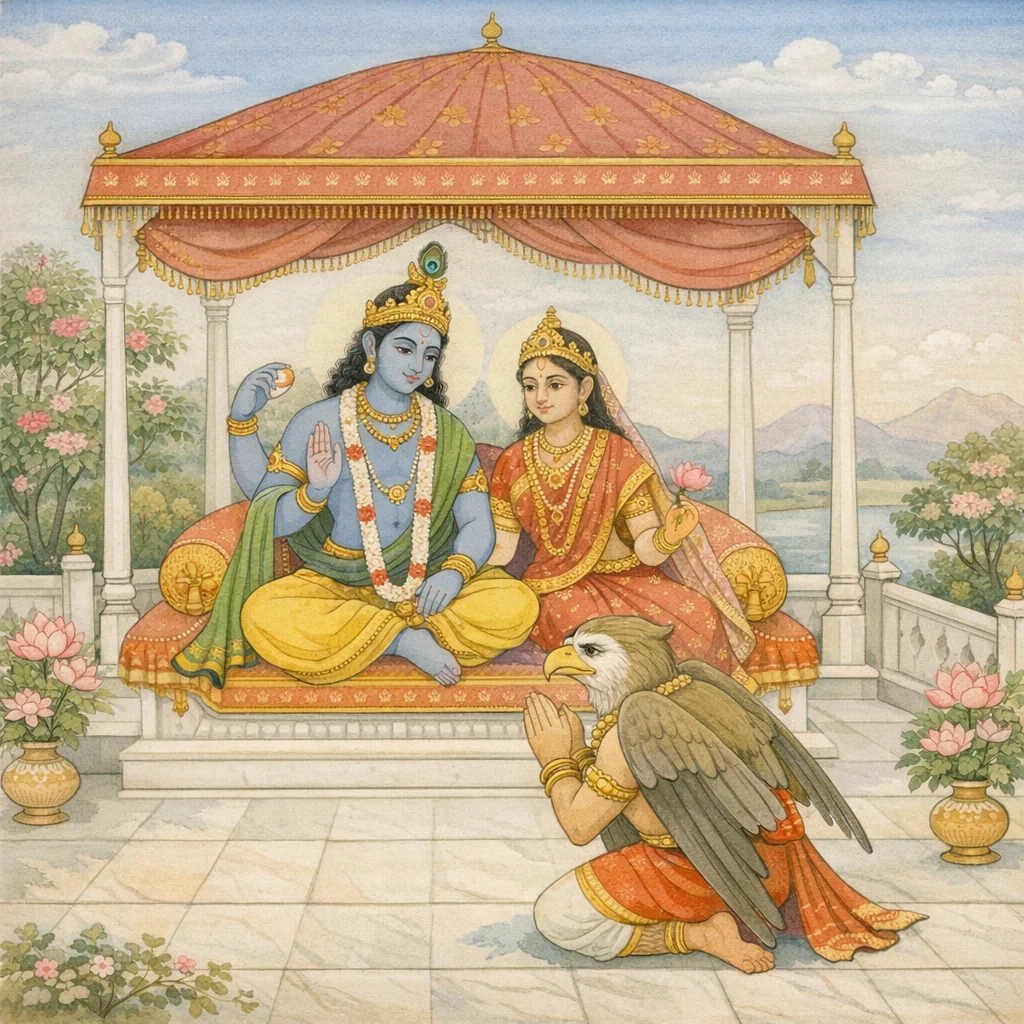
The chapter opens with Sūta at Naimiṣāraṇya answering Śaunaka’s sages, promising to clear the doctrinal doubt of how the embodied jīva gains another body—immediately, after Yama’s torments, or by other explanatory principles. He grounds the teaching in the Kṛṣṇa–Garuḍa dialogue. Garuḍa, having wandered through Pātāla, earth, and heaven while chanting Hari’s name, finds no lasting peace and returns to Vaikuṇṭha, beyond rajas and tamas, radiant with Viṣṇu’s attendants and Śrī’s worship. After beholding Viṣṇu, Garuḍa asks an extensive set of questions on death-rites: funeral arrangements (bier, feet to the south, pañcaratna, darbha), the rationale of dāna (cow, gold, iron, sesame, salt, grains, land), the working of the ativāha body, the meaning of piṇḍa offerings, dāhodaka, bone-collection, day-based purifications (2nd, 4th, 10th, 11th, 13th), and whether year-long rites are feasible. He also asks metaphysical questions about the jīva’s departure, the dissolution of elements and faculties, the fate of merit and demerit, and the role of sapiṇḍana. The chapter ends by heightening ethical urgency—fear of sinners’ destinies and compassion for universal suffering—setting up the next adhyāyas where Viṣṇu will answer systematically about death, the road to Saṃyamanī, and efficacious rites for the preta.
Shlokas
Verse 1
धर्मन्दृढबद्धमूलो वेदस्कन्धः पुराणशाखाढ्यः / क्रतुकुसुमो मोक्षफलो मधुसूदनपादपो जयति
Victorious is the tree of Madhusūdana: its roots are firmly bound in Dharma, its trunk is the Veda, rich with the branches of the Purāṇas; its blossoms are the sacrificial rites, and its fruit is Liberation (mokṣa).
Verse 2
नैमिषे ऽनिमिषक्षेत्रे शौनकाद्या मुनीश्वराः / कर्मणामन्तरे सूतं स्वासीनमिदमब्रुवन्
In Naimiṣa, the sacred Animisha-field, the great sages headed by Śaunaka, during an interval between their rites, addressed Sūta, who was seated there, with these words.
Verse 3
सूत जानासि सकलं वस्तु व्यासप्रसादतः / तेन नः सन्दिहानानां सन्देहं छेत्तुमर्हसि
O Sūta, by the grace of Vyāsa you know the entire teaching; therefore, for us who are in doubt, you ought to cut through and remove our uncertainty.
Verse 4
यथा तृणजलौकेति न्यायमा श्रित्य कञ्चन / देहिनो ऽन्यतनुप्राप्तिं केचित्त्वेवं वदन्ति हि
Relying on the maxim of the “blade of grass and the leech,” some indeed say that the embodied self attains another body in this manner.
Verse 5
केचित्पुनर्यातनानां यामीनामुपभोगतः / पश्चाद्देहान्तरप्राप्तिं वदन्ति किमु तत्रसत्
Some say that after undergoing and exhausting the Yama-born torments, one thereafter attains another body. What, then, is the truth in this matter?
Verse 6
सूत उवाच / साधु पृष्टं महाभागाः शृणुध्वं भवतां पुनः / सन्देहो नोपपद्येत लोकार्थं किल पृच्छताम्
Sūta said: “You noble ones have asked well. Listen once again. For those who inquire for the welfare of the world, doubt should not arise.”
Verse 7
तदहं कृष्णगरुडसंवादद्वारकं द्विजाः / अपाकरिष्ये सन्देहं भवतां भावितात्मनाम्
Therefore, O twice-born sages, by means of this dialogue between Krishna and Garuda, I shall remove the doubts of you who are purified and disciplined in mind.
Verse 8
नमः कृष्णाय मुनये य एनं समुपाश्रिताः / अञ्जस्तरन्ति संसारसागरं कुनदीमिव
Salutations to the sage Krishna; those who take refuge in him swiftly cross the ocean of worldly existence, as though it were but a small stream.
Verse 9
एकदा वैनतेयस्य लोकानां लोकनस्पृहा / बभूव सो ऽथ बभ्राम तेषु नाम हरेर्गृणन्
Once, Vainateya (Garuda) developed a strong longing to see the various worlds. Then he wandered through them, continually chanting the name of Hari (Vishnu).
Verse 10
स पातालं भुवं स्वर्गं भ्रान्त्वालब्धशमाशयः / लोकदुः खेनातिदुः खी पुनर्वैकुण्ठमागमत्
Having wandered through Pātāla, the earthly realm, and heaven, yet finding no resting-place of peace, he was deeply afflicted by the sorrow of the worlds and returned again to Vaikuṇṭha.
Verse 11
न रजो न तमश्चैव सत्त्वं ताभ्यां च मिश्रितम् / यत्र प्रवर्तते नैव सत्त्वमेव प्रवर्तते
Where neither rajas nor tamas operate—and even sattva is not mixed with them—there nothing else truly functions; there, sattva alone is said to prevail.
Verse 12
न यत्र माया नाशश्च न चै रागादयो मलाः / श्यामावदाताः सुरुचः शतपत्रविलोचनाः
Where there is neither māyā nor destruction, and where impurities such as attachment (rāga) and the rest do not exist—there dwell radiant beings, dark-and-fair in hue, of splendid luster, with lotus-petal-like eyes.
Verse 13
सुरासुरार्चिता यत्र गणा विष्णोः सुपेशसः / पिशङ्गवस्त्राभारणा मणियुङ्निष्कभूषिताः
There, the splendidly formed attendants of Lord Viṣṇu—revered by both the Devas and the Asuras—are seen, clad in tawny-golden garments and ornaments, adorned with jeweled necklaces and decorative gold pendants.
Verse 14
चतुर्भुजाः कुण्डलिनो मौलिनो मालिनस्तथा / भ्राजिष्णुभिर्विमानानां पङ्किभिर्ये महात्मनाम्
There are great souls who are four-armed, adorned with earrings, crowned and garlanded; they move in shining ranks, accompanied by radiant celestial chariots (vimānas).
Verse 15
द्योतन्ते द्योतमानानां प्रमदानां च पङ्क्तिभिः / श्रीर्यत्र नानाविभवैर्हरेः पादौ मुदार्चति
There, rows of radiant maidens shine in splendor; and there Śrī (Lakṣmī), endowed with many glorious opulences, joyfully worships the lotus-feet of Hari (Viṣṇu).
Verse 16
हरिं गायति दोलास्थं गीयमानालिभिः स्वयम् / ददर्श श्रीहरिं तत्र श्रीपतिं सात्वतां पतिम्
As he sang of Hari—seated upon a swing, while even the bees seemed to sing along—he beheld there Śrī Hari: the Lord of Śrī (Lakṣmī), the sovereign Lord of the Sātvatas, the devotees.
Verse 17
जगत्पतिं यज्ञपतिं पार्षदैः परिषेवितम् / सुनन्दनन्दप्रबलार्हणमुख्यैर्निरन्तरम्
Ever attended by His retinue, the Lord of the universe—the Master of yajña, the sacred sacrifices—was continually served by the foremost attendants, such as Sunanda, Nanda, Prabala, Arhaṇa, and others.
Verse 18
भृत्यप्रसादसुमुखमायतारुणलोचनम् / किरीटिनं कुण्डलिनं श्रिया वक्षसि लक्षितम्
His face was gracious, bestowing favor upon His attendants; His youthful eyes were long and radiant. Crowned and adorned with earrings, He bore upon His chest the mark of Śrī (Lakṣmī), the very sign of divine splendor.
Verse 19
पीतांशुकं चतुर्बाहुं प्रसन्नहसिताननम् / अभ्यर्हणासनासीनं ताभिः शक्तिभिरावृतम्
Clad in yellow garments, four-armed, with a serene face brightened by a gentle smile—He sat upon a throne worthy of honor, surrounded by those divine powers (Śaktis).
Verse 20
प्रधानपुरुषाभ्यां च महता चाहमा तथा / एकादशोन्द्रियैश्चैव पञ्चभूतैस्तथैव च
From Pradhāna (primordial Nature) and Puruṣa (the conscious principle), likewise from Mahat (cosmic intellect) and Ahaṃkāra (the sense of “I”), and also from the eleven sense-faculties and from the five great elements—thus the embodied being is constituted.
Verse 21
स्वरूपेरममाणं तमीश्वरं विनतासुतः / तद्दर्शनाह्लादयुतस्वान्तो हृष्यत्तनूरुहः
Vinatā’s son, Garuḍa, beheld the Lord, delighting in His own divine nature; and, gladdened within by that vision, he thrilled—his bodily hairs standing on end.
Verse 22
लोचनाभ्यामश्रु मुञ्चन्प्रेममग्नो ननाम ह / नमागतं नतं स्वीय वाहनं विष्णुरब्रवीत् / भूमिः का लङ्घिता पक्षिंस्त्वयेयन्तमनेहसम्
Overwhelmed with love, shedding tears from both eyes, he bowed down. Seeing His own mount arrive and bow, Lord Viṣṇu spoke: “O bird, what lands have you crossed—coming so swiftly, without fatigue?”
Verse 23
गरुड उवाच / तव प्रसादाद्वैकुण्ठ त्रैलोक्यं सचराचरम्
Garuḍa said: By Your grace, O Vaikuṇṭha, the entire three worlds—everything moving and unmoving—are sustained and made possible.
Verse 24
मया विलोकितं सर्वं जगत्स्थावरजङ्गमम् / भूर्लोकात्सत्यपर्यन्तं पुरं याम्यं विना प्रभो
O Lord, I have beheld the entire universe—everything unmoving and moving—from Bhū-loka up to Satya-loka; only the city of Yama I have not seen, O Prabhu.
Verse 25
भूर्लोकः सर्वलोकानां प्रचुरः सर्वजन्तुषु / मानुष्यं सर्वभूतानां भुक्तिमुक्त्यालयं शुभम्
Among all the worlds, Bhūrloka—the earthly realm—is most abundant in living beings. Human birth, among all creatures, is a blessed abode where both rightful enjoyment of worldly life and liberation (mokṣa) may be attained.
Verse 26
अतः सुकृतिनां लोको न भूतो न भविष्यति
Therefore, the realm attained by the meritorious is unrivalled—none like it has existed before, nor will any arise in the future.
Verse 27
गायन्ति देवाः किल गीतकानि धन्यास्तु ये भारतभूमिभागे / स्वर्गापवर्गस्य फलार्जनाय भवन्ति भूयः पुरुषाः सुरत्वात्
It is said that the gods sing hymns of praise: “Blessed indeed are those who gain human birth in some region of the land of Bhārata. To obtain the fruits of heaven—and even of liberation—they become human once more, having fallen from godhood.”
Verse 28
प्रेतः कौक्षिप्यते कस्मात्पञ्चरत्नं मुखे कथम् / अधस्ताच्चालिता दर्भाः पादौ याम्यां व्यवस्थितौ
Garuda asks: “Why is the dead person (preta) laid out upon a bier? Why are the five precious substances placed in the mouth? Why are blades of darbha-grass arranged and moved beneath? And why are the feet set facing south, the direction of Yama?”
Verse 29
किमर्थं पुत्रपौत्राश्च तस्य तिष्ठन्ति चाग्रतः / किमर्थं दीयते दानं गोदानमपि केशव
For what purpose do his sons and grandsons stand before him? For what purpose is charity given—especially the gift of a cow (go-dāna), O Keśava?
Verse 30
बन्धुमित्राण्यमित्राश्च क्षमापयन्ति तत्कथम् / तिलालोहं हिरण्यं च कर्पासं लवणं तथा
How, indeed, are relatives and friends—and even enemies—brought to forgiveness? It is through sacred offerings of sesame, iron, gold, cotton, and likewise salt.
Verse 31
सप्तधान्यं क्षितिर्गावो दीयन्ते केनहेतुना / कथं हि म्रियते जन्तुर्मृतो वै कुत्र गच्छति
For what reason are the seven kinds of grain, land, and cows given in charity? And how does a living being die—and after death, where does he truly go?
Verse 32
अतिवाहशरीरं च कथं हि श्रयते तदा / शवं स्कन्धे वहेत्पुत्रो अग्निदाता च पौत्रकः
And at that time, how does the ativāha—the subtle, carrying body—find its support? The son bears the corpse upon his shoulder, and the grandson bestows the funeral fire.
Verse 33
आज्येनाभ्यञ्जनं कस्मात्कुत एकाहुतिक्रिया / वसुन्धरा किमर्थं च कुतः स्त्रीशब्दकीर्तनम्
Why is the anointing done with ghee? Why is the rite of offering a single oblation performed? For what purpose is the Earth invoked as “Vasundharā”? And why is the word “strī” (woman) recited?
Verse 34
यमसूक्तं किमर्थं च उदीच्या दिशमाहरेत् / पानीयमेकवस्त्रेण सूर्यबिम्बनिरीक्षणम्
For what purpose is the Yama-hymn (Yama-sūkta) recited, and why is the rite performed facing—or drawing one’s attention to—the northern direction? Why are water-offerings, the wearing of a single cloth, and the gazing upon the Sun’s disc also prescribed?
Verse 35
यवसर्षपदूर्वास्तु पाषाणे निम्बपत्रकम् / वस्त्रं नरश्च नारी च विदध्यादधरोत्तरम्
Upon a stone one should place barley, mustard seeds, and the sacred dūrvā grass, together with neem leaves; then one should arrange the garment-offerings—those for man and for woman—in proper order, first the lower and then the upper.
Verse 36
अन्नाद्यं गृहमागत्य न भोक्तव्यं जनैः सह / नवकांश्चैव पिण्डांश्च किमर्थं ददते सुताः
When food has been brought into the house, it should not be eaten together with other people. For what purpose, indeed, do sons offer the nine portions and the piṇḍa-balls to the departed?
Verse 37
किमर्थं चत्वरे दुग्धं यात्रे पक्वे च मृन्मये / काष्ठत्रयं गणाबद्धं कृत्वा रात्रौ चतुष्पथे
For what purpose is milk offered at the crossroads, and why is food for the journey cooked in an earthen pot? And why, at night at the four-way crossing, are three pieces of wood bound together and set in place?
Verse 38
निशायां दीयते दीपो यावदब्दं दिनेदिन / दाहोदकं किमर्थं च किमर्थं च जनैः सह
At night a lamp is offered, day after day, for as long as a year. For what purpose is the post-cremation water-offering (dāhodaka) performed, and for what purpose is it done together with the gathered people, the kin?
Verse 39
भगवन्नाति वाहश्च नव पिण्डाः प्रदापयेत् / कथं देयं पितृभ्यश्च वाहस्यावाहनं कथम्
Garuda said: “O Blessed Lord, one should offer nine piṇḍas and also make provision for the conveyance. How are these offerings to be given to the Pitṛs, and how is the conveyance to be invoked for the departed?”
Verse 40
इदञ्चेत्क्रियते देव कस्मात्पिण्डं प्रदापयेत् / किं तत्प्रदीयते तस्य पिण्डदानाद्यनन्तरम्
If this must be done, O Lord, why should one offer the piṇḍa (funerary rice-ball)? And what, indeed, is bestowed upon the departed immediately after the offering of the piṇḍa and the related rites?
Verse 41
अस्थिसञ्चयनं चैव घटस्फोटं तथैव च / द्वितीये ऽह्नि कुतः स्नानं चतुर्थे साग्निके द्विजे
The gathering of the bones and the breaking of the water-pot are likewise enjoined. Yet how can there be bathing on the second day, and how can there be the sacred-fire rite on the fourth day for a twice-born (dvija) who has already performed the cremation?
Verse 42
दशमे किं मलस्नानं कार्यं सर्वजनैः सह / कस्मात्तैलोद्वर्तनं च स्कन्धवाहगृहं नयेत्
On the tenth day, why should all people together perform the purificatory bath after the period of impurity? And for what reason is oil-massage with rubbing done, and the body carried upon the shoulders and taken to the house?
Verse 43
तैलोद्वर्तनकं चापि दधुः स्थूलजलाशये / दशमे ऽहनि यत्पिण्डं तद्दद्या दामिषेण तु
They also perform the oil-rubbing and place curd (dadhi) in a broad reservoir of water. And the piṇḍa to be offered on the tenth day should be offered with meat as its accompaniment.
Verse 44
पिणाञ्चैकादशे कस्माद्वृषोत्सर्गादिपूर्वकम् / भाजनोपानहौ च्छत्रं वासांसि त्वङ्गुलीयकम्
Why, on the eleventh day, are the piṇḍa-offerings performed together with preliminaries such as the gifting and release of a bull (vṛṣotsarga) and the like? (Also enjoined are gifts of) a vessel, footwear, an umbrella, garments, and a ring.
Verse 45
त्रयोदशे ऽह्नि देयं स्यात्पददानं किमर्थकम् / श्राद्धानि षोडशैतानि अब्दं यावत्कुतो घटः
On the thirteenth day, the offering called “padadāna,” the gift of the feet, should be given—what is its purpose? And if these sixteen śrāddha rites are to be performed until a full year is completed, from where is one to obtain so much water in a pot for the rites?
Verse 46
अन्नाद्येनोदकेनैव षष्ट्याधिकशतत्रयम् / दिनेदिने च दातव्यं घटान्नं प्रेततृप्तये
With food and with water alone, three hundred and sixty offerings are to be given; day after day one should offer a pot-measure of cooked rice, for the satisfaction of the preta, the departed spirit.
Verse 47
प्राप्ते काले वै म्रियते अनित्या मानवाः प्रभो
When the destined time arrives, human beings surely die; O Lord, mortals are impermanent.
Verse 48
छिद्रं तु नैव पश्यामि कुतो जीवः स निर्गतः / कुतो गच्छन्ति भूतानि पृथिव्यापो मनस्तथा / तेजो वदस्व मे नाथ वायुराकाशमेव च
“I see no opening at all—so from where does that jīva, the individual soul, depart? And where do the constituents go: earth and water, and likewise the mind? O Lord, tell me also about fire, wind, and indeed space.”
Verse 49
कुतः कर्मेन्द्रियाणीह पञ्चबुद्धीन्द्रियाणि च / वायवश्चैव पञ्चैते कथं गच्छन्ति चात्ययम्
From where do the organs of action (karmendriyas) arise here, and the five organs of perception (buddhīndriyas) as well? And these five vital airs (prāṇas)—how do they depart at the time of death?
Verse 50
लोभमोहादयः पञ्च शरीरे चैव तस्कराः / तृष्णा कामो ह्यहङ्कारः कुतो यान्ति जनार्दना
Greed and delusion—these five are truly thieves dwelling within the body. Along with craving, desire, and egoism—O Janārdana—where could they go, save to remain with the embodied being?
Verse 51
पुण्यं वाप्यथवापुण्यं यत्किञ्चित्सुकृतं तथा / नष्टे देहे कुतो यान्ति दानानि विविधानि च
Whether merit or demerit—whatever good deed has been done—and likewise the various gifts of charity: when the body is destroyed, where do they go?
Verse 52
सपिण्डनं किमर्थं च पूर्णे संवत्सरे ऽपि वा / प्रेतस्य मेलनं केषां किंविधं तत्र कारयेत्
For what purpose is the sapiṇḍana rite performed—must it be done even after the completion of a full year? With whom is the departed preta to be ritually united, and in what manner should that joining be carried out?
Verse 53
मूर्छनात्पननाद्वापि विपत्तिर्यदि जायते / ये दग्धा ये त्वदग्धाश्च पतिता ये नरा भुवि
If, due to fainting or disorderly wailing, a calamity arises, then the men on earth—those who are cremated, those who are not cremated, and those who have fallen—are all implicated in that condition.
Verse 54
यानि चान्यानि भूतानि तेषामन्ते भवेच्च किम् / पापिनो ये दुराचारा ये चान्ये गतबुद्धयः
And what becomes, in the end, of other beings as well? What is the final outcome for sinners—those of corrupt conduct—and for others whose discernment has fallen away?
Verse 55
आत्मघाती ब्रह्महा च स्तेयी विश्वासघातकः / कपिलायाः पिबेच्छूद्रो यः पठेदिदमक्षरम्
A self-slayer, a slayer of a brāhmaṇa, a thief, and a betrayer of trust—even a Śūdra who drinks the milk of a tawny Kapilā cow—whoever recites this sacred, syllabled text is spoken of as connected with release from such sins.
Verse 56
धारयेद्ब्रह्मसूत्रं वा का गतिस्तस्य माधव / शूद्रस्य ब्राह्मणी भार्या संगृहीता यदा भवेत्
“Even if he were to wear the sacred thread (brahmasūtra), what destiny would be his, O Mādhava, when a Śūdra keeps a Brāhmaṇī woman as wife or partner?”
Verse 57
भीतो ऽहं पापिनस्तस्मात्तन्मे वद जगत्प्रभो / अन्यच्च शृणु विश्वात्मन्मया कौतुकिना रयात्
I am afraid of the fate of sinners; therefore, O Lord of the world, tell me of it. And further, O Soul of the universe, please hear what I, out of curiosity, quickly ask.
Verse 58
लोकांल्लोकयता लोके जगाहे विश्वमण्डलम् / तत्राजनि जनान्दृष्ट्वा दुः खेष्वेव निमज्जतः
Moving through the world and beholding its many realms, he entered the cosmic sphere; and there, seeing the people, he found them sinking—utterly immersed—only in suffering.
Verse 59
स्वान्ते मे दुर्धरा पीडा तत्पीडातो गरीयसी / त्रिदिवे दितिजातेभ्यो भूमौ मृत्युरुगादिभिः
Within my own heart there is an unbearable pain—and there is something even heavier than that pain: in heaven it is caused by the Daityas, born of Diti, and on earth by Death, disease, and the like.
Verse 60
इष्टवस्तुवियो गैश्च पाताले मामकं भयम् / एवं न निर्भयं स्थानमन्यदीश भवत्पदात्
From separation from what is dear, and from the terrors of Pātāla, I am afraid. Thus, O Lord, there is no other truly fear-free refuge apart from Your sacred feet.
Verse 61
असत्यं स्वप्नमायावत्कालेन कवलीकृतम् / तत्रापि भारते वर्षे बहुदुः खस्य भागिनः
All this is unreal—like a dream or an illusion—swallowed up by Time. Even so, in Bhārata-varṣa people become sharers of abundant sorrow.
Verse 62
जना दृष्टा मया रागद्वेषमोहादिविप्लुताः / केचिदन्धाः केकराक्षास्खलद्वाचस्तु पङ्गवः
I have seen people overwhelmed by passion, hatred, delusion, and the like. Some were blind; some were squint-eyed; some spoke with faltering, stumbling speech; and some were lame.
Verse 63
खञ्जाः काणाश्च बधिरा मूकाः कुष्ठाश्च लोमशाः / नानारोगपरीताश्च खपुष्पाच्चाभिमानिनः
They become lame, one-eyed, deaf, mute, afflicted with leprosy, and covered with excessive hair; they are beset by many diseases—and (some) become vain and deluded, proud of mere empty appearances, like a ‘sky-flower’.
Verse 64
तेषां दोषस्य वैचित्र्यं मृत्योर्गोचरतामपि / दृष्ट्वा प्रसुमनाः प्राप्तः को मृत्युश्चित्रता कथम्
Seeing the diverse varieties of their faults—and also how they fall within the range of Death—he became inwardly astonished and asked: “Who is Death? And how is Death so manifold?”
Verse 65
मृतिर्यस्य विधानेन मरणादप्यनन्तरम् / विधिनाब्दक्रिया यस्य न स दुर्गतिमाप्नुयात्
One whose death occurs according to the prescribed rites, and for whom—immediately after death—the annual śrāddha and related ceremonies are duly performed, does not fall into an evil destiny.
Verse 66
ऋषिभ्यस्तु मया पूर्वमिति सामान्यतः श्रुतम् / ज्ञानाय तद्द्विशेषस्य पृच्छामीदमिति प्रभो
“Earlier I heard this only in a general way, as ‘from the sages (ṛṣi).’ But to know its specific details, O Lord, I ask you this.”
Verse 67
म्रियमाणस्य किं कृत्यं किं दानं वासवानुज / वाहमृत्योरन्तराले को विधिर्दहनस्य च
O younger brother of Vāsava (Indra), what should be done for one who is dying, and what gifts (dāna) should be given? And in the interval between death and the funeral fire, what is the proper rule for the cremation rites?
Verse 68
सद्यो विलम्बतो वा किं देहमन्यं प्रपद्यते / संयमन्यां क्रम्यमाणमावर्षं का मृतिक्रिया
Whether immediately or after some delay, does the departed one take up another body? And while being led along the road to Saṃyamanī for as long as a year, what funeral rite can truly be of use?
Verse 69
प्रायश्चित्तं दुर्मतेः किं पञ्चकादिमृतस्य च / प्रसादं कुरु मे मोहं छेत्तुमर्हस्यशेषतः
What expiation (prāyaścitta) is there for one of wicked mind, and also for one who has died within the first five days? Be gracious to me and completely cut away my delusion.
Verse 70
सर्वमन्तेमया पृष्टं ब्रूहि लोकहिताय वै
At the end I have asked everything; now speak indeed for the welfare of the world.
Frequently Asked Questions
The southward orientation symbolically aligns the departed with Yama’s direction (dakṣiṇa-dik) and the prescribed route of post-mortem passage, while the bier functions as a ritually marked, transitional support for the body during the liminal interval before cremation and subsequent preta-oriented rites.
By describing embodiment as constituted from Pradhāna/Puruṣa through Mahat, Ahaṃkāra, the sense-faculties, and the mahābhūtas, the text frames death as a disaggregation and transfer problem: rites, gifts, and piṇḍa offerings are then questioned as dharmic instruments meant to aid the jīva’s transition through that subtle-physical interface (ativāha-śarīra and karmic continuity).