Adhyaya 4
Nābhāga’s Inheritance, Śiva’s Verdict, and the Rise of Ambarīṣa—Prelude to Durvāsā’s Offense
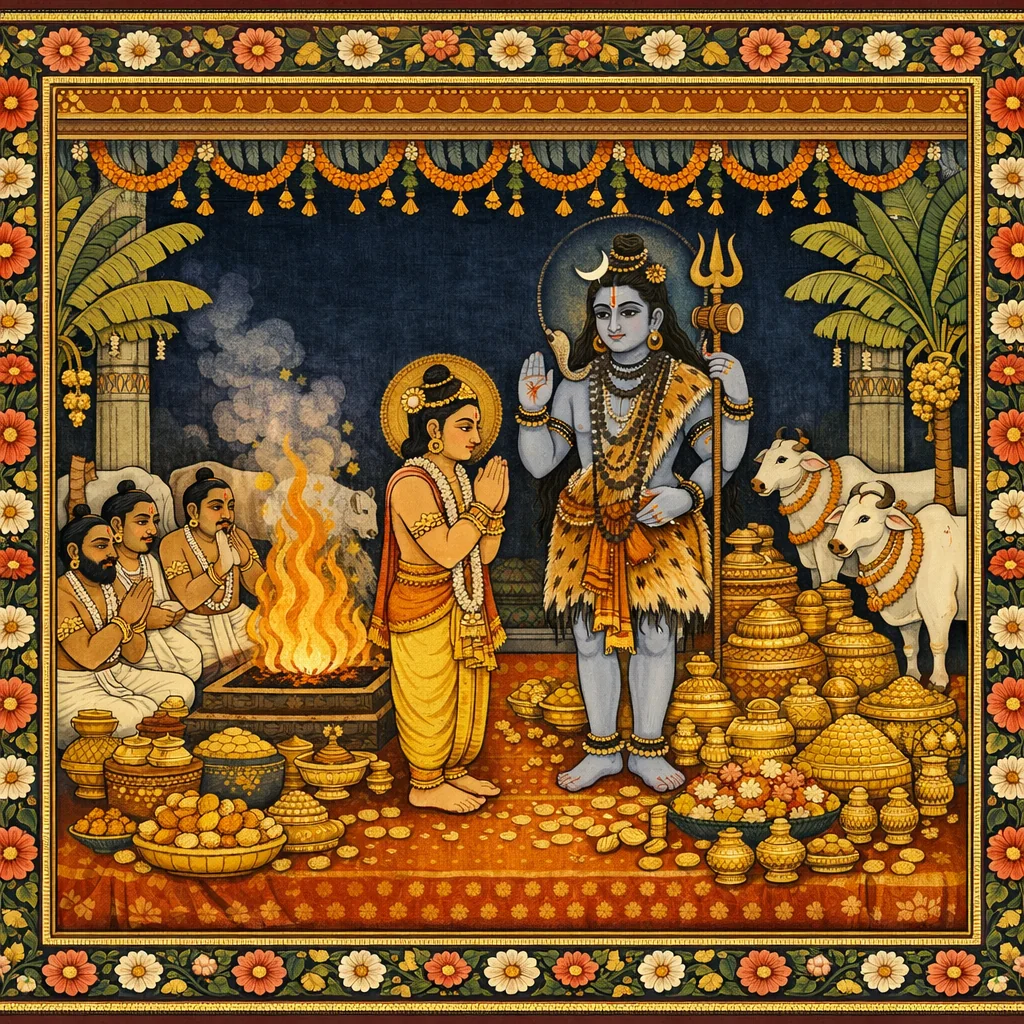
This chapter carries the dynastic narrative from Nābhāga’s disrupted inheritance to the rise of Mahārāja Ambarīṣa. Returning from his guru’s āśrama, Nābhāga finds his brothers have already divided the estate and cynically assign their father as his “share.” His father directs him to the Aṅgirasa sages’ sacrifice, foretelling their periodic confusion, and instructs him to recite Vaiśvadeva-related Vedic hymns. By obediently applying the mantras, Nābhāga gains the sacrificial wealth. A dark figure then claims the riches; Nābhāga’s father judges that the claimant is Lord Śiva’s right, since the remnants of Dakṣa’s yajña were allotted to Śiva. Nābhāga humbly yields; Śiva confirms the truth, grants him the wealth, and gives transcendental instruction—showing poṣaṇa through humility and proper recognition of divine shares (bhāga). The narrative then turns to Ambarīṣa’s birth and character: detachment from imperial opulence, full engagement of the senses in Vaiṣṇava bhakti, and strict observance of the Ekādaśī vow. The chapter ends at a crucial hinge as Durvāsā Muni arrives uninvited exactly when the Dvādaśī fast must be broken, setting up the coming tension between ritual timing, hospitality, and the gravity of vaiṣṇava-aparādha.
Shlokas
Verse 1
श्रीशुक उवाच नाभागो नभगापत्यं यं ततं भ्रातर: कविम् । यविष्ठं व्यभजन् दायं ब्रह्मचारिणमागतम् ॥ १ ॥
Śukadeva Gosvāmī said: Nābhāga, the son of Nabhaga, stayed for a long time at his spiritual master’s abode. Thinking he would not become a householder and would not return, his brothers divided their father’s property among themselves without setting aside a share for him. When Nābhāga came back from the gurukula as a brahmacārī, they gave him their father as his portion.
Verse 2
भ्रातरोऽभाङ्क्त किं मह्यं भजाम पितरं तव । त्वां ममार्यास्तताभाङ्क्षुर्मा पुत्रक तदादृथा: ॥ २ ॥
Nābhāga asked, “My brothers, what share have you given me of our father’s estate?” The elder brothers replied, “Your share is our father.” But when Nābhāga approached his father and said, “Father, my elder brothers have given you as my portion,” the father answered, “My son, do not trust their cheating words; I am not your property.”
Verse 3
इमे अङ्गिरस: सत्रमासतेऽद्य सुमेधस: । षष्ठं षष्ठमुपेत्याह: कवे मुह्यन्ति कर्मणि ॥ ३ ॥
The father said: All these descendants of Aṅgirā are now performing a great sattrayajña. Though highly intelligent, O poet, on every sixth day they become bewildered in the sacrificial rites and commit mistakes in their daily duties.
Verse 4
तांस्त्वं शंसय सूक्ते द्वे वैश्वदेवे महात्मन: । ते स्वर्यन्तो धनं सत्रपरिशेषितमात्मन: ॥ ४ ॥ दास्यन्ति तेऽथ तान्गच्छ तथा स कृतवान् यथा । तस्मै दत्त्वा ययु: स्वर्गं ते सत्रपरिशेषणम् ॥ ५ ॥
Nābhāga’s father said: “Go to those great souls and recite two Vedic hymns concerning Vaiśvadeva. When they complete the sacrifice and depart for the heavenly realms, they will give you the wealth remaining from the rite; therefore go at once.”
Verse 5
तांस्त्वं शंसय सूक्ते द्वे वैश्वदेवे महात्मन: । ते स्वर्यन्तो धनं सत्रपरिशेषितमात्मन: ॥ ४ ॥ दास्यन्ति तेऽथ तान्गच्छ तथा स कृतवान् यथा । तस्मै दत्त्वा ययु: स्वर्गं ते सत्रपरिशेषणम् ॥ ५ ॥
Nābhāga did exactly as his father advised. He went to the sages and recited the hymns; the ṛṣis of the Aṅgirā line gave him all the remaining wealth of the sacrifice and then departed for the heavenly worlds.
Verse 6
तं कश्चित् स्वीकरिष्यन्तं पुरुष: कृष्णदर्शन: । उवाचोत्तरतोऽभ्येत्य ममेदं वास्तुकं वसु ॥ ६ ॥
As Nābhāga was accepting the riches, a dark-looking man came from the north and said, “All the wealth of this sacrificial arena belongs to me.”
Verse 7
ममेदमृषिभिर्दत्तमिति तर्हि स्म मानव: । स्यान्नौ ते पितरि प्रश्न: पृष्टवान् पितरं यथा ॥ ७ ॥
Nābhāga said, “These riches were given to me by the ṛṣis.” The dark-looking man replied, “Then let us ask your father; he will decide.” Accordingly, Nābhāga questioned his father.
Verse 8
यज्ञवास्तुगतं सर्वमुच्छिष्टमृषय: क्वचित् । चक्रुर्हि भागं रुद्राय स देव: सर्वमर्हति ॥ ८ ॥
The father said: Whatever remains within the sacrificial arena has been assigned by the ṛṣis as the share of Rudra-deva (Lord Śiva). That deva is worthy of all; therefore everything in the arena belongs to Rudra.
Verse 9
नाभागस्तं प्रणम्याह तवेश किल वास्तुकम् । इत्याह मे पिता ब्रह्मञ्छिरसा त्वां प्रसादये ॥ ९ ॥
Then Nābhāga, bowing down to Lord Śiva, said: “O worshipful Lord, all the wealth within this sacrificial arena is indeed yours. Thus has my father, the brāhmaṇa, declared; therefore I lower my head and beg your mercy.”
Verse 10
यत् ते पितावदद् धर्मं त्वं च सत्यं प्रभाषसे । ददामि ते मन्त्रदृशो ज्ञानं ब्रह्म सनातनम् ॥ १० ॥
Lord Rudra said: “What your father has spoken as dharma is true, and you too are speaking that same truth. Therefore I, who know the Vedic mantras, shall grant you eternal knowledge of Brahman.”
Verse 11
गृहाण द्रविणं दत्तं मत्सत्रपरिशेषितम् । इत्युक्त्वान्तर्हितो रुद्रो भगवान् धर्मवत्सल: ॥ ११ ॥
Lord Śiva said, “Take all the wealth remaining from my sacrifice; I give it to you.” Having spoken thus, Rudra, the blessed Lord devoted to dharma, disappeared from that place.
Verse 12
य एतत् संस्मरेत् प्रात: सायं च सुसमाहित: । कविर्भवति मन्त्रज्ञो गतिं चैव तथात्मन: ॥ १२ ॥
One who, with steady attention, hears, chants, or remembers this narration in the morning and in the evening surely becomes learned, skilled in the Vedic hymns, and adept in self-realization.
Verse 13
नाभागादम्बरीषोऽभून्महाभागवत: कृती । नास्पृशद् ब्रह्मशापोऽपि यं न प्रतिहत: क्वचित् ॥ १३ ॥
From Nābhāga was born Mahārāja Ambarīṣa, a great bhāgavata devotee renowned for his noble merits. Though cursed by an infallible brāhmaṇa, the curse could not touch him and never took effect.
Verse 14
श्रीराजोवाच भगवञ्छ्रोतुमिच्छामि राजर्षेस्तस्य धीमत: । न प्राभूद् यत्र निर्मुक्तो ब्रह्मदण्डो दुरत्यय: ॥ १४ ॥
King Parīkṣit said: O Bhagavān, I wish to hear the history of the wise rajarṣi Mahārāja Ambarīṣa. How astonishing that the insurmountable brāhmaṇa’s curse, the brahma-daṇḍa, could not act upon him.
Verse 15
श्रीशुक उवाच अम्बरीषो महाभाग: सप्तद्वीपवतीं महीम् । अव्ययां च श्रियं लब्ध्वा विभवं चातुलं भुवि ॥ १५ ॥ मेनेऽतिदुर्लभं पुंसां सर्वं तत् स्वप्नसंस्तुतम् । विद्वान् विभवनिर्वाणं तमो विशति यत् पुमान् ॥ १६ ॥
Śukadeva Gosvāmī said: The greatly fortunate Mahārāja Ambarīṣa attained sovereignty over the earth of seven islands and inexhaustible, unlimited opulence. Yet, knowing all such splendor to be merely material—like a dream that must fade—he cared nothing for it, understanding that the nondevotee who gains such wealth sinks ever deeper into the darkness of material nature.
Verse 16
श्रीशुक उवाच अम्बरीषो महाभाग: सप्तद्वीपवतीं महीम् । अव्ययां च श्रियं लब्ध्वा विभवं चातुलं भुवि ॥ १५ ॥ मेनेऽतिदुर्लभं पुंसां सर्वं तत् स्वप्नसंस्तुतम् । विद्वान् विभवनिर्वाणं तमो विशति यत् पुमान् ॥ १६ ॥
Śukadeva Gosvāmī said: The greatly fortunate Mahārāja Ambarīṣa attained sovereignty over the earth of seven islands and inexhaustible, unlimited opulence. Yet, knowing all such splendor to be merely material—like a dream that must fade—he cared nothing for it, understanding that the nondevotee who gains such wealth sinks ever deeper into the darkness of material nature.
Verse 17
वासुदेवे भगवति तद्भक्तेषु च साधुषु । प्राप्तो भावं परं विश्वं येनेदं लोष्ट्रवत् स्मृतम् ॥ १७ ॥
Mahārāja Ambarīṣa was a great devotee of Bhagavān Vāsudeva and of the saintly devotees of the Lord. By that devotion he regarded the entire universe as insignificant as a mere stone.
Verse 18
स वै मन: कृष्णपदारविन्दयो- र्वचांसि वैकुण्ठगुणानुवर्णने । करौ हरेर्मन्दिरमार्जनादिषु श्रुतिं चकाराच्युतसत्कथोदये ॥ १८ ॥ मुकुन्दलिङ्गालयदर्शने दृशौ तद्भृत्यगात्रस्पर्शेऽङ्गसङ्गमम् । घ्राणं च तत्पादसरोजसौरभे श्रीमत्तुलस्या रसनां तदर्पिते ॥ १९ ॥ पादौ हरे: क्षेत्रपदानुसर्पणे शिरो हृषीकेशपदाभिवन्दने । कामं च दास्ये न तु कामकाम्यया यथोत्तमश्लोकजनाश्रया रति: ॥ २० ॥
Mahārāja Ambarīṣa fixed his mind always on Kṛṣṇa’s lotus feet; his words in glorifying the qualities of Vaikuṇṭha; his hands in cleaning and serving Hari’s temple; and his ears in hearing sacred narrations of Acyuta. He used his eyes to behold Mukunda’s Deity, temples, and holy dhāmas; his touch to associate with the bodies of the Lord’s devotees; his smell to savor the fragrance of tulasī offered to the Lord; and his tongue to taste the Lord’s prasāda. He used his feet to walk to the Lord’s tīrthas and temples, his head to bow to Hṛṣīkeśa, and all his desires for dāsya-sevā—not for sense enjoyment. Thus engaging all his senses in bhakti, he increased his attachment to the Lord and became free from all material desires.
Verse 19
स वै मन: कृष्णपदारविन्दयो- र्वचांसि वैकुण्ठगुणानुवर्णने । करौ हरेर्मन्दिरमार्जनादिषु श्रुतिं चकाराच्युतसत्कथोदये ॥ १८ ॥ मुकुन्दलिङ्गालयदर्शने दृशौ तद्भृत्यगात्रस्पर्शेऽङ्गसङ्गमम् । घ्राणं च तत्पादसरोजसौरभे श्रीमत्तुलस्या रसनां तदर्पिते ॥ १९ ॥ पादौ हरे: क्षेत्रपदानुसर्पणे शिरो हृषीकेशपदाभिवन्दने । कामं च दास्ये न तु कामकाम्यया यथोत्तमश्लोकजनाश्रया रति: ॥ २० ॥
Mahārāja Ambarīṣa ever fixed his mind upon the lotus feet of Śrī Kṛṣṇa; his speech in glorifying the virtues of the Lord of Vaikuṇṭha; his hands in services such as cleansing Hari’s temple; and his ears in hearing the sacred kathā of Acyuta. He engaged his eyes in darśana of Mukunda’s Deity, His temples and dhāmas; his touch in contact with the bodies of the Lord’s bhaktas; his smell in the fragrance of tulasī offered at His lotus feet; and his tongue in tasting the Lord’s prasāda. His feet walked to Hari’s holy kṣetras, his head bowed to Hṛṣīkeśa, and all desires were offered into dāsya-sevā—not for sense enjoyment—thus increasing loving attachment to Uttamaśloka.
Verse 20
स वै मन: कृष्णपदारविन्दयो- र्वचांसि वैकुण्ठगुणानुवर्णने । करौ हरेर्मन्दिरमार्जनादिषु श्रुतिं चकाराच्युतसत्कथोदये ॥ १८ ॥ मुकुन्दलिङ्गालयदर्शने दृशौ तद्भृत्यगात्रस्पर्शेऽङ्गसङ्गमम् । घ्राणं च तत्पादसरोजसौरभे श्रीमत्तुलस्या रसनां तदर्पिते ॥ १९ ॥ पादौ हरे: क्षेत्रपदानुसर्पणे शिरो हृषीकेशपदाभिवन्दने । कामं च दास्ये न तु कामकाम्यया यथोत्तमश्लोकजनाश्रया रति: ॥ २० ॥
Mahārāja Ambarīṣa set his mind upon Kṛṣṇa’s lotus feet, his speech in describing Vaikuṇṭha’s virtues, his hands in sevā such as cleansing Hari’s temple, and his ears in hearing Acyuta’s sat-kathā. His eyes were engaged in darśana of Mukunda’s Deity and dhāma; his touch in contact with the bhaktas’ bodies; his smell in the fragrance of tulasī offered at His feet; and his tongue in tasting the Lord’s offered prasāda. His feet went to Hari’s kṣetras, his head bowed to Hṛṣīkeśa, and all desires were placed in dāsya-sevā—not in sense lust—thus bhakti-rati sheltered in Uttamaśloka increased.
Verse 21
एवं सदा कर्मकलापमात्मन: परेऽधियज्ञे भगवत्यधोक्षजे । सर्वात्मभावं विदधन्महीमिमां तन्निष्ठविप्राभिहित: शशास ह ॥ २१ ॥
Thus, while performing his royal duties, Mahārāja Ambarīṣa always offered the fruits of all his activities to Bhagavān Adhokṣaja, the Lord of all yajñas, beyond the reach of the senses. Taking counsel from brāhmaṇas steadfast in devotion, he ruled the earth without difficulty.
Verse 22
ईजेऽश्वमेधैरधियज्ञमीश्वरं महाविभूत्योपचिताङ्गदक्षिणै: । ततैर्वसिष्ठासितगौतमादिभि- र्धन्वन्यभिस्रोतमसौ सरस्वतीम् ॥ २२ ॥
In the arid regions where the river Sarasvatī flowed, Mahārāja Ambarīṣa performed great sacrifices such as the aśvamedha-yajña with vast opulence, proper paraphernalia, and fitting dakṣiṇā for the brāhmaṇas, thus pleasing Īśvara, the Lord of all yajñas. Sages like Vasiṣṭha, Asita, and Gautama supervised as ṛtvij priests.
Verse 23
यस्य क्रतुषु गीर्वाणै: सदस्या ऋत्विजो जना: । तुल्यरूपाश्चानिमिषा व्यदृश्यन्त सुवासस: ॥ २३ ॥
In the sacrifice arranged by Mahārāja Ambarīṣa, the assembly members and the ṛtvij priests were splendidly dressed and appeared like the devas themselves. With eager attention they ensured that the yajña was performed properly according to sacred rite.
Verse 24
स्वर्गो न प्रार्थितो यस्य मनुजैरमरप्रिय: । शृण्वद्भिरुपगायद्भिरुत्तमश्लोकचेष्टितम् ॥ २४ ॥
The citizens of Mahārāja Ambarīṣa’s realm continually heard and sang the divine deeds of the Lord, Uttamaśloka; therefore they did not even desire heaven, though it is dear to the demigods.
Verse 25
संवर्धयन्ति यत् कामा: स्वाराज्यपरिभाविता: । दुर्लभा नापि सिद्धानां मुकुन्दं हृदि पश्यत: ॥ २५ ॥
Those filled with the transcendental joy of serving Mukunda take no interest even in the rare attainments of the siddhas, for such achievements do not increase the bliss of the devotee who beholds Kṛṣṇa within the heart.
Verse 26
स इत्थं भक्तियोगेन तपोयुक्तेन पार्थिव: । स्वधर्मेण हरिं प्रीणन् सर्वान् कामान्शनैर्जहौ ॥ २६ ॥
Thus Mahārāja Ambarīṣa, the king of this earth, practiced devotional service with austerity; by pleasing Hari through his own prescribed duties, he gradually abandoned all material desires.
Verse 27
गृहेषु दारेषु सुतेषु बन्धुषु द्विपोत्तमस्यन्दनवाजिवस्तुषु । अक्षय्यरत्नाभरणाम्बरादि- ष्वनन्तकोशेष्वकरोदसन्मतिम् ॥ २७ ॥
Mahārāja Ambarīṣa gave up all attachment to home and household affairs, to wife, children, friends and relatives; to the finest elephants, splendid chariots, carts and horses; to inexhaustible jewels, ornaments, garments, and an endless treasury—seeing all as temporary and material.
Verse 28
तस्मा अदाद्धरिश्चक्रं प्रत्यनीकभयावहम् । एकान्तभक्तिभावेन प्रीतो भक्ताभिरक्षणम् ॥ २८ ॥
Pleased by Mahārāja Ambarīṣa’s unalloyed, one-pointed devotion, the Supreme Lord bestowed upon the King His disc, the Hari-cakra—terrifying to enemies and ever protecting the devotee from danger and adversity.
Verse 29
आरिराधयिषु: कृष्णं महिष्या तुल्यशीलया । युक्त: सांवत्सरं वीरो दधार द्वादशीव्रतम् ॥ २९ ॥
To worship Lord Śrī Kṛṣṇa, Mahārāja Ambarīṣa, together with his queen of equal virtue, observed the Ekādaśī‑Dvādaśī vow for one full year.
Verse 30
व्रतान्ते कार्तिके मासि त्रिरात्रं समुपोषित: । स्नात: कदाचित् कालिन्द्यां हरिं मधुवनेऽर्चयत् ॥ ३० ॥
At the close of the vow, in the month of Kārtika, he fasted for three nights, bathed in the Kālindī (Yamunā), and worshiped Hari in Madhuvana.
Verse 31
महाभिषेकविधिना सर्वोपस्करसम्पदा । अभिषिच्याम्बराकल्पैर्गन्धमाल्यार्हणादिभि: ॥ ३१ ॥ तद्गतान्तरभावेन पूजयामास केशवम् । ब्राह्मणांश्च महाभागान् सिद्धार्थानपि भक्तित: ॥ ३२ ॥
Following the rules of mahābhiṣeka, Mahārāja Ambarīṣa bathed the Deity of Śrī Kṛṣṇa with full paraphernalia, then adorned Him with fine garments, ornaments, fragrant garlands, and other offerings. With a heart wholly fixed on the Lord, he worshiped Keśava and also honored, with devotion, the greatly fortunate brāhmaṇas who were free from material desire.
Verse 32
महाभिषेकविधिना सर्वोपस्करसम्पदा । अभिषिच्याम्बराकल्पैर्गन्धमाल्यार्हणादिभि: ॥ ३१ ॥ तद्गतान्तरभावेन पूजयामास केशवम् । ब्राह्मणांश्च महाभागान् सिद्धार्थानपि भक्तित: ॥ ३२ ॥
Following the rules of mahābhiṣeka, Mahārāja Ambarīṣa bathed the Deity of Śrī Kṛṣṇa with full paraphernalia, then adorned Him with fine garments, ornaments, fragrant garlands, and other offerings. With a heart wholly fixed on the Lord, he worshiped Keśava and also honored, with devotion, the greatly fortunate brāhmaṇas who were free from material desire.
Verse 33
गवां रुक्मविषाणीनां रूप्याङ्घ्रीणां सुवाससाम् । पय:शीलवयोरूपवत्सोपस्करसम्पदाम् ॥ ३३ ॥ प्राहिणोत् साधुविप्रेभ्यो गृहेषु न्यर्बुदानि षट् । भोजयित्वा द्विजानग्रे स्वाद्वन्नं गुणवत्तमम् ॥ ३४ ॥ लब्धकामैरनुज्ञात: पारणायोपचक्रमे । तस्य तर्ह्यतिथि: साक्षाद् दुर्वास भगवानभूत् ॥ ३५ ॥
Thereafter Mahārāja Ambarīṣa satisfied all who came as guests to his home, especially the saintly brāhmaṇas. He gave in charity sixty crores of cows—horns plated with gold, hooves plated with silver—adorned with fine cloth, full of milk, gentle in nature, young and beautiful, and accompanied by their calves. Then he first fed the dvijas the finest and most delicious fare; when they were fully pleased and granted permission, he was about to perform pāraṇa to end the Ekādaśī fast. At that very moment, Durvāsā Muni, the powerful mystic, appeared as an uninvited guest.
Verse 34
गवां रुक्मविषाणीनां रूप्याङ्घ्रीणां सुवाससाम् । पय:शीलवयोरूपवत्सोपस्करसम्पदाम् ॥ ३३ ॥ प्राहिणोत् साधुविप्रेभ्यो गृहेषु न्यर्बुदानि षट् । भोजयित्वा द्विजानग्रे स्वाद्वन्नं गुणवत्तमम् ॥ ३४ ॥ लब्धकामैरनुज्ञात: पारणायोपचक्रमे । तस्य तर्ह्यतिथि: साक्षाद् दुर्वास भगवानभूत् ॥ ३५ ॥
Thereafter, Mahārāja Ambarīṣa satisfied all the guests who came to his home, especially the saintly brāhmaṇas. He gave in charity sixty crores of cows whose horns were plated with gold and whose hooves were plated with silver; they were adorned with fine cloth, their udders full of milk, gentle in nature, youthful and beautiful, and accompanied by their calves. After this gift, the King first fed the brāhmaṇas sumptuously with the best and most delicious foods; and when they were fully pleased and had granted permission, he was about to perform the pāraṇa to end the Ekādaśī fast—when, at that very moment, Durvāsā Muni appeared as an uninvited guest.
Verse 35
गवां रुक्मविषाणीनां रूप्याङ्घ्रीणां सुवाससाम् । पय:शीलवयोरूपवत्सोपस्करसम्पदाम् ॥ ३३ ॥ प्राहिणोत् साधुविप्रेभ्यो गृहेषु न्यर्बुदानि षट् । भोजयित्वा द्विजानग्रे स्वाद्वन्नं गुणवत्तमम् ॥ ३४ ॥ लब्धकामैरनुज्ञात: पारणायोपचक्रमे । तस्य तर्ह्यतिथि: साक्षाद् दुर्वास भगवानभूत् ॥ ३५ ॥
Thus Mahārāja Ambarīṣa pleased all his guests, especially the saintly brāhmaṇas, and donated sixty crores of cows with gold-plated horns and silver-plated hooves. After feeding the brāhmaṇas the finest delicacies and receiving their permission, he was about to perform the pāraṇa to conclude the Ekādaśī fast—when, at that very moment, Durvāsā Muni appeared as an uninvited guest.
Verse 36
तमानर्चातिथिं भूप: प्रत्युत्थानासनार्हणै: । ययाचेऽभ्यवहाराय पादमूलमुपागत: ॥ ३६ ॥
Rising to receive the uninvited guest Durvāsā Muni, King Ambarīṣa offered him a seat and the articles for worship. Then, sitting at the sage’s feet, the King humbly requested him to partake of the meal.
Verse 37
प्रतिनन्द्य स तां याञ्चां कर्तुमावश्यकं गत: । निममज्ज बृहद् ध्यायन् कालिन्दीसलिले शुभे ॥ ३७ ॥
Durvāsā Muni gladly accepted Mahārāja Ambarīṣa’s request, but to perform the required rites he went to the Yamunā River. There he immersed himself in the auspicious waters of the Kālindī and meditated upon the impersonal, formless Brahman.
Verse 38
मुहूर्तार्धावशिष्टायां द्वादश्यां पारणं प्रति । चिन्तयामास धर्मज्ञो द्विजैस्तद्धर्मसङ्कटे ॥ ३८ ॥
Meanwhile, on the Dvādaśī day only half a muhūrta remained for performing the pāraṇa. Therefore, Mahārāja Ambarīṣa, well versed in dharma, consulted learned brāhmaṇas in that moment of grave religious dilemma.
Verse 39
ब्राह्मणातिक्रमे दोषो द्वादश्यां यदपारणे । यत् कृत्वा साधु मे भूयादधर्मो वा न मां स्पृशेत् ॥ ३९ ॥ अम्भसा केवलेनाथ करिष्ये व्रतपारणम् । आहुरब्भक्षणं विप्रा ह्यशितं नाशितं च तत् ॥ ४० ॥
The King said: “To overstep proper respect toward the brāhmaṇas is a grave offense; yet to neglect the pāraṇa within the time of Dvādaśī is a fault in the vow. Therefore, O vipras, if you deem it auspicious and not adharma, I shall break the fast by drinking only water.” Thus, after consulting the brāhmaṇas, he concluded that water-drinking is regarded as both eating and not eating.
Verse 40
ब्राह्मणातिक्रमे दोषो द्वादश्यां यदपारणे । यत् कृत्वा साधु मे भूयादधर्मो वा न मां स्पृशेत् ॥ ३९ ॥ अम्भसा केवलेनाथ करिष्ये व्रतपारणम् । आहुरब्भक्षणं विप्रा ह्यशितं नाशितं च तत् ॥ ४० ॥
I shall perform the pāraṇa with water alone, for the vipras declare that drinking water is accepted as both eating and not eating.
Verse 41
इत्यप: प्राश्य राजर्षिश्चिन्तयन् मनसाच्युतम् । प्रत्यचष्ट कुरुश्रेष्ठ द्विजागमनमेव स: ॥ ४१ ॥
Having thus sipped water, the saintly King Ambarīṣa, meditating on Acyuta within his heart, O best of the Kurus, simply waited for the dvija Durvāsā to return.
Verse 42
दुर्वास यमुनाकूलात् कृतावश्यक आगत: । राज्ञाभिनन्दितस्तस्य बुबुधे चेष्टितं धिया ॥ ४२ ॥
After completing the noon rites, Durvāsā returned from the bank of the Yamunā. The King honored him duly, yet Durvāsā, by mystic insight, understood that Ambarīṣa had drunk water without his permission.
Verse 43
मन्युना प्रचलद्गात्रो भ्रुकुटीकुटिलानन: । बुभुक्षितश्च सुतरां कृताञ्जलिमभाषत ॥ ४३ ॥
Still hungry, Durvāsā Muni—his limbs trembling with anger, his face contorted and brows knit in a frown—spoke wrathfully to King Ambarīṣa, who stood before him with folded hands.
Verse 44
अहो अस्य नृशंसस्य श्रियोन्मत्तस्य पश्यत । धर्मव्यतिक्रमं विष्णोरभक्तस्येशमानिन: ॥ ४४ ॥
Alas, behold the conduct of this cruel man, intoxicated by opulence. He is no devotee of Lord Viṣṇu; proud of wealth and rank, he deems himself God and has transgressed the laws of dharma.
Verse 45
यो मामतिथिमायातमातिथ्येन निमन्त्र्य च । अदत्त्वा भुक्तवांस्तस्य सद्यस्ते दर्शये फलम् ॥ ४५ ॥
Mahārāja Ambarīṣa, you invited me as a guest to dine, yet without feeding me you ate first yourself. For this misconduct I shall at once show you its fruit as punishment.
Verse 46
एवं ब्रुवाण उत्कृत्य जटां रोषप्रदीपित: । तया स निर्ममे तस्मै कृत्यां कालानलोपमाम् ॥ ४६ ॥
As Durvāsā Muni spoke thus, his face reddened with wrath. Tearing out a tuft of his matted hair, he fashioned a fearsome kṛtyā—like the blazing fire of devastation—to punish Mahārāja Ambarīṣa.
Verse 47
तामापतन्तीं ज्वलतीमसिहस्तां पदा भुवम् । वेपयन्तीं समुद्वीक्ष्य न चचाल पदान्नृप: ॥ ४७ ॥
Blazing and weapon in hand, making the earth tremble with its steps, that creature rushed before Mahārāja Ambarīṣa. Yet the King, seeing it, was not disturbed at all and did not move even slightly from his place.
Verse 48
प्राग्दिष्टं भृत्यरक्षायां पुरुषेण महात्मना । ददाह कृत्यां तां चक्रं क्रुद्धाहिमिव पावक: ॥ ४८ ॥
By the prior command of the Supreme Personality of Godhead, to protect His devotee, the Sudarśana cakra at once burned that kṛtyā to ashes—just as a forest fire instantly consumes an angry serpent.
Verse 49
तदभिद्रवदुद्वीक्ष्य स्वप्रयासं च निष्फलम् । दुर्वास दुद्रुवे भीतो दिक्षु प्राणपरीप्सया ॥ ४९ ॥
Seeing his own endeavor fail and the Sudarśana cakra rushing toward him, Durvāsā Muni became terrified and ran in all directions to save his life.
Verse 50
तमन्वधावद् भगवद्रथाङ्गं दावाग्निरुद्धूतशिखो यथाहिम् । तथानुषक्तं मुनिरीक्षमाणो गुहां विविक्षु: प्रससार मेरो: ॥ ५० ॥
Like the blazing tongues of a forest fire chasing a serpent, the Lord’s rathāṅga—the Sudarśana cakra—pursued Durvāsā Muni. Seeing it almost touch his back, he ran with great speed, longing to enter a cave on Mount Sumeru.
Verse 51
दिशो नभ: क्ष्मां विवरान्समुद्रान् लोकान् सपालांस्त्रिदिवं गत: स: । यतो यतो धावति तत्र तत्र सुदर्शनं दुष्प्रसहं ददर्श ॥ ५१ ॥
To save himself, Durvāsā Muni fled everywhere—through all directions, into the sky, across the earth, into caves, into the ocean, to the worlds of the rulers of the three realms, and even to the heavenly planets—yet wherever he ran he at once saw the unbearable fire of the Sudarśana cakra pursuing him.
Verse 52
अलब्धनाथ: स सदा कुतश्चित् सन्त्रस्तचित्तोऽरणमेषमाण: । देवं विरिञ्चं समगाद्विधात- स्त्राह्यात्मयोनेऽजिततेजसो माम् ॥ ५२ ॥
With a fearful heart, Durvāsā Muni searched here and there for shelter; but finding none, he finally approached Deva Viriñci, Lord Brahmā, and pleaded, “O self-born lord, protect me from the blazing Sudarśana cakra sent by Bhagavān Ajita.”
Verse 53
श्रीब्रह्मोवाच स्थानं मदीयं सहविश्वमेतत् क्रीडावसाने द्विपरार्धसंज्ञे । भ्रूभङ्गमात्रेण हि सन्दिधक्षो: कालात्मनो यस्य तिरोभविष्यति ॥ ५३ ॥ अहं भवो दक्षभृगुप्रधाना: प्रजेशभूतेशसुरेशमुख्या: । सर्वे वयं यन्नियमं प्रपन्ना मूर्ध्न्यार्पितं लोकहितं वहाम: ॥ ५४ ॥
Lord Brahmā said: At the end of the dvi-parārdha, when the Lord’s pastimes conclude, Viṣṇu, the very Self of Time, with a mere flick of His eyebrows causes the entire universe—along with our abodes—to vanish. I, Bhava (Śiva), Dakṣa, Bhṛgu and the foremost sages, and also the rulers of beings, of human society, and of the devas—all of us submit to the ordinance of that Supreme Person, Lord Viṣṇu; bowing our heads, we bear out His commands for the welfare of all living entities.
Verse 54
श्रीब्रह्मोवाच स्थानं मदीयं सहविश्वमेतत् क्रीडावसाने द्विपरार्धसंज्ञे । भ्रूभङ्गमात्रेण हि सन्दिधक्षो: कालात्मनो यस्य तिरोभविष्यति ॥ ५३ ॥ अहं भवो दक्षभृगुप्रधाना: प्रजेशभूतेशसुरेशमुख्या: । सर्वे वयं यन्नियमं प्रपन्ना मूर्ध्न्यार्पितं लोकहितं वहाम: ॥ ५४ ॥
Lord Brahmā said: At the end of the dvi-parārdha, when the Lord’s pastimes conclude, Śrī Viṣṇu, the very Soul of Time, by a mere movement of His eyebrows causes this entire universe—along with my own abode—to disappear. I, Lord Śiva, Dakṣa, Bhṛgu and the foremost sages, the prajāpatis, and the rulers of beings, of human society, and of the devas—all bow our heads in surrender to that Supreme Lord Viṣṇu and carry out His commands for the welfare of all living entities.
Verse 55
प्रत्याख्यातो विरिञ्चेन विष्णुचक्रोपतापित: । दुर्वास: शरणं यात: शर्वं कैलासवासिनम् ॥ ५५ ॥
Refused by Viriñci (Lord Brahmā) and scorched by the blazing heat of Lord Viṣṇu’s Sudarśana cakra, Durvāsā went to seek shelter of Śarva (Lord Śiva), who resides on Kailāsa.
Verse 56
श्रीशङ्कर उवाच वयं न तात प्रभवाम भूम्नि यस्मिन् परेऽन्येऽप्यजजीवकोशा: । भवन्ति काले न भवन्ति हीदृशा: सहस्रशो यत्र वयं भ्रमाम: ॥ ५६ ॥
Lord Śiva said: My dear son, neither I nor Brahmā nor the other devas—who wander within this universe under the delusion of our own greatness—can display any power to rival the Supreme Personality of Godhead. By the Lord’s mere direction, innumerable universes and their inhabitants arise and are destroyed in due course of time.
Verse 57
अहं सनत्कुमारश्च नारदो भगवानज: । कपिलोऽपान्तरतमो देवलो धर्म आसुरि: ॥ ५७ ॥ मरीचिप्रमुखाश्चान्ये सिद्धेशा: पारदर्शना: । विदाम न वयं सर्वे यन्मायां माययावृता: ॥ ५८ ॥ तस्य विश्वेश्वरस्येदं शस्त्रं दुर्विषहं हि न: । तमेवं शरणं याहि हरिस्ते शं विधास्यति ॥ ५९ ॥
Lord Śiva said: I, Sanat-kumāra, Nārada, the venerable Lord Brahmā, Kapila, Apāntaratama (Vyāsadeva), Devala, Dharma (Yamarāja), Āsuri, Marīci and many other perfected seers know past, present and future; yet, being covered by the Lord’s māyā, we cannot fathom how vast that illusory energy is. This weapon of the Lord of the universe—the Sudarśana—is intolerable even to us. Therefore go and take shelter of the Supreme Lord Viṣṇu; Hari will surely bestow auspiciousness upon you.
Verse 58
अहं सनत्कुमारश्च नारदो भगवानज: । कपिलोऽपान्तरतमो देवलो धर्म आसुरि: ॥ ५७ ॥ मरीचिप्रमुखाश्चान्ये सिद्धेशा: पारदर्शना: । विदाम न वयं सर्वे यन्मायां माययावृता: ॥ ५८ ॥ तस्य विश्वेश्वरस्येदं शस्त्रं दुर्विषहं हि न: । तमेवं शरणं याहि हरिस्ते शं विधास्यति ॥ ५९ ॥
Lord Śiva said: I, Sanat-kumāra, Nārada, the venerable Lord Brahmā, Kapila, Apāntaratama (Vyāsadeva), Devala, Dharma (Yamarāja), Āsuri, Marīci and many other perfected seers know past, present and future; yet, being covered by the Lord’s māyā, we cannot fathom how vast that illusory energy is. This weapon of the Lord of the universe—the Sudarśana—is intolerable even to us. Therefore go and take shelter of the Supreme Lord Viṣṇu; Hari will surely bestow auspiciousness upon you.
Verse 59
अहं सनत्कुमारश्च नारदो भगवानज: । कपिलोऽपान्तरतमो देवलो धर्म आसुरि: ॥ ५७ ॥ मरीचिप्रमुखाश्चान्ये सिद्धेशा: पारदर्शना: । विदाम न वयं सर्वे यन्मायां माययावृता: ॥ ५८ ॥ तस्य विश्वेश्वरस्येदं शस्त्रं दुर्विषहं हि न: । तमेवं शरणं याहि हरिस्ते शं विधास्यति ॥ ५९ ॥
I (Śiva), Sanat-kumāra, Nārada, the venerable Lord Brahmā, Kapila, Apāntaratama (Vyāsadeva), Devala, Dharmarāja, Āsuri, Marīci and many other perfected seers know past, present and future; yet, being covered by the Lord’s māyā, we cannot fathom the vastness of that illusory potency. This weapon of the Lord of the universe—the Sudarśana cakra—is intolerable even to us; therefore go and take shelter of Hari, Lord Viṣṇu. He will surely bestow auspiciousness upon you.
Verse 60
ततो निराशो दुर्वास: पदं भगवतो ययौ । वैकुण्ठाख्यं यदध्यास्ते श्रीनिवास: श्रिया सह ॥ ६० ॥
Thereafter, disappointed even after taking shelter of Lord Śiva, Durvāsā Muni went to Vaikuṇṭha-dhāma, where Śrīnivāsa Nārāyaṇa resides with His consort, the goddess of fortune, Lakṣmī.
Verse 61
सन्दह्यमानोऽजितशस्त्रवह्निना तत्पादमूले पतित: सवेपथु: । आहाच्युतानन्त सदीप्सित प्रभो कृतागसं माव हि विश्वभावन ॥ ६१ ॥
Scorched by the fiery heat of the Sudarśana cakra, Durvāsā Muni fell, trembling, at the lotus feet of Nārāyaṇa and said: “O Acyuta, O unlimited Lord, protector of the universe! You alone are the supreme goal of the devotees. I am a grievous offender—please grant me shelter.”
Verse 62
अजानता ते परमानुभावं कृतं मयाघं भवत: प्रियाणाम् । विधेहि तस्यापचितिं विधात- र्मुच्येत यन्नाम्न्युदिते नारकोऽपि ॥ ६२ ॥
O my Lord, O supreme controller! Not knowing Your boundless majesty, I have offended Your most dear devotee. Kindly arrange atonement and save me from the reaction of this offense. You can do all things, for even one fit for hell may be delivered simply by the awakening of Your holy name within the heart.
Verse 63
श्रीभगवानुवाच अहं भक्तपराधीनो ह्यस्वतन्त्र इव द्विज । साधुभिर्ग्रस्तहृदयो भक्तैर्भक्तजनप्रिय: ॥ ६३ ॥
The Supreme Lord said to the brāhmaṇa: “O dvija, I am wholly dependent upon My devotees—indeed, as if I were not independent at all. My heart is captured by the sādhus; therefore My devotees are dear to Me, and even the devotees of My devotee are exceedingly dear to Me.”
Verse 64
नाहमात्मानमाशासे मद्भक्तै: साधुभिर्विना । श्रियं चात्यन्तिकीं ब्रह्मन् येषां गतिरहं परा ॥ ६४ ॥
O best of brāhmaṇas, without My saintly devotees—those for whom I alone am the supreme destination—I do not wish to enjoy even My transcendental bliss and My highest opulences.
Verse 65
ये दारागारपुत्राप्तप्राणान् वित्तमिमं परम् । हित्वा मां शरणं याता: कथं तांस्त्यक्तुमुत्सहे ॥ ६५ ॥
My pure devotees abandon wife, home, children, relatives, wealth, and even life itself, taking shelter of Me alone; how could I ever give up such devotees?
Verse 66
मयि निर्बद्धहृदया: साधव: समदर्शना: । वशीकुर्वन्ति मां भक्त्या सत्स्त्रिय: सत्पतिं यथा ॥ ६६ ॥
The sādhus, whose hearts are firmly bound to Me and who see all beings equally, bring Me fully under their control by bhakti—just as chaste women, by service, win over their gentle husbands.
Verse 67
मत्सेवया प्रतीतं ते सालोक्यादिचतुष्टयम् । नेच्छन्ति सेवया पूर्णा: कुतोऽन्यत् कालविप्लुतम् ॥ ६७ ॥
Though by serving Me they automatically attain the four liberations—sālokya and the rest—My devotees, fulfilled in loving service, do not desire even these; what then to speak of other fleeting joys, destroyed by time?
Verse 68
साधवो हृदयं मह्यं साधूनां हृदयं त्वहम् । मदन्यत् ते न जानन्ति नाहं तेभ्यो मनागपि ॥ ६८ ॥
The pure devotee always dwells in the core of My heart, and I always dwell in the heart of the pure devotee. My devotees know nothing but Me, and I know no one but them, not even slightly.
Verse 69
उपायं कथयिष्यामि तव विप्र शृणुष्व तत् । अयं ह्यात्माभिचारस्ते यतस्तं याहि मा चिरम् । साधुषु प्रहितं तेज: प्रहर्तु: कुरुतेऽशिवम् ॥ ६९ ॥
O brāhmaṇa, I shall tell you the means for your protection—hear Me. By offending Mahārāja Ambarīṣa you have acted against your own self; therefore go to him at once, without delay. Power directed against the saintly devotee surely brings misfortune upon the wielder; the harm falls on the doer, not on the object.
Verse 70
तपो विद्या च विप्राणां नि:श्रेयसकरे उभे । ते एव दुर्विनीतस्य कल्पेते कर्तुरन्यथा ॥ ७० ॥
For a brāhmaṇa, austerity and sacred learning are both auspicious and lead to the highest good. But when possessed by one who is ungentle and undisciplined, that same austerity and learning yield the opposite result and become most dangerous.
Verse 71
ब्रह्मंस्तद् गच्छ भद्रं ते नाभागतनयं नृपम् । क्षमापय महाभागं तत: शान्तिर्भविष्यति ॥ ७१ ॥
O best of brāhmaṇas, may all good befall you: go at once to King Ambarīṣa, the son of Mahārāja Nābhāga. Beg forgiveness from that great bhāgavata; then peace will come to you.
Frequently Asked Questions
The text frames it as deliberate deceit rooted in the assumption that Nābhāga would not return from prolonged residence at his spiritual master’s place. Their act illustrates how material inheritance disputes arise from adharma and misjudgment, while the Bhāgavata redirects the plot toward a higher inheritance—mantra, dharma, and divine favor—showing that true prosperity comes through obedience to righteous counsel and recognition of the Lord’s order.
He is identified through Nābhāga’s father’s śāstric reasoning as Lord Śiva’s representative (indeed Śiva’s presence/claim), because remnants and shares connected to the Dakṣa-yajña were allotted to Śiva. The episode teaches that yajña proceeds by ordained distributions (bhāga), and that prosperity becomes secure only when one honors the rightful divine share rather than asserting possessiveness.
Śiva appears as dharma-rakṣaka and mantra-jña (knower of Vedic mantras), affirming truthfulness and rewarding humility. The Bhāgavata commonly presents Śiva as the greatest Vaiṣṇava and as an empowered guardian within the Lord’s cosmic administration. Here, Śiva’s gift and instruction reinforce that devotion is protected across the divine hierarchy when one acts without envy and with surrender.
Ambarīṣa’s model assigns each sense to a concrete devotional act—mind in remembrance, speech in kīrtana, hands in temple service, ears in śravaṇa, eyes in darśana and tīrtha, smell with tulasī, tongue with prasāda, legs in pilgrimage, head in obeisance, and desires in service. This is emphasized to show a practical blueprint of bhakti as total life-integration (not mere belief), producing vairāgya and steadiness even amid royal opulence.
He faced a dharma-saṅkaṭa (ethical dilemma): honoring a guest-brāhmaṇa versus not missing the Dvādaśī window to properly conclude the Ekādaśī vow. Consulting learned brāhmaṇas, he followed the nuanced rule that sipping water can count as both ‘eating’ and ‘not eating,’ preserving the vow without intentional disrespect. The later conflict arises not from Ambarīṣa’s pride but from Durvāsā’s misreading and anger—setting the stage for the doctrine that the Lord’s protection stands with the devotee and that vaiṣṇava-aparādha rebounds upon the offender.