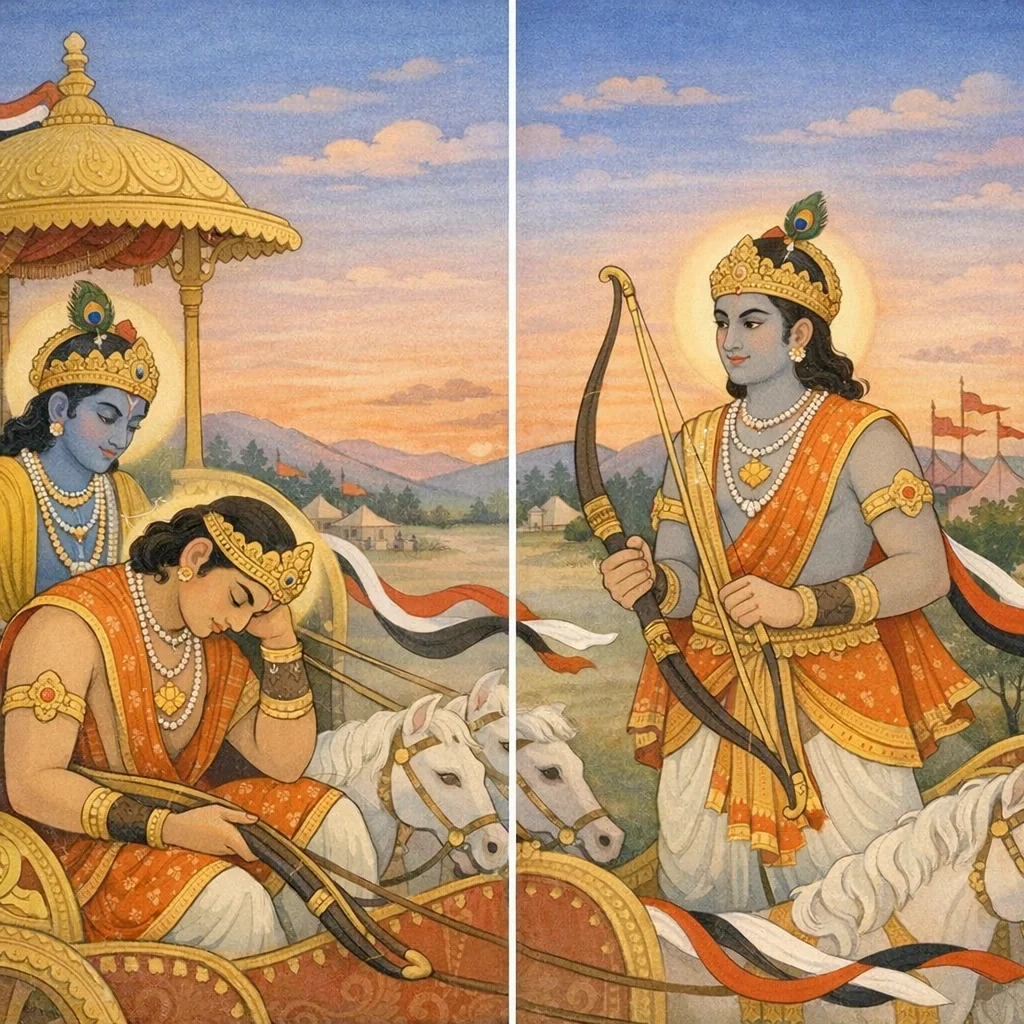
Chapter 18: Moksha Sannyasa Yoga
मोक्षसंन्यासयोग
The Yoga of Liberation through Renunciation
Chapter 18 functions as the Bhagavad Gita’s integrative conclusion, where Arjuna seeks conceptual clarity on the distinction between saṃnyāsa (renunciatory relinquishment) and tyāga (renunciation of fruits). Krishna responds by systematizing renunciation within an ethical framework of duty, arguing that obligatory action is not to be abandoned, but performed without attachment and without possessive authorship. The chapter maps human agency through a fivefold causal analysis and then classifies knowledge, action, doer, intellect, resolve, and happiness according to the three guṇas, offering a diagnostic psychology of motivation and decision-making. It further articulates vocation (svabhāva-born work) as a legitimate soteriological path when offered to the Divine, aligning ordinary responsibility with inner freedom. The philosophical arc culminates in bhakti as the most direct mode of knowing the Supreme, and in the final teaching of śaraṇāgati—total refuge—where the seeker’s dilemma is resolved through surrender, mental steadiness, and God-centered action.
Speakers
Key Concepts
Philosophical Constructs
Shlokas in Chapter 18
Verse 1
अर्जुन उवाच । संन्यासस्य महाबाहो तत्त्वमिच्छामि वेदितुम् त्यागस्य च हृषीकेश पृथक्केशिनिषूदन ॥ १८.१ ॥
Arjuna said: O mighty-armed one, I wish to know the true nature of sannyāsa, and also of tyāga, O Hṛṣīkeśa—O slayer of Keśin—distinctly.
Verse 2
श्रीभगवानुवाच । काम्यानां कर्मणां न्यासं संन्यासं कवयो विदुः सर्वकर्मफलत्यागं प्राहुस्त्यागं विचक्षणाः ॥ १८.२ ॥
The Blessed Lord said: The renunciation (nyāsa) of desire-motivated actions the sages know as sannyāsa; and the relinquishment of the fruits of all actions the discerning declare to be tyāga.
Verse 3
त्याज्यं दोषवदित्येके कर्म प्राहुर्मनीषिणः । यज्ञदानतपःकर्म न त्याज्यमिति चापरे ॥ १८.३ ॥
Some thinkers declare action to be abandoned as tainted with fault; others say that acts of sacrifice, charity, and austerity are not to be abandoned.
Verse 4
निश्चयं शृणु मे तत्र त्यागे भरतसत्तम । त्यागो हि पुरुषव्याघ्र त्रिविधः संप्रकीर्तितः ॥ १८.४ ॥
O best of the Bharatas, hear from Me the settled truth regarding renunciation; for, O tiger among men, renunciation has been declared to be threefold.
Verse 5
यज्ञदानतपःकर्म न त्याज्यं कार्यमेव तत् । यज्ञो दानं तपश्चैव पावनानि मनीषिणाम् ॥ १८.५ ॥
Acts of sacrifice, charity, and austerity are not to be abandoned; they are indeed to be performed. For sacrifice, charity, and austerity are purifying for the wise.
Verse 6
एतान्यपि तु कर्माणि सङ्गं त्यक्त्वा फलानि च । कर्तव्यानीति मे पार्थ निश्चितं मतमुत्तमम् ॥ १८.६ ॥
But, O Partha, even these actions should be performed, having abandoned attachment and also the fruits; this is My firm and highest conviction.
Verse 7
नियतस्य तु संन्यासः कर्मणो नोपपद्यते । मोहात्तस्य परित्यागस्तामसः परिकीर्तितः ॥ १८.७ ॥
Renunciation of prescribed duty is not proper; abandoning it out of delusion is declared to be tamasic.
Verse 8
दुःखमित्येव यत्कर्म कायक्लेशभयात्त्यजेत् । स कृत्वा राजसं त्यागं नैव त्यागफलं लभेत् ॥ १८.८ ॥
He who abandons action, saying, ‘It is suffering,’ out of fear of bodily hardship—having thus made rajasic renunciation—does not attain the fruit of renunciation.
Verse 9
कार्यमित्येव यत्कर्म नियतं क्रियतेऽर्जुन । सङ्गं त्यक्त्वा फलं चैव स त्यागः सात्त्विको मतः ॥ १८.९ ॥
O Arjuna, that prescribed action which is performed only with the understanding, “This is my duty,” abandoning attachment and also the fruit—such renunciation is held to be sāttvika.
Verse 10
न द्वेष्ट्यकुशलं कर्म कुशले नानुषज्जते । त्यागी सत्त्वसमाविष्टो मेधावी छिन्नसंशयः ॥ १८.१० ॥
He who neither hates unwholesome action nor clings to wholesome action—such a renouncer, pervaded by sattva, wise, and with doubts cut asunder.
Verse 11
न हि देहभृता शक्यं त्यक्तुं कर्माण्यशेषतः । यस्तु कर्मफलत्यागी स त्यागीत्यभिधीयते ॥ १८.११ ॥
For the embodied being it is not possible to abandon actions entirely; but he who renounces the fruit of action is called a renouncer.
Verse 12
अनिष्टमिष्टं मिश्रं च त्रिविधं कर्मणः फलम् । भवत्यत्यागिनां प्रेत्य न तु संन्यासिनां क्वचित् ॥ १८.१२ ॥
The fruit of action is threefold—undesired, desired, and mixed; it accrues after death to those who do not renounce, but never to the sannyāsins.
Verse 13
पञ्चैतानि महाबाहो कारणानि निबोध मे । सांख्ये कृतान्ते प्रोक्तानि सिद्धये सर्वकर्मणाम् ॥ १८.१३ ॥
O mighty-armed one, learn from Me these five causes, declared in the Sāṅkhya teaching that brings final discernment, for the accomplishment of all actions.
Verse 14
अधिष्ठानं तथा कर्ता करणं च पृथग्विधम् । विविधाश्च पृथक्चेष्टा दैवं चैवात्र पञ्चमम् ॥ १८.१४ ॥
The basis (the body), the doer, the various kinds of instruments (the senses), the many and distinct activities, and also the Divine—these are the five factors here.
Verse 15
शरीरवाङ् mनोभिर्यत्कर्म प्रारभते नरः । न्याय्यं वा विपरीतं वा पञ्चैते तस्य हेतवः ॥ १८.१५ ॥
Whatever action a person undertakes with body, speech, and mind—whether rightful or contrary—these five are its causes.
Verse 16
तत्रैवं सति कर्तारमात्मानं केवलं तु यः । पश्यत्यकृतबुद्धित्वान्न स पश्यति दुर्मतिः ॥ १८.१६ ॥
Therefore, when this is so, one who—through unrefined understanding—sees the Self alone as the doer, that misguided person truly does not see.
Verse 17
यस्य नाहंकृतो भावो बुद्धिर्यस्य न लिप्यते । हत्वापि स इमाँल्लोकान्न हन्ति न निबध्यते ॥ १८.१७ ॥
He who has no sense of ‘I am the doer,’ and whose intellect is not tainted—though he slays these beings, he does not truly slay, nor is he bound.
Verse 18
ज्ञानं ज्ञेयं परिज्ञाता त्रिविधा कर्मचोदना । करणं कर्म कर्तेति त्रिविधः कर्मसंग्रहः ॥ १८.१८ ॥
Knowledge, the knowable, and the knower—these three are the impulse to action; instrument, action, and doer—these three constitute the aggregate of action.
Verse 19
ज्ञानं कर्म च कर्ता च त्रिधैव गुणभेदतः । प्रोच्यते गुणसंख्याने यथावच्छृणु तान्यपि ॥ १८.१९ ॥
Knowledge, action, and the doer—these three are declared to be of three kinds, distinguished by the guṇas. As set forth in the analysis of the guṇas, hear them also rightly, as they truly are.
Verse 20
सर्वभूतेषु येनैकं भावमव्ययमीक्षते । अविभक्तं विभक्तेषु तज्ज्ञानं विद्धि सात्त्विकम् ॥ १८.२० ॥
That knowledge by which one beholds the one imperishable Being in all beings—undivided amid the divided—know that knowledge to be sāttvika.
Verse 21
पृथक्त्वेन तु यज्ज्ञानं नानाभावान्पृथग्विधान् । वेत्ति सर्वेषु भूतेषु तज्ज्ञानं विद्धि राजसम् ॥ १८.२१ ॥
But that knowledge by which one knows, in all beings, manifold states as separate and diverse—know that knowledge to be rājasika.
Verse 22
यत्तु कृत्स्नवदेकस्मिन्कार्ये सक्तमहैतुकम् । अतत्त्वार्थवदल्पं च तत्तामसमुदाहृतम् ॥ १८.२२ ॥
But that which clings to a single effect as though it were the whole, without reason, devoid of true meaning, and trivial—this is declared to be tāmasika knowledge.
Verse 23
नियतं सङ्गरहितमरागद्वेषतः कृतम् । अफलप्रेप्सुना कर्म यत्तत्सात्त्विकमुच्यते ॥ १८.२३ ॥
That action which is ordained, done without attachment, free from rāga and dveṣa, and performed by one who seeks no fruit—such action is called sāttvika.
Verse 24
यत्तु कामेप्सुना कर्म साहंकारेण वा पुनः । क्रियते बहुलायासं तद्राजसमुदाहृतम् ॥ १८.२४ ॥
But that action which is performed by one who seeks the desired objects, or again out of egoism, and which is attended with much strain and exertion—such is declared to be rajasic.
Verse 25
अनुबन्धं क्षयं हिंसामनवेक्ष्य च पौरुषम् । मोहादारभ्यते कर्म यत्तत्तामसमुच्यते ॥ १८.२५ ॥
That action which is begun in delusion, without regard to consequences, loss, injury, and one’s own capacity—such is said to be tamasic.
Verse 26
मुक्तसङ्गोऽनहंवादी धृत्युत्साहसमन्वितः । सिद्ध्यसिद्ध्योर्निर्विकारः कर्ता सात्त्विक उच्यते ॥ १८.२६ ॥
The doer who is free from attachment, not given to egoistic speech, endowed with steadfastness and zeal, and unperturbed in success and failure—is said to be sattvic.
Verse 27
रागी कर्मफलप्रेप्सुर्लुब्धो हिंसात्मकोऽशुचिः । हर्षशोकान्वितः कर्ता राजसः परिकीर्तितः ॥ १८.२७ ॥
The doer who is passionate, who longs for the fruits of action, greedy, injurious by nature, impure, and swayed by joy and sorrow—is proclaimed to be rajasic.
Verse 28
अयुक्तः प्राकृतः स्तब्धः शठो नैष्कृतिकोऽलसः । विषादी दीर्घसूत्री च कर्ता तामस उच्यते ॥ १८.२८ ॥
The doer who is undisciplined, coarse, stubborn, deceitful, malicious, lazy, despondent, and procrastinating—is said to be tamasic.
Verse 29
बुद्धेर्भेदं धृतेश्चैव गुणतस्त्रिविधं शृणु । प्रोच्यमानमशेषेण पृथक्त्वेन धनंजय ॥ १८.२९ ॥
Hear from Me, O Dhanañjaya, the threefold distinction of intellect and of steadfastness, according to the guṇas, set forth completely and separately.
Verse 30
प्रवृत्तिं च निवृत्तिं च कार्याकार्ये भयाभये । बन्धं मोक्षं च या वेत्ति बुद्धिः सा पार्थ सात्त्विकी ॥ १८.३० ॥
That intellect is sattvic, O Pārtha, which knows rightly activity and withdrawal, what ought to be done and what ought not, fear and fearlessness, bondage and liberation.
Verse 31
यया धर्ममधर्मं च कार्यं चाकार्यमेव च । अयथावत्प्रजानाति बुद्धिः सा पार्थ राजसी ॥ १८.३१ ॥
That intellect is rajasic, O Pārtha, by which one understands dharma and adharma, and what ought and ought not to be done, in a distorted manner.
Verse 32
अधर्मं धर्ममिति या मन्यते तमसावृता । सर्वार्थान्विपरीतांश्च बुद्धिः सा पार्थ तामसी ॥ १८.३२ ॥
That intellect is tamasic, O Pārtha, which, veiled by darkness, takes adharma to be dharma and sees all things in a perverted way.
Verse 33
धृत्या यया धारयते मनःप्राणेन्द्रियक्रियाः । योगेनाव्यभिचारिण्या धृतिः सा पार्थ सात्त्विकी ॥ १८.३३ ॥
That steadfastness is sattvic, O Pārtha, by which one holds firm the functions of mind, life-breath, and senses through unwavering yoga.
Verse 34
यया तु धर्मकामार्थान्धृत्या धारयतेऽर्जुन । प्रसङ्गेन फलाकाङ्क्षी धृतिः सा पार्थ राजसी ॥ १८.३४ ॥
That firmness, O Arjuna, by which one, attached and craving for fruits, upholds dharma, kāma (pleasure), and artha (wealth), is declared rajasic, O Pārtha.
Verse 35
यया स्वप्नं भयं शोकं विषादं मदमेव च । न विमुञ्चति दुर्मेधा धृतिः सा पार्थ तामसी ॥ १८.३५ ॥
That firmness, O Pārtha, by which a dull-minded person does not relinquish sleep, fear, grief, dejection, and intoxication (delusive pride), is declared tamasic.
Verse 36
सुखं त्विदानीं त्रिविधं शृणु मे भरतर्षभ । अभ्यासाद्रमते यत्र दुःखान्तं च निगच्छति ॥ १८.३६ ॥
Now hear from Me, O best of the Bharatas, the threefold happiness—wherein one delights through practice and comes to the end of suffering.
Verse 37
यत्तदग्रे विषमिव परिणामेऽमृतोपमम् । तत्सुखं सात्त्विकं प्रोक्तमात्मबुद्धिप्रसादजम् ॥ १८.३७ ॥
That happiness which is like poison at first, but like nectar in the end—such happiness is declared sattvic, born of the clarity and serenity of self-knowledge.
Verse 38
विषयेन्द्रियसंयोगाद्यत्तदग्रेऽमृतोपमम् । परिणामे विषमिव तत्सुखं राजसं स्मृतम् ॥ १८.३८ ॥
That happiness which arises from the contact of the senses with their objects, which at first seems like nectar but in the end is like poison—such happiness is remembered as rajasic.
Verse 39
यदग्रे चानुबन्धे च सुखं मोहनमात्मनः । निद्रालस्यप्रमादोत्थं तत्तामसमुदाहृतम् ॥ १८.३९ ॥
That pleasure which, both at the beginning and in its consequence, deludes the self, and which arises from sleep, indolence, and heedlessness—such pleasure is declared to be tamasic.
Verse 40
न तदस्ति पृथिव्यां वा दिवि देवेषु वा पुनः । सत्त्वं प्रकृतिजैर्मुक्तं यदेभिः स्यात्त्रिभिर्गुणैः ॥ १८.४० ॥
There is no being on earth, nor again among the gods in heaven, that is free from these three guṇas born of Prakṛti.
Verse 41
ब्राह्मणक्षत्रियविशां शूद्राणां च परन्तप । कर्माणि प्रविभक्तानि स्वभावप्रभवैर्गुणैः ॥ १८.४१ ॥
O scorcher of foes, the duties of brāhmaṇas, kṣatriyas, vaiśyas, and śūdras are apportioned according to the guṇas born of their own nature.
Verse 42
शमो दमस्तपः शौचं क्षान्तिरार्जवमेव च । ज्ञानं विज्ञानमास्तिक्यं ब्रह्मकर्म स्वभावजम् ॥ १८.४२ ॥
Serenity, self-control, austerity, purity, forbearance, straightforwardness, knowledge, realized wisdom, and faith in the Veda and the Divine—these are the duties of a brāhmaṇa, born of his nature.
Verse 43
शौर्यं तेजो धृतिर्दाक्ष्यं युद्धे चाप्यपलायनम् । दानमीश्वरभावश्च क्षात्रं कर्म स्वभावजम् ॥ १८.४३ ॥
Valor, splendor, steadfastness, skill, and not fleeing in battle; generosity and lordliness—these are the duties of a kṣatriya, born of his nature.
Verse 44
कृषिगौरक्ष्यवाणिज्यं वैश्यकर्म स्वभावजम् । परिचर्यात्मकं कर्म शूद्रस्यापि स्वभावजम् ॥ १८.४४ ॥
Agriculture, protection of cows, and trade—these are the duties born of the Vaishya’s own nature; and service in the form of attendance is the duty born of the Shudra’s own nature as well.
Verse 45
स्वे स्वे कर्मण्यभिरतः संसिद्धिं लभते नरः । स्वकर्मनिरतः सिद्धिं यथा विन्दति तच्छृणु ॥ १८.४५ ॥
Engaged in one’s own duty, a person attains perfection. How, devoted to his own work, he attains that perfection—hear that.
Verse 46
यतः प्रवृत्तिर्भूतानां येन सर्वमिदं ततम् । स्वकर्मणा तमभ्यर्च्य सिद्धिं विन्दति मानवः ॥ १८.४६ ॥
From whom arises the activity of all beings, and by whom all this is pervaded—worshipping Him through one’s own work, a person attains perfection.
Verse 47
श्रेयान्स्वधर्मो विगुणः परधर्मात्स्वनुष्ठितात् । स्वभावनियतं कर्म कुर्वन्नाप्नोति किल्बिषम् ॥ १८.४७ ॥
Better is one’s own dharma, though deficient in qualities, than another’s dharma well performed. Doing the work ordained by one’s own nature, one does not incur sin.
Verse 48
सहजं कर्म कौन्तेय सदोषमपि न त्यजेत् । सर्वारम्भा हि दोषेण धूमेनाग्निरिवावृताः ॥ १८.४८ ॥
O son of Kunti, one should not abandon the work born of one’s own nature, even though it be flawed; for all undertakings are veiled by some defect, as fire is by smoke.
Verse 49
असक्तबुद्धिः सर्वत्र जितात्मा विगतस्पृहः । नैष्कर्म्यसिद्धिं परमां संन्यासेनाधिगच्छति ॥ १८.४९ ॥
He whose intellect is unattached everywhere, who has conquered the self, and who is free from craving—by renunciation he attains the supreme perfection of actionlessness (naiṣkarmya-siddhi).
Verse 50
सिद्धिं प्राप्तो यथा ब्रह्म तथाप्नोति निबोध मे । समासेनैव कौन्तेय निष्ठा ज्ञानस्य या परा ॥ १८.५० ॥
Learn from Me, O son of Kuntī, in brief, how one who has attained perfection reaches Brahman—the supreme culmination of knowledge.
Verse 51
बुद्ध्या विशुद्ध्या युक्तो धृत्यात्मानं नियम्य च । शब्दादीन्विषयांस्त्यक्त्वा रागद्वेषौ व्युदस्य च ॥ १८.५१ ॥
Endowed with a purified intellect, restraining the self by steadfastness; abandoning sense-objects such as sound, and casting aside attachment and aversion—
Verse 52
विविक्तसेवी लघ्वाशी यतवाक्कायमानसः । ध्यानयोगपरो नित्यं वैराग्यं समुपाश्रितः ॥ १८.५२ ॥
Dwelling in solitude, eating lightly, controlling speech, body, and mind; ever devoted to the yoga of meditation, taking refuge in dispassion—
Verse 53
अहंकारं बलं दर्पं कामं क्रोधं परिग्रहम् । विमुच्य निर्ममः शान्तो ब्रह्मभूयाय कल्पते ॥ १८.५३ ॥
Abandoning egoism, forcefulness, arrogance, desire, anger, and possessiveness; becoming free from ‘mine’ and tranquil—he becomes fit for Brahman-realization (brahma-bhāva).
Verse 54
ब्रह्मभूतः प्रसन्नात्मा न शोचति न काङ्क्षति । समः सर्वेषु भूतेषु मद्भक्तिं लभते पराम् ॥ १८.५४ ॥
Having become Brahman-realized, serene in heart, he neither grieves nor desires; equal toward all beings, he attains supreme devotion to Me.
Verse 55
भक्त्या मामभिजानाति यावान्यश्चास्मि तत्त्वतः । ततो मां तत्त्वतो ज्ञात्वा विशते तदनन्तरम् ॥ १८.५५ ॥
By devotion he truly knows Me—who and how great I am in essence; then, having known Me in truth, he enters into Me thereafter.
Verse 56
सर्वकर्माण्यपि सदा कुर्वाणो मद्व्यपाश्रयः । मत्प्रसादादवाप्नोति शाश्वतं पदमव्ययम् ॥ १८.५६ ॥
Even while ever performing all actions, one who takes refuge in Me attains, by My grace, the eternal, imperishable abode.
Verse 57
चेतसा सर्वकर्माणि मयि संन्यस्य मत्परः । बुद्धियोगमुपाश्रित्य मच्चित्तः सततं भव ॥ १८.५७ ॥
Mentally surrendering all actions to Me, regarding Me as the Supreme Goal, taking refuge in the yoga of discernment—be ever with your mind fixed on Me.
Verse 58
मच्चित्तः सर्वदुर्गाणि मत्प्रसादात्तरिष्यसि । अथ चेत्त्वमहंकारान्न श्रोष्यसि विनङ्क्ष्यसि ॥ १८.५८ ॥
With your mind fixed on Me, by My grace you shall cross over all difficulties; but if, from ego, you will not listen, you shall perish.
Verse 59
यदहंकारमाश्रित्य न योत्स्य इति मन्यसे । मिथ्यैष व्यवसायस्ते प्रकृतिस्त्वां नियोक्ष्यति ॥ १८.५९ ॥
If, taking refuge in ego, you think, “I will not fight,” that resolve of yours is vain; your own nature will compel you to action.
Verse 60
स्वभावजेन कौन्तेय निबद्धः स्वेन कर्मणा । कर्तुं नेच्छसि यन्मोहात्करिष्यस्यवशोऽपि तत् ॥ १८.६० ॥
O son of Kunti, bound by your own action born of your nature, what you do not wish to do out of delusion—you will do even against your will.
Verse 61
ईश्वरः सर्वभूतानां हृद्देशेऽर्जुन तिष्ठति । भ्रामयन्सर्वभूतानि यन्त्रारूढानि मायया ॥ १८.६१ ॥
O Arjuna, the Lord abides in the heart-region of all beings, causing all beings to revolve by His māyā, as though mounted on a machine.
Verse 62
तमेव शरणं गच्छ सर्वभावेन भारत । तत्प्रसादात्परां शान्तिं स्थानं प्राप्स्यसि शाश्वतम् ॥ १८.६२ ॥
O Bhārata, go to Him alone for refuge with your whole being; by His grace you shall attain supreme peace and the eternal abode.
Verse 63
इति ते ज्ञानमाख्यातं गुह्याद्गुह्यतरं मया । विमृश्यैतदशेषेण यथेच्छसि तथा कुरु ॥ १८.६३ ॥
Thus I have declared to you the knowledge more secret than the most secret; reflect on it fully, and then do as you wish.
Verse 64
सर्वगुह्यतमं भूयः शृणु मे परमं वचः । इष्टोऽसि मे दृढमिति ततो वक्ष्यामि ते हितम् ॥ १८.६४ ॥
Hear again My supreme word, the most secret of all; you are dearly beloved to Me—therefore I shall speak to you what is for your welfare.
Verse 65
मन्मना भव मद्भक्तो मद्याजी मां नमस्कुरु । मामेवैष्यसि सत्यं ते प्रतिजाने प्रियोऽसि मे ॥ १८.६५ ॥
Fix your mind on Me, become My devotee, worship Me, and bow to Me; you shall surely come to Me—this truth I promise you, for you are dear to Me.
Verse 66
सर्वधर्मान्परित्यज्य मामेकं शरणं व्रज । अहं त्वां सर्वपापेभ्यो मोक्षयिष्यामि मा शुचः ॥ १८.६६ ॥
Abandoning all dharmas, take refuge in Me alone; I shall liberate you from all sins—do not grieve.
Verse 67
इदं ते नातपस्काय नाभक्ताय कदाचन । न चाशुश्रूषवे वाच्यं न च मां योऽभ्यसूयति ॥ १८.६७ ॥
This should never be spoken to one without austerity, nor to one without devotion; nor to one who is unwilling to listen, nor to one who reviles Me.
Verse 68
य इमं परमं गुह्यं मद्भक्तेष्वभिधास्यति । भक्तिं मयि परां कृत्वा मामेवैष्यत्यसंशयः ॥ १८.६८ ॥
He who shall declare this supreme secret among My devotees, having performed supreme devotion to Me, shall come to Me alone—without doubt.
Verse 69
न च तस्मान्मनुष्येषु कश्चिन्मे प्रियकृत्तमः । भविता न च मे तस्मादन्यः प्रियतरो भुवि ॥ १८.६९ ॥
And among men there shall be none who does what is dearer to Me than he; nor shall there be another on earth more beloved to Me than he.
Verse 70
अध्येष्यते च य इमं धर्म्यं संवादमावयोः । ज्ञानयज्ञेन तेनाहमिष्टः स्यामिति मे मतिः ॥ १८.७० ॥
And he who shall study this sacred dialogue of ours—by the sacrifice of knowledge he shall worship Me; such is My conviction.
Verse 71
श्रद्धावाननसूयश्च शृणुयादपि यो नरः । सोऽपि मुक्तः शुभाँल्लोकान्प्राप्नुयात्पुण्यकर्मणाम् ॥ १८.७१ ॥
Even the man who, endowed with faith and free from fault-finding, merely hears it—he too, liberated, shall attain the auspicious worlds of the doers of merit.
Verse 72
कच्चिदेतच्छ्रुतं पार्थ त्वयैकाग्रेण चेतसा । कच्चिदज्ञानसंमोहः प्रनष्टस्ते धनंजय ॥ १८.७२ ॥
O Pārtha, has this been heard by you with a one-pointed mind? O Dhanañjaya, has your delusion born of ignorance been destroyed?
Verse 73
अर्जुन उवाच । नष्टो मोहः स्मृतिर्लब्धा त्वत्प्रसादान्मयाच्युत । स्थितोऽस्मि गतसन्देहः करिष्ये वचनं तव ॥ १८.७३ ॥
Arjuna said: O Acyuta, by Your grace my delusion is destroyed; memory is regained. I stand firm, free from doubt; I shall do Your word.
Verse 74
संजय उवाच । इत्यहं वासुदेवस्य पार्थस्य च महात्मनः संवादमिममश्रौषमद्भुतं रोमहर्षणम् ॥ १८.७४ ॥
Sañjaya said: Thus I heard this wondrous, hair-raising dialogue between Vāsudeva and the great-souled Pārtha.
Verse 75
व्यासप्रसादाच्छ्रुतवानेतद्गुह्यमहं परम् । योगं योगेश्वरात्कृष्णात्साक्षात्कथयतः स्वयम् ॥ १८.७५ ॥
By the grace of Vyāsa I heard this supreme secret—this Yoga—directly from Kṛṣṇa, the Lord of Yoga, as He Himself spoke it.
Verse 76
राजन्संस्मृत्य संस्मृत्य संवादमिममद्भुतम् । केशवार्जुनयोः पुण्यं हृष्यामि च मुहुर्मुहुः ॥ १८.७६ ॥
O King, remembering again and again this wondrous and holy dialogue between Keśava and Arjuna, I rejoice time and again.
Verse 77
तच्च संस्मृत्य संस्मृत्य रूपमत्यद्भुतं हरेः । विस्मयो मे महान् राजन्हृष्यामि च पुनः पुनः ॥ १८.७७ ॥
And, O King, remembering again and again that most wondrous form of Hari, great is my amazement, and I rejoice again and again.
Verse 78
यत्र योगेश्वरः कृष्णो यत्र पार्थो धनुर्धरः । तत्र श्रीर्विजयो भूतिर्ध्रुवा नीतिर्मतिर्मम ॥ १८.७८ ॥
Wherever there is Kṛṣṇa, the Lord of Yoga, and wherever there is Pārtha, the bow-wielding warrior, there surely are prosperity, victory, well-being, and steadfast righteousness—such is my conviction.
Frequently Asked Questions
It offers a practical psychology of decision-making: anxiety and confusion are reduced by shifting from egoic ownership to disciplined action, evaluating one’s motives through the guṇas, and practicing tyāga—working without compulsive attachment to outcomes.
The chapter emphasizes that the Supreme abides as the inner guide in the heart, while wise action recognizes multi-causal agency and relinquishes the false claim of isolated doership; liberation is aligned with knowing the Divine through devotion and inner purification.
Arjuna’s uncertainty is resolved by distinguishing abandonment from renunciation: prescribed responsibility should be fulfilled as an offering, with detachment from results and surrender to the Divine, culminating in the assurance of refuge (śaraṇāgati).
Use Chapter 18 as a leadership and resilience framework: do your role (svadharma) with clear standards, reduce stress by focusing on process over outcome, audit choices via sāttvika/ rājasa/ tāmasa patterns, and cultivate steadiness through devotion, reflection, and ethical self-regulation.