
Bhagavad Gita — Moksha Sannyasa Yoga, Shloka 39
Moksha Sannyasa Yoga
यदग्रे चानुबन्धे च सुखं मोहनमात्मनः । निद्रालस्यप्रमादोत्थं तत्तामसमुदाहृतम् ॥ १८.३९ ॥
yad agre cānubandhe ca sukhaṃ mohanam ātmanaḥ | nidrālasyapramādotthaṃ tat tāmasam udāhṛtam || 18.39 ||

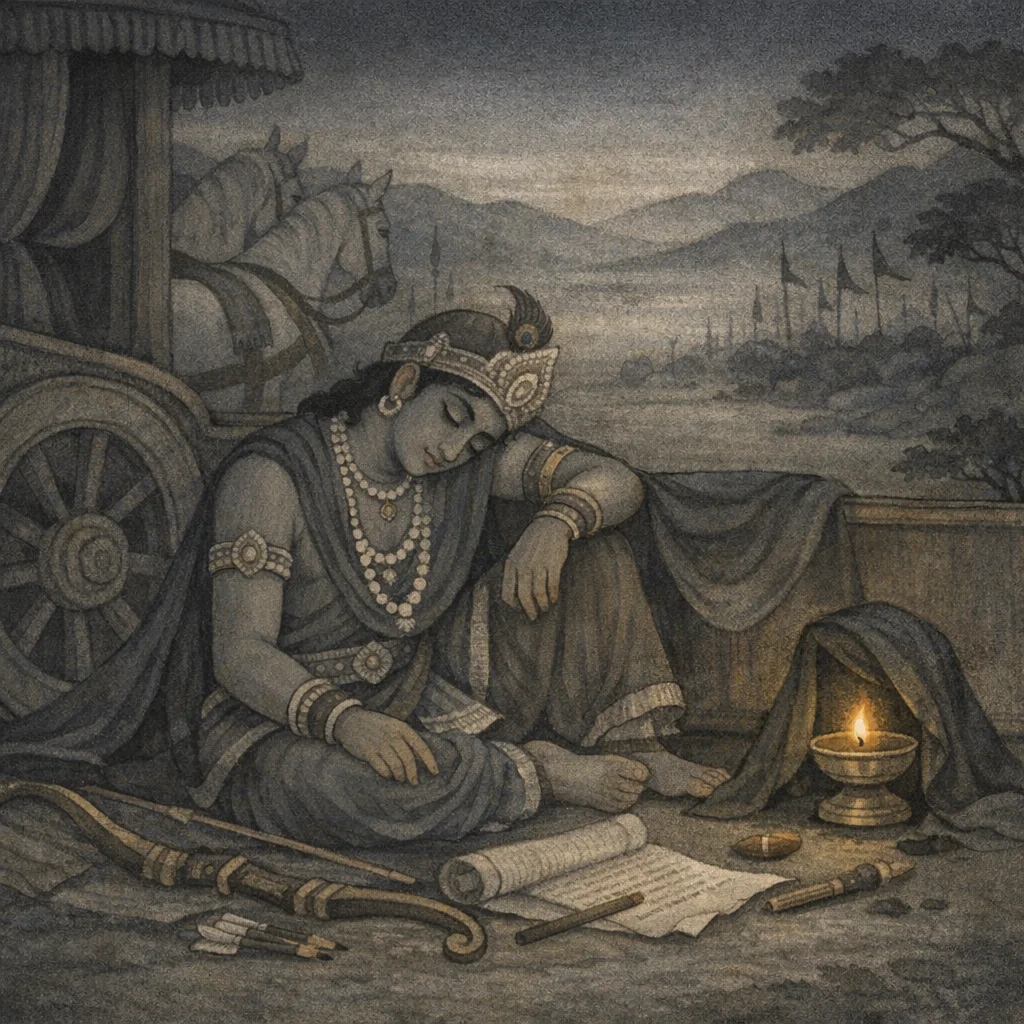
That pleasure which, both at the beginning and in its consequence, deludes the self, and which arises from sleep, indolence, and heedlessness—such pleasure is declared to be tamasic.
जो सुख आरम्भ में और परिणाम में भी आत्मा को मोहित करने वाला होता है तथा निद्रा, आलस्य और प्रमाद से उत्पन्न होता है, वह तामस सुख कहा गया है।
That pleasure which deludes the self both at the beginning and in its consequence, arising from sleep, sloth, and heedlessness—this is declared to be tāmasa (darkness-born) pleasure.
Translations differ mainly on rendering 'anubandhe' as 'in consequence/afterwards' vs. 'in its continuation.' The evaluative point remains: such pleasure is stupefying rather than clarifying.
FAQs
The verse links certain comforts to reduced awareness: habits that feel soothing may actually dull agency and clarity, reinforcing avoidance and procrastination.
Tāmasa pleasure is characterized not by genuine fulfillment but by obscuration of understanding; it strengthens ignorance (avidyā) and distances one from self-knowledge.
Following the classification of sāttvika and rājasa pleasures, this completes the triad and supports the broader ethical-psychological mapping of the guṇas.
It encourages distinguishing restorative rest from escapist inertia, and examining whether a 'comfortable' routine increases lucidity or merely numbs discomfort.