
Bhagavad Gita — Moksha Sannyasa Yoga, Shloka 55
Moksha Sannyasa Yoga
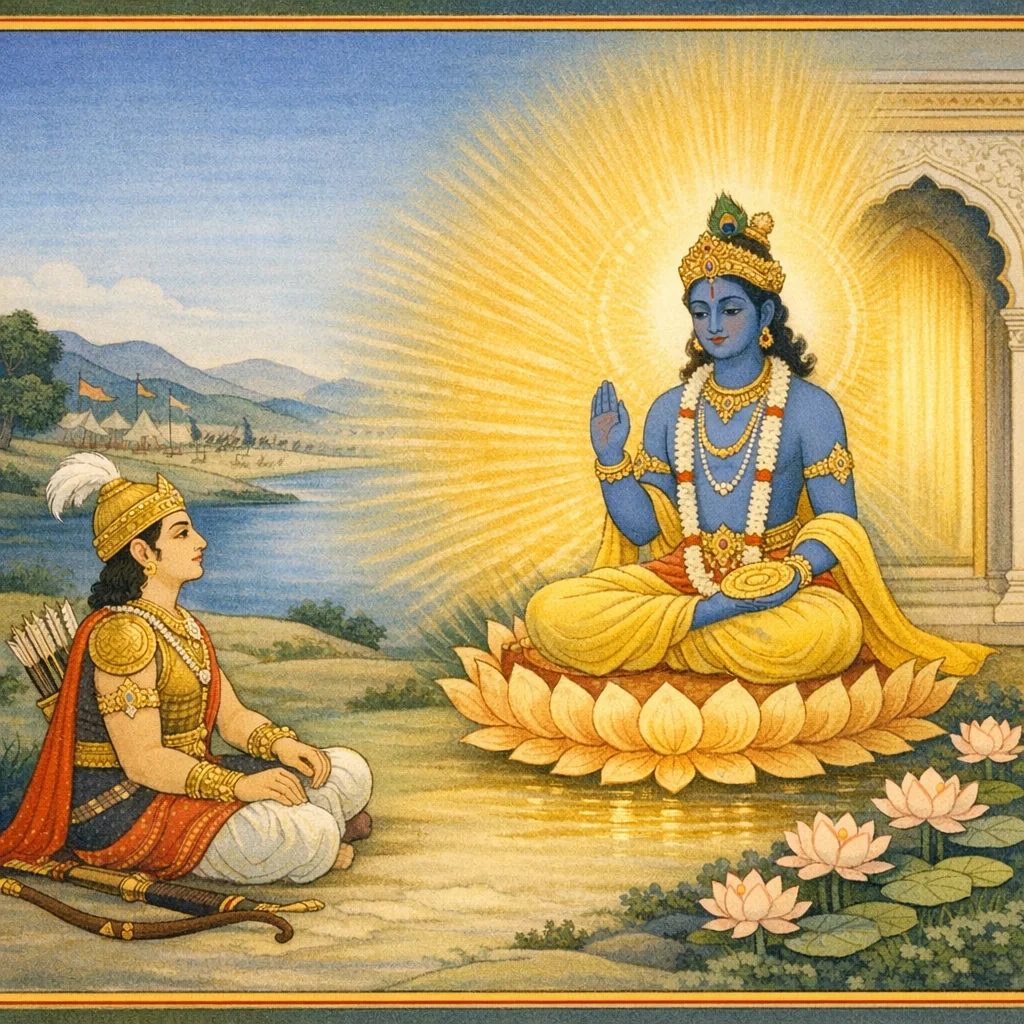
भक्त्या मामभिजानाति यावान्यश्चास्मि तत्त्वतः । ततो मां तत्त्वतो ज्ञात्वा विशते तदनन्तरम् ॥ १८.५५ ॥
bhaktyā mām abhijānāti yāvān yaś cāsmi tattvataḥ | tato māṁ tattvato jñātvā viśate tad-anantaram || 18.55 ||

By devotion he truly knows Me—who and how great I am in essence; then, having known Me in truth, he enters into Me thereafter.
भक्ति से वह मुझे तत्त्वतः जानता है कि मैं कितना और कैसा हूँ; फिर मुझे तत्त्वतः जानकर तत्पश्चात् उसमें प्रवेश करता है।
Through devotion one comes to know Me in truth—what and how much I am; then, having known Me in truth, one enters (into that reality) immediately thereafter.
‘Viśate’ (‘enters’) is interpreted as entry into divine being, proximity, or union, depending on theological orientation. The verse emphasizes epistemic truth (tattvataḥ) mediated by bhakti, which some schools treat as an independent means (sādhana) and others as the mature form of knowledge.
FAQs
Devotion is presented as a focused, value-laden attention that reorganizes priorities and reduces self-centered preoccupations, enabling deeper insight.
The verse claims that ultimate reality (here personalized as Kṛṣṇa) is knowable ‘in truth’ through bhakti, culminating in ‘entering’—a term that can denote union, participation, or liberated proximity.
It develops 18.54’s claim that the Brahman-state leads to supreme devotion, now asserting devotion’s role in true knowledge and final attainment.
Sustained commitment to a highest ideal—ethical, contemplative, or devotional—can deepen understanding beyond abstract theory and translate into lived transformation.