
Bhagavad Gita — Moksha Sannyasa Yoga, Shloka 40
Moksha Sannyasa Yoga
न तदस्ति पृथिव्यां वा दिवि देवेषु वा पुनः । सत्त्वं प्रकृतिजैर्मुक्तं यदेभिः स्यात्त्रिभिर्गुणैः ॥ १८.४० ॥
na tad asti pṛthivyāṃ vā divi deveṣu vā punaḥ | sattvaṃ prakṛtijair muktaṃ yad ebhiḥ syāt tribhir guṇaiḥ || 18.40 ||

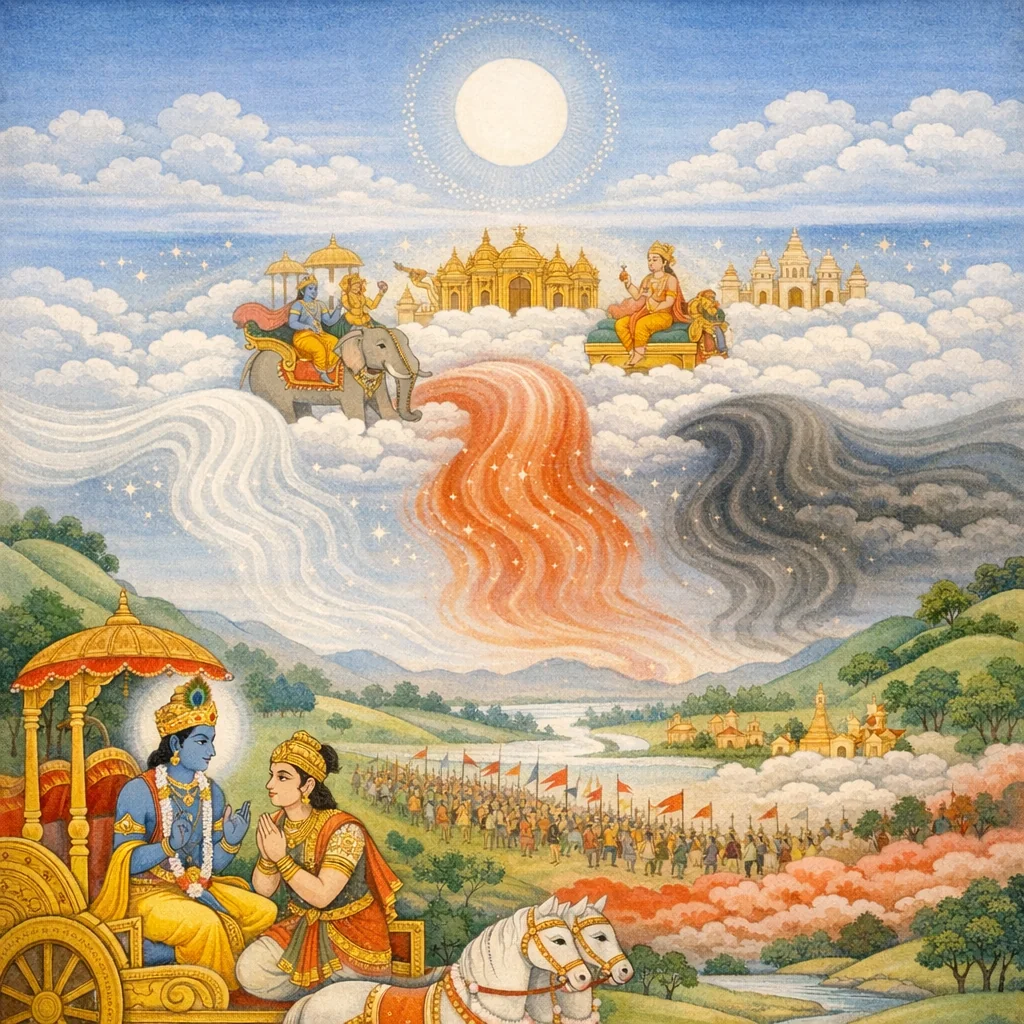
There is no being on earth, nor again among the gods in heaven, that is free from these three guṇas born of Prakṛti.
पृथ्वी पर, स्वर्ग में अथवा देवताओं में भी ऐसा कोई प्राणी नहीं है, जो प्रकृति से उत्पन्न इन तीन गुणों से रहित हो।
There is no being on earth, nor again in heaven among the gods, that would be free from these three guṇas born of prakṛti.
Some editions include this verse without ellipsis; the sense is stable across recensions. The statement is cosmological and anthropological, asserting the universality of guṇa-conditioning for embodied beings.
FAQs
It frames temperament and behavior as shaped by pervasive modes (clarity, activity, inertia), encouraging self-observation rather than moral absolutism.
Within Sāṃkhya-influenced categories, prakṛti’s guṇas govern manifest existence; liberation is not denial of their operation but insight into the Self as distinct from them.
This verse transitions from classifying happiness to a broader claim: all beings operate under guṇas, grounding the ensuing discussion of vocation and duty.
It can support a nuanced view of personality and motivation—recognizing constraints while still cultivating conditions that increase clarity and responsibility.